1 Chronicles 22:11

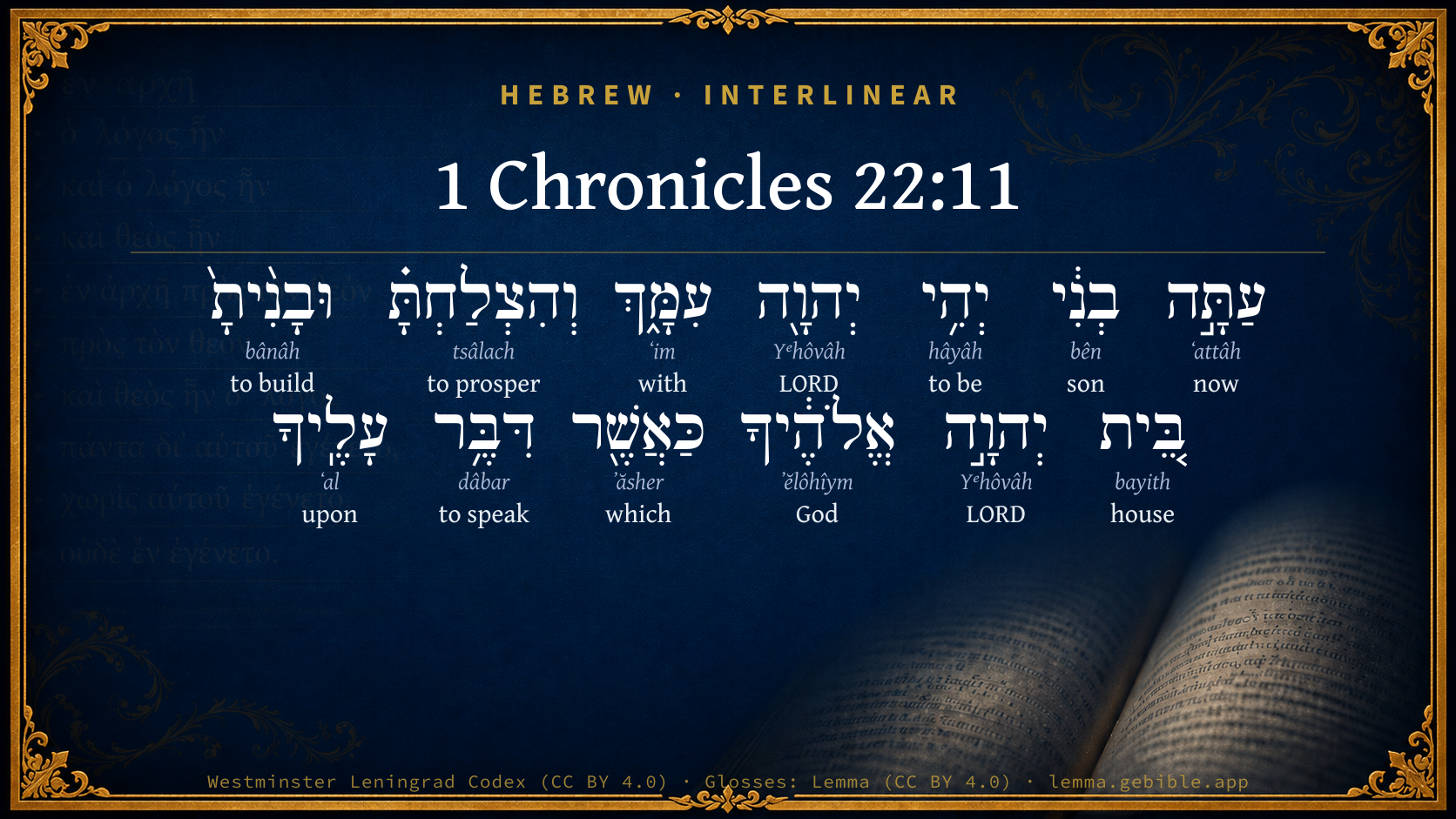
Hebrew (Westminster Leningrad Codex) 1 Chronicles 22:11 appears in the Hebrew Old Testament. The text above is from the Westminster Leningrad Codex. Each word links to its Strong’s number, a concise gloss, and parsing drawn from the Open Scriptures Hebrew Bible morphology. Click any word for its full Brown-Driver-Briggs (BDB) entry.
Download image
Cite this verse

1 Chronicles 22:11 (World English Bible). Public Domain. Lemma interlinear Bible study tool, https://lemma.gebible.app/v/1-chronicles/22/11.

Show BibTeX & RIS
BibTeX
RIS
English Translation
Now, my son, Yahweh be with you; and prosper you, and build the house of Yahweh your God, as he has spoken concerning you.
World English Bible · Public Domain
Download a study sheet

One document with this verse’s original text, its word-by-word gloss line, the meaning frame, cross-references with their text, attributed commentary, and full source and license credits — printable, and it pastes into notes with its structure intact.

This verse Autodidact and up

Study sheet (.html) Plain text (.txt)

A passage Seminary Student

Up to 50 verses in one chapter. A passage sheet keeps up to 6 commentary sources and 12 cross-references per verse, in the order this page ranks them, and says so on the sheet whenever that leaves anything out. Ask for a single verse and you get the Autodidact verse sheet above.

Everything on this page stays free to read, with no account — the sheet is a download of what is already on screen, not access to it.

Want to remove ads? Support Godless Engineer
Compare translations 3

The same verse in 3 English versions, stacked beneath the original-language interlinear above. Click any original word for its lexicon entry.

Each is an independent rendering of the whole verse — the interlinear is not word-aligned to these translations.

Highlighted words mark where these versions differ — a whole-verse word diff, not a word-by-word alignment.

  • World English Bible Public Domain
    Now, my son, Yahweh be with you; and prosper you, and build the house of Yahweh your God, as he has spoken concerning you.
  • King James Version Public Domain
    Now, my son, the LORD be with thee; and prosper thou, and build the house of the LORD thy God, as he hath said of thee.
  • unfoldingWord Literal Text CC BY-SA 4.0
    Now, my son, may Yahweh be with you, and may you succeed, and may you build a house of Yahweh your God, just as he spoke about you.

unfoldingWord Literal Text — © unfoldingWord, licensed CC BY-SA 4.0. Word-aligned USFM3 via Door43 (git.door43.org/unfoldingWord/en_ult).

Versions to compare (up to 4)

3 of 4 selected

Show all 18 translations

Every available English version of this verse, each an independent rendering of the whole verse.

  • World English Bible Public Domain
    Now, my son, Yahweh be with you; and prosper you, and build the house of Yahweh your God, as he has spoken concerning you.
  • Berean Standard Bible Public Domain
    Now, my son, may the LORD be with you, and may you succeed in building the house of the LORD your God, as He said you would.
  • Majority Standard Bible Public Domain
    Now, my son, may the LORD be with you, and may you succeed in building the house of the LORD your God, as He said you would.
  • King James Version Public Domain
    Now, my son, the LORD be with thee; and prosper thou, and build the house of the LORD thy God, as he hath said of thee.
  • American Standard Version (1901) Public Domain
    Now, my son, Jehovah be with thee; and prosper thou, and build the house of Jehovah thy God, as he hath spoken concerning thee.
  • Revised Version (1885) Public Domain
    Now, my son, the LORD be with thee; and prosper thou, and build the house of the LORD thy God, as he hath spoken concerning thee.
  • Geneva Bible (1599) Public Domain
    Nowe therefore my sonne, the Lord shalbe with thee, and thou shalt prosper, and thou shalt builde an house to the Lord thy God, as he hath spoken of thee.
  • Douay-Rheims (1899) Public Domain
    Now then, my son, the Lord be with thee, and do thou prosper, and build the house to the Lord thy God, as he hath spoken of thee.
  • Young's Literal Translation Public Domain
    `Now, my son, Jehovah is with thee, and thou hast prospered, and hast built the house of Jehovah thy God, as He spake concerning thee.
  • Literal Standard Version CC BY-SA 4.0
    Now my son, YHWH is with you, and you have prospered, and have built the house of your God YHWH, as He spoke concerning you.
  • Unlocked Literal Bible CC BY-SA 4.0
    Now, my son, may Yahweh be with you and enable you to succeed. May you build the house of Yahweh your God, as he said you would.
  • unfoldingWord Literal Text CC BY-SA 4.0
    Now, my son, may Yahweh be with you, and may you succeed, and may you build a house of Yahweh your God, just as he spoke about you.
  • Darby Bible Public Domain
    Now, my son, Jehovah be with thee, that thou mayest prosper, and build the house of Jehovah thy God, as he has said of thee.
  • World Messianic Bible Public Domain
    Now, my son, may the LORD be with you and prosper you, and build the house of the LORD your God, as he has spoken concerning you.
  • Webster's Bible Public Domain
    Now, my son, the LORD be with thee; and prosper thou, and build the house of the LORD thy God, as he hath said of thee.
  • Free Bible Version CC BY-SA 4.0
    Now, my son, may the Lord be with you so you may succeed in building the house of the Lord your God, just as he said you would.
  • Bible in Basic English Public Domain
    Now, my son, may the Lord be with you; and may you do well, and put up the house of the Lord your God, as he has said of you.
  • JPS Tanakh (1917) Public Domain
    Now, my son, the LORD be with thee; and prosper thou, and build the house of the LORD thy God, as He hath spoken concerning thee.

Literal Standard Version (2020), Covenant Press — licensed CC BY-SA 4.0. Text via the HelloAO Bible API (eBible.org). Unlocked Literal Bible (unfoldingWord) — licensed CC BY-SA 4.0. Text via the HelloAO Bible API (eBible.org). unfoldingWord Literal Text — © unfoldingWord, licensed CC BY-SA 4.0. Word-aligned USFM3 via Door43 (git.door43.org/unfoldingWord/en_ult). Free Bible Version, Dr. Jonathan Gallagher — licensed CC BY-SA 4.0. Text via the HelloAO Bible API (eBible.org).

Word by word

More ways to search: Search by grammar → Find every occurrence → Compare this word →

Practice this passage: Drill this verse → Learn its vocabulary →

וְהִצְלַחְתָּ֗
tsâlach
H6743
“and · to prosper”
Conjunction + Verb, Hiphil, Sequential Perfect, 2nd Person, Masculine, Singular
Part of Speech
Conjunction + Verb
Stem
Hiphil
Form
Sequential Perfect
Person
2nd Person
Gender
Masculine
Number
Singular
Full BDB Definition

Origin: a primitive root

TWOT: 1916 , 1917

(Qal) to rush - to advance, prosper, make progress, succeed, be profitable - (Qal) to prosper - (Hiphil) - to make prosperous, bring to successful issue, cause to prosper - to show or experience prosperity, prosper
  1. עַתָּ֣ה ʻattâh H6258 “now” Adverb
  2. בְנִ֔י bên H1121 “son · my” Noun, Common, Masculine, Singular, Construct + Suffix, Personal, 1st Person, Common, Singular
  3. יְהִ֥י hâyâh H1961 “to be” Verb, Qal, Jussive, 3rd Person, Masculine, Singular
  4. יְהוָ֖ה Yᵉhôvâh H3068 “LORD” Noun, Proper
  5. עִמָּ֑ךְ ʻim H5973 “with · you” Preposition + Suffix, Personal, 2nd Person, Feminine, Singular
  6. וּבָנִ֨יתָ֙ bânâh H1129 “and · to build” Conjunction + Verb, Qal, Sequential Perfect, 2nd Person, Masculine, Singular
  7. בֵּ֚ית bayith H1004 “house of” Noun, Common, Masculine, Singular, Construct
  8. יְהוָ֣ה Yᵉhôvâh H3068 “LORD” Noun, Proper
  9. אֱלֹהֶ֔יךָ ʼĕlôhîym H430 “God(s) · your” Noun, Common, Masculine, Plural, Construct + Suffix, Personal, 2nd Person, Masculine, Singular
  10. כַּאֲשֶׁ֖ר ʼăsher H834 “like/as · which” Preposition + Particle, Relative
  11. דִּבֶּ֥ר dâbar H1696 “to speak” Verb, Piel, Perfect, 3rd Person, Masculine, Singular
  12. עָלֶֽיךָ ʻal H5921 “upon · you” Preposition + Suffix, Personal, 2nd Person, Masculine, Singular

About this verse

These counts appear in no published source. They are computed here, from the morphology-tagged text and Lemma’s own curated glosses. What Lemma adds →

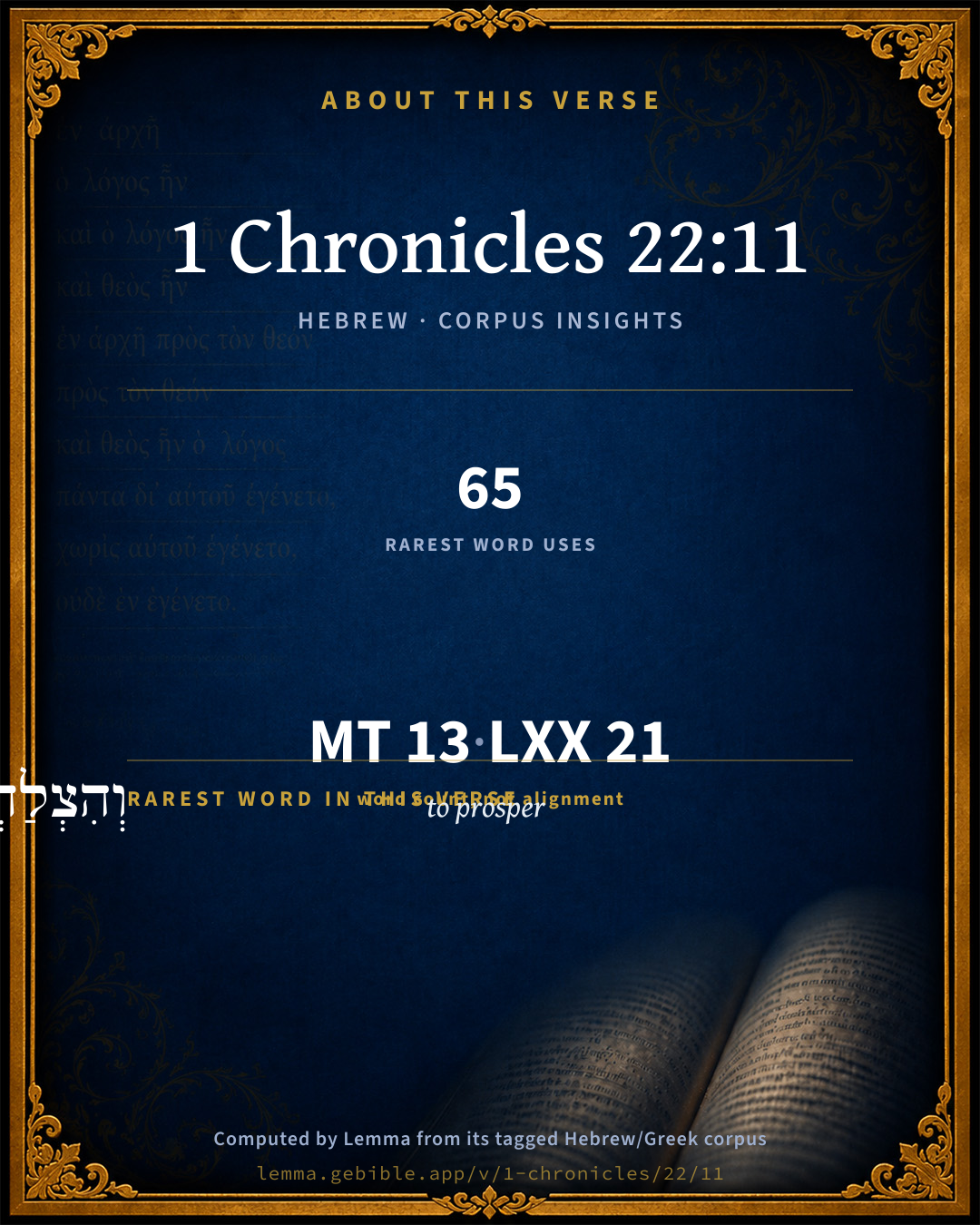
13
words
12
distinct lemmas
Historical
section

Grammatical profile

  • 4 verbs
  • 5 nouns
  • 2 prepositions
  • 1 adverb
  • 1 particle

Verb forms

  • יְהִ֥י Qal · Jussive
  • וְהִצְלַחְתָּ֗ Hiphil · Sequential Perfect
  • וּבָנִ֨יתָ֙ Qal · Sequential Perfect
  • דִּבֶּ֥ר Piel · Perfect

Repetition

A word recurs within this verse — often emphatic in Hebrew:

  • יְהוָ֖ה LORD H3068 ×2

Hebrew & Septuagint length

In English translation the verse runs 24 words from the Hebrew and 29 from the Septuagint (LXX English) — closely comparable.

A rough comparison of the two English renderings, which tokenize alike — not a word-level alignment.

Word counts can differ between the Hebrew and the Greek without any difference in meaning — e.g. the Hebrew direct-object marker אֵת has no separate Greek word, and Greek often adds the article ὁ.

In the original languages it is 13 Hebrew tokens and 21 Greek tokens — but the two are counted differently (Hebrew bundles its prefixes and suffixes into one token; the Greek is in lemma form), so that isn’t a like-for-like length.

Cross-references

7

Topical passages linked to 1 Chronicles 22:11 in the Treasury of Scripture Knowledge — connected by theme and wording, ordered by reader-vote popularity; previews shown in the World English Bible.

  • 1 Chronicles 22:16 of the gold, the silver, and the brass, and the iron, there is no number. Arise and be doing, and Yahweh be with you.
  • 1 Chronicles 28:20 David said to Solomon his son, Be strong and of good courage, and do it: don't be afraid, nor be dismayed; for Yahweh God, even my God, is with you; he will not fail you, nor forsake you, until all the work for the service of the house of Yahweh is finished.
  • Isaiah 26:12 Yahweh, you will ordain peace for us; for you have also worked all our works for us.
  • Matthew 1:23 "Behold, the virgin shall be with child, And shall bring forth a son. They shall call his name Immanuel;" Which is, being interpreted, "God with us."
  • Matthew 28:20 teaching them to observe all things that I commanded you. Behold, I am with you always, even to the end of the age." Amen.
  • Romans 15:33 Now the God of peace be with you all. Amen.
  • 2 Timothy 4:22 The Lord Jesus Christ be with your spirit. Grace be with you. Amen.

Cross-references courtesy of OpenBible.info (CC BY 4.0).

Hebrew and Greek witnesses Masoretic Hebrew ↔ Greek Septuagint

The same verse in the two great witnesses to the Old Testament, shown verse-for-verse.

These are two independent witnesses, not word-aligned to each other, and the Septuagint is shown in lemma (dictionary) form.

Hebrew 1 Chronicles 22:11 Masoretic · Westminster Leningrad Codex

עַתָּ֣ה בְנִ֔י יְהִ֥י יְהוָ֖ה עִמָּ֑ךְ וְהִצְלַחְתָּ֗ וּבָנִ֨יתָ֙ בֵּ֚ית יְהוָ֣ה אֱלֹהֶ֔יךָ כַּאֲשֶׁ֖ר דִּבֶּ֥ר עָלֶֽיךָ

Now, my son, Yahweh be with you; and prosper you, and build the house of Yahweh your God, as he has spoken concerning you.

World English Bible · Public Domain

Greek LXX 1 Chronicles 22:11 Septuagint · lemma form

καί νῦν υἱός ἐγώ εἰμί μετά σύ κύριος καί εὐοδόω καί οἰκοδομέω οἶκος ὁ κύριος θεός σύ ὡς λαλέω περί σύ

And now, my son, the Lord shall be with you, and prosper you; and you shall build a house to the Lord your God, as he spoke concerning you.

LXX2012 (modern English Septuagint) · Public Domain

Hebrew: Westminster Leningrad Codex (CC BY 4.0). Greek: Septuagint (public domain); English from LXX2012 (modern English Septuagint) (Public Domain). How the Septuagint differs from the Hebrew →

Commentary

Notes on 1 Chronicles 22:11 from classic Christian and Jewish commentators (each source and its license shown beneath its notes). The classic Christian expositions comment on the surrounding passage and are grouped to its opening verse, so a note may address several verses; the Jewish commentaries on the Tanakh (Rashi and others) are per-verse, so they appear only where the commentator wrote on this verse.

Lemma curates 59 commentaries, every one of them public domain or Creative Commons licensed, each selected and text-cleaned for this edition rather than reprinted as found. About our sources →

Trapp's Complete Commentary

John Trapp

1Ch 22:11 Now, my son, the LORD be with thee; and prosper thou, and build the house of the LORD thy God, as he hath said of thee.

Ver. 11. The Lord be with thee; and prosper thou.] This is both votura et vaticinium, a prayer and a promise.

John Trapp, A Commentary or Exposition upon All the Books of the Old and New Testament (1647–1656) — public domain. Text from a community e-Sword module.

The Biblical Illustrator

Joseph S. Exell

1Ch_22:11-13

Now, my son, the Lord be with thee.

A fathers prayer for his son

I. For the possession of moral qualities.

1. Wisdom and understanding.

2. Strength end moral courage.

II. For the presence of God.

III. For successful undertaking. (J. Wolfendale.)

Condition of successful effort

I. Personal fitness.

1. Wisdom to direct.

2. Strength to work.

II. Gods presence to help in its prosecution.

III. Loyal obedience to god: keep the law of the Lord. (J. Wolfendale.)

The qualifications needed

I. The source from whence they come.

II. The design for which they are given. (J. Wolfendale.)

Keeping Gods law

I. Gods will is a law.

II. This law should be kept.

III. Obedience to this law is wisdom. (J. Wolfendale.)

Right training

We have read that Solomon was young and tender, young and timid; it would seem as if David, recognising the timidity of his son, specially charged him to cultivate courage, bravery, fearlessness. This was training up a child in the way he should go. We are too fond of training our strongest faculties, and thus we are tempted to neglect the weaker side of our nature. Find out the weak side of a childs character, and address yourself assiduously to its cultivation. We should seek to fall the empty sack, not to overcrowd the full one. Bring into play the muscles that are most difficult to get at, and do not overtrain those which afford the fairest prospect of immediate results. When we complain of a weak memory, or a hesitant will, or a defective imagination, we should address ourselves to the cultivation of that which is in special need of culture. (J. Parker, D. D.)

The Biblical Illustrator, edited by Joseph S. Exell (c. 1880s–1900s) — public domain. Text from a community e-Sword module.

Geneva Bible (1599)

Geneva Bible translators

He showeth that there can be no prosperity, but when the Lord is with us.

Geneva Bible (1599) marginal notes — public domain. Text via Bolls.life.

Ellicott's Commentary for English Readers

(11) The Lord be with thee.—See 1Ch_9:20. (1Sa_3:19; 2Ki_18:7 : “The Lord was with him.”) The phrase is the origin of the familiar liturgical formula, “The Lord be with you.”

And prosper thou, and build the house.—Not a command, but a wish, i.e., mayest thou prosper and build. The verb “prosper” (literally, carry through, make succeed) is used transitively in 2Ch_7:11 and Gen_24:40.

As he hath said of (upon) thee.—This phrase (dibbèr ‘al) is specially used of Divine threats and promises. (See Gen_18:19; Isa_37:22; and comp. 1Ch_22:8, above: “And the word of the Lord became upon me.”)

A Bible Commentary for English Readers, edited by Charles John Ellicott (1878–1897) — public domain. Text from a community e-Sword module.

John Gill's Exposition

Now, my son, the Lord be with thee, &c. Or "shall be with thee" (r), as some; and if it be as a prayer, it was no doubt a prayer of faith; the Targum is,"may the Word of the Lord be thine help:"

and prosper thee; may success attend thee:

and build the house of the Lord thy God, as he hath said of thee; foretold he should, and therefore would assist him to do it, which was an encouragement to go about it.

(r) "erit", Pagninus, Montanus; "futurus est", Junius & Tremellius, Piscator.

John Gill's Exposition of the Whole Bible (1746–1763) — public domain (CC PDM 1.0). Text via the HelloAO Bible API.

Matthew Poole's English Annotations

Prosper thou; go on prosperously in carrying on this work; or, the Lord give thee that rest and prosperity which is necessary for it.

Matthew Poole's English Annotations on the Holy Bible (1683–1685) — public domain. Text from a community e-Sword/MySword module.

The Pulpit Commentary

Vers. 11-13.

The aged king"s charge to his son and successor.

The language of David to his son here, and shortly afterwards to the princes of the kingdom, indicate well his recognition and lively memory of the fact that stone and wood, gold and iron, will need willing hands, earnest minds, devoted hearts, and that even the best material of doctrine and truth will lie dead without the energy of the will and the living Spirit. The present utterances of David"s lips, though somewhat various, go together to make what may still be correctly called one charge. And this charge is formulated in words of

I DIRECT ADDRESS AND INCITEMENT. David uses the direct human means, he looks upon his son. He speaks as a father to his son. With these natural aids of human look and voice he appeals to him, and remembers that the memory of them may possess an influence of incalculable helpfulness at some critical moments in time to come. It is not sufficient that we think and pray over God"s work and over others. We must use that word as a weapon, and wield it with all such force, both of kind and of degree, as may be open to us. So to preaching and teaching the best, the purest, and the most prepared of Divine truth, we must add the instrument of appeal. That appeal must be in God"s name, and must consist of his truth, but it must still be our appeal, warm with the love and sympathy of the heart of a fellow-creature, and quivering with the anxious tones of a fellow-creature"s voice. And in carrying out these methods, however undesignedly, David:

1. Announces the opportunity that lies before his son. He will not suffer any risk in the matter, but constrains his son to look at the opportunity, secures his surveying it in something of its proper dimensions. Solomon was very young still; but youth often under-estimates the dimensions of the things that are greatest of all. Just as the vast scenery that the eye looks on for the first time seems to have been over-described and exaggerated, till the truth grows on the eye day after day, and month after month, and that eye becomes educated to estimate magnitude more correctly. David, therefore, fixes attention, at all events, upon the grandeur of the opportunity which has now fallen to the lot of a very young man the house of the Lord thy God.

2. Emphasizes the value of the suggestions arising from a fathers experience. David has not concealed from his young son what it had been in himself which had stood in the way of his accomplishing his own desire. It is not always to be expected, nor always wise or right, that a father "make a clean breast of it" to a young son. But David has done this now, and adds advice, and the tones of an earnest deep feeling which failed not to betray itself.

3. Urges the far more potent inducement of the Divine designation. "Build the house of the Lord thy God, as he hath said of thee. " If somewhat veiled, this is in effect the strong argument enwrapt in St. Paul"s exhortation, "Work out your own salvation with fear and trembling, for it is God that worketh in you both to will and to do of his good pleasure". (Php_2:12, 13) What a tremendous force has developed itself from the midst of all the weakness of human powers, when these have heard and surrendered themselves to the Divine call! Nothing so disarms as the consciousness that God and his truth are against you; and nothing fills the heart with such true fire and such abiding, growing determination as the happy contrary.

4. Appeals to the principle of sanctified courage. "Be strong, and of good courage; dread not, nor be dismayed." The strength, the courage, the fearlessness, not such as should have to be shown against any outer foe, but against the foe who must be feared from within: To fear responsibility rather than to dare it, is one thing; to run away from duty, from high endeavour, from difficult enterprise because of responsibility, is another thing, and an ignoble thing. Against temptation of this kind even a man"s natural courage should largely defend him, much more should godly courage.

II INDIRECT ADDRESS, AS OVERHEARD, FOR INSTANCE, IN THE SUGGESTIONS OF FERVENT PRAYER. Of all malevolent influences, one of the most disastrous is when the impression is produced upon one that he is "prayed against. " 0f all tendering, melting influences, one of the most effective has been observed to be when genuine prayer has been overheard; the person praying unconscious thereof, and the person prayed for convinced of the same. But in this case David wishes his young son to hear and knew his prayer and deepest desires for him. And Solomon hears therein:

1. The prayer that speaks gentle, thoughtful affection. "The Lord be with thee the unchanging, almighty, unerring Friend. This petition, too familiar to our ear, too little familiar to our thought, knows no limit of time, sets no bound to help, begs constant mercy, constant love.

2. The prayer that suggests the memory of need the need of "wisdom and understanding." Amid high position, great power, immense wealth and glory, David will not have his son forget the need of that "wisdom and understanding" which were more precious than rubies, and above all price. Nor will he have him forget that from God alone are these to be derived. And the exceeding importance that David attaches to the possession of these is further indicated by the word "only." If only these are given by the Giver of all good, if only these are treasured by his son, all else may be trusted to go well.

3. The prayer that honours obedience. Solomon must "keep the Law of the Lord his God;" he must "take heed to fulfil the statutes and judgments with which the Lord charged Moses concerning Israel." His principle, his idea, his habit none of these must look the way of doing his own will, ruling for his own ends or glory. He is but a vicegerent over God"s people, and follows in this respect the greatest exemplars and models of his people from most ancient, most honoured times. God had so "charged" Moses concerning Israel, that Moses had for the most part been obedient and "faithful as a servant;" and David prays that a similarly gracious, condescending, and commanding charge" may be vouchsafed to Solomon, and heard and "kept" by Solomon.

4. The prayer that authoritatively pronounces the embryo blessing. "Then shalt thou prosper." So this charge, both for its matter and for its manner, for its following the precedents of wise human means, and for its imploring the Divine blessing and unhesitatingly avowing the perpetual need of Divine interposition, was well adapted to produce lasting impression on Solomon. What could the loving father and the dying king do more for his people, for his son, for his God?

Vers. 11-13.

Fatherly wishes and prayers.

David was not satisfied to make material preparations for the erection of the temple at Jerusalem. He had something more valuable than metals and stone and timber to give his son, in view of the great work which it should devolve upon him to execute. He gave to Solomon his counsels and his prayers. In these verses David

I LAYS DOWN THE CONDITIONS AND QUALIFICATIONS OF SUCCESSFUL WORK FOR THE LORD. These are:

1. Intellectual gifts," wisdom and understanding." If bodily strength is a gift from the Lord, much more is vigour and versatility of mind. A curse when employed in the service of self and sin, these endowments become a precious and unspeakable blessing when consecrated to the cause of God.

2. A position of influence and authority. Solomon had "charge concerning Israel." All who by birth, station, position, or office have special influence over others have also special responsibilities. This is true, not only of political, but also of social and educational influence.

3. Reverent regard to Gods will. Solomon"s strength was in "keeping the Law of the Lord," in "taking heed to fulfil the statutes and judgments which the Lord charged Moses with concerning Israel.

4. A fearless and courageous spirit. This seems natural to some men; but in those naturally self-distrustful courage may be cultivated by a habitual reliance upon the grace and promises of God.

5. Above all, the presence of the Lord. If he be with his servants, his work shall prosper in their hands. Here David also

II EXPRESSES HIS HEART"S DESIRE AND PRAYER ON HIS SON"S BEHALF. We read David"s heart in these utterances. Whilst his judgment as to the conditions of prosperity are Laid down, how devoutly does he desire that success may crown Solomon"s efforts, that the work of the Lord may be accomplished! It was natural to the King of Israel to shape his wishes into prayers; the wishes of so pious a man could be nothing less than prayers. His heart"s desire for his son was this The Lord be with thee! give thee all qualifications and all help in his service!

PRACTICAL LESSONS.

1. Regard and seek all means of usefulness. Especially should the young prize every means of serving their generation according to the will of God. Nothing is to be despised or rejected which can tend to bring about an end so desirable.

2. In the acquisition and employment of all means of usefulness, neglect not those habits of prayer which will tend to make those means abundantly efficacious. T.

The Pulpit Commentary (1880–1919), ed. H.D.M. Spence-Jones & Joseph S. Exell — public domain. Text from a community e-Sword module.

Keil & Delitzsch

C. F. Keil & F. Delitzsch

Now, my son, the Lord be with thee, &c. Or "shall be with thee" (r), as some; and if it be as a prayer, it was no doubt a prayer of faith; the Targum is,"may the Word of the Lord be thine help:"

and prosper thee; may success attend thee:

and build the house of the Lord thy God, as he hath said of thee; foretold he should, and therefore would assist him to do it, which was an encouragement to go about it.

(r) "erit", Pagninus, Montanus; "futurus est", Junius & Tremellius, Piscator.

Keil & Delitzsch — Biblical Commentary on the Old Testament (1861–1891) — public domain (CC PDM 1.0). Text via the HelloAO Bible API. (Old Testament only.)

unfoldingWord translationNotes

Door43 World Missions Community

Connecting Statement:

David continues speaking to Solomon.

Now

David uses this word to introduce something important he is about to say.

May you build

Solomon would not personally do the building, but he would direct others to do it. AT: "May you direct people to build" (See: Metonymy)

when he places you in charge over Israel

"when he makes you king of Israel"

Be strong and courageous ... Do not fear or be discouraged

These two sentences mean the same thing, stated in different ways in order to emphasize that Solomon should not be afraid. (See: Parallelism)

translationWords

house of God

understand

obey

law

statute

decree

Moses

fear

unfoldingWord translationNotes — © Distant Shores Media and the Door43 World Missions Community, licensed CC BY-SA 4.0. Source: git.door43.org/Door43/en_tn.

Lesson kit

Teaching starters — assembled from the data on this page, not authored interpretation. Every prompt links to the verse data it draws on. Edit before teaching.

1 Chronicles, in the Historical, opens this verse with 13 words (12 distinct Hebrew lemmas). Its most distinctive word is tsâlach (“to prosper”). A historical commentator’s framing appears above. Read the whole chapter for the surrounding context.

Discussion questions

  1. The word tsâlach carries the sense “to prosper.” How does it shape the verse?
  2. How does 1 Chronicles 22:16, which shares this passage’s theme, read alongside this verse?
  3. What does the repetition of “LORD” (2× in this one verse) do in this verse?
  4. These translations render this verse differently; the difference is in the English rendering, not the original. What questions does that raise?
  5. «יְהִ֥י» is a Qal Jussive verb. How does that grammatical form shape the action described?
  6. Compare how Trapp's Complete Commentary and The Biblical Illustrator read this verse. Where do they agree or differ?

Things to notice

Reading settings

Reading text

Shown beneath each verse's original-language words.

Old Testament
Old Testament edition

Read the OT as the Masoretic Hebrew (MT) or the Greek Septuagint (LXX).

English shown for the Greek Septuagint (in the Hebrew ↔ Greek comparison).

Comparing translations? Open the Compare panel on any verse page to stack up to four side by side.