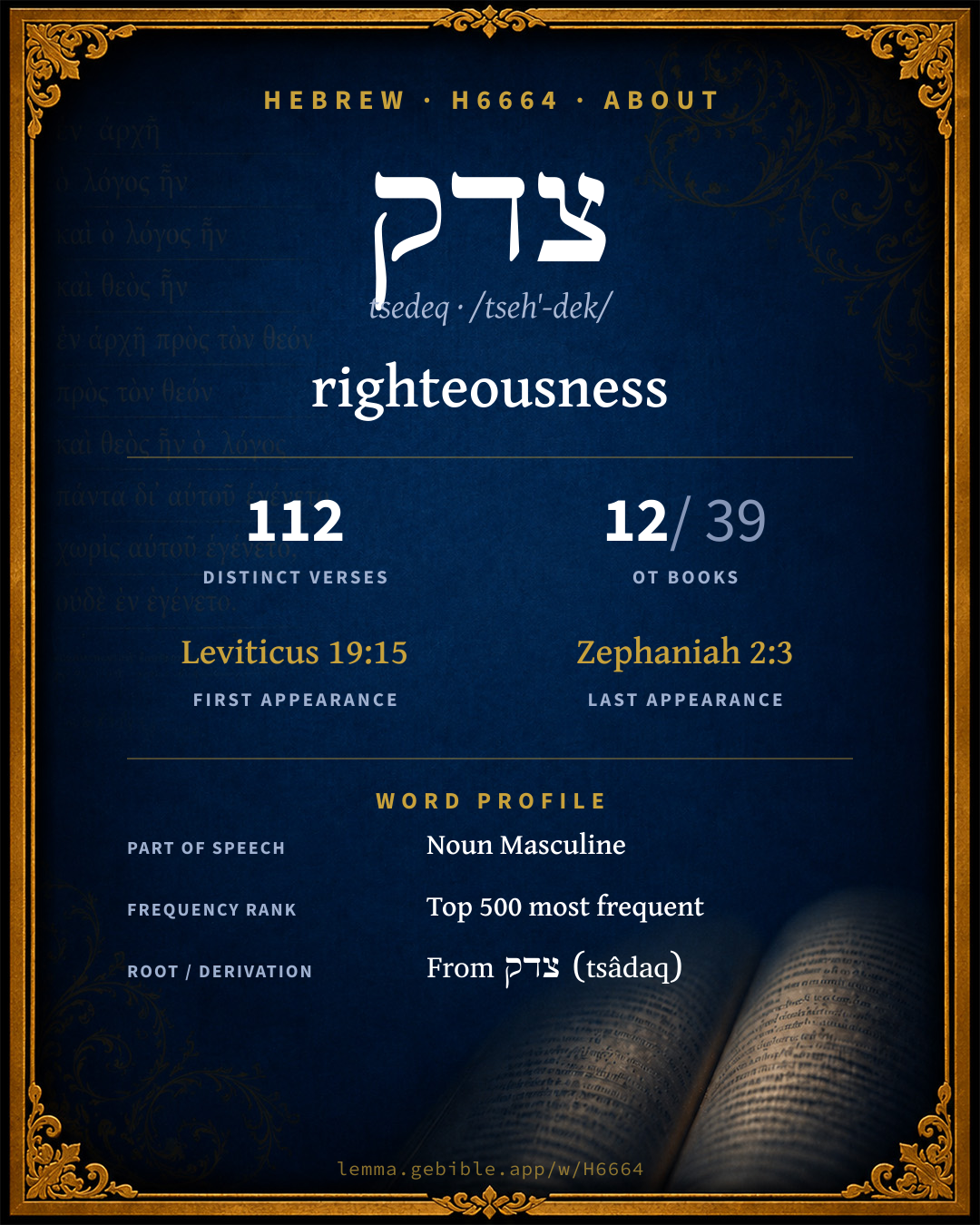
צֶ֫דֶק
righteousness
also: justice, rightness fuller range ↓
Full lexicon entry — Brown-Driver-Briggs (BDB)
From Brown-Driver-Briggs (BDB)
Where this word appears
See every Absolute-state word in the Hebrew Bible →
Grammar key — what these labels mean
Part of speech
- Noun
- A naming word — a person, place, thing, or idea.
Noun type
- Common
- A common noun — a general class of person, place, or thing (“king,” “city,” “water”), not a specific name.
State
- Absolute
- The independent form of a noun, not bound to a following word.
- Construct
- A noun bound to a following noun in a possessive / “of” relationship (the construct chain).
Gender
- Masculine
- Grammatically masculine.
Number
- Singular
- One.
2 verses where H6664 appears in the Construct state in the Book of Jeremiah. Filtered view — show all forms. Click any verse to open its interlinear word-by-word view. Verse text shown in the World English Bible for context — . Each verse’s Hebrew form is shown with its reference; the English is not keyword-highlighted, since the data carries no word-level English alignment. Use “Compare translations” on any verse to read it across multiple English versions. This concordance covers the Hebrew Bible; Septuagint (Greek Old Testament) occurrences are not indexed here.
Jeremiah
- Jeremiah 23:6 צִדְקֵֽ/נוּ n c ms cs + sfx pers 1cp In his days Judah shall be saved, and Israel shall dwell safely; and this is his name by which he shall be called: Yahweh our righteousness.
- Jeremiah 33:16 צִדְקֵֽ/נוּ n c ms cs + sfx pers 1cp In those days shall Judah be saved, and Jerusalem shall dwell safely; and this is [the name] by which she shall be called: Yahweh our righteousness.
About this entry
At a glance — auto-summarized from this page’s data, not written by a person. Every figure links to its source below. This summary describes the numbers; it doesn’t interpret them.
צדק — transliterated tsedeq — is a Hebrew noun carrying the sense “righteousness.” Alongside “righteousness” the lexicon also lists “justice” and “rightness” — part of its full sense range. It appears 112 verses across 12 books of the Hebrew Bible, among its common vocabulary. More than a third of its appearances fall in Psalms. Its earliest occurrence is Leviticus 19:15. Each statement above links to its evidence; the full detail follows below.
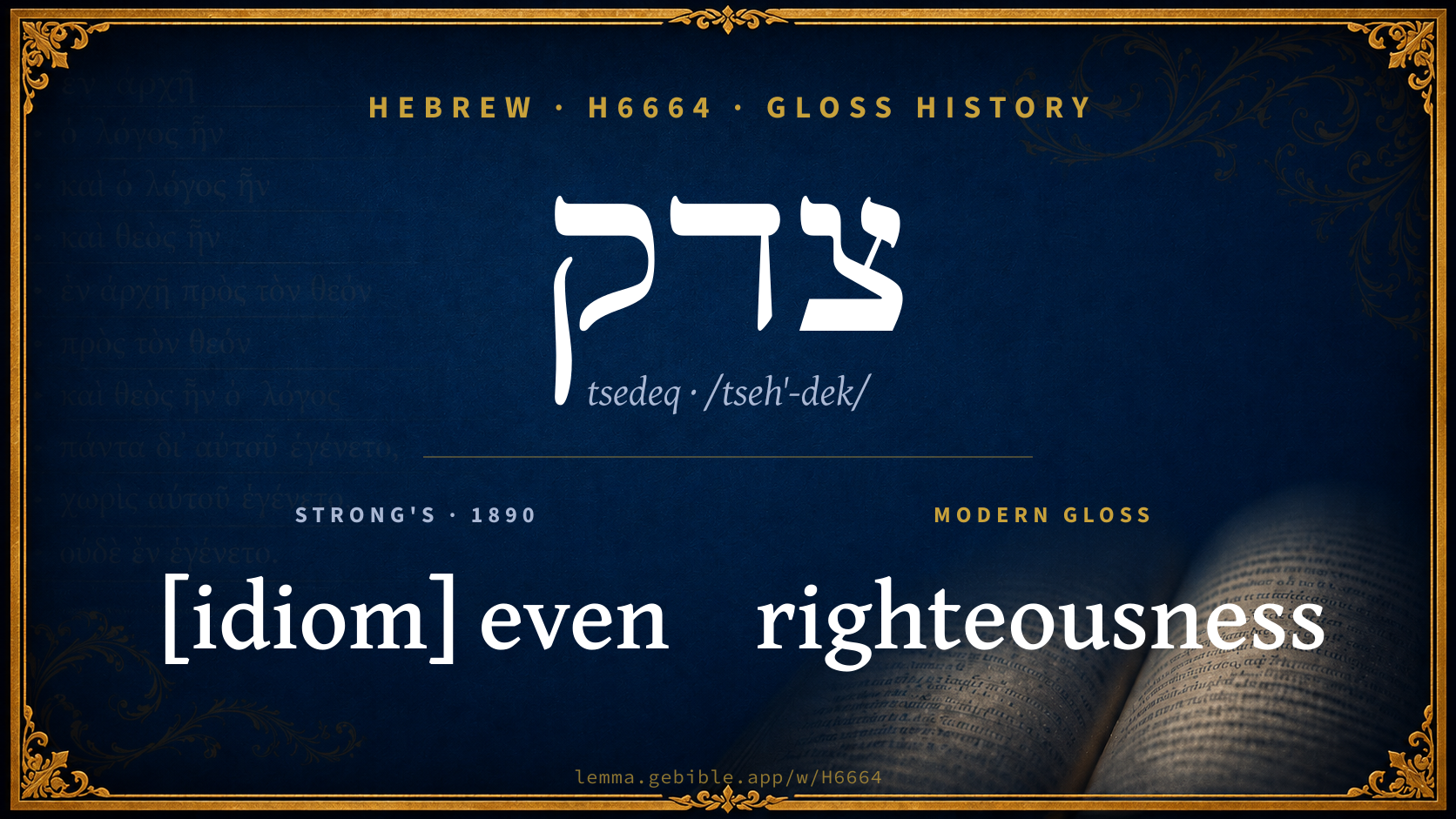
Gloss history
Strong's 1890 vs modern scholarship
About this word
Strong's H6664 catalogs a Hebrew word from the Hebrew Old Testament.
These counts are not copied from any lexicon or concordance. They are computed here, from the morphology-tagged Hebrew Old Testament. What Lemma adds →
- 112
- distinct verses
- The word appears in 112 distinct verses.
- 12 / 39
- OT books
- The word appears in 12 of 39 Old Testament books.
- #363
- by frequency
- Top 500 most frequent Hebrew words (rank 363 of 8,640 Hebrew words by occurrence).
View all 112 occurrences in the concordance →
By section of the Old Testament
By traditional corpus
Conventional, traditional groupings — biblical authorship is debated, so this is a traditional corpus grouping, not an authorship claim. Each share is this word’s portion of its verses in that division of the Hebrew canon. Each figure is a share of the word’s 112 distinct verses.
- Writings (Ketuvim) 69 verses · 62%
- Prophets (Nevi'im) 36 verses · 32%
- Torah (Pentateuch) 7 verses · 6%
How translations render this word
Counts come from each version’s own published word-to-Strong’s tagging or interlinear alignment — an approximate guide to how each version renders this word, not a word-level alignment the data otherwise carries. Because each total is that version’s own tagged count, the per-version totals vary from one another and need not match the appearance or distinct-verse counts above. These counts may also differ from a printed concordance because Lemma counts each distinctly tagged rendering and does not collapse phrase taggings into a single head-word total. This is a fixed set of word-tagged versions (KJV, ASV, BSB, ULT) and does not change with the reading translation you choose elsewhere. Each version’s license is shown beside its name below (and on Sources).
- King James Version: Righteousness 66×, Just 10×, Justice 10×
- American Standard Version: Righteousness 61×, Just 8×, Righteous 4×
- Berean Standard Bible: Righteousness 57×, Righteous 14×, Honest 6×
- unfoldingWord Literal Text: Righteousness 93×, According to my righteousness 3×, Accurate 3×
King James Version Public Domain
Renders H6664 across 116 tagged occurrences — most commonly:
Plus 16 renderings that appear only once — usually multi-word phrases or single function words the recovered tagging swept in, not distinct renderings.
American Standard Version Public Domain
Renders H6664 across 118 tagged occurrences — most commonly:
Plus 35 renderings that appear only once — usually multi-word phrases or single function words the recovered tagging swept in, not distinct renderings.
Berean Standard Bible Public Domain
Renders H6664 across 116 tagged occurrences — most commonly:
Plus other, less common renderings. Plus 10 renderings that appear only once — usually multi-word phrases or single function words the recovered tagging swept in, not distinct renderings. Not rendered by a distinct English word in 3 further occurrences.
unfoldingWord Literal Text CC BY-SA 4.0
Renders H6664 across 120 tagged occurrences — most commonly:
Plus 11 renderings that appear only once — usually multi-word phrases or single function words the recovered tagging swept in, not distinct renderings.
15 senses and sub-senses in the full BDB
What do BDB’s symbols mean?
BDB uses these scholarly abbreviations:
| Symbol | Meaning |
|---|---|
| 𝔊 | the Septuagint (the ancient Greek translation, LXX) |
| 𝔙 | the Vulgate (the Latin translation) |
| 𝔖 | the Syriac version (the Peshitta) |
| 𝔗 | the Targum (the Aramaic translation) |
| ψ | the Psalms |
| √ | root (the underlying root or stem) |
| ‖ | parallel passage (a synonymous or contrasted parallel) |
| † | the dagger: every passage where the word occurs is cited |
The 15 senses and sub-senses the full Brown-Driver-Briggs lexicon distinguishes for this word, in lexicon order (not ranked by frequency), with BDB’s own verbatim wording and sub-sense lettering. Shown in Hebrew script with BDB’s own scholarly abbreviations. The condensed entry is in the Lexicon Entry tab. See also the Forms in the corpus table below.
- 1. what is right, just, normal; rightness, justness, of weights and measures, אֵיפָה, אֶבֶן שְׁלֵמָה וָצֶדֶק Dt 25:15 a perfect and a just weight, ephah; מֹאזְנֵי צ׳; אַבְנֵי צ׳, אֵיפַת צ׳, הִין צ׳, בַּת צ׳ Lv 19:36 (H) Jb 31:6; Ez 45:10; מַעְגְּלֵי צ׳ right paths ψ 23:3; זִבְחֵי צ׳ right peace-offerings Dt 33:19 ψ 4:6; 51:21. e.g. Deuteronomy 25:15
- 2. righteousness, in government:
- a. of judges, rulers, kings, שׁפט בצ׳ Lv 19:15 (H); שׁפט צ׳ Dt 1:16 Pr 31:9; משׁפט צ׳ Dt 16:18; רדף צ׳ v 20; חוֹקֵק צ׳ Pr 8:15; מלך לצ׳ Is 32:1; דבּר צ׳ ψ 58:2; also Pr 25:5 ψ 94:15; Ec 5:7. e.g. Leviticus 19:15
- b. of law, as מִשְׁפָּטִים Is 58:2 ψ 119:7, 62, 75, 106, 160 (𝔊, but MT מִשְׁפַּט), v 164; as עֵדוֹת v 138, 144; as מִצְוֹת v 172. e.g. Isaiah 58:2
- c. of Davidic king, Messiah Is 11:4, 5; 16:5 ψ 45:5, דין בצ׳ 72:2. e.g. Isaiah 11:4
- d. of Jerus., as seat of just government, עִיר הַצֶּדֶק Is 1:26 city of righteousness; נְוֵה צ׳ Je 31:23; 50:7 (poss. these reflect an orig. god צֶדֶק, v. מַלְכִּי צֶדֶק); צ׳ יָלִין בָּהּ Is 1:21 righteousness used to lodge in her; cf. מְקוֹם הצ׳ Ec 3:16 the place of righteousness. e.g. Isaiah 1:26
- e. of God’s attribute as sovereign Jb 36:3, husband of Israel Ho 2:21; צ׳ his personif. agent ψ 85:11, 12, 14, foundation of his throne 89:15 = 97:2; in his government ψ 9:9; 65:6; 96:13 = 98:9, promise Is 45:19, administration of justice Jb 8:3 Je 11:20 ψ 7:18; 48:11; 50:6 = 97:6, vindication of his people 9:5; 35:24, 28; raising up Cyrus Is 45:13, calling his servant 42:6; אֱלֹהֵי צִדְקִי ψ 4:2 God of my righteousness (who vindicates me); his צ׳ is everlasting 119:142. e.g. Job 36:3
- 3. righteousness, justice, in a case or cause Jb 6:29; 8:6; 29:14 ψ 35:27; Is 59:4; God שׁפט כצ׳ ψ 7:9 judges according to righteousness; גמל כצ׳ 18:21; השׁיב כצ׳ v 25; שׁמע צ׳ 17:1; הוציא צ׳ 37:6. e.g. Job 6:29
- 4. rightness, in speech, דבּר צ׳ ψ 52:5 (opp. שֶׁקֶר); יַגִּיד צ׳ Pr 12:17; בצ׳ כל אמרי פי 8:8; שִׂפְתֵי צ׳ 16:13. e.g. Psalms 52:5
- 5. righteousness, as ethically right Jb 35:2 ψ 17:15; 45:8; Pr 1:3; 2:9; Ec 7:15; Je 22:13; Ez 3:20; Ho 10:12 (read פְּרִי צ׳, so 𝔊 We Now); צ׳ עלמים Dn 9:24; עשׂה צ׳ Is 64:4 ψ 119:121; פעל צ׳ 15:2; למד צ׳ Is 26:9, 10; בקּשׁ צ׳ Zp 2:3; רדף צ׳ Is 51:1; ידע צ׳ v 7. e.g. Job 35:2
- 6. righteousness as vindicated, justification in controversy with enemies and troubles, deliverance, victory, prosperity:
- a. of God as covenant-keeping, in redemption, בִּימִין צִדְקִי Is 41:10, ‖ יֵשַׁע 45:8; 51:5, cf. 42:21; בשּׂר צ׳ ψ 40:10; אִמְרַת צ׳ 119:123. e.g. Isaiah 41:10
- b. in name יהוה צִדְקֵנוּ, of Messianic king (vindicating people’s cause and giving victory) Je 23:6; of city 33:16. e.g. Jeremiah 23:6
- c. of people as enjoying צ׳ of salvation, ‖ יְשׁוּעָה Is 62:1; ‖ כָּבוֹד 58:3; 62:2; כהנים יִלְבְּשׁוּ צ׳ ψ 132:9; שַׁעֲרֵי צ׳ 118:19; אֵילֵי הצ׳ Is 61:3. e.g. Isaiah 62:1
- d. of Cyrus, צ׳ יִקְרָאֵהוּ לְרַגְלוֹ Is 41:2 (who) in victory calleth him at every step (CheHpt. on whose steps attends victory, so Di Du). e.g. Isaiah 41:2
Senses from the full Brown-Driver-Briggs lexicon (Brown, Driver, Briggs; Oxford 1906 — public domain), digitized via Sefaria, supplemented by the OpenScriptures HebrewLexicon (CC BY 4.0). Full attribution on Sources.
Word origin
n.m. Is 1:21 rightness, righteousness;—צ׳ Lv 19:36 + 87 times; צִדְקִי Is 41:10 + 8 times, etc.;—
— Brown-Driver-Briggs (Oxford 1906, public domain), digitized via Sefaria, supplemented by the OpenScriptures HebrewLexicon (CC BY 4.0). See Sources.
Derived from צדק (tsâdaq) (H6663) — to be righteous.
Jastrow Dictionary
A second Hebrew/Aramaic lexicon for comparison, covering Aramaic and post-biblical (Talmudic, Targumic, Midrashic) usage that the biblical-Hebrew BDB does not. Matched by lemma rather than by Strong’s number, so a lemma may carry more than one Jastrow headword (shown separately below), and the entries cover usage well beyond the Bible.
צָדַק
- [to be clear, pure, sincere,] to be right, true, just; to be cleared. Y. Snh. IV, 22ᵇ top יכול אם צ׳ בדינך יִצְדַּק בדיני you may think, if he (the guilty) is cleared in thy court, he will also be cleared in my (God’s) court.
- 1. (cmp. (cmp. זכה) to act in favor of a person; to be liberal. B. Bath. 88ᵇ (ref. to Deut. XXV, 15) צַדֵּק משלך ותן לו be liberal with what is thine own and give it to him, i.e. add overweight and overmeasure (גֵּירוּמִים); Ḥull. 134ᵃ (ref. to the poor man’s share). Num. R. s. 2 (ref. to ואתן צדק Job XXVI, 3) צי׳ עמהם שלא וכ׳ the Lord dealt kindly with them in not changing their arrangements. e.g. Deuteronomy 25:15
- 2. to justify, declare or consider a person right; to defend. Gen. R. s. 49 (ref. to Ps. XLV, 8) אהבת לצַדֵּק את בריותי וכ׳ thou (Abraham) lovest to defend my creatures, and hatest to condemn them. Y. Snh. IV, beg. 22ᵃ צַדְּקֵיהוּ consider him to be right (a true witness), opp. חקריהו cross-examine him; Deut. R. s. 5.—Esp. צ׳ את הדין to justify God’s judgment, to submit to divine dispensation as just, to punishment as deserved. Sifra Sh’mini, introd. כיון ששמע אהרן כך צ׳ … ושתק when Aaron heard this, he submitted to divine judgment and kept his peace (Lev. X, 3). Ib. אברהם צי׳ עליו וכ׳ Abraham resigned himself to God’s will, for we read (Gen. XVIII, 27), ‘I am dust and ashes’. Ib. צִידְּקוּ עליהם וכ׳ they resigned themselves &c. Y. Sot. VIII, 22ᶜ bot. צ̇ד̇ק̇יהו שצ̇יר̇ק̇ עליו וכ׳. Shallum was surnamed Zedekiah (justifier of God), because he justified God’s judgment upon him. Ab. Zar. 18ᵃ בשעה שיצאו … צידקו עליהם וכ׳ all three of them, when they were taken out for execution, resigned themselves &c. (reciting an appropriate Bible verse); a. fr.—Part. pass. מְצוּדָּק; pl. מְצוּדָּקִים. Mekh. Mishp., s. 20 (ref. to Ex. XXIII, 8) שונא דברים המצ׳ וכ׳ he will hate the justified words (the exhortations to justice) spoken at Sinai; Yalk. Ex. 353 (not דברי). e.g. Psalms 45:8
- 1. to justify, clear, declare to be right; to make virtuous. Snh. 10ᵃ (ref. to Deut. XXV, 1) עדים שהרשיעו את הצדיק ואתו … והִצְדִּיקוּ וכ׳ when witnesses denounced an innocent man, and other witnesses came and justified him that was right, and thus exposed those (first witnesses) as wicked men; Macc. 2ᵇ. Gen. R. s. 21 (ref. to Ps. XVI, 5) לכשיקיץ … אני מַצְדִּיקוֹ מאותה גזרה when he that is created in thine (Adam’s) image shall awake (when the Messiah comes) …, then I shall clear him from this decree (of expulsion from Eden). Lev. R. s. 4, beg. (ref. to Koh. III, 16) מקום שהִצְדַּקְתִּים וכ׳ there where I made them virtuous and called them divine beings …, there they acted wickedly &c. Gen. R. s. 43 (ref. to Gen. XIV, 18) המקום הזה מַצְדִּיק וכ׳ this place (Salem-Jerusalem) makes its inhabitants righteous.—ה׳ עליו את הדין to deal strictly with. Taan. 8ᵃ כל המצדיק … מַצְדִּיקִין עליו את הדין וכ׳ he who makes himself righteous here below (who strives for righteousness) is judged righteously (strictly dealt with) in the judgment above (cmp. Yeb. 121ᵇ quot. s. v. דִּקְדֵּק). Hor. 11ᵇ (play on צדקיהו) אמר לו יה יַצְדִּיק עליך וכ׳ he (Nebuchadnezzar) said to him, Yah shall deal strictly with thee, if thou wilt rebel against me; a. fr. e.g. Deuteronomy 25:1
- 2. to treat with צְדָקָה, to be liberal towards. Y. Peah IV, end 18ᶜ (alluding to Ps. LXXXII, 3) עני ורש הַצְדִּיקוּהוּ במתנותיו (not ועשיר) treat the poor and needy liberally as regards the gifts belonging to him (v. Ḥull. 134ᵃ quot. supra).—3) ה׳ את הדין to submit to divine judgment, be resigned (v. supra). Sifra l. c. למודים צדיקים שמַצְדִּיקִים וכ׳ the righteous are wont to resign themselves to the will of God. Taan. 11ᵃ מצדיק עליו וכ׳ he acknowledges the justice of the verdict and says, you have judged me rightly &c. Ber. 19ᵃ והוא עומד ומצדיק וכ׳ he (the mourner) stands up and declares the judgment to be just &c.; a. fr.—Part. pass. מוּצְדָּק justified, lawfully qualified. Gitt. 86ᵃ (in a Chaldaic formula of sale of a slave) מ׳ לעבדו, v. עַבְדּוּתָא. e.g. Psalms 82:3
- to justify one’s self, excuse one’s self. Gen. R. s. 92 (ref. to Gen. XLIV, 16) מה נִצְטַּדָּק בדינה how can we justify ourselves for what we have done in the case of Dinah (that we killed the Shechemites)? &c.; Yalk. ib. 150. e.g. Genesis 44:16
צְדַק
- , to be clear, just. Targ. Ps. XIX, 10 צְדִיקוּ Ms. (ed. זכיאו).
- to justify, do justice to. Ib. LXXXII, 3.—א׳ דינא to acknowledge the justice of divine judgment. Taan. 22ᵇ דקא מַצְדִּיק דינא אנפשיה וכ׳ Ms. M. (ed. מצדיק עליה וכ׳) that he acknowledged the justice of God’s decree over him, saying (Lam. I, 18) &c. e.g. Lamentations 1:18
צֶדֶק
- 1. (b. h.; preced.) righteousness, justice, equity; virtue. Ḥag. 12ᵇ, v. עֲרָבוֹת I. Yalk. Deut. 907 (ref. to Deut. XVI, 9) אין יוצא ידי עולמו עד שיורה צ׳ בהוראתו he (that takes bribes) will not finish his days before he will prove that his (wrong) decision was right; Sifré Deut. 144 עד שיורוהו (corr. acc.). Midr. Till. to Ps. LVIII ed. Bub. ולא הודה בצִדְקוֹ של דוד he would not confess that David was right. Ib. בצ׳ רדפתם אחרי did you pursue me justly? או בצ׳ שפטתם אותי or did you judge me in righteousness?; a. fr.—מְשִׁיחַ צֶ׳ the true Messiah (Jer. XXIII, 6). Pesik. R. s. 37 אפרים מ׳ צִדְקִי Ephraim, my (the Lord’s) true Messiah. Ib. מ׳ צִדְקֵינוּ our true Messiah; a. fr. e.g. Deuteronomy 16:9
- 2. Tsedeḳ, the planet Jupiter. Sabb. 156ᵃ, v. צַדְקָן. Ib. 156ᵇ top דקאי צ׳ במערב because Ts. stands in the west (thy planet is declining). Gen. R. s. 43 (ref. to Is. XLI, 2) מזל צ׳ היה מאיר לו the planet Ts. shone on his (Abraham’s) way; a. fr. e.g. Isaiah 41:2
A Dictionary of the Targumim, the Talmud Babli and Yerushalmi, and the Midrashic Literature (Marcus Jastrow; London, Luzac, 1903) — Public Domain. Digitized via Sefaria. Digitized via Sefaria. Full attribution on Sources.
Forms in the corpus
The 52 distinct written forms H6664 takes in the Hebrew Bible, most frequent first — each parse links to that state’s occurrences in the concordance. Hebrew forms include their vowel points and cantillation, so a single lemma takes many written forms.
Same root — word family
Other BDB entries built from the same root as H6664, grouped by Strong’s listed origin. These share a root / origin per the lexicon — not necessarily a shared meaning. Each links to that word’s own entry.
Derives from
Shares the same root
Proper names from this root
People and places named from this root — a name, not an additional meaning of the word.
Compare all same-root words → Showing 4 of 6 — not the complete family. 2 of the same-root words are proper names (people or places). They share a root, not necessarily a meaning.
Septuagint verse parallels
This word appears in 92 verses that also exist in the Greek Old Testament (Septuagint), out of the 112 Hebrew verses it occurs in. You can read those verses in Greek by switching the Old Testament edition to the Septuagint.
Read these verses in the Septuagint
- Leviticus 19:15
- Deuteronomy 1:16
- Job 6:29
- Psalms 4:1
- Proverbs 1:3
- Ecclesiastes 3:16
- Isaiah 1:21
- Jeremiah 11:20
- Ezekiel 3:20
- Daniel 9:24
- Hosea 2:19
- Zephaniah 2:3
This is a verse-level parallel only — the same verses exist in both the Hebrew and Greek Old Testaments. No word-level Hebrew↔Greek correspondence is claimed: the data carries no such alignment, so no Greek word is shown as this Hebrew word’s translation. Coverage is not total — the Septuagint omits the deuterocanon and renumbers the Psalms, so some Hebrew verses have no direct Greek parallel.