

Psalms 18:20

Hebrew (Westminster Leningrad Codex) Psalms 18:20 appears in the Hebrew Old Testament. The text above is from the Westminster Leningrad Codex. Each word links to its Strong’s number, a concise gloss, and parsing drawn from the Open Scriptures Hebrew Bible morphology. Click any word for its full Brown-Driver-Briggs (BDB) entry.
Download image
Cite this verse

Psalms 18:20 (World English Bible). Public Domain. Lemma interlinear Bible study tool, https://lemma.gebible.app/v/psalms/18/20.

Show BibTeX & RIS
BibTeX
RIS
English Translation
Yahweh has rewarded me according to my righteousness. According to the cleanness of my hands has he recompensed me.
World English Bible · Public Domain
Download a study sheet

One document with this verse’s original text, its word-by-word gloss line, the meaning frame, cross-references with their text, attributed commentary, and full source and license credits — printable, and it pastes into notes with its structure intact.

This verse Autodidact and up

Study sheet (.html) Plain text (.txt)

A passage Seminary Student

Up to 50 verses in one chapter. A passage sheet keeps up to 6 commentary sources and 12 cross-references per verse, in the order this page ranks them, and says so on the sheet whenever that leaves anything out. Ask for a single verse and you get the Autodidact verse sheet above.

Everything on this page stays free to read, with no account — the sheet is a download of what is already on screen, not access to it.

Want to remove ads? Support Godless Engineer
Compare translations 3

The same verse in 3 English versions, stacked beneath the original-language interlinear above. Click any original word for its lexicon entry.

Each is an independent rendering of the whole verse — the interlinear is not word-aligned to these translations.

Highlighted words mark where these versions differ — a whole-verse word diff, not a word-by-word alignment.

  • World English Bible Public Domain
    Yahweh has rewarded me according to my righteousness. According to the cleanness of my hands has he recompensed me.
  • King James Version Public Domain
    The LORD rewarded me according to my righteousness; according to the cleanness of my hands hath he recompensed me.
  • unfoldingWord Literal Text CC BY-SA 4.0
    Yahweh has rewarded me according to my righteousness, according to the cleanness of my hands he has given back to me.

unfoldingWord Literal Text — © unfoldingWord, licensed CC BY-SA 4.0. Word-aligned USFM3 via Door43 (git.door43.org/unfoldingWord/en_ult).

Versions to compare (up to 4)

3 of 4 selected

Show all 18 translations

Every available English version of this verse, each an independent rendering of the whole verse.

  • World English Bible Public Domain
    Yahweh has rewarded me according to my righteousness. According to the cleanness of my hands has he recompensed me.
  • Berean Standard Bible Public Domain
    The LORD has rewarded me according to my righteousness; He has repaid me according to the cleanness of my hands.
  • Majority Standard Bible Public Domain
    The LORD has rewarded me according to my righteousness; He has repaid me according to the cleanness of my hands.
  • King James Version Public Domain
    The LORD rewarded me according to my righteousness; according to the cleanness of my hands hath he recompensed me.
  • American Standard Version (1901) Public Domain
    Jehovah hath rewarded me according to my righteousness; According to the cleanness of my hands hath he recompensed me.
  • Revised Version (1885) Public Domain
    The LORD rewarded me according to my righteousness; according to the cleanness of my hands hath he recompensed me.
  • Geneva Bible (1599) Public Domain
    The Lord rewarded me according to my righteousnes: according to the purenes of mine hands he recompensed me:
  • Douay-Rheims (1899) Public Domain
    And he brought me forth into a large place: he saved me, because he was well pleased with me.
  • Young's Literal Translation Public Domain
    Jehovah doth recompense me According to my righteousness, According to the cleanness of my hands, He doth return to me.
  • Literal Standard Version CC BY-SA 4.0
    YHWH repays me || According to my righteousness, || According to the cleanness of my hands, || He returns to me.
  • Unlocked Literal Bible CC BY-SA 4.0
    Yahweh has rewarded me because of my righteousness; he has restored me because my hands were clean.
  • unfoldingWord Literal Text CC BY-SA 4.0
    Yahweh has rewarded me according to my righteousness, according to the cleanness of my hands he has given back to me.
  • Darby Bible Public Domain
    Jehovah hath rewarded me according to my righteousness; according to the cleanness of my hands hath he recompensed me.
  • World Messianic Bible Public Domain
    The LORD has rewarded me according to my righteousness. According to the cleanness of my hands, he has recompensed me.
  • Webster's Bible Public Domain
    \\18:19\\He brought me forth also in a large place; he delivered me, because he delighted in me.
  • Free Bible Version CC BY-SA 4.0
    The Lord rewarded me because I do what's right; he repaid me because I am innocent.
  • Bible in Basic English Public Domain
    The Lord gives me the reward of my righteousness, because my hands are clean before him.
  • JPS Tanakh (1917) Public Domain
    (18-21) The LORD rewarded me according to my righteousness; according to the cleanness of my hands hath He recompensed me.

Literal Standard Version (2020), Covenant Press — licensed CC BY-SA 4.0. Text via the HelloAO Bible API (eBible.org). Unlocked Literal Bible (unfoldingWord) — licensed CC BY-SA 4.0. Text via the HelloAO Bible API (eBible.org). unfoldingWord Literal Text — © unfoldingWord, licensed CC BY-SA 4.0. Word-aligned USFM3 via Door43 (git.door43.org/unfoldingWord/en_ult). Free Bible Version, Dr. Jonathan Gallagher — licensed CC BY-SA 4.0. Text via the HelloAO Bible API (eBible.org).

Word by word

More ways to search: Search by grammar → Find every occurrence → Compare this word →

Practice this passage: Drill this verse → Learn its vocabulary →

About this verse

These counts appear in no published source. They are computed here, from the morphology-tagged text and Lemma’s own curated glosses. What Lemma adds →

7
words
6
distinct lemmas
Wisdom
section

Notable vocabulary

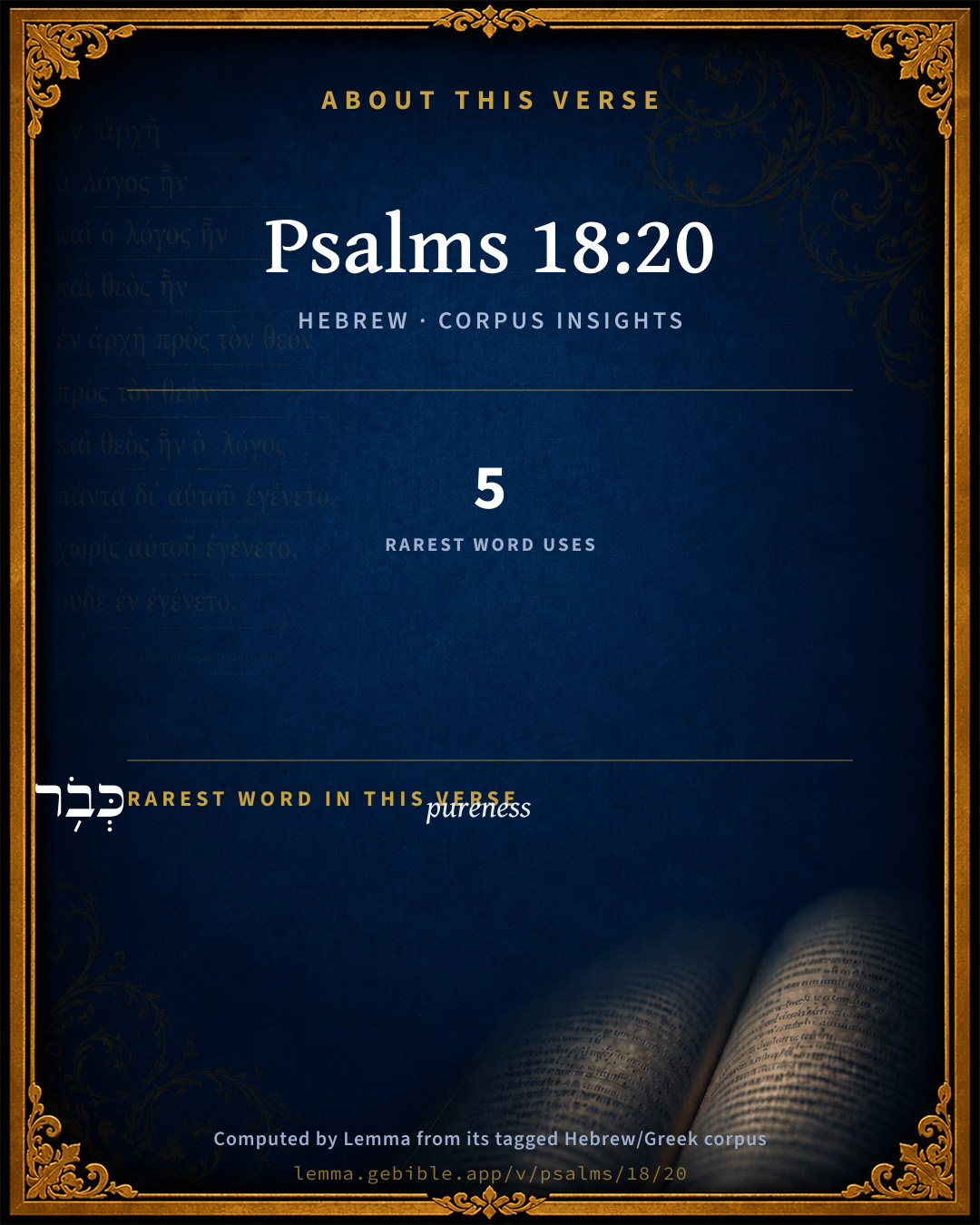
The rarest word here is כְּבֹ֥ר pureness H1252 — appearing just 5 times in the whole Hebrew Bible.

Shared distinctive vocabulary

כְּבֹ֥ר pureness H1252 occurs in 5 verses of the Hebrew Bible. Also found in:

Grammatical profile

  • 2 verbs
  • 4 nouns
  • 1 preposition

Verb forms

  • יִגְמְלֵ֣נִי Qal · Imperfect
  • יָשִׁ֥יב Hiphil · Imperfect

Hebrew & Septuagint length

In English translation the verse runs 19 words from the Hebrew and 22 from the Septuagint (LXX English) — closely comparable.

A rough comparison of the two English renderings, which tokenize alike — not a word-level alignment.

Word counts can differ between the Hebrew and the Greek without any difference in meaning — e.g. the Hebrew direct-object marker אֵת has no separate Greek word, and Greek often adds the article ὁ.

Cross-references

16

Topical passages linked to Psalms 18:20 in the Treasury of Scripture Knowledge — connected by theme and wording, ordered by reader-vote popularity; previews shown in the World English Bible.

  • Psalms 24:4 He who has clean hands and a pure heart; Who has not lifted up his soul to falsehood, And has not sworn deceitfully.
  • Psalms 58:11 So that men shall say, "Most assuredly there is a reward for the righteous. Most assuredly there is a God who judges the earth."
  • Matthew 6:4 so that your merciful deeds may be in secret, then your Father who sees in secret will reward you openly.
  • 1 Corinthians 3:8 Now he who plants and he who waters are the same, but each will receive his own reward according to his own labor.
  • Job 22:30 He will even deliver him who is not innocent; Yes, he shall be delivered through the cleanness of your hands."
  • Proverbs 11:18 Wicked people earn deceitful wages, But one who sows righteousness reaps a sure reward.
  • Psalms 7:3 Yahweh, my God, if I have done this, If there is iniquity in my hands,
  • Psalms 7:8 Yahweh administers judgment to the peoples. Judge me, Yahweh, according to my righteousness, And to my integrity that is in me.
  • Psalms 18:24 Therefore Yahweh has rewarded me according to my righteousness, According to the cleanness of my hands in his eyesight.
  • Isaiah 49:4 But I said, I have labored in vain, I have spent my strength for nothing and vanity; yet surely the justice [due] to me is with Yahweh, and my recompense with my God.
  • Isaiah 62:11 Behold, Yahweh has proclaimed to the end of the earth, Say you to the daughter of Zion, Behold, your salvation comes; behold, his reward is with him, and his recompense before him.
  • Hebrews 7:26 For such a high priest was fitting for us: holy, guiltless, undefiled, separated from sinners, and made higher than the heavens;
  • 1 Samuel 24:11–13 Moreover, my father, behold, yes, see the skirt of your robe in my hand; for in that I cut off the skirt of your robe, and didn't kill you, know you and see that there is neither evil nor disobedience in my hand, and I have not sinned against you, though you hunt after my life to take it.
  • 1 Samuel 24:17 He said to David, You are more righteous than I; for you have rendered to me good, whereas I have rendered to you evil.
  • 1 Samuel 24:19–20 For if a man finds his enemy, will he let him go away unharmed? Therefore may Yahweh reward you good for that which you have done to me this day.
  • Psalms 26:6 I will wash my hands in innocence, So I will go about your altar, Yahweh;

Cross-references courtesy of OpenBible.info (CC BY 4.0).

Hebrew and Greek witnesses Masoretic Hebrew ↔ Greek Septuagint

The same verse in the two great witnesses to the Old Testament, shown verse-for-verse.

You’re reading Greek Psalm 17 (Hebrew Psalm 18). The Septuagint counts the superscription, so verse numbers can differ from the Hebrew — chapter-level alignment, not verse-by-verse. Numbering follows Rahlfs.

These are two independent witnesses, not word-aligned to each other, and the Septuagint is shown in lemma (dictionary) form.

Hebrew Psalms 18:20 Masoretic · Westminster Leningrad Codex

יִגְמְלֵ֣נִי יְהוָ֣ה כְּצִדְקִ֑י כְּבֹ֥ר יָ֝דַ֗י יָשִׁ֥יב לִֽי

Yahweh has rewarded me according to my righteousness. According to the cleanness of my hands has he recompensed me.

World English Bible · Public Domain

Greek LXX Greek Psalm 17:20 Septuagint · lemma form

καί ἐκἄγω ἐγώ εἰς πλατυσμός ῥύομαι ἐγώ ὅτι θέλω ἐγώ ῥύομαι ἐγώ ἐκ ἐχθρός ἐγώ δυνατός καί ἐκ ὁ μισέω ἐγώ

And the Lord will recompense me according to my righteousness; even according to the purity of my hands will he recompense me.

LXX2012 (modern English Septuagint) · Public Domain

Hebrew: Westminster Leningrad Codex (CC BY 4.0). Greek: Septuagint (public domain); English from LXX2012 (modern English Septuagint) (Public Domain). How the Septuagint differs from the Hebrew →

Commentary

Notes on Psalms 18:20 from classic Christian and Jewish commentators (each source and its license shown beneath its notes). The classic Christian expositions comment on the surrounding passage and are grouped to its opening verse, so a note may address several verses; the Jewish commentaries on the Tanakh (Rashi and others) are per-verse, so they appear only where the commentator wrote on this verse.

Lemma curates 59 commentaries, every one of them public domain or Creative Commons licensed, each selected and text-cleaned for this edition rather than reprinted as found. About our sources →

Matthew Henry's Commentary

Here, I. David reflects with comfort upon his own integrity, and rejoices in the testimony of his conscience that he had had his conversation in godly sincerity and not with fleshly wisdom, Co2 1:12. His deliverances were an evidence of this, and this was the great comfort of his deliverances. His enemies had misrepresented him, and perhaps, when his troubles continued long, he began to suspect himself; but, when God visibly took his part, he had both the credit and the comfort of his righteousness. 1. His deliverances cleared his innocency before men, and acquitted him from those crimes which he was falsely accused of. This he calls rewarding him according to his righteousness (Psa 18:20, Psa 18:24), that is, determining the controversy between him and his enemies, according to the justice of his cause and the cleanness of his hands, from that sedition, treason, and rebellion, with which he was charged. He had often appealed to God concerning his innocency; and now God had given judgment upon the appeal (as he always will) according to equity. 2. They confirmed the testimony of his own conscience for him, which he here reviews with a great deal of pleasure, Psa 18:21-23. His own heart knows, and is ready to attest it, (1.) That he had kept firmly to his duty, and had not departed, not wickedly, not wilfully departed, from his God. Those that forsake the ways of the Lord do, in effect, depart from their God, and it is a wicked thing to do so. But though we are conscious to ourselves of many a stumble, and many a false step taken, yet if we recover ourselves by repentance, and go on in the way of our duty, it shall not be construed into a departure, for it is not a wicked departure, from our God. (2.) That he had kept his eye upon the rule of God's commands (Psa 18:22): "All his judgments were before me; and I had a respect to them all, despised none as little, disliked none as hard, but made it my care and business to conform to them all. His statutes I did not put away from me, out of my sight, out of my mind, but kept my eye always upon them, and did not as those who, because they would quit the ways of the Lord, desire not the knowledge of those ways." (3.) That he had kept himself from his iniquity, and thereby had approved himself upright before God. Constant care to abstain from that sin, whatever it be, which most easily besets us, and to mortify the habit of it, will be a good evidence for us that we are upright before God. As David's deliverances cleared his integrity, so did the exaltation of Christ clear his, and for ever roll away the reproach that was cast upon him; and therefore he is said to be justified in the Spirit, Ti1 3:16.

II. He takes occasion thence to lay down the rules of God's government and judgment, that we may know not only what God expects from us, but what we may expect from him, Psa 18:25, Psa 18:26. 1. Those that show mercy to others (even they need mercy, and cannot depend upon the merit, no, not of their works of mercy) shall find mercy with God, Mat 5:7. 2. Those that are faithful to their covenants with God, and the relations wherein they stand to him, shall find him all that to them which he has promised to be. Wherever God finds an upright man, he will be found an upright God. 3. Those that serve God with a pure conscience shall find that the words of the Lord are pure words, very sure to be depended on and very sweet to be delight in. 4. Those that resist God, and walk contrary to him, shall find that he will resist them, and walk contrary to them, Lev 26:21, Lev 26:24.

III. Hence he speaks comfort to the humble ("Thou wilt save the afflicted people, that are wronged and bear it patiently"), terror to the proud ("Thou wilt bring down high looks, that aim high, and look with scorn and disdain upon the poor and pious"), and encouragement to himself - "Thou wilt light my candle, that is, thou wilt revive and comfort my sorrowful spirit, and not leave me melancholy; thou wilt recover me out of my troubles and restore me to peace and prosperity; thou wilt make my honour bright, which is now eclipsed; thou wilt guide my way, and make it plain before me, that I may avoid the snares laid for me; thou wilt light my candle to work by, and give me an opportunity of serving thee and the interests of thy kingdom among men."

Let those that walk in darkness, and labour under many discouragements in singing these verses, encourage themselves that God himself will be a light to them.

Matthew Henry's Commentary on the Whole Bible (1708–1710) — public domain (CC PDM 1.0). Text via the HelloAO Bible API.

Trapp's Complete Commentary

John Trapp

Psa 18:20 The LORD rewarded me according to my righteousness; according to the cleanness of my hands hath he recompensed me.

Ver. 20. The Lord rewarded me according to my righteousness] viz. The righteousness of my cause; and my freedom from such crimes of disloyalty and ambition, wherewith mine enemies charged me, as if pricked on by my pride I sought the kingdom. As also, according to mine honest desire and endeavour in all things else to keep a good conscience, void of offence toward God and men. This, though God’s own work, and a debt most due to him, yet he is pleased graciously to reward.

John Trapp, A Commentary or Exposition upon All the Books of the Old and New Testament (1647–1656) — public domain. Text from a community e-Sword module.

The Biblical Illustrator

Joseph S. Exell

Psa_18:20-27

The Lord reward me according to my righteousness.

Of the justice of Davids behaviour

I. Davids righteousness. Righteousness consists in rendering to all their due, and the revealed will of God is the standard of it (Deu_6:25). As we are under infinitely greater obligations to perform our duty to God than we can be under to perform any services to our fellow men, righteousness includes in it that piety which has God for its object, as well as the performance of those duties to which our neighbours have a right. Yet it is not seldom used to denote the rectitude of our dispositions and conduct to our fellow men, as godliness denotes right tempers and behaviour towards God. David laid it down as his settled purpose to walk in the law of the Lord, the great standard of righteousness, and through Divine mercy he was enabled to keep his resolution inviolable through the course of his life. He did not pretend to perfection. He referred all his actions to the glory of God; he loved His testimonies with his whole heart, and took pleasure in the habitation of His house. He made use of all his power to advance the honour of his God.

1. He behaved righteously towards King Saul, his first and great enemy. He was just to all his fellow subjects whilst he lived under the government of Saul. He acquired a high reputation for the prudence with which he managed all his affairs, and he would not have attained this honest fame if he had not abstained from all appearance of evil. We have no reason to form the least doubt of the care that David took, when he was an outlaw and a fugitive, to keep his followers from using any unwarrantable means for the supply of their wants, although they must often have been in extreme poverty. We have a testimonial from Nabals servants of the honesty of Davids men, and even of their generous care of Nabals substance, at a time when the ,good man was almost reduced to beggary. We have no reason to doubt of Davids rectitude of behaviour in all the dealings that he had with strangers. He had transactions in the time of his troubles with the king of Moab, to whom he committed the care of his father and mother when they could no longer dwell with safety at Bethlehem. We have no further account of any dealings with that prince, although we afterwards find him carrying on a bloody war with the Moabites. We have not the means of knowing whether the king of Moab had provoked this war by cruelty to Davids father and mother; but we can have no doubt that the cause of the war was just on Davids part. After the kind treatment which he received from the king of Gath, he took Gath out of the hands of the Philistines, but the Philistines themselves were the authors of the war. David in his government was a man of blood, but in his disposition he was a man of peace. A necessity was laid upon him to fight the battles of the Lord, and of the people of the Lord. When he was advanced to the throne of Israel it is testified of him that he did justice and judgment to all his people. He tells us (Psa_75:1-10; Psa_101:1-8) how he intended to govern his family and his kingdom, and doubtless, as far as human infirmity would permit, he kept his resolution. Gratitude may well be considered as an ingredient of justice. We owe returns of love and of the proper fruits of it to friends who love us, and who are glad to serve us according to the best of their abilities. Davids gratitude to his benefactors was a remarkable part of his character. We find him sending presents of the spoils gained in battle to those places where he and his men were accustomed to haunt. When Saul was dead he was so far from expressing resentment against him, that he inquired whether there were any left of his family, that he might show them the kindness of God for Jonathans sake, And many years afterwards he showed that Jonathan was not forgotten by him, when he took care to secure Mephibosheth from the destruction brought upon the family of Saul, at the requisition of the Gibeonites. He was grateful for favours even to those heathens from whom he received any kindness. Nahash, king of the Ammonites, showed kindness on some occasions to David, perhaps rather from hatred to Saul than goodwill to the poor man whom Saul oppressed. Yet David showed kindness unto Hanun, the son of Nahash, for his fathers sake. Righteousness in a king will dispose him to an impartial execution of the laws against criminals. A wise king crusheth the wicked, and bringeth the wheel over them. But how was this consistent with the favour showed to Joab and to Absalom? Did he not know that God had forbidden any satisfaction to be taken for the life of a murderer? Yes, he knew it very well, and took measures even when he was dying that Joabs grey hairs should not come down to the grave without blood. It is perhaps impossible entirely to justify him for suffering that bloody man to live so long above the ground. Yet never was lenity to a criminal more excusable. Seldom has a prince or a nation been more indebted to a subject than David and his people were to Joab for brilliant services. And it appears to have been almost impracticable to bring to condign punishment a man so popular, and of such power in the army as Joab. David himself made this excuse for himself when he said, These men, the sons of Zerniah, are too strong for me. We may observe likewise that David was once indebted for his own life to Abishai, the brother of Joab, who seems to have had some share in the blood of Abner. He might with some appearance of reason think that he owed a life to the family of his sister Zeruiah, or that at least he might incline to the favourable side when plausible reasons could be advanced for their exculpation. We cannot pretend to vindicate his behaviour in the case of Uriah. But we cannot reprobate that part of his conduct in stronger language than David himself did. We may make the same observation concerning another instance of Davids procedure, which has given occasion to animadversions on his conduct; I mean the charge given to Solomon concerning Shimei. Behold thou hast with thee Shimei the son of Gera, a Benjamite of Bahurim, which cursed me with a grievous curse in the day when I went to Mahanaim; but he came down to meet me at Jordan, and I sware to him by the Lord, saying, I will not put thee to death with the sword. Now, therefore, hold him not guiltless, for thou art a wise man, and knowest what thou oughtest to do unto him, but his hoary head bring thou clown to the grave with blood. We might have observed that fidelity in performing engagements is an essential part of justice in which it cannot be supposed that David would be deficient. But how could David observe his promise and oath to Shimei if he brought down the hairs of Shimei with blood to the grave by the hands of Solomon? A man is no less accountable for what he commands to be done, than for what he does with his own hands. Can we reasonably suppose that David on his deathbed would commit an act of wickedness for which his memory might be detested by all who feared an oath? In fact, we find that the crime of cursing David at Mahanaim was not the ground of the sentence against Shimei, although the reason he had given by that crime to suspect his loyalty was the cause why he was laid under a prohibition of leaving Jerusalem under pain of death. But there is another reading of the last part of the charge equally agreeable to the words of the original, which clears the character of David from all blame, Neither bring down his grey hairs to the grave with blood; keep a strict eye over him as a man disaffected to my family; punish him for any new crime by which he may merit punishment, but let my oath be sacred, and bring not down his grey hairs to the grave with blood, for that crime which I sware by the Lord not to punish with death. Charity is essential to justice. There are duties which we owe to all men, by the second great commandment of the law, the commandment to love our neighbour as ourselves. If David had not conscientiously observed this precept he could not have so often appealed to God, the Searcher of hearts, as the witness of his inviolable regard to these Divine testimonies, which were the light to his path and the lamp by which his feet were guided in the way of peace.

II. Gods regard to Davids righteousness in the deliverances granted to him from his enemies. Without all doubt, David ascribed all the rich favours he received from God to that sovereign and free mercy to which every saint of God must be infinitely indebted (Psa_86:11; Psa_116:4-5). He was sensible, like his father Jacob, that he was not worthy of the least of Gods mercies, and that there was no merit in the least of his works (Psa_138:2-3). But he knew at the same time that, through the infinite mercy of God, the good works of His people are accepted and rewarded by Him (Psa_11:6). Mercy and truth meet together in God, righteousness and peace kiss each other, and display their united glories in the administrations of His providence to His people. The Lord shows forth the exceeding riches of His grace in making them righteous, and when they are made righteous He shows both His grace and His justice in rewarding them according to their righteousness. There is so much sin mingled even with their good works that, if they were still under the law, they could not escape the condemnation at once of all their works, and of their persons likewise. But all their iniquities, and amongst other iniquities those which cleave to their holy things, are covered from Gods sight. Their good works, therefore, cannot but be well-pleasing to God, and richly rewarded by Him. He will never be unrighteous to forget any of their works or labours of love, and therefore those who follow after righteousness shall have a sure reward. But did not David glory in himself rather than in the Lord when he spoke of his own righteousness m such high terms. This question leads us--

III. To consider Davids consciousness of his own righteousness. He speaks with perfect assurance concerning the regard which God expressed to his righteousness. Is this the language of humility? It would indeed be very presumptuous to form and to express such a judgment concerning ourselves without searching our own hearts, without comparing them with the law of God, and without finding good evidence that our hearts are sound in Gods statutes. But in none of these particulars had David been negligent.

1. He had searched his heart as well as his ways. I thought, he says, upon my ways., and turned my feet unto Thy testimonies. He was far from thinking that his ways could be right unless his heart was right in the sight of God.

2. His standard by which be tried himself was the law of his God. He was fully sensible of the folly of trying himself by any other standard.

3. He found in his heart and ways an habitual conformity to the law of God. He was indeed constrained to acknowledge that in many things he had offended God. When he meditated on the admirable purity of the law he cried, Who can understand his errors? cleanse Thou me from secret faults. Yet he could with confidence say that he had hoped for Gods salvation, and done His commandments. This conclusion he did not rashly form from the consideration of a few of his actions, or of the frame of his heart at some particular periods of his life. Many deceive themselves by forming a hasty judgment of themselves, founded on temporary impressions made upon their minds in some moments of seriousness, excited by some particular circumstance of providence, or by the transient influence of some Divine truths. He knew the deceitfulness of the heart of man, and that without Divine illumination he might easily deceive himself. He therefore referred himself to God, the Searcher of hearts, to preserve him from entertaining any false hopes of the goodness of his own condition (Psa_139:23-24).

IV. The assurance which David had of Gods respect to his own righteousness in the deliverances granted to him by His gracious providence. We must not place humility ill all affected ignorance of what is true, either concerning oar own personal righteousness or concerning Gods acceptance of it. Nothing could be more dangerous than the presumption that God is well pleased with us if our way or our heart is perverse before Him (Mic_3:10-12). Nothing could be more unbecoming in a Christian than the forgetfulness of his infinite obligations to that grace which has blotted out his innumerable transgressions. Yet it is desirable for every child of God to be well assured of the cleanness of his hands in Gods sight, and of the acceptance of his works as well as of his person. As it is our duty to pray to God for the acceptance of our services, it must be our duty likewise humbly and thankfully to acknowledge Gods righteousness and grace in His dealings with us. The riches of Divine mercy appear in the acceptance of our works, and in the consequent rewards bestowed on them, as well as in the acceptance of our persons. Were it not that our iniquities are hidden from Gods sight, such works as even Davids could not have been rewarded by that God who is of purer eyes than to behold evil. Go thy way, says Solomon, eat thy bread with cheerfulness, and drink thy wine with a merry heart, for God now accepteth thy works. If God does not accept our works, we can have no well-grounded pleasure in the bounties of His providence. On the whole learn--

1. The great advantage of walking in the ways of God. The Lord loveth him that followeth after righteousness. Say ye to the righteous, it shall be well with him. What reason have we to adore that plan of mercy which allows us to hope for Divine acceptance, and for the reward of our works done to please God, although they are so imperfect that we must daily seek from God the pardon of our iniquities.

2. Gods people ought patiently to hold on in the way of righteousness amidst the most discouraging dispensations of providence. David had, after all his dismal days, a new song put into his mouth to magnify the Lord.

3. When we obtain deliverances it is our duty to consider how we behaved under our troubles. Yet we still ought to bless God for deliverances hem trouble, although we should not dare to say that we have kept the way of God when we are under it.

4. Let us give praise to God for the great salvation wrought by our Lord Jesus Christ. The deliverances of David were salvations to all Israel. It is to be feared that many of us are totally destitute of righteousness. (G. Lawson.)

Justification by works

Why did God delight in David? The Psalmist declares that the ultimate reason was no arbitrary favouritism, but that God delighted in His servant because of his personal faith and character. David asserts the sincerity of his desire to please God; he asserts the uprightness of his conduct before God. The spirit of this appeal is far removed from Pharisaism; it is not an outburst of self-complacency and vain gloriousness, but the legitimate expression of conscious integrity. If the grace of God has done anything for us, why should we not simply and candidly realise and express the fact? Nothing succeeds like success, and we are ignoring a fountain of inspiration when we timidly shut our eyes to, the clear evidences of the victories of the inner life. To the glory of Gods grace let us honestly acknowledge to ourselves and others the growing dominion of righteousness in our soul.

1. God deals with us as we deal with Him. Therefore hath the Lord recompensed me. God had dealt with him as he had dealt with God. He trusted God, and God delivered him; he loved God, and God delighted in him; he served God, and God honoured and blessed him. This is ever the great canon of the Divine rule. As we love God, He will love us. We love God, because He first loved us; but having known His love, there is a very true sense in which its proportion is henceforth determined by the measure of our reciprocation. As we trust God, He will succour us. A great faith sinks Alpine ranges to a plain, it crosses Atlantic depths dryshod. The lack of such faith entangles us in many embarrassments and miseries. As we serve God He will requite us. According to the measure of our love, faith, and service shall be our safety, strength, and bliss. Are any poor in joy, grace, power, and peace? Let them act more generously towards God.

2. God deals with us as we deal with one another (see Psa_18:25-26). The great truth taught in these verses is, that Gods dealing with us is regulated by our dealing with one another. This is the clear, hill teaching of the whole of revelation. How mistaken are those who imagine spiritual religion to be anti-social. It is a common complaint that religious faith is a weakening, impoverishing, disintegrating influence in social life: the love given to God is supposed to be subtracted from our love to humanity; the service rendered to the kingdom of God is considered as so much filched from the service of humanity. No mistake could be greater. God does not judge us apart from society, but strictly in and through our relation to it. As we deal with our brother the great Father deals with us. Some people are religious without being good; that is, they are not kind to their fellows, just, generous, truthful, helpful. This will not do. A true Christian is both religious and good. God does not test us by our ecclesiastical life, but by our social, human life. Social duty and spiritual prosperity are closely related. When we suffer stagnation of spiritual life we search for the reason in the neglect of Church fellowship or worship, the reading of Gods Word, or of the sacraments; but the reason will just as often be found in our failure to do justly and to love mercy in our social relation.

3. God deals with us as we deal with ourselves. I was also upright before Him. As we honour ourselves by keeping ourselves pure, God honours us by abundance of grace and peace. There is a true sense ill which He accepts us according to our own valuation. If we reverence our body, hallow our gifts, prize our fair name, esteem our time and influence as choice treasure, God follows up such self-respect by great spiritual enrichment and blessing. If we would realise the fulness of blessing we must respect ourselves and keep from iniquity. (W. L. Watkinson.)

Gods interpositions

I. As a vindication of his own character.

1. He--David--regarded his character as very excellent. Of that excellency he speaks in terms emphatic and strong. Can his language be justified? Not in an absolute sense. Morally, in the sight of God, David was very far from a perfect man. It can be justified in an average sense, and in an official sense.

2. David regarded his character as divinely influential. Was he right in supposing that God came to his deliverance on account of what he was in himself, or on account of what he had done to serve Him?

1. Individual character is known to God.

2. Individual character is interesting to God. Nothing in the universe touches the heart of the Great Father so much as the moral character of His children.

II. As an illustration of Gods manifestation. He rises to a view of the great principle with which God deals with all His moral creatures. As man is, so is God to him. This is true in two respects.

1. As a personal power. God treats man according to his character.

2. As a mental conception. Mans idea of God is his God, it is the deity, he worships. Man worships the God he has imaged to himself; and men have different images, according to the state of their own hearts. The revengeful man has a God of vengeance, the sectarian man has a God of sects, the capricious man has a capricious God, the selfish man has a greedy God, the despotic man has an arbitrary God, and the loving man has a loving God. Our moral nature rises and falls with our conception of God, for man must need assimilate himself to what he worships. Every man copies the God in whom he believes. (Homilist.)

The Biblical Illustrator, edited by Joseph S. Exell (c. 1880s–1900s) — public domain. Text from a community e-Sword module.

Joseph Benson's Commentary

Psa 18:20-24. The Lord rewarded me according to my righteousness — “Commentators have been much perplexed,” says Dr. Horne, “to account for these unlimited claims to righteousness made by David, and that long after the matter of Uriah, and toward the close of life. Certain, indeed, it is,” adds he, “that the expressions considered as David’s must be confined, either to his steadfast adherence to the true worship, in opposition to idolatry, or to his innocence with regard to some particular crimes falsely alleged against him by his adversaries. But if the Psalm be prophetical, and sung by the victorious monarch in the person of King Messiah, then do the verses now before us no less exactly than beautifully delineate that all- perfect righteousness wrought by the Redeemer, in consequence of which he obtained deliverance for himself and his people.” Most commentators, however, are, and have always been, of opinion, that David spoke here in his own person, and not in the person of the Messiah, to whom no part of the Psalm, upon a fair construction, except the last two verses, appears to have any reference. But as, by rewarding and recompensing him, David chiefly meant the Lord’s delivering him from Saul and his other enemies that then were, and exalting him to the throne of Judah and Israel; so he must of necessity be understood as speaking principally of his righteousness, and the cleanness of his hands, prior to that period. And, certainly, in that former part of his life, “no instance can be alleged against him,” as Dr. Dodd observes, “in which he violated the known precepts of religion and virtue, enjoined by that constitution he was under;” and therefore, conscious of his integrity thus far, he might justly glory and rejoice that God, who was a witness to it, had thus bountifully rewarded it. And, as to his great sin in the matter of Uriah, wherein he highly offended and greatly dishonoured God, and for which God chastised him for many years, by various calamities, his repentance for that dreadful crime, or rather, for that complication of crimes, was so sincere, and the fruits and proofs of it were so manifest, that God was pleased to remove the judgments by which he had corrected him, and to deliver him from his rebellious son Absalom and his party, and from all the other enemies that rose up against him. Many learned men, however, are of opinion that David did not compose this Psalm after his sin in the matter of Uriah, much less in his old age, but rather in his younger days upon his deliverance from Saul, and the other enemies who persecuted him in Saul’s days, and opposed his advancement to the crown. This, they suppose, appears from the title of the Psalm, compared with 2Sa 22:1. Dr. Delaney thinks he wrote the greater part of it soon after the deliverance he obtained from Saul’s messengers, when they were sent to his house to take him, and when he was let down by Michal out of the window, and escaped over the garden or city-wall: and he thinks the 29th verse refers to this escape, and is a proof that he penned the Psalm on that occasion. But Dr. Dodd, and many others think it was composed some time after he was put in peaceable possession of the kingdom, and had introduced the ark into Jerusalem. If either of these opinions be correct, he wrote the Psalm before his fall, and while his character was quite unblemished. But be this as it may, if he wrote it even after that unhappy event, it must also have been written after his repentance, and after he was become a new creature in heart and life: and it does not appear, on a candid examination of the particulars included in the account which he here gives of the uprightness of his conduct, that there is any clause or expression contained in it which will not admit of a fair and easy interpretation, in perfect consistency with his real character, according to the delineation which the inspired writers of his history have given of it. The following short explication of the passage, chiefly taken from Bishop Patrick’s paraphrase, it is thought, makes this evident.

The Lord rewarded me, &c. — The Lord knew that I was unjustly persecuted, and therefore rewarded me according to the integrity and purity of my actions, as I was never guilty of that whereof they accused me. For (Psa 18:21) I have kept the ways of the Lord — I never took any unlawful courses for my deliverance; and have not wickedly departed from my God — But when Saul, my great enemy, (who maliciously and unweariedly sought my life,) fell into my hands, and I had it in my power and was urged to kill him, I would not do it, because he was the Lord’s anointed: nor did I ever injure him or his party. For (Psa 18:22) all his (God’s) judgments were before me, &c. — I laid his precepts before me as the rule of my actions, and did not put them away, or bid them, as it were, stand aside. I was also (Psa 18:23) upright before him — I chose rather to suffer any thing than lose my integrity; and I kept myself from mine iniquity — How unjustly soever my enemies dealt with me, I would not imitate them, but though I could not hinder their iniquity, I kept myself from that, which, if I had committed it, would have been mine; guarding especially against that sin to which I was most inclined or tempted. Therefore (Psa 18:24) hath the Lord recompensed me, &c. — He who administers all things with the greatest justice and the greatest goodness heard my prayer, and dealt with me according to my innocent intentions, which would not suffer me to act unmercifully or unjustly toward Saul in any respect, much less to defile my hands with his blood.

Joseph Benson's Commentary on the Old and New Testaments (1811–1818) — public domain. Text from a community e-Sword module.

Whedon's Commentary on the Bible

Daniel D. Whedon

20. According to my righteousness—Psa_18:20-26 seem to date the psalm before David’s great sin. But he specially appeals to his righteousness as relating to the causes of his wars, for which he had given no provocation. In this his history vindicates him. The frank and positive character of David is here brought out. If he has sinned, his confessions and repentance are open and hearty. If he has acted uprightly, he stands firm in his innocence.

Daniel D. Whedon (gen. ed.), Commentary on the Old and New Testaments (1874–1909) — public domain. Text from a community e-Sword module.

J. A. Alexander on Psalms

Joseph Addison Alexander

21. (Psa 18:20). Jehovah will treat me according to my righteousness; according to the cleanness of my hands will he repay me. The future verbs have reference to the condition of the Psalmist under his afflictions, and the hopes which even then he was enabled to cherish. At the same time they make this the announcement of a general and perpetual truth, a law by which God's dispensations are to be controlled for ever. The hands are mentioned as organs or instruments of action. Compare Isa 1:15, Job 9:30; Job 22:30. The righteousness here claimed is not an absolute perfection or entire exemption from all sinful infirmity, but what Paul calls submission to the righteousness of God (Rom 10:3), including faith in his mercy and a sincere governing desire to do his will. This is a higher and more comprehensive sense than innocence of some particular charge, or innocence in reference to man, though not in reference to God.

Joseph Addison Alexander, The Psalms Translated and Explained (1850) — public domain. Text from a community e-Sword module.

Tyndale Open Study Notes

Tyndale Open Resources

18:20-24 The psalmist affirms that loyalty is rewarded. He puts his trust in the Lord (see 16:1) and commits himself to living with integrity (see Pss 1, 15, 24; see also 19:12-14).

Tyndale Open Study Notes — © Tyndale Open Resources, licensed CC BY-SA 4.0. Text via the HelloAO Bible API.

Geneva Bible (1599)

Geneva Bible translators

David was sure of his righteous cause, and good behavior toward Saul and his enemies, and therefore was assured of God’s favor and deliverance.

Geneva Bible (1599) marginal notes — public domain. Text via Bolls.life.

Jamieson, Fausset & Brown

Robert Jamieson, A. R. Fausset & David Brown

The statements of innocence, righteousness, &c., refer, doubtless, to his personal and official conduct and his purposes, during all the trials to which he was subjected in Saul's persecutions and Absalom's rebellions, as well as the various wars in which he had been engaged as the head and defender of God's Church and people.

Jamieson, Fausset & Brown — Commentary Critical and Explanatory on the Whole Bible (1871) — public domain (CC PDM 1.0). Text via the HelloAO Bible API.

Adam Clarke's Commentary

Verse 20. The Lord rewarded me] David proceeds to give the reasons why God had so marvellously interposed in his behalf.

According to my righteousness] Instead of being an enemy to Saul, I was his friend. I dealt righteously with him while he dealt unrighteously with me.

Adam Clarke's Commentary on the Bible (1810–1826) — public domain. Text from a community e-Sword/MySword module.

John Calvin's Commentaries

20. Jehovah rewarded me. David might seem at first sight to contradict himself; for, while a little before he declared that all the blessings which he possessed were to be traced to the good pleasure of God, he now boasts that God rendered to him a just recompense. But if we remember for what purpose he connects these commendations of his own integrity with the good pleasure of God, it will be easy to reconcile these apparently conflicting statements. He has before declared that God was the sole author and originator of the hope of coming to the kingdom which he entertained, and that he had not been elevated to it by the suffrages of men, nor had he rushed forward to it through the mere impulse of his own mind, but accepted it because such was the will of God. Now he adds, in the second place, that he had yielded faithful obedience to God, and had never turned aside from his will. Both these things were necessary; first, that God should previously show his favor freely towards David, in choosing him to be king; and next, that David, on the other hand, should, with an obedient spirit, and a pure conscience, receive the kingdom which God thus freely gave him; and farther, that whatever the wicked might attempt, with the view of overthrowing or shaking his faith, he should nevertheless continue to adhere to the direct course of his calling. Thus, then, we see that these two statements, so far from disagreeing with each other, admirably harmonise. David here represents God as if the president Agonotheta. Calvin alludes to the ancient games and combats of Greece, the presidents of which were called Agonothetee.

ArMeta. Those who exercised themselves with the view of contending for the prizes in the Grecian games and combats were called AtMetce.

“Sans que nous ne creature quelconque luy en donnions” occasion. — Fr.

There, however, still remains one question. If God rendered to David a just recompense, it may be said, does it not seem, when he shows himself liberal towards his people, that he is so in proportion as each of them has deserved? I answer, When the Scripture uses the word reward or recompense, it is not to show that God owes us any thing, and it is therefore a groundless and false conclusion to infer from this that there is any merit or worth in works. God, as a just judge, rewards every man according to his works, but he does it in such a manner, as to show that all men are indebted to him, while he himself is under obligation to no one. The reason is not only that which St Augustine has assigned, namely, that God finds no righteousness in us to recompense, except what he himself has freely given us, but also because, forgiving the blemishes and imperfections which cleave to our works, he imputes to us for righteousness that which he might justly reject. If, therefore, none of our works please God, unless the sin which mingles with them is pardoned, it follows, that the recompense which he bestows on account of them proceeds not from our merit, but from his free and undeserved grace. We ought, however, to attend to the special reason why David here speaks of God rewarding him according to his righteousness. He does not presumptuously thrust himself into the presence of God, trusting to or depending upon his own obedience to the law as the ground of his justification; but knowing that God approved the affection of his heart, and wishing to defend and acquit himself from the false and wicked calumnies of his enemies, he makes God himself the judge of his cause. We know how unjustly and shamefully he had been loaded with false accusations, and yet these calumnies did not so much bear against the honor and name of David as against the welfare and estate of the whole Church in common. It was indeed mere private spite which stirred up Saul, and drove him into fury against David, and it was to please the king that all other men were so rancorous against an innocent individual, and broke forth so outrageously against him; but Satan, there is no doubt, had a prime agency in exciting these formidable assaults upon the kingdom of David, and by them he endeavored to accomplish his ruin, because in the person of this one man God had placed, and, as it were, shut up the hope of the salvation of the whole people. This is the reason why David labors so carefully and so earnestly to show and to maintain the righteousness of his cause. When he presents and defends himself before the judgment-seat of God against his enemies, the question is not concerning the whole course of his life, but only respecting one certain cause, or a particular point. We ought, therefore, to attend to the precise subject of his discourse, and what he here debates. The state of the matter is this: His adversaries charged him with many crimes; first, of rebellion and treason, accusing him of having revolted from the king his father-in-law; in the second place, of plunder and robbery, as if, like a robber, he had taken possession of the kingdom; thirdly, of sedition, as if he had thrown the kingdom into confusion when it enjoyed tranquillity; and, lastly, of cruelty and many flagitious actions, as if he had been the cause of murders, and had prosecuted his conspiracy by many dangerous means and unlawful artifices. David, in opposition to these accusations, with the view of maintaining his innocence before God, protests and affirms that he had acted uprightly and sincerely in this matter, inasmuch as he attempted nothing without the command or warrant of God; and whatever hostile attempts his enemies made against him, he nevertheless always kept himself within the bounds prescribed by the Divine Law. It would be absurd to draw from this the inference that God is merciful to men according as he judges them to be worthy of his favor. Here the object in view is only to show the goodness of a particular cause, and to maintain it in opposition to wicked calumniators; and not to bring into examination the whole life of a man, that he may obtain favor, and be pronounced righteous before God. In short, David concludes from the effect and the issue, that his cause was approved of by God, not that one victory is always and necessarily the sign of a good cause, but because God, by evident tokens of his assistance, showed that he was on the side of David.

John Calvin's Commentaries (1540-1563) — public domain. Text from the Calvin Translation Society English edition (1840s-50s) via the Christian Classics Ethereal Library (ccel.org). Calvin's coverage is partial (roughly two-thirds of the Bible); uncommented books and verses are honest gaps, never fabricated. The 19th-century editor's footnotes and remarks are omitted so the notes are faithfully Calvin's own voice.

Ellicott's Commentary for English Readers

(20-23) for this protestation of innocence comp. Psalms 7, 17 and Job, passim. Self-righteous pride and vindication of one’s character under calumny are very different things. If taken of the nation at large, comp. Num_23:21. Here, also, the text in Samuel offers one or two trifling variations from ours.

A Bible Commentary for English Readers, edited by Charles John Ellicott (1878–1897) — public domain. Text from a community e-Sword module.

The Cambridge Bible for Schools and Colleges

gen. ed. J. J. S. Perowne

20. rewarded me] Or, dealt with me, for the primary idea of the word is not that of recompence, although this lies in the context. Cp. Psa_13:6.

the cleanness of my hands] = the innocence of my conduct. Cp. Psa_24:4, Psa_26:6.

20–23. The language is inspired by the courage of a childlike simplicity. It is no vainglorious boasting of his own merits, but a testimony to the faithfulness of Jehovah to guard and reward His faithful servants. David does not lay claim to a sinless righteousness, but to single-hearted sincerity in his devotion to God. Compare his own testimony (1Sa_26:23), God’s testimony (1Ki_14:8), and the testimony of history (1Ki_11:4; 1Ki_15:5), to his essential integrity. Cp. Psa_7:8, Psa_17:3-4; and see Introd. p. lxxxvii f.

Is not this conscious rectitude, this “princely heart of innocence,” a clear indication that the Psalm was written before his great fall?

The Cambridge Bible for Schools and Colleges (gen. ed. J. J. S. Perowne; Cambridge University Press, 1878–1918) — public domain. Text from a community e-Sword module.

John Gill's Exposition

For I have kept the ways of the Lord,.... Not those which the Lord himself walks in, his ways of providence, or of grace; though these are and should be taken notice of and observed by good men, as the word (y) used will bear to be rendered; but the ways which he has prescribed and directed men to walk in, the ways of his commandments, in which they should go; these were, in some measure, kept by David, who often, in the hundred nineteenth psalm speaks of his keeping the testimonies and statutes, and commandments of the Lord; as they are by good men, with some degree of pleasure, they take delight to walk in them; and with some degree of constancy, they keep walking in them, without turning to the right hand or the left, though solicited to it; but yet not perfectly, for they have many a slip and fall in them; wherefore this cannot be a reason of their being rewarded according to their righteousness: in strict justice, the words better agree with Christ, who kept the law of God perfectly, did his will completely; he came from heaven to do it; it was his meat and drink to accomplish it; and he always did the things which pleased his father, wherefore he rewarded him;

and have not wickedly departed from my God; which was, in some sense, true of David; not as by disbelieving the power and providence, the promises, truth, and faithfulness of God, and his covenant interest in him; which to do would have been a wicked departure from God; see Heb 3:12; nor by forsaking the house and worship of God; though he was driven from thence by wicked men, yet sore against his will, and which during his exile he frequently laments and complains of; nor by sinning wilfully and presumptuously, only through error, inadvertency, infirmity, and temptation: but when it is observed, how much unbelief, which is a partial departing from the living God, and how many there are that neglect private and public worship, and what a proneness there is to sin and wickedness, and how much there is of the will in sinful actions, in the best of men; it is right and best to understand this of Christ, who never was guilty of sin, nor committed any wickedness in departing from God in the least: as man, God was his God, and he always believed his interest in him, and claimed it even when he forsook him on the cross; nor did he quit his service, desert his cause, nor depart from the work and business he enjoined him, till it was finished.

(y) "observaveram", Tigurine version, Vatablus; "observo", Junius & Tremellius; "observavi", Gejerus, Michaelis; so Ainsworth.

John Gill's Exposition of the Whole Bible (1746–1763) — public domain (CC PDM 1.0). Text via the HelloAO Bible API.

Albert Barnes' Notes on the Bible

The Lord rewarded me according to my righteousness - That is, he saw that I did not deserve the treatment which I received from my enemies, and therefore he interposed to save me. Compare the note at Psa 17:3.

According to the cleanness of my hands - So far as my fellow-men are concerned. I have done them no wrong.

Hath he recompensed me - By rescuing me from the power of my enemies. It is not inconsistent with proper views of piety - with true humility before God - to feel and to say, that so far as our fellow-men are concerned, we have not deserved ill-treatment at their hands; and, when we are delivered from their power, it is not improper to say and to feel that the interposition in the case has been according to justice and to truth.

Albert Barnes' Notes on the Bible (1834–1885) — public domain. Text from a community e-Sword/MySword module.

Matthew Poole's English Annotations

As I had a just cause, and made it my care and business to deal righteously with God, and with Saul, and all others; so God (who hath engaged himself by his promise to suceour and reward them that are such) was graciously pleased to own me, and to plead my cause against my unrighteous enemies. And because I would not deliver myself from straits and miseries by unrighteous means, namely, by killing Saul, as I was advised to do, God was pleased to deliver me in a more honourable and effectual manner.

The cleanness of my hands, i.e. the innocency of my actions and carriage towards Saul, from whose blood I kept my hands pure.

Matthew Poole's English Annotations on the Holy Bible (1683–1685) — public domain. Text from a community e-Sword/MySword module.

The Treasury of David

Charles H. Spurgeon

Ver. 20. The Lord rewarded me according to my righteousness. Viewing this psalm as prophetical of the Messiah, these strongly expressed claims to righteousness are readily understood, for his garments were as white as snow; but considered as the language of David they have perplexed many. Yet the case is clear, and if the words be not strained beyond their original intention, no difficulty need occur. Albeit that the dispensations of divine grace are to the fullest degree sovereign and irrespective of human merit, yet in the dealings of Providence there is often discernible a rule of justice by which the injured are at length avenged, and the righteous ultimately delivered. David's early troubles arose from the wicked malice of envious Saul, who no doubt prosecuted his persecutions under cover of charges brought against the character of "the man after God's own heart." These charges David declares to have been utterly false, and asserts that he possessed a grace given righteousness which the Lord had graciously rewarded in defiance of all his calumniators. Before God the man after God's own heart was a humble sinner, but before his slanderers he could with unblushing face speak of the

cleanness of his hands and the righteousness of his life. He knows little of the sanctifying power of divine grace who is not at the bar of human equity able to plead innocence. There is no self righteousness in an honest man knowing that he is honest, nor even in his believing that God rewards him in providence because of his honesty, for such is often a most evident matter of fact; but it would be self righteousness indeed if we transferred such thoughts from the region of providential government into the spiritual kingdom, for there grace reigns not only supreme but sole in the distribution of divine favours. It is not at all an opposition to the doctrine of salvation by grace, and no sort of evidence of a Pharisaic spirit, when a gracious man, having been slandered, stoutly maintains his integrity, and vigorously defends his character. A godly man has a clear conscience, and knows himself to be upright; is he to deny his own consciousness, and to despise the work of the Holy Ghost, by hypocritically making himself out to be worse than he is? A godly man prizes his integrity very highly, or else he would not be a godly man at all; is he to be called proud because he will not readily lose the jewel of a reputable character? A godly man can see that in divine providence uprightness and truth are in the long run sure to bring their own reward; may he not, when he sees that reward bestowed in his own case, praise the Lord for it? Yea rather, must he not show forth the faithfulness and goodness of his God? Read the cluster of expressions in this and the following verses as the song of a good conscience, after having safely outridden a storm of obloquy, persecution, and abuse, and there will be no fear of our upbraiding the writer as one who sets too high a price upon his own moral character.

Ver. 20. The Lord rewarded me according to my righteousness; according to the clearness of my hands hath he recompensed me. We must stand our ground, and be stiff for ourselves against all misjudgings. It is good to be zealously affected always in a good matter, whether it respects the glory of God immediately and alone, or whether it respects the credit of our brethren or our own. To desire to be famous in the world, and as those giants in the old world (Ge 6:4), men of renown, or, as the original text hath it, men of name, is a very great vanity; but to protect and preserve our good name is a great and necessary duty. Joseph Caryl.

None.

Psalms 18:21*

Charles H. Spurgeon's The Treasury of David (1869–1885) — public domain. Psalms only. Text from a community e-Sword/MySword module.

The Pulpit Commentary

The Lord rewarded me according to my righteousness. David has spoken of his "righteousness" already in Psa_7:8. We must not suppose him to mean absolute blamelessness, any more than Job means such blamelessness by his "integrity". (Job_27:5 Job_31:6) He means honesty of purpose, the sincere endeavour to do right, such conduct as brings about "the answer of a good conscience before God". (1Pe_3:21) According to the cleanness of my hands hath he recompensed me. (comp. Job_27:9 Psa_24:4) "Clean hands" are hands unstained by any wicked action.

The Pulpit Commentary (1880–1919), ed. H.D.M. Spence-Jones & Joseph S. Exell — public domain. Text from a community e-Sword module.

John Wesley's Explanatory Notes

Righteousness - Just cause. The innocency of my actions towards Saul, from whose blood I kept my hands pure.

John Wesley, Explanatory Notes Upon the Whole Bible (1754–1765) — public domain. Text via the GEBible commentary corpus.

Keil & Delitzsch

C. F. Keil & F. Delitzsch

(Heb.: 18:21-24) On גּמל (like שׁלּם with the accusative not merely of the thing, but also of the person, e.g., Sa1 24:18), εὐ or κακῶς πράττειν τινά, vid., on Psa 7:5. שׁמר, to observe = to keep, is used in the same way in Job 22:15. רשׁע מן is a pregnant expression of the malitiosa desertio. "From God's side," i.e., in His judgment, would be contrary to the general usage of the language (for the מן in Job 4:17 has a different meaning) and would be but a chilling addition. On the poetical form מנּי, in pause מנּי, vid., Ew. 263, b. The fut. in Psa 18:23, close after the substantival clause Psa 18:23, is not intended of the habit in the past, but at the present time: he has not wickedly forsaken God, but (כּי = imo, sed) always has God's commandments present before him as his rule of conduct, and has not put them far away out of his sight, in order to be able to sin with less compunction; and thus then (fut. consec.) in relation (עם, as in Deu 18:13, cf. Sa2 23:5) to God he was תמים, with his whole soul undividedly devoted to Him, and he guarded himself against his iniquity (עון, from עוה, Arab. 'wâ, to twist, pervert, cf. Arab. gwâ, of error, delusion, self-enlightenment), i.e., not: against acquiescence in his in-dwelling sin, but: against iniquity becoming in any way his own; מעוני equivalent to מעותי (Dan 9:5), cf. מחיּי = than that I should live, Jon 4:8. In this strophe, this Psalm strikes a cord that harmonises with Psa 17:1-15, after which it is therefore placed. We may compare David's own testimony concerning himself in Sa1 26:23., the testimony of God in Kg1 14:8, and the testimony of history in Kg1 15:5; Kg1 11:4.

Keil & Delitzsch — Biblical Commentary on the Old Testament (1861–1891) — public domain (CC PDM 1.0). Text via the HelloAO Bible API. (Old Testament only.)

unfoldingWord translationNotes

Door43 World Missions Community

my hands were clean

Here having clean hands represents being innocent of wrongdoing. AT: "I was innocent" or "my actions were right" (See: Metonymy)

I have kept the ways of Yahweh

The laws of Yahweh are spoken of as if they were the paths on which one should walk. AT: "I have obeyed Yahweh's laws" (See: Metaphor)

have not wickedly turned away from my God

Here being wicked is spoken of as if one left the right path and took the wrong path. AT: "have not done wickedly by turning away from my God" (See: Metaphor)

translationWords

Yahweh

reward

righteous

restore

evil

turn

God

unfoldingWord translationNotes — © Distant Shores Media and the Door43 World Missions Community, licensed CC BY-SA 4.0. Source: git.door43.org/Door43/en_tn.

Lesson kit

Teaching starters — assembled from the data on this page, not authored interpretation. Every prompt links to the verse data it draws on. Edit before teaching.

Psalms, in the Wisdom, opens this verse with 7 words (6 distinct Hebrew lemmas). Its most distinctive word is bôr (“pureness”). A historical commentator’s framing appears above. Read the whole chapter for the surrounding context.

Discussion questions

  1. How does “pureness” (bôr) shape what this verse is saying?
  2. How does 2 Samuel 22:21, which shares the word «pureness», read alongside this verse?
  3. These translations render this verse differently; the difference is in the English rendering, not the original. What questions does that raise?
  4. «יִגְמְלֵ֣נִי» is a Qal Imperfect verb. How does that grammatical form shape the action described?
  5. Compare how Matthew Henry's Commentary and Trapp's Complete Commentary read this verse. Where do they agree or differ?

Things to notice

Reading settings

Reading text

Shown beneath each verse's original-language words.

Old Testament
Old Testament edition

Read the OT as the Masoretic Hebrew (MT) or the Greek Septuagint (LXX).

English shown for the Greek Septuagint (in the Hebrew ↔ Greek comparison).

Comparing translations? Open the Compare panel on any verse page to stack up to four side by side.