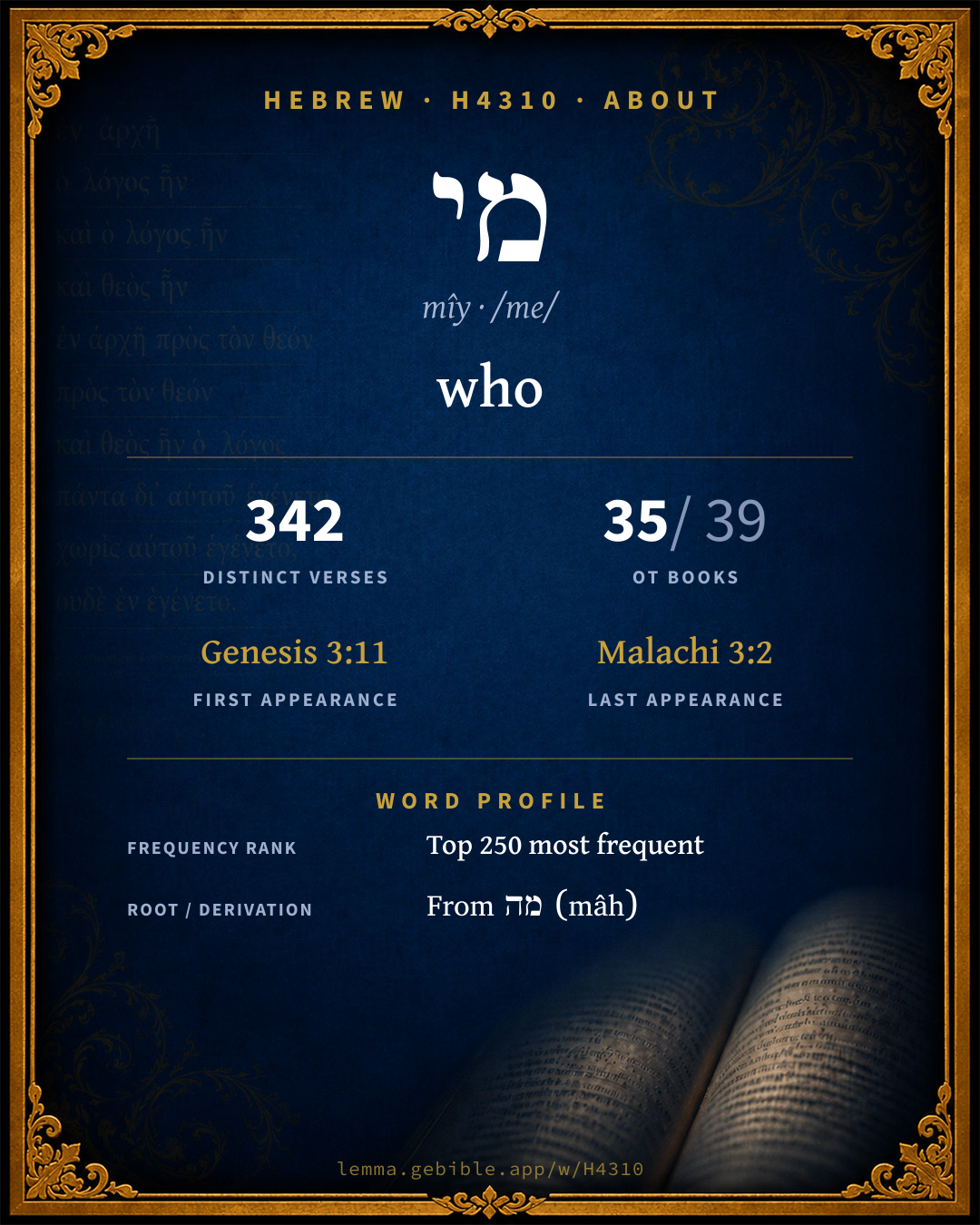
מִי
who
Full lexicon entry — Brown-Driver-Briggs (BDB)
From Brown-Driver-Briggs (BDB)
Where this word appears
Grammar key — what these labels mean
Part of speech
- Particle
- A short function word — article, negation, interrogative, the sign of the direct object, and the like.
Every verse where H4310 appears in the Book of Jonah — 3 distinct verses. Click any verse to open its interlinear word-by-word view. Verse text shown in the World English Bible for context — . Each verse’s Hebrew form is shown with its reference; the English is not keyword-highlighted, since the data carries no word-level English alignment. Use “Compare translations” on any verse to read it across multiple English versions. This concordance covers the Hebrew Bible; Septuagint (Greek Old Testament) occurrences are not indexed here.
Jonah
- Jonah 1:7 בְּ/שֶׁ/לְּ/מִ֛י prep + ptcl rel + prep + ptcl inter They all said to each other, "Come, let us cast lots, that we may know for whose cause this evil is on us." So they cast lots, and the lot fell on Jonah.
- Jonah 1:8 לְ/מִי prep + ptcl inter Then they asked him, "Tell us, please, for whose cause this evil is on us. What is your occupation? Where do you come from? What is your country? Of what people are you?"
- Jonah 3:9 מִֽי ptcl inter Who knows whether God will not turn and repent, and turn away from his fierce anger, so that we might not perish?"
About this entry
At a glance — auto-summarized from this page’s data, not written by a person. Every figure links to its source below. This summary describes the numbers; it doesn’t interpret them.
“who” is the headline sense of the Hebrew word מי (mîy). Scripture first uses it in Genesis 3:11. It appears 342 verses across 35 books of the Hebrew Bible, among its common vocabulary. It shares a root with מה, מא and מדוע. See the sense tree, 342-verse concordance, and the renderings breakdown below.
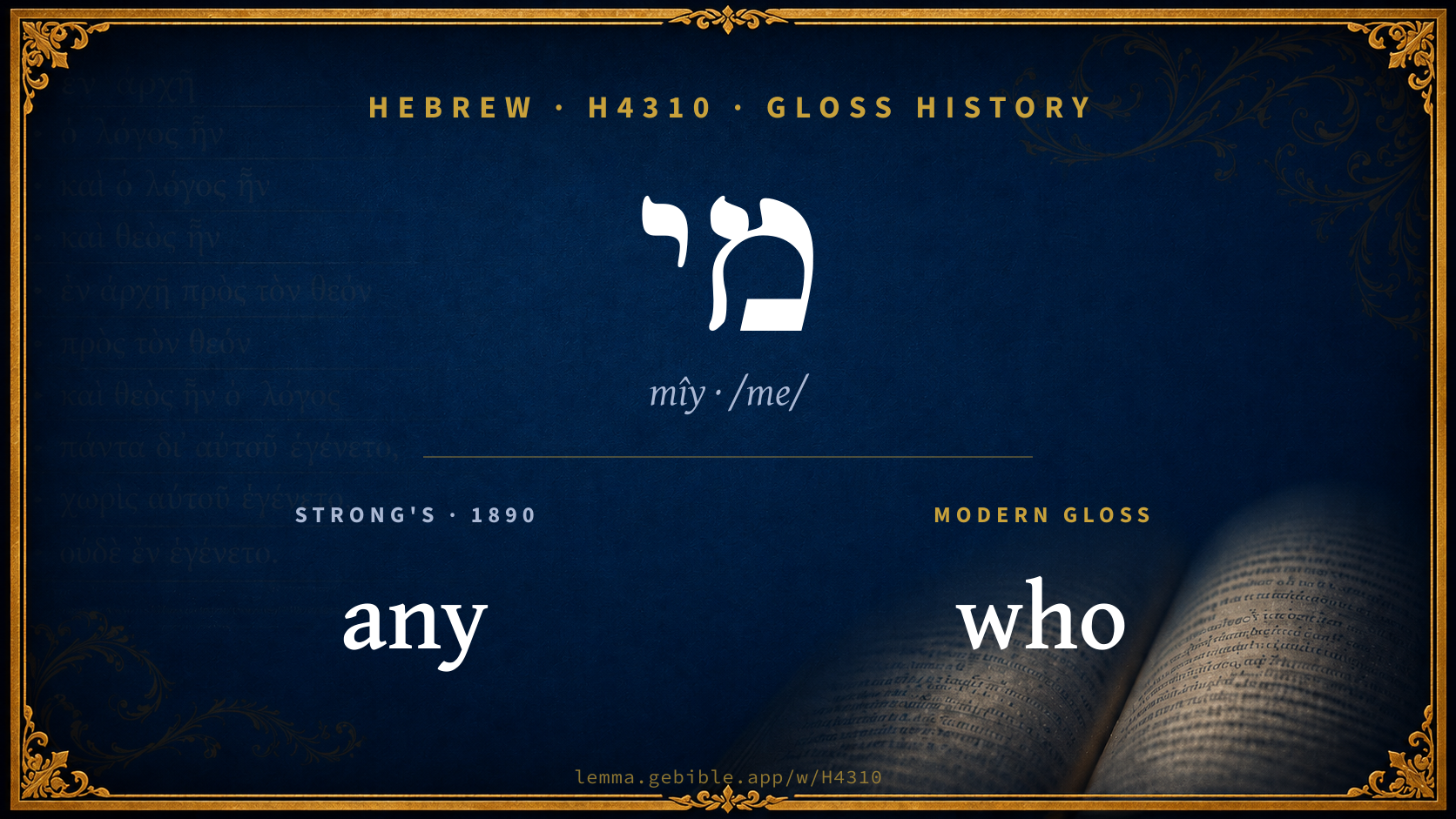
Gloss history
Strong's 1890 vs modern scholarship
About this word
Strong's H4310 catalogs a Hebrew word from the Hebrew Old Testament.
These counts are not copied from any lexicon or concordance. They are computed here, from the morphology-tagged Hebrew Old Testament. What Lemma adds →
- 342
- distinct verses
- The word appears in 342 distinct verses.
- 35 / 39
- OT books
- The word appears in 35 of 39 Old Testament books.
- #116
- by frequency
- Top 250 most frequent Hebrew words (rank 116 of 8,640 Hebrew words by occurrence).
View all 342 occurrences in the concordance →
By section of the Old Testament
By traditional corpus
Conventional, traditional groupings — biblical authorship is debated, so this is a traditional corpus grouping, not an authorship claim. Each share is this word’s portion of its verses in that division of the Hebrew canon. Each figure is a share of the word’s 342 distinct verses.
- Prophets (Nevi'im) 157 verses · 46%
- Writings (Ketuvim) 135 verses · 39%
- Torah (Pentateuch) 50 verses · 15%
How translations render this word
Counts come from each version’s own published word-to-Strong’s tagging or interlinear alignment — an approximate guide to how each version renders this word, not a word-level alignment the data otherwise carries. Because each total is that version’s own tagged count, the per-version totals vary from one another and need not match the appearance or distinct-verse counts above. These counts may also differ from a printed concordance because Lemma counts each distinctly tagged rendering and does not collapse phrase taggings into a single head-word total. This is a fixed set of word-tagged versions (KJV, ASV, BSB, ULT) and does not change with the reading translation you choose elsewhere. Each version’s license is shown beside its name below (and on Sources).
- King James Version: An 1×, Any 1×, Are with you if any 1×
- American Standard Version: Who 2×
- Berean Standard Bible: Who 272×, Whom 40×, What 17×
- unfoldingWord Literal Text: Who 297×, Whom 53×, Whoever 12×
King James Version Public Domain
Renders H4310 across 12 tagged occurrences — most commonly:
American Standard Version Public Domain
Renders H4310 across 12 tagged occurrences — most commonly:
Plus 10 renderings that appear only once — usually multi-word phrases or single function words the recovered tagging swept in, not distinct renderings.
Berean Standard Bible Public Domain
Renders H4310 across 417 tagged occurrences — most commonly:
Plus other, less common renderings. Plus 24 renderings that appear only once — usually multi-word phrases or single function words the recovered tagging swept in, not distinct renderings. Not rendered by a distinct English word in 8 further occurrences.
unfoldingWord Literal Text CC BY-SA 4.0
Renders H4310 across 420 tagged occurrences — most commonly:
Plus other, less common renderings. Plus 15 renderings that appear only once — usually multi-word phrases or single function words the recovered tagging swept in, not distinct renderings.
8 senses and sub-senses in the full BDB
What do BDB’s symbols mean?
BDB uses these scholarly abbreviations:
| Symbol | Meaning |
|---|---|
| 𝔊 | the Septuagint (the ancient Greek translation, LXX) |
| 𝔙 | the Vulgate (the Latin translation) |
| 𝔖 | the Syriac version (the Peshitta) |
| 𝔗 | the Targum (the Aramaic translation) |
| ψ | the Psalms |
| √ | root (the underlying root or stem) |
| ‖ | parallel passage (a synonymous or contrasted parallel) |
| † | the dagger: every passage where the word occurs is cited |
The 8 senses and sub-senses the full Brown-Driver-Briggs lexicon distinguishes for this word, in lexicon order (not ranked by frequency), with BDB’s own verbatim wording and sub-sense lettering. Shown in Hebrew script with BDB’s own scholarly abbreviations. The condensed entry is in the Lexicon Entry tab. See also the Forms in the corpus table below.
- a. מִי is rarely used of things, and usually where persons are understood or implied: Gn 33:8 מי לך כל־המחנה הזה who (or what) to thee is all this camp? Dt 4:7 Ju 9:28 מִי שְׁכֶם who is Shechem (i.e. the Shechemites)? Mi 1:5 מִי־פֶשַׁע יַעֲקֹב הֲלֹא שֹׁמְרוֹן, v b Ct 3:6 Ju 13:17 מִי שְׁמֶ֑ךָ (but מה Gn 32:28 Ex 3:13: with מי cf. מַן in Aramaic Ezr 5:4 Gn Ex. ll. cc. 𝔗; and see NöM. p. 341). On 1 S 18:18, v. II. חַי. e.g. Genesis 33:8
- b. in the gen., בַּת־מִי אַתְּ whose daughter art thou? Gn 24:23, 47 1 S 12:3(×3); 17:55 Je 44:28 Jb 26:4; 33:28; after various preps., as אַחֲרֵי מִי 1 S 24:15(×2); אֶל־מִי 1 S 6:20 2 K 9:5 +; בְּמִי by whom? †1 K 20:14, לְמִי20 to whom? whose? Gn 32:18 לְמִי אַתָּה, 38:25 Pr 20:29 (6 times) +; מִמִּי †Ez 32:19 ψ 27:1(×2); עַל־מִי 2 K 18:20; 19:22 Is 57:4 +; אֶת־מִי (so always in acc.), 1 S 12:3(×2); 28:11 Is 6:8; = with whom? Jb 12:3. e.g. Genesis 24:23
- c. in an indirect qu., as Gn 21:26; 43:22 לא ידענו מי שׂם we do not know who put, etc., Dt 21:1 ψ 39:7 Jos 24:15 בַּחֲרוּ … אֶת־מִי תַעֲבֹד֑וּן choose whom ye will serve, after ראה 1 S 14:17, שׁאל 17:56, הגיד 1 K 1:20, הודיע v 27. e.g. Genesis 21:26
- d. מי ב׳ who among …? 1 S 22:14 Is 36:20; 43:9; 48:14 (בהם); 42:23; 50:10 Hg 2:3 (all בכם); מי מן who of …? Ju 21:8 2 K 6:11 Is 50:1. e.g. 1 Samuel 22:14
- e. strengthened and emph. forms of interrog.: (a) מי זה (v. זה 4 b), מי הוא (v. הוא 4 b β), מי הוא זה †ψ 24:10 Je 30:21 Est 7:5 (v. ibid.); (b) מִי אֶחָד what single one …? Ju 21:8, cf. 2 S 7:23 (= 1 Ch 17:21). e.g. Psalms 24:10
- f. various rhetorical uses (often repeated in ‖ cl., as ψ 15:1; 18:32 Is 28:9; 29:15):—(a) sq. impf. it expresses a wish (the question implying a desire that the person asked for were present), 2 S 15:4 מִי יְשִׂמֵנִי שֹׁפֵט who will set me judge? i.e. would that some one would make me judge! 23:15 מִי יַשְׁקֵנִי מַיִם = O that one would give me to drink, etc.! cf. Nu 11:4, 18 Mal 1:10 ψ 4:7; 60:11; 94:16 Is 42:23, and very often in the phr. מִי יִתֵּן who will give? i.e. would that there were …! as Nu 11:29 ומי יתן כל עם י׳ נביאים = and would that all י׳’s people were prophets! Dt 28:67 מי יתן ערב = would it were even! Ju 9:29 + (v. נָתַן). (b) it expresses contempt (who? implying the answer no one at all), Ex 5:2 מי י׳ אשׁר אשׁמע בקולו who is י׳ that I should listen to his voice? Ju 9:28 מִי אֲבִימֶלֶךְ וּמִי שְׁכֶם כִּי נַעַבְדֶנּוּ, v 38 1 S 17:26 who is this Phil. that he should have reproached, etc.? 25:10 מי דוד ומי בן ישׁי, Is 28:9 Jb 26:4 Pr 30:9 מי י׳; or modesty (real or assumed), Ex 3:11 מִי אָנֹכִי כִּי אֵלֵךְ אֶל־פַּרְעֹה, 1 S 18:18 מי אנכי ומי חיי who am I, and who is my clan (חַיִּי), that I should be the king’s son-in-law? 2 S 7:18 1 Ch 29:14 2 Ch 2:5; or surprise, Is 44:10; 49:21. (c) in impassioned prose, and especially in poetry, implying the answer few or none, it is equiv. to a rhetorical negative, Dt 9:2 מִי יִתְיַצֵּב לִפְנֵי בְנֵי עֲנָק who can stand, etc.? 30:12 מִי יַעֲלֶה־לָּנוּ הַשָּׁמַיְמָה, v 13 1 S 4:8 מִי יַצִּילֵנוּ וגי, 6:20; 22:14; 26:9, 15 2 S 16:10; מי יאמר who shall (or can) say? Jb 9:12 Pr 20:9 Ec 8:4; with the perfect (of experience), who has ever …? Nu 23:10 Dt 5:23 Is 36:20; 66:8(×2) Je 18:13 מִי שָׁמַע כָּאֵלֶּה, 23:18 (MT), 30:21 Jb 4:7; 9:4 מִי הִקְשָׁה אֵלָיו וַיִּשְׁלָ֑ם, 41:3 Pr 30:4 La 3:37; poet., very often, as Gn 49:9 וּכְלָבִיא מִי יְקִימֶנּוּ who can rouse him up? (i.e. no one), Ex 15:11(×2) מִי כָמוֹךָ (so ψ 35:10 al.), Nu 24:9, 23 1 S 2:25 מי יתפלל לו who shall intercede for him? (i.e. no one), Is 1:12; 10:3; 40:13, 14, 18; 41:26; 42:19; 43:9; 48:14; 50:1; 53:1 מִי הֶאֱמִין לִשְׁמֻעָתֵנוּ (i.e. few or none), etc.; ψ 18:32 מִי אֱלוֹהַּ מִבַּלְעֲדֵי י׳, 76:8; 89:7; 130:3 Jb 21:31; 34:29 Je 17:9 Jo 2:11 Mal 3:2; מִי לֹא … Am 3:8 Je 10:7 Jb 12:9 (cf. 25:3 Na 3:19); (יְשִׁיבֶנָּה) מִי יְשִׁיבֶנּוּ who shall (can) turn it back? †Jb 9:12; 11:10; 23:13 Is 14:27; 43:13 Je 2:24; implying the answer, no one but God, Is 40:12; 41:2 Jb 38:5, 6, 25, etc.; defiantly, Is 50:9 מִי הוּא יַרְשִׁיעֵנִי, Je 21:13; 49:4 מִי יָבוֹא אֵלַי, v 19 Ob 3 ψ 12:5 מִי אָדוֹן לָנוּ, 59:8; 64:6 Jb 9:19 וְאִם לְמִשְׁפָּט מִי יוֹעִידֵנִי, 13:19 מִי הוּא יָרִיב עִמָּדִי who is he that will contend with me? 17:3; 41:2. Notice in examples of this kind the freq. order of words: Pr 20:6 ואישׁ אמוּנים מי ימצא, 24:22 ופיד שׁניהם מי יודע, 31:10 Na 1:6 לפני זעמו מי יעמד, ψ 147:17 לפני קֹרָתוֹ מי יעמד, Jb 4:2 וַעְצֹר בְּמִלִּין מִי יוּכ֑ל, Jb 26:14; 38:37; 39:5; 41:5, 6 ψ 6:6 בִּשְׁאוֹל מִי יוֹדֶה־לָּ֑ךְ, 19:13; and with the nom. pendens, Je 24 תַּאֲנָתָהּ מִי יְשִׁיבֶנָּה, Pr 18:14 Jb 17:15 וְתִקְוָתִי מִי יְשׁוּרֶנָּה, 38:29 וּכְפֹר שָׁמַיִם מִי יְלָדוֹ, (d) מִי יוֹדֵעַ who knoweth? (ψ 90:11 Pr 24:22), sq. a verbal clause, becomes (cf. nescio an) = it may be, perchance, †2 S 12:22 מִי יוֹדֵעַ יְחָנֵּנִי י׳ (Qr וְחַנַּנִי), Jo 2:14 (= Jon 3:9) מי יודע ישׁוב ונחם, Est 4:14 מי יודע אם. (e) especially in poetry, a question with מי, to which the answer follows, in an effective mode of affirming a fact, or introducing a description: ψ 15:1, 1 (see v 2–5), 24:3, 8, 10 Is 23:8 מי יעץ זאת וג׳ (v 9 the answ., י׳ צ׳ יְעָצָהּ), 33:14 (see v 15f.), 37:23; 41:2, 4; 60:8; 63:1 Je 46:7 Ct 3:6, cf. 6:10; 8:3; answered by הֲלֹא Ex 4:11 Is 42:24; 45:21 Mi 1:5(×2). e.g. Psalms 15:1
- g. מִי may sometimes be rendered whosoever, though, as the examples will shew, it does not really mean it: Ex 24:14 מי בעל דברים יִגַּשׁ אליהם, lit. Who hath a cause? let him draw nigh unto them, i.e. whoso hath a cause, let him, etc., Is 50:8b מִי בַעַל מִשְׁפָּטִי יִגַּשׁ אֵלַי, 54:15 Ju 7:3 מִי יָרֵא וְחָרֵד יָשֹׁב וג׳ who is fearful and trembling? let him return, Pr 9:4, 16 מִי־פֶ֖תִי יָסֻר הֵנָּה, Ezr 1:3 (cf. with וְ in apod. Je 9:11 Ho 14:10 ψ 107:43; Zc 4:10 is dubious, on account of anom. tense and construct.); so with מי האישׁ אשׁר … Dt 20:5, 6, 7 Ju 10:18, cf. ψ 25:12. With 1 ps. in apod., Ex 32:33 מִי אֲשֶׁר חָטָא לִי אֶמְחֶנּוּ מִסִּפְרִי, Je 49:19 (= 50:44) וּמִי בָחוּר אֵלֶיהָ אֶפְקֹד and who is chosen? I will appoint him over her! Is 50:8a; with an imv. in the apod. Ex 32:24 (against accents; v. Ra) למי זהב התפרקו who hath gold? break it off you! Gn 19:12 1 S 11:12, cf. ψ 34:13f.; without a verb, Ex 32:26 מי לי׳ אלי who is on J.’s side? (let him come) to me! so 2 S 20:11 (מי אשׁר); Ec 5:9; 9:4 (מי אשׁר). e.g. Exodus 24:14
- h. once, following a verb (cf. מָה 3), any one, 2 S 18:12 שִׁמְרוּ־מִי בַּנַּעַר באבשׁלום Have a care, whosoever ye be, of, etc. (𝔊 𝔖 𝔙 Bu לִי; cf. v 5). e.g. 2 Samuel 18:12
Senses from the full Brown-Driver-Briggs lexicon (Brown, Driver, Briggs; Oxford 1906 — public domain), digitized via Sefaria, supplemented by the OpenScriptures HebrewLexicon (CC BY 4.0). Full attribution on Sources.
Word origin
pron. interrog. who? of persons, as מָה (q.v.) of things (Ethiopic ሚ but only = What? and How? Assyrian mî, me (rare) JägerBAS. ii. 277, the usually Sem. form for Who? has n, viz. Assyrian mannu, manu (DlHWB 419), Ethiopic መኑ man(n)ū, Aramaic ܡܰܢ, Arabic مَنْ, vulg.-Arabic min, mīn, from a form resembling which, by rejection of n, prob. Heb. מִי: WSG 123 f.):—who? (τίς; quis?) Gn 3:11 מִי הִגִּיד לְךָ who told thee? 24:65 מִי הָאִישׁ הַלָּזֶה who is this man? 27:18 מי אתה בני who art thou, my son? Nu 22:9 Ju 1:1; 6:29; 15:6; 18:3; 20:18; 2 S 1:8 + often; Ru 3:9 מִי אָ֑תְּ who art thou (fem.)? Is 51:12; of more than one, מִי אֵלֶּה who are these? Gn 33:5; 48:8 Is 60:8; מי אתם 2 K 10:13; once, more explicitly, מִי וָמִי הַהֹלְכִים Ex 10:8; = as who? (i.e. in what condition, or capacity), Am 7:2 מי יקום יעקב, v 5 Is 51:19 מִי אֲנַחֲמֵךְ (but Vrss Che Lag Brd Du מִי יְ׳, as ‖ מִי יָנוּד), Ru 3:16 (Be Ke Köiii. 388). Note in partic.:
— Brown-Driver-Briggs (Oxford 1906, public domain), digitized via Sefaria, supplemented by the OpenScriptures HebrewLexicon (CC BY 4.0). See Sources.
Derived from מה (mâh) (H4100) — what.
Jastrow Dictionary
A second Hebrew/Aramaic lexicon for comparison, covering Aramaic and post-biblical (Talmudic, Targumic, Midrashic) usage that the biblical-Hebrew BDB does not. Matched by lemma rather than by Strong’s number, so a lemma may carry more than one Jastrow headword (shown separately below), and the entries cover usage well beyond the Bible.
מִי I
- , מִי־, מֵי־ from, of; because, v. מִ־.
מִי II
- (b. h.)
- 1. who?; which?; he who. M. Kat. 16ᵇ ראה מי קורא וכ׳ Ms. M. (ed. omit ראה) see who calls thee outside. Keth. 64ᵇ מי שוכר את מי which hires which?, i.e. which (of the two) hires and which is hired? B. Bath. IX, 1 מי שמת וכ׳ he who (if one) died and left &c. Ib. VI, 7 מי שהיתה דרך וכ׳ he through whose field there is a public passage. Ib. 6 מי שיש לו גינה וכ׳ he who has a garden &c.; a. v. fr.—(Chald.) Ab. Zar. 41ᵇ מי יימר דבטליה Ms. M. (ed. דבטלה) who can say (how do we know) that he cancelled it?
- 2. [who will?,] Oh that! Sot. V, 2, a. e. מי יגלה וכ׳, v. גָּלָה. Pes. 49ᵇ מי יתן לי ת"ח וכ׳ Oh that I had a scholar before me, and I would &c.; a. fr.
- 3. [is there any?; in gen. introducing a question:] is there?, does he? &c. Sabb. 31ᵃ מי כאן הלל does Hillel live here? Ḥull. 33ᵃ מי איכא מידי וכ׳ is there anything which is permitted &c. Ber. 34ᵃ top, v. חַבְרוּתָא. Ḥull. 32ᵇ מהו מי מצטרף וכ׳ how is it? can the first cut be combined with the second to effect &c.? Naz. 32ᵇ אילו … מי הוה נדריתון if one had come … would you have vowed? Ib. מי יודעין לאימתי did they know when? Ib. מי ידעין בהי וכ׳ did they know on what day?—Pes. 14ᵇ, a. fr. מי דמי (sub. הא להא) is there an analogy between the two cases?; v. דְּמֵי I; a. v. fr.
מַי
- what?; v. מַאי.
מַי ²
- water, v. מַיִם.
A Dictionary of the Targumim, the Talmud Babli and Yerushalmi, and the Midrashic Literature (Marcus Jastrow; London, Luzac, 1903) — Public Domain. Digitized via Sefaria. Digitized via Sefaria. Full attribution on Sources.
Forms in the corpus
The 49 distinct written forms H4310 takes in the Hebrew Bible, most frequent first — each parse links to that state’s occurrences in the concordance. Hebrew forms include their vowel points and cantillation, so a single lemma takes many written forms.
| Form | Parsing | Example | Uses |
|---|---|---|---|
| מִֽי | Particle, Interrogative | Deuteronomy 5:29 | 75 |
| מִ֣י | Particle, Interrogative | Amos 3:8 | 71 |
| מִ֥י | Particle, Interrogative | Amos 7:2 | 42 |
| מִ֤י | Particle, Interrogative | Ecclesiastes 3:22 | 41 |
| מִי | Particle, Interrogative | Deuteronomy 3:24 | 40 |
| מִ֖י | Particle, Interrogative | Amos 3:8 | 23 |
| וּ/מִ֥י | Particle, Interrogative | Ecclesiastes 2:25 | 21 |
| וּ/מִ֣י | Particle, Interrogative | Ecclesiastes 2:19 | 19 |
| מִ֚י | Particle, Interrogative | Ecclesiastes 8:1 | 9 |
| וּ/מִֽי | Particle, Interrogative | Deuteronomy 20:6 | 8 |
| וּ/מִ֤י | Particle, Interrogative | 1 Samuel 22:14 | 6 |
| מִ֗י | Particle, Interrogative | 1 Kings 1:20 | 6 |
| מִ֨י | Particle, Interrogative | Ezekiel 31:18 | 5 |
| מִ֭י | Particle, Interrogative | Job 12:9 | 5 |
| מִי֙ | Particle, Interrogative | Ecclesiastes 9:4 | 5 |
| וּ/מִי֙ | Particle, Interrogative | Deuteronomy 4:8 | 4 |
| לְ/מִי | Particle, Interrogative | Genesis 32:17 | 3 |
| מִ֛י | Particle, Interrogative | Isaiah 57:4 | 3 |
| וּ/מִ֨י | Particle, Interrogative | Judges 9:29 | 2 |
| וּ/מִי | Particle, Interrogative | Jeremiah 49:19 | 2 |
| לְ/מִ֖י | Particle, Interrogative | Lamentations 2:20 | 2 |
| לְ/מִ֞י | Particle, Interrogative | Esther 6:6 | 2 |
| לְ/מִ֥י | Particle, Interrogative | Isaiah 46:5 | 2 |
| מִ֠י | Particle, Interrogative | 2 Chronicles 32:14 | 2 |
| בְּ/מִ֔י | Particle, Interrogative | 1 Kings 20:14 | 1 |
| בְּ/שֶׁ/לְּ/מִ֛י | Particle, Interrogative | Jonah 1:7 | 1 |
| וָ/מִ֖י | Particle, Interrogative | Exodus 10:8 | 1 |
| וּ/לְ/מִ֖י | Particle, Interrogative | Genesis 32:17 | 1 |
| וּ/לְ/מִ֣י | Particle, Interrogative | Ecclesiastes 4:8 | 1 |
| וּ/לְ/מִי֙ | Particle, Interrogative | 1 Samuel 9:20 | 1 |
| וּ/מִ֖י | Particle, Interrogative | Jeremiah 15:5 | 1 |
| וּֽ/מִ֥י | Particle, Interrogative | Isaiah 14:27 | 1 |
| לְ/מִ֣י | Particle, Interrogative | Exodus 32:24 | 1 |
| לְ/מִ֤י | Particle, Interrogative | Proverbs 23:29 | 1 |
| לְ/מִ֨י | Particle, Interrogative | Proverbs 23:29 | 1 |
| לְ/מִ֪י | Particle, Interrogative | Proverbs 23:29 | 1 |
| לְ/מִי֙ | Particle, Interrogative | 2 Samuel 16:19 | 1 |
| לְ֝/מִ֗י | Particle, Interrogative | Proverbs 23:29 | 1 |
| לְ֭/מִי | Particle, Interrogative | Proverbs 23:29 | 1 |
| לְֽ/מִי | Particle, Interrogative | 1 Samuel 30:13 | 1 |
| מִ/מִּ֖י | Particle, Interrogative | Ezekiel 32:19 | 1 |
| מִ/מִּ֣י | Particle, Interrogative | Psalms 27:1 | 1 |
| מִ/מִּ֥י | Particle, Interrogative | Psalms 27:1 | 1 |
| מִ֑י | Particle, Interrogative | 2 Kings 9:32 | 1 |
| מִ֕י | Particle, Interrogative | 2 Samuel 18:12 | 1 |
| מִ֝֗י | Particle, Interrogative | Job 25:3 | 1 |
| מִ֝י | Particle, Interrogative | Job 26:4 | 1 |
| מִ֞י | Particle, Interrogative | Isaiah 57:11 | 1 |
| מִי֩ | Particle, Interrogative | 2 Samuel 20:11 | 1 |
Same root — word family
Other BDB entries built from the same root as H4310, grouped by Strong’s listed origin. These share a root / origin per the lexicon — not necessarily a shared meaning. Each links to that word’s own entry.
Derives from
Shares the same root
- מא mâʼ H3964 what
- מדוע maddûwaʻ H4069 why
- מדי madday H4078 what is enough, sufficiency, enough
- מה mâh H4101 whatever
- מהה mâhahh H4102 to delay
- מן mân H4478 manna
- מתלאה mattᵉlâʼâh H4972 weariness
Proper names from this root
People and places named from this root — a name, not an additional meaning of the word.
- מכנדבי Maknadbay H4367 Machnadebai
- מיכאל Mîykâʼêl H4317 Michael
- מיכיה Mîykâyâh H4320 Micah
- מישאל Mîyshâʼêl H4332 Mishael
Compare all same-root words → Showing 4 of 13 — not the complete family. 4 of the same-root words are proper names (people or places). They share a root, not necessarily a meaning.
Septuagint verse parallels
This word appears in 325 verses that also exist in the Greek Old Testament (Septuagint), out of the 342 Hebrew verses it occurs in. You can read those verses in Greek by switching the Old Testament edition to the Septuagint.
Read these verses in the Septuagint
- Genesis 3:11
- Exodus 2:14
- Numbers 11:4
- Deuteronomy 3:24
- Joshua 9:8
- Judges 1:1
- Ruth 2:5
- 1 Samuel 2:25
- 2 Samuel 1:8
- 1 Kings 1:20
- 2 Kings 6:11
- 1 Chronicles 11:17
This is a verse-level parallel only — the same verses exist in both the Hebrew and Greek Old Testaments. No word-level Hebrew↔Greek correspondence is claimed: the data carries no such alignment, so no Greek word is shown as this Hebrew word’s translation. Coverage is not total — the Septuagint omits the deuterocanon and renumbers the Psalms, so some Hebrew verses have no direct Greek parallel.