
Isaiah 57:11

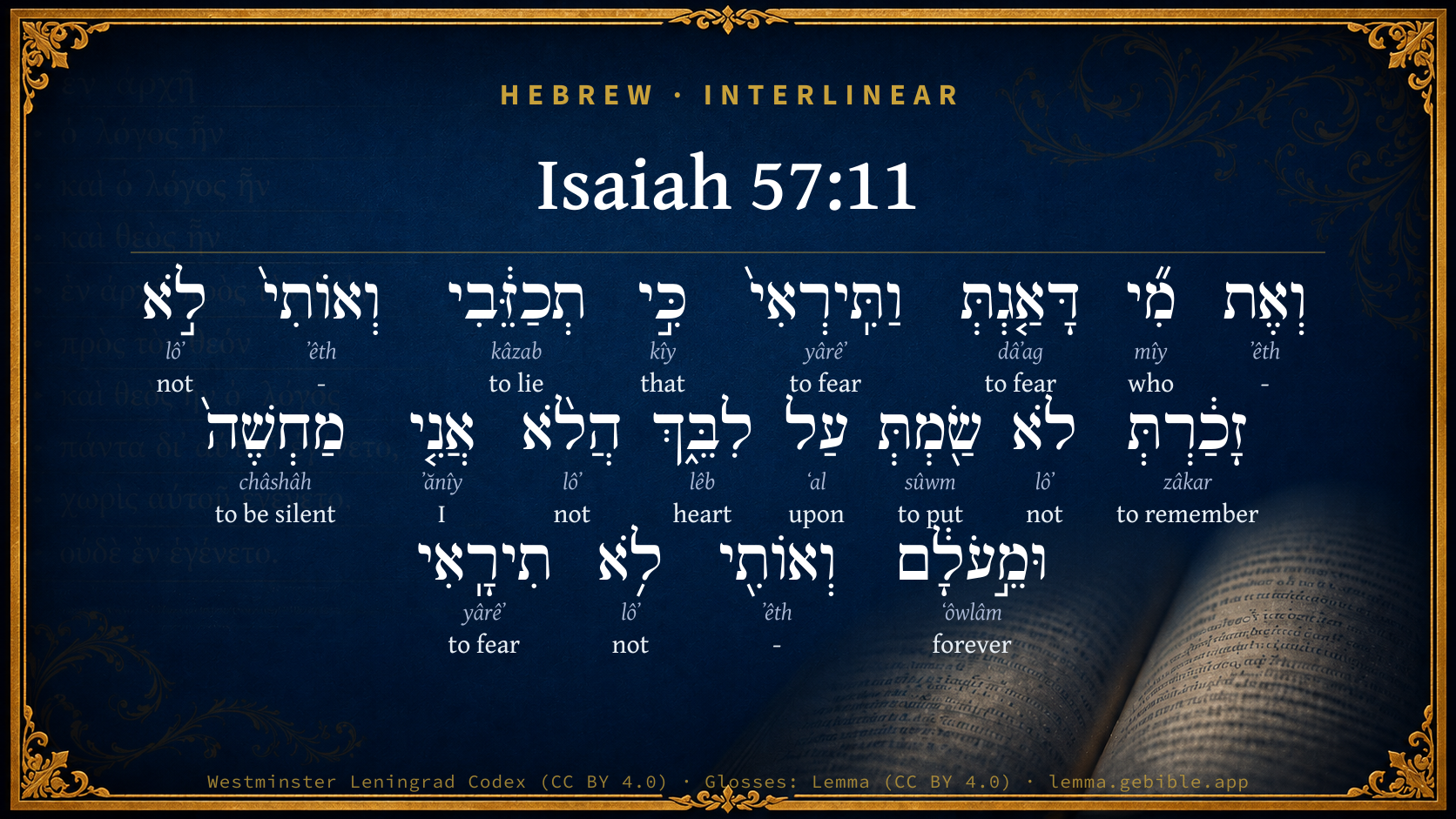
Hebrew (Westminster Leningrad Codex) Isaiah 57:11 appears in the Hebrew Old Testament. The text above is from the Westminster Leningrad Codex. Each word links to its Strong’s number, a concise gloss, and parsing drawn from the Open Scriptures Hebrew Bible morphology. Click any word for its full Brown-Driver-Briggs (BDB) entry.
Download image
Cite this verse

Isaiah 57:11 (World English Bible). Public Domain. Lemma interlinear Bible study tool, https://lemma.gebible.app/v/isaiah/57/11.

Show BibTeX & RIS
BibTeX
RIS
English Translation
Of whom have you been afraid and in fear, that you lie, and have not remembered me, nor laid it to your heart? Haven't I held my peace even of long time, and you don't fear me?
World English Bible · Public Domain
Download a study sheet

One document with this verse’s original text, its word-by-word gloss line, the meaning frame, cross-references with their text, attributed commentary, and full source and license credits — printable, and it pastes into notes with its structure intact.

This verse Autodidact and up

Study sheet (.html) Plain text (.txt)

A passage Seminary Student

Up to 50 verses in one chapter. A passage sheet keeps up to 6 commentary sources and 12 cross-references per verse, in the order this page ranks them, and says so on the sheet whenever that leaves anything out. Ask for a single verse and you get the Autodidact verse sheet above.

Everything on this page stays free to read, with no account — the sheet is a download of what is already on screen, not access to it.

Want to remove ads? Support Godless Engineer
Compare translations 3

The same verse in 3 English versions, stacked beneath the original-language interlinear above. Click any original word for its lexicon entry.

Each is an independent rendering of the whole verse — the interlinear is not word-aligned to these translations.

Highlighted words mark where these versions differ — a whole-verse word diff, not a word-by-word alignment.

  • World English Bible Public Domain
    Of whom have you been afraid and in fear, that you lie, and have not remembered me, nor laid it to your heart? Haven't I held my peace even of long time, and you don't fear me?
  • King James Version Public Domain
    And of whom hast thou been afraid or feared, that thou hast lied, and hast not remembered me, nor laid it to thy heart? have not I held my peace even of old, and thou fearest me not?
  • unfoldingWord Literal Text CC BY-SA 4.0
    And whom do you dread and fear, that you lie and do not remember me, you do not set to your heart? not me being silent even from eternity that you do not fear me?

unfoldingWord Literal Text — © unfoldingWord, licensed CC BY-SA 4.0. Word-aligned USFM3 via Door43 (git.door43.org/unfoldingWord/en_ult).

Versions to compare (up to 4)

3 of 4 selected

Show all 18 translations

Every available English version of this verse, each an independent rendering of the whole verse.

  • World English Bible Public Domain
    Of whom have you been afraid and in fear, that you lie, and have not remembered me, nor laid it to your heart? Haven't I held my peace even of long time, and you don't fear me?
  • Berean Standard Bible Public Domain
    Whom have you dreaded and feared, so that you lied and failed to remember Me or take this to heart? Is it not because I have long been silent that you do not fear Me?
  • Majority Standard Bible Public Domain
    Whom have you dreaded and feared, so that you lied and failed to remember Me or take this to heart? Is it not because I have long been silent that you do not fear Me?
  • King James Version Public Domain
    And of whom hast thou been afraid or feared, that thou hast lied, and hast not remembered me, nor laid it to thy heart? have not I held my peace even of old, and thou fearest me not?
  • American Standard Version (1901) Public Domain
    And of whom hast thou been afraid and in fear, that thou liest, and hast not remembered me, nor laid it to thy heart? have not I held my peace even of long time, and thou fearest me not?
  • Revised Version (1885) Public Domain
    And of whom hast thou been afraid and in fear, that thou liest, and hast not remembered me, nor laid it to thy heart? have not I held my peace even of long time, and fearest me not?
  • Geneva Bible (1599) Public Domain
    And whome diddest thou reuerence or feare, seeing thou hast lyed vnto me, and hast not remembred me, neither set thy minde thereon? is it not because I holde my peace, and that of long time? therefore thou fearest not me.
  • Douay-Rheims (1899) Public Domain
    For whom hast thou been solicitous and afraid, that thou hast lied, and hast not been mindful of me, nor thought on me in thy heart? for I am silent, and as one that seeth not, and thou hast forgotten me.
  • Young's Literal Translation Public Domain
    And of whom hast thou been afraid, and fearest, That thou liest, and Me hast not remembered? Thou hast not laid `it' to thy heart, Am not I silent, even from of old? And Me thou fearest not?
  • Literal Standard Version CC BY-SA 4.0
    And of whom have you been afraid, and fear, || That you lie, and have not remembered Me? You have not laid [it] to your heart, || Am I not silent, even from of old? And you do not fear Me?
  • Unlocked Literal Bible CC BY-SA 4.0
    “Whom are you worried about? Whom do you fear so much that has caused you to act so deceitfully, so much that you would not remember me or think about me? Because I was silent for so long, you are no longer afraid of me.
  • unfoldingWord Literal Text CC BY-SA 4.0
    And whom do you dread and fear, that you lie and do not remember me, you do not set to your heart? not me being silent even from eternity that you do not fear me?
  • Darby Bible Public Domain
    And of whom hast thou been afraid or feared, that thou hast lied, and hast not remembered me, nor taken it to heart? Have not I even of long time held my peace, and thou fearest me not?
  • World Messianic Bible Public Domain
    “Whom have you dreaded and feared, so that you lie, and have not remembered me, nor laid it to your heart? Haven’t I held my peace for a long time, and you don’t fear me?
  • Webster's Bible Public Domain
    And of whom hast thou been afraid or feared, that thou hast lied, and hast not remembered me, nor laid it to thy heart? have not I held my peace even of old, and thou fearest me not?
  • Free Bible Version CC BY-SA 4.0
    Who were you scared of, who frightened you so much that you lied to me, didn't remember me, didn't even think about me? Is it because I've been quiet for so long that you don't even fear me?
  • Bible in Basic English Public Domain
    And of whom were you in fear, so that you were false, and did not keep me in mind, or give thought to it? Have I not been quiet, keeping myself secret, and so you were not in fear of me?
  • JPS Tanakh (1917) Public Domain
    And of whom hast thou been afraid and in fear, that thou wouldest fail? And as for Me, thou hast not remembered Me, nor laid it to thy heart. Have not I held My peace even of long time? Therefore thou fearest Me not.

Literal Standard Version (2020), Covenant Press — licensed CC BY-SA 4.0. Text via the HelloAO Bible API (eBible.org). Unlocked Literal Bible (unfoldingWord) — licensed CC BY-SA 4.0. Text via the HelloAO Bible API (eBible.org). unfoldingWord Literal Text — © unfoldingWord, licensed CC BY-SA 4.0. Word-aligned USFM3 via Door43 (git.door43.org/unfoldingWord/en_ult). Free Bible Version, Dr. Jonathan Gallagher — licensed CC BY-SA 4.0. Text via the HelloAO Bible API (eBible.org).

Word by word

More ways to search: Search by grammar → Find every occurrence → Compare this word →

Practice this passage: Drill this verse → Learn its vocabulary →

דָּאַ֤גְתְּ
dâʼag
H1672
“to fear”
Verb, Qal, Perfect, 2nd Person, Feminine, Singular
Part of Speech
Verb
Stem
Qal
Form
Perfect
Person
2nd Person
Gender
Feminine
Number
Singular
Full BDB Definition

Origin: a primitive root

TWOT: 393

to fear, be anxious, be concerned, be afraid, be careful - (Qal) - to be anxious, be concerned - to fear, dread
  1. וְאֶת ʼêth H853 “and · -” Conjunction + Particle, Direct Object
  2. מִ֞י mîy H4310 “who” Particle, Interrogative
  3. וַתִּֽירְאִי֙ yârêʼ H3372 “and · to fear” Conjunction + Verb, Qal, Sequential Imperfect, 2nd Person, Feminine, Singular
  4. כִּ֣י kîy H3588 “that” Conjunction
  5. תְכַזֵּ֔בִי kâzab H3576 “to lie” Verb, Piel, Imperfect, 2nd Person, Feminine, Singular
  6. וְאוֹתִי֙ ʼêth H853 “and · - · me” Conjunction + Particle, Direct Object + Suffix, Personal, 1st Person, Common, Singular
  7. לֹ֣א lôʼ H3808 “not” Particle, Negative
  8. זָכַ֔רְתְּ zâkar H2142 “to remember” Verb, Qal, Perfect, 2nd Person, Feminine, Singular
  9. לֹא lôʼ H3808 “not” Particle, Negative
  10. שַׂ֖מְתְּ sûwm H7760 “to put” Verb, Qal, Perfect, 2nd Person, Feminine, Singular
  11. עַל ʻal H5921 “upon” Preposition
  12. לִבֵּ֑ךְ lêb H3820 “heart · your” Noun, Common, Masculine, Singular, Construct + Suffix, Personal, 2nd Person, Feminine, Singular
  13. הֲלֹ֨א lôʼ H3808 “not” Particle, Interrogative + Particle, Negative
  14. אֲנִ֤י ʼănîy H589 “I” Pronoun, Personal, 1st Person, Common, Singular
  15. מַחְשֶׁה֙ châshâh H2814 “being silent” Verb, Hiphil, Participle Active, Masculine, Singular, Absolute
  16. וּמֵ֣עֹלָ֔ם ʻôwlâm H5769 “and · from · forever” Conjunction + Preposition + Noun, Common, Masculine, Singular, Absolute
  17. וְאוֹתִ֖י ʼêth H853 “and · - · me” Conjunction + Particle, Direct Object + Suffix, Personal, 1st Person, Common, Singular
  18. לֹ֥א lôʼ H3808 “not” Particle, Negative
  19. תִירָֽאִי yârêʼ H3372 “to fear” Verb, Qal, Imperfect, 2nd Person, Feminine, Singular

About this verse

These counts appear in no published source. They are computed here, from the morphology-tagged text and Lemma’s own curated glosses. What Lemma adds →

20
words
14
distinct lemmas
Prophets
section

Notable vocabulary

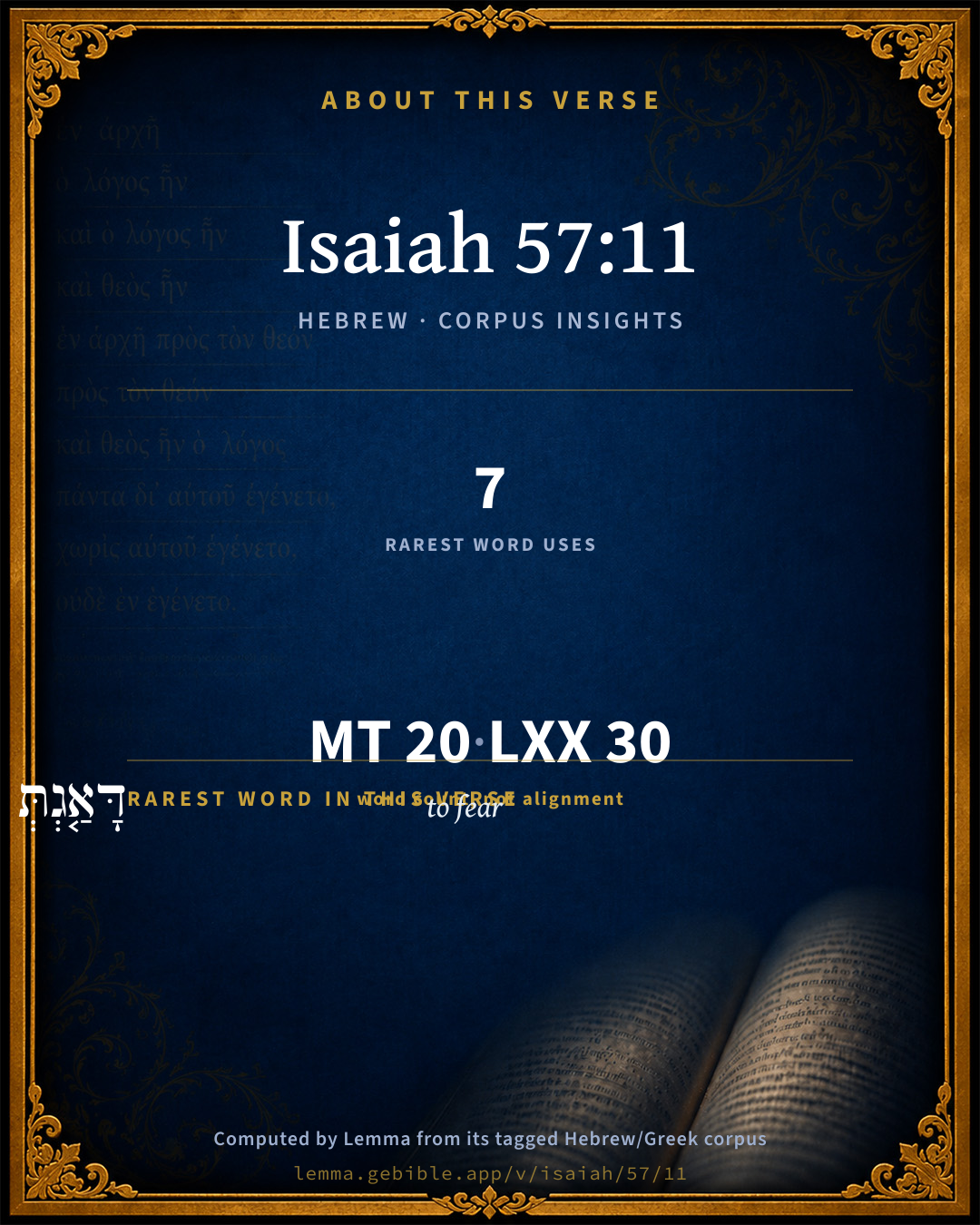
The rarest word here is דָּאַ֤גְתְּ to fear H1672 — appearing just 7 times in the whole Hebrew Bible.

Shared distinctive vocabulary

דָּאַ֤גְתְּ to fear H1672 occurs in 7 verses of the Hebrew Bible. Also found in:

Grammatical profile

  • 7 verbs
  • 2 nouns
  • 1 pronoun
  • 1 preposition
  • 1 conjunction
  • 8 particles

Verb forms

  • דָּאַ֤גְתְּ Qal · Perfect
  • וַתִּֽירְאִי֙ Qal · Sequential Imperfect
  • תְכַזֵּ֔בִי Piel · Imperfect
  • זָכַ֔רְתְּ Qal · Perfect
  • שַׂ֖מְתְּ Qal · Perfect
  • מַחְשֶׁה֙ Hiphil · Participle Active
  • תִירָֽאִי Qal · Imperfect

Repetition

Words recur within this verse — often emphatic in Hebrew:

  • וַתִּֽירְאִי֙ to fear H3372 ×2
  • לֹ֣א not H3808 ×4

Hebrew & Septuagint length

In English translation the verse runs 37 words from the Hebrew and 37 from the Septuagint (LXX English) — the same length.

A rough comparison of the two English renderings, which tokenize alike — not a word-level alignment.

Word counts can differ between the Hebrew and the Greek without any difference in meaning — e.g. the Hebrew direct-object marker אֵת has no separate Greek word, and Greek often adds the article ὁ.

In the original languages it is 20 Hebrew tokens and 30 Greek tokens — but the two are counted differently (Hebrew bundles its prefixes and suffixes into one token; the Greek is in lemma form), so that isn’t a like-for-like length.

Cross-references

20

Topical passages linked to Isaiah 57:11 in the Treasury of Scripture Knowledge — connected by theme and wording, ordered by reader-vote popularity; previews shown in the World English Bible.

  • Isaiah 51:12–13 I, even I, am he who comforts you: who are you, that you are afraid of man who shall die, and of the son of man who shall be made as grass;
  • Psalms 50:21 You have done these things, and I kept silent. You thought that the "I AM" was just like you. I will rebuke you, and accuse you in front of your eyes.
  • Proverbs 29:25 The fear of man proves to be a snare, But whoever puts his trust in Yahweh is kept safe.
  • Jeremiah 3:21 A voice is heard on the bare heights, the weeping [and] the petitions of the children of Israel; because they have perverted their way, they have forgotten Yahweh their God.
  • Ecclesiastes 8:11 Because sentence against an evil work is not executed speedily, therefore the heart of the sons of men is fully set in them to do evil.
  • Isaiah 26:10 Let favor be shown to the wicked, yet will he not learn righteousness; in the land of uprightness will he deal wrongfully, and will not see the majesty of Yahweh.
  • Isaiah 30:9 For it is a rebellious people, lying children, children who will not hear the law of Yahweh;
  • Isaiah 59:3–4 For your hands are defiled with blood, and your fingers with iniquity; your lips have spoken lies, your tongue mutters wickedness.
  • Jeremiah 2:32 Can a virgin forget her ornaments, or a bride her attire? yet my people have forgotten me days without number.
  • Jeremiah 9:3–5 They bend their tongue, [as it were] their bow, for falsehood; and they are grown strong in the land, but not for truth: for they proceed from evil to evil, and they don't know me, says Yahweh.
  • Jeremiah 42:20 For you have dealt deceitfully against your own souls; for you sent me to Yahweh your God, saying, Pray for us to Yahweh our God; and according to all that Yahweh our God shall say, so declare to us, and we will do it:
  • Ezekiel 13:22 Because with lies you have grieved the heart of the righteous, whom I have not made sad; and strengthened the hands of the wicked, that he should not return from his wicked way, and be saved alive:
  • Hosea 11:12 Ephraim surrounds me with falsehood, And the house of Israel with deceit; And Judah still us unruly with God, And is unfaithful to the Holy One.
  • Matthew 26:69–75 Now Peter was sitting outside in the court, and a maid came to him, saying, "You were also with Jesus, the Galilean!"
  • Acts 5:3 But Peter said, "Ananias, why has Satan filled your heart to lie to the Holy Spirit, and to keep back part of the price of the land?
  • Galatians 2:12–13 For before some people came from James, he ate with the Gentiles. But when they came, he drew back and separated himself, fearing those who were of the circumcision.
  • 2 Thessalonians 2:9 even he whose coming is according to the working of Satan with all power and signs and lying wonders,
  • 1 Timothy 4:2 through the hypocrisy of men who speak lies, branded in their own conscience as with a hot iron;
  • Revelation 21:8 But for the cowardly, unbelieving, sinners, abominable, murderers, sexually immoral, sorcerers, idolaters, and all liars, their part is in the lake that burns with fire and sulfur, which is the second death."
  • Revelation 22:15 Outside are the dogs, the sorcerers, the sexually immoral, the murderers, the idolaters, and everyone who loves and practices falsehood.

Cross-references courtesy of OpenBible.info (CC BY 4.0).

Hebrew and Greek witnesses Masoretic Hebrew ↔ Greek Septuagint

The same verse in the two great witnesses to the Old Testament, shown verse-for-verse.

These are two independent witnesses, not word-aligned to each other, and the Septuagint is shown in lemma (dictionary) form.

Hebrew Isaiah 57:11 Masoretic · Westminster Leningrad Codex

וְאֶת מִ֞י דָּאַ֤גְתְּ וַתִּֽירְאִי֙ כִּ֣י תְכַזֵּ֔בִי וְאוֹתִי֙ לֹ֣א זָכַ֔רְתְּ לֹא שַׂ֖מְתְּ עַל לִבֵּ֑ךְ הֲלֹ֨א אֲנִ֤י מַחְשֶׁה֙ וּמֵ֣עֹלָ֔ם וְאוֹתִ֖י לֹ֥א תִירָֽאִי

Of whom have you been afraid and in fear, that you lie, and have not remembered me, nor laid it to your heart? Haven't I held my peace even of long time, and you don't fear me?

World English Bible · Public Domain

Greek LXX Isaiah 57:11 Septuagint · lemma form

σύ τίς εὐλαβέομαι φοβέω καί ψεύδω ἐγώ καί οὐ μιμνήσκω ἐγώ οὐδέ λαμβάνω ἐγώ εἰς ὁ διάνοια οὐδέ εἰς ὁ καρδία σύ καΐἐγώ σύ ὁράω παραὁράω καί ἐγώ οὐ φοβέω

Through dread of whom have you feared, and lied against me, and has not remembered, nor considered me, nor regarded me, yes, though when I see you I pass you by, yet you have not feared me.

LXX2012 (modern English Septuagint) · Public Domain

On this verse, Keil & Delitzsch discusses the Septuagint’s reading. Read the note in Commentary ↓

Hebrew: Westminster Leningrad Codex (CC BY 4.0). Greek: Septuagint (public domain); English from LXX2012 (modern English Septuagint) (Public Domain). How the Septuagint differs from the Hebrew →

Targum (Aramaic paraphrase)

1

The Targum is the ancient Jewish Aramaic paraphrase of the Hebrew Scriptures — an interpretive translation, not the Hebrew text itself. Onkelos (literal) and Pseudo-Jonathan (expansive) render the Torah, and Jonathan the Prophets. Coverage is partial: where no permissively-licensed English translation exists for a verse, only the Aramaic is shown. This is verse-level text, not a word-by-word alignment to the Hebrew.

  1. Targum Jonathan Prophets (Joshua–Malachi)
    וְיַת מַן יְצֵיפְתְּ וְקָדָם מַן דְחֵילְתְּ אֲרֵי אַסְגֵית לְמַלָלָא כַדְבִין וּפוּלְחָנִי לָא אַדְכַּרְתְּ וְלָא שַׁוֵית דְחַלְתִּי עַל לִבִּיךְ הֲלָא אֲנָא יְהָבִית אַרְכָּא מֵעַלְמָא דְאִם תְּתוּבִין לְאוֹרַיְתָא וְלִקֳדָמַי לָא תַבְתְּ:

    And of whom hast thou been afraid? and on account of whom hast thou feared? Thou hast surely multiplied speaking lies, and thou hast not remembered my service, and hast not had my fear in thine heart: I would have given you the ends of the world, if you had returned to my law; but thou hast not returned to me.

    Targum Jonathan — Aramaic: “Mikraot Gedolot” (public domain). English: “Sefaria Community Translation” (CC0 1.0 (public-domain dedication)); “London "Chaldee Paraphrase," 1871” (public domain). Text via Sefaria.

Commentary

Notes on Isaiah 57:11 from classic Christian and Jewish commentators (each source and its license shown beneath its notes). The classic Christian expositions comment on the surrounding passage and are grouped to its opening verse, so a note may address several verses; the Jewish commentaries on the Tanakh (Rashi and others) are per-verse, so they appear only where the commentator wrote on this verse.

Lemma curates 59 commentaries, every one of them public domain or Creative Commons licensed, each selected and text-cleaned for this edition rather than reprinted as found. About our sources →

Trapp's Complete Commentary

John Trapp

Isa 57:11 And of whom hast thou been afraid or feared, that thou hast lied, and hast not remembered me, nor laid [it] to thy heart? have not I held my peace even of old, and thou fearest me not?

Ver. 11. And of whom hast thou been afraid or feared?] q.d., Not me surely, as thou oughtst; but thy fellow creatures, whom thou shouldst have looked upon as so many mice.

That thou hast lied,] i.e., So basely flattered the Assyrian.

Have I not held my peace?] i.e., Borne with thee, more than any else would ever have done? And yet my lenity is even worse than lost upon thee.

John Trapp, A Commentary or Exposition upon All the Books of the Old and New Testament (1647–1656) — public domain. Text from a community e-Sword module.

Joseph Benson's Commentary

Isa 57:11-14. Of whom hast thou been afraid, &c. — And what, or who are they, the fear of whom drives thee to these wicked and desperate practices? Are they not weak and mortal creatures, such as wholly depend upon me, and can do nothing without me? The fear of my displeasure ought, in all reason, to outweigh all thy other fears and apprehensions, and deter thee from breaking that covenant whereby thou art engaged to me. That thou hast lied — That thou hast dealt thus perfidiously with me, and sought for such foreign assistances contrary to my command. And hast not remembered me — Hast forgotten all those great things which I have done for thee, and all those promises which I have made to thee. Nor laid it to thy heart — Or, nor set me upon thy heart: hast not seriously and affectionately considered what I am, how all-sufficient, faithful, and gracious: for then thou wouldest not have distrusted or disobeyed me. Have I not held my peace, &c. — The Bishops’ Bible, published under Queen Elizabeth, translates the clause thus: Is it not because I held my peace, and that of a long time, therefore thou fearest me not? Sinners take encouragement to continue in sin, from God’s patience and long-suffering. I will declare thy righteousness — I will no longer be silent, but “will show thee thy deserts, and give thee a view of thy deeds, which then will appear quite of another sort than what thy own self-conceit makes thee believe them to be.” For they shall not profit thee — These actions shall be of no real advantage, but quite the contrary. When those criest — Namely, unto me for deliverance; let thy companies deliver thee — Expect it, not from me, whom thou hast forsaken and despised, but from those foreign troops, to which thou hast sought and trusted for succour. But the wind shall carry them all away — They shall be so far from saving thee, that they shall not be able to deliver themselves; but shall be carried away suddenly and violently by the blast of mine anger. Vanity shall take them — Their endeavours to help thee shall be vain and fruitless. But he that putteth his trust in me — Those that still depend upon me, and make use of none of those indirect means to preserve themselves; shall possess the land —

Shall be preserved in, or restored to, their own land, or shall have temporal blessings as far as will be good for them; and shall inherit my holy mountain — Shall enjoy my favour and presence in my temple: shall be blessed with the privileges of the church on earth, and brought at length to the joys of heaven. And shall say — Hebrew, and he shall say: or, and one shall say: God shall raise up one who shall say, with authority and efficacy, Cast ye up, &c. — Make causeways, where it is needful, for the safe and easy passage of my people, and remove all things which may hinder them in their return.

Joseph Benson's Commentary on the Old and New Testaments (1811–1818) — public domain. Text from a community e-Sword module.

Keil & Delitzsch

C. F. Keil & F. Delitzsch

From fear of man, Israel, and still more Judah, had given up the fear of Jehovah. "And of whom hast thou been afraid, and (whom) didst thou fear, that thou becamest a liar, and didst not continue mindful of me, and didst not take it to heart?" It was of men - only mortal men, with no real power (Isa 51:12) - that Israel was so needlessly afraid, that it resorted to lies and treachery to Jehovah (kı̄, ut, an interrogative sentence, as in Sa2 7:18; Psa 8:5): purchasing the favour of man out of the fear of man, and throwing itself into the arms of false tutelar deities, it banished Jehovah its true shelter out of its memory, and did not take it to heart, viz., the sinfulness of such infidelity, and the eventful consequences by which it was punished (compare Isa 47:7 and Isa 42:25).

With Isa 57:11 the reproaches are addressed to the present. The treachery of Israel had been severely punished in the catastrophe of which the captivity was the result, but without effecting any improvement. The great mass of the people were as forgetful of God as ever, and would not be led to repentance by the long-suffering of God, which had hitherto spared them from other well-merited punishments. "Am I not silent, and that for a long time, whereas thou wast not afraid of me?" A comparison with Isa 42:14 will show that the prophecy returns here to its ordinary style. The lxx and Jerome render the passage as if the reading were מעלם (viz., עיני = παρορῶν, quasi non videns), and this is the reading which Lowth adopts. We may see from this, that the original text had a defective ומעלם, which was intended, however, to be read וּמעלם. The prophet applies the term ‛ōlâm (see Isa 42:14) to the captivity, which had already lasted a long time - a time of divine silence: the silence of His help so fas as the servants of Jehovah were concerned, but the silence of His wrath as to the great mass of the people.

Keil & Delitzsch — Biblical Commentary on the Old Testament (1861–1891) — public domain (CC PDM 1.0). Text via the HelloAO Bible API. (Old Testament only.)

Tyndale Open Study Notes

Tyndale Open Resources

57:11 The people were living in fear of false gods instead of fearing the Lord (see 8:12-13).

Tyndale Open Study Notes — © Tyndale Open Resources, licensed CC BY-SA 4.0. Text via the HelloAO Bible API.

Geneva Bible (1599)

Geneva Bible translators

Broken promise with me.

Meaning, that the wicked abuse God’s lenity, and grow to further wickedness.

Geneva Bible (1599) marginal notes — public domain. Text via Bolls.life.

Jamieson, Fausset & Brown

Robert Jamieson, A. R. Fausset & David Brown

Israel wished not to seem altogether to have denied God. Therefore they "lied" to Him. God asks, Why dost thou do so? "Whom dost thou fear? Certainly not Me; for thou hast not remembered Me." Translate, "seeing that thou hast not remembered Me."

laid it to . . . heart--rather, "nor hast Me at heart"; hast no regard for Me; and that, because I have been long silent and have not punished thee. Literally, "Have I not held My peace, and that for long? and so thou fearest Me not" (Psa 50:21; Ecc 8:11). It would be better openly to renounce God, than to "flatter Him" with lies of false professions (Psa 78:36) [LUDOVICUS DE DIEU]. However, Isa 51:12-13 favors English Version of the whole verse; God's "silent" long-suffering, which was intended to lead them to repentance, caused them "not to fear Him" (Rom 2:4-5).

Jamieson, Fausset & Brown — Commentary Critical and Explanatory on the Whole Bible (1871) — public domain (CC PDM 1.0). Text via the HelloAO Bible API.

Adam Clarke's Commentary

Verse 11. Nor laid it to thy heart - "Nor revolved it in thy hand"] Eight MSS., (four ancient,) and the two oldest editions, with another, add the conjunction ו vau, ולא velo: which is confirmed by all the ancient Versions.

Even of old - "And winked"] For ומעולם umeolam, which makes no good sense or construction in this place, twenty-three MSS. (seven ancient) and three editions have מעלם, (to be thus pointed מעלם malim;) παροπω, Septuagint; quasi non videns, "as if not seeing," Vulgate. See Ps 10:1. The truth of this reading, so confirmed, admits of no doubt. In one of my own MSS. the ו vau has been written, but afterwards struck out. Is it not because I was silent, and winked?

Adam Clarke's Commentary on the Bible (1810–1826) — public domain. Text from a community e-Sword/MySword module.

Ellicott's Commentary for English Readers

(11) And of whom hast thou been afraid . . .?—The question implies that Judah had been led by the fear of man to forsake the fear of Jehovah, and this had led her to what was, in the fullest sense of the word, the false step of an alliance with Assyria, which was an acted lie.

Have I not held my peace . . .?—The words suggest, half-pityingly, the cause of the people’s little faith. From “of old,” i.e., during the period that preceded the captivity, or perhaps in the dark time of Manasseh, Jehovah had been silent, and His long- suffering had been mistaken for apathy, and therefore the people had not feared Him.

A Bible Commentary for English Readers, edited by Charles John Ellicott (1878–1897) — public domain. Text from a community e-Sword module.

The Cambridge Bible for Schools and Colleges

gen. ed. J. J. S. Perowne

11. Most critics detect in this verse a milder tone on the part of the Divine speaker, as if He would find a partial excuse for the apostasies of the people in their undue fear of other gods, and distrust of Jehovah, who had so long time kept silence (cf. ch. Isa_51:12 f., Isa_42:14). If this impression be right, the theory that the Samaritans are the persons addressed at once falls to the ground. Another view is, however, possible. The question of whom hast thou been afraid and feared? may imply a simple negative answer,—“thou hast been absolutely fearless.” The language of the verse yields itself to either interpretation.

that thou hast lied] Or, “for thou art treacherous.”

have not I held my peace, &c.] Or “Is it not so? I have been silent” etc.: “It was because I held my peace that thou didst not fear me, but other gods.” Cf. Psa_50:21 (“These things thou didst and I kept silence” etc).

even of old] (Isa_42:14). The LXX. and Vulg. evidently vocalised the word differently (מַעְלִם for מֵעֹלָם), so as to read “and covered (sc. my eyes)”; (cf. Psa_10:1; Isa_1:15).

The Cambridge Bible for Schools and Colleges (gen. ed. J. J. S. Perowne; Cambridge University Press, 1878–1918) — public domain. Text from a community e-Sword module.

John Gill's Exposition

And of whom hast thou been afraid or feared, that thou hast lied,.... By assuming the name of Christian, when it did not belong to her; as it does not to the church of Rome which is antichristian: this lie is told, not out of any fear of God, or reverence of Christ; for she has no fear or reverence of either; but to serve a purpose, to blind the eyes of men under the Christian name, and, with a pretence to serve the cause of Christianity, to get all Christendom under her power:

and hast not remembered me; or, "for thou hast not remembered me, nor laid it to thy heart?" or, "put me upon thy heart" (x); had no regard to Christ, nor had true faith in him, nor love to him; but all the reverse; degraded him in his offices, corrupted his doctrines, ordinances, and worship. The Targum is,

"and hast not remembered my worship, nor put my fear upon thy heart:''

and have not held my peace even of old, and thou fearest me not or, "therefore thou fearest me not" (y); because as yet the vials of God's wrath are not poured out, or his judgment inflicted on antichrist; but, ever since he began to reign, he has enjoyed great prosperity; therefore he fears not God, nor regards man; but says, "I sit a queen, and am no widow, and shall see no sorrow", Rev 18:7.

(x) "nam mei non es recordata, neque posuisti me super cor tuum", Grotius. (y) "idcirco me non times", Calvin, Piscator, Gataker.

John Gill's Exposition of the Whole Bible (1746–1763) — public domain (CC PDM 1.0). Text via the HelloAO Bible API.

Albert Barnes' Notes on the Bible

And of whom hast thou been afraid - The sense of this verse is exceedingly obscure. The design is evidently to reprove the Jews for the course which they had been pursuing in practicing idolatry, and in seeking the alliance of foreign powers. The main scope of the passage seems to be, to state that all this was proof that they did not fear God. Their conduct did not originate from any reverence for him, or any respect to his commands. And the question, ‘of whom hast thou been afraid?’ seems to mean that they had not been afraid of God. If they had had any reverence for any being or object that had led to the course which they had pursued, it was not for God.

That thou hast lied - That thou hast been false and unfaithful to God. The image is here kept up of unfaithfulness to the marriage vow Isa 57:6-8.

And hast not remembered me - The proof of this was, that they had fallen into idolatry, and had sought the alliance and friendship of foreign powers.

Have not I held my peace - The idea here seems to be, that God had been silent a long time, and they had, therefore, been emboldened to sin. He had, as it were, connived at their apostasy and infidelity; and they had thus cast off the fear of him, and given themselves wholly to idolatry. Compare Ecc 8:11.

Albert Barnes' Notes on the Bible (1834–1885) — public domain. Text from a community e-Sword/MySword module.

Haydock's Catholic Bible Commentary

CHAPTER LVII.

Afraid, since thou hast despised my, my laws and offers.

George Leo Haydock (1774–1849), Haydock's Catholic Family Bible and Commentary, 1859 edition — public domain. Excludes Psalms (Douay-Rheims chapter numbering differs from Protestant) and Deuterocanonical books (Catholic canon only).

Matthew Poole's English Annotations

And of whom hast thou been afraid or feared? and what or who are they the fear of whom drives thee to these wicked and desperate courses? Are they not men, weak and mortal creatures, such as wholly depend upon me, and can do nothing to thee either against me or without me?

That thou hast lied; that thou hast dealt thus disloyally and perfidiously with me, and sought for such foreign assistances, contrary to my command, and thy solemn covenant,

and hast not remembered me: hast thou forgotten all those great things which I have done for thee, and all those promises which I have made to thee, and constantly performed, when thou hast not grossly violated the conditions upon which they were made?

Nor laid it to thy heart; or thus, nor set me upon thine heart, as these very words are rendered, Son 8:6. And so this is a repetition of what is said in the foregoing clause in other words. The sense is, Thou hast not seriously and affectionately considered what I am, how all-sufficient, and faithful, and gracious, for then thou wouldst not have distrusted or disobeyed me.

Have not I held my peace even of old? have not I forborne to reprove and punish thee for this and for other sins, from time to time, ever since thou wast my people, that by this goodness I might oblige thee to love me, and to cleave unto me?

And thou fearest me not; or, therefore thou dost not fear or regard me. Thus thou abusest mine indulgence and long-suffering, taking occasion from thence to despise me.

Matthew Poole's English Annotations on the Holy Bible (1683–1685) — public domain. Text from a community e-Sword/MySword module.

Whedon's Commentary on the Bible

Daniel D. Whedon

11. Of whom hast thou been afraid — Much in these verses is very obscure, and this verse more than all. The question and context imply that there really was one or more who were objects of fear. But they were not such as would relieve from fear. Is there here an obscure reference to Israel and Judah in the times of Ahaz and Hezekiah? Much like this could have been asked in the past days of Isaiah. Look at chap. 28. The facts of that history seem prophetically paralleled along almost all the earthly life of the Jews. The Jews relied, not on Jehovah, but on earthly powers, to deliver them. One time it is Egypt; another, Syria; at another, it is Assyria. So through all their future, the same question applies. Not Jehovah, indeed, but weak man is carnal Israel’s reliance. Is not this the key to the meaning, and are not the words following, to Isa_57:13, sheer irony on the same line of thought? The description of life at Jerusalem in Isaiah’s time, and long afterward, is put in strong colours, but the inward spirit of that life is not overdrawn. In the reign of Ahaz idolatry became rampant, even on the surface; in Hezekiah’s time it was repressed, but not fully suppressed; in Manasseh’s, it was outrageous. Josiah attempted to crush it forever, but it was too late. The proneness to idolatry in the nation could not be arrested — its onward rush dashed the nation to ruin. Captivity and exile alone cured the evil. A similar spiritual aspect, though assuming a different phase, largely appeared in the ruling class at Jerusalem in Christ’s time; and so far forth this prophecy has continued application.

Daniel D. Whedon (gen. ed.), Commentary on the Old and New Testaments (1874–1909) — public domain. Text from a community e-Sword module.

The Pulpit Commentary

Of whom hast thou been afraid? Judah"s abandonment of Jehovah and devotion to new deities was caused by fear the fear of man, especially of Assyria. This induced them to seek for help in each new superstition that presented itself, and produced the enlarged syncretism which has been noticed in the comment on ver. 8. But how absurd to be driven by fear of man into offending God! That thou hast lied (see the last clause of ver. 4, with the comment). Have not I held my peace, etc.? i.e. "Is it not because I have for so long a time held my peace, that thou fearest me not?" God had for a long time suffered them to "go on still in their wickedness he had not interposed with any severe judgment; therefore they had ceased to fear him, and had feared men instead.

Wrong thoughts of God keep men from repentance.

God pleads, saying, "Who filled thee with dread, or of whom wast thou afraid, when thou provedst false, and didst not remember me?" Some mental creation of God, or some false teaching concerning God, occupied the thought and the heart, and kept the men of Israel from feeling all those persuasions to repentance which come from the full and the worthy knowledge of him. Compare the expressions, "Not knowing that the goodness of God leadeth thee to repentance;" "This is life eternal, to know thee, the only true God, and Jesus Christ whom thou hast sent." Some think that the allusion is to the helpless idols in whose aid the people vainly trusted. Matthew Arnold paraphrases thus: "How could thy calamities, and the fear of thy Babylonian tyrant, make thee so superstitious and forgetful?" Illustrating the earlier method of interpreting the verse, it may be shown how wrong and imperfect thoughts of God are still the great hindrances in men"s way. These wrong thoughts come either as

I CREATIONS OF MEN"S OWN FEARS. God too often is not to men what he really is, but what he seems to be when seen through their fears and conscience of sin. So a revelation was needed which could assure men of God"s pitying mercy and forgiving love. When men, conscious of transgression and fearing judgment, try to paint God, we cannot wonder that their picture should be untrue and unworthy The thing of which it is so difficult to persuade sinners is that there is forgiveness with God, and that he delighteth in mercy.

II MISCONCEPTIONS OF THEOLOGICAL TEACHINGS. There is always the danger to be guarded against that the exigencies of a system make us fashion a suitable God, rather than try to recognize in all simplicity the God who has been revealed. Therefore, in our day, so many resist the teachings that are known as Calvinistic. The hard, legal Deity of that system is felt to represent most imperfectly and unworthily the Father of Jesus, and Saviour of the world. But we must understand that the false representations are more often found in the statements of those who attempt to expound a system than in the system itself.

III AS ONE-SIDED VISIONS OF TRUTH WHICH NEEDS TO BE SEEN AS A WHOLE. This mistake is often pointed out in connection with the two attributes of "mercy" and "justice." The modern tendency to dwell on the milder features of the Divine nature, and to exclude the sterner ones, is perilously keeping men from that repentance which is the only open highway to the eternal life. R.T.

The Pulpit Commentary (1880–1919), ed. H.D.M. Spence-Jones & Joseph S. Exell — public domain. Text from a community e-Sword module.

John Wesley's Explanatory Notes

Feared - And who are they, the fear of whom drives thee to these wicked courses? Lied - That thou hast dealt thus perfidiously with me. Not remembered - Hast thou forgotten all those great things which I have done for thee. Held my peace - Have not I forbore to punish thee from time to time, that by this goodness I might oblige thee to love me. And thou - Or, therefore thou dost not fear or regard me. Thou abusest my long-suffering.

John Wesley, Explanatory Notes Upon the Whole Bible (1754–1765) — public domain. Text via the GEBible commentary corpus.

J. A. Alexander on Isaiah

Joseph Addison Alexander

“And whom hast thou feared and been afraid of, that thou shouldest lie? and me thou hast not remembered, thou hast not called to mind (or laid to heart). Is it not (because) I hold my peace, and that of old, that thou wilt not fear me?” They have no real fear of God; why then should they affect to serve Him? His forbearance only served to harden and embolden them. ‘Have I not long kept silence? It cannot be that you fear me.’ The image is identical with that presented in Isa 42:14. See also Isa 40:27; Isa 51:12-13.

Joseph Addison Alexander, The Prophecies of Isaiah (1846–1847; New York: Scribner, 1870–1878) — public domain. Text from a community e-Sword module.

unfoldingWord translationNotes

Door43 World Missions Community

General Information:

Yahweh continues speaking to the unfaithful people of Israel.

Whom are you worried about? Whom do you fear so much that has caused you to act so deceitfully ... about me?

Yahweh uses these questions to scold the people. AT: "You must really fear these idols for you to act so deceitfully ... about me!" (See: Rhetorical Question)

so much that you would not remember me or think about me

These two phrases mean basically the same thing and emphasize that, although the people should have remembered Yahweh, they did not. (See: Doublet)

I will proclaim all your righteous acts and tell all that you have done

Yahweh is being sarcastic, calling their evil deeds so-called righteousness. (See: Irony)

translationWords

fear

deceive

preach

righteous

works

unfoldingWord translationNotes — © Distant Shores Media and the Door43 World Missions Community, licensed CC BY-SA 4.0. Source: git.door43.org/Door43/en_tn.

Rashi

Rabbi Shlomo Yitzchaki (Rashi)

And whom did you dread Of whom were you afraid?

that you failed Heb. תְּכַזֵּבִי, that you ceased to worship Me and you betrayed Me. Comp. (infra 58:11) “Whose water shall not fail (יְכַזְּבוּ).” Comp. also (Psalms 116:11) “Every man is a traitor (כֹּזֵב).” Falajjnc in O.F., to fail. Likewise, every expression of כָּזָב means one upon whom people rely, and he fails and betrays them.

Indeed, I am silent I kept silent in the face of many transgressions that you transgressed against Me.

Rashi on the Tanakh — English translations: “The Judaica Press complete Tanach with Rashi, translated by A. J. Rosenberg” (CC BY 4.0); “Pentateuch with Rashi's commentary by M. Rosenbaum and A.M. Silbermann, 1929-1934” (public domain); “The Metsudah Tanach series, Lakewood, N.J” (CC BY 4.0); and “The Book of Joshua, Metsudah Publications, 1997” (CC BY 4.0). Text via Sefaria.

Ibn Ezra

Rabbi Abraham ibn Ezra

And of whom hast thou been afraid, etc. What hadst thou to fear from an enemy and to be afraid of him for, so as to lie, and not to think of me.

מחשה is a causative verb, and means silencing. אני מחשה ומעולם I silence, even of old, those that lie; this I am doing now, and have always done. It is, however, possible to explain the words ואת מי דאגת ונו׳ when hast thou feared me, etc.; but I prefer the first explanation. Some compare אני מחשה with החשתי I have holden my peace (42:14), and explain it I held my peace, I forbore; it is in that case an anthropomorphism.

Ibn Ezra on the Tanakh — English translations: “Sefaria Community Translation” (CC0 1.0 (public-domain dedication)); “Yalkut, Sifsei Chachomim Chumash, Metsudah Publications, 2009” (CC BY 4.0); and “Commentary of Ibn Ezra on Isaiah - trans. by M. Friedlander, 1873” (public domain). Text via Sefaria.

Lesson kit

Teaching starters — assembled from the data on this page, not authored interpretation. Every prompt links to the verse data it draws on. Edit before teaching.

Isaiah, in the Prophets, opens this verse with 20 words (14 distinct Hebrew lemmas). Its most distinctive word is dâʼag (“to fear”). A historical commentator’s framing appears above. Read the whole chapter for the surrounding context.

Discussion questions

  1. How does “to fear” (dâʼag) shape what this verse is saying?
  2. How does 1 Samuel 9:5, which shares the word «to fear», read alongside this verse?
  3. What does the repetition of “to fear” (2× in this one verse) do in this verse?
  4. These translations render this verse differently. What is at stake in choosing one wording over another?
  5. «דָּאַ֤גְתְּ» is a Qal Perfect verb. How does that grammatical form shape the action described?
  6. Compare how Trapp's Complete Commentary and Joseph Benson's Commentary read this verse. Where do they agree or differ?

Things to notice

Reading settings

Reading text

Shown beneath each verse's original-language words.

Old Testament
Old Testament edition

Read the OT as the Masoretic Hebrew (MT) or the Greek Septuagint (LXX).

English shown for the Greek Septuagint (in the Hebrew ↔ Greek comparison).

Comparing translations? Open the Compare panel on any verse page to stack up to four side by side.