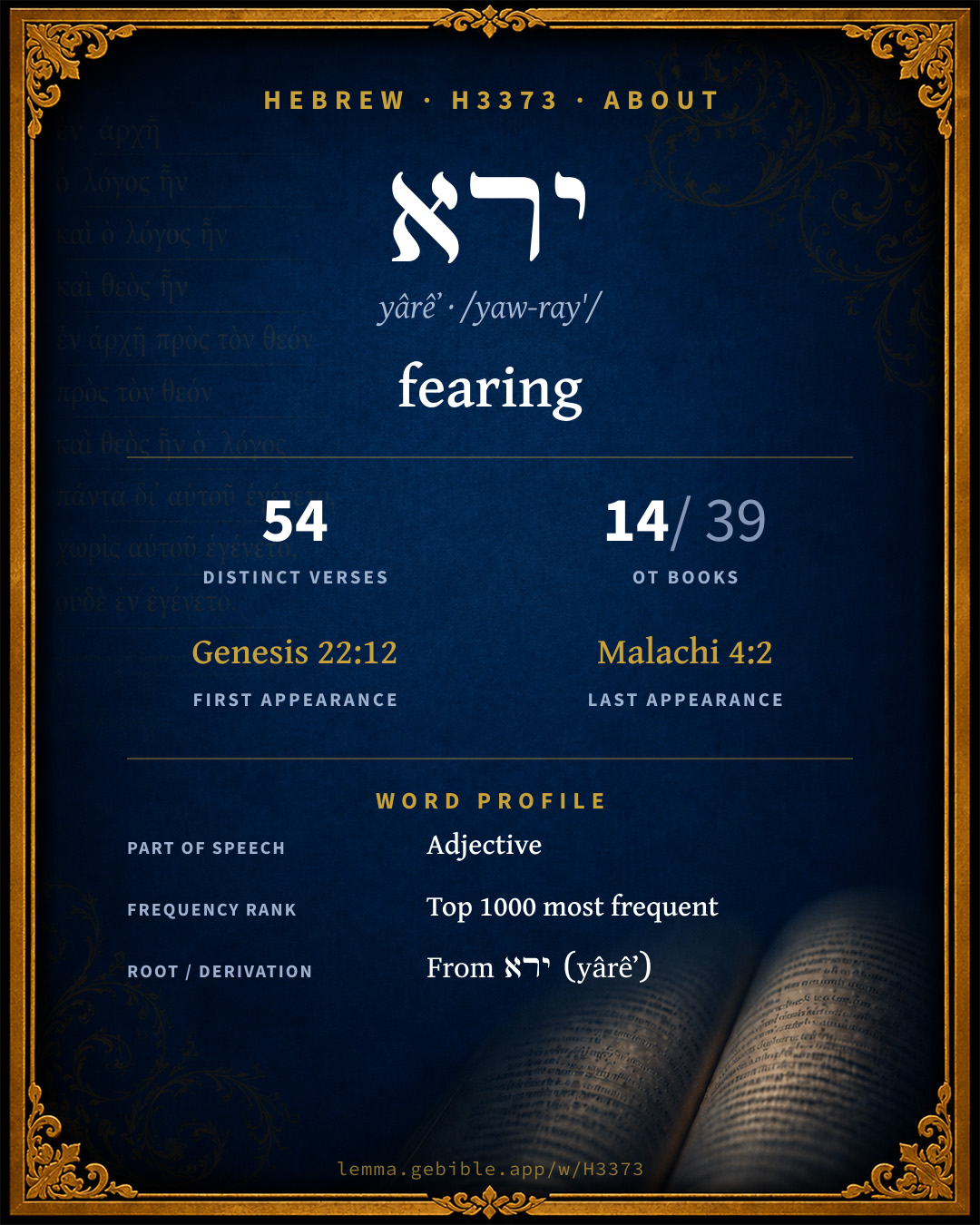
יָרֵא
fearing
Full lexicon entry — Brown-Driver-Briggs (BDB)
From Brown-Driver-Briggs (BDB)
Where this word appears
Grammar key — what these labels mean
Part of speech
- Adjective
- A word that describes or qualifies a noun.
- Verb
- An action or state-of-being word.
- Noun
- A naming word — a person, place, thing, or idea.
Noun type
- Common
- A common noun — a general class of person, place, or thing (“king,” “city,” “water”), not a specific name.
Stem
- Qal
- The basic, simple active stem — the plain form of the verb (“he wrote”). Here: ‘fear’
Form
- Participle Active
- A verbal adjective expressing ongoing or characteristic action (“writing / one who writes”).
- Perfect
- A completed action or state — Hebrew marks aspect (completeness) more than strict tense (“he wrote”).
- Infinitive Construct
- A bound verbal noun, frequently with prepositions (“to write / in writing”).
State
- Construct
- A noun bound to a following noun in a possessive / “of” relationship (the construct chain).
- Absolute
- The independent form of a noun, not bound to a following word.
Person
- 3rd Person
- The one spoken about (“he / she / it / they”).
Gender
- Masculine
- Grammatically masculine.
- Feminine
- Grammatically feminine.
Number
- Plural
- More than one (in Hebrew, generally three or more).
- Singular
- One.
Every verse where H3373 appears in the Book of Psalms — 27 distinct verses. Click any verse to open its interlinear word-by-word view. Verse text shown in the World English Bible for context — . Each verse’s Hebrew form is shown with its reference; the English is not keyword-highlighted, since the data carries no word-level English alignment. Use “Compare translations” on any verse to read it across multiple English versions. This concordance covers the Hebrew Bible; Septuagint (Greek Old Testament) occurrences are not indexed here.
Psalms
- Psalms 15:4 יִרְאֵ֣י adj Adjective mp cs In whose eyes a vile man is despised, But who honors those who fear Yahweh; He who keeps an oath even when it hurts, and doesn't change;
- Psalms 22:23 יִרְאֵ֤י adj Adjective mp cs You who fear Yahweh, praise him! All you descendants of Jacob, glorify him! Stand in awe of him, all you descendants of Israel!
- Psalms 22:25 יְרֵאָֽי/ו adj Adjective mp cs + sfx pers 3ms Of you comes my praise in the great assembly. I will pay my vows before those who fear him.
- Psalms 25:12 יְרֵ֣א adj Adjective ms cs What man is he who fears Yahweh? He shall instruct him in the way that he shall choose.
- Psalms 25:14 לִ/ירֵאָ֑י/ו prep + Adjective Adjective mp cs + sfx pers 3ms The friendship of Yahweh is with those who fear him. He will show them his covenant.
- Psalms 31:19 לִּֽ/ירֵ֫אֶ֥י/ךָ prep + Adjective Adjective mp cs + sfx pers 2ms Oh how great is your goodness, Which you have laid up for those who fear you, Which you have worked for those who take refuge in you, Before the sons of men!
- Psalms 33:18 יְרֵאָ֑י/ו adj Adjective mp cs + sfx pers 3ms Behold, Yahweh's eye is on those who fear him, On those who hope in his loving kindness;
- Psalms 34:7 לִֽ/ירֵאָ֗י/ו prep + Adjective Adjective mp cs + sfx pers 3ms The angel of Yahweh encamps round about those who fear him, And delivers them.
- Psalms 34:9 לִ/ירֵאָֽי/ו prep + Adjective Adjective mp cs + sfx pers 3ms Oh fear Yahweh, you his saints, For there is no lack with those who fear him.
- Psalms 60:4 לִּ/ירֵאֶ֣י/ךָ prep + Adjective Adjective mp cs + sfx pers 2ms You have given a banner to those who fear you, That it may be displayed because of the truth. Selah.
- Psalms 61:5 יִרְאֵ֥י adj Adjective mp cs For you, God, have heard my vows. You have given me the heritage of those who fear your name.
- Psalms 66:16 יִרְאֵ֣י adj Adjective mp cs Come, and hear, all you who fear God. I will declare what he has done for my soul.
- Psalms 85:9 לִ/ירֵאָ֣י/ו prep + Adjective Adjective mp cs + sfx pers 3ms Surely his salvation is near those who fear him, That glory may dwell in our land.
- Psalms 103:11 יְרֵאָֽי/ו adj Adjective mp cs + sfx pers 3ms For as the heavens are high above the earth, So great is his loving kindness toward those who fear him.
- Psalms 103:13 יְרֵאָֽי/ו adj Adjective mp cs + sfx pers 3ms Like a father has compassion on his children, So Yahweh has compassion on those who fear him.
- Psalms 103:17 יְרֵאָ֑י/ו adj Adjective mp cs + sfx pers 3ms But Yahweh's loving kindness is from everlasting to everlasting with those who fear him, His righteousness to children's children;
- Psalms 111:5 לִֽ/ירֵאָ֑י/ו prep + Adjective Adjective mp cs + sfx pers 3ms He has given food to those who fear him. He always remembers his covenant.
- Psalms 115:11 יִרְאֵ֣י adj Adjective mp cs You who fear Yahweh, trust in Yahweh! He is their help and their shield.
- Psalms 115:13 יִרְאֵ֣י adj Adjective mp cs He will bless those who fear Yahweh, Both small and great.
- Psalms 118:4 יִרְאֵ֣י adj Adjective mp cs Now let those who fear Yahweh say That his loving kindness endures forever.
- Psalms 119:74 יְ֭רֵאֶי/ךָ adj Adjective mp cs + sfx pers 2ms Those who fear you will see me and be glad, Because I have put my hope in your word.
- Psalms 119:79 יְרֵאֶ֑י/ךָ adj Adjective mp cs + sfx pers 2ms Let those who fear you turn to me. They will know your statutes.
- Psalms 128:1 יְרֵ֣א adj Adjective ms cs Blessed is everyone who fears Yahweh, Who walks in his ways.
- Psalms 128:4 יְרֵ֣א adj Adjective ms cs Behold, thus is the man blessed who fears Yahweh.
- Psalms 135:20 יִֽרְאֵ֥י adj Adjective mp cs House of Levi, praise Yahweh! You who fear Yahweh, praise Yahweh!
- Psalms 145:19 יְרֵאָ֥י/ו adj Adjective mp cs + sfx pers 3ms He will fulfill the desire of those who fear him. He also will hear their cry, and will save them.
- Psalms 147:11 יְרֵאָ֑י/ו Qal ptcp.act mp cs + sfx pers 3cs Yahweh takes pleasure in those who fear him, In those who hope in his loving kindness.
About this entry
At a glance — auto-summarized from this page’s data, not written by a person. Every figure links to its source below. This summary describes the numbers; it doesn’t interpret them.
At its core, ירא (yârêʼ) means “fearing.” The word gravitates to Psalms (50%), then Proverbs and Deuteronomy. It turns up in 54 verses across 14 books, a moderately common footprint. It first appears in Genesis 22:12. Translators differ — “fear” in the King James Version, then “fear him” (Berean Standard Bible), as the renderings breakdown shows. Dig into 54-verse concordance and the renderings breakdown below.
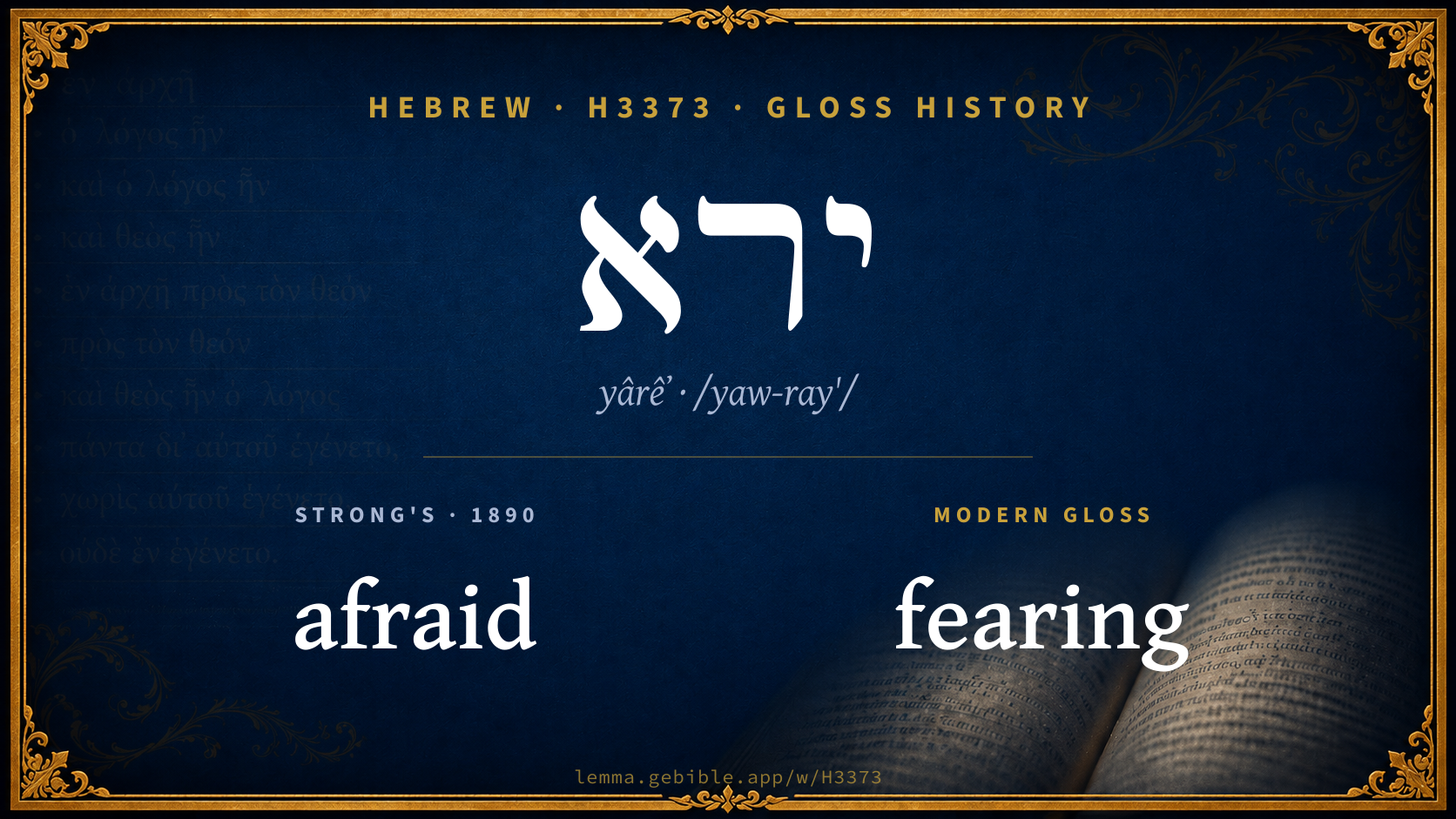
Gloss history
Strong's 1890 vs modern scholarship
About this word
Strong's H3373 catalogs a Hebrew word from the Hebrew Old Testament.
These counts are not copied from any lexicon or concordance. They are computed here, from the morphology-tagged Hebrew Old Testament. What Lemma adds →
- 54
- distinct verses
- The word appears in 54 distinct verses.
- 14 / 39
- OT books
- The word appears in 14 of 39 Old Testament books.
- #696
- by frequency
- Top 1000 most frequent Hebrew words (rank 696 of 8,640 Hebrew words by occurrence).
View all 54 occurrences in the concordance →
Most concentrated in
- Psalms 27 verses 50%
- Proverbs 4 verses 7%
- Deuteronomy 3 verses 6%
By section of the Old Testament
By traditional corpus
Conventional, traditional groupings — biblical authorship is debated, so this is a traditional corpus grouping, not an authorship claim. Each share is this word’s portion of its verses in that division of the Hebrew canon. Each figure is a share of the word’s 54 distinct verses.
- Writings (Ketuvim) 37 verses · 69%
- Prophets (Nevi'im) 11 verses · 20%
- Torah (Pentateuch) 6 verses · 11%
How translations render this word
Counts come from each version’s own published word-to-Strong’s tagging or interlinear alignment — an approximate guide to how each version renders this word, not a word-level alignment the data otherwise carries. Because each total is that version’s own tagged count, the per-version totals vary from one another and need not match the appearance or distinct-verse counts above. These counts may also differ from a printed concordance because Lemma counts each distinctly tagged rendering and does not collapse phrase taggings into a single head-word total. This is a fixed set of word-tagged versions (KJV, ASV, BSB, ULT) and does not change with the reading translation you choose elsewhere. Each version’s license is shown beside its name below (and on Sources).
BDB lists this Strong’s number as 2 distinct words (homographs). Each count above pools all of them and is not split by sense — see the Senses section below. A low-frequency rendering may belong to a different one of those words, not the primary meaning.
- King James Version†: Fear 15×, I fear 4×, Feared 3×
- American Standard Version†: Fear 14×, Feareth 4×, I fear 3×
- Berean Standard Bible†: Fear him 11×, Fear 10×, Fears 9×
- unfoldingWord Literal Text†: Fear 8×, Fearers of 7×, Fearing 6×
King James Version Public Domain
Renders H3373 across 64† tagged occurrences — most commonly:
Plus 29 renderings that appear only once — usually multi-word phrases or single function words the recovered tagging swept in, not distinct renderings.
American Standard Version Public Domain
Renders H3373 across 64† tagged occurrences — most commonly:
Plus 30 renderings that appear only once — usually multi-word phrases or single function words the recovered tagging swept in, not distinct renderings.
Berean Standard Bible Public Domain
Renders H3373 across 65† tagged occurrences — most commonly:
Plus 14 renderings that appear only once — usually multi-word phrases or single function words the recovered tagging swept in, not distinct renderings.
unfoldingWord Literal Text CC BY-SA 4.0
Renders H3373 across 60† tagged occurrences — most commonly:
Plus 17 renderings that appear only once — usually multi-word phrases or single function words the recovered tagging swept in, not distinct renderings.
19 senses and sub-senses in the full BDB
Hebrew verbs can shift meaning by stem (binyan): Qal is the basic action, Niphal is often passive or reflexive, Piel often intensifies or makes it factitive, and Hiphil is typically causative. The senses below are grouped under the stem BDB assigns to each.
What do BDB’s symbols mean?
BDB uses these scholarly abbreviations:
| Symbol | Meaning |
|---|---|
| 𝔊 | the Septuagint (the ancient Greek translation, LXX) |
| 𝔙 | the Vulgate (the Latin translation) |
| 𝔖 | the Syriac version (the Peshitta) |
| 𝔗 | the Targum (the Aramaic translation) |
| ψ | the Psalms |
| √ | root (the underlying root or stem) |
| ‖ | parallel passage (a synonymous or contrasted parallel) |
| † | the dagger: every passage where the word occurs is cited |
The 19 senses and sub-senses the full Brown-Driver-Briggs lexicon distinguishes for this word, in lexicon order (not ranked by frequency), with BDB’s own verbatim wording and sub-sense lettering. Shown in Hebrew script with BDB’s own scholarly abbreviations. The condensed entry is in the Lexicon Entry tab. See also the Forms in the corpus table below.
ירא I fear (NH id.
Qal
- Pf. יר׳ Gn 19:30 + 14 times; 3 f. יָֽרְאָה Je 3:8 ψ 76:9; יָרֵ֑אָה Gn 18:15; pl. 2 m. יְרֵאתֶם Nu 12:8 + 2 times; + 23 times Pf.; Impf. יִירָא Am 3:8 + 3 times; וַיִּירָא Gn 28:17 + 5 times; וַיִּרָא Je 26:21 + 5 times; pl. יִירְאוּ (יִֽרְאוּ) 23:4 +; יִרָאוּן Dt 13:12, +, etc.; 136 times Impf.; Imv. יְרָא Pr 3:7 + 3 times; יְראוּ Jos 24:14 + 2 times; Inf. cstr. יְרֹא Jos 22:25; לֵרֹא 1 S 18:29 (Ges§ 69, R. i.); לְיִרְאָה Dt 4:10 + 13 times; sf. יִרְאָתוֹ 2 S 3:11; יִרְאָתָם Is 29:13; יְרָאתֶם Jos 4:24 (read יִרְאָתָם Bö§ 1081 a Ew337 b Di etc.); Pt. יָרֵא Gn 32:12 + 15 times; cstr. יְרֵא 22:12 + 10 times; pl. יְרֵאִים Je 42:11 + 6 times; cstr. יִרְאֵי Ex 18:21 + 12 times; f. cstr. יִרְאַת Pr 31:30;— e.g. Genesis 19:30
- 1. fear, be afraid (not in P):
- a. abs. Gn 3:10; 18:15; 32:8; 43:18 Ex 14:10 (J), Gn 20:8; 28:17; 42:35 Ex 2:14 Jos 10:2 (E), Dt 20:8; 31:8 Ju 7:3; 8:20 1 S 4:7; 17:11, 24; 23:3; 28:5; 31:4 = 1 Ch 10:4, 2 K 10:4 2 Ch 20:3 Ne 2:2; 6:13 Is 54:14 Je 3:8; 23:4; 26:21 Am 3:8 Jon 1:5, 10 ψ 27:3; 46:3; 49:6 (but Bae reads ראה) 56:4, 5, 12; 64:5, 10; 76:9; 112:8; 118:6 Pr 14:16 Jb 6:21; 11:15; (וּ, י)אַל־תִּירָא fear not Gn 15:1; 21:17; 35:17; 50:19, 21 Ex 20:20 Jos 10:25 (E), Gn 26:24; 43:23 Ex 14:13 Jos 8:1 (J), Dt 1:21; 20:3; 31:6 Ju 4:18; 6:23 1 S 4:20; 12:20; 22:23; 23:17; 28:13 2 S 9:7; 13:28 1 K 17:13 2 K 6:16 1 Ch 22:13; 28:20 2 Ch 20:17 Is 7:4; 35:4; 40:9; 41:10, 13, 14; 43:1, 5; 44:2; 54:4 Je 30:10; 46:27, 28 Jo 2:21, 22 Zp 3:16 Hg 2:5 Zc 8:13, 15 ψ 49:17 La 3:57 Dn 10:12, 19 Ru 3:11; יִשְׁמְעוּ וי׳ hear and fear Dt 13:12; 17:13; 19:20; 21:21; (י)ראו וי׳ see and fear ψ 40:4; 52:8 Is 41:5 Zc 9:5. e.g. Genesis 3:10
- b. c. acc. rei or pers. Nu 14:9(×2) (J), 21:34 (E), Dt 3:2, 22 Ju 6:27 1 S 15:24 2 S 3:11 1 K 1:51 Is 8:12; 51:7; 57:11 Ez 3:9; 11:8 Hb 3:2 (acc. פעלךָ in corrected rhythm), ψ 23:4 Dn 1:10; acc. of God (י׳) 1 S 12:18 2 S 6:9 = 1 Ch 13:12 Is 57:11 Je 5:22 Jon 1:16 Jb 9:35; 37:24. e.g. Numbers 14:9
- c. with מִן be afraid of, Dt 1:29; 2:4; 7:18; 20:1; 28:10 Jos 10:8 (D) 1 S 28:20 2 K 25:24 Is 10:24; 51:12 Je 10:5; 42:11, 16 Ez 2:6(×3) Mi 7:17 ψ 3:7; 27:1; 65:9; 91:5; 112:7; 119:120 Pr 3:25; 31:21 Jb 5:21, 22 Ec 12:5; with מִפְּנֵי Dt 5:5; 7:19 Jos 9:24; 11:6 (D), 1 S 7:7; 18:29; 21:13 1 K 1:50 2 K 1:15; 19:6 (= Is 37:6) 25:26 2 Ch 20:15; 32:7 Ne 4:8 Je 1:8; 41:18; 42:11(×2); מִלִּפְנֵי 1 S 18:12, with בְּ because of, for Je 51:46. e.g. Deuteronomy 1:29
- d. with inf. and לְ fear to do a thing Gn 19:30; 26:7 (J), Nu 12:8 (E), Ju 7:10 2 S 1:14; 10:19; 12:18; with infin. and מִן, afraid of doing Gn 46:3 Ex 3:6 (E), 1 S 3:15 Je 40:9 Jb 32:6. e.g. Genesis 19:30
- e. with פֶּן fear lest Gn 31:31 (E) 32:12 (J). e.g. Genesis 31:31
- 2. stand in awe of, with מן and inf. וַיִּירְאוּ מִגֶּשֶׁת אֵלָיו Ex 34:30 (P) and they stood in awe of drawing nigh unto him; יִירְאוּ מֵיהוה וגו׳ ψ 33:8 let all the earth stand in awe of Yahweh; וְיָרֵאתָ מֵאֱלהֶיךָ and thou shalt stand in awe of thy God Lv 19:14, 32; 25:17, 36, 43 (all H); with מִפְּנֵי, of the king Solomon 1 K 3:28; מִפְּנֵי י׳ אלהים Ex 9:30 (J?); מפני י׳ Hg 1:12; (אלהים) י׳ מלפני stand in awe before (God) Ec 3:14; 8:12, 13. e.g. Exodus 34:30
- 3. fear, reverence, honour, e.g. parents Lv 19:3 (H), Moses and Joshua Jos 4:14(×2), the oath 1 S 14:26 Ec 9:2, commandment Pr 13:13, the sanctuary Lv 19:30; 26:2 (H), other gods Ju 6:10 2 K 17:7, 35, 37, 38; elsewhere of God: e.g. Leviticus 19:3
- a. abs. Je 44:10. e.g. Jeremiah 44:10
- b. with acc. (ה)אלהים Gn 42:18 Ex 1:17, 21; 18:21 (E), Dt 25:18 ψ 55:20; 66:16 Jb 1:1, 8, 9; 2:3 Ec 5:6; 7:18; 8:12; 12:13 Ne 7:2; יר׳ יהוה Ex 14:31 (J), Jos 22:25 (P), 24:14 (E), 1 S 12:14, 24 1 K 18:3, 12 2 K 4:1; 17:25, 28, 32, 33, 34, 41 Is 50:10 Je 26:19 Ho 10:3 Jon 1:9 Mal 3:16(×2) ψ 15:4; 22:24; 25:12; 34:10; 112:1; 115:11, 13; 118:4; 128:1, 4; 135:20 Pr 3:7; 14:2; 24:21; 31:30; יר׳ י׳ אֱלֹהֶיךָ (and other sfs.) Dt 6:2, 13, 24; 10:12, 20; 14:23; 17:19; 31:12, 13 Jos 4:24 (D), 2 K 17:39 Je 5:24; with sfs. referring to Yahweh or Elohim Dt 4:10; 5:26; 8:6; 13:5 1 K 8:40, 43 = 2 Ch 6:31, 33, 2 K 17:36 Is 25:3; 29:13 Je 10:7; 32:39 Mal 2:5; 3:5 Zp 3:7 ψ 22:26; 25:14; 31:20; 33:18; 34:8, 10; 60:6; 67:8; 72:5; 85:10; 103:11, 13, 17; 111:5; 119:63, 74, 79; 145:19; 147:11; הַיָּרֵא אֶת־דְּבַר י׳ Ex 9:20 he that feared the word of Yahweh (J); the name (of Yahweh) Dt 28:58 Is 59:19 Mal 3:20 ψ 61:6; 86:11; 102:16 Ne 1:11. e.g. Genesis 42:18
Niphal
- Impf. 2 m. תִּוָּרֵא ψ 130:4; Pt. נוֹרָא Gn 28:17 + 33 times; f. נוֹרָאָה Is 21:1; pl. נוֹרָאוֹת 64:2 + 5 times; נוֹרָאֹת Dt 10:21; נֹרָאוֹת 2 S 7:23; sf. נוֹרְאוֹתֶיךָ ψ 145:6;— e.g. Psalms 130:4
- 1. be fearful, dreadful, e.g. wilderness Dt 1:19; 8:15, land Is 21:1, people 18:2, 7 Hb 1:7, ice (in sim.) כְּעֵין הַקֶּרַח הנ׳ Ez 1:22 (del. 𝔊 Co). e.g. Deuteronomy 1:19
- 2. cause astonishment and awe: of Yahweh himself ψ 47:3; 68:36; 76:8; נוֹרָא תְהִלֹּת awe-inspiring in praises Ex 15:11 (song); עַל־אלוהּ נוֹרָא הוֹד awe-inspiring majesty (is) upon Eloah Jb 37:22; c. לְ, to kings of the earth ψ 76:13; c. על of hostile nations Zp 2:11; of י׳’s doings Ex 34:10 (J) ψ 66:3, 5; (ה)נוראות wonderful, glorious things, of Messianic king 45:5; of Yahweh himself Dt 10:21 2 S 7:23 = 1 Ch 17:21 Is 64:2 ψ 106:22; 145:6; נו׳ adverbially in ψ 65:6; 139:14 Ges§ 118. 5. b DaSynt. § 70(b); יוֹם י׳ הגדול והנורא the great and awful day of Yahweh Jo 3:4 Mal 3:23 cf. Jo 2:11. e.g. Psalms 47:3
- 3. inspire reverence, godly fear, and awe:
- a. as attribute of God, לְמַעַן תִּוָּרֵא that thou mightest be revered ψ 130:4; (ה)גָּדוֹל ו(ה)נוֹרָא (the) great and awful (God) Dt 7:21; 10:17 Ne 1:5; 4:8; 9:32 Dn 9:4; with עַל, above all gods ψ 96:4 = 1 Ch 16:25; above the angels round about him ψ 89:8. e.g. Psalms 130:4
- b. of the name of Yahweh Dt 28:58 ψ 99:3; 111:9 Mal 1:14. e.g. Deuteronomy 28:58
- c. of sacred things: מלאךְ האלהים Ju 13:6; place of theophany Gn 28:17 (E). e.g. Judges 13:6
Piel
- Pf. 3 m. sf. יֵֽרְאֻנִי 2 S 14:15; Inf. sf. לְיָֽרְאֵנִי Ne 6:19; לְיָֽרְאָם 2 Ch 32:18; Pt. pl. מְיָֽרְאִים Ne 6:9, 14 make afraid, terrify, with acc. e.g. 2 Samuel 14:15
ירא II verb. v. supr. Pt.
Senses from the full Brown-Driver-Briggs lexicon (Brown, Driver, Briggs; Oxford 1906 — public domain), digitized via Sefaria, supplemented by the OpenScriptures HebrewLexicon (CC BY 4.0). Full attribution on Sources.
Word origin
I. vb. fear (NH id.; Assyrian îrû, id.; Hpt KAT2 Gloss i., COTGloss)—
II. adj. verb. v. supr. Pt.
— Brown-Driver-Briggs (Oxford 1906, public domain), digitized via Sefaria, supplemented by the OpenScriptures HebrewLexicon (CC BY 4.0). See Sources.
Derived from ירא (yârêʼ) (H3372) — to fear.
Jastrow Dictionary
A second Hebrew/Aramaic lexicon for comparison, covering Aramaic and post-biblical (Talmudic, Targumic, Midrashic) usage that the biblical-Hebrew BDB does not. Matched by lemma rather than by Strong’s number, so a lemma may carry more than one Jastrow headword (shown separately below), and the entries cover usage well beyond the Bible.
יָרֵא
- (b. h.) to tremble, fear; to revere; to shun. Sabb. 88ᵃ (ref. to Ps. LXXVI, 9) אם יָרְאָה וכ׳ if she (the earth) trembled, how could she be at rest, &c.?—Ber. 16ᵇ ליִרְאָה את שמך so as to fear thy name.—(Usu. as participle or adjective) יָרֵא m. Ned. 8ᵇ (ref. to Mal. III, 20) אלו … שהן יְרֵאִין להוציא וכ׳ who are afraid to utter the name of the Lord in vain.—יְרֵא חֵטא shunning sin, of careful conduct, conscientious. Ab. II, 5. Ib. 8; a. fr.—יְרֵא שָׁמַיִם God-fearing, pious. Ber. 8ᵃ גדול … יותר מי׳ ש׳ he who lives on the (honest) labor of his hand, stands higher than the pious man. Succ. 49ᵇ, v. יָרַע; a. fr.—Fem. יְרֵאָה, constr. יְרֵאַת. Lam. R. to II, 13 (play on י̇ר̇ושׁל̇ם̇) הבת שי̇ר̇אה ומשׁול̇מ̇ת לי the daughter that fears (me) and is at peace with me. Ib. כשאת יְרֵיאָה את מושלמת לי Ar. (missing in ed.) when thou art God-fearing, thou art at peace with me. Yeb. 62ᵇ.—Part. pass. יָראוּי. Ber. 33ᵇ; Meg. 25ᵃ Ms. M. (v. Rabb. D. S. a. l. note). e.g. Psalms 76:9
- , fut. יִוָּרֵא to be feared. Koh. R. to IX, 7; Pesik. Ul’kaḥ., p. 183ᵇ, a. e. למען תִּוָּרֵא וכ׳ (Ps. CXXX, 4) ‘in order that thou mayest be feared’, that the fear of thee be put on mankind.—Part. נוֹרָא fearful, awe-inspiring. Ber. l. c. Yoma 69ᵇ לא אמר נ׳ Jeremiah did not say nora (only gadol a. gibbor, Jer. XXXII, 18).—Fem. pl. ניֹרָאוֹת awe-inspiring deeds. Ib. אתא … נכרים … איה נוֹרְאוֹתָיו came Jeremiah and said, Strangers dance on His temple ruins, where are His awful deeds?; Y. Ber. VII, 11ᶜ. Ib. לזה נאה לקרות נורא בנ׳ וכ׳ (Daniel said) Him it is becoming to call awe-inspiring for the awful deeds He performed for us &c.; Midr. Till. to Ps. XIX; a. fr. e.g. Psalms 130:4
- , Nithpa. נִתְיָירֵא
- 1. to be feared, revered. Zeb. 115ᵇ (ref. to Ps. LXVIII, 36) בשעה … מִתְיָירֵא ומתעלה וכ׳ when the Lord executes judgment on His saints, He is feared and praised &c.; Yalk. Lev. 525. e.g. Psalms 68:36
- 2. to be afraid. Ber. 61ᵇ אי אתה מתי׳ מפני וכ׳ art thou not afraid of the (Roman) government?—Midr. Till. l. c. שנכנסו … וכא נִתְיָירְאוּ the enemy entered His house and were not afraid (of the Lord). Ex. R. s. 29 אם המטרונה מִתְיָירֵאת וכ׳ if the queen is afraid, what shall the servants … do?; a. fr.
A Dictionary of the Targumim, the Talmud Babli and Yerushalmi, and the Midrashic Literature (Marcus Jastrow; London, Luzac, 1903) — Public Domain. Digitized via Sefaria. Digitized via Sefaria. Full attribution on Sources.
Forms in the corpus
The 34 distinct written forms H3373 takes in the Hebrew Bible, most frequent first — each parse links to that state’s occurrences in the concordance. Hebrew forms include their vowel points and cantillation, so a single lemma takes many written forms.
Same root — word family
Other BDB entries built from the same root as H3373, grouped by Strong’s listed origin. These share a root / origin per the lexicon — not necessarily a shared meaning. Each links to that word’s own entry.
Derives from
Shares the same root
Derived from this word
Proper names from this root
People and places named from this root — a name, not an additional meaning of the word.
Compare all same-root words → Showing 4 of 7 — not the complete family. 3 of the same-root words are proper names (people or places). They share a root, not necessarily a meaning.
Septuagint verse parallels
This word appears in 42 verses that also exist in the Greek Old Testament (Septuagint), out of the 54 Hebrew verses it occurs in. You can read those verses in Greek by switching the Old Testament edition to the Septuagint.
Read these verses in the Septuagint
- Genesis 22:12
- Exodus 18:21
- Deuteronomy 7:19
- Judges 7:3
- 1 Kings 18:3
- Job 1:1
- Psalms 15:4
- Proverbs 13:13
- Ecclesiastes 7:18
- Isaiah 29:13
- Jeremiah 26:19
- Daniel 1:10
This is a verse-level parallel only — the same verses exist in both the Hebrew and Greek Old Testaments. No word-level Hebrew↔Greek correspondence is claimed: the data carries no such alignment, so no Greek word is shown as this Hebrew word’s translation. Coverage is not total — the Septuagint omits the deuterocanon and renumbers the Psalms, so some Hebrew verses have no direct Greek parallel.