Jonah 1:9

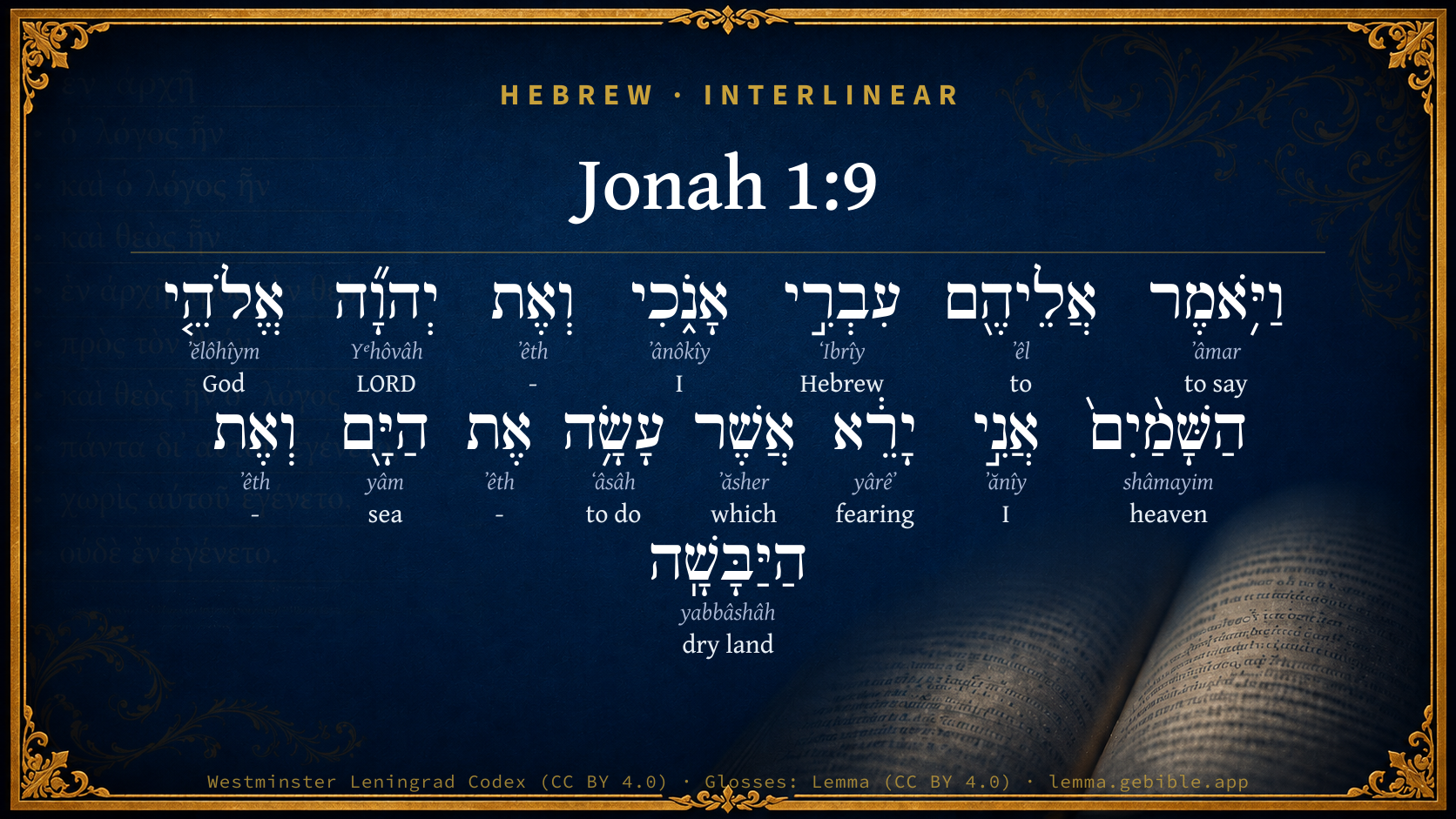
Hebrew (Westminster Leningrad Codex) Jonah 1:9 appears in the Hebrew Old Testament. The text above is from the Westminster Leningrad Codex. Each word links to its Strong’s number, a concise gloss, and parsing drawn from the Open Scriptures Hebrew Bible morphology. Click any word for its full Brown-Driver-Briggs (BDB) entry.
Download image
Cite this verse

Jonah 1:9 (World English Bible). Public Domain. Lemma interlinear Bible study tool, https://lemma.gebible.app/v/jonah/1/9.

Show BibTeX & RIS
BibTeX
RIS
English Translation
He said to them, "I am a Hebrew, and I fear Yahweh, the God of heaven, who has made the sea and the dry land."
World English Bible · Public Domain
Download a study sheet

One document with this verse’s original text, its word-by-word gloss line, the meaning frame, cross-references with their text, attributed commentary, and full source and license credits — printable, and it pastes into notes with its structure intact.

This verse Autodidact and up

Study sheet (.html) Plain text (.txt)

A passage Seminary Student

Up to 50 verses in one chapter. A passage sheet keeps up to 6 commentary sources and 12 cross-references per verse, in the order this page ranks them, and says so on the sheet whenever that leaves anything out. Ask for a single verse and you get the Autodidact verse sheet above.

Everything on this page stays free to read, with no account — the sheet is a download of what is already on screen, not access to it.

Want to remove ads? Support Godless Engineer
Compare translations 3

The same verse in 3 English versions, stacked beneath the original-language interlinear above. Click any original word for its lexicon entry.

Each is an independent rendering of the whole verse — the interlinear is not word-aligned to these translations.

Highlighted words mark where these versions differ — a whole-verse word diff, not a word-by-word alignment.

  • World English Bible Public Domain
    He said to them, "I am a Hebrew, and I fear Yahweh, the God of heaven, who has made the sea and the dry land."
  • King James Version Public Domain
    And he said unto them, I am an Hebrew; and I fear the LORD, the God of heaven, which hath made the sea and the dry land.
  • unfoldingWord Literal Text CC BY-SA 4.0
    So he said to them, “I am a Hebrew, and I fear Yahweh, the God of heaven, who has made the sea and the dry land.”

unfoldingWord Literal Text — © unfoldingWord, licensed CC BY-SA 4.0. Word-aligned USFM3 via Door43 (git.door43.org/unfoldingWord/en_ult).

Versions to compare (up to 4)

3 of 4 selected

Show all 18 translations

Every available English version of this verse, each an independent rendering of the whole verse.

  • World English Bible Public Domain
    He said to them, "I am a Hebrew, and I fear Yahweh, the God of heaven, who has made the sea and the dry land."
  • Berean Standard Bible Public Domain
    “I am a Hebrew,” replied Jonah. “I worship the LORD, the God of the heavens, who made the sea and the dry land.”
  • Majority Standard Bible Public Domain
    “I am a Hebrew,” replied Jonah. “I worship the LORD, the God of the heavens, who made the sea and the dry land.”
  • King James Version Public Domain
    And he said unto them, I am an Hebrew; and I fear the LORD, the God of heaven, which hath made the sea and the dry land.
  • American Standard Version (1901) Public Domain
    And he said unto them, I am a Hebrew; and I fear Jehovah, the God of heaven, who hath made the sea and the dry land.
  • Revised Version (1885) Public Domain
    And he said unto them, I am an Hebrew; and I fear the LORD, the God of heaven, which hath made the sea and the dry land.
  • Geneva Bible (1599) Public Domain
    And he answered them, I am an Ebrewe, and I feare the Lord God of heauen, which hath made the sea, and the dry lande.
  • Douay-Rheims (1899) Public Domain
    And he said to them: I am a Hebrew, and I fear the Lord the God of heaven, who made both the sea and the dry land.
  • Young's Literal Translation Public Domain
    And he saith unto them, `A Hebrew I `am', and Jehovah, God of the heavens, I am reverencing, who made the sea and the dry land.'
  • Literal Standard Version CC BY-SA 4.0
    And he says to them, “I—a Hebrew, and I fear YHWH, God of the heavens, who made the sea and the dry land.”
  • Unlocked Literal Bible CC BY-SA 4.0
    Jonah said to them, “I am a Hebrew; and I fear Yahweh, the God of heaven, who has made the sea and the dry land.”
  • unfoldingWord Literal Text CC BY-SA 4.0
    So he said to them, “I am a Hebrew, and I fear Yahweh, the God of heaven, who has made the sea and the dry land.”
  • Darby Bible Public Domain
    And he said unto them, I am a Hebrew, and I fear Jehovah, the God of the heavens, who hath made the sea and the dry [land].
  • World Messianic Bible Public Domain
    He said to them, “I am a Hebrew, and I fear the LORD, the God of heaven, who has made the sea and the dry land.”
  • Webster's Bible Public Domain
    And he said to them, I am a Hebrew; and I fear the LORD, the God of heaven, who hath made the sea and the dry land.
  • Free Bible Version CC BY-SA 4.0
    “I am a Hebrew,” Jonah replied, “and I worship the Lord, the God of the heavens, the sea, and the land.”
  • Bible in Basic English Public Domain
    And he said to them, I am a Hebrew, a worshipper of the Lord, the God of heaven, who made the sea and the dry land.
  • JPS Tanakh (1917) Public Domain
    And he said unto them: 'I am an Hebrew; and I fear the LORD, the God of heaven, who hath made the sea and the dry land.'

Literal Standard Version (2020), Covenant Press — licensed CC BY-SA 4.0. Text via the HelloAO Bible API (eBible.org). Unlocked Literal Bible (unfoldingWord) — licensed CC BY-SA 4.0. Text via the HelloAO Bible API (eBible.org). unfoldingWord Literal Text — © unfoldingWord, licensed CC BY-SA 4.0. Word-aligned USFM3 via Door43 (git.door43.org/unfoldingWord/en_ult). Free Bible Version, Dr. Jonathan Gallagher — licensed CC BY-SA 4.0. Text via the HelloAO Bible API (eBible.org).

Word by word

More ways to search: Search by grammar → Find every occurrence → Compare this word →

Practice this passage: Drill this verse → Learn its vocabulary →

הַיַּבָּשָֽׁה
yabbâshâh
H3004
“the · dry land”
Particle, Definite Article + Noun, Common, Feminine, Singular, Absolute
Part of Speech
Particle + Noun
Type
Common
Gender
Feminine
Number
Singular
State
Absolute
Full BDB Definition

Origin: from H3001

TWOT: 837b

dry land, dry ground
  1. וַיֹּ֥אמֶר ʼâmar H559 “and · to say” Conjunction + Verb, Qal, Sequential Imperfect, 3rd Person, Masculine, Singular
  2. אֲלֵיהֶ֖ם ʼêl H413 “to · them” Preposition + Suffix, Personal, 3rd Person, Masculine, Plural
  3. עִבְרִ֣י ʻIbrîy H5680 “Hebrew” Noun, Gentilic, Masculine, Singular, Absolute
  4. אָנֹ֑כִי ʼânôkîy H595 “I” Pronoun, Personal, 1st Person, Common, Singular
  5. וְאֶת ʼêth H853 “and · -” Conjunction + Particle, Direct Object
  6. יְהוָ֞ה Yᵉhôvâh H3068 “LORD” Noun, Proper
  7. אֱלֹהֵ֤י ʼĕlôhîym H430 “God(s) of” Noun, Common, Masculine, Plural, Construct
  8. הַשָּׁמַ֨יִם֙ shâmayim H8064 “the · heaven(s)” Particle, Definite Article + Noun, Common, Masculine, Plural, Absolute
  9. אֲנִ֣י ʼănîy H589 “I” Pronoun, Personal, 1st Person, Common, Singular
  10. יָרֵ֔א yârêʼ H3373 “fearing” Verb, Qal, Perfect, 3rd Person, Masculine, Singular
  11. אֲשֶׁר ʼăsher H834 “which” Particle, Relative
  12. עָשָׂ֥ה ʻâsâh H6213 “to do” Verb, Qal, Perfect, 3rd Person, Masculine, Singular
  13. אֶת ʼêth H853 “-” Particle, Direct Object
  14. הַיָּ֖ם yâm H3220 “the · sea” Particle, Definite Article + Noun, Common, Masculine, Singular, Absolute
  15. וְאֶת ʼêth H853 “and · -” Conjunction + Particle, Direct Object

About this verse

These counts appear in no published source. They are computed here, from the morphology-tagged text and Lemma’s own curated glosses. What Lemma adds →

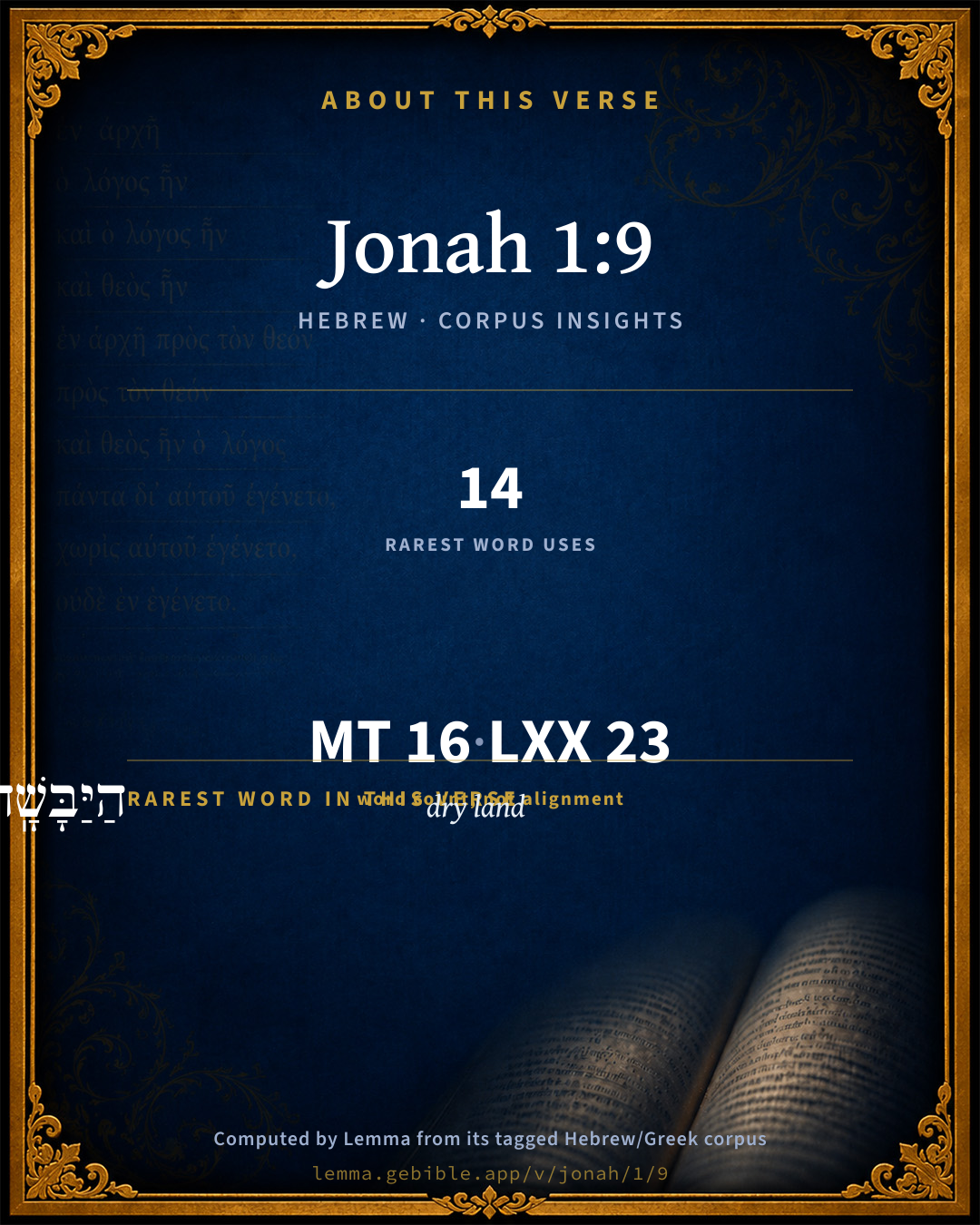
16
words
14
distinct lemmas
Prophets
section

Notable vocabulary

The rarest word here is הַיַּבָּשָֽׁה dry land H3004 — appearing just 14 times in the whole Hebrew Bible.

Shared distinctive vocabulary

הַיַּבָּשָֽׁה dry land H3004 occurs in 14 verses of the Hebrew Bible. Also found in:

Grammatical profile

  • 3 verbs
  • 6 nouns
  • 2 pronouns
  • 1 preposition
  • 4 particles

Verb forms

  • וַיֹּ֥אמֶר Qal · Sequential Imperfect
  • יָרֵ֔א Qal · Perfect
  • עָשָׂ֥ה Qal · Perfect

Hebrew & Septuagint length

In English translation the verse runs 25 words from the Hebrew and 28 from the Septuagint (LXX English) — closely comparable.

A rough comparison of the two English renderings, which tokenize alike — not a word-level alignment.

Word counts can differ between the Hebrew and the Greek without any difference in meaning — e.g. the Hebrew direct-object marker אֵת has no separate Greek word, and Greek often adds the article ὁ.

In the original languages it is 16 Hebrew tokens and 23 Greek tokens — but the two are counted differently (Hebrew bundles its prefixes and suffixes into one token; the Greek is in lemma form), so that isn’t a like-for-like length.

Cross-references

25

Topical passages linked to Jonah 1:9 in the Treasury of Scripture Knowledge — connected by theme and wording, ordered by reader-vote popularity; previews shown in the World English Bible.

  • Psalms 146:5–6 Happy is he who has the God of Jacob for his help, Whose hope is in Yahweh, his God:
  • Nehemiah 9:6 You are Yahweh, even you alone; you have made heaven, the heaven of heavens, with all their host, the earth and all things that are thereon, the seas and all that is in them, and you preserve them all; and the host of heaven worships you.
  • Psalms 95:5–6 The sea is his, and he made it. His hands formed the dry land.
  • Psalms 136:26 Oh give thanks to the God of heaven; For his loving kindness endures forever.
  • Nehemiah 1:4 It happened, when I heard these words, that I sat down and wept, and mourned certain days; and I fasted and prayed before the God of heaven,
  • Genesis 14:13 One who had escaped came and told Abram, the Hebrew. Now he lived by the oaks of Mamre, the Amorite, brother of Eshcol, and brother of Aner; and these were allies of Abram.
  • Genesis 39:14 that she called to the men of her house, and spoke to them, saying, "Behold, he has brought in a Hebrew to us to mock us. He came in to me to lie with me, and I cried with a loud voice.
  • 2 Kings 17:25 So it was, at the beginning of their dwelling there, that they didn't fear Yahweh: therefore Yahweh sent lions among them, which killed some of them.
  • 2 Kings 17:28 So one of the priests whom they had carried away from Samaria came and lived in Bethel, and taught them how they should fear Yahweh.
  • 2 Kings 17:32–35 So they feared Yahweh, and made to them from among themselves priests of the high places, who sacrificed for them in the houses of the high places.
  • Ezra 1:2 Thus says Cyrus king of Persia, All the kingdoms of the earth has Yahweh, the God of heaven, given me; and he has charged me to build him a house in Jerusalem, which is in Judah.
  • Ezra 5:11 Thus they returned us answer, saying, We are the servants of the God of heaven and earth, and are building the house that was built these many years ago, which a great king of Israel built and finished.
  • Ezra 7:12–13 Artaxerxes, king of kings, to Ezra the priest, the scribe of the law of the God of heaven, perfect and so forth.
  • Nehemiah 2:4 Then the king said to me, For what do you make request? So I prayed to the God of heaven.
  • Job 1:9 Then Satan answered Yahweh, and said, "Does Job fear God for nothing?
  • Daniel 2:18–19 that they would desire mercies of the God of heaven concerning this secret; that Daniel and his companions should nor perish with the rest of the wise men of Babylon.
  • Daniel 2:44 In the days of those kings shall the God of heaven set up a kingdom which shall never be destroyed, nor shall the sovereignty of it be left to another people; but it shall break in pieces and consume all these kingdoms, and it shall stand forever.
  • Hosea 3:5 Afterward the children of Israel shall return, and seek Yahweh their God, and David their king, and shall come with trembling to Yahweh and to his blessings in the last days.
  • Acts 14:15 "Men, why are you doing these things? We also are men of like passions with you, and bring you good news, that you should turn from these vain things to the living God, who made the sky and the earth and the sea, and all that is in them;
  • Acts 17:23–25 For as I passed along, and observed the objects of your worship, I found also an altar with this inscription: 'TO AN UNKNOWN GOD.' What therefore you worship in ignorance, this I announce to you.
  • Acts 27:23 For there stood by me this night an angel, belonging to the God whose I am and whom I serve,
  • Philippians 3:5 circumcised the eighth day, of the stock of Israel, of the tribe of Benjamin, a Hebrew of Hebrews; concerning the law, a Pharisee;
  • Revelation 11:13 In that day there was a great earthquake, and a tenth of the city fell. Seven thousand people were killed in the earthquake, and the rest were terrified, and gave glory to the God of heaven.
  • Revelation 15:4 Who wouldn't fear you, Lord, And glorify your name? For you only are holy. For all the nations will come and worship before you. For your righteous acts have been revealed."
  • Revelation 16:11 and they blasphemed the God of heaven because of their pains and their sores. They didn't repent of their works.

Cross-references courtesy of OpenBible.info (CC BY 4.0).

Hebrew and Greek witnesses Masoretic Hebrew ↔ Greek Septuagint

The same verse in the two great witnesses to the Old Testament, shown verse-for-verse.

These are two independent witnesses, not word-aligned to each other, and the Septuagint is shown in lemma (dictionary) form.

Hebrew Jonah 1:9 Masoretic · Westminster Leningrad Codex

וַיֹּ֥אמֶר אֲלֵיהֶ֖ם עִבְרִ֣י אָנֹ֑כִי וְאֶת יְהוָ֞ה אֱלֹהֵ֤י הַשָּׁמַ֨יִם֙ אֲנִ֣י יָרֵ֔א אֲשֶׁר עָשָׂ֥ה אֶת הַיָּ֖ם וְאֶת הַיַּבָּשָֽׁה

He said to them, "I am a Hebrew, and I fear Yahweh, the God of heaven, who has made the sea and the dry land."

World English Bible · Public Domain

Greek LXX Jonah 1:9 Septuagint · lemma form

καί εἶπον πρός αὐτός δοῦλος κύριος ἐγώ εἰμί καί ὁ κύριος θεός ὁ οὐρανός ἐγώ σέβομαι ὅς ποιέω ὁ θάλασσα καί ὁ ξηρός

And he said to them, I am a servant of the Lord; and I worship the Lord God of heaven, who made the sea, and the dry land.

LXX2012 (modern English Septuagint) · Public Domain

On this verse, Keil & Delitzsch discusses the Septuagint’s reading. Read the note in Commentary ↓

Hebrew: Westminster Leningrad Codex (CC BY 4.0). Greek: Septuagint (public domain); English from LXX2012 (modern English Septuagint) (Public Domain). How the Septuagint differs from the Hebrew →

Targum (Aramaic paraphrase)

1

The Targum is the ancient Jewish Aramaic paraphrase of the Hebrew Scriptures — an interpretive translation, not the Hebrew text itself. Onkelos (literal) and Pseudo-Jonathan (expansive) render the Torah, and Jonathan the Prophets. Coverage is partial: where no permissively-licensed English translation exists for a verse, only the Aramaic is shown. This is verse-level text, not a word-by-word alignment to the Hebrew.

  1. Targum Jonathan Prophets (Joshua–Malachi)
    וַאֲמַר לְהוֹן יְהוּדָאָה אֲנָא וּמִן קֳדָם יְיָ אֱלָהָא דִשְׁמַיָא אֲנָא דָחֵל דַעֲבַד יַת יַמָא וְיַת יַבֶּשְׁתָּא:

    And he said to them, “A Jew am I, and before the LORD God of Heaven, who made the sea and the land, I revere.”

    Targum Jonathan — Aramaic: “Mikraot Gedolot” (public domain). English: “Sefaria Community Translation” (CC0 1.0 (public-domain dedication)); “London "Chaldee Paraphrase," 1871” (public domain). Text via Sefaria.

Commentary

Notes on Jonah 1:9 from classic Christian and Jewish commentators (each source and its license shown beneath its notes). The classic Christian expositions comment on the surrounding passage and are grouped to its opening verse, so a note may address several verses; the Jewish commentaries on the Tanakh (Rashi and others) are per-verse, so they appear only where the commentator wrote on this verse.

Lemma curates 59 commentaries, every one of them public domain or Creative Commons licensed, each selected and text-cleaned for this edition rather than reprinted as found. About our sources →

Trapp's Complete Commentary

John Trapp

Jon 1:9 And he said unto them, I [am] an Hebrew; and I fear the LORD, the God of heaven, which hath made the sea and the dry [land].

Ver. 9. And he said unto them, I am an Hebrew] i.e. A true believer, as was Eber the patriarch, Gen 10:21, and, after him, Abram the Hebrew, as he is called, Gen 14:13. This name of Hebrews, as it was the first title given to Abraham and his seed, so it endureth one of the last, 2Co 11:22 Php 3:5; Epistle to the Hebrews, title.

And I fear the Lord God of heaven] That is mine occupation; "I serve God with my spirit in the gospel of his Son," as Paul hath it, Rom 1:9. Every faithful minister is servant to the King of heaven, Act 27:23 (this the devil could not deny, Act 16:16-17); neither is he of his meaner or inferior servants, of his underlings, but of the noblest employment; ministers are his stewards, ambassadors, paranymphs, or spokesmen, &c., and this is their occupation, or their work; far beyond that of Solomon’s servants.

Which hath made the sea and the dry land] This troublesome sea that now so threateneth you, and that dry land which you would so fain recover. These, with all their contents, are his creatures; neither did he make them, and then leave them to fate or fortune, as a carpenter leaves the house he hath built to others, or a shipwright the ship; but he ordereth and ruleth them at his pleasure, and will unmake all again rather than have his people lack help in one season, Psa 124:8; Psa 134:3. This was part of Jonah’s confession, and but part of it; for he told them (no doubt) how ill he had dealt with this great and good God, running away by stealth from his Master’s service, and detracting his yoke, and that, therefore, he was justly apprehended and adjudged to death. To this purpose was Jonah’s confession, quae ei salutis fuit exordium, saith Mercer, which was the beginning of his safety and salvation. Now his hard heart is broken, and his dumb mouth opened, not only to confess his offence, but to aggravate it; in that being not only a Hebrew of the Hebrews, a member of the true Church, but a prophet, a doctor in Israel, he should deal so perversely and perfidiously. It is a sweet happiness when sin swells as a toad in a man’s eyes, and he can freely confess it in the particulars, and with utmost aggravation; laying open "all his transgressions in all his sins," as Moses phraseth it, Lev 16:21. Affliction sanctified will bring a soul to this, as here it did the prophet; like herein to that helve Elisha cast into the water, that fetched up the iron that was in the bottom.

John Trapp, A Commentary or Exposition upon All the Books of the Old and New Testament (1647–1656) — public domain. Text from a community e-Sword module.

The Biblical Illustrator

Joseph S. Exell

Jon_1:9

I am a Hebrew, and I fear the Lord.

Jonahs confession

I. The advantage of being born and educated in some countries above others. Consider them both in a natural and in a spiritual sense. Some countries place their inhabitants under serious disabilities. The conditions are most deplorable when mens bodies draw the yoke of slavery, and minds are destitute of common civility, as well as of all true conceptions concerning God or religion. What then are the natural advantages into which we are born? And how great are the spiritual advantages?

II. The greatest happiness men can receive doth arise from their being numbered among those people who fear the Lord. This happiness is best demonstrated by comparison with the enjoyments of other people and nations. That this happiness may abide for ever with us, we are obliged--

1. To keep up a friendly society and correspondence with all men.

2. We are more particularly engaged to love and help one another, as fellow-countrymen. (John Hartcliffe, M. A.)

The confession and its sequel

Here is Jonah at the bar of inquiry. Conscience brings every man there. There is a present judgment-seat as well as a future. Observe--

1. The interrogators. Heathen sailors.

2. The prisoner at the bar. A prophet of Israel. A degrading position to be in.

3. The investigation. It was kind, considerate, circumstantial.

The verse 9 sets forth the elicited confession., Confession is a relief, a necessity, and a Divine condition of forgiveness: Here it was ingenious, contrite, humiliating, God-honouring. Verse 10 suggests that Gods terribleness, as seen in His judgments on sin, inspires the greatest terror. This prompts to earnest inquiry. Verses 11-15 set forth the humanity of the jeopardised heathen crew and the self-sentencing of Jonah. Their conduct shows great caution, tenderness, sympathy, moral change. There was earnest prayer; reluctance to touch Gods anointed; recognition of the Divine Sovereignty. The self-sentencing of Jonah was the result of conscious demerit. Learn--

1. That no sinner visited with Divine judgments is justified in taking his own life.

2. When God intends to execute judgments.

3. That in executing sentence against transgressors we should be certified it is in harmony with the will of God. Verse 16 indicates the moral effects of the whole phenomena on the sailors. They feared, sacrificed, vowed.

Verse 17 sets forth justice attempered by mercy through miracle. Learn that--

1. Irrational creatures, as well as inanimate creation, are subject to Divine control.

2. That we may alight on the mercy of God at the most unexpected hour and in the most unlikely place.

3. That partial deliverance is Divinely intended to exercise and develop faith.

4. That salvation shall be wrought for the penitent if it necessitate a departure from the ordinary course of things. (J. O. Keen, D. D.)

The Biblical Illustrator, edited by Joseph S. Exell (c. 1880s–1900s) — public domain. Text from a community e-Sword module.

Joseph Benson's Commentary

Jon 1:9-10. And he said, I am a Hebrew — One descended from Heber, whose offspring by Abraham are well known. And I fear the Lord — Or rather JEHOVAH, the God of heaven, Jehovah being the peculiar name of the true God, by which he was distinguished from those who had the name of gods and lords among the heathen. Which hath made the sea and the dry land — These words, as Mr. Locke observes, are a further distinction between the true God and the gods of the heathen; as if he had said, I worship and serve the one living and true God; that eternal and almighty Being, who made and ruleth the heavens and the earth, and all creatures therein. Then were the men exceedingly afraid — And with good reason, for they perceived that God was against them, even the God that made the world and governs all things, and that this tempest proceeded from his offended justice. Hence they inferred that their case was perilous in the extreme. And having learned from Jonah that he had disobeyed this Almighty God, and fled from his presence, they said unto him, Why hast thou done this? — How couldst thou dare to behave in such a manner, or disobey his commands, whom thou acknowledgest to be so great and powerful a Being, and Lord of all?

Joseph Benson's Commentary on the Old and New Testaments (1811–1818) — public domain. Text from a community e-Sword module.

Keil & Delitzsch

C. F. Keil & F. Delitzsch

Jonah begins by answering the last question, saying that he was "a Hebrew," - the name by which the Israelites designated themselves in contradistinction to other nations, and by which other nations designated them (see at Gen 14:13, and my Lehrbuch der Einleitung, 9, Anm. 2) - and that he worshipped "the God of heaven, who created the sea and the dry" (i.e., the land). ירא has been rendered correctly by the lxx σέβομαι, colo, revereor; and does not mean, "I am afraid of Jehovah, against whom I have sinned" (Abarbanel). By the statement, "I fear," etc., he had no intention of describing himself as a righteous or innocent man (Hitzig), but simply meant to indicate his relation to God - namely, that he adored the living God who created the whole earth and, as Creator, governed the world. For he admits directly after, that he has sinned against this God, by telling them, as we may see from Jon 1:10, of his flight from Jehovah. He had not told them this as soon as he embarked in the ship, as Hitzig supposes, but does so now for the first time when they ask about his people, his country, etc., as we may see most unmistakeably from Jon 1:10. In Jon 1:9 Jonah's statement is not given completely; but the principal fact, viz., that he was a Hebrew and worshipped Jehovah, is followed immediately by the account of the impression which this acknowledgement made upon the heathen sailors; and the confession of his sin is mentioned afterwards as a supplement, to assign the reason for the great fear which came upon the sailors in consequence. מה־זּאת עשׂית, What hast thou done! is not a question as to the nature of his sin, but an exclamation of horror at his flight from Jehovah, the God heaven and earth, as the following explanatory clauses כּי ידעוּ וגו clearly show. The great fear which came upon the heathen seamen at this confession of Jonah may be fully explained from the dangerous situation in which they found themselves, since the storm preached the omnipotence of God more powerfully than words could possibly do.

Keil & Delitzsch — Biblical Commentary on the Old Testament (1861–1891) — public domain (CC PDM 1.0). Text via the HelloAO Bible API. (Old Testament only.)

Tyndale Open Study Notes

Tyndale Open Resources

1:9 a Hebrew: See also Gen 41:12; Exod 1:15; 2:11. • Jonah worshiped the Lord, who in contrast to the sailors’ false gods made the sea and the land, and thus controlled them. Many gods were believed to have jurisdiction over specific realms and functions. The designation God of heaven likely conveyed the superiority of that deity over all others, as heaven is the highest realm. The Old Testament consistently proclaims that the Lord alone is the one true God (see, e.g., Deut 6:4), while at times adopting language that reflects his superiority to the false gods that occupied the imaginations of pagan peoples (see Ps 95:3-5).

Tyndale Open Study Notes — © Tyndale Open Resources, licensed CC BY-SA 4.0. Text via the HelloAO Bible API.

Jamieson, Fausset & Brown

Robert Jamieson, A. R. Fausset & David Brown

I am an Hebrew--He does not say "an Israelite." For this was the name used among themselves; "Hebrew," among foreigners (; ).

I fear the Lord--in profession: his practice belied his profession: his profession aggravated his guilt.

God . . . which . . . made the sea--appropriately expressed, as accounting for the tempest sent on the sea. The heathen had distinct gods for the "heaven," the "sea," and the "land." Jehovah is the one and only true God of all alike. Jonah at last is awakened by the violent remedy from his lethargy. Jonah was but the reflection of Israel's backsliding from God, and so must bear the righteous punishment. The guilt of the minister is the result of that of the people, as in Moses' case (). This is what makes Jonah a suitable type of Messiah, who bore the imputed sin of the people.

Jamieson, Fausset & Brown — Commentary Critical and Explanatory on the Whole Bible (1871) — public domain (CC PDM 1.0). Text via the HelloAO Bible API.

Adam Clarke's Commentary

Verse 9. I fear the Lord] In this Jonah was faithful. He gave an honest testimony concerning the God he served, which placed him before the eyes of the sailors as infinitely higher than the objects of their adoration; for the God of Jonah was the God of heaven, who made the sea and the dry land, and governed both. He also honestly told them that he was fleeing from the presence of this God, whose honourable call he had refused to obey. See Jon 1:10.

Adam Clarke's Commentary on the Bible (1810–1826) — public domain. Text from a community e-Sword/MySword module.

John Calvin's Commentaries

I now come to his answer, He said to them, I am an Hebrew; and I fear Jehovah the God of heaven, Who has created the sea and the dry land Here Jonah seemed as yet to evade, yea, to disown his crime, for he professed himself to be the worshipper of the true God. Who would not have said, but that he wished here to escape by a subterfuge, as he set up his own piety to cover the crime before-mentioned? But all things are not here in the first verse related; for shortly after, it follows, that the sailors knew of Jonah’s flight; and that he had himself told them, that he had disobeyed God’s call and command. There is then no doubt but that Jonah honestly confessed his own sin, though he does not say so. But we know, that it is a mode of speaking common among the Hebrews to add in the last place what had been first said; and grammarians say, that it is ὕστερον προτερον, (last first,) when anything is left out in its proper place and then added as an explanation. When therefore Jonah says that he was an Hebrew, and worshipper of the true God, — this tended to aggravate his fault or crime rather than to excuse it: for had he said only, that he was conscious of having done wrong in disobeying God, his crime would not have appeared so atrocious; but when he begins by sayings that known to him was the true God, the framer of heaven and earth, the God of Israel, who had made himself known by a law given and published, — when Jonah made this introduction, he thereby removed from himself all pretenses as to ignorance and misconception. He had been educated in the law, and had, from childhood, been taught who the true God was. He could not then have fallen through ignorance; and further, he did not, as the others, worship fictitious gods; he was an Israelite. As then he had been brought up in true religion, his sin was the more atrocious, inasmuch as he had fallen away from God, having despised his command, and, as it were, shaken off the yoke, and had become a fugitive.

We now then perceive the reason why Jonah called himself here an Hebrew, and testified that he was the worshipper of the true God. First, by saying that he was an Hebrew, he distinguished the God of Abraham from the idols of the Gentiles: for the religion of the chosen people was well known in all places, though disapproved by universal consent; at the same time, the Cilicians and other Asiatics, and also the Grecians, and the Syrians in another quarter, — all these knew what the Israelites gloried in, — that the true God had appeared to their father Abraham, and then made with him a gratuitous covenant, and also had given the law by Moses; — all this was sufficiently known by report. Hence Jonah says now, that he was an Hebrew, as though he had said, that he had no concern with any fictitious god, but with the God of Abraham, who had formerly appeared to the holy Fathers, and who had also given a perpetual testimony of his will by Moses. We see then how emphatically he declared, that he was an Hebrew: secondly, he adds, I fear Jehovah the God of heaven. By the word fear is meant worship: for it is not to be taken here as often in other places, that is, in its strict meaning; but fear is to be understood for worship: “I am not given”, he says, “to various superstitions, but I have been taught in true religion; God has made himself known to me from my childhood: I therefore do not worship any idol, as almost all other people, who invent gods for themselves; but I worship God, the creator of heaven and earth.” He calls him the God of heaven, that is, who dwells alone as God in heaven. While the others thought heaven to be filled with a great number of gods, Jonah here sets up against them the one true God, as though he said, “Invent according to your own fancy innumerable gods, there is yet but one, who possesses the highest authority in heaven; for it is he who made the sea and the dry land. ”

We now then apprehend what Jonah meant by these words: he shows here that it was no wonder that God pursued him with so much severity; for he had not committed a slight offense, but a fatal sin. We now see how much Jonah had profited since the Lord had begun severely to deal with him: for inasmuch as he was asleep yea, and insensible in his sin, he would have never repented had it not been for this violent remedy. But when the Lord roused him by his severity, he then not only confessed that he was guilty, or owned his guilt in a formal manner, (defunctorie — as ridding one’s self of a business, carelessly;) but also willingly testified, as we see, before men who were heathens, that he was the guilty man, who had forsaken the true God, in whose worship he had been well instructed. This was the fruit of true penitence, and it was also the fruit of the chastisement which God had inflicted on him. If then we wish God to approve of our repentance, let us not seek evasions, as for the most part is the case; nor let us extenuate our sins, but by a free confession testify before the whole world what we have deserved.

John Calvin's Commentaries (1540-1563) — public domain. Text from the Calvin Translation Society English edition (1840s-50s) via the Christian Classics Ethereal Library (ccel.org). Calvin's coverage is partial (roughly two-thirds of the Bible); uncommented books and verses are honest gaps, never fabricated. The 19th-century editor's footnotes and remarks are omitted so the notes are faithfully Calvin's own voice.

Ellicott's Commentary for English Readers

(9) And he said . . .—“The emergency recalls Jonah to his true self. All the better part of his character now comes out. His conduct throughout the remainder of the chapter is dignified and manly, worthy of a servant and prophet of Jehovah” (Perowne).

I am a Hebrew.—The original order is more striking, A Hebrew I. The LXX. read, “a servant of the Lord.”

Which hath made . . .—These words mark the great change that has already come upon the prophet. He feels now how futile it was to try to hide or fly from the Creator of all the universe. But he speaks also for the sake of the crew, who, though recognising the existence of Jehovah as the tribal God of Israel, had never realised His relation to themselves as Creator of the world in which they lived, and of the sea on which they sailed. The storm preached the omnipotence of God.

A Bible Commentary for English Readers, edited by Charles John Ellicott (1878–1897) — public domain. Text from a community e-Sword module.

The Cambridge Bible for Schools and Colleges

gen. ed. J. J. S. Perowne

9. The emergency recalls Jonah to his true self. All the better part of his character now comes out. His conduct throughout the remainder of the chapter is dignified and manly, worthy of a servant and prophet of Jehovah.

a Hebrew] This is the name by which the Jews were known to foreigners (comp. the use of it by Juvenal and other classical writers). It is quite in keeping with Biblical usage that Jonah employs it in describing himself to the heathen sailors. Had he been addressing one of his own countrymen, he would have spoken of himself as an Israelite.

I fear the Lord] Rather, I fear Jehovah. They knew already (Jon_1:10) that he was a worshipper of Jehovah, and that he had offended Him, and was fleeing from His presence. But hitherto they had only looked upon Jehovah as a god, one of many, with whom they had no concern. Comp. Pharaoh’s contemptuous question, “Who is Jehovah, that I should obey his voice, to let Israel go? I know not Jehovah, neither will I let Israel go.” Exo_5:2. Now, however, when Jonah added that Jehovah was the God of heaven, who had made the sea and the dry land, while the tempest raged still to confirm his words, “The men were exceedingly afraid.”

The Cambridge Bible for Schools and Colleges (gen. ed. J. J. S. Perowne; Cambridge University Press, 1878–1918) — public domain. Text from a community e-Sword module.

John Gill's Exposition

And he said unto them, I am an Hebrew,.... He does not say a Jew, as the Targum wrongly renders it; for that would have been false, since he was of the tribe of Zebulun, which was in the kingdom of Israel, and not of Judah; nor does he say an Israelite, lest he should be thought to be in the idolatry of that people; but a Hebrew, which was common to both; and, besides, it not only declared what nation he was of, but what religion he professed, and who was his God:

and I fear the Lord, the God of heaven, which hath made the sea and the dry land; this answers to the other question, what was his occupation or business? he was one that feared the Lord, that served and worshipped him; a prophet of the great God, as Josephus (g) expresses and so Kimchi; the mighty Jehovah, that made the "heavens", and dwells in them; and from whence that storm of wind came, which had so much distressed the ship, and still continued: and who made the "sea", which was now so boisterous and raging, and threatened them with ruin; and "the dry land", where they would be glad to have been at that instant. By this description of God, as the prophet designed to set him forth in his nature and works, so to distinguish him from the gods of Heathens, who had only particular parts of the universe assigned to them, when his Jehovah was Lord of all; but where was the prophet's fear and reverence of God when he fled from him, and disobeyed him? it was not lost, though not in exercise.

(g) Antiqu. l. 9. c. 10. sect. 2.

John Gill's Exposition of the Whole Bible (1746–1763) — public domain (CC PDM 1.0). Text via the HelloAO Bible API.

Albert Barnes' Notes on the Bible

I am an Hebrew - This was the name by which Israel was known to foreigners. It is used in the Old Testament, only when they are spoken of by foreigners, or speak of themselves to foreigners, or when the sacred writers mention them in contrast with foreigners . So Joseph spoke of his land Gen 40:15, and the Hebrew midwives Exo 1:19, and Moses’ sister Exo 2:7, and God in His commission to Moses Exo 3:18; Exo 7:16; Exo 9:1 as to Pharaoh, and Moses in fulfilling it Exo 5:3. They had the name, as having passed the River Euphrates, “emigrants.” The title might serve to remind themselves, that they were “strangers” and “pilgrims,” Heb 11:13. whose fathers had left their home at God’s command and for God , “passers by, through this world to death, and through death to immortality.”

And I fear the Lord - , i. e., I am a worshiper of Him, most commonly, one who habitually stands in awe of Him, and so one who stands in awe of sin too. For none really fear God, none fear Him as sons, who do not fear Him in act. To be afraid of God is not to fear Him. To be afraid of God keeps men away from God; to fear God draws them to Him. Here, however, Jonah probably meant to tell them, that the Object of his fear and worship was the One Self-existing God, He who alone is, who made all things, in whose hands are all things. He had told them before, that he had fled “from being before Yahweh.” They had not thought anything of this, for they thought of Yahweh, only as the God of the Jews. Now he adds, that He, Whose service he had thus forsaken, was “the God of heaven, Who made the sea and dry land,” that sea, whose raging terrified them and threatened their lives. The title, “the God of heaven,” asserts the doctrine of the creation of the heavens by God, and His supremacy.

Hence, Abraham uses it to his servant Gen 24:7, and Jonah to the pagan mariners, and Daniel to Nebuchadnezzar Dan 2:37, Dan 2:44; and Cyrus in acknowledging God in his proclamation 2Ch 36:23; Ezr 1:2. After his example, it is used in the decrees of Darius Ezr 6:9-10 and Artaxerxes Ezr 7:12, Ezr 7:21, Ezr 7:23, and the returned exiles use it in giving account of their building the temple to the Governor Ezr 5:11-12. Perhaps, from the habit of contact with the pagan, it is used once by Daniel Dan 2:18 and by Nehemiah Neh 1:4-5; Neh 2:4, Neh 2:20. Melchizedek, not perhaps being acquainted with the special name, Yahweh, blessed Abraham in the name of “God, the Possessor” or “Creator of heaven and earth” Gen 14:19, i. e., of all that is. Jonah, by using it, at once taught the sailors that there is One Lord of all, and why this evil had fallen on them, because they had himself with them, the renegade servant of God. “When Jonah said this, he indeed feared God and repented of his sin. If he lost filial fear by fleeing and disobeying, he recovered it by repentance.”

Albert Barnes' Notes on the Bible (1834–1885) — public domain. Text from a community e-Sword/MySword module.

Haydock's Catholic Bible Commentary

Fear, and therefore fly from the face of the Lord, ver. 3, 10. (Haydock) --- He knew that God is every where, ver. 3., and Psalm cxxxiii. 8. (Calmet) --- Septuagint, "I worship." Fear is often taken in this sense. (Haydock)

George Leo Haydock (1774–1849), Haydock's Catholic Family Bible and Commentary, 1859 edition — public domain. Excludes Psalms (Douay-Rheims chapter numbering differs from Protestant) and Deuterocanonical books (Catholic canon only).

Matthew Poole's English Annotations

And he said unto them; Jonah freely and readily gives account of himself.

I am a Hebrew; one that am descended from Heber, whose offspring by Abraham are well known, and probably to these mariners: he saith not, a Jew, because he was not in strictness of speech, for he was of the tribe of Zebulun; nor an Israelite, distinguished from the Jew, lest he should seem to own himself of that idolatrous faction.

I fear; I worship and serve the true God only; or possibly it may imply that his employment was in the immediate. service of God, as a religious person that had abdicated the world, and dedicated himself to God.

The Lord; the eternal and almighty God; yours are upstart gods, and have no power or might, nor can they do any thing.

The God of heaven; who first made, now ruleth, and ever will rule the heavens, which none of your gods can pretend to, those heavens from whence you see this storm falleth.

Which hath made the sea; that sea which now threatens you for my sake, and threatens me for my sin; my God hath raised the sea in his quarrel to contend thus furiously, and he can, and none but he can, command it to be still. And the dry land; a description of the earth: you would get thither, but all your gods cannot bring you thither, or give you to set one foot upon it, if my God say no. This is the sum of what Jonah declares, by which he intimateth his innocency from any flagitious crime, as they might imagine him guilty, and yet confesseth the greatness of his sin, which he had before told them, though they understood it not, or thought light of it, he fled from the presence of the Lord.

Matthew Poole's English Annotations on the Holy Bible (1683–1685) — public domain. Text from a community e-Sword/MySword module.

The Pulpit Commentary

I am a Hebrew. This is the name used by foreigners in speaking of Israelites, or by Israelites in speaking of themselves to Gentiles. (see Gen_14:13 Gen_39:14 Gen_41:12 Exo_1:16 1Sa_4:6, for the former use; and for the latter, Gen_40:15 Exo_2:7 Exo_3:18) Convinced that God had miraculously pointed him out as the culprit on whose account the storm was sent, and goaded by the stings of conscience, Jonah loses all his previous indecision and spiritual stupor, and in a manly and straightforward way confesses the truth without disguise. The LXX, reading differently, renders, Doulov Kuriou eimi egw , "A servant of Jehovah am I" This makes a tautological statement with the next words, and leaves one of the sailors" questions unanswered. I fear the Lord. I worship, reverence (sebomai , Septuagint) Jehovah, who is not a local deity like the false gods whom you adore, but the Creator of heaven and earth, the Maker and Ruler of sea and dry land. So Abraham calls the Lord the God of heaven, (Gen_24:7) and Daniel (Dan_2:37, Dan_2:44) uses the same expression. (comp. Psa_96:5 Jer_10:11)

A good confession.

What an insight this story gives us into the life and habits of travellers in ancient times! Curiosity is always entertaining; but the inquisitiveness of these seamen bound for Tarshish, as they questioned their passenger regarding his occupation, his race, and his religion, is a revelation of their character, and affords an opportunity to the prophet to avow his religious faith. Jonah was not willing to obey God; yet he was not slow to confess God. There is much to admire in his language.

I IT WAS AN INTELLIGENT CONFESSION. God is to many little more than a name; religion merely a form of words. There are those who are satisfied to name the name of their hereditary deity. Jonah"s acknowledgment was accompanied by statements which prove his faith to have been something more than traditional. He described the Jehovah whom he worshipped as the God of heaven, the Maker of the sea and of the land. The words remind us of the opening of the Apostles" Creed. To confess God truly is to recognize his attributes and his method of dealing with the sons of men. It is not enough to utter mechanically a form of words.

II IT WAS A BOLD CONFESSION. Instead of being alarmed by the dangers of the deep, the prophet seemed now to recover the self-possession which he had lost. In the presence of the angry elements and the anxious sailors, and above all in the presence of the Lord of nature and of man, Jonah confessed his God. Was there in this conduct something of the spirit embodied in the words, "Though he slay me, yet will I trust in him"?

III IT WAS A REVERENT CONFESSION. "I fear the Lord;" i.e. revere, worship, and honor him. They who know him aright may well offer to him the veneration and adoration which angels delight to present. Who would not fear his great Name? Alas! that the name of God should ever pass irreverent lips!

IV IT WAS, HOWEVER, A CONFESSION WHICH WAS INCONSISTENT WITH THE PROPHET"S CONDUCT, AND WAS THEREFORE HIS CONDEMNATION. How was it that he, who so honourably confessed his God in the tempest, had fled from that God, and disobeyed his plain commands? Could he use this language and not feel that it censured himself for so acting as he had done? It is well that we should verbally acknowledge God, that we should sincerely confess his right over us. But it may be that when we recite our Creed, and make our confession, we shall learn to think of our frequent inconsistencies with the profession which we avow. The knowledge of God may bring us to the knowledge of ourselves; and confession may lead to penitence, and so to reconciliation.

The Pulpit Commentary (1880–1919), ed. H.D.M. Spence-Jones & Joseph S. Exell — public domain. Text from a community e-Sword module.

John Wesley's Explanatory Notes

I fear - I worship and serve the true God; the eternal and almighty God, who made and ruleth the heavens.

John Wesley, Explanatory Notes Upon the Whole Bible (1754–1765) — public domain. Text via the GEBible commentary corpus.

Fairbairn on Ezekiel, Jonah & the Pastoral Epistles

Patrick Fairbairn

We cannot but admire the frankness of Jonah’s confession of guilt, and his willing surrender to the claims of justice, when the temptations were so great to an opposite course—an evidence surely of something very different from a sophisticated mind or a seared conscience. When thus directly called in providence to consider his ways, we hear of no shuffling excuses or dishonest evasions, but only the unreserved utterance of a heart already conscious of its guilt, and itself the foremost to pronounce judgment on the offence. But the situation of Jonah, when so detected by the singular providence of God, and constrained to witness to his own condemnation, was of the most sad and humiliating description. “A righteous man,” says Solomon, “falling down before the wicked, is as a troubled fountain and a corrupt spring.” Here was a righteous man fallen in the worst sense—fallen from his righteousness: more than that, a prophet specially raised up and supernaturally endowed for advancing among men the interests of God’s kingdom—one who, by his wholesome instructions and exemplary character, should have been as a crystal spring, sending forth all around streams of living water, yet found an occasion of trouble and distress, a terror to himself and a bane to others! When the chief prophet of God to Israel, and his chosen representative to the world, lay thus prostrate as a detected and doomed sinner before a company of heathen mariners, how entirely did the foundations of the earth seem to be out of course! O unhappy Israel! have thy backslidings mounted so high as to reach even the ambassadors of heaven within thy borders? How near must thou be to destruction, when thy very lights are thus dimming their brightness, thy standard-bearers fainting and falling down in confusion before the heathen, who should have stood with awe in their presence, and, from fellowship with them, should have derived only life and blessing!

Such reflections naturally force themselves on our minds in connexion with so grievous a fall in the high places of Israel. The work of God required a man of high-strung energy and noble elevation of soul, and Jonah, at this stage of his career, proved inadequate to the occasion; he sinks like a fragile vessel beneath the burden which the Spirit of God had deemed it needful to impose on him. But he is not alone in the condemnation; he bears upon his soul the iniquities also of those with whom he is connected—Israel behind, and now Nineveh before; his miserable failure is but the reflection of their widespread degeneracy and manifold provocations, as was formerly the case with Moses at the waters of Meribah; (Deu 4:21. The Lord is there said to have been “angry with Moses for their sakes,” as it is in our version; but as it should rather be, “on account of their words,” viz., the murmuring and rebellious words they spoke at Meribah. What Hengstenberg has correctly noted on the connexion of Moses and Aaron with the guilt of the people, may substantially be applied also to Jonah: “The guilt of the leaders is plainly to be recognized as the result of that of the people. Without the unbelief of the latter, there had not been the exhibition of weakness on the part of the former. Faint and wearied by the long course of provocations, they were at last, in a moment of weakness, carried away by the stream of the popular spirit of defection.”— ( Authentie, ii. p. 426).) for it was his vexing and unfruitful connexion with a people bent on backsliding, that had brought such faintness upon his spirit and such back-sliding into his course; so that in his declension was proclaimed the solemn lesson, “the whole head is sick, the whole heart is faint.” This thought, however, was rather for Israel at large than for Jonah himself, since it could not properly excuse or justify, however it might in part account for, his present humiliating and perilous condition.

Patrick Fairbairn — An Exposition of Ezekiel (1851), Jonah (1849), and The Pastoral Epistles (1874) — public domain. Text from a community e-Sword module.

Scofield Reference Notes

C. I. Scofield

fear

(See Scofield "Psa 19:9")

The Scofield Reference Bible (1917 edition), notes by C. I. Scofield — public domain. Text from a community e-Sword module.

Lesson kit

Teaching starters — assembled from the data on this page, not authored interpretation. Every prompt links to the verse data it draws on. Edit before teaching.

Jonah, in the Prophets, opens this verse with 16 words (14 distinct Hebrew lemmas). Its most distinctive word is yabbâshâh (“dry land”). A historical commentator’s framing appears above. Read the whole chapter for the surrounding context.

Discussion questions

  1. How does “dry land” (yabbâshâh) shape what this verse is saying?
  2. Genesis 1:9 shares the word «dry land» with this verse. How do the two illuminate each other?
  3. These translations render this verse differently. What is at stake in choosing one wording over another?
  4. The verb «וַיֹּ֥אמֶר» is Qal Sequential Imperfect. How does its form color the action?
  5. Reading how Trapp's Complete Commentary and The Biblical Illustrator read this verse, where do the two commentators agree and where do they part?

Things to notice

Reading settings

Reading text

Shown beneath each verse's original-language words.

Old Testament
Old Testament edition

Read the OT as the Masoretic Hebrew (MT) or the Greek Septuagint (LXX).

English shown for the Greek Septuagint (in the Hebrew ↔ Greek comparison).

Comparing translations? Open the Compare panel on any verse page to stack up to four side by side.