
Psalms 111:5

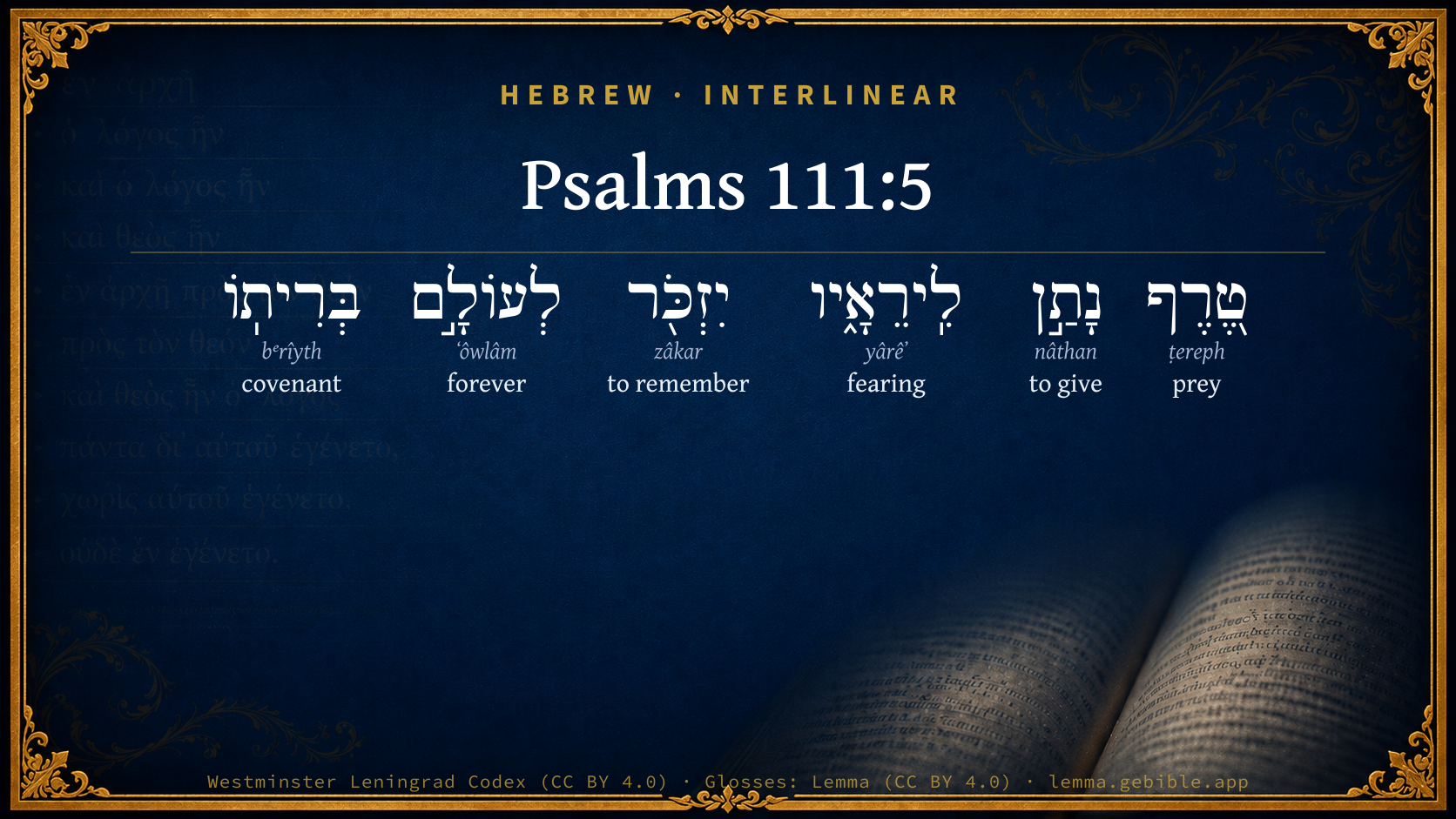
Hebrew (Westminster Leningrad Codex) Psalms 111:5 appears in the Hebrew Old Testament. The text above is from the Westminster Leningrad Codex. Each word links to its Strong’s number, a concise gloss, and parsing drawn from the Open Scriptures Hebrew Bible morphology. Click any word for its full Brown-Driver-Briggs (BDB) entry.
Download image
Cite this verse

Psalms 111:5 (World English Bible). Public Domain. Lemma interlinear Bible study tool, https://lemma.gebible.app/v/psalms/111/5.

Show BibTeX & RIS
BibTeX
RIS
English Translation
He has given food to those who fear him. He always remembers his covenant.
World English Bible · Public Domain
Download a study sheet

One document with this verse’s original text, its word-by-word gloss line, the meaning frame, cross-references with their text, attributed commentary, and full source and license credits — printable, and it pastes into notes with its structure intact.

This verse Autodidact and up

Study sheet (.html) Plain text (.txt)

A passage Seminary Student

Up to 50 verses in one chapter. A passage sheet keeps up to 6 commentary sources and 12 cross-references per verse, in the order this page ranks them, and says so on the sheet whenever that leaves anything out. Ask for a single verse and you get the Autodidact verse sheet above.

Everything on this page stays free to read, with no account — the sheet is a download of what is already on screen, not access to it.

Want to remove ads? Support Godless Engineer
Compare translations 3

The same verse in 3 English versions, stacked beneath the original-language interlinear above. Click any original word for its lexicon entry.

Each is an independent rendering of the whole verse — the interlinear is not word-aligned to these translations.

Highlighted words mark where these versions differ — a whole-verse word diff, not a word-by-word alignment.

  • World English Bible Public Domain
    He has given food to those who fear him. He always remembers his covenant.
  • King James Version Public Domain
    He hath given meat unto them that fear him: he will ever be mindful of his covenant.
  • unfoldingWord Literal Text CC BY-SA 4.0
    He gives food to those fearing him. He remembers his covenant forever.

unfoldingWord Literal Text — © unfoldingWord, licensed CC BY-SA 4.0. Word-aligned USFM3 via Door43 (git.door43.org/unfoldingWord/en_ult).

Versions to compare (up to 4)

3 of 4 selected

Show all 18 translations

Every available English version of this verse, each an independent rendering of the whole verse.

  • World English Bible Public Domain
    He has given food to those who fear him. He always remembers his covenant.
  • Berean Standard Bible Public Domain
    He provides food for those who fear Him; He remembers His covenant forever.
  • Majority Standard Bible Public Domain
    He provides food for those who fear Him; He remembers His covenant forever.
  • King James Version Public Domain
    He hath given meat unto them that fear him: he will ever be mindful of his covenant.
  • American Standard Version (1901) Public Domain
    He hath given food unto them that fear him: He will ever be mindful of his covenant.
  • Revised Version (1885) Public Domain
    He hath given meat unto them that fear him: he will ever be mindful of his covenant.
  • Geneva Bible (1599) Public Domain
    He hath giuen a portion vnto them that feare him: he wil euer be mindfull of his couenant.
  • Douay-Rheims (1899) Public Domain
    he hath given food to them that fear him. He will be mindful for ever of his covenant:
  • Young's Literal Translation Public Domain
    Prey He hath given to those fearing Him, He remembereth to the age His covenant.
  • Literal Standard Version CC BY-SA 4.0
    He has given prey to those fearing Him, || He remembers His covenant for all time.
  • Unlocked Literal Bible CC BY-SA 4.0
    He gives food to his faithful followers. He will always call to mind his covenant.
  • unfoldingWord Literal Text CC BY-SA 4.0
    He gives food to those fearing him. He remembers his covenant forever.
  • Darby Bible Public Domain
    He hath given meat unto them that fear him; he is ever mindful of his covenant.
  • World Messianic Bible Public Domain
    He has given food to those who fear him. He always remembers his covenant.
  • Webster's Bible Public Domain
    He hath given food to them that fear him: he will ever be mindful of his covenant.
  • Free Bible Version CC BY-SA 4.0
    He feeds those who respect him; he always remembers the agreement he made.
  • Bible in Basic English Public Domain
    He has given food to his worshippers; he will keep his agreement in mind for ever.
  • JPS Tanakh (1917) Public Domain
    He hath given food unto them that fear Him; He will ever be mindful of His covenant.

Literal Standard Version (2020), Covenant Press — licensed CC BY-SA 4.0. Text via the HelloAO Bible API (eBible.org). Unlocked Literal Bible (unfoldingWord) — licensed CC BY-SA 4.0. Text via the HelloAO Bible API (eBible.org). unfoldingWord Literal Text — © unfoldingWord, licensed CC BY-SA 4.0. Word-aligned USFM3 via Door43 (git.door43.org/unfoldingWord/en_ult). Free Bible Version, Dr. Jonathan Gallagher — licensed CC BY-SA 4.0. Text via the HelloAO Bible API (eBible.org).

Word by word

More ways to search: Search by grammar → Find every occurrence → Compare this word →

Practice this passage: Drill this verse → Learn its vocabulary →

About this verse

These counts appear in no published source. They are computed here, from the morphology-tagged text and Lemma’s own curated glosses. What Lemma adds →

6
words
6
distinct lemmas
Wisdom
section

Notable vocabulary

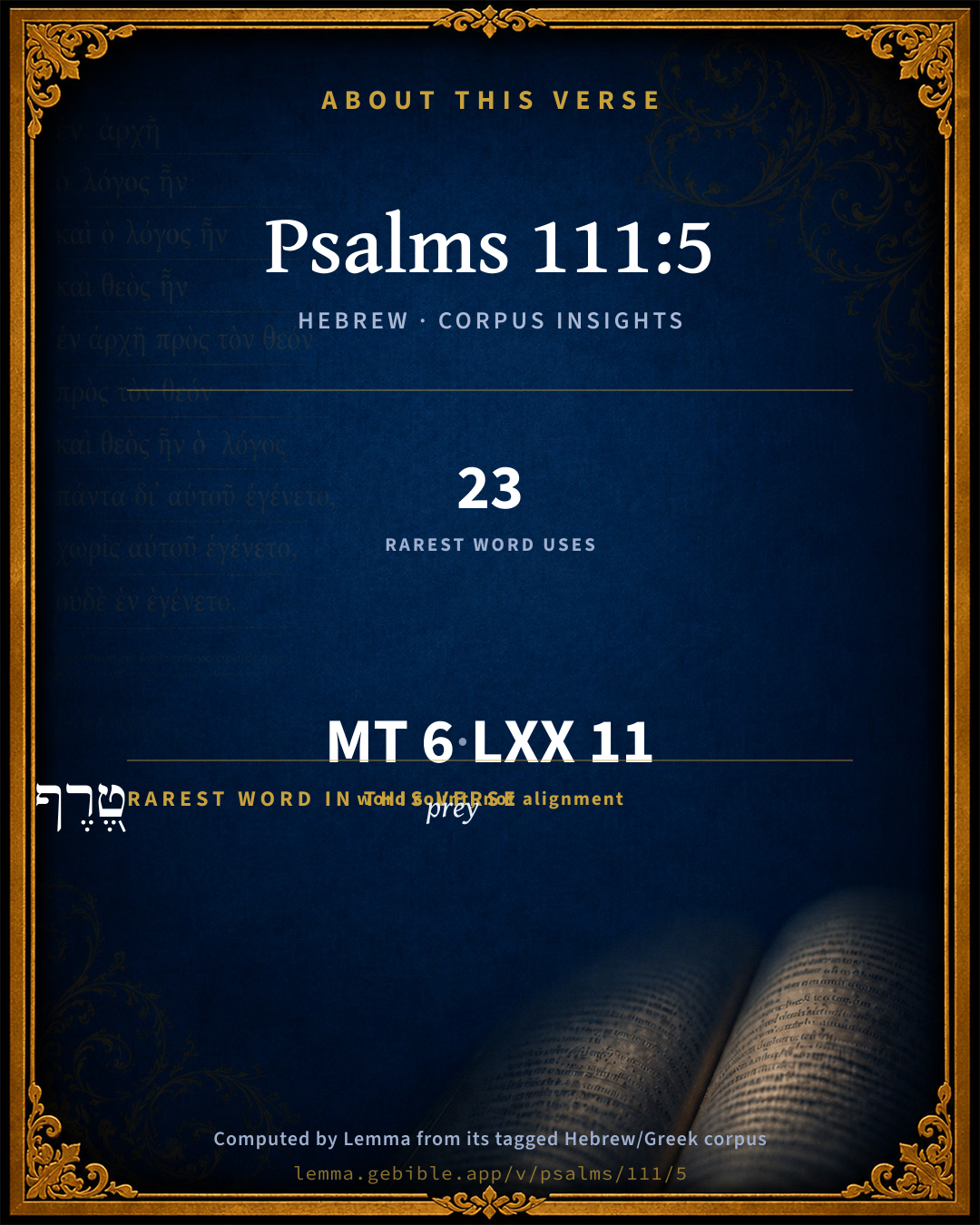
The rarest word here is טֶ֭רֶף prey H2964 — appearing just 23 times in the whole Hebrew Bible.

Shared distinctive vocabulary

טֶ֭רֶף prey H2964 occurs in 23 verses of the Hebrew Bible. Also found in:

Grammatical profile

  • 2 verbs
  • 3 nouns
  • 1 adjective

Verb forms

  • נָתַ֣ן Qal · Perfect
  • יִזְכֹּ֖ר Qal · Imperfect

Hebrew & Septuagint length

In English translation the verse runs 14 words from the Hebrew and 16 from the Septuagint (LXX English) — closely comparable.

A rough comparison of the two English renderings, which tokenize alike — not a word-level alignment.

Word counts can differ between the Hebrew and the Greek without any difference in meaning — e.g. the Hebrew direct-object marker אֵת has no separate Greek word, and Greek often adds the article ὁ.

In the original languages it is 6 Hebrew tokens and 11 Greek tokens — but the two are counted differently (Hebrew bundles its prefixes and suffixes into one token; the Greek is in lemma form), so that isn’t a like-for-like length.

Cross-references

11

Topical passages linked to Psalms 111:5 in the Treasury of Scripture Knowledge — connected by theme and wording, ordered by reader-vote popularity; previews shown in the World English Bible.

  • Psalms 105:8 He has remembered his covenant forever, The word which he commanded to a thousand generations,
  • Luke 1:72 To show mercy towards our fathers, To remember his holy covenant,
  • Nehemiah 1:5 and said, I beg you, Yahweh, the God of heaven, the great and awesome God, who keeps covenant and loving kindness with those who love him and keep his commandments:
  • Psalms 89:34 I will not break my covenant, Nor alter what my lips have uttered.
  • Psalms 106:45 He remembered for them his covenant, And repented according to the multitude of his loving kindnesses.
  • Daniel 9:4 I prayed to Yahweh my God, and made confession, and said, Oh, Lord, the great and dreadful God, who keeps covenant and loving kindness with those who love him and keep his commandments,
  • Matthew 6:26–33 See the birds of the sky, that they don't sow, neither do they reap, nor gather into barns. Your heavenly Father feeds them. Aren't you of much more value than they?
  • Psalms 34:9–10 Oh fear Yahweh, you his saints, For there is no lack with those who fear him.
  • Psalms 37:3 Trust in Yahweh, and do good. Dwell in the land, and enjoy safe pasture.
  • Isaiah 33:16 He shall dwell on high; his place of defense shall be the munitions of rocks; his bread shall be given [him]; his waters shall be sure.
  • Luke 12:30 For the nations of the world seek after all of these things, but your Father knows that you need these things.

Cross-references courtesy of OpenBible.info (CC BY 4.0).

Hebrew and Greek witnesses Masoretic Hebrew ↔ Greek Septuagint

The same verse in the two great witnesses to the Old Testament, shown verse-for-verse.

You’re reading Greek Psalm 110 (Hebrew Psalm 111). The Septuagint counts the superscription, so verse numbers can differ from the Hebrew — chapter-level alignment, not verse-by-verse. Numbering follows Rahlfs.

These are two independent witnesses, not word-aligned to each other, and the Septuagint is shown in lemma (dictionary) form.

Hebrew Psalms 111:5 Masoretic · Westminster Leningrad Codex

טֶ֭רֶף נָתַ֣ן לִֽירֵאָ֑יו יִזְכֹּ֖ר לְעוֹלָ֣ם בְּרִיתֽוֹ

He has given food to those who fear him. He always remembers his covenant.

World English Bible · Public Domain

Greek LXX Greek Psalm 110:5 Septuagint · lemma form

τροφή δίδωμι ὁ φοβέω αὐτός μιμνήσκω εἰς ὁ αἰών διαθήκη αὐτός

He has given food to them that fear him: he will remember his covenant for ever.

LXX2012 (modern English Septuagint) · Public Domain

Hebrew: Westminster Leningrad Codex (CC BY 4.0). Greek: Septuagint (public domain); English from LXX2012 (modern English Septuagint) (Public Domain). How the Septuagint differs from the Hebrew →

Commentary

Notes on Psalms 111:5 from classic Christian and Jewish commentators (each source and its license shown beneath its notes). The classic Christian expositions comment on the surrounding passage and are grouped to its opening verse, so a note may address several verses; the Jewish commentaries on the Tanakh (Rashi and others) are per-verse, so they appear only where the commentator wrote on this verse.

Lemma curates 59 commentaries, every one of them public domain or Creative Commons licensed, each selected and text-cleaned for this edition rather than reprinted as found. About our sources →

Trapp's Complete Commentary

John Trapp

Psa 111:5 He hath given meat unto them that fear him: he will ever be mindful of his covenant.

Ver. 5. He hath given meat] Heb. a prey, Escam demensam; as he did manna to the Israelites, to each a homer; so to all his he giveth food convenient for them, Pro 30:8, Cibum et potum, quae sunt divitiae Christianorum (Jerome).

He will ever be mindful of his covenant] To pass by his people’s sins, and to supply all their necessities; all his paths to such are not mercy only, but truth, Psa 25:10

John Trapp, A Commentary or Exposition upon All the Books of the Old and New Testament (1647–1656) — public domain. Text from a community e-Sword module.

The Biblical Illustrator

Joseph S. Exell

Psa_111:5

He hath given meat unto them that fear Him.

The Lords faithfulness in providing food for His people

Consider the text--

I. In its literal sense.

1. The work, on account of which the psalmist here calls upon us to praise God, is the supply of food; the furnishing us with those provisions which are necessary for the support and comfort of our bodies.

(1) They are the Lords gifts.

(2) They are special marks of the Lords favour to His people.

(3) They are proofs of the Lords faithfulness and truth.

2. Let us beseech Him to give us His grace, that we may receive with thankfulness, and enjoy with moderation, and use to His glory, those gifts of His providence, which He has been pleased to bestow on us; and that we may show forth His praise not only with our lips, but in our lives, by giving up ourselves to His service, and by walking before Him in holiness and righteousness all our days.

3. And let us learn to confide in Him for blessings to come.

II. In its figurative or spiritual meaning.

1. In this sense, the meat mentioned in the text signifies that meat of which our Saviour speaks when He directs us to labour for the meat which endureth unto everlasting life; namely, spiritual food, that food by which the soul is supported, strengthened, and refreshed.

2. And what, in this view of the text, is the covenant of which He will ever be mindful, but the covenant of grace: that spiritual covenant, well ordered in all things and sure, which God has made with every believer in Christ? The terms of this covenant are, Repent ye and believe the Gospel. Believe in the Lord Jesus Christ. And the promises of it are, Thou shalt be saved. Thou shalt have everlasting life. (E. Cooper, M.A.)

He will over be mindful of His covenant.--

The covenant

I. What is this covenant? If you go to a lawyer, and inquire how a deed runs, he may reply, I can give you an abstract, but I had better read it to you. He can tell you the sum and substance of it; but if you want to be very accurate, and it is a very important business, you will say, I should like to hear it read. We will now read certain passages of Scripture which contain the covenant of grace, or an abstract of it (Jer_31:31-34; Eze_11:19-20; Eze_36:25, etc.). Let us just go a little into detail about this. God has made a covenant with certain people that He will do all this for them, and in each case it is of pure grace. He will take away their stony hearts: it is clear from this promise that when He began with them they had stony hearts. He will forgive their iniquities: when He began with them they had many iniquities. He will give them a heart of flesh: when He began with them they had not a heart of flesh. He will turn them to keep His statutes: when He began with them they did not keep His statutes. They were a sinful, wilful, wicked, degenerate people, and He called to them many times to come to Him and repent, but they would not. Here He speaks like a king, and no longer pleads, but decrees. He says, I will do this and that to you, and you shall be this and that in return. Oh, blessed covenant! Oh, mighty, sovereign grace!

II. Have i any portion in it?

1. Are you in Christ? If so, you are saved in Him.

2. Have you faith? This is the mark, the seal, the badge of His chosen.

3. Have you been born again? Is the life that is in you a life given by God? The true life is not of the will of man, nor of blood, nor of natural excellence; but it comes by the working of the eternal Spirit, and is of God. If you have this life you are in the covenant, for it is written, In Isaac shall thy seed be called. The children of the promise, these are counted for the seed.

III. If indeed we can believe upon the good evidence of Gods Word that we are of the seed with whom the covenant was made in Christ Jesus, then every blessing of the covenant will come to us. I will put it a little more personally--every blessing of the covenant will come to you.

1. God cannot lie, cannot deny Himself.

2. God made the covenant freely. If He had not meant to keep it, He would not have made it.

3. On the covenant document there is a seal--the blood of the Son of God.

4. God delights in the covenant, so we are sure He will not run back from it.

5. God has sealed the covenant with an oath (Heb_6:18). (C. H. Spurgeon.)

Covenant blessings

I. The gift: He hath given meat. We are to understand this expression, of course in a twofold sense, of our necessities; the first, temporal, the other, spiritual.

II. The covenant. The covenant of grace is a covenant without any conditions on our part whatever, of any sort, in any form, or any fashion. The covenant, in fact, is not made between us and God; it is made between God and Christ, our Representative. All the conditions of that covenant are fulfilled, so that there are none left for us to fulfil. The conditions were that Christ should suffer, and He has suffered; that Christ should obey, and He has obeyed. God will not suffer one single promise of the covenant to be unfulfilled, nor one single blessing of the covenant to be kept back.

III. The character of the persons here referred to: them that fear Him. Those who fear the Lord are in the covenant of His grace. If we fear Him, we may believe that He will ever give meat unto us, and that He will always keep His covenant towards us which He has made for us in Christ Jesus our Lord. (C. H. Spurgeon.)

The Biblical Illustrator, edited by Joseph S. Exell (c. 1880s–1900s) — public domain. Text from a community e-Sword module.

Joseph Benson's Commentary

Psa 111:5-6. He hath given meat — All necessary provisions for their being and well-being; unto them that fear him — To the Israelites, the only people in the world that feared and worshipped the true God according to his will, and especially to those among them that truly feared him, and, for their sakes, to the body of that nation, as well in the wilderness as in their following straits and miseries. He will ever be — Or, he hath ever been, mindful of his covenant — Which he made with Abraham, and with his seed for ever; whereby he engaged to be their God, and to provide all necessaries for them. He hath showed — Not only by his words, but by his actions; the power of his works — His mighty power in his works, and especially, as it here follows, in giving them the heritage of the heathen, the land of Canaan, which had been possessed and inherited by the heathen.

Joseph Benson's Commentary on the Old and New Testaments (1811–1818) — public domain. Text from a community e-Sword module.

J. A. Alexander on Psalms

Joseph Addison Alexander

5. (Psa 111:5) Prey hath he given to those fearing him; he will remember to eternity his covenant. The first word properly denotes the food of wild beasts, and may here be either a poetical equivalent to food, provision, as in Pro 31:15, Mal 3:10, or intended to suggest the additional idea of food obtained at the expense of enemies. In either case there seems to be no reason for restricting the clause to the supply of Israel in the desert, although that would necessarily occur to every reader, as the great historical example of the general fact alleged, and in the last clause represented as a proof of God's fidelity to covenant engagements.

Joseph Addison Alexander, The Psalms Translated and Explained (1850) — public domain. Text from a community e-Sword module.

Tyndale Open Study Notes

Tyndale Open Resources

111:5 God takes care of his people’s needs, even providing food. He remembers his covenant with Abraham (see 105:8-11).

Tyndale Open Study Notes — © Tyndale Open Resources, licensed CC BY-SA 4.0. Text via the HelloAO Bible API.

Geneva Bible (1599)

Geneva Bible translators

God hath given to his people all that was necessary for them, and will do still even for his covenant’s sake, and in this sense the Hebrew word is taken, Prov. 30:8 and 31:15.

Or, prey, and food.

Geneva Bible (1599) marginal notes — public domain. Text via Bolls.life.

Adam Clarke's Commentary

Verse 5. He hath given meat] טרף tereph, PREY. This may allude to the quails in the wilderness. The word signifies what is taken in hunting-wild beasts, venison, or fowls of any kind; particularly such as were proper for food. It also signifies spoil taken from enemies. And he may also refer to the wondrous manner in which they were fed and supported during their captivity; and by his support he proved that he was mindful of his covenant. He had promised such blessings; he was faithful to his promises.

Adam Clarke's Commentary on the Bible (1810–1826) — public domain. Text from a community e-Sword/MySword module.

John Calvin's Commentaries

5 He hath given a portion to them that fear him The Church being a mirror of the grace and justice of God, what the prophet said respecting them is here expressly applied to her; not that he designs to treat of the justice of God, in general, but only of that which he peculiarly displays towards his own people. Hence he adds, that God’s care of his people is such as to lead him to make ample provision for the supply of all their wants. The word טרף, tereph, which we have translated portion, is frequently taken for a prey: others render it meat; but I rather choose to render it portion, in which sense it is taken in Proverbs 30:8, and Proverbs 31:15; as if he should say, that God had given his people all that was needful, and that, considered as a portion, it was large and liberal; for we know that the people of Israel were enriched, not in consequence of their own industry, but by the blessing of God, who, like the father of a family, bestows upon his household every thing necessary for their subsistence. In the following clause of the verse, he assigns as the reason for his care and kindness, his desire of effectually demonstrating that his covenant was not null and void. And here it must be carefully observed, that if, in former times, and from a respect to his gracious covenant, he manifested so great kindness towards the people of Israel, in like manner, the goodness which we receive from him is the result of our adoption into his family; and because God is never weary in showing kindness to his people, he says that the remembrance of his covenant shall never be effaced. Moreover, as he daily and constantly loads us with his benefits, so our faith must, in some measure, correspond with it: it must not fail, but must rise above life and death.

The next verse is subjoined, by way of exposition, for the purpose of showing that God, in bestowing upon his people the heritage of the heathen, had manifested to them the power of his works. He does indeed employ the term show, but he means a true showing; because the possession of the Holy Land was not acquired by mere human power, but it was given to them by Divine power, and through the working of many miracles; and thus God, as it were, openly testified to the descendants of Abraham with what incomparable power he is invested. It is on this account that he sets up the people of Israel as a match for so many other nations, who would assuredly never have vanquished so many enemies, unless they had been sustained from on high.

John Calvin's Commentaries (1540-1563) — public domain. Text from the Calvin Translation Society English edition (1840s-50s) via the Christian Classics Ethereal Library (ccel.org). Calvin's coverage is partial (roughly two-thirds of the Bible); uncommented books and verses are honest gaps, never fabricated. The 19th-century editor's footnotes and remarks are omitted so the notes are faithfully Calvin's own voice.

Ellicott's Commentary for English Readers

(5) He hath given.—Better, He gave.

Meat.—The word often means “prey,” from its being torn as by a wild beast, but it is used in Pro_31:15, Mal_3:10, in the simple sense of food. (Comp. also the verb, Pro_30:8.) There need not therefore be any allusion to the spoils taken in the Canaanitish wars, though the next verse makes this exceedingly probable. (See Sir G. Grove’s remarks; article “Meat” in Smith’s Bible Dictionary.)

A Bible Commentary for English Readers, edited by Charles John Ellicott (1878–1897) — public domain. Text from a community e-Sword module.

The Cambridge Bible for Schools and Colleges

gen. ed. J. J. S. Perowne

5. meat] As He made provision for Israel’s wants in the wilderness by the manna, so He provides for the wants of His people at all times (Psa_34:9-10). Tereph, lit. prey of a lion, in later Heb. has the general sense of food (Pro_31:15; Mal_3:10). The unusual word is chosen here for the sake of the acrostic.

he will remember his covenant for ever] The deliverance from Egypt was a proof that Jehovah remembered His covenant with the patriarchs (Exo_2:24; Exo_6:5), and a pledge that He would never be unmindful of it. Cp. Psa_105:8; Psa_105:10.

The Cambridge Bible for Schools and Colleges (gen. ed. J. J. S. Perowne; Cambridge University Press, 1878–1918) — public domain. Text from a community e-Sword module.

John Gill's Exposition

He hath given meat to them that fear him,.... Or a "prey" (h), alluding to the spoil of the Egyptians; or to the manna; corporeal food, daily bread, which they that fear him shall not want, Psa 34:9 spiritual meat, such that endures for ever; the flesh of Christ, which is meat indeed; the word and ordinances, in which are milk for babes, and meat for strong men; savoury meat does God give his people, such as their souls love, and the world knows nothing of; all is given, and freely given, and in plenty.

He will ever be mindful of his covenant; made with Abraham, and that at Sinai; and especially which he made with his people in Christ before the world was; and which is the ground and foundation of all his works of grace and redemption, and the reason why he gives food unto them; he never forgets that, his promises in it, nor the blessings of it, nor the people for whom they are made and provided, nor his love unto them; he is a covenant keeping God.

(h) "praedam", Montanus, Vatablus, Musculus; so Ainsworth.

John Gill's Exposition of the Whole Bible (1746–1763) — public domain (CC PDM 1.0). Text via the HelloAO Bible API.

Albert Barnes' Notes on the Bible

He hath given meat unto them that fear him - Margin, “prey.” The idea is, that he has supplied their needs. The Hebrew word is, “prey,” and the allusion is to the mode in which the needs of the beasts of the field are supplied. The meaning may be that they had obtained this from their enemies, as beasts of prey take their food by making war; or the word may be used in a general sense, as meaning that God had supplied their needs.

He will ever be mindful of his covenant - He will never leave or forsake his people; he will be faithful to all the promises that he has made to them.

Albert Barnes' Notes on the Bible (1834–1885) — public domain. Text from a community e-Sword/MySword module.

Matthew Poole's English Annotations

Meat; which includes all necessary provisions for their being and well-being. The word signifies spoil, and so may relate to the spoil of the Egyptians granted by God to the Israelites; but it is sometimes used for food, as Pro 31:15; Mal 3:10.

Unto them that fear him; to the Israelites, the only people in the world which feared and worshipped the true God according to his will; and especially to those among them that truly feared God, and, for their sakes, to the body of that nation, as well in the wilderness, as in their following straits and miseries.

He will ever be mindful; or, he hath ever been; for both in the first branch of this verse, and in the foregoing and following verses, he is speaking of the former works of God. So the future tense is put for the past, as it is frequently, and as on the contrary the past tense is put for the future.

Of his covenant, which he made with Abraham and with his seed forever; whereby he obliged himself to be their God, and to provide all necessaries for them.

Matthew Poole's English Annotations on the Holy Bible (1683–1685) — public domain. Text from a community e-Sword/MySword module.

The Treasury of David

Charles H. Spurgeon

Ver. 5. He hath given meat unto them that fear him. Or spoil, as some read it, for the Lord's people both in coming out of Egypt and at other times have been enriched from their enemies. Not only in the wilderness with manna, but everywhere else by his providence he has supplied the necessities of his believing people. Somewhere or other they have had food convenient for them, and that in times of great scarcity. As for spiritual meat, that has been plentifully furnished them in Christ Jesus; they have been fed with the finest of the wheat, and made to feast on royal dainties. His word is as nourishing to the soul as bread to the body, and there is such an abundance of it that no heir of heaven shall ever be famished. Truly the fear of the Lord is wisdom, since it secures to a man the supply of all that he needs for soul and body.

He will ever be mindful of his covenant. He could not let his people lack meat because he was in covenant with them, and they can never want in the future, for he will continue to act upon the terms of that covenant. No promise of the Lord shall fall to the ground, nor will any part of the great compact of eternal love be revoked or allowed to sink into oblivion. The covenant of grace is the plan of the great work which the Lord works out for his people, and it will never be departed from: the Lord has set his hand and seal to it, his glory and honour are involved in it, yea, his very name hangs upon it, and he will not even in the least jot or tittle cease to be mindful of it. Of this the feeding of his people is the pledge: he would not so continually supply their needs if he meant after all to destroy them. Upon this most blessed earnest let us settle our minds; let us rest in the faithfulness of the Lord, and praise him with all our hearts every time that we eat bread or feed upon his word.

Ver. 5. The first hemistich is the consequence of what is stated in the second, i.e., because God remembered his covenant, therefore he gave food to them who fear him. George Phillips.

Ver. 5. He hath given meat, etc. The meat here mentioned is supposed to respect the paschal lamb, when they were to remember the works of God. Thomas Manton.

Ver. 5. Meat. Literally, booty or spoil:the spoil (Ex 12:36) brought by Israel out of Egypt, as God had engaged by covenant to Abraham, Ge 15:14, They shall come out with great substance(Kimchi). Rather the manna and quails, which to the hungry people were like a booty thrown in their way. The word is used for "meat" in general, in Pr 31:15; Mal 3:10. A. R. Fausset.

Ver. 5. He hath given meat. I rather choose to render it portion, in which sense it is taken in Pr 30:8 31:15; as if he should say, that God has given his people all that was needful, and that, considered as a portion, it was large and liberal; for we know that the people of Israel were enriched, not in consequence of their own industry, but by the blessing of God, who, like the father of a family, bestows upon his household everything necessary for their subsistence. In the following clause of the verse, he assigns as the reason for his care and kindness his desire of effectually demonstrating that his covenant was not null and void. John Calvin.

Ver. 5. He will ever be mindful of his covenant. This clause would seem to be introduced parentheticallya passing thought, a happy thought, presenting itself spontaneously to the psalmist's mind, and immediately expressed with his lips. It will be observed it is in the future tense, while all the other clauses are in the past"He hath made his wonderful works to be remembered"; "He hath given meat unto them that fear him"; "He will ever be mindful of his covenant"; not he hath ever been. Dwelling on these past favours of God to Israel, it is his joy to think that they were but partial fulfilments of a covenant promise, which still remained, and in its highest sense should remain for ever; and that covenant itself the memorial or type of the better, the spiritual covenant, the gospel. So out of the abundance of the heart his mouth speaketh, and he celebrates God's promised truth to Israel as the memorial and pledge of his eternal faithfulness to the New Testament Israel, his blood ransomed church. James H. Vidal.

Ver. 5. There is,

1. Encouragement from the past: "He hath given meat, " etc.

2. Confidence for the future: "He will ever be mindful, " etc. G. R.

Psalms 111:6*

Charles H. Spurgeon's The Treasury of David (1869–1885) — public domain. Psalms only. Text from a community e-Sword/MySword module.

Whedon's Commentary on the Bible

Daniel D. Whedon

5. He hath given meat—The word “meat” commonly signifies prey, booty, but should here be understood of ordinary food, as in Pro_31:15; Mal_3:10. The passage is parallel to Psa_34:9. The first hemistich is the fruit and evidence of the truth of the second. Because he is mindful of his covenant, therefore he giveth food to those who fear him. The language indicates that the people had recently emerged from want and penury to plentifulness. See on Psa_107:4-7. The sustentation of an overburdened population in Palestine (commonly estimated at 6,000,000 in prosperous times, within an area of about 12,000 square miles, or about one third of that of the State of New York,) was always a wonder, and called forth many specific laws and humane customs.

Daniel D. Whedon (gen. ed.), Commentary on the Old and New Testaments (1874–1909) — public domain. Text from a community e-Sword module.

The Pulpit Commentary

He hath given meat unto them that fear him. The manna may be primarily in the writer"s mind, but he is also thinking of the "food given to all flesh" (Psa_136:25) continually. He will ever be mindful of his covenant. The covenant with Abraham, made "to a thousand generations". (Psa_105:8)

Meat given to them that fear the Lord.

I LITERALLY, THE DECLARATION OF THE TEXT IS TRUE. Each harvest as it comes round, the daily supply of needed food, all are in evidence to support the declaration. Three facts are noted concerning this.

1. It is the Lord who is the Giver. To speak as so many do about nature and law, as if they were the producers of our food, is merely an evasion, and a not always creditable one, of the real truth.

2. The gift is the special mark of the Divine favor to his people. At once the reply arises But are not the wicked fed as well as, and often better than, the good? Yes, this is so; but as Sodom would have been spared had there been found ten righteous men in her, so the world of the godless is spared and fed for the sake of the people of God, the salt of the earth. Without these, wherefore should God keep the world going? Therefore, though the ungodly do share, and more than share, these Divine supplies, they do not take them as gifts from God at all; still less do they believe what is the truth, that it is not for their sake, but for the sake of "them that fear him," God vouchsafes these supplies. "All things are yours," said St. Paul to the believing people of God; and his word but echoes the truth before us now.

3. They are proofs of Gods faithfulness and truth. He never fails to do his part, though at times, by the cruelty and mismanagement of men, the portion of meat designed for some of his children gets terribly diminished, and even intercepted altogether. But it is the duty of them that fear God to do their best to bring such wrong to an end.

II SPIRITUALLY ALSO IT IS TRUE. We are authorized by our Lord to take the food of the body as symbol of the food of the soul; and so read, the text is still true, and, indeed, more so than read literally.

1. Christ is that living Bread. (John 6) And as bread is that one food which all partake of because it ministers to the physical needs of all; so Christ, the Bread of life, meets the deeper spiritual needs of all, of every age, clime, rank, character, condition.

2. And how freely and abundantly it is given, and how indispensable is it likewise!

3. But as the bread for the body, so this Bread of life must be eaten, not merely talked about, if it is to do us any good. We must receive Christ into our hearts by a true faith, and we must do this day by day continually. If we do this we shall know how true the text is. S.C.

The excellency of the Divine memory.

"He will ever be mindful of his covenant." To the Jewish mind it was a source of constant satisfaction that Jehovah was actually under covenant-pledge to his people. Every look-back over the history of his race brought to view the fact, again and again, that Jehovah kept his covenant in mind. This, no doubt, seemed the more striking to him, because that same review of the history of the race revealed the fact that Israel had not kept in mind his covenant-pledge; but Jehovah"s mindfulness of his covenant stood out in strong contrast with the people"s unmindfulness of their covenant. See how this Divine memory of covenant becomes a ground of consolation and strength to the psalmist.

I THE DIVINE MEMORY ENSURES PROMPT AND EFFICIENT HELP IN OUR TIMES OF NEED. It is memory of a solemn pledge to defend and succor. Illustrate by the influence which a vow, or pledge, or covenant has upon us. Illustrate by the free mason, who so solemnly pledges brotherly help to his brother freemasons wherever he may meet them. Long years after, and in distant lands, he meets a needy brother, remembers his covenant, and at once gives help and comforting and guidance. Whensoever his people are in need, God may be thought of as remembering what he has pledged. For his pledge we must look back to his entering into covenant with Abraham, and his renewing covenant with Isaac, Jacob, and Moses. What Jehovah promised to be to Israel, the Father of Jesus has promised, in the new covenant, to be to us. To see the importance of the Divine memory, we should conceive what our condition would be if our God were forgetful, and willingly disregarded his promises, on which we are permitted to hope. It would be sad and hopeless indeed if we were left to keep God in mind of what he has given us to rely on. There is always rest in the confidence we have in his faithfulness. He ever remembers his word unto his servants.

II THE DIVINE MEMORY IMPLIES DIVINE TRIUMPH OVER HUMAN UNFAITHFULNESS. The old covenant was broken by Israel, and so God was relieved of his pledge. No one could have complained if God had refused to recognize any further obligations. That he does remember his covenant is a triumph of Divine love, which will not be frustrated, in its beneficent designs, even by man"s sin. Man may forget, God will not. The glory of Jehovah, and of Jehovah-Jesus, lies in this triumph of persistent redeeming love over all our failure, neglect, and transgression. R.T.

The Pulpit Commentary (1880–1919), ed. H.D.M. Spence-Jones & Joseph S. Exell — public domain. Text from a community e-Sword module.

John Wesley's Explanatory Notes

Meat - All necessary provisions for their being and well-being.

John Wesley, Explanatory Notes Upon the Whole Bible (1754–1765) — public domain. Text via the GEBible commentary corpus.

Scofield Reference Notes

C. I. Scofield

fear

(See Scofield "Psa 19:9").

The Scofield Reference Bible (1917 edition), notes by C. I. Scofield — public domain. Text from a community e-Sword module.

Rashi

Rabbi Shlomo Yitzchaki (Rashi)

He gave food Heb. טֶרֶף, food.

Rashi on the Tanakh — English translations: “The Judaica Press complete Tanach with Rashi, translated by A. J. Rosenberg” (CC BY 4.0); “Pentateuch with Rashi's commentary by M. Rosenbaum and A.M. Silbermann, 1929-1934” (public domain); “The Metsudah Tanach series, Lakewood, N.J” (CC BY 4.0); and “The Book of Joshua, Metsudah Publications, 1997” (CC BY 4.0). Text via Sefaria.

Lesson kit

Teaching starters — assembled from the data on this page, not authored interpretation. Every prompt links to the verse data it draws on. Edit before teaching.

Psalms, in the Wisdom, opens this verse with 6 words (6 distinct Hebrew lemmas). Its most distinctive word is ṭereph (“prey”). A historical commentator’s framing appears above. Read the whole chapter for the surrounding context.

Discussion questions

  1. What does “prey” (ṭereph) contribute to the verse as a whole?
  2. Genesis 49:9 shares the word «prey» with this verse. How do the two illuminate each other?
  3. These translations render this verse differently. What is at stake in choosing one wording over another?
  4. The verb «נָתַ֣ן» is Qal Perfect. How does its form color the action?
  5. Reading how Trapp's Complete Commentary and The Biblical Illustrator read this verse, where do the two commentators agree and where do they part?

Things to notice

Reading settings

Reading text

Shown beneath each verse's original-language words.

Old Testament
Old Testament edition

Read the OT as the Masoretic Hebrew (MT) or the Greek Septuagint (LXX).

English shown for the Greek Septuagint (in the Hebrew ↔ Greek comparison).

Comparing translations? Open the Compare panel on any verse page to stack up to four side by side.