
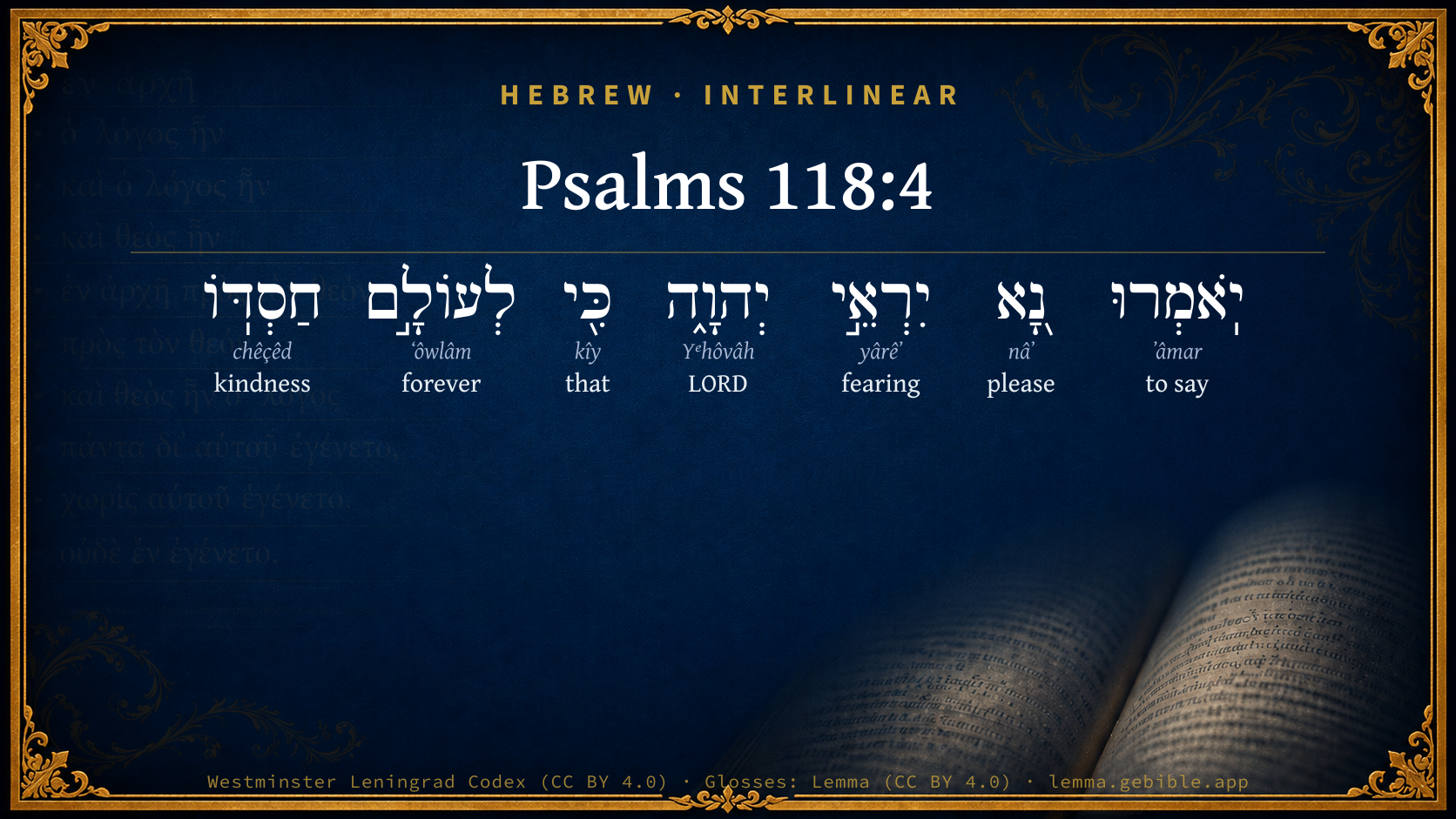
Psalms 118:4

Hebrew (Westminster Leningrad Codex) Psalms 118:4 appears in the Hebrew Old Testament. The text above is from the Westminster Leningrad Codex. Each word links to its Strong’s number, a concise gloss, and parsing drawn from the Open Scriptures Hebrew Bible morphology. Click any word for its full Brown-Driver-Briggs (BDB) entry.
Download image
Cite this verse

Psalms 118:4 (World English Bible). Public Domain. Lemma interlinear Bible study tool, https://lemma.gebible.app/v/psalms/118/4.

Show BibTeX & RIS
BibTeX
RIS
English Translation
Now let those who fear Yahweh say That his loving kindness endures forever.
World English Bible · Public Domain
Download a study sheet

One document with this verse’s original text, its word-by-word gloss line, the meaning frame, cross-references with their text, attributed commentary, and full source and license credits — printable, and it pastes into notes with its structure intact.

This verse Autodidact and up

Study sheet (.html) Plain text (.txt)

A passage Seminary Student

Up to 50 verses in one chapter. A passage sheet keeps up to 6 commentary sources and 12 cross-references per verse, in the order this page ranks them, and says so on the sheet whenever that leaves anything out. Ask for a single verse and you get the Autodidact verse sheet above.

Everything on this page stays free to read, with no account — the sheet is a download of what is already on screen, not access to it.

Want to remove ads? Support Godless Engineer
Compare translations 3

The same verse in 3 English versions, stacked beneath the original-language interlinear above. Click any original word for its lexicon entry.

Each is an independent rendering of the whole verse — the interlinear is not word-aligned to these translations.

Highlighted words mark where these versions differ — a whole-verse word diff, not a word-by-word alignment.

  • World English Bible Public Domain
    Now let those who fear Yahweh say That his loving kindness endures forever.
  • King James Version Public Domain
    Let them now that fear the LORD say, that his mercy endureth for ever.
  • unfoldingWord Literal Text CC BY-SA 4.0
    Let the fearers of Yahweh indeed say, “For his covenant faithfulness to forever.”

unfoldingWord Literal Text — © unfoldingWord, licensed CC BY-SA 4.0. Word-aligned USFM3 via Door43 (git.door43.org/unfoldingWord/en_ult).

Versions to compare (up to 4)

3 of 4 selected

Show all 18 translations

Every available English version of this verse, each an independent rendering of the whole verse.

  • World English Bible Public Domain
    Now let those who fear Yahweh say That his loving kindness endures forever.
  • Berean Standard Bible Public Domain
    Let those who fear the LORD say, “His loving devotion endures forever.”
  • Majority Standard Bible Public Domain
    Let those who fear the LORD say, “His loving devotion endures forever.”
  • King James Version Public Domain
    Let them now that fear the LORD say, that his mercy endureth for ever.
  • American Standard Version (1901) Public Domain
    Let them now that fear Jehovah say, That his lovingkindness `endureth' for ever.
  • Revised Version (1885) Public Domain
    Let them now that fear the LORD say, that his mercy endureth for ever.
  • Geneva Bible (1599) Public Domain
    Let them, that feare the Lord, nowe say, That his mercie endureth for euer.
  • Douay-Rheims (1899) Public Domain
    Let them that fear the Lord now say, that his mercy endureth for ever.
  • Young's Literal Translation Public Domain
    I pray you, let those fearing Jehovah say, That, to the age `is' His kindness.
  • Literal Standard Version CC BY-SA 4.0
    Now let those fearing YHWH say, || His kindness [is] for all time.
  • Unlocked Literal Bible CC BY-SA 4.0
    Let the loyal followers of Yahweh say, “His covenant faithfulness endures for ever.”
  • unfoldingWord Literal Text CC BY-SA 4.0
    Let the fearers of Yahweh indeed say, “For his covenant faithfulness to forever.”
  • Darby Bible Public Domain
    Oh let them that fear Jehovah say, that his loving-kindness [endureth] for ever.
  • World Messianic Bible Public Domain
    Now let those who fear the LORD say that his loving kindness endures forever.
  • Webster's Bible Public Domain
    Let them now that fear the LORD say, that his mercy endureth for ever.
  • Free Bible Version CC BY-SA 4.0
    Let those who honor the Lord say, “His trustworthy love lasts forever.”
  • Bible in Basic English Public Domain
    Let all worshippers of the Lord now say, that his mercy is unchanging for ever.
  • JPS Tanakh (1917) Public Domain
    So let them now that fear the LORD say, for His mercy endureth for ever.

Literal Standard Version (2020), Covenant Press — licensed CC BY-SA 4.0. Text via the HelloAO Bible API (eBible.org). Unlocked Literal Bible (unfoldingWord) — licensed CC BY-SA 4.0. Text via the HelloAO Bible API (eBible.org). unfoldingWord Literal Text — © unfoldingWord, licensed CC BY-SA 4.0. Word-aligned USFM3 via Door43 (git.door43.org/unfoldingWord/en_ult). Free Bible Version, Dr. Jonathan Gallagher — licensed CC BY-SA 4.0. Text via the HelloAO Bible API (eBible.org).

Word by word

More ways to search: Search by grammar → Find every occurrence → Compare this word →

Practice this passage: Drill this verse → Learn its vocabulary →

About this verse

These counts appear in no published source. They are computed here, from the morphology-tagged text and Lemma’s own curated glosses. What Lemma adds →

7
words
7
distinct lemmas
Wisdom
section

Shared distinctive vocabulary

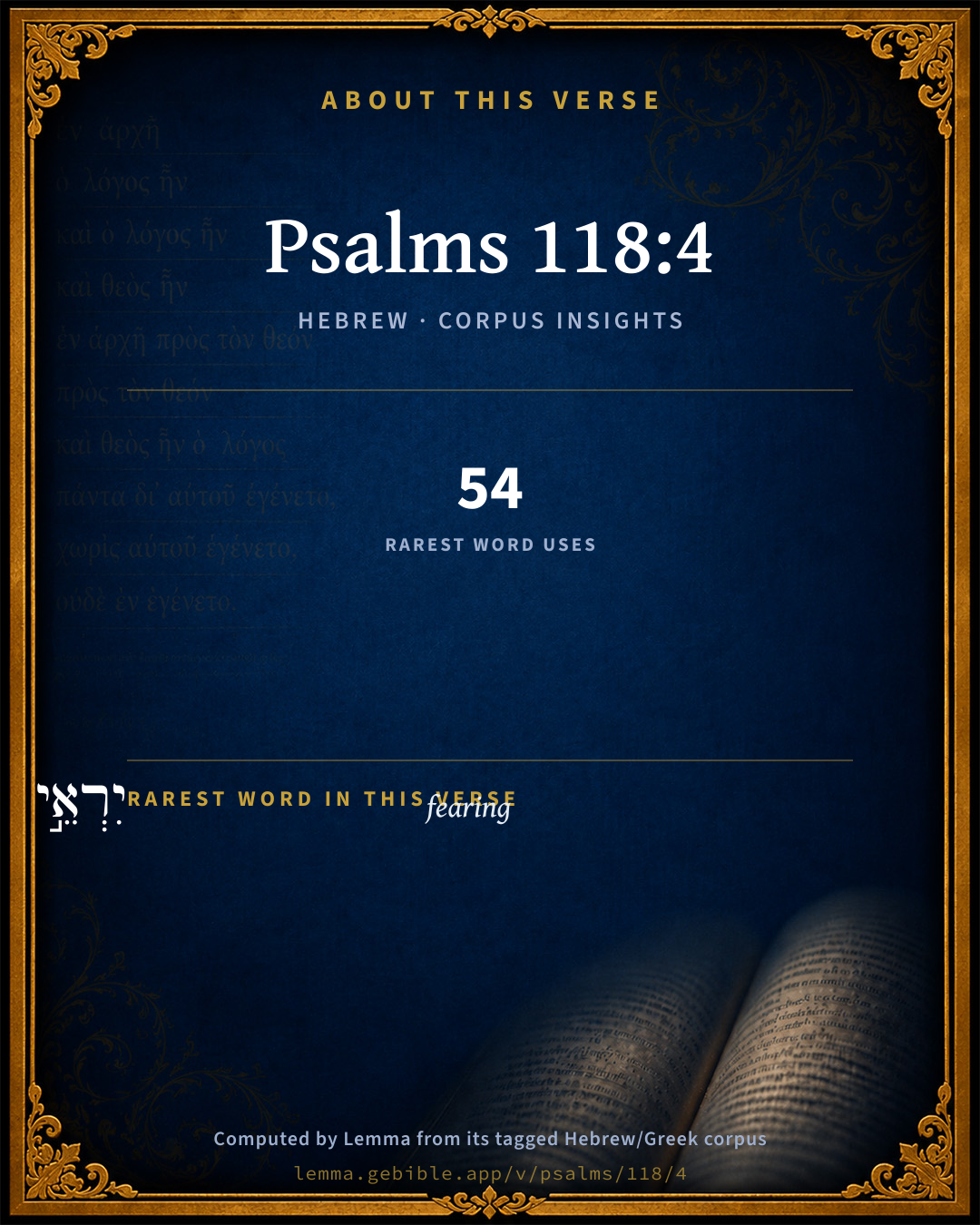
יִרְאֵ֣י fearing H3373 occurs in 54 verses of the Hebrew Bible. Also found in:

Grammatical profile

  • 1 verb
  • 3 nouns
  • 1 adjective
  • 1 conjunction
  • 1 particle

Verb forms

  • יֹֽאמְרוּ Qal · Jussive

Hebrew & Septuagint length

In English translation the verse runs 13 words from the Hebrew and 18 from the Septuagint (LXX English) — closely comparable.

A rough comparison of the two English renderings, which tokenize alike — not a word-level alignment.

Word counts can differ between the Hebrew and the Greek without any difference in meaning — e.g. the Hebrew direct-object marker אֵת has no separate Greek word, and Greek often adds the article ὁ.

Cross-references

2

Topical passages linked to Psalms 118:4 in the Treasury of Scripture Knowledge — connected by theme and wording, ordered by reader-vote popularity; previews shown in the World English Bible.

  • Psalms 22:23 You who fear Yahweh, praise him! All you descendants of Jacob, glorify him! Stand in awe of him, all you descendants of Israel!
  • Revelation 19:5 A voice came forth from the throne, saying, "Give praise to our God, all you his servants, you who fear him, the small and the great!"

Cross-references courtesy of OpenBible.info (CC BY 4.0).

Hebrew and Greek witnesses Masoretic Hebrew ↔ Greek Septuagint

The same verse in the two great witnesses to the Old Testament, shown verse-for-verse.

You’re reading Greek Psalm 117 (Hebrew Psalm 118). The Septuagint counts the superscription, so verse numbers can differ from the Hebrew — chapter-level alignment, not verse-by-verse. Numbering follows Rahlfs.

These are two independent witnesses, not word-aligned to each other, and the Septuagint is shown in lemma (dictionary) form.

Hebrew Psalms 118:4 Masoretic · Westminster Leningrad Codex

יֹֽאמְרוּ נָ֭א יִרְאֵ֣י יְהוָ֑ה כִּ֖י לְעוֹלָ֣ם חַסְדּֽוֹ

Now let those who fear Yahweh say That his loving kindness endures forever.

World English Bible · Public Domain

Greek LXX Greek Psalm 117:4 Septuagint · lemma form

εἶπον δή πᾶς ὁ φοβέω ὁ κύριος ὅτι ἀγαθός ὅτι εἰς ὁ αἰών ὁ ἔλεος αὐτός

Let now all that fear the Lord say, that he is good: for his mercy endures for ever.

LXX2012 (modern English Septuagint) · Public Domain

Hebrew: Westminster Leningrad Codex (CC BY 4.0). Greek: Septuagint (public domain); English from LXX2012 (modern English Septuagint) (Public Domain). How the Septuagint differs from the Hebrew →

Commentary

Notes on Psalms 118:4 from classic Christian and Jewish commentators (each source and its license shown beneath its notes). The classic Christian expositions comment on the surrounding passage and are grouped to its opening verse, so a note may address several verses; the Jewish commentaries on the Tanakh (Rashi and others) are per-verse, so they appear only where the commentator wrote on this verse.

Lemma curates 59 commentaries, every one of them public domain or Creative Commons licensed, each selected and text-cleaned for this edition rather than reprinted as found. About our sources →

Trapp's Complete Commentary

John Trapp

Psa 118:4 Let them now that fear the LORD say, that his mercy [endureth] for ever.

Ver. 4. Let them now that fear the Lord say] See Psa 115:11, and observe that the psalmist beateth upon the το νυν (as doth also the apostle, 2Co 6:2), Now, now, now, saith he; because, for aught we know, it is now or never, today or not at all; the dead praise thee not, Psa 6:5.

That his mercy, &c.] This is the fourth time in four verses, as Psa 136:1-26, in every one of those twenty-six verses; like as a bird that having gotten a note, recordeth it over and over.

John Trapp, A Commentary or Exposition upon All the Books of the Old and New Testament (1647–1656) — public domain. Text from a community e-Sword module.

Adam Clarke's Commentary

Verse 4. That fear the Lord] All sincere penitents and genuine believers. See the notes on Ps 115:9-11.

Adam Clarke's Commentary on the Bible (1810–1826) — public domain. Text from a community e-Sword/MySword module.

John Gill's Exposition

The Lord is on my side,.... Or "for me" (s); he was on the side of David, hence all his prosperity and victories, the wonderful things done by him, his exaltation to the throne, and the establishment of it; and so he was on the side of Christ, he was near unto him, at his right hand, to guide, direct, and assist him as man; and he is likewise on the side of his people, to fight their battles for them, to support them under all their afflictions, to supply all their wants, to deliver them from all evil, to carry on the work of grace in their souls, and to bring them to glory, The Targum is,

"the Word of the Lord is for my help.''

I will not fear: what can man do unto me? David did not; he was not afraid of ten thousands of men, no, not of a whole army that encamped against him, God being for him, the strength of his life, and his salvation, Psa 3:6; nor did the Messiah; he was not afraid of Herod when he was told he would kill him; nor of the high priests, Scribes and Pharisees, though he knew he should fall into their hands, and they would deliver him to the Gentiles, to be scourged and crucified; nor of Judas and his band of men, who came to take him; nor of Pilate his judge, who had no power against him but what was given him. Nor have the saints any reason to fear what man can do unto them, when grace is in exercise; for what is man to God, who is but flesh, and that flesh grass? Nor can he do anything without a divine permission; is often frustrated in his attempt; and what he is suffered to do is overruled for good; and the utmost he can do is to kill the body; he cannot destroy the soul, or hinder the happiness of it; see Psa 56:4.

(s) "pro me", Musculus, Michaelis.

John Gill's Exposition of the Whole Bible (1746–1763) — public domain (CC PDM 1.0). Text via the HelloAO Bible API.

Albert Barnes' Notes on the Bible

Let them now that fear the Lord say ... - Compare Psa 115:11. All that worship God are interested in what God has done for me. It is a manifestation of the divine character which should cheer them. They are called, therefore, to unite with the author of the psalm in praise and thanksgiving, not merely from sympathy with him, but because great truths of religion had been illustrated, in his case, which were of as much importance to them as to him.

Albert Barnes' Notes on the Bible (1834–1885) — public domain. Text from a community e-Sword/MySword module.

Matthew Poole's English Annotations

The Gentile proselytes, whereof there were in David’s time, and were likely to be, greater numbers than formerly had been.

Matthew Poole's English Annotations on the Holy Bible (1683–1685) — public domain. Text from a community e-Sword/MySword module.

The Treasury of David

Charles H. Spurgeon

Ver. 4. Let them now that fear the LORD say, that his mercy endureth for ever. If there were any throughout the world who did not belong to Israel after the flesh, but nevertheless had a holy fear and lowly reverence of God, the Psalmist calls upon them to unite with him in his thanksgiving, and to do it especially on the occasion of his exaltation to the throne; and this is no more than they would cheerfully agree to do, since every good man in the world is benefited when a true servant of God is placed in a position of honour and influence. The prosperity of Israel through the reign of David was a blessing to all who feared Jehovah. A truly God fearing man will have his eye much upon God's mercy, because he is deeply conscious of his need of it, and because that attribute excites in him a deep feeling of reverential awe. "There is forgiveness with thee that thou mayest be feared."

In the three exhortations, to Israel, to the house of Aaron, and to them that fear the Lord, there is a repetition of the exhortation to say, "that his mercy endureth for ever." We are not only to believe, but to declare the goodness of God; truth is not to be hushed up, but proclaimed. God would have his people act as witnesses, and not stand silent in the day when his honour is impugned. Specially is it our joy to speak out to the honour and glory of God when we think up, in the exaltation of his dear Son. We should shout "Hosannah, "and sing loud "Hallelujahs" when we behold the stone which the builders rejected lifted into its proper place.

In each of the three exhortations notice carefully the word "now." There is no time like time present for telling out the praises of God. The present exaltation of the Son of David now demands from all who are the subjects of his kingdom continual songs of thanksgiving to him who hath set him on high in the midst of Zion. Now with us should mean always. When would it be right to cease from praising God, whose mercy never ceases?

The fourfold testimonies to the everlasting mercy of God which are now before us speak like four evangelists, each one declaring the very pith and marrow of the gospel; and they stand like four angels at the four corners of the earth holding the winds in their hands, restraining the plagues of the latter days that the mercy and long suffering of God may endure towards the sons of men. Here are four cords to bind the sacrifice to the four horns of the altar, and four trumpets with which to proclaim the year of jubilee to every quarter of the world. Let not the reader pass on to the consideration of the rest of the Psalm until he has with all his might lifted up both heart and voice to praise the Lord, "for his mercy endureth for ever."

"Let us with a gladsome mind

Praise the Lord, for he is kind;

For his mercies shall endure

Ever faithful, ever sure."

Ver. 4. Them that fear the LORD. Who were neither of "the house of Aaron, "that is, of the priests or Levites; nor of "the house of Israel, "that is, native Jews; yet might be of the Jewish religion, and "fear the LORD." These were called proselytes, and are here invited to praise the Lord. Joseph Caryl.

Ver. 4. God's mercy endureth for ever. That is, his covenant mercy, that precious church privilege: this is perpetual to his people, and should perpetually remain as a memorial in our hearts. And therefore it is that this is the foot or burden of these first four verses. Neither is there any idle repetition, but a notable expression of the saints' insatiableness of praising God for his never failing mercy. These heavenly birds having got a note, sing it over and over. In the last Psalm there are but six verses, yet twelve Hallelujahs. Abraham Wright.

Psalms 118:5*

Charles H. Spurgeon's The Treasury of David (1869–1885) — public domain. Psalms only. Text from a community e-Sword/MySword module.

The Pulpit Commentary

Let them now that fear the Lord say, that his mercy endureth forever. Let the real Israel, the true worshippers of Jehovah, those who worship him in spirit and in truth, set their seal also to the great confession, and solemnly sanction what the people and the priests have done.

Personal experience of Divine mercies.

"Let them now that fear the Lord say, that his mercy endureth for ever." The term "fear the Lord" suggests personal apprehensions of God, personal dealings with God, and personal relations with him. It is inconceivable that there can have been these close personal associations with God without their having left a deep impression of the abundance, adaptation, and continuance of the Divine mercy. No man can look over his life, and trace God"s manner of dealing with him, without being disposed to say, "To the Lord our God belong mercies and forgivenesses;" "Also unto thee belongeth mercy, for thou renderest to every man according to his works." What impressions of the Divine mercies come to us out of our personal experience?

I THE MERCY OF GOD HAS TAKEN SHAPE AS A DIVINE PATIENCE. That may well be put first, for, when the heart is tender, it is that comes to us most affectingly. When anything like a fitting sense of our own willfulness and waywardness comes upon our hearts, it is the marvel, over which we never tire of brooding, that God has been so patient with us. Never offended with us, as our fellow-men have easily been; never "dealing with us after our sins, nor rewarding us according to our iniquities." It is not only that he has quietly waited, it is that he has so gently borne with us. Divine patience is never to be thought of as a mere sitting down and waiting. It is best suggested by a mother"s ways with a sickly babe; or the doctor"s ways with an irritable, fractious patient. There be many to whom God"s mercy always appears as his patience and long-suffering, and they praise him for that.

II THE MERCY OF GOD HAS TAKEN SHAPE AS A DIVINE DISCIPLINE. This is the thought that comes to us as life advances, and the events of the past gain their true perspective. At the time things seemed to be afflictions, calamity, needless strain, and we fretted ourselves weary in trying to find why such hard things were put into our lot. Distance from them increases, and we find they look quite differently. Things are related which we thought had nothing to do with each other. We see how our cultured power came out of our stern experiences; and then we see that God"s mercy is the way in which he has made the hard things of life train and discipline characters meet for the heavenly spheres. R.T.

The Pulpit Commentary (1880–1919), ed. H.D.M. Spence-Jones & Joseph S. Exell — public domain. Text from a community e-Sword module.

Scofield Reference Notes

C. I. Scofield

fear

(See Scofield "Psa 19:9").

The Scofield Reference Bible (1917 edition), notes by C. I. Scofield — public domain. Text from a community e-Sword module.

Rashi

Rabbi Shlomo Yitzchaki (Rashi)

Those who fear the Lord These are the Levites, about whom it is written (Exod. 32:26): “Whoever is the Lord’s, let him come to me! And all the sons of Levi gathered around him,” in the episode of the [Golden] Calf, and they fought with Israel when they said (Num. 14:4), “Let us appoint a leader and return to Egypt.”

Rashi on the Tanakh — English translations: “The Judaica Press complete Tanach with Rashi, translated by A. J. Rosenberg” (CC BY 4.0); “Pentateuch with Rashi's commentary by M. Rosenbaum and A.M. Silbermann, 1929-1934” (public domain); “The Metsudah Tanach series, Lakewood, N.J” (CC BY 4.0); and “The Book of Joshua, Metsudah Publications, 1997” (CC BY 4.0). Text via Sefaria.

Lesson kit

Teaching starters — assembled from the data on this page, not authored interpretation. Every prompt links to the verse data it draws on. Edit before teaching.

Psalms, in the Wisdom, opens this verse with 7 words (7 distinct Hebrew lemmas). Its most distinctive word is yârêʼ (“fearing”). A historical commentator’s framing appears above. Read the whole chapter for the surrounding context.

Discussion questions

  1. How does “fearing” (yârêʼ) shape what this verse is saying?
  2. Genesis 22:12 shares the word «fearing» with this verse. How do the two illuminate each other?
  3. These translations render this verse differently; the difference is in the English rendering, not the original. What questions does that raise?
  4. The verb «יֹֽאמְרוּ» is Qal Jussive. How does its form color the action?
  5. Reading how Trapp's Complete Commentary and Adam Clarke's Commentary read this verse, where do the two commentators agree and where do they part?

Things to notice

Reading settings

Reading text

Shown beneath each verse's original-language words.

Old Testament
Old Testament edition

Read the OT as the Masoretic Hebrew (MT) or the Greek Septuagint (LXX).

English shown for the Greek Septuagint (in the Hebrew ↔ Greek comparison).

Comparing translations? Open the Compare panel on any verse page to stack up to four side by side.