
1 Kings 18:3

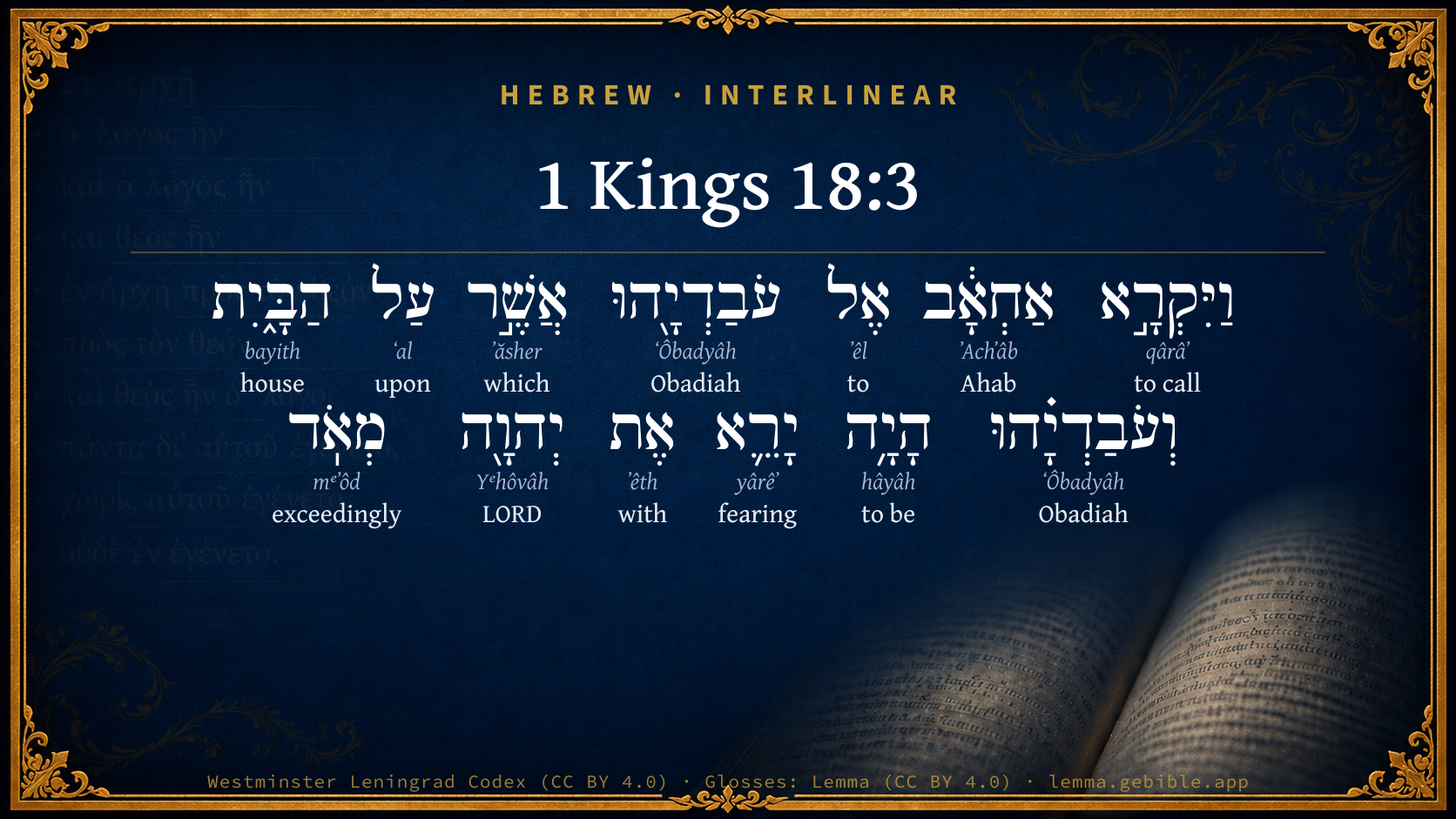
Hebrew (Westminster Leningrad Codex) 1 Kings 18:3 appears in the Hebrew Old Testament. The text above is from the Westminster Leningrad Codex. Each word links to its Strong’s number, a concise gloss, and parsing drawn from the Open Scriptures Hebrew Bible morphology. Click any word for its full Brown-Driver-Briggs (BDB) entry.
Download image
Cite this verse

1 Kings 18:3 (World English Bible). Public Domain. Lemma interlinear Bible study tool, https://lemma.gebible.app/v/1-kings/18/3.

Show BibTeX & RIS
BibTeX
RIS
English Translation
Ahab called Obadiah, who was over the household. (Now Obadiah feared Yahweh greatly:
World English Bible · Public Domain
Highlights
  • 1 first appearance in the Hebrew Bible
Full analysis ↓
Download a study sheet

One document with this verse’s original text, its word-by-word gloss line, the meaning frame, cross-references with their text, attributed commentary, and full source and license credits — printable, and it pastes into notes with its structure intact.

This verse Autodidact and up

Study sheet (.html) Plain text (.txt)

A passage Seminary Student

Up to 50 verses in one chapter. A passage sheet keeps up to 6 commentary sources and 12 cross-references per verse, in the order this page ranks them, and says so on the sheet whenever that leaves anything out. Ask for a single verse and you get the Autodidact verse sheet above.

Everything on this page stays free to read, with no account — the sheet is a download of what is already on screen, not access to it.

Want to remove ads? Support Godless Engineer
Compare translations 3

The same verse in 3 English versions, stacked beneath the original-language interlinear above. Click any original word for its lexicon entry.

Each is an independent rendering of the whole verse — the interlinear is not word-aligned to these translations.

Highlighted words mark where these versions differ — a whole-verse word diff, not a word-by-word alignment.

  • World English Bible Public Domain
    Ahab called Obadiah, who was over the household. (Now Obadiah feared Yahweh greatly:
  • King James Version Public Domain
    And Ahab called Obadiah, which was the governor of his house. (Now Obadiah feared the LORD greatly:
  • unfoldingWord Literal Text CC BY-SA 4.0
    And Ahab called to Obadiah, who over the house. (Now Obadiah was fearing Yahweh greatly.

unfoldingWord Literal Text — © unfoldingWord, licensed CC BY-SA 4.0. Word-aligned USFM3 via Door43 (git.door43.org/unfoldingWord/en_ult).

Versions to compare (up to 4)

3 of 4 selected

Show all 18 translations

Every available English version of this verse, each an independent rendering of the whole verse.

  • World English Bible Public Domain
    Ahab called Obadiah, who was over the household. (Now Obadiah feared Yahweh greatly:
  • Berean Standard Bible Public Domain
    and Ahab summoned Obadiah, who was in charge of the palace. (Now Obadiah greatly feared the LORD,
  • Majority Standard Bible Public Domain
    and Ahab summoned Obadiah, who was in charge of the palace. (Now Obadiah greatly feared the LORD,
  • King James Version Public Domain
    And Ahab called Obadiah, which was the governor of his house. (Now Obadiah feared the LORD greatly:
  • American Standard Version (1901) Public Domain
    And Ahab called Obadiah, who was over the household. (Now Obadiah feared Jehovah greatly:
  • Revised Version (1885) Public Domain
    And Ahab called Obadiah, which was over the household. (Now Obadiah feared the LORD greatly:
  • Geneva Bible (1599) Public Domain
    And Ahab called Obadiah the gouernour of his house: (and Obadiah feared God greatly:
  • Douay-Rheims (1899) Public Domain
    And Achab called Abdias the governor of his house: now Abdias feared the Lord very much.
  • Young's Literal Translation Public Domain
    and Ahab calleth unto Obadiah, who `is' over the house -- and Obadiah hath been fearing Jehovah greatly,
  • Literal Standard Version CC BY-SA 4.0
    and Ahab calls to Obadiah, who [is] over the house—and Obadiah has been fearing YHWH greatly,
  • Unlocked Literal Bible CC BY-SA 4.0
    Ahab called Obadiah, who was in charge of the palace. Now Obadiah honored Yahweh very much,
  • unfoldingWord Literal Text CC BY-SA 4.0
    And Ahab called to Obadiah, who over the house. (Now Obadiah was fearing Yahweh greatly.
  • Darby Bible Public Domain
    And Ahab called Obadiah, who was the steward of his house (now Obadiah feared Jehovah greatly;
  • World Messianic Bible Public Domain
    Ahab called Obadiah, who was over the household. (Now Obadiah feared the LORD greatly;
  • Webster's Bible Public Domain
    And Ahab called Obadiah who was the governor of his house. (Now Obadiah feared the LORD greatly:
  • Free Bible Version CC BY-SA 4.0
    Ahab summoned Obadiah, the manager of his palace (Obadiah was a very sincere believer in the Lord.
  • Bible in Basic English Public Domain
    And Ahab sent for Obadiah, the controller of the king's house. (Now Obadiah had the fear of the Lord before him greatly;
  • JPS Tanakh (1917) Public Domain
    And Ahab called Obadiah, who was over the household. — Now Obadiah feared the LORD greatly;

Literal Standard Version (2020), Covenant Press — licensed CC BY-SA 4.0. Text via the HelloAO Bible API (eBible.org). Unlocked Literal Bible (unfoldingWord) — licensed CC BY-SA 4.0. Text via the HelloAO Bible API (eBible.org). unfoldingWord Literal Text — © unfoldingWord, licensed CC BY-SA 4.0. Word-aligned USFM3 via Door43 (git.door43.org/unfoldingWord/en_ult). Free Bible Version, Dr. Jonathan Gallagher — licensed CC BY-SA 4.0. Text via the HelloAO Bible API (eBible.org).

Word by word

More ways to search: Search by grammar → Find every occurrence → Compare this word →

Practice this passage: Drill this verse → Learn its vocabulary →

עֹבַדְיָ֖הוּ
ʻÔbadyâh
H5662
“Obadiah”
Noun, Proper
Part of Speech
Noun
Type
Proper
Full BDB Definition

Origin: act part of H5647 and H3050

TWOT: None

Obadiah = "servant of Jehovah" - the 4th of the 12 minor prophets; nothing personal is known of him but it is probable that he was contemporary with Jeremiah, Ezekiel, and Daniel - the prophetic book by him; prophesies against Edom - father of Ishmaiah, one of the chiefs of Zebulun in the time of David - a Merarite Levite overseer of the work of restoring the temple in the time of king Josiah of Judah - chief of the household of king Ahab of Israel; an devout worshipper of Jehovah who at risk to his own life hid over 100 prophets during the persecution of Jezebel - a descendant of David - a chief of the tribe of Issachar - a Benjamite, one of the 6 sons of Azel and a descendant of king Saul - a Levite, son of Shemaiah and a descendant of Jeduthun - a Gadite chief, the 2nd of the lion-faced Gadites who joined David at Ziklag - a prince of Judah in the time of king Jehoshaphat of Judah - a priest, son of Jehiel of the sons of Joab who returned from exile with Ezra - a gatekeeper in the time of Nehemiah - one of the men who sealed the covenant with Nehemiah - perhaps the same as 12
  1. וַיִּקְרָ֣א qârâʼ H7121 “and · to call” Conjunction + Verb, Qal, Sequential Imperfect, 3rd Person, Masculine, Singular
  2. אַחְאָ֔ב ʼAchʼâb H256 “Ahab” Noun, Proper
  3. אֶל ʼêl H413 “to” Preposition
  4. אֲשֶׁ֣ר ʼăsher H834 “which” Particle, Relative
  5. עַל ʻal H5921 “upon” Preposition
  6. הַבָּ֑יִת bayith H1004 “the · house” Particle, Definite Article + Noun, Common, Masculine, Singular, Absolute
  7. וְעֹבַדְיָ֗הוּ ʻÔbadyâh H5662 “and · Obadiah” Conjunction + Noun, Proper
  8. הָיָ֥ה hâyâh H1961 “to be” Verb, Qal, Perfect, 3rd Person, Masculine, Singular
  9. יָרֵ֛א yârêʼ H3373 “fearing” Adjective, Adjective, Masculine, Singular, Absolute
  10. אֶת ʼêth H854 “with” Preposition
  11. יְהוָ֖ה Yᵉhôvâh H3068 “LORD” Noun, Proper
  12. מְאֹֽד mᵉʼôd H3966 “exceedingly” Adverb

About this verse

These counts appear in no published source. They are computed here, from the morphology-tagged text and Lemma’s own curated glosses. What Lemma adds →

13
words
12
distinct lemmas
Historical
section

Notable vocabulary

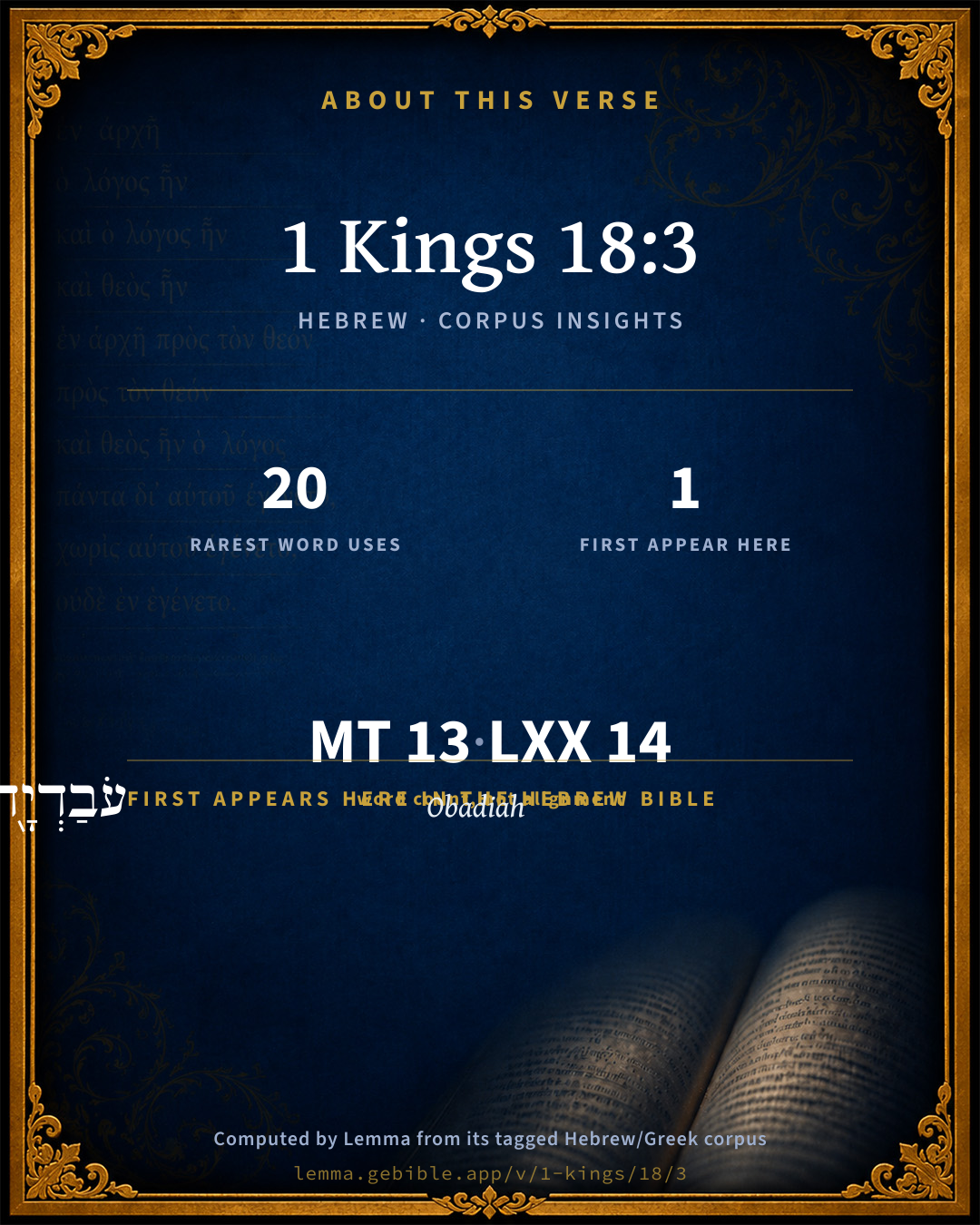
The rarest word here is עֹבַדְיָ֖הוּ Obadiah H5662 — appearing just 20 times in the whole Hebrew Bible.

First appearance in Scripture

This word makes its first canonical appearance in the Hebrew Bible here:

  • עֹבַדְיָ֖הוּ Obadiah H5662

Shared distinctive vocabulary

עֹבַדְיָ֖הוּ Obadiah H5662 occurs in 19 verses of the Hebrew Bible. Also found in:

Grammatical profile

  • 2 verbs
  • 5 nouns
  • 1 adjective
  • 3 prepositions
  • 1 adverb
  • 1 particle

Verb forms

  • וַיִּקְרָ֣א Qal · Sequential Imperfect
  • הָיָ֥ה Qal · Perfect

Repetition

A word recurs within this verse — often emphatic in Hebrew:

  • עֹבַדְיָ֖הוּ Obadiah H5662 ×2

Hebrew & Septuagint length

In English translation the verse runs 13 words from the Hebrew and 12 from the Septuagint (LXX English) — closely comparable.

A rough comparison of the two English renderings, which tokenize alike — not a word-level alignment.

Word counts can differ between the Hebrew and the Greek without any difference in meaning — e.g. the Hebrew direct-object marker אֵת has no separate Greek word, and Greek often adds the article ὁ.

In the original languages it is 13 Hebrew tokens and 14 Greek tokens — but the two are counted differently (Hebrew bundles its prefixes and suffixes into one token; the Greek is in lemma form), so that isn’t a like-for-like length.

Cross-references

17

Topical passages linked to 1 Kings 18:3 in the Treasury of Scripture Knowledge — connected by theme and wording, ordered by reader-vote popularity; previews shown in the World English Bible.

  • Nehemiah 7:2 that I gave my brother Hanani, and Hananiah the governor of the castle, charge over Jerusalem; for he was a faithful man, and feared God above many.
  • 1 Kings 16:9 His servant Zimri, captain of half his chariots, conspired against him. Now he was in Tirzah, drinking himself drunk in the house of Arza, who was over the household in Tirzah:
  • Matthew 10:28 Don't be afraid of those who kill the body, but are not able to kill the soul. Rather, fear him who is able to destroy both soul and body in Gehenna.
  • Genesis 22:12 He said, "Don't lay your hand on the boy, neither do anything to him. For now I know that you fear God, seeing you have not withheld your son, your only son, from me."
  • Genesis 24:2 Abraham said to his servant, the elder of his house, who ruled over all that he had, "Please put your hand under my thigh.
  • Genesis 24:10 The servant took ten camels, of his master's camels, and departed, having all goodly things of his master's in his hand. He arose, and went to Mesopotamia, to the city of Nahor.
  • Genesis 39:4–5 Joseph found favor in his sight. He ministered to him, and he made him overseer over his house, and all that he had he put into his hand.
  • Genesis 39:9 He isn't greater in this house than I, neither has he kept back anything from me but you, because you are his wife. How then can I do this great wickedness, and sin against God?"
  • Genesis 41:40 You shall be over my house, and according to your word will all my people be ruled. Only in the throne I will be greater than you."
  • Genesis 42:18 Joseph said to them the third day, "Do this, and live, for I fear God.
  • 1 Kings 18:12 It will happen, as soon as I am gone from you, that the Spirit of Yahweh will carry you I don't know where; and so when I come and tell Ahab, and he can't find you, he will kill me: but I your servant fear Yahweh from my youth.
  • 2 Kings 4:1 Now there cried a certain woman of the wives of the sons of the prophets to Elisha, saying, Your servant my husband is dead; and you know that your servant did fear Yahweh: and the creditor is come to take to him my two children to be bondservants.
  • Nehemiah 5:15 But the former governors who were before me were chargeable to the people, and took of them bread and wine, besides forty shekels of silver; yes, even their servants bore rule over the people: but I didn't do so, because of the fear of God.
  • Proverbs 14:26 In the fear of Yahweh is a secure fortress, And he will be a refuge for his children.
  • Malachi 3:16 Then those who feared Yahweh spoke one with another; and Yahweh listened, and heard, and a book of memory was written before him, for those who feared Yahweh, and who honored his name.
  • Acts 10:2 a devout man, and one who feared God with all his house, who gave gifts for the needy generously to the people, and always prayed to God.
  • Acts 10:35 but in every nation he who fears him and works righteousness is acceptable to him.

Cross-references courtesy of OpenBible.info (CC BY 4.0).

Hebrew and Greek witnesses Masoretic Hebrew ↔ Greek Septuagint

The same verse in the two great witnesses to the Old Testament, shown verse-for-verse.

These are two independent witnesses, not word-aligned to each other, and the Septuagint is shown in lemma (dictionary) form.

Hebrew 1 Kings 18:3 Masoretic · Westminster Leningrad Codex

וַיִּקְרָ֣א אַחְאָ֔ב אֶל עֹבַדְיָ֖הוּ אֲשֶׁ֣ר עַל הַבָּ֑יִת וְעֹבַדְיָ֗הוּ הָיָ֥ה יָרֵ֛א אֶת יְהוָ֖ה מְאֹֽד

Ahab called Obadiah, who was over the household. (Now Obadiah feared Yahweh greatly:

World English Bible · Public Domain

Greek LXX 1 Kings 18:3 Septuagint · lemma form

καί καλέω αχααβ ὁ αβδιου ὁ οἰκονόμος καί αβδιου εἰμί φοβέω ὁ κύριος σφόδρα

And Achaab called Abdiu the steward. Now Abdiu feared the Lord greatly.

LXX2012 (modern English Septuagint) · Public Domain

Hebrew: Westminster Leningrad Codex (CC BY 4.0). Greek: Septuagint (public domain); English from LXX2012 (modern English Septuagint) (Public Domain). How the Septuagint differs from the Hebrew →

Targum (Aramaic paraphrase)

1

The Targum is the ancient Jewish Aramaic paraphrase of the Hebrew Scriptures — an interpretive translation, not the Hebrew text itself. Onkelos (literal) and Pseudo-Jonathan (expansive) render the Torah, and Jonathan the Prophets. Coverage is partial: where no permissively-licensed English translation exists for a verse, only the Aramaic is shown. This is verse-level text, not a word-by-word alignment to the Hebrew.

  1. Targum Jonathan Prophets (Joshua–Malachi)
    וּקְרָא אַחְאָב לְעוֹבַדְיָהוּ דִי מְמַנָא עַל בֵּיתָא וְעוֹבַדְיָהוּ הֲוָה דָחִיל מִן קֳדָם יְיָ לַחֲדָא:

    (no public-domain English translation for this verse)

    Targum Jonathan — Aramaic: “Mikraot Gedolot” (public domain). English: “Sefaria Community Translation” (CC0 1.0 (public-domain dedication)); “London "Chaldee Paraphrase," 1871” (public domain). Text via Sefaria.

Commentary

Notes on 1 Kings 18:3 from classic Christian and Jewish commentators (each source and its license shown beneath its notes). The classic Christian expositions comment on the surrounding passage and are grouped to its opening verse, so a note may address several verses; the Jewish commentaries on the Tanakh (Rashi and others) are per-verse, so they appear only where the commentator wrote on this verse.

Lemma curates 59 commentaries, every one of them public domain or Creative Commons licensed, each selected and text-cleaned for this edition rather than reprinted as found. About our sources →

Trapp's Complete Commentary

John Trapp

1Ki 18:3 And Ahab called Obadiah, which [was] the governor of [his] house. (Now Obadiah feared the LORD greatly:

Ver. 3. And Ahab called Obadiah.] Who was neither the prophet Odadiah, as some have thought, nor that good captain over fifty, who begged his life of Elijah, {2Ki 1:13} but another, a good officer, under wicked Ahab; such as was also Jacob to Laban, Joseph to Pharaoh, Naaman to Benhadad, Mordecai to Ahashuerus, Nehemiah to Artaxerxes, some good people in Nero’s house, Trajan to Valens, Cromwell to Henry VIII, &c.

Now Obadiah feared God greatly.] And God bore with him, though he hazarded not his life and liberty for the legal ceremonies.

John Trapp, A Commentary or Exposition upon All the Books of the Old and New Testament (1647–1656) — public domain. Text from a community e-Sword module.

The Biblical Illustrator

Joseph S. Exell

1Ki_18:3

Ahab called Obadiah, which was the governor of his house.

Obadiah

There are men in sacred story, and in every history, who play a secondary place in the strange stirring drama of human progress--lieutenants to the great leaders--men with firm wills, stalwart hearts, gifts of energy, wisdom, and restraint. And behind these a great number who have no name in storied page, prophets who have no prophet renown, kings uncrowned, victors without honour, martyrs without a martyrs fame, saints uncanonised, wise men who have no enrolment among the worlds sages! The glory of the firmament on a clear and radiant night is not fashioned of those few chief stars which flash with distinguished brightness, and catch the glance and win the admiration of the careless observer; but in the multitude of stars which are not chief--which wear not the most dazzling splendour--these bring their brightness, and those far off nebulous mists bring theirs. Were these to fail, how tame the heavens would grow! So in the Bible story--the glory is not concentrated in the chief men. All the interest of that history is not in those few who stand like giants among their fellows. There are men of less distinguished greatness who are worthy of observation, and will repay our study. The less known, and in some respects the less gifted men of Bible story have this interest for us: they are nearer to us--they are not set apart from us and hedged in by specialities of gifts or office, moving in a sphere in which we can have no place. Elijah stands like a mountain apart--lonely, grand, terrible--and though an apostle tells us he is a man of like passions with ourselves, yet the glamour of supernatural gifts separates him from us. But when we look at Obadiah, we see one who stands upon our level, who moves in our sphere. We do not stand in awe of him. Contact with him is contact of man with man, and no dazzle of the supernatural comes between us. We have only a feeble, broken outline of the mans character. The sketch which the sacred narrative gives is very brief. He is Ahabs servant, governor of his house. He is Jehovahs servant, and in the palace where Jezebel is queen and Baal and Ashtaroth are the worshipped gods. The hints which this brief narrative affords us are suggestive of a noble type of man, fearing God, defending the weak, rendering all lawful service.

1. He was the honoured servant of an impious king, governor of his house. This was an office of great dignity and influence; that he reached it and held it is a witness alike to his integrity and efficiency. He was a careful, faithful, diligent servant to King Ahab. How came he to this high place? He did not purchase it by an unworthy deference; the fawning of the flatterer did not win it; the pliancy of an easy conscience did not secure it; for he feared the Lord greatly: feared Him from his youth up. Such a fear, if it does not secure steadfast principle in life and character, is a mere profession--an utter sham. Obadiah has reached this place in the straight lines of integrity, not by the crooked, wriggling line of policy. The lines of principle do sometimes land a man in the high places. He was an honoured servant, because he was efficient; he did not do his work with a slack hand because Ahab was an apostate king and Jezebel a heathen queen. His religion was the inspiration of his work--the condition of his efficiency. What he did, he did with his might. Religion is no excuse for inefficiency in any honest work to which men set their hands. Whatsoever thy hand findeth to do, do it with thy might. That injunction concerns our work in the world as well as in the Church-U-concerns the keeping of accounts as much as keeping the Sabbath; the discharge of business obligations as truly as the fulfilment of religious duties. The irresolute, indifferent, and inefficient servant cannot be excused, because he has a gift in prayer. Idleness at the counter, at the desk, the bench, the anvil, is not to be excused because the transgressor is a zealous teacher in his class. Inability may be an excuse for inefficiency, but religion cannot be; it is the enrichment and endowment of a mans nature; it should stir all gifts that are in him to a quicker energy, a finer power. What is the witness of this to you and me? That we who are servants of the Lord, in fulfilling our earthly duties and obligations, should be diligent and faithful. It is a commendation of Christs religion which has been overlooked.

2. Obadiah was faithfully Gods witness in a degenerate court. As far as it was possible, he served his king; but there are no indications that he trifled with conscience, no signs in the narrative that he was unfaithful to the claims of God. He feared the Lord greatly--this is the witness of no shallow religiousness. In that unhallowed court he was a leaven of purity. In that degenerate age he was a witness for God. In those high places, where pleasure and passion held wild carnival, he exercised self-control, and strove to live a life true to God. He feared the Lord greatly. He who fails in this allegiance, though he stands amid the splendour that beats upon a throne, is yet a child of darkness. Understand it well. Obadiah had no gifts of prophet power--no unique spiritual gift. He was for the most part a man just like ourselves. Yet in the court of Ahab, where influences of evil must have gathered the force and fierceness of a stormy sea, he was steadfast and immovable. Little faith would have been shattered and swept away; a faint heart, a feeble zeal, could not have borne the strain. It is only in the possession of a full, rich, spiritual power we shall bear in life and character clear witness for God and for His Christ. If we are to thwart in any way such powers of darkness as are figured to us in this imperious Queen Jezebel, we must fear the Lord greatly; our love of Him must glow like the morning; our faith in Him must be steadfast as the stars; our zeal for Him burn like a concentrated fire. It is this thoroughness in Christian life which is the condition of resolute faithfulness--the root of working power and widening usefulness. (W. S. Davis.)

A noble character

Obadiah feared the Lord. That is to say, he was loyal to the Lord; the law of God was the rule of his life. He feared to sin; kept watch over his heart, held guard on his lips, and followed the commandments of the Most High. Obadiah feared the Lord from his youth. That is to say, this tree of righteousness, called Obadiah, was strong, widespread, and beautiful, bending with the fruits of goodness, because he was planted in the garden of grace when he was a sapling, a tender plant, whose childhood was given to the love and service of his God.

1. Obadiahs goodness makes us wonder. He lived in an age and in a country when and where goodness was sadly scarce. The wonder is that King Ahab would have this man by him, much more that he should commit the highest office and the most important trust into his hands. Obadiahs presence must have been a standing rebuke to the selfish and sensual king. If I wonder that Ahab would have him about him, I wonder more that Obadiah was willing to stay. The corrupt atmosphere of Ahabs shameless court must have been a rank offence to him. Then why did he not go? The Prophet Elijah, wandering alone among the glens of Thisbe, or the rocks of Horeb, or by the waters of Cherith, or the coasts of Zidon, would be glad, poor outlaw, of a little congenial company. Why doesnt Obadiah join him? Because he feared the Lord greatly; and both patriotism and religion, loyalty to the interests of his country and the honour of his God, bound him to his post.

2. I find still further cause for wonder, in that the goodness of Obadiah had been maintained during his residence in the court of King Ahab. I marvel at it. I know what comes to a statue of white marble exposed to the corrosive fogs of London. I know what happens to the rippling music and the silver beauty of the summer brook when it falls into the turbid river rolling its dull waters in sullen silence to the sea. I know the fate of May flowers when the blast of the cast winds blow a malison on their beauty. I know, too, by sad experience, what comes to human hearts and consciences when fierce and fiery, or subtle and winsome temptations ply their evil power. This man, this one man Obadiah, feared the Lord. He shone like a solitary star in a murky midnight sky. He bloomed like a lily in a bed of thorns.

3. The goodness of Obadiah gives me further cause for wonder in that it grew and ripened under unfavourable treatment. It is said of him, that he feared the Lord from his youth. The guiding principle of his whole career was the fear of God. There is no doubt that his religion met with some shrewd blows and sore bruises as his beard grew; and that as he advanced to mature manhood, the world, the flesh, and the devil, hit both hard and often at the man who would be good in spite of them. Now Obadiah feared the Lord greatly. Instead of descending a valley, he has been climbing the hill. Instead of lapsing into silence with broken strings, his life-harp vibrates with richer melody and a holier psalm. The way of duty is not only the way of safety, but it is the way to more perfect goodness and increasing strength.

4. I find further cause for wonder in Obadiahs simple faith in the supernatural, the miracle-working power of God. Go, tell the king, said the stalwart and hairy Tishbite, Behold, Elijah is here. Nay, said Obadiah, Ahab has hunted for thee high and low to kill thee, that at the ebbing of thy blood the wells and rivers may flow again. If I send him here, the Spirit of the Lord will carry thee away, and the king will slay me. Poor superstitious, old-fashioned, simplehearted Obadiah! And yet the simple soul, palace governor though he be, thinks that Elijah can be suddenly spirited away; that the laws of nature can be tampered with, gravitation suspended, and a miracle can be wrought by a fancied Deity whom every one regards as an exploded myth!

5. I find still another wonder, still another lesson in the piety of Obadiah: his noble deeds of kindness to others at great cost and danger to himself. (J. J. Wray.)

Standing alone

Mr. Jackson Wray finely compares Obadiah to a scene he once saw on the west coast of Africa. Crossing a barren tract of country, he beheld a fair and stately palm tree springing up from the desert sand. Its graceful shaft rose to a height of near a hundred feet, crested with a coronet of leafy splendour, rich with clusters of ripening fruit. All around it was stunted brushwood and dwarfish thorn. It stood alone in solitary magnificence. Even so was Obadiah in King Ahabs palace.

Grace superior to the forces of environment

A great city spoils everything within its circle, and you say it has the same effect upon character, and that a low type of character is excusable when you consider a city environment. No. That wont do for us. I rejoice to think that the grace of God makes a man triumph over the worst circumstances. Scientists say it is impossible for anything to exist and come to perfection except it has proper conditions. If you are to have the rose you must have the sun, and if you are to have the fern you must have the shade, and for the willow the watercourse. Suitable conditions, or life and perfection are impossibilities! Well, I suppose it is so, but I rejoice to say that breaks down when you come to character. This very day I can show you lovely roses growing in cellars; I can show you the purest of lilies in the miriest of places; I can show you the palms of the East growing in Lapland; in other words, to drop the imagery, I can show you the purest and noblest of men and women under circumstances that seem altogether unsuitable to a pure and noble life. Dont say that because your environment is this or that, therefore you must be a this or that mean creature. The Kingdom of God is within you, and can set circumstances at defiance. (W. L. Watkinson.)

Unheroic Christianity

The poor man must often have been in a great strait to reconcile his duty to Jehovah with his duty to his other master, Ahab. And Elijah shrewdly hinted at it when he said: Go, tell thy lord, behold, Elijah is here! Imagine a courtier of Oliver Cromwell trying to be true to the Commonwealth and to the cause of the exiled Stuarts! The life of policy and expediency is a species of rope-walking--it needs considerable practice in the art of balancing. There are scores of Obadiahs everywhere around us, and in the professing Church. They know the right, and are secretly trying to do it, but they say as little about religion as they can. They never rebuke sin. They never confess their true colours. They find pretexts and excuses to satisfy the remonstrances of an uneasy conscience. They are as nervous of being identified by declared Christians as Obadiah was when Elijah sent him to Ahab. They are sorry for those who suffer for righteousness sake, but it never occurs to them to stand in the pillory by their side. They content themselves with administering some little relief to them, as Obadiah did to the harried prophets, and whilst they conceal that relief from the world, they put it in as a claim to the people of God for recognition and protection, as Obadiah did (verse 13). They sometimes are on the point of throwing up all to take up an uncompromising attitude, but they find it hard to go forth to suffer affliction with the people of God so long as they are well provided for within the palace walls. (F. B. Meyer, B. A.)

The Biblical Illustrator, edited by Joseph S. Exell (c. 1880s–1900s) — public domain. Text from a community e-Sword module.

Joseph Benson's Commentary

1Ki 18:3. Obadiah, who was governor of his house — Intrusted with the management of the affairs of his family, and highly valued by him on account of his singular prudence and fidelity. Now Obadiah feared the Lord greatly — Was a truly pious man, and worshipped Jehovah alone, with sincere and fervent affection to his service. This circumstance, one might have supposed, would have made Ahab discard, if not persecute him; but it is likely he found him so very useful a servant, that for his own advantage, he connived at his not worshipping Baal and the calves. But, it will be said; “How could he and some other Israelites be said to fear the Lord, when they did not go up to Jerusalem to worship, as God had commanded?” Although they seem not to be wholly excusable in this neglect, yet because they worshipped God in spirit and in truth, and performed all moral duties to God and their brethren, and abstained from idolatry, being kept from Jerusalem by violence, God bore with their infirmity herein.

Joseph Benson's Commentary on the Old and New Testaments (1811–1818) — public domain. Text from a community e-Sword module.

Tyndale Open Study Notes

Tyndale Open Resources

18:3-6 Due to the severity of the continuing drought, Ahab and Obadiah, his chief officer (cp. 4:6; 16:9), set out to locate sufficient water and grass for the king’s horses. These provisions were crucial for military preparedness. Assyrian king Shalmaneser III wrote that Ahab put some 2,000 horse-drawn chariots into the Battle of Qarqar (853 BC). Solomon had also had many horses and chariots (10:26).

Tyndale Open Study Notes — © Tyndale Open Resources, licensed CC BY-SA 4.0. Text via the HelloAO Bible API.

Geneva Bible (1599)

Geneva Bible translators

God had begun to work his fear in his heart, but had not yet brought him to that knowledge, which is also requisite of the godly: that is, to profess his Name openly.

Geneva Bible (1599) marginal notes — public domain. Text via Bolls.life.

Jamieson, Fausset & Brown

Robert Jamieson, A. R. Fausset & David Brown

Obadiah feared the Lord greatly--Although he did not follow the course taken by the Levites and the majority of pious Israelites at that time of emigration into Judah (Ch2 11:13-16), he was a secret and sincere worshipper. He probably considered the violent character of the government, and his power of doing some good to the persecuted people of God as a sufficient excuse for his not going to worship in Jerusalem.

Jamieson, Fausset & Brown — Commentary Critical and Explanatory on the Whole Bible (1871) — public domain (CC PDM 1.0). Text via the HelloAO Bible API.

Adam Clarke's Commentary

Verse 3. Obadiah feared the Lord greatly] He was a sincere and zealous worshipper of the true God, and his conduct towards the persecuted prophets was the full proof both of his piety and humanity.

Adam Clarke's Commentary on the Bible (1810–1826) — public domain. Text from a community e-Sword/MySword module.

Ellicott's Commentary for English Readers

(3) Obadiah.—The name (“servant of Jehovah”) here corresponds to the character of the man. It is curiously significant of the hesitating and temporising attitude of Ahab, that, while Jezebel is suffered to persecute, a high officer in the court is able to profess openly the service of Jehovah, and secretly to thwart the cruelty of the queen. In his heart Ahab always seems to acknowledge the true God, but is overborne by the commanding and ruthless nature of Jezebel.

A Bible Commentary for English Readers, edited by Charles John Ellicott (1878–1897) — public domain. Text from a community e-Sword module.

The Cambridge Bible for Schools and Colleges

gen. ed. J. J. S. Perowne

3. Obadiah] The Hebrew word Obadjahu, signifies ‘servant of Jehovah,’ and is a frequent name in the Old Testament, the most conspicuous person so called being the prophet who was contemporary with Jeremiah. See Oba_1:1.

which was the governor of his house] R.V. more literally, which was over the household. See above 1Ki_16:9.

The Cambridge Bible for Schools and Colleges (gen. ed. J. J. S. Perowne; Cambridge University Press, 1878–1918) — public domain. Text from a community e-Sword module.

John Gill's Exposition

And Ahab called Obadiah, which was the governor of his house,.... Perhaps his steward: the Jews (m) take him to be Obadiah the prophet, who wrote the small prophecy that goes by his name:

(now Obadiah feared the Lord greatly:) who, though he did not go up to Jerusalem to worship, which ceremonial service was dispensed with in him, yet he did not worship the calves, nor Baal, but served the Lord in a spiritual manner.

(m) T. Bab. Sanhedrin, fol. 39. 2.

John Gill's Exposition of the Whole Bible (1746–1763) — public domain (CC PDM 1.0). Text via the HelloAO Bible API.

Albert Barnes' Notes on the Bible

Obadiah’s name, “servant of Yahweh,” indicates his religious character. It corresponds to the modern Arabic name Abdallah. Ahab could scarcely have been ignorant of Obadiah’s faithfulness to Yahweh; and it tells in favor of the monarch’s tolerance that he should have maintained an adherent of the old religion in so important an office. There seems to be no doubt that the worst deeds of Ahab’s reign sprang less from his own free will and natural disposition than from the evil counsels, or rather perhaps the imperious requirements, of his wife.

Albert Barnes' Notes on the Bible (1834–1885) — public domain. Text from a community e-Sword/MySword module.

Haydock's Catholic Bible Commentary

Abdias. Some suppose that he was the fourth of the minor prophets, or the husband of the Sunamitess, (4 Kings iv.) or the third of the captains, who were ordered by Ochozias to seize Elias, 4 Kings i. 13. (Tirinus) --- But this is uncertain. He took care of the persecuted prophets, (ver. 4, 13.) judging it better to obey God than man. (Calmet)

George Leo Haydock (1774–1849), Haydock's Catholic Family Bible and Commentary, 1859 edition — public domain. Excludes Psalms (Douay-Rheims chapter numbering differs from Protestant) and Deuterocanonical books (Catholic canon only).

Matthew Poole's English Annotations

Which was the governor of his house; being valued by Ahab for his great prudence and fidelity, and therefore indulged as to the worship of the calves and Baal.

Obadiah feared the Lord greatly.

Quest. How could he and some other Israelites be said to fear the Lord, when they did not go up to Jerusalem to worship, as God had commanded?

Answ. Although they seem not to be wholly excusable in this neglect, because they should have preferred God’s service before their worldly commodity, according to the good example of the priests and Levites, and the generality of the godly people who did so, 2Ch 11:13,16; yet because they worshipped God in spirit and truth, and performed all moral duties to God and their brethren, and abstained from idolatry, and being kept from Jerusalem by violence, they thought necessity and the apparent hazard of their lives would excuse them from ceremonial services; and God bare with their infirmity herein.

Matthew Poole's English Annotations on the Holy Bible (1683–1685) — public domain. Text from a community e-Sword/MySword module.

Whedon's Commentary on the Bible

Daniel D. Whedon

3. Governor of his house — Literally, Obadiah, who was over the house; lord-chamberlain of the palace, an officer of high rank and great influence in the kingdom. This is specially remarkable in view of Obadiah’s marked piety, and the wickedness of the royal family.

Daniel D. Whedon (gen. ed.), Commentary on the Old and New Testaments (1874–1909) — public domain. Text from a community e-Sword module.

The Pulpit Commentary

And Ahab called Rather, had called. "The verbs arqYwyhiYw etc. (vers. 3, 4, 5, 6), carry on the circumstantial clauses" (Keil). Obadiah This name is almost as remarkable as Elijah"s, or would be, if it were not more common. It means "servant of Jehovah." Compare the modern Arabic Abdallah. Although borne by one who "feared the Lord greatly" (ver. 3), and "from his youth" (ver. 12), it occurs too frequently (1Ch_3:21 1Ch_7:3 1Ch_8:38 1Ch_9:16; 2Ch_17:7 2Ch_34:12; Ezra Oba_1:1., etc.) to justify the belief that it was assumed or bestowed as an indication of his character (Rawlinson), which was the governor of his Heb. over the house. See note on 1Ki_4:6, and. 1Ki_16:9. Rawlinson says it "tells in favour of the monarch"s tolerance that he should have maintained an adherent of the old religion in so important an office." But it is just as probable that it was because of his religion that he occupied this post of trust. Ahab could depend on his fidelity and conscientiousness (Now Obadiah here begins a second parenthesis within the first feared Heb. was fearing the Lord greatly.

Vers. 3, 4.

The Governor of Ahab"s House.

There are few things in these books of Scripture more surprising and suggestive than the position of Obadiah in She palace of Ahab. Consider

I THE AGE. We have seen that during this reign, (1Ki_16:30, 33 21:25) and especially in the capital city of Samaria, (1Ki_16:32) the wickedness of Israel had reached its zenith. From the accession of Jeroboam, and the schism which followed it, the northern kingdom had steadily gone from bad to worse, till its apostasy and impiety culminated under the malign influences of Ahab and Jezebel. Their joint reign marks a new departure in the religious history of the ten tribes. Hitherto men had worshipped the God of their fathers, though in an irregular and unauthorized way, and idolatry, though not unknown, had not been open and unblushing. Now, however, the whole nation, with but few exceptions, abandoned itself to the licentious worship of Phoenician gods, and the ancestral religion was proscribed, its altars were overthrown, and a determined effort was made to stamp out its prophets and professors.

II THE PLACE. We should expect, consequently what Elijah really believed to be the case (1Ki_19:10) that to find a pious man we must search the land as with a lantern. We should expect to find some Abdiels, "faithful among the faithless found," but we should look for them away from the haunts of men, in "caves and dens of the earth," in the brook Cherith, or the cottage of Zarephath, or wandering about "in sheepskins and goatskins," etc.. (Heb_11:37, Heb_11:38) But we should hardly hope to find them in the cities of Israel, in the broad light of day, in conspicuous positions, and least of all should we look for them in Samaria, where Satan"s seat was, the fortress and citadel of Baal.

Or if we were so sanguine, notwithstanding the godlessness of the times and the genius of the place, as to count on some saints in Samaria, we should never betake ourselves to the great men; (Jer_5:5) we should go in search of piety in the cottages of the poor. We should never dream of finding any followers of the Lord occupying an exalted station, living under the shadow of the palace, or in close contact with the determined and unscrupulous queen.

III HIS POSITION. But if we were assured that even in Ahab"s palace, under the same roof with Jezebel, a devout and steadfast servant of Jehovah was to be found, we should certainly have expected to find him in some insignificant servitor, some poor retainer of the place. That any high official, that a minister of state could retain his piety in that cesspool of corruption, that hotbed of idolatry and immorality, and at the very time that Jezebel was cutting off the Lord"s prophets, would seem to us altogether out of the question. "What communion," we should ask, "hath light with darkness? or what part hath he that believeth with an infidel?

IV HIS PIETY. Yet we find that Obadiah, the intendant of the palace of Samaria, the trusted and faithful minister of Ahab, the "third ruler in the kingdom," "feared the Lord greatly" (ver. 3), and, though surrounded by Baal-worshippers, never bowed the knee to Baal; though risking his life by his devotion to Jehovah, yet served Him truly, and succoured His prophets.

We have a parallel to this, and a still more striking instance of piety under the most adverse and discouraging circumstances in the New Testament. We have something like it, indeed, in the case of Daniel and the three Hebrew children; something approaching it in the case of Joanna, the wife of Chuza, Herod"s steward; (Luk_8:8) but we find a still closer analogue in the saints of Caesar"s household. (Php_4:22)

When we remember that the saints of Rome were the talk, the admiration, the patterns of the early Christian Churches" throughout the whole world"; (Rom_1:8) that among the saints of Rome, those of the palace or of the barracks (Php_1:18) attached to Caesar"s palace on the Palatine, were conspicuous, at least (ch. 4:22) for their charity, for the crowning Christian grace of filadelfia, the stamp and seal royal of the saints (Joh_13:35; 1Jn_4:20) when we remember, too, that this was in Rome, at that period the very worst city in the world, the resort their own writers being witness of all the knaves and charlatans and libertines of the empire; that this was in the year A.D. 63, when the palace of the Caesars was occupied by Nero, of all those born of women perhaps the meanest, basest, most infamous, most profligate; that this Nero was murderer of brother, murderer of mother, of wife, of paramour; persecutor and butcher of the Christians, sworn foe of goodness and purity in every shape, patron and abettor of every kind of abomination, according to some the "Beast" of the Apocalypse; when we consider that under his roof, in the pandemonium which he had created around him, saints were found, meek followers of the unspotted Christ, we cannot but be impressed with the fact that the wisdom of God has preserved for our encouragement two conspicuous instances one under the Old Dispensation, one under the New of fervent piety living and thriving in a palace under the most adverse circumstances, amid the overflowings of ungodliness. And these facts may suggest the following lessons:

1. Let every man, wherein he is called, there abide with God". (1Co_7:20, 1Co_7:24) The temptation to desert our post, because of the difficulties, seductions, persecutions it affords, is peculiarly strong, because it presents itself under the garb of a religious duty. We think we shall "one day fall by the hand of Saul". (1Sa_27:1) We fear the temptation may be too strong for us, and we consult, as we fancy, only for our safety, in flight. But we forget that "every man"s life is a plan of God;" that we have been placed where we are by Him, and placed there to do His work. We forget also that His "grace is sufficient" for us; that with every temptation He can make a way to escape; (1Co_10:13) that He will not suffer us to be tempted above that we are able to bear; and that flight under such circumstances must be mere cowardice and faithlessness. It was a great mistake of the hermits and the religious of a past age to leave the world because it was so wicked, for this was to take the salt out of the earth, and to leave it to corruption. If the men who alone can leaven society shut themselves up in a cloister or a study, it is simply leaving it to the devil to do his worst. This is not to fight, but to flee. Except these abide in the ship, how can it be saved? (Act_27:31) It is egregious selfishness to hide our candle under a bushel, lest perchance the blasts of temptation should extinguish it. Obadiah was called by the providence of God to be governor of Ahab"s house. The post must have been one of extreme difficulty, of constant trial and imminent peril. We see from vers. 10, 14 the kind of man he had to deal with, and how, from day to day, he carried his life in his hand. But he did not desert the state of life into which it had pleased God to call him. /Is considered that he was there for some good purpose; that he had a work to do which only he could do, and he resolved to stop and do his duty. Perhaps he remembered the ruler of Pharaoh"s house, and the deliverance he wrought for Israel, (Gen_45:7, Gen_45:8) Anyhow, he waited and endured, and at length the opportunity came. When Jezebel would exterminate the Lord"s prophets, then the steward of the palace understood why he had been placed in that perilous and responsible position. It was that he might save much people alive (Gen_1:20) Then he did what, perhaps, only he could have done took a hundred of the Lord"s prophets, hid them in two eaves, and fed them with bread and water.

2. The saints make the best servants. It is scarcely less strange to find Ahab employing Obadiah than to find Obadiah serving under Ahab. Some have seen herein a proof of the king"s tolerance, but it is much more like a proof of his sagacity. Whether he knew of Obadiah"s faith may be uncertain, but we may be sure that he had proved his fidelity. It was because Obadiah was "faithful in all his house" that he was retained in this position. It was not to Ahab"s interest to have a Baal-worshipper at the head of his retainers. Bad men do not care to be served by their kind. They pay piety and probity the compliment such as it is of encouraging it in their dependants and children. They find, as Potiphar did, as Darius did, that the God-fearing bring a blessing with them. (Gen_39:5) For if there is no special benediction of their basket and store, of their fruit and fold, (Deu_28:4, Deu_28:5) yet they are guarded against peculation and. (Luk_16:1) How many, like Ahab, have found that those who share their sins or pleasures cannot be entrusted with their goods; that if they would have faithful servants, they must have God-fearing ones. (See Krummacher, 1. secs. 145-149.)

3. It is only the power of God could keep men holy in Ahabs or Neros palace. Coleridge has somewhere said that there are two classes of Christian evidences Christianity and Christendom; the system in itself, its pure morality, its beneficent teachings, and its results, its conquests, and achievements in the world. For it is altogether beyond the power of human nature to work the moral changes which Christianity has wrought either to convert men or to preserve them from falling. That a man who is notorious in his neighbourhood, the talk and terror of the country side, a chartered libertine, an ame damnee, or even like St. Paul, a persecutor and injurious; or like Augustine, or John Newton; that such an one should be suddenly stopped, transformed, ennobled, should preach the faith which he once persecuted this is very difficult to account for on human grounds. And that men with every temptation to sin, everything to lose and nothing to gain by godliness, worldly interest, pride, passion, shame, everything combining against religion that these should, nevertheless, denying ungodliness and worldly lusts, live soberly, righteously, and godly (Tit_2:12) in the Sodom around them this is no less a miracle of Divine grace. The influences that preserved an Obadiah, a St. Paul, a Pudens, and Linus, and Claudia (2Ti_4:21) must have been from above. We know only too well what human nature, unassisted by grace, is capable of. We know it tends inevitably, not to bear a rich crop of virtues, but, like the cereals, to degenerate, to run to seed. In Socrates and Seneca heathens" we see it at its best, and yet how wide the gulfbetween Nero"s preceptor and the saints of Nero"s household. When we see our nature, planted in a hotbed of grossness and profligacy, nevertheless yield the "peaceable fruits of righteousness," then we know that the hand of the great Husbandman must, if silently and unseen, yet assuredly, have been at work.

1. If religion held its own in Ahabs or in Neros court, it will hold its own and win its way anywhere. How can we ever despair of our religion so long as we have such proofs that it is the "power of God unto salvation"? Society, both in England and on the continent of Europe, may be very godless; it may be changing for the worse; we may be preparing for an outbreak of Communism, Nihilism, Materialism, Atheism; the masses in our large towns may be very brutal and besotted and animal, may be utterly estranged from religion in every shape; but, whatever England is like, and whatever Europe is like, its state is nothing like so desperate as was that of Rome under Nero. The savages to whom we send our missionaries, again, no doubt they are debased, sensual, apathetic, or even hostile to our religion; but are they really worse, is their case more hopeless, than that of Ahab"s or Nero"s subjects? And if the days of persecution are not ended; if in China, and Melanesia, and Turkey the sword is still whetted against the Christian, can we find among them all a more truculent persecutor than Jezebel, a more savage and unprincipled inquisitor than Tigellinus. But we cannot pretend that our sufferings are anything like theirs. No longer are the prophets hunted like partridges; no longer are they clad in the skins of wild beasts, or dipped into cauldrons of pitch; no longer do we hear the sanguinary cry, Christianos ad leones. And yet, despite those terrible mockings and scourgings, those agonies in the amphi-theatre, those privations in the caves, religion, in Samaria and in Rome alike, held its ground. In Israel, seven thousand true-hearted confessors would neither be tempted nor terrified into bowing the knee to Baal. In Italy, the blood of the martyrs was the seed of the Church; neither Nero, nor Decius, nor Diocletian could hinder the onward march of Christ"s baptized host, and now it is matter of history how one day the empire woke up to find itself Christian.

2. If men could be saints in Ahabs and Neros palace, they may be saints any where. How constantly do men plead the adverse circumstances in which they are placed as a reason why they cannot serve God. Sometimes it is a godless street or wicked hamlet; sometimes it is an irreligious household or infidel workshop; or their trade is such, their employers or associates are such, that they cannot live a godly life. But the example of Obadiah, the example of those saints of the Praeterium, convicts them of untruth and of cowardice. They cannot have greater temptations or fiercer persecutions than befell those Roman Christians. If they proved steadfast, and lived in sweetness and purity, which of us cannot do the same wherever we may be placed?

3. The saints of Ahabs and Neros courts shall rise up in judgment with this generation, and shall condemn it. In a wicked city, in an impure court, through fire and blood, they kept the faith. Christianity is now established in the land. Kings are its nursing fathers. Its holy rites are celebrated freely and openly. Yet how many dishonour or deny it! how many are ashamed of their religion! With what shame will they meet the brave confessors of the past I They will need no condemnation from their Judge. (Matthew Joh_5:45)

The Pulpit Commentary (1880–1919), ed. H.D.M. Spence-Jones & Joseph S. Exell — public domain. Text from a community e-Sword module.

John Wesley's Explanatory Notes

Obadiah - Being valued by Ahab for his great prudence and fidelity, and therefore indulged as to the worship of the calves and Baal. "But how could he and some other Israelites be said to fear the Lord, when they did not go up to Jerusalem to worship, as God had commanded?" Although they seem not to be wholly excusable in this neglect, yet because they worshipped God in spirit and truth, and performed all moral duties to God and their brethren, and abstained from idolatry, being kept from Jerusalem by violence, God bares with their infirmity herein.

John Wesley, Explanatory Notes Upon the Whole Bible (1754–1765) — public domain. Text via the GEBible commentary corpus.

Scofield Reference Notes

C. I. Scofield

Obadiah In such a time as the reign of Ahab and Jezebel a believer’s true place was by Elijah’s side. Obadiah is a warning type of the men of God who adhere to the world while still seeking to serve God. The secret of the Lord, and the power of the Lord were with Elijah, the separated servant. Cf. 2Ti 2:20; 2Ti 2:21.

feared (See Scofield "Psa 19:9").

The Scofield Reference Bible (1917 edition), notes by C. I. Scofield — public domain. Text from a community e-Sword module.

unfoldingWord translationNotes

Door43 World Missions Community

Now Obadiah honored Yahweh

The word "Now" is used here to mark a break in the main story line. Here the writer tells about a new person in the story.

one hundred prophets and hid them by fifties

"100 prophets and hid them in groups of 50" (See: Numbers)

translationWords

call

honor

Yahweh

Jezebel

prophet

bread

unfoldingWord translationNotes — © Distant Shores Media and the Door43 World Missions Community, licensed CC BY-SA 4.0. Source: git.door43.org/Door43/en_tn.

Lesson kit

Teaching starters — assembled from the data on this page, not authored interpretation. Every prompt links to the verse data it draws on. Edit before teaching.

1 Kings, in the Historical, opens this verse with 13 words (12 distinct Hebrew lemmas). Its most distinctive word is ʻÔbadyâh (“Obadiah”). A historical commentator’s framing appears above. Read the whole chapter for the surrounding context.

Discussion questions

  1. The word ʻÔbadyâh carries the sense “Obadiah.” How does it shape the verse?
  2. This is the first place “Obadiah” appears in Scripture (first appears here). What does its debut here establish?
  3. How does 1 Kings 18:4, which shares the word «Obadiah», read alongside this verse?
  4. What does the repetition of “Obadiah” (2× in this one verse) do in this verse?
  5. These translations render this verse differently; the difference is in the English rendering, not the original. What questions does that raise?
  6. «וַיִּקְרָ֣א» is a Qal Sequential Imperfect verb. How does that grammatical form shape the action described?
  7. Compare how Trapp's Complete Commentary and The Biblical Illustrator read this verse. Where do they agree or differ?

Things to notice

Reading settings

Reading text

Shown beneath each verse's original-language words.

Old Testament
Old Testament edition

Read the OT as the Masoretic Hebrew (MT) or the Greek Septuagint (LXX).

English shown for the Greek Septuagint (in the Hebrew ↔ Greek comparison).

Comparing translations? Open the Compare panel on any verse page to stack up to four side by side.