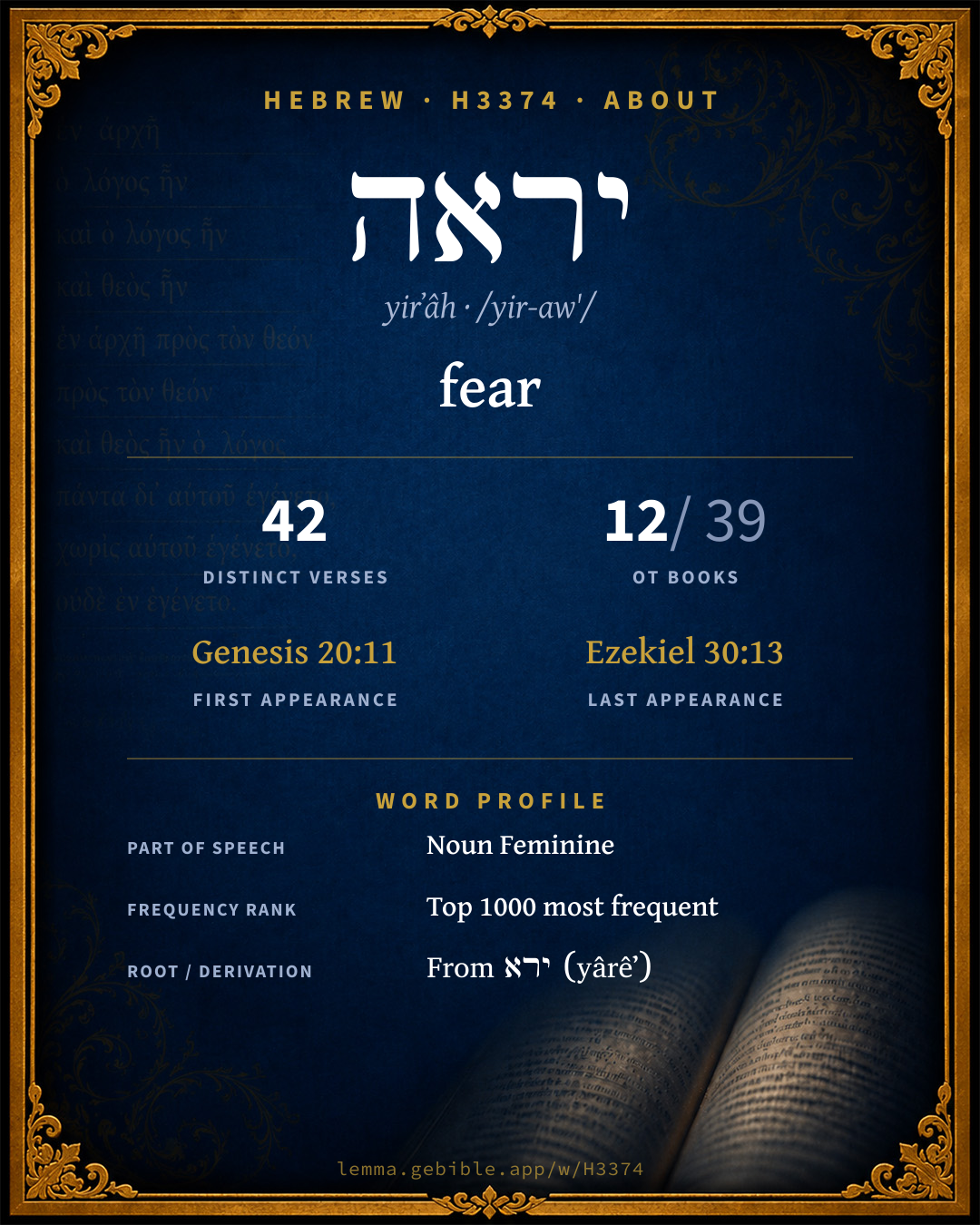
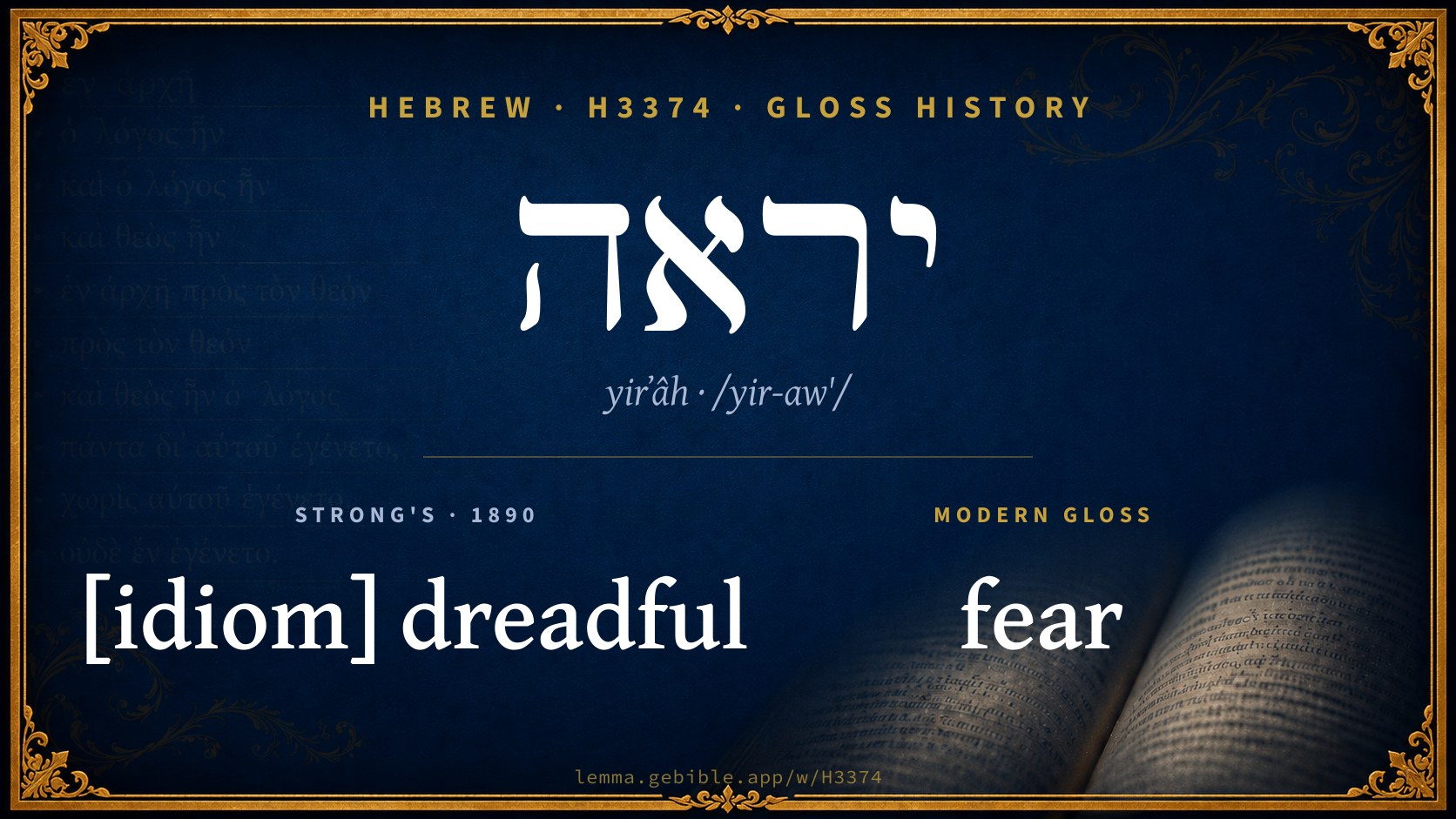
יִרְאָה
fear
also: terror, fearing fuller range ↓
Full lexicon entry — Brown-Driver-Briggs (BDB)
From Brown-Driver-Briggs (BDB)
Where this word appears
See every Construct-state word in the Hebrew Bible →
Grammar key — what these labels mean
Part of speech
- Noun
- A naming word — a person, place, thing, or idea.
Noun type
- Common
- A common noun — a general class of person, place, or thing (“king,” “city,” “water”), not a specific name.
State
- Construct
- A noun bound to a following noun in a possessive / “of” relationship (the construct chain).
- Absolute
- The independent form of a noun, not bound to a following word.
Gender
- Feminine
- Grammatically feminine.
Number
- Singular
- One.
Grammatical forms
- Noun, Common, Feminine, Singular, Construct 37 times (88%)
- Noun, Common, Feminine, Singular, Absolute 5 times (12%)
Parsed forms decoded from the imported morphology (morphhb / Westminster Leningrad Codex — WLC text public domain, morphhb tagging CC BY 4.0), counted across 42 parsed occurrences — not distinct verses.
Every verse where H3374 appears — 42 distinct verses across 12 books. Click any verse to open its interlinear word-by-word view. Verse text shown in the World English Bible for context — . Each verse’s Hebrew form is shown with its reference; the English is not keyword-highlighted, since the data carries no word-level English alignment. Use “Compare translations” on any verse to read it across multiple English versions. This concordance covers the Hebrew Bible; Septuagint (Greek Old Testament) occurrences are not indexed here.
Genesis 1 verse
Exodus 1 verse
Deuteronomy 1 verse
2 Samuel 1 verse
2 Chronicles 1 verse
Nehemiah 2 verses
- Nehemiah 5:9 בְּ/יִרְאַ֤ת prep + n c fs cs Also I said, The thing that you do is not good: ought you not to walk in the fear of our God, because of the reproach of the nations our enemies?
- Nehemiah 5:15 יִרְאַ֥ת n c fs cs But the former governors who were before me were chargeable to the people, and took of them bread and wine, besides forty shekels of silver; yes, even their servants bore rule over the people: but I didn't do so, because of the fear of God.
Job 5 verses
- Job 4:6 יִ֭רְאָתְ/ךָ n c fs cs + sfx pers 2ms Isn't your piety your confidence, The integrity of your ways your hope?
- Job 6:14 וְ/יִרְאַ֖ת conj + n c fs cs "To him who is ready to faint, kindness should be shown from his friend; Even to him who forsakes the fear of the Almighty.
- Job 15:4 יִרְאָ֑ה n c fs Yes, you do away with fear, And hinder devotion before God.
- Job 22:4 הֲֽ֭/מִ/יִּרְאָ֣תְ/ךָ ptcl inter + prep + n c fs cs + sfx pers 2ms Is it for your piety that he reproves you, That he enters with you into judgment?
- Job 28:28 יִרְאַ֣ת n c fs cs To man he said, 'Behold, the fear of the Lord, that is wisdom. To depart from evil is understanding.'"
Psalms 8 verses
- Psalms 2:11 בְּ/יִרְאָ֑ה prep + n c fs Serve Yahweh with fear, And rejoice with trembling.
- Psalms 5:7 בְּ/יִרְאָתֶֽ/ךָ prep + n c fs cs + sfx pers 2ms But as for me, in the abundance of your loving kindness I will come into your house: I will bow toward your holy temple in reverence of you.
- Psalms 19:9 יִרְאַ֤ת n c fs cs The fear of Yahweh is clean, enduring forever. Yahweh's ordinances are true, and righteous altogether.
- Psalms 34:11 יִֽרְאַ֥ת n c fs cs Come, you children, listen to me. I will teach you the fear of Yahweh.
- Psalms 55:5 יִרְאָ֣ה n c fs Fearfulness and trembling have come on me. Horror has overwhelmed me.
- Psalms 90:11 וּ֝/כְ/יִרְאָתְ/ךָ֗ conj + prep + n c fs cs + sfx pers 2ms Who knows the power of your anger, Your wrath according to the fear that is due to you?
- Psalms 111:10 יִרְאַ֬ת n c fs cs The fear of Yahweh is the beginning of wisdom. All those who do his work have a good understanding. His praise endures forever!
- Psalms 119:38 לְ/יִרְאָתֶֽ/ךָ prep + n c fs cs + sfx pers 2ms Fulfill your promise to your servant, That you may be feared.
Proverbs 14 verses
- Proverbs 1:7 יִרְאַ֣ת n c fs cs The fear of Yahweh is the beginning of knowledge; But the foolish despise wisdom and instruction.
- Proverbs 1:29 וְ/יִרְאַ֥ת conj + n c fs cs Because they hated knowledge, And didn't choose the fear of Yahweh.
- Proverbs 2:5 יִרְאַ֣ת n c fs cs Then you will understand the fear of Yahweh, And find the knowledge of God.
- Proverbs 8:13 יִֽרְאַ֣ת n c fs cs The fear of Yahweh is to hate evil. I hate pride, arrogance, the evil way, and the perverse mouth.
- Proverbs 9:10 יִרְאַ֣ת n c fs cs The fear of Yahweh is the beginning of wisdom. The knowledge of the Holy One is understanding.
- Proverbs 10:27 יִרְאַ֣ת n c fs cs The fear of Yahweh prolongs days, But the years of the wicked shall be shortened.
- Proverbs 14:26 בְּ/יִרְאַ֣ת prep + n c fs cs In the fear of Yahweh is a secure fortress, And he will be a refuge for his children.
- Proverbs 14:27 יִרְאַ֣ת n c fs cs The fear of Yahweh is a fountain of life, Turning people from the snares of death.
- Proverbs 15:16 בְּ/יִרְאַ֣ת prep + n c fs cs Better is little, with the fear of Yahweh, Than great treasure with trouble.
- Proverbs 15:33 יִרְאַ֣ת n c fs cs The fear of Yahweh teaches wisdom. Before honor is humility.
- Proverbs 16:6 וּ/בְ/יִרְאַ֥ת conj + prep + n c fs cs By mercy and truth iniquity is atoned for. By the fear of Yahweh men depart from evil.
- Proverbs 19:23 יִרְאַ֣ת n c fs cs The fear of Yahweh leads to life, then contentment; He rests and will not be touched by trouble.
- Proverbs 22:4 יִרְאַ֣ת n c fs cs The result of humility and the fear of Yahweh Is wealth, honor, and life.
- Proverbs 23:17 בְּ/יִרְאַת prep + n c fs cs Don't let your heart envy sinners; But rather fear Yahweh all the day long.
Isaiah 5 verses
- Isaiah 7:25 יִרְאַ֖ת n c fs cs All the hills that were cultivated with the hoe, you shall not come there for fear of briers and thorns; but it shall be for the sending forth of oxen, and for the treading of sheep."
- Isaiah 11:2 וְ/יִרְאַ֥ת conj + n c fs cs The Spirit of Yahweh shall rest on him, the spirit of wisdom and understanding, the spirit of counsel and might, the spirit of knowledge and of the fear of Yahweh.
- Isaiah 11:3 בְּ/יִרְאַ֣ת prep + n c fs cs His delight shall be in the fear of Yahweh; and he shall not judge after the sight of his eyes, neither decide after the hearing of his ears;
- Isaiah 33:6 יִרְאַ֥ת n c fs cs There shall be stability in your times, abundance of salvation, wisdom, and knowledge: the fear of Yahweh is your treasure.
- Isaiah 63:17 מִ/יִּרְאָתֶ֑/ךָ prep + n c fs cs + sfx pers 2ms O Yahweh, why do you make us to err from your ways, and harden our heart from your fear? Return for your servants' sake, the tribes of your inheritance.
Jeremiah 1 verse
Ezekiel 2 verses
- Ezekiel 1:18 וְ/יִרְאָ֣ה conj + n c fs As for their rims, they were high and dreadful; and they four had their rims full of eyes round about.
- Ezekiel 30:13 יִרְאָ֖ה n c fs Thus says the Lord Yahweh: I will also destroy the idols, and I will cause the images to cease from Memphis; and there shall be no more a prince from the land of Egypt: and I will put a fear in the land of Egypt.
About this entry
At a glance — auto-summarized from this page’s data, not written by a person. Every figure links to its source below. This summary describes the numbers; it doesn’t interpret them.
יראה — transliterated yirʼâh — is a Hebrew noun carrying the sense “fear.” Where the King James Version says “fear,” newer translations reach for “fear of” (unfoldingWord Literal Text); the renderings breakdown has the detail. The Hebrew Bible uses it across 42 verses — moderately common. More than a third of its appearances fall in Proverbs. Alongside “fear” the lexicon also lists “terror” and “fearing” — part of its full sense range. See the sense tree, 42-verse concordance, and the renderings breakdown below.
Gloss history
Strong's 1890 vs modern scholarship
About this word
Strong's H3374 catalogs a Hebrew word from the Hebrew Old Testament.
These counts are not copied from any lexicon or concordance. They are computed here, from the morphology-tagged Hebrew Old Testament. What Lemma adds →
- 42
- distinct verses
- The word appears in 42 distinct verses.
- 12 / 39
- OT books
- The word appears in 12 of 39 Old Testament books.
- #864
- by frequency
- Top 1000 most frequent Hebrew words (rank 864 of 8,640 Hebrew words by occurrence).
View all 42 occurrences in the concordance →
By section of the Old Testament
By traditional corpus
Conventional, traditional groupings — biblical authorship is debated, so this is a traditional corpus grouping, not an authorship claim. Each share is this word’s portion of its verses in that division of the Hebrew canon. Each figure is a share of the word’s 42 distinct verses.
- Writings (Ketuvim) 30 verses · 71%
- Prophets (Nevi'im) 9 verses · 21%
- Torah (Pentateuch) 3 verses · 7%
How translations render this word
Counts come from each version’s own published word-to-Strong’s tagging or interlinear alignment — an approximate guide to how each version renders this word, not a word-level alignment the data otherwise carries. Because each total is that version’s own tagged count, the per-version totals vary from one another and need not match the appearance or distinct-verse counts above. These counts may also differ from a printed concordance because Lemma counts each distinctly tagged rendering and does not collapse phrase taggings into a single head-word total. This is a fixed set of word-tagged versions (KJV, ASV, BSB, ULT) and does not change with the reading translation you choose elsewhere. Each version’s license is shown beside its name below (and on Sources).
- King James Version: Fear 32×
- American Standard Version: Fear 28×
- Berean Standard Bible: Fear 32×
- unfoldingWord Literal Text: Fear of 25×, Fear 6×
King James Version Public Domain
Renders H3374 across 43 tagged occurrences — most commonly:
Plus 11 renderings that appear only once — usually multi-word phrases or single function words the recovered tagging swept in, not distinct renderings. Not rendered by a distinct English word in 2 further occurrences.
American Standard Version Public Domain
Renders H3374 across 43 tagged occurrences — most commonly:
Plus 15 renderings that appear only once — usually multi-word phrases or single function words the recovered tagging swept in, not distinct renderings.
Berean Standard Bible Public Domain
Renders H3374 across 43 tagged occurrences — most commonly:
Plus 11 renderings that appear only once — usually multi-word phrases or single function words the recovered tagging swept in, not distinct renderings. Not rendered by a distinct English word in 2 further occurrences.
unfoldingWord Literal Text CC BY-SA 4.0
Renders H3374 across 42 tagged occurrences — most commonly:
Plus 11 renderings that appear only once — usually multi-word phrases or single function words the recovered tagging swept in, not distinct renderings.
Senses in the full BDB
What do BDB’s symbols mean?
BDB uses these scholarly abbreviations:
| Symbol | Meaning |
|---|---|
| 𝔊 | the Septuagint (the ancient Greek translation, LXX) |
| 𝔙 | the Vulgate (the Latin translation) |
| 𝔖 | the Syriac version (the Peshitta) |
| 𝔗 | the Targum (the Aramaic translation) |
| ψ | the Psalms |
| √ | root (the underlying root or stem) |
| ‖ | parallel passage (a synonymous or contrasted parallel) |
| † | the dagger: every passage where the word occurs is cited |
The 4 senses and sub-senses the full Brown-Driver-Briggs lexicon distinguishes for this word, in lexicon order (not ranked by frequency), with BDB’s own verbatim wording and sub-sense lettering. Shown in Hebrew script with BDB’s own scholarly abbreviations. The condensed entry is in the Lexicon Entry tab. See also the Forms in the corpus table below.
- 1. fear, terror Is 7:25 Ez 30:13; י׳ גְדוֹלָה great fear Jon 1:10, 16; ‖ פַּחַד Dt 2:25; ‖ רעד(ה) ψ 2:11; 55:6. e.g. Isaiah 7:25
- 2. a terror = obj. of terror, ‖ גֹּבַהּ Ez 1:18 (del. Co). e.g. Ezekiel 1:18
- 3. fear of God, reverence, piety יִרְאַת אֱלֹהִים Gn 20:11 (E), 2 S 23:3 Ne 5:15; יר׳ שַׁדַּי Jb 6:14; יר׳ אֱלֹהֵינוּ Ne 5:9; יר׳ יהוה 2 Ch 19:9 Is 11:3; 33:6 ψ 34:12 Pr 10:27; 14:26, 27; 15:16; 19:23; 22:4; 23:17; ‖ the knowledge (of God) Pr 1:29; 2:5 Is 11:2; is the beginning of wisdom ψ 111:10 Pr 9:10, and knowledge 1:7; the instruction of wisdom 15:33, is to hate evil 8:13, and it involves departing from evil 16:6; י׳ אֲדֹנָי is wisdom Jb 28:28; יִרְאָה is defined by context 15:4; with sfs. these are usually obj., fear of him Ex 20:20 (E), of thee ψ 5:8; 90:11; 119:38 Is 63:17, of me Je 32:40, but subj., thy fear (i.e. thy religion) Jb 4:6; 22:4. e.g. Genesis 20:11
- 4. יִרְאַת יהוֹה ψ 19:10 the fear of י׳ = the law as revered. e.g. Psalms 19:10
Senses from the full Brown-Driver-Briggs lexicon (Brown, Driver, Briggs; Oxford 1906 — public domain), digitized via Sefaria, supplemented by the OpenScriptures HebrewLexicon (CC BY 4.0). Full attribution on Sources.
Word origin
n.f. fear;—יר׳ Ez 30:13 + 6 times; cstr. יִרְאַת Gn 20:11 + 27 times; sf. יִרְאָתִי Je 32:40; יִרְאָתוֹ Ex 20:20; יִרְאָֽתְךָ Jb 4:6 + 3 times; יִרְאָתֶ֑ךָ ψ 5:8 + 2 times;—
— Brown-Driver-Briggs (Oxford 1906, public domain), digitized via Sefaria, supplemented by the OpenScriptures HebrewLexicon (CC BY 4.0). See Sources.
Derived from ירא (yârêʼ) (H3373) — fearing.
Jastrow Dictionary
A second Hebrew/Aramaic lexicon for comparison, covering Aramaic and post-biblical (Talmudic, Targumic, Midrashic) usage that the biblical-Hebrew BDB does not. Matched by lemma rather than by Strong’s number, so a lemma may carry more than one Jastrow headword (shown separately below), and the entries cover usage well beyond the Bible.
יִרְאָה
- preced.)
- 1. infin. of יָרֵא q. v.
- 2. fear. Ber. 17ᵃ יִרְאָתִי the fear of me. Ib. ערום בי׳ cautious in religious affairs. Koh. R. to IX, 7 שתהא יִרְאָתְךָ וכ׳, v. preced.—עשה מִיִּ׳ (or עבד) to do good (to worship) from motives of fear, opp. מאהבה. Sot. 31ᵃ; a. fr., v. אַהֲבָה.—Y. Sot. V, 20ᶜ bot. פרוש י׳, v. פָּרוּשׁ; a. v. fr.—יִרְאַת שמים fear of the Lord; יִרְאַת חטא fear of sin (v. preced.). Ber. 6ᵇ. Ib. 16ᵇ; a. fr.
- 3. object of fear, idol. Snh. 106ᵃ הוציאה יִרְאָתָהּ וכ׳ she took her idol out of her bosom. Pesik. Vayhi. p. 65ᵇ; Mekh. Bo. s. 13 יִרְאָתֵנוּ our (Egyptian) deity; a. fr.—Pl. יִרְאוֹת. Ib. B’shall., Vayhi, s. 1; Yalk. Ex. 230 מכל הי׳ שלהם of all their (the Egyptians’) gods.
A Dictionary of the Targumim, the Talmud Babli and Yerushalmi, and the Midrashic Literature (Marcus Jastrow; London, Luzac, 1903) — Public Domain. Digitized via Sefaria. Digitized via Sefaria. Full attribution on Sources.
Forms in the corpus
The 27 distinct written forms H3374 takes in the Hebrew Bible, most frequent first — each parse links to that state’s occurrences in the concordance. Hebrew forms include their vowel points and cantillation, so a single lemma takes many written forms.
Same root — word family
Other BDB entries built from the same root as H3374, grouped by Strong’s listed origin. These share a root / origin per the lexicon — not necessarily a shared meaning. Each links to that word’s own entry.
Derives from
Proper names from this root
People and places named from this root — a name, not an additional meaning of the word.
Compare all same-root words → 1 of the same-root words is a proper name (a person or place). They share a root, not necessarily a meaning.
Septuagint verse parallels
This word appears in 38 verses that also exist in the Greek Old Testament (Septuagint), out of the 42 Hebrew verses it occurs in. You can read those verses in Greek by switching the Old Testament edition to the Septuagint.
Read these verses in the Septuagint
- Genesis 20:11
- Exodus 20:20
- Deuteronomy 2:25
- 2 Samuel 23:3
- 2 Chronicles 19:9
- Job 4:6
- Psalms 2:11
- Proverbs 1:7
- Isaiah 7:25
- Ezekiel 1:18
This is a verse-level parallel only — the same verses exist in both the Hebrew and Greek Old Testaments. No word-level Hebrew↔Greek correspondence is claimed: the data carries no such alignment, so no Greek word is shown as this Hebrew word’s translation. Coverage is not total — the Septuagint omits the deuterocanon and renumbers the Psalms, so some Hebrew verses have no direct Greek parallel.