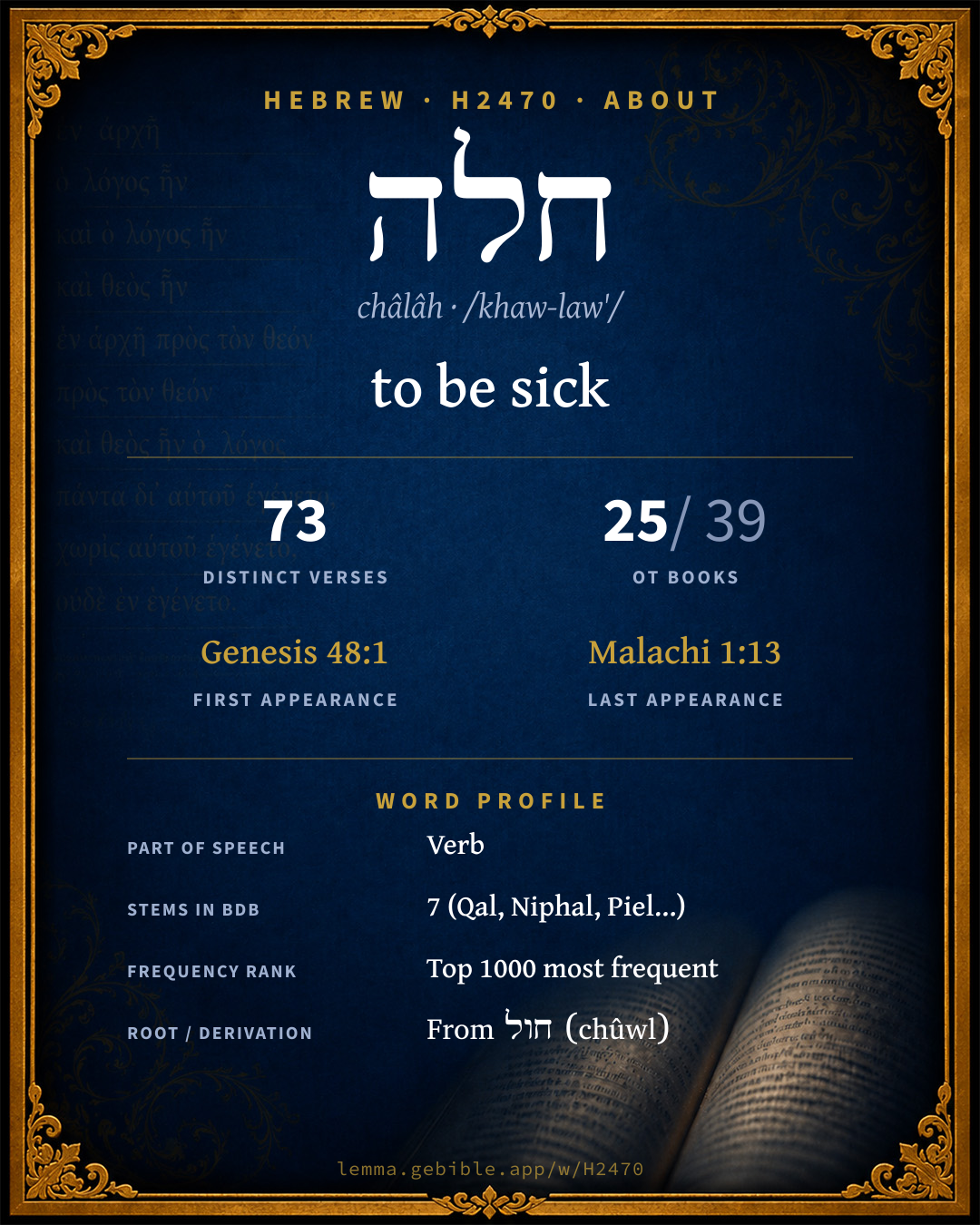
חָלָה
to be sick
‘to be sick’ is one of 4 main senses fuller range ↓
Full lexicon entry — Brown-Driver-Briggs (BDB)
From Brown-Driver-Briggs (BDB)
Where this word appears
See every Hiphil verb in the Hebrew Bible →
Grammar key — what these labels mean
Part of speech
- Verb
- An action or state-of-being word.
Stem
- Qal
- The basic, simple active stem — the plain form of the verb (“he wrote”). Here: ‘be or become weak’
- Piel
- An intensive or resultative active stem. Here: ‘mollify’
- Niphal
- Usually the simple passive or reflexive of the Qal (“he was written”). Here: ‘make oneself sick’
- Hophal
- The passive counterpart of the Hiphil (“he was caused to…”). Here: ‘be made sick = wounded’
- Hithpael
- The reflexive or reciprocal stem (the subject acts on itself).
- Pual
- The passive counterpart of the Piel. Here: ‘be made weak’
- Hiphil
- The causative active stem (“he caused / brought about”). Here: ‘make’
Form
- Perfect
- A completed action or state — Hebrew marks aspect (completeness) more than strict tense (“he wrote”).
- Participle Active
- A verbal adjective expressing ongoing or characteristic action (“writing / one who writes”).
- Sequential Imperfect
- An imperfect with prefixed waw — the standard past-narrative form (waw-consecutive imperfect).
- Infinitive Construct
- A bound verbal noun, frequently with prepositions (“to write / in writing”).
- Participle Passive
- A verbal adjective expressing action received (“written”).
- Imperfect
- An incomplete, ongoing, or future action (“he will / would write”).
- Sequential Perfect
- A perfect with prefixed waw continuing a preceding imperfect or command (waw-consecutive perfect).
- Imperative
- A direct command (“write!”).
State
- Absolute
- The independent form of a noun, not bound to a following word.
- Construct
- A noun bound to a following noun in a possessive / “of” relationship (the construct chain).
Person
- 3rd Person
- The one spoken about (“he / she / it / they”).
- 1st Person
- The speaker (“I / we”).
- 2nd Person
- The one addressed (“you”).
Gender
- Masculine
- Grammatically masculine.
- Feminine
- Grammatically feminine.
- Common
- Either gender — not distinguished for this form.
Number
- Singular
- One.
- Plural
- More than one (in Hebrew, generally three or more).
1 verse where H2470 appears in the Qal stem in the Book of Proverbs. Filtered view — show all forms. Click any verse to open its interlinear word-by-word view. Verse text shown in the World English Bible for context — . Each verse’s Hebrew form is shown with its reference; the English is not keyword-highlighted, since the data carries no word-level English alignment. Use “Compare translations” on any verse to read it across multiple English versions. This concordance covers the Hebrew Bible; Septuagint (Greek Old Testament) occurrences are not indexed here.
Proverbs
About this entry
At a glance — auto-summarized from this page’s data, not written by a person. Every figure links to its source below. This summary describes the numbers; it doesn’t interpret them.
“to be sick” is the headline sense of the Hebrew verb חלה (châlâh). Translators differ — “was sick” in the King James Version, then “ill” (Berean Standard Bible), as the renderings breakdown shows. It turns up in 73 verses across 25 books, a moderately common footprint. First canonically at Genesis 48:1, it enters the text early. Read the stem: it spans 7 stems, including Qal and Niphal. See the sense tree, 73-verse concordance, and the renderings breakdown below.
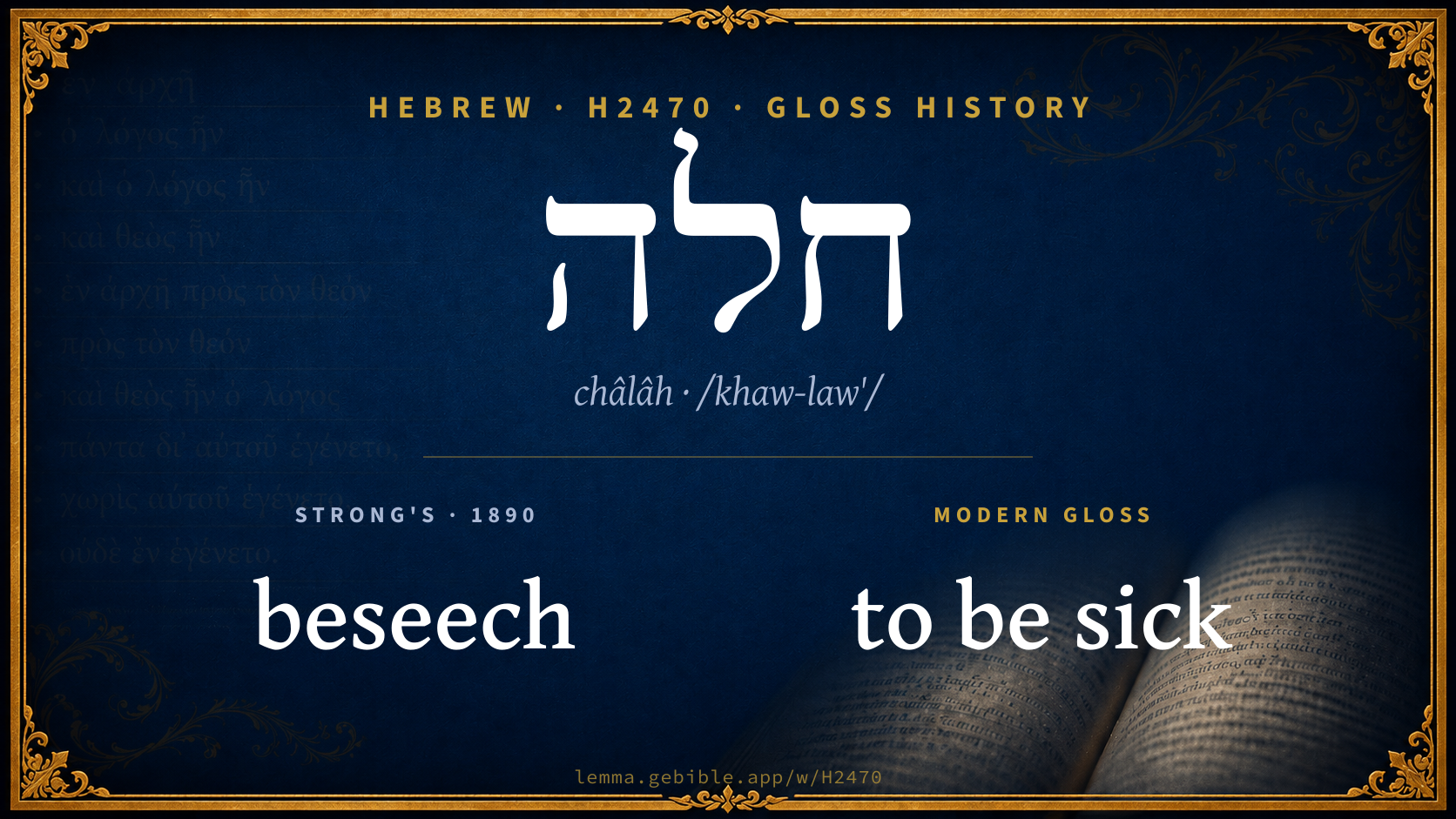
Gloss history
Strong's 1890 vs modern scholarship
About this word
Strong's H2470 catalogs a Hebrew word from the Hebrew Old Testament.
These counts are not copied from any lexicon or concordance. They are computed here, from the morphology-tagged Hebrew Old Testament. What Lemma adds →
- 73
- distinct verses
- The word appears in 73 distinct verses.
- 25 / 39
- OT books
- The word appears in 25 of 39 Old Testament books.
- #532
- by frequency
- Top 1000 most frequent Hebrew words (rank 532 of 8,640 Hebrew words by occurrence).
View all 73 occurrences in the concordance →
By section of the Old Testament
By traditional corpus
Conventional, traditional groupings — biblical authorship is debated, so this is a traditional corpus grouping, not an authorship claim. Each share is this word’s portion of its verses in that division of the Hebrew canon. Each figure is a share of the word’s 73 distinct verses.
- Prophets (Nevi'im) 50 verses · 68%
- Writings (Ketuvim) 20 verses · 27%
- Torah (Pentateuch) 3 verses · 4%
How translations render this word
Counts come from each version’s own published word-to-Strong’s tagging or interlinear alignment — an approximate guide to how each version renders this word, not a word-level alignment the data otherwise carries. Because each total is that version’s own tagged count, the per-version totals vary from one another and need not match the appearance or distinct-verse counts above. These counts may also differ from a printed concordance because Lemma counts each distinctly tagged rendering and does not collapse phrase taggings into a single head-word total. This is a fixed set of word-tagged versions (KJV, ASV, BSB, ULT) and does not change with the reading translation you choose elsewhere. Each version’s license is shown beside its name below (and on Sources).
BDB lists this Strong’s number as 2 distinct words (homographs). Each count above pools all of them and is not split by sense — see the Senses section below. A low-frequency rendering may belong to a different one of those words, not the primary meaning.
- King James Version†: Was sick 6×, Sick 5×, Besought 4×
- American Standard Version†: Was sick 6×, Entreat 5×, Sick 5×
- Berean Standard Bible†: Ill 5×, Sick 4×, Grievous 3×
- unfoldingWord Literal Text†: Sick 6×, Entreated 5×, Was sick 5×
King James Version Public Domain
Renders H2470 across 75† tagged occurrences — most commonly:
Plus 39 renderings that appear only once — usually multi-word phrases or single function words the recovered tagging swept in, not distinct renderings.
American Standard Version Public Domain
Renders H2470 across 75† tagged occurrences — most commonly:
Plus other, less common renderings. Plus 33 renderings that appear only once — usually multi-word phrases or single function words the recovered tagging swept in, not distinct renderings.
Berean Standard Bible Public Domain
Renders H2470 across 75† tagged occurrences — most commonly:
Plus other, less common renderings. Plus 37 renderings that appear only once — usually multi-word phrases or single function words the recovered tagging swept in, not distinct renderings.
unfoldingWord Literal Text CC BY-SA 4.0
Renders H2470 across 92† tagged occurrences — most commonly:
Plus other, less common renderings. Plus 53 renderings that appear only once — usually multi-word phrases or single function words the recovered tagging swept in, not distinct renderings.
19 senses and sub-senses in the full BDB
Hebrew verbs can shift meaning by stem (binyan): Qal is the basic action, Niphal is often passive or reflexive, Piel often intensifies or makes it factitive, and Hiphil is typically causative. The senses below are grouped under the stem BDB assigns to each. This entry also uses Pual (the passive of Piel), Hithpael (reflexive or reciprocal), and Hophal (the passive of Hiphil).
What do BDB’s symbols mean?
BDB uses these scholarly abbreviations:
| Symbol | Meaning |
|---|---|
| 𝔊 | the Septuagint (the ancient Greek translation, LXX) |
| 𝔙 | the Vulgate (the Latin translation) |
| 𝔖 | the Syriac version (the Peshitta) |
| 𝔗 | the Targum (the Aramaic translation) |
| ψ | the Psalms |
| √ | root (the underlying root or stem) |
| ‖ | parallel passage (a synonymous or contrasted parallel) |
| † | the dagger: every passage where the word occurs is cited |
The 19 senses and sub-senses the full Brown-Driver-Briggs lexicon distinguishes for this word, in lexicon order (not ranked by frequency), with BDB’s own verbatim wording and sub-sense lettering. Shown in Hebrew script with BDB’s own scholarly abbreviations. The condensed entry is in the Lexicon Entry tab. See also the Forms in the corpus table below.
חלה I be weak, sick (NH id.
Qal
- Pf. ח׳ 1 K 14:1 + 8 times; 2 fs. חָלִית Is 57:10; 1 s. חָלִיתִי 1 S 30:13 + 2 times; וְחָלִי֫תִי consec. Ju 16:7, 11, 17, חָלוּ֫ Je 5:3 (so read, v. infr.); Impf. וַיָּ֑חַל 2 K 1:2; Inf. sf. חֲלֹתוֹ Is 38:9; חֲלוֹתִי ψ 77:11 cf. sub Pi.; חֲלוֹתָם ψ 35:13; Pt. חֹלֶה Gn 48:1 + 6 times + 1 S 22:8 (v. infr.); חוֹלֶה Ne 2:2 Mal 1:13; f. חוֹלָה Ec 5:12 + 3 times (for Je 4:31 v. I. חוּל), cstr. חוֹלַת Ct 2:5; 5:8;— e.g. 1 Kings 14:1
- 1. be or become weak, Samson Ju 16:7, 11, 17; feel weak Is 57:10 (Che) Ez 34:4, 16. e.g. Judges 16:7
- 2. become sick, ill Gn 48:1 (E) 1 S 19:14; 30:13 1 K 14:1, 5; 15:23 (of Asa, = חלא 2 Ch 16:2) 17:17 2 K 1:2; 8:7; 13:14 (c. acc. cogn.) 20:12 = Is 39:1, Is 33:24; 38:9 Pr 23:35 ψ 35:13 Ne 2:2, cf. ψ 77:11 חֲלוֹתִי for חַלּוֹתִי Che after Bi; lame and sick—i.e. imperfect for sacrifice—of animals Mal 1:8, 13; sick from effect of wounds 2 K 8:29 = 2 Ch 22:6, cf. Pr 23:35, מַכָּה with חֳלִי Dt 28:59, 61 Je 6:7; 10:19; hyperbol. sick from love חוֹלַת אַהֲבָה אני Ct 2:5; 5:8; be sick unto dying חלה לָמוּת 2 K 20:1 = Is 38:1, ח׳עד־למות (late) 2 Ch 32:24; Je 5:3 read prob. לֹא חָלוּ֫ (for MT חָ֫לוּ, v. I. חול) of the people, unmoved by י׳’s chastisements; thou hast smitten them, but they are not sick (cf. Niph. Am 6:6); of sickness of the mind in MT 1 S 22:8 sq. עַל (but read rather חֹמֵל 𝔊 Gr Klo Dr); pt. as adj. severe, sore רָעָה חוֹלָה Ec 5:12, 15;—on Je 4:31 v. I. חול. e.g. Genesis 48:1
Niphal
- Pf. 1 s. נֶחֱלֵיתִי Dn 8:27; 3 pl. נֶחְלוּ Am 6:6 Je 12:13; Pt. f. נַחֲלָה Is 17:11 + 4 times; pl. נַחְלוֹת Ez 34:4 (del. Co) v 21;— e.g. Daniel 8:27
- 1. make oneself sick, fig. for strain oneself Je 12:13 (but Gr נִלְאוּ). e.g. Jeremiah 12:13
- 2. be made sick Dn 8:27; לֹא נֶח׳ of indifference, apathy Am 6:6 sq. על (cf. Qal Je 5:3); pt. diseased, as subst. c. art. Ez 34:4 (del. Co) v 21; = severe, sore (pred. of מַכָּה) Na 3:19 Je 10:19; 14:17; 30:12; also (מַכָּה om.) Is 17:11. e.g. Daniel 8:27
Piel
- Pf. חִלָּה make sick, c. acc. cogn. + בְּ of land Dt 29:21; Inf. cstr. חַלּוֹתִי הִיא ψ 77:11 read prob. חֲלוֹתִי, Inf. Qal, my sickness, so Bi Che (others der. from חלל my wounding, v. De).—For other forms of Pi. v. II. חלה. e.g. Deuteronomy 29:21
Pual
- Pf. be made weak, 2 ms. חֻלֵּיתָ Is 14:10. e.g. Isaiah 14:10
Hithpael
- Impf. וַיִּתְחָ֑ל 2 S 13:6; Imv. הִתְחָ֑ל 2 S 13:5; Inf. הִתְחַלּוֹת 2 S 13:2;—make oneself sick, of Ammon’s morbid passion for his sister 2 S 13:2, sq. בַּעֲבוּר; of his pretended sickness of body 2 S 13:5, 6. e.g. 2 Samuel 13:6
Hiphil
- Pf. 3 ms. הֶחֱלִי Is 53:10; 1 s. הֶהֱלֵתִי Mi 6:13; pl. הֶחֱלוּ Ho 7:5 (on text v. infr.); Pt. מַחֲלָה Pr 13:12;— e.g. Isaiah 53:10
- 1. make (sick, i.e.) sore thy smiting הַכּוֹתֶ֑ךָ Mi 6:13 (cf. Na 3:19, Niph.); obj. (implic.) a person, וי׳ חָפֵץ דַּכְּאוֹ הֶחֱלִי Is 53:10 it pleased י׳ to bruise him, making him sick = to bruise him sorely, v. further Di. e.g. Micah 6:13
- 2. make sick, obj. לֵב (of hope deferred) Pr 13:12. e.g. Proverbs 13:12
- 3. shew (signs of) sickness, become sick, only הֶח׳ שׂרים חֲמַת מִיָּ֑יִן Ho 7:5 princes are become sick with fever of wine (Now Che VB; > Vrss Hi-St who read הֵחֵלּוּ they begin the day with wine-fever). e.g. Hosea 7:5
Hophal
- Pf. be made sick = wounded הָֽחֳלֵיתִי 1 K 22:34 = 2 Ch 18:33, 2 Ch 35:23. e.g. 1 Kings 22:34
חלה II
Piel
- Pf. חִלָּה 2 Ch 33:12, חִלִּיתִי 1 S 13:12 ψ 119:58, וְחִלּוּ consec. Jb 11:19, חִלִּינוּ Dn 9:13; Impf. וַיְחַל Ex 32:11 + 3 times, יְחַלּוּ ψ 45:13 Pr 19:6; Imv. חַל־נָא 1 K 13:6, חַלּוּ־נָא Mal 1:9; Inf. cstr. לְחַלּוֹת Zc 7:2 + 2 times;— e.g. 2 Chronicles 33:12
- 1. ח׳ את־פני־י׳:
- a. mollify, pacify, appease י׳, i.e. induce him to shew favour in place of wrath and chastisement Ex 32:11 (JE), 1 K 13:6 (+ הִתְפַּלֵּל), v 6 2 K 13:4 Je 26:19 (+ וַיִּנָּ֫חֶם), 2 Ch 33:12 (‖ וַיִּכָּנַע מאד מִלִּפְנֵי), Dn 9:13; also ח׳ פני־אֵל Mal 1:9 (sq. וִיחָנֵּ֑נוּ that he may be gracious to us). e.g. Exodus 32:11
- b. entreat the favour of י׳, i.e. aim at success, prosperity, etc., through his favour, 1 S 13:12 (in anticipation of war), Zc 8:21, 22 (‖ לְבַקֵּשׁ אֶת־י׳; of cities and nations assembling at Jerusalem for worship), Zc 7:2 (‖ לְבַקֵּשׁ אֶת־י׳) of worship at Jerusalem; quite gen., as habit of God-fearing man, ψ 119:58 (+ בְּכָל־לֵב). e.g. 1 Samuel 13:12
- 2. entreat favour of men (in sense of 1 b)—רַבִּים יְח׳ פני־נָדִיב Pr 19:6 many entreat a prince’s favour (‖ וְכָל־הָרֵעַ לְאִישׁ מַתָּן); יח׳ פָּנַיִךְ ψ 45:13 of favour of king’s bride; וְח׳ פָּנֶיךָ רַבִּים Jb 11:19 favour of Job when absolved and restored. e.g. Proverbs 19:6
Senses from the full Brown-Driver-Briggs lexicon (Brown, Driver, Briggs; Oxford 1906 — public domain), digitized via Sefaria, supplemented by the OpenScriptures HebrewLexicon (CC BY 4.0). Full attribution on Sources.
Word origin
I. vb. be weak, sick (NH id.; Aramaic חֲלָא suffer (rare); Assyrian ḫalû, sickness, grief, DlPr 181)—
II. vb. only Pi. sq. פְּנֵי, פָּנֶיךָ, פָּנַיִךְ = mollify, appease, entreat the favour of, lit. make the face of any one sweet or pleasant (cf. Arabic حَلَا, حَلِىَ be sweet, pleasant, Aramaic ܚܠܻܝ, חֲלִי, id., adj. חָלֵי sweet);—
— Brown-Driver-Briggs (Oxford 1906, public domain), digitized via Sefaria, supplemented by the OpenScriptures HebrewLexicon (CC BY 4.0). See Sources.
Derived from חול (chûwl) (H2342) — to writhe.
Jastrow Dictionary
A second Hebrew/Aramaic lexicon for comparison, covering Aramaic and post-biblical (Talmudic, Targumic, Midrashic) usage that the biblical-Hebrew BDB does not. Matched by lemma rather than by Strong’s number, so a lemma may carry more than one Jastrow headword (shown separately below), and the entries cover usage well beyond the Bible.
חָלָה
- , v. חלי
חַלָּה
- 1. [rolled, rounded] cake.—Pl. חַלּוֹת. Ukts. III, 5 ח׳ חריע (Tosef. Maas. Sh. I, 13 חַלַּת (collect. noun), a. e., v. חֲרִיעַ.—Men. III, 6 שתי ח׳ the two loaves (offered on the Feast of Weeks, Lev. XXIII, 17).—B. Bath. V, 3; Ukts. III, 11 ח׳ דבש honey-combs; a. fr. e.g. Leviticus 23:17
- 2. (with ref. to Num. XV, 20, sq.) Ḥallah, the priest’s share of the dough. Sabb. II, 6, v. זָהִיר. Ḥall. I, 1 חייבין בח׳ are subject to the law of Ḥallah.—Ib. II, 7 שעור הח׳ the quantity to be set aside for the priest. Ib. 8 מעיסה שלא הורמה חַלָּתָהּ Ms. M. (v. Rabb. D. S. a. l. note) from a dough from which the priest’s share has not yet been taken; a. fr.—Pl. as ab. Pesik. Shimu, p. 118ᵃ שתי ח׳ two portions (one for being burnt, and one for the priest); Y. Erub. III, end, 21ᶜ; Cant. R. to I 6; a. e.—Trnsf. ḥallah, the sanctification of creation, man. Gen. R. s. 14, beg.; Yalk. Prov. 962, a. e. (ref. to Prov. XXIX, 4, ואיש תרומות) that is Adam שהיה גמר חַלָּתוֹ וכ׳ who was the final sanctification of the world; Gen. R. s. 17, end.—Ḥallah, name of a treatise of the Mishnah, Tosefta a. Talm. Y., of the Order of Z’raïm. e.g. Numbers 15:20
חלי
- 1. to be lax, to be sick, faint away, grieve. Ex. R. s. 43 (expl. ויחל, Ex. XXXII, 11 ח׳ משה Moses was sick (grieved). Kidd. 71ᵇ, a. e. מדי חוֹלָה Media is sick, v. גּוֹסֵס.—Ber. 28ᵇ כשח׳ וכ׳ when R. … fell sick; a. fr.—V. חוֹלֶה. e.g. Exodus 32:11
- 2. to be smooth (to the taste), sweet.
- 1. to soften, sweeten; to soothe, assuage (by prayer, gifts &c.). Ex. R. l. c. מהו וַיְחַל שהכניס וכ׳ what does vayḥal (Ex. l. c.) mean? He offered &c. (ref. to Ps. XLV, 13). Ib. מהו ויחל עשה את המר וכ׳ he made sweet what was bitter. Ib. חַלֵּי מרירתן וכ׳ sweeten thou the bitterness (sin) of Israel &c.—Ib. מי שיְחַלֶּה וכ׳ one to sweeten the bitterness &c. (by prayer). Yalk. Ex. 392 אביי אמר עד שחִילֵּהוּ להקב"ה בתפילתו (v. infra) Ab. explained vayḥal, until he assuaged (the anger of) the Lord &c. Deut. R. s. 3 הרי בניך מרים חַלֵּה אותן thy children are bitter, sweeten them. Ib. היאך יהא א"ל הוי חל אתה רחמים, read: היאך אהא אומר א"ל הוי אומר חַלֵּה את המרים what shall I say? Said He, Say, sweeten &c.; Yalk. Ex. 392. Lam. R. to I, 2 לא חִלִּינוּ פניך we did not assuage thee by repentance; Ex. R. s. 45 חלִּינוּ מלפני הקב"ה we prayed &c.; a. fr. e.g. Psalms 45:13
- 1. to assuage, soften. Ber. 32ᵃ אביי אמר עד שהֶחֱלֵהוּ להקב"ה בתפלה Ms. M. (v. D. S. a. l.) until he assuaged &c., v. supra. [Ib. שה׳ עליהם וכ׳, read: שהֵחֵל, v. חָלַל.]
- 2. to make sick, wear out. Ib. עמד משה … עד שהחלהו (Ms. M. עד שחלה) Moses stood in prayer … until He wore Him out (by his persistency, v. Rashi a. l. a. Rabb. D. S. a. l. note 3).—3) (v. חָלַל a. חִלְחֵל) to permeate, affect. B. Mets. 107ᵇ bile is called maḥlah (v. מַחְלָה) שהיא מַחְלָה וכ׳ (Ms. F. שמְחַלֶּלֶת) for it goes through the entire body [perh. מְחַלָּה, fr. חָלַל].
- to be made sick. Ber. l. c. עמד … עד שה׳ ed. Sonc. a. oth. (v. supra) until He was worn out.
A Dictionary of the Targumim, the Talmud Babli and Yerushalmi, and the Midrashic Literature (Marcus Jastrow; London, Luzac, 1903) — Public Domain. Digitized via Sefaria. Digitized via Sefaria. Full attribution on Sources.
Forms in the corpus
The 59 distinct written forms H2470 takes in the Hebrew Bible, most frequent first — each parse links to that stem’s occurrences in the concordance. Hebrew forms include their vowel points and cantillation, so a single lemma takes many written forms.
Same root — word family
Other BDB entries built from the same root as H2470, grouped by Strong’s listed origin. These share a root / origin per the lexicon — not necessarily a shared meaning. Each links to that word’s own entry.
Derives from
Shares the same root
Derived from this word
- חלא châlâʼ H2456 to be sick
- חלי chălîy H2481 ornament
- חלי chŏlîy H2483 sickness
- חלל châlal H2490 to profane
- מחלה machăleh H4245 disease
- מחלי machluy H4251 sickness
Proper names from this root
People and places named from this root — a name, not an additional meaning of the word.
- חוילה Chăvîylâh H2341 Havilah
- חול Chûwl H2343 Hul
- חלחול Chalchûwl H2478 Halhul
- מחלה Machlâh H4244 Mahlah
- מחלון Machlôwn H4248 Mahlon
- מחלי Machlîy H4249 Mahli
- מחלת machălath H4257 Mahalath
Compare all same-root words → Showing 4 of 19 — not the complete family. 7 of the same-root words are proper names (people or places). They share a root, not necessarily a meaning.
Septuagint verse parallels
This word appears in 71 verses that also exist in the Greek Old Testament (Septuagint), out of the 73 Hebrew verses it occurs in. You can read those verses in Greek by switching the Old Testament edition to the Septuagint.
Read these verses in the Septuagint
- Genesis 48:1
- Exodus 32:11
- Deuteronomy 29:22
- Judges 16:7
- 1 Samuel 13:12
- 2 Samuel 13:2
- 1 Kings 13:6
- 2 Kings 1:2
- 2 Chronicles 18:33
- Job 11:19
- Psalms 35:13
- Proverbs 13:12
This is a verse-level parallel only — the same verses exist in both the Hebrew and Greek Old Testaments. No word-level Hebrew↔Greek correspondence is claimed: the data carries no such alignment, so no Greek word is shown as this Hebrew word’s translation. Coverage is not total — the Septuagint omits the deuterocanon and renumbers the Psalms, so some Hebrew verses have no direct Greek parallel.