
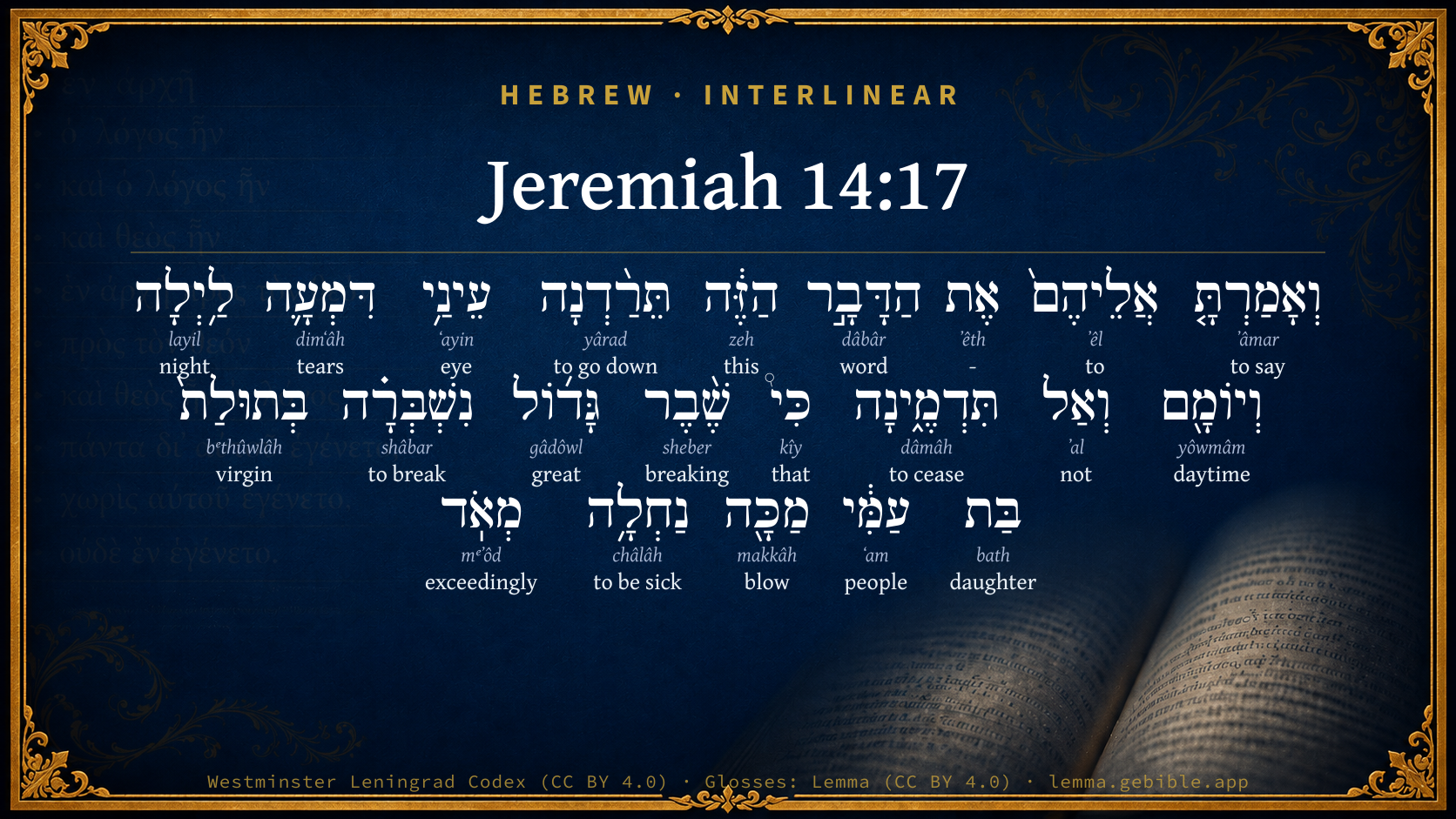
Jeremiah 14:17

Hebrew (Westminster Leningrad Codex) Jeremiah 14:17 appears in the Hebrew Old Testament. The text above is from the Westminster Leningrad Codex. Each word links to its Strong’s number, a concise gloss, and parsing drawn from the Open Scriptures Hebrew Bible morphology. Click any word for its full Brown-Driver-Briggs (BDB) entry.
Download image
Cite this verse

Jeremiah 14:17 (World English Bible). Public Domain. Lemma interlinear Bible study tool, https://lemma.gebible.app/v/jeremiah/14/17.

Show BibTeX & RIS
BibTeX
RIS
English Translation
You shall say this word to them, Let my eyes run down with tears night and day, and let them not cease; for the virgin daughter of my people is broken with a great breach, with a very grievous wound.
World English Bible · Public Domain
Download a study sheet

One document with this verse’s original text, its word-by-word gloss line, the meaning frame, cross-references with their text, attributed commentary, and full source and license credits — printable, and it pastes into notes with its structure intact.

This verse Autodidact and up

Study sheet (.html) Plain text (.txt)

A passage Seminary Student

Up to 50 verses in one chapter. A passage sheet keeps up to 6 commentary sources and 12 cross-references per verse, in the order this page ranks them, and says so on the sheet whenever that leaves anything out. Ask for a single verse and you get the Autodidact verse sheet above.

Everything on this page stays free to read, with no account — the sheet is a download of what is already on screen, not access to it.

Want to remove ads? Support Godless Engineer
Compare translations 3

The same verse in 3 English versions, stacked beneath the original-language interlinear above. Click any original word for its lexicon entry.

Each is an independent rendering of the whole verse — the interlinear is not word-aligned to these translations.

Highlighted words mark where these versions differ — a whole-verse word diff, not a word-by-word alignment.

  • World English Bible Public Domain
    You shall say this word to them, Let my eyes run down with tears night and day, and let them not cease; for the virgin daughter of my people is broken with a great breach, with a very grievous wound.
  • King James Version Public Domain
    Therefore thou shalt say this word unto them; Let mine eyes run down with tears night and day, and let them not cease: for the virgin daughter of my people is broken with a great breach, with a very grievous blow.
  • unfoldingWord Literal Text CC BY-SA 4.0
    And you shall speak this word to them: ‘Let my eyes flow with tears, night and day, and let them not cease, for with a great breaking she has been broken, the virgin daughter of my people, with a very severe blow.

unfoldingWord Literal Text — © unfoldingWord, licensed CC BY-SA 4.0. Word-aligned USFM3 via Door43 (git.door43.org/unfoldingWord/en_ult).

Versions to compare (up to 4)

3 of 4 selected

Show all 18 translations

Every available English version of this verse, each an independent rendering of the whole verse.

  • World English Bible Public Domain
    You shall say this word to them, Let my eyes run down with tears night and day, and let them not cease; for the virgin daughter of my people is broken with a great breach, with a very grievous wound.
  • Berean Standard Bible Public Domain
    You are to speak this word to them: ‘My eyes overflow with tears; day and night they do not cease, for the virgin daughter of my people has been shattered by a crushing blow, a severely grievous wound.
  • Majority Standard Bible Public Domain
    You are to speak this word to them: ‘My eyes overflow with tears; day and night they do not cease, for the virgin daughter of my people has been shattered by a crushing blow, a severely grievous wound.
  • King James Version Public Domain
    Therefore thou shalt say this word unto them; Let mine eyes run down with tears night and day, and let them not cease: for the virgin daughter of my people is broken with a great breach, with a very grievous blow.
  • American Standard Version (1901) Public Domain
    And thou shalt say this word unto them, Let mine eyes run down with tears night and day, and let them not cease; for the virgin daughter of my people is broken with a great breach, with a very grievous wound.
  • Revised Version (1885) Public Domain
    And thou shalt say this word unto them, Let mine eyes run down with tears night and day, and let them not cease; for the virgin daughter of my people is broken with a great breach, with a very grievous wound.
  • Geneva Bible (1599) Public Domain
    Therefore thou shalt say this worde vnto them, Let mine eyes drop downe teares night and day without ceasing: for the virgine daughter of my people is destroyed with a great destruction, and with a sore grieuous plague.
  • Douay-Rheims (1899) Public Domain
    And thou shalt speak this word to them: Let my eyes shed down tears night and day, and let them not cease, because the virgin daughter of my people is afflicted with a great affliction, with an exceeding grievous evil.
  • Young's Literal Translation Public Domain
    And thou hast said unto them this word: Tears come down mine eyes night and day, And they do not cease, For, `with' a great breach, Broken hath been the virgin daughter of my people, A very grievous stroke.
  • Literal Standard Version CC BY-SA 4.0
    And you have said this word to them: Tears come down my eyes night and day, || And they do not cease, || For [with] a great breach, || The virgin daughter of my people has been broken, || A very grievous stroke.
  • Unlocked Literal Bible CC BY-SA 4.0
    Say this word to them: 'Let my eyes flow with tears, night and day. Do not let them stop, for there will be a great collapse of the virgin daughter of my people— a great and incurable wound.
  • unfoldingWord Literal Text CC BY-SA 4.0
    And you shall speak this word to them: ‘Let my eyes flow with tears, night and day, and let them not cease, for with a great breaking she has been broken, the virgin daughter of my people, with a very severe blow.
  • Darby Bible Public Domain
    And thou shalt say this word unto them: Let mine eyes run down with tears, night and day, and not cease; for the virgin daughter of my people is broken with a great breach, with a very grievous blow.
  • World Messianic Bible Public Domain
    “You shall say this word to them: “‘Let my eyes run down with tears night and day, and let them not cease; for the virgin daughter of my people is broken with a great breach, with a very grievous wound.
  • Webster's Bible Public Domain
    Therefore thou shalt say this word to them; Let my eyes run down with tears night and day, and let them not cease: for the virgin daughter of my people is broken with a great breach, with a very grievous blow.
  • Free Bible Version CC BY-SA 4.0
    This is what you are to tell them: Tears flow from my eyes without stopping day or night, because my people have been crushed by a heavy blow, a really serious wound.
  • Bible in Basic English Public Domain
    And you are to say this word to them, Let my eyes be streaming with water night and day, and let it not be stopped; for the virgin daughter of my people is wounded with a great wound, with a very bitter blow.
  • JPS Tanakh (1917) Public Domain
    And thou shalt say this word unto them: Let mine eyes run down with tears night and day, and let them not cease; for the virgin daughter of my people is broken with a great breach, with a very grievous blow.

Literal Standard Version (2020), Covenant Press — licensed CC BY-SA 4.0. Text via the HelloAO Bible API (eBible.org). Unlocked Literal Bible (unfoldingWord) — licensed CC BY-SA 4.0. Text via the HelloAO Bible API (eBible.org). unfoldingWord Literal Text — © unfoldingWord, licensed CC BY-SA 4.0. Word-aligned USFM3 via Door43 (git.door43.org/unfoldingWord/en_ult). Free Bible Version, Dr. Jonathan Gallagher — licensed CC BY-SA 4.0. Text via the HelloAO Bible API (eBible.org).

Word by word

More ways to search: Search by grammar → Find every occurrence → Compare this word →

Practice this passage: Drill this verse → Learn its vocabulary →

תִּדְמֶ֑ינָה
dâmâh
H1820
“to cease”
Verb, Qal, Jussive, 3rd Person, Feminine, Plural
Part of Speech
Verb
Stem
Qal
Form
Jussive
Person
3rd Person
Gender
Feminine
Number
Plural
Full BDB Definition

Origin: a primitive root

TWOT: 438

to cease, cause to cease, cut off, destroy, perish - (Qal) - to cease - to cause to cease, destroy - (Niphal) - to be cut off - to be undone, be cut off at sight of the theophany
  1. וְאָמַרְתָּ֤ ʼâmar H559 “and · to say” Conjunction + Verb, Qal, Sequential Perfect, 2nd Person, Masculine, Singular
  2. אֲלֵיהֶם֙ ʼêl H413 “to · them” Preposition + Suffix, Personal, 3rd Person, Masculine, Plural
  3. אֶת ʼêth H853 “-” Particle, Direct Object
  4. הַדָּבָ֣ר dâbâr H1697 “the · word” Particle, Definite Article + Noun, Common, Masculine, Singular, Absolute
  5. הַזֶּ֔ה zeh H2088 “the · this” Particle, Definite Article + Pronoun, Demonstrative, Masculine, Singular
  6. תֵּרַ֨דְנָה yârad H3381 “to go down” Verb, Qal, Imperfect, 3rd Person, Feminine, Plural
  7. עֵינַ֥י ʻayin H5869 “eyes · my” Noun, Common, Both, Dual, Construct + Suffix, Personal, 1st Person, Common, Singular
  8. דִּמְעָ֛ה dimʻâh H1832 “tears” Noun, Common, Feminine, Singular, Absolute
  9. לַ֥יְלָה layil H3915 “night” Noun, Common, Masculine, Singular, Absolute
  10. וְיוֹמָ֖ם yôwmâm H3119 “and · daytime” Conjunction + Adverb
  11. וְאַל ʼal H408 “and · not” Conjunction + Particle, Negative
  12. כִּי֩ kîy H3588 “that” Conjunction
  13. שֶׁ֨בֶר sheber H7667 “breaking” Noun, Common, Masculine, Singular, Absolute
  14. גָּד֜וֹל gâdôwl H1419 “great” Adjective, Adjective, Masculine, Singular, Absolute
  15. נִשְׁבְּרָ֗ה shâbar H7665 “to break” Verb, Niphal, Perfect, 3rd Person, Feminine, Singular
  16. בְּתוּלַת֙ bᵉthûwlâh H1330 “virgin of” Noun, Common, Feminine, Singular, Construct
  17. בַּת bath H1323 “daughter of” Noun, Common, Feminine, Singular, Construct
  18. עַמִּ֔י ʻam H5971 “people · my” Noun, Common, Masculine, Singular, Construct + Suffix, Personal, 1st Person, Common, Singular
  19. מַכָּ֖ה makkâh H4347 “blow” Noun, Common, Feminine, Singular, Absolute
  20. נַחְלָ֥ה châlâh H2470 “being sick” Verb, Niphal, Participle Active, Feminine, Singular, Absolute
  21. מְאֹֽד mᵉʼôd H3966 “exceedingly” Adverb

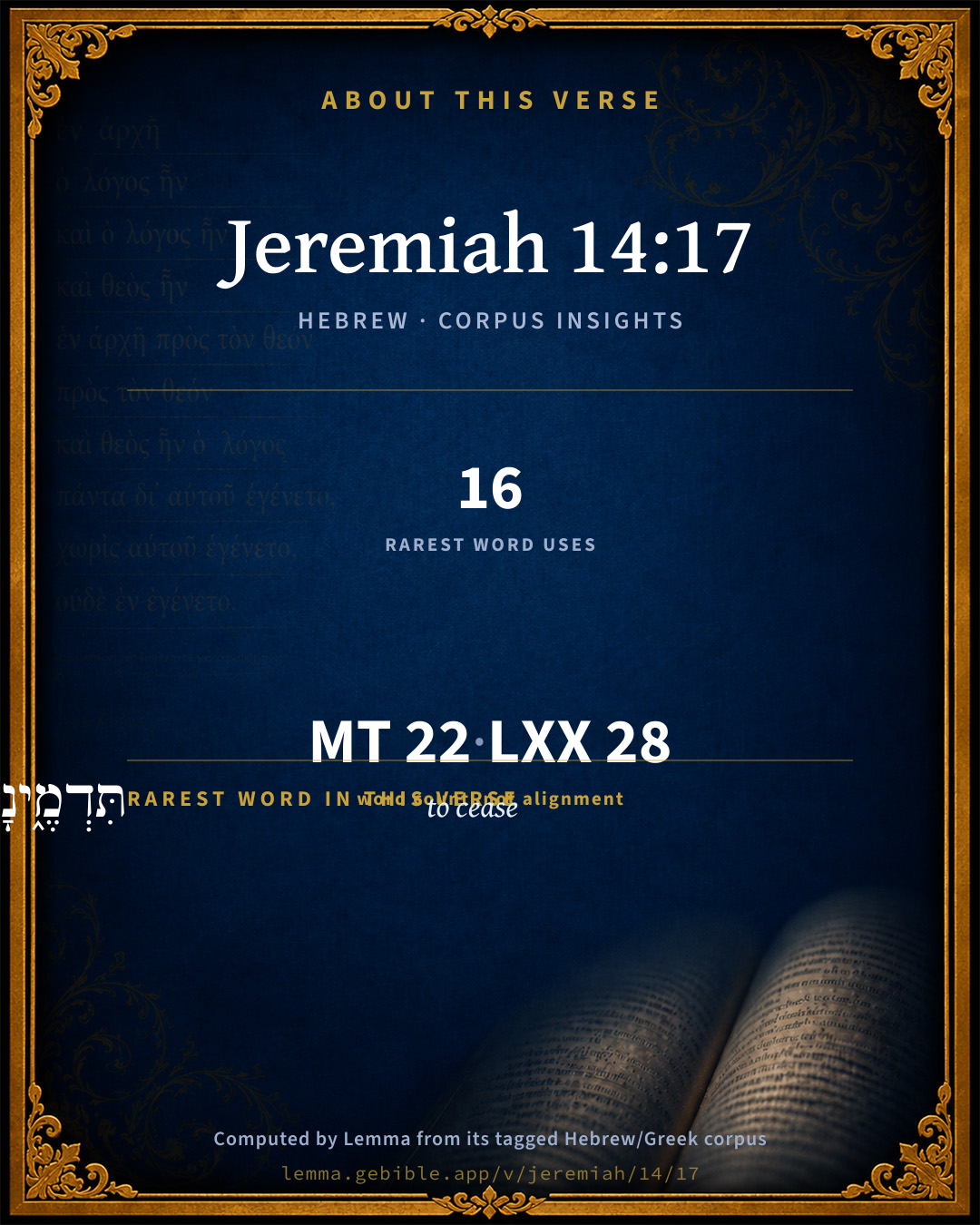
About this verse

These counts appear in no published source. They are computed here, from the morphology-tagged text and Lemma’s own curated glosses. What Lemma adds →

22
words
22
distinct lemmas
Prophets
section

Notable vocabulary

The rarest word here is תִּדְמֶ֑ינָה to cease H1820 — appearing just 16 times in the whole Hebrew Bible.

Shared distinctive vocabulary

תִּדְמֶ֑ינָה to cease H1820 occurs in 14 verses of the Hebrew Bible. Also found in:

Grammatical profile

  • 5 verbs
  • 9 nouns
  • 1 adjective
  • 1 pronoun
  • 1 preposition
  • 1 conjunction
  • 2 adverbs
  • 2 particles

Verb forms

  • וְאָמַרְתָּ֤ Qal · Sequential Perfect
  • תֵּרַ֨דְנָה Qal · Imperfect
  • תִּדְמֶ֑ינָה Qal · Jussive
  • נִשְׁבְּרָ֗ה Niphal · Perfect
  • נַחְלָ֥ה Niphal · Participle Active

Hebrew & Septuagint length

In the original languages it is 22 Hebrew tokens and 28 Greek tokens — but the two are counted differently (Hebrew bundles its prefixes and suffixes into one token; the Greek is in lemma form), so that isn’t a like-for-like length.

Cross-references

15

Topical passages linked to Jeremiah 14:17 in the Treasury of Scripture Knowledge — connected by theme and wording, ordered by reader-vote popularity; previews shown in the World English Bible.

  • Jeremiah 8:21 For the hurt of the daughter of my people am I hurt: I mourn; dismay has taken hold on me.
  • Jeremiah 9:1 Oh that my head were waters, and my eyes a spring of tears, that I might weep day and night for the slain of the daughter of my people!
  • Jeremiah 13:17 But if you will not hear it, my soul shall weep in secret for [your] pride; and my eye shall weep sore, and run down with tears, because Yahweh's flock is taken captive.
  • Lamentations 1:15–16 The Lord has set at nothing all my mighty men in the midst of me; He has called a solemn assembly against me to crush my young men: The Lord has trodden as in a winepress the virgin daughter of Judah.
  • Lamentations 2:13 What shall I testify to you? what shall I liken to you, daughter of Jerusalem? What shall I compare to you, that I may comfort you, virgin daughter of Zion? For your breach is great like the sea: who can heal you?
  • Micah 6:13 Therefore I also have struck you with a grievous wound. I have made you desolate because of your sins.
  • Psalms 39:10 Remove your scourge away from me. I am overcome by the blow of your hand.
  • Psalms 119:136 Streams of tears run down my eyes, Because they don't observe your law.
  • Isaiah 37:22 this is the word which Yahweh has spoken concerning him: The virgin daughter of Zion has despised you and ridiculed you; the daughter of Jerusalem has shaken her head at you.
  • Jeremiah 10:19 Woe is me because of my hurt! my wound is grievous: but I said, Truly this is [my] grief, and I must bear it.
  • Lamentations 2:18 Their heart cried to the Lord: wall of the daughter of Zion, let tears run down like a river day and night; Give yourself no respite; don't let the apple of your eye cease.
  • Jeremiah 30:14–15 All your lovers have forgotten you; they don't seek you: for I have wounded you with the wound of an enemy, with the chastisement of a cruel one, for the greatness of your iniquity, because your sins were increased.
  • Lamentations 3:48–49 My eye runs down with streams of water, for the destruction of the daughter of my people.
  • Amos 5:2 "The virgin of Israel has fallen; She shall rise no more. She is cast down on her land; There is no one to raise her up."
  • Jeremiah 8:18 Oh that I could comfort myself against sorrow! my heart is faint within me.

Cross-references courtesy of OpenBible.info (CC BY 4.0).

Hebrew and Greek witnesses Masoretic Hebrew ↔ Greek Septuagint

The same verse in the two great witnesses to the Old Testament, shown verse-for-verse.

These are two independent witnesses, not word-aligned to each other, and the Septuagint is shown in lemma (dictionary) form.

Hebrew Jeremiah 14:17 Masoretic · Westminster Leningrad Codex

וְאָמַרְתָּ֤ אֲלֵיהֶם֙ אֶת הַדָּבָ֣ר הַזֶּ֔ה תֵּרַ֨דְנָה עֵינַ֥י דִּמְעָ֛ה לַ֥יְלָה וְיוֹמָ֖ם וְאַל תִּדְמֶ֑ינָה כִּי֩ שֶׁ֨בֶר גָּד֜וֹל נִשְׁבְּרָ֗ה בְּתוּלַת֙ בַּת עַמִּ֔י מַכָּ֖ה נַחְלָ֥ה מְאֹֽד

You shall say this word to them, Let my eyes run down with tears night and day, and let them not cease; for the virgin daughter of my people is broken with a great breach, with a very grievous wound.

World English Bible · Public Domain

Greek LXX Structure differs

In the Septuagint, Jeremiah is about an eighth shorter than the Hebrew and arranges its material differently — the Oracles Against the Nations (Hebrew chapters 46–51) appear in the middle of the Greek book, after 25:13. Because the chapter and verse boundaries do not line up, a verse-for-verse comparison with the Hebrew is not shown.

A verse-for-verse comparison isn’t shown here because the chapters and verses don’t line up. Switch to the LXX edition with the MT / LXX toggle above to read the Greek directly.

On this verse, John Gill's Exposition discusses the Septuagint’s reading. Read the note in Commentary ↓

Hebrew: Westminster Leningrad Codex (CC BY 4.0). Greek: Septuagint (public domain); English from a public-domain English Septuagint. How the Septuagint differs from the Hebrew →

Targum (Aramaic paraphrase)

1

The Targum is the ancient Jewish Aramaic paraphrase of the Hebrew Scriptures — an interpretive translation, not the Hebrew text itself. Onkelos (literal) and Pseudo-Jonathan (expansive) render the Torah, and Jonathan the Prophets. Coverage is partial: where no permissively-licensed English translation exists for a verse, only the Aramaic is shown. This is verse-level text, not a word-by-word alignment to the Hebrew.

  1. Targum Jonathan Prophets (Joshua–Malachi)
    וְתֵימַר לְהוֹן יַת פִּתְגָמָא הָדֵין יְשַׁגְרַן עֵינַי דִמְעַן לֵילֵי וִימָם וְלָא יִשְׁתְּקָן אֲרֵי תְבָרָא רַבָּא אִתְּבָרַת מַלְכוּת כְּנִשְׁתָּא דְעַמִי מָחָא מְמַרְעָא לַחֲדָא:

    (no public-domain English translation for this verse)

    Targum Jonathan — Aramaic: “Mikraot Gedolot” (public domain). English: “Sefaria Community Translation” (CC0 1.0 (public-domain dedication)); “London "Chaldee Paraphrase," 1871” (public domain). Text via Sefaria.

Commentary

Notes on Jeremiah 14:17 from classic Christian and Jewish commentators (each source and its license shown beneath its notes). The classic Christian expositions comment on the surrounding passage and are grouped to its opening verse, so a note may address several verses; the Jewish commentaries on the Tanakh (Rashi and others) are per-verse, so they appear only where the commentator wrote on this verse.

Lemma curates 59 commentaries, every one of them public domain or Creative Commons licensed, each selected and text-cleaned for this edition rather than reprinted as found. About our sources →

Matthew Henry's Commentary

The present deplorable state of Judah and Jerusalem is here made the matter of the prophet's lamentation (Jer 14:17, Jer 14:18) and the occasion of his prayer and intercession for them (Jer 14:19), and I am willing to hope that the latter, as well as the former, was by divine direction, and that these words (Jer 14:17), Thus shalt thou say unto them (or concerning them, or in their hearing), refer to the intercession, as well as to the lamentation, and then it amounts to a revocation of the directions given to the prophet not to pray for them, Jer 14:11. However, it is plain, by the prayers we find in these verses, that the prophet did not understand it as a prohibition, but only as a discouragement, like that Jo1 5:16, I do not say he shall pray for that. Here,

I. The prophet stands weeping over the ruins of his country; God directs him to do so, that, showing himself affected, he might, if possible, affect them with the foresight of the calamities that were coming upon them. Jeremiah must say it not only to himself, but to them too: Let my eyes run down with tears, Jer 14:17. Thus he must signify to them that he certainly foresaw the sword coming, and another sort of famine, more grievous even than this which they were now groaning under; this was in the country for want of rain, that would be in the city through the straitness of the siege. The prophet speaks as if he already saw the miseries attending the descent which the Chaldeans made upon them: The virgin daughter of my people, that is as dear to me as a daughter to her father, is broken with a great breach, with a very grievous blow, much greater and more grievous than any she has yet sustained; for (Jer 14:18) in the field multitudes lie dead that were slain by the sword, and in the city multitudes lie dying for want of food. Doleful spectacles! "The prophets and the priests, the false prophets that flattered them with their lies and the wicked priests that persecuted the true prophets, are now expelled their country, and go about either as prisoners and captives, whithersoever their conquerors lead them, or as fugitives and vagabonds, wherever they can find shelter and relief, in a land that they know not." Some understand this of the true prophets, Ezekiel and Daniel, that were carried to Babylon with the rest. The prophet's eyes must run down with tears day and night, in prospect of this, that the people might be convinced, not only that this woeful day would infallibly come, and would be a very woeful day indeed, but that he was far from desiring it, and would as gladly have brought them messages of peace as their false prophets, if he might have had warrant from heaven to do it. Note, Because God, though he inflicts death on sinners, yet delights not in it, it becomes his ministers, though in his name they pronounce the death of sinners, yet sadly to lament it.

II. He stands up to make intercession for them; for who knows but God will yet return and repent? While there is life there is hope, and room for prayer. And, though there were many among them who neither prayed themselves nor valued the prophet's prayers, yet there were some who were better affected, would join with him in his devotions, and set the seal of their Amen to them.

1. He humbly expostulates with God concerning the present deplorableness of their case, Jer 14:19. It was very sad, for, (1.) Their expectations from their God failed them; they thought he had avouched Judah to be his, but now, it seems, he has utterly rejected it, and cast it off, will not own any relation to it nor concern for it. They thought Zion was the beloved of his soul, was his rest for ever; but now his soul even loathes Zion, loathes even the services there performed, for the sake of the sins there committed. (2.) Then no marvel that all their other expectations failed them: They were smitten, and their wounds were multiplied, but there was no healing for them; they looked for peace, because after a storm there usually comes a calm and fair weather, after a long fit of wet; but there was no good, things went still worse and worse. They looked for a healing time, but could not gain so much as a breathing time. "Behold, trouble at the door, by which we hoped peace would enter. And is it so then? Hast thou indeed rejected Judah? Justly thou mightest. Hath thy soul loathed Zion? We deserve it should. But wilt thou not at length in wrath remember mercy?"

2. He makes a penitent confession of sin, speaking that language which they all should have spoken, though but few did (Jer 14:20): "We acknowledge our wickedness, the abounding wickedness of our land and the iniquity of our fathers, which we have imitated, and therefore justly smart for. We know, we acknowledge, that we have sinned against thee, and therefore thou art just in all that is brought upon us; but, because we confess our sins, we hope to find thee faithful and just in forgiving our sins."

3. He deprecates God's displeasure, and by faith appeals to his honour and promise, Jer 14:21. His petition is, "Do not abhor us; though thou afflict us, do not abhor us; though thy hand by turned against us, let not thy heart be so, nor let thy mind be alienated from us." They own God might justly abhor them, they had rendered themselves odious in his eyes; yet, when they pray, Do not abhor us, they mean, "Receive us into favour again. Let not thy soul loathe Zion, Jer 14:19. Let not our incense be an abomination." They appeal, (1.) To the honour of God, the honour of his scriptures, by which he has made himself known - his word, which he has magnified above all his name: "Do not abhor us, for thy name's sake, that the name of thine by which we are called and which we call upon." The honour of his sanctuary is pleaded: "Lord, do not abhor us, for that will disgrace the throne of thy glory" (the temple, which is called a glorious high throne from the beginning, Jer 17:12); let not that which has been the joy of the whole earth be made a hissing and an astonishment. We deserve to have disgrace put upon us, but let it not be so as to reflect upon thyself; let not the desolations of the temple give occasion to the heathen to reproach him that used to be worshipped there, as if he could not, or would not, protect it, or as if the gods of the Chaldeans had been too hard for him. Note, Good men lay the credit of religion, and its profession in the world, nearer their hearts than any private interest or concern of their own; and those are powerful pleas in prayer which are fetched thence and great supports to faith. We may be sure that God will not disgrace the throne of his glory on earth; nor will he eclipse the glory of his throne by one providence without soon making it shine forth, and more brightly than before, by another. God will be no loser in his honour at the long-run. (2.) To the promise of God; of this they are humbly bold to put him in mind: Remember thy covenant with us, and break not that covenant. Not that they had any distrust of his fidelity, or that they thought he needed to be put in mind of his promise to them, but what he had said he would plead with himself they take the liberty to plead with him. Then will I remember my covenant, Lev 26:42.

4. He professes a dependence upon God for the mercy of rain, which they were now in want of, Jer 14:22. If they have forfeited their interest in him as their God in covenant, yet they will not let go their hold on him as the God of nature. (1.) They will never make application to the idols of the heathen, for that would be foolish and fruitless: Are there any among the vanities of the Gentiles that can cause rain? No; in a time of great drought in Israel, Baal, though all Israel presented their prayers to him in the days of Ahab, could not relieve them; it was that God only who answered by fire that could answer by water too. (2.) They will not terminate their regards in second causes, nor expect supply from nature only: Can the heavens give showers? No, not without orders from the God of heaven; for it is he that has the key of the clouds, that opens the bottles of heaven and waters the earth from his chambers. But, (3.) All their expectation therefore is from him and their confidence in him: "Art not thou he, O Lord our God! from whom we may expect succour and to whom we must apply? Art thou not he that causest rain and givest showers? For thou hast made all these things; thou gavest them being, and therefore thou givest them law and hast them all at thy command; thou madest that moisture in nature which is in a constant circulation to serve the intentions of Providence, and thou directest it, and makest what use thou pleasest of it; therefore we will wait upon thee, and upon thee only; we will ask of the Lord rain, Zac 10:1. We will trust in him to give it to us in due time, and be willing to tarry his time; it is fit that we should, and it will not be in vain to do so." Note, The sovereignty of God should engage, and his all-sufficiency encourage, our attendance on him and our expectations from him at all times.

Matthew Henry's Commentary on the Whole Bible (1708–1710) — public domain (CC PDM 1.0). Text via the HelloAO Bible API.

Trapp's Complete Commentary

John Trapp

Jer 14:17 Therefore thou shalt say this word unto them; Let mine eyes run down with tears night and day, and let them not cease: for the virgin daughter of my people is broken with a great breach, with a very grievous blow.

Ver. 17. Let mine eyes run down.] This the prophet did doubtless in good earnest; like as Samuel mourned for the rejection of Saul, and our Saviour wept over Jerusalem.

And let them not cease.] Heb., Be silent; for tears also have a voice, {Psa 39:12} and do oft prove very effectual orators.

John Trapp, A Commentary or Exposition upon All the Books of the Old and New Testament (1647–1656) — public domain. Text from a community e-Sword module.

Joseph Benson's Commentary

Jer 14:17-18. Therefore thou shalt say this word unto them — Either, 1st, The word spoken above; the threatenings denounced in the last two verses against the false prophets and the people, the deceivers and the deceived: or, 2d, As the passage is generally interpreted, and as our translators have understood it, the words following, namely, the prophet’s lamentation and prayer. Let mine eyes run down with tears — As if he had said, However insensible you are of your own condition, yet God commands me to bewail those calamities which I foresee are coming upon you. For the virgin daughter of my people — That is as dear to me as a daughter to her father; is broken with a great breach — Much greater than any she has yet sustained. The dissolution of a government, or body politic, is called a breach, by way of allusion to the breaking or disjointing the limbs of a human body. The prophet speaks as if he already saw the miseries attending the invasion of the country by the Chaldeans. If I go forth into the field, &c. — Multitudes lie dead in the field, slain with the sword; and in the city multitudes lie dying for want of food: doleful spectacle! Yea both the prophet and the priest — Namely, the false prophets, who flattered the people with their lies, and the wicked priests, who persecuted the true prophets, are now expelled their country, and go about into a land they know not — Either as prisoners and captives, whithersoever their conquerors lead them; or, as fugitives and vagabonds, wherever they can find shelter. Some understand it of the true prophets, Ezekiel and Daniel, who were carried to Babylon with the rest. But as the Hebrew word here used, סחרו, properly signifies, to go about on account of traffic, or, merchandise, the sense of the clause may be, “The prophet and the priest carry on a trade against the land, and acknowledge it not.” That is, they deceive the people with lying divinations for the sake of gain, and when accused of it, will not own their guilt. Blaney renders it, They go trafficking about the city, meaning, “They go about with their false doctrine and lying predictions, as peddlers do with their wares, seeking their own gain,” and take no knowledge — That is, “pay no regard to the miseries in which their country is involved, but act as if they were totally insensible of them.”

Joseph Benson's Commentary on the Old and New Testaments (1811–1818) — public domain. Text from a community e-Sword module.

Tyndale Open Study Notes

Tyndale Open Resources

14:17-18 As he surveyed Judah’s condition, God vividly expressed his grief through a short poem. The Lord takes no pleasure in the death of the wicked (Ezek 18:23; 33:11).

Tyndale Open Study Notes — © Tyndale Open Resources, licensed CC BY-SA 4.0. Text via the HelloAO Bible API.

Geneva Bible (1599)

Geneva Bible translators

The false prophets promised peace and assurance, but Jeremiah calleth to tears, and repentance for their affliction, which is at hand, as Jer. 9:1; Lam. 1:16 and 2:18.

Geneva Bible (1599) marginal notes — public domain. Text via Bolls.life.

Jamieson, Fausset & Brown

Robert Jamieson, A. R. Fausset & David Brown

(Jer 9:1; Lam 1:16). Jeremiah is desired to weep ceaselessly for the calamities coming on his nation (called a "virgin," as being heretofore never under foreign yoke), (Isa 23:4).

Jamieson, Fausset & Brown — Commentary Critical and Explanatory on the Whole Bible (1871) — public domain (CC PDM 1.0). Text via the HelloAO Bible API.

Adam Clarke's Commentary

Verse 17. For the virgin daughter of my people is broken] First, the land was sadly distressed by Pharaoh-necho, king of Egypt. Secondly, it was laid under a heavy tribute by Nebuchadnezzar. And, thirdly, it was nearly desolated by a famine afterwards. In a few years all these calamities fell upon them; these might be well called a great breach, a very grievous blow.

Adam Clarke's Commentary on the Bible (1810–1826) — public domain. Text from a community e-Sword/MySword module.

John Calvin's Commentaries

God shews here again how tardy, yea, how stupid the people were, whom no threatenings could induce to return to a right mind. When, therefore, they daringly neglected all threatenings, God bids a sad spectacle to be presented to them, justly calculated to fin them with fear and shame; he bids his Prophet to speak rims to them, “Behold, I shall be wholly dissolved into tears, and that on your account.” The Prophet, no doubt, wept sincerely when he saw his own people wilfully drawing upon themselves the wrath of God and their final dest, ruction; nor could he divest himself of his humane feelings: but he speaks not here only of his own solicitude, but God himself bids him thus to speak, in order that the Jews might be ashamed of their carelessness, as they ridiculed or despised, with dry eyes, the calamity which was nigh them, and the Prophet alone wept for them. We have spoken of this in the ninth chapter and in other places. There indeed the Prophet wished that his eyes were fountains of tears; but his object was, no doubt, not only to shew his concern for his own nation, but also thus to try whether they could be turned to repentance, their hardness being so great: and in this place the same thing is shewn still more clearly; for God bids the Prophet to weep, not in secret, but to declare this to the whole people, Behold, my eyes come down into tears, and there shall be no rest, no cessation.

We now perceive the design of the Holy Spirit; for as the obstinacy of the people was so great that they shed no tears, though God often terrified them with the most dreadful threatenings, it was necessary that this coming calamity should be set before their eyes, in the person of Jeremiah, as in a mirror, in order that they might at length learn to fear. Whenever such passages occur, let us remember that at this day also men are equally stupid, so that they ought not to be less sharply urged, and that, God in the gospel adds vehemence and sharp goads to the truth; for such is not only the sloth of our hearts, but also their hardness, that it is necessary to constrain those who will not suffer themselves to be drawn and led.

Some render the words, “Descend shall tears from mine eyes;” but more correct is the other version, “Mine eyes shall descend into, tears,” as ב, beth, is to be prefixed to דמעה damoe, or ל lamed; and it is added, night and day, because the daughter of my people is broken with a great breaJeremiah As yet the Jews were indeed existing as a nation; but the Prophet gives here a striking representation, as though the scene was present, that they might know that a sudden destruction was at hand, though they as yet trusted in their own auxiliaries; nor indeed could they have been led to fear God in any degree until, their quietness was disturbed.

He calls them the virgin daughter of his people, not for honor’s sake, but because God had hitherto spared the Jews. Virgin is sometimes taken in a good sense; for God, when speaking of the holy marriage, by which he had bound the Jews to himself, compares his people to a virgin. But the daughter of Babylon is also often called a virgin, because the Chaldeans, through long peace, had accustomed themselves to delicacies. So also in this place the Prophet, by way of concession, says that his own nation were soft and tender, because they had been borne with through the indulgence of God. But as in war virgins are exposed to violations, and the lust of men rages without shame and beyond all limits, so God intended here to set forth the fierceness of his vengeance; as though he had said, “Now indeed ye are tender and delicate young women, but in a short time your condition will be changed; nor is there any reason why the constant happiness which ye have hitherto enjoyed should deceive you.”

And for the same purpose he adds, that the smiting would be very bitter It was indeed necessary by many words to exaggerate that vengeance, of which the people made no account. It now follows —

John Calvin's Commentaries (1540-1563) — public domain. Text from the Calvin Translation Society English edition (1840s-50s) via the Christian Classics Ethereal Library (ccel.org). Calvin's coverage is partial (roughly two-thirds of the Bible); uncommented books and verses are honest gaps, never fabricated. The 19th-century editor's footnotes and remarks are omitted so the notes are faithfully Calvin's own voice.

Ellicott's Commentary for English Readers

(17) Thou shalt say this word.—Though not in form a prediction, no words could express more emphatically the terrible nature of the judgments implied in the preceding verse. The language (in part a reproduction of Jer_13:17) is all but identical with that which recurs again and again in the Lamentations (Jer_1:16; Jer_2:11; Jer_2:18), and may be looked upon as the germ of which those elegies of woe were the development.

A Bible Commentary for English Readers, edited by Charles John Ellicott (1878–1897) — public domain. Text from a community e-Sword module.

The Cambridge Bible for Schools and Colleges

gen. ed. J. J. S. Perowne

17. grievous] Heb. sick. See on Jer_10:19.

The Cambridge Bible for Schools and Colleges (gen. ed. J. J. S. Perowne; Cambridge University Press, 1878–1918) — public domain. Text from a community e-Sword module.

John Gill's Exposition

Therefore thou shalt say this word unto them,.... Instead of praying for the people, the prophet has a doleful lamentation put into his mouth, to pronounce in their hearing, in order to assure them of the calamities that were coming upon them, and to affect them with them.

Let mine eyes run down with tears night and day, and let them not cease: or "be silent" (p); signifying that there would be quickly just reason and occasion for incessant grief and sorrow in them; and if they were so hardened as not to be affected with their case, he could not refrain shedding tears night and day in great abundance; which would have a voice in them, to call upon them to weeping and lamentation also. Some take these words to be a direction and instruction to the people; so the Septuagint,

"bring down upon your eyes tears night and day, and let them not cease;''

and the Arabic version,

"pour out of your eyes tears night and day continually;''

and the Syriac version is,

"let our eyes drop tears night and day incessantly.''

For the virgin daughter of my people is broken with a great breach, with a very grievous blow; cities are sometimes called virgins, which were never taken; and so Jerusalem here, it having never been taken since it was in the hands of the people of Judah; nor were its inhabitants as yet carried captive, but now would be; which, together with the famine and the sword, by which many should perish, is the great breach and grievous blow spoken of; and which is given as a reason, and was a sufficient one, for sorrow and mourning.

(p) "sileant", Schmidt; "taceant", Pegninus, Montanus.

John Gill's Exposition of the Whole Bible (1746–1763) — public domain (CC PDM 1.0). Text via the HelloAO Bible API.

Albert Barnes' Notes on the Bible

A message from God to the effect that the calamity would be so overwhelming as to cause perpetual weeping; it is set before the people under the representation of Jeremiah’s own sorrow.

The virgin daughter of my people - The epithet testifies to God’s previous care of Judah. She had been as jealously guarded from other nations as virgins are in an oriental household (compare Son 4:12).

Albert Barnes' Notes on the Bible (1834–1885) — public domain. Text from a community e-Sword/MySword module.

Haydock's Catholic Bible Commentary

My. Septuagint, "your eyes." Jeremias shews by his tears the future misery. (Calmet) --- Virgin. Though many were sinners, the Church had some just souls. (Worthington)

George Leo Haydock (1774–1849), Haydock's Catholic Family Bible and Commentary, 1859 edition — public domain. Excludes Psalms (Douay-Rheims chapter numbering differs from Protestant) and Deuterocanonical books (Catholic canon only).

Whedon's Commentary on the Bible

Daniel D. Whedon

17. Thou shalt say this word — But no message for the people follows. Hence, some would connect this clause with that which precedes, making it equivalent to in this manner hath God spoken. But this is unnecessary, and is opposed to the invariable usage of this formula, which always looks forward and never backward. The true explanation is this: God’s message in this instance is Jeremiah’s pungent and perpetual grief. That which leads him to weep day and night ought certainly to alarm them.

Daniel D. Whedon (gen. ed.), Commentary on the Old and New Testaments (1874–1909) — public domain. Text from a community e-Sword module.

The Pulpit Commentary

Vers. 17-21. The prophet"s grief, and second intercession.

Therefore thou shalt say, etc. There is something strange and contrary to verisimilitude in the prefixing of this formula, not to a Divine revelation, but to a mere expression of the pained human feelings of the prophet. It is possible that the editor of Jeremiah"s prophecies thought the paragraph which begins here needed something to link it with the preceding passage, and selected his formula rather unsuitably. Let mine eyes run down, etc. (comp. Jer_13:27) Jeremiah"s tender compassion shows itself in his choice of the expression, the virgin daughter of my people, just as we feel an added bitterness in the premature death of a cherished maiden.

Vers. 17-22. The distracting power of great distress.

The prophet seems blinded by his tears. The distress portrayed here is terrible indeed, and the prophet so realized it that his mind appears to have reeled beneath his apprehensions of the coming calamities. Hence he falls into utterances which can only be regarded, however pardonable and comprehensible under his piteous circumstances (cf. Ver. 18), as exaggerated, and in many respects, as all such utterances are, incorrect. Every sentence in Ver. 19, etc., is open to grave question. It would be dreadful if they were not. Note

I THE PROPHET"S EXPOSTULATIONS, (Ver. 19) Now, God did not "utterly reject Judah," nor did "his soul loathe Zion." It was his love for his people that determined him at all costs to purge them from their evil.

II HIS COMPLAINTS. (Ver. 19) He complains that they had been disappointed and implies that God was the cause why their expectations had failed. They had no right to look for peace, being what they were.

III HIS CONFESSIONS. Nothing could be more appropriate or more sure to gain the mercy of God than such confession as this, if it were indeed sincere and general on the part of those who had sinned. But this it was not; it was because they would not repent, would not return unto the Lord, that therefore his wrath arose against them until there was no remedy.

IV HIS ENTREATIES. (Ver. 21) God never "abhorred" his people but only their sins; and that God should be thought to "disgrace" the throne of his glory can only be explained on the grounds we have stated. Nor either is it God"s way to break his covenant.

V HIS PLEAS. (Ver. 22) Here the prophet pleads truly. There was no hope in any heathen deity, but in God alone. And had the people indeed "waited" upon God, matters had gone more happily with them. But this was just what they did not do. Now, concerning all such utterances as these:

1. Bear with them. God did so. He rebuked not his servant, though that servant had spoken unadvisedly concerning him.

2. Be very slow to believe them. Cf. Naomi, and her false forebodings of fear. How ill she thought God would deal with her! How gracious, in fact, that dealing was I And St. Paul assures us that God hath not cast off his people." "All Israel shall be saved." Let us wait on and wait for God.

3. Be ashamed if by our sin we have caused such distress. Jeremiah had not sinned, but he mourns as if the sin were his own. Beholding the sorrow our sin causes to those who love us will, if we be not utterly hardened, arouse shame, sorrow, and contrition in our own hearts.

4. If those who know most of the mind of God tremble for us, have we not reason to tremble for ourselves? C.

The Pulpit Commentary (1880–1919), ed. H.D.M. Spence-Jones & Joseph S. Exell — public domain. Text from a community e-Sword module.

Keil & Delitzsch

C. F. Keil & F. Delitzsch

The words, "and speak unto them this word," surprise us, because no word from God follows, as in Jer 13:12, but an exposition of the prophet's feelings in regard to the dreadful judgment announced. Hence Dahl. and Ew. propose to join the words in question with what goes before, while at the same time Ew. hints a suspicion that an entire sentence has been dropped after the words. But for this suspicion there is no ground, and the joining of the words with the preceding context is contrary to the unfailing usage of this by no means infrequent formula. The true explanation is found in Kimchi and Calvin. The prophet is led to exhibit to the hardened people the grief and pain he feels in contemplating the coming ruin of Judah, ut pavorem illis incuteret, si forte, cum haec audirent, resipiscerent (Kimchi). If not his words, then surely his tears; for the terrible calamity he has to announce must touch and stagger them, so that they may be persuaded to examine themselves and consider what it is that tends to their peace. To make impression on their hardened consciences, he depicts the appalling ruin, because of which his eyes run with tears day and night. On "run down," etc., cf. Jer 9:17; Jer 13:17; Lam 2:18, etc. "Let them not cease" gives emphasis: not be silent, at peace, cf. Lam 3:49, i.e., weep incessantly day and night. The appellation of the people: virgin-daughter of my people, i.e., daughter that is my people, cf. Jer 8:11, corresponds to the love revealing itself in tears. The depth of sorrow is further shown in the clause: with a blow that is very dangerous, cf. Jer 10:19. In Jer 14:18 the prophet portrays the condition of things after the fall of Jerusalem: out upon the field are those pierced with the sword; in the city תּחלוּאי , lit., suffering of famine, Deu 29:21, here abstr. pro concr. of those pining in famine; and those that remain in life depart into exile. Instead of the people Jeremiah mentions only the prophets and priests as being the flower of God's people. סחר, to wander about, in Hebr. usually in the way of commerce, here acc. to Aram. usage, possibly too with the idea of begging subjoined. In the ולא ידעוּ Graf holds the ו to be entirely out of place, while Hitz. pronounces against him. The words are variously taken; e.g., and know nothing, wander about aimless and helpless. But with this the omission of the article with ארץ is incompatible. The omission shows that "and now not" furnishes an attribute to "into a land." We therefore translate: and know it not = which they know not, since the pronominal suffix is wont to be often omitted where it can without difficulty be supplied from the preceding clause.

Keil & Delitzsch — Biblical Commentary on the Old Testament (1861–1891) — public domain (CC PDM 1.0). Text via the HelloAO Bible API. (Old Testament only.)

unfoldingWord translationNotes

Door43 World Missions Community

night and day

Here two opposite times of the day are given to mean all the time. AT: "all the time, both night and day" (See: Merism)

of the virgin daughter of my people

Here Yahweh speaks of his people being precious and dear to him as if they were his virgin daughter. AT: "of my people whom I cherish as a virgin daughter" (See: Metaphor)

incurable wound

a cut or break in skin that cannot be cured

who were killed by the sword

This can be stated in active form. Also, here the "sword" represents war. AT: "who died by the sword" or "who died in war" (See: Active or Passive and Metonymy)

there are the diseases that are caused by famine

Here the "diseases" represent the people who have these diseases because of their starvation. AT: "there are the ones who are sick because of famine" (See: Metonymy)

wander

move around without purpose

they do not know

It may be helpful to state what they do not know. AT: "they do not know what they are doing" (See: Assumed Knowledge and Implicit Information)

translationWords

word

virgin

people of God

sword

famine

priest

know

unfoldingWord translationNotes — © Distant Shores Media and the Door43 World Missions Community, licensed CC BY-SA 4.0. Source: git.door43.org/Door43/en_tn.

Rashi

Rabbi Shlomo Yitzchaki (Rashi)

very grievous an expression of illness (חֹלִי).

Rashi on the Tanakh — English translations: “The Judaica Press complete Tanach with Rashi, translated by A. J. Rosenberg” (CC BY 4.0); “Pentateuch with Rashi's commentary by M. Rosenbaum and A.M. Silbermann, 1929-1934” (public domain); “The Metsudah Tanach series, Lakewood, N.J” (CC BY 4.0); and “The Book of Joshua, Metsudah Publications, 1997” (CC BY 4.0). Text via Sefaria.

Lesson kit

Teaching starters — assembled from the data on this page, not authored interpretation. Every prompt links to the verse data it draws on. Edit before teaching.

Jeremiah, in the Prophets, opens this verse with 22 words (22 distinct Hebrew lemmas). Its most distinctive word is dâmâh (“to cease”). A historical commentator’s framing appears above. Read the whole chapter for the surrounding context.

Discussion questions

  1. What does “to cease” (dâmâh) contribute to the verse as a whole?
  2. Psalms 49:12 shares the word «to cease» with this verse. How do the two illuminate each other?
  3. These translations render this verse differently; the difference is in the English rendering, not the original. What questions does that raise?
  4. The verb «וְאָמַרְתָּ֤» is Qal Sequential Perfect. How does its form color the action?
  5. Reading how Matthew Henry's Commentary and Trapp's Complete Commentary read this verse, where do the two commentators agree and where do they part?

Things to notice

Reading settings

Reading text

Shown beneath each verse's original-language words.

Old Testament
Old Testament edition

Read the OT as the Masoretic Hebrew (MT) or the Greek Septuagint (LXX).

English shown for the Greek Septuagint (in the Hebrew ↔ Greek comparison).

Comparing translations? Open the Compare panel on any verse page to stack up to four side by side.