
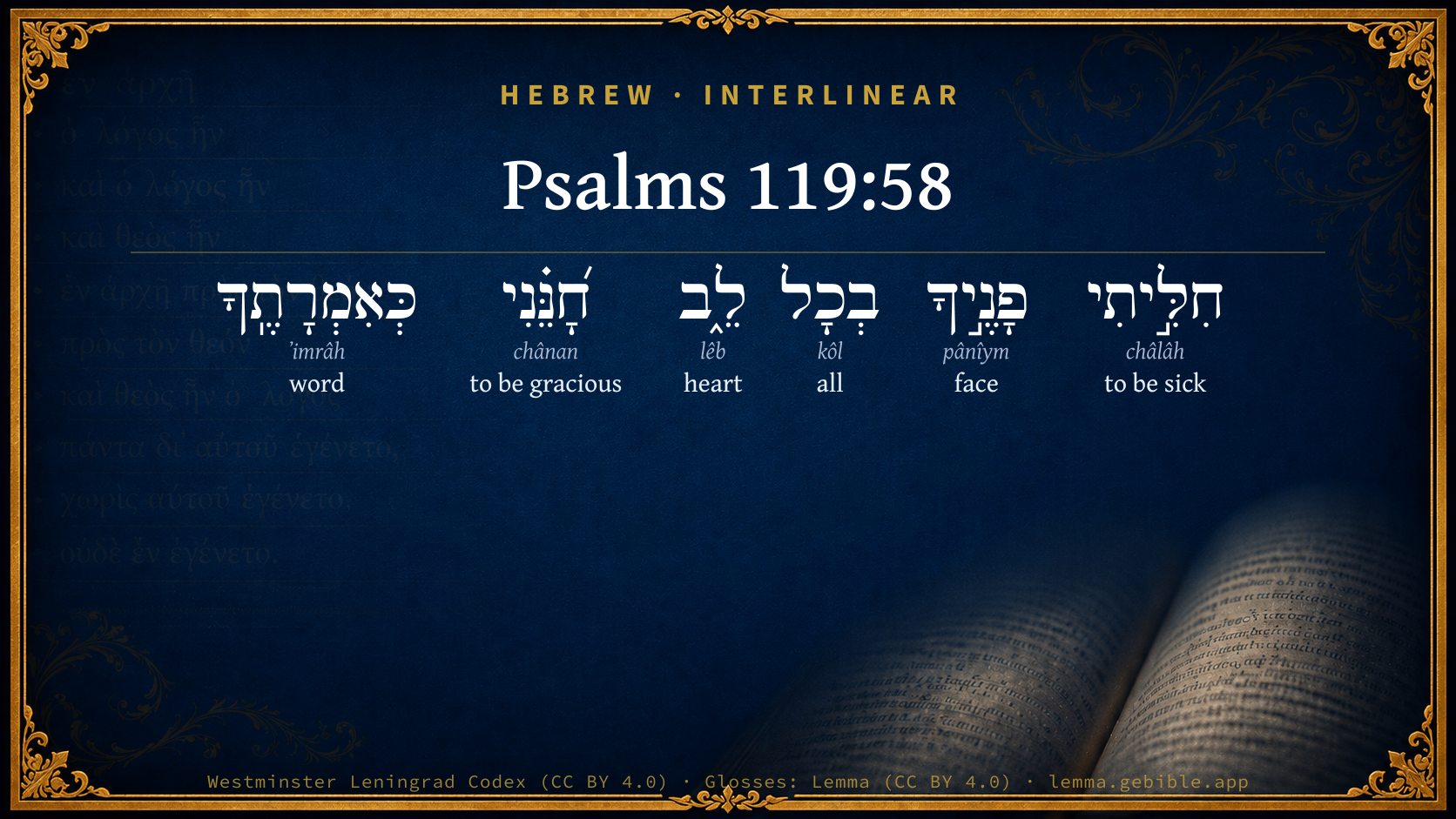
Psalms 119:58

Hebrew (Westminster Leningrad Codex) Psalms 119:58 appears in the Hebrew Old Testament. The text above is from the Westminster Leningrad Codex. Each word links to its Strong’s number, a concise gloss, and parsing drawn from the Open Scriptures Hebrew Bible morphology. Click any word for its full Brown-Driver-Briggs (BDB) entry.
Download image
Cite this verse

Psalms 119:58 (World English Bible). Public Domain. Lemma interlinear Bible study tool, https://lemma.gebible.app/v/psalms/119/58.

Show BibTeX & RIS
BibTeX
RIS
English Translation
I sought your favor with my whole heart. Be merciful to me according to your word.
World English Bible · Public Domain
Download a study sheet

One document with this verse’s original text, its word-by-word gloss line, the meaning frame, cross-references with their text, attributed commentary, and full source and license credits — printable, and it pastes into notes with its structure intact.

This verse Autodidact and up

Study sheet (.html) Plain text (.txt)

A passage Seminary Student

Up to 50 verses in one chapter. A passage sheet keeps up to 6 commentary sources and 12 cross-references per verse, in the order this page ranks them, and says so on the sheet whenever that leaves anything out. Ask for a single verse and you get the Autodidact verse sheet above.

Everything on this page stays free to read, with no account — the sheet is a download of what is already on screen, not access to it.

Want to remove ads? Support Godless Engineer
Compare translations 3

The same verse in 3 English versions, stacked beneath the original-language interlinear above. Click any original word for its lexicon entry.

Each is an independent rendering of the whole verse — the interlinear is not word-aligned to these translations.

Highlighted words mark where these versions differ — a whole-verse word diff, not a word-by-word alignment.

  • World English Bible Public Domain
    I sought your favor with my whole heart. Be merciful to me according to your word.
  • King James Version Public Domain
    I intreated thy favour with my whole heart: be merciful unto me according to thy word.
  • unfoldingWord Literal Text CC BY-SA 4.0
    I entreat your face with a whole heart; be merciful to me according to your word.

unfoldingWord Literal Text — © unfoldingWord, licensed CC BY-SA 4.0. Word-aligned USFM3 via Door43 (git.door43.org/unfoldingWord/en_ult).

Versions to compare (up to 4)

3 of 4 selected

Show all 17 translations

Every available English version of this verse, each an independent rendering of the whole verse.

  • World English Bible Public Domain
    I sought your favor with my whole heart. Be merciful to me according to your word.
  • Berean Standard Bible Public Domain
    I have sought Your face with all my heart; be gracious to me according to Your promise.
  • Majority Standard Bible Public Domain
    I have sought Your face with all my heart; be gracious to me according to Your promise.
  • King James Version Public Domain
    I intreated thy favour with my whole heart: be merciful unto me according to thy word.
  • American Standard Version (1901) Public Domain
    I entreated thy favor with my whole heart: Be merciful unto me according to thy word.
  • Revised Version (1885) Public Domain
    I entreated thy favour with my whole heart: be merciful unto me according to thy word.
  • Geneva Bible (1599) Public Domain
    I made my supplication in thy presence with my whole heart: be mercifull vnto me according to thy promise.
  • Young's Literal Translation Public Domain
    I appeased Thy face with the whole heart, Favour me according to Thy saying.
  • Literal Standard Version CC BY-SA 4.0
    I appeased Your face with the whole heart, || Favor me according to Your saying.
  • Unlocked Literal Bible CC BY-SA 4.0
    I earnestly request your favor with my whole heart; be merciful to me, as your word promised.
  • unfoldingWord Literal Text CC BY-SA 4.0
    I entreat your face with a whole heart; be merciful to me according to your word.
  • Darby Bible Public Domain
    I have sought thy favour with [my] whole heart: be gracious unto me according to thy ùword.
  • World Messianic Bible Public Domain
    I sought your favor with my whole heart. Be merciful to me according to your word.
  • Webster's Bible Public Domain
    I entreated thy favor with my whole heart: be merciful to me according to thy word.
  • Free Bible Version CC BY-SA 4.0
    My whole being wants your blessing—please be kind to me, as you have promised!
  • Bible in Basic English Public Domain
    I have given my mind to do your pleasure with all my heart; have mercy on me, as you have said.
  • JPS Tanakh (1917) Public Domain
    I have entreated Thy favour with my whole heart; be gracious unto me according to Thy word.

Literal Standard Version (2020), Covenant Press — licensed CC BY-SA 4.0. Text via the HelloAO Bible API (eBible.org). Unlocked Literal Bible (unfoldingWord) — licensed CC BY-SA 4.0. Text via the HelloAO Bible API (eBible.org). unfoldingWord Literal Text — © unfoldingWord, licensed CC BY-SA 4.0. Word-aligned USFM3 via Door43 (git.door43.org/unfoldingWord/en_ult). Free Bible Version, Dr. Jonathan Gallagher — licensed CC BY-SA 4.0. Text via the HelloAO Bible API (eBible.org).

Word by word

More ways to search: Search by grammar → Find every occurrence → Compare this word →

Practice this passage: Drill this verse → Learn its vocabulary →

About this verse

These counts appear in no published source. They are computed here, from the morphology-tagged text and Lemma’s own curated glosses. What Lemma adds →

6
words
6
distinct lemmas
Wisdom
section

Shared distinctive vocabulary

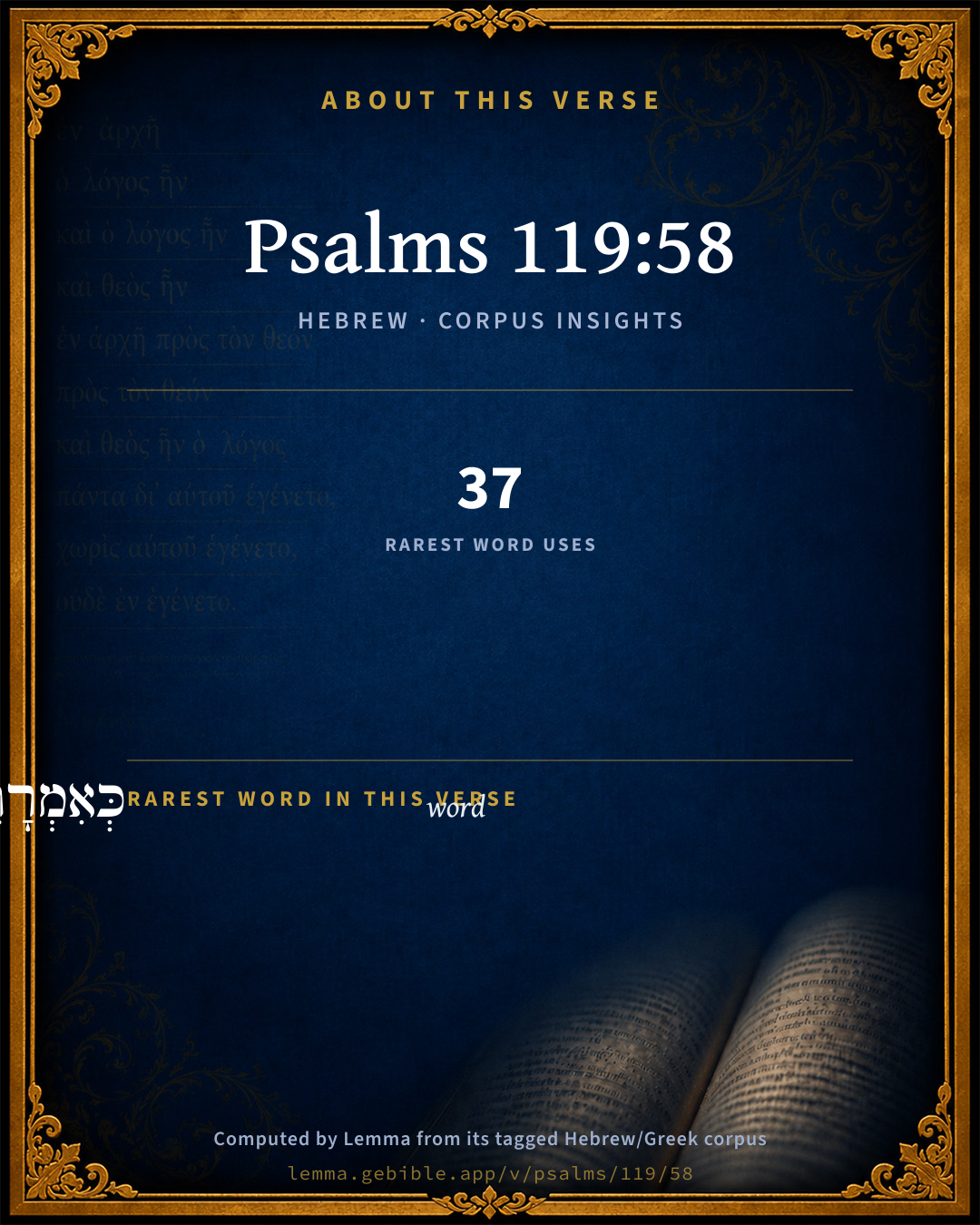
כְּאִמְרָתֶֽךָ word H565 occurs in 35 verses of the Hebrew Bible. Also found in:

Grammatical profile

  • 2 verbs
  • 4 nouns

Verb forms

  • חִלִּ֣יתִי Piel · Perfect
  • חָ֝נֵּ֗נִי Qal · Imperative

Hebrew & Septuagint length

In English translation the verse runs 16 words from the Hebrew and 16 from the Septuagint (LXX English) — the same length.

A rough comparison of the two English renderings, which tokenize alike — not a word-level alignment.

Word counts can differ between the Hebrew and the Greek without any difference in meaning — e.g. the Hebrew direct-object marker אֵת has no separate Greek word, and Greek often adds the article ὁ.

Cross-references

17

Topical passages linked to Psalms 119:58 in the Treasury of Scripture Knowledge — connected by theme and wording, ordered by reader-vote popularity; previews shown in the World English Bible.

  • Psalms 119:41 Let your loving kindness also come to me, Yahweh, Your salvation, according to your word.
  • Hebrews 10:22 let's draw near with a true heart in fullness of faith, having our hearts sprinkled from an evil conscience, and having our body washed with pure water,
  • Psalms 119:10 With my whole heart, I have sought you. Don't let me wander from your commandments.
  • Psalms 119:170 Let my supplication come before you. Deliver me according to your word.
  • 1 Kings 13:6 The king answered the man of God, Entreat now the favor of Yahweh your God, and pray for me, that my hand may be restored me again. The man of God entreated Yahweh, and the king's hand was restored him again, and became as it was before.
  • Psalms 4:6 Many say, "Who will show us any good?" Yahweh, let the light of your face shine on us.
  • Psalms 27:8 When you said, "Seek my face," My heart said to you, "I will seek your face, Yahweh."
  • Job 11:19 Also you shall lie down, and none shall make you afraid; Yes, many shall court your favor.
  • Psalms 51:1–3 Have mercy on me, God, according to your loving kindness. According to the multitude of your tender mercies, blot out my transgressions.
  • Psalms 56:4 In God, I praise his word. In God, I put my trust. I will not be afraid. What can flesh do to me?
  • Psalms 56:10 In God, I will praise his word. In Yahweh, I will praise his word.
  • Psalms 86:1–3 Hear, Yahweh, and answer me, For I am poor and needy.
  • Psalms 119:65 Do good to your servant, According to your word, Yahweh.
  • Psalms 119:76 Please let your loving kindness be for my comfort, According to your word to your servant.
  • Psalms 138:2 I will bow down toward your holy temple, And give thanks to your Name for your loving kindness and for your truth; For you have exalted your Name and your Word above all.
  • Hosea 7:14 They haven't cried to me with their heart, But they howl on their beds. They assemble themselves for grain and new wine. They turn away from me.
  • Matthew 24:35 Heaven and earth will pass away, but my words will not pass away.

Cross-references courtesy of OpenBible.info (CC BY 4.0).

Hebrew and Greek witnesses Masoretic Hebrew ↔ Greek Septuagint

The same verse in the two great witnesses to the Old Testament, shown verse-for-verse.

You’re reading Greek Psalm 118 (Hebrew Psalm 119). The Septuagint counts the superscription, so verse numbers can differ from the Hebrew — chapter-level alignment, not verse-by-verse. Numbering follows Rahlfs.

These are two independent witnesses, not word-aligned to each other, and the Septuagint is shown in lemma (dictionary) form.

Hebrew Psalms 119:58 Masoretic · Westminster Leningrad Codex

חִלִּ֣יתִי פָנֶ֣יךָ בְכָל לֵ֑ב חָ֝נֵּ֗נִי כְּאִמְרָתֶֽךָ

I sought your favor with my whole heart. Be merciful to me according to your word.

World English Bible · Public Domain

Greek LXX Greek Psalm 118:58 Septuagint · lemma form

δέω ὁ πρόσωπον σύ ἐν ὅλος καρδία ἐγώ ἐλεέω ἐγώ κατά ὁ λόγιον σύ

I implored your favor with my whole heart: have mercy upon me according to your word.

LXX2012 (modern English Septuagint) · Public Domain

Hebrew: Westminster Leningrad Codex (CC BY 4.0). Greek: Septuagint (public domain); English from LXX2012 (modern English Septuagint) (Public Domain). How the Septuagint differs from the Hebrew →

Commentary

Notes on Psalms 119:58 from classic Christian and Jewish commentators (each source and its license shown beneath its notes). The classic Christian expositions comment on the surrounding passage and are grouped to its opening verse, so a note may address several verses; the Jewish commentaries on the Tanakh (Rashi and others) are per-verse, so they appear only where the commentator wrote on this verse.

Lemma curates 59 commentaries, every one of them public domain or Creative Commons licensed, each selected and text-cleaned for this edition rather than reprinted as found. About our sources →

Trapp's Complete Commentary

John Trapp

Psa 119:58 I intreated thy favour with [my] whole heart: be merciful unto me according to thy word.

Ver. 58. I intreated thy favour] Heb. thy face, that is, thy Christ, saith Ambrose and Hilary: this David did in the sense of his own utter inability to do as he had promised.

Be merciful unto me, &c.] This was the sum of his petition, and must be the main of ours.

John Trapp, A Commentary or Exposition upon All the Books of the Old and New Testament (1647–1656) — public domain. Text from a community e-Sword module.

The Biblical Illustrator

Joseph S. Exell

Psa_119:58-60

I entreated Thy favour with my whole heart: be merciful unto me according to Thy Word.

The duties which mark the commencement of the Christian course

I. The consideration of our ways.

1. He betakes himself to consider--

(1) not the ways of other people, officiously prying into their char-actors, scrutinizing what is amiss in them, etc.

(2) Nor the light in which his own ways are regarded by other persons.

2. But his own ways, as they are in reality, and as they appear in the sight of that God, who trieth the heart and the reins.

II. An attention to Gods word.

1. Mans sinful and lost state.

2. The great remedy for this.

III. Earnest prayer for Gods proffered mercy and grace.

1. The object of his prayer--Gods favour and Gods mercy according to His Word.

2. The cordiality of his prayer.

IV. An immediate obedience to Gods commandments.

1. The nature of his obedience. It is not the obedience of an angel that never sinned; hut of a sinner under a dispensation of mercy.

2. This obedience is immediate; is net delayed, but attended to at once.

(1) Because he is aware of the shortness and uncertainty of his life.

(2) Because, even though his life should be spared, his faculties may not.

(3) Because, even though both his life and his faculties should be continued to him, the grace of God, without which all attempts at Christian obedience must be utterly vain, may be denied him.

(4) Because, even though this most tremendous of all judgments should not be inflicted on him, still, by his delay, he would only increase the difficulties of his obedience, whenever he should set about it.

(5) Because by his delay he would lose all that comfort and sweet satisfaction of mind which are the ordinary accompaniments of obedience.

(6) Because by such delay he would lose also so many opportunities never to be recovered of doing good to man, and of glorifying the God of his salvation; and--

(7) Because he would suffer materially as to his eternal state; for, though the idea of merit is to be entirely excluded and our admission into heaven is to be ascribed solely to Gods mercy in Christ; still, through that same mercy, will no sincere attempt at obedience, not even the grant of a cup of cold water given on truly Christian principles, fail of an abundant gracious reward. (John Natt, B. D.)

Laws for the bestowment of the Divine mercy

I. Principles or laws in accordance with which God shows mercy.

1. His own pleasure.

2. Through Jesus Christ.

3. He limits its highest exercise to the penitent and godly.

4. His own glory.

II. Why the devout mind would have these laws always observed. (J. R. Page.)

The Biblical Illustrator, edited by Joseph S. Exell (c. 1880s–1900s) — public domain. Text from a community e-Sword module.

J. A. Alexander on Psalms

Joseph Addison Alexander

58. (Psa 119:58) I have sought thy favour with all (my) heart; be gracious unto me according to thy word. In the first clause, we have a repetition of the singular and striking idiom used in Psa 45:12, and explained by some as meaning strictly to soothe or stroke the face, and by others to soften or subdue it, i.e. the hostility or opposition expressed by it. With all (my) heart, or with a whole heart, as in Psa 119:2; Psa 119:34, above. Thy word or saying, i.e. thy promise. The original expression is not the one so constantly employed in this psalm, but that used. in Psa 119:10; Psa 119:41, and derived from the verb to say.

Joseph Addison Alexander, The Psalms Translated and Explained (1850) — public domain. Text from a community e-Sword module.

Matthew Henry's Commentary

David, having in the foregoing verse reflected upon his covenants with God, here reflects upon his prayers to God, and renews his petition. Observe, 1. What he prayed for. Having taken God for his portion, he entreated his favour, as one that knew he had forfeited it, was unworthy of it, and yet undone without it, but for ever happy if he could obtain it. We cannot demand God's favour as a debt, but must be humble suppliants for it, that God will not only be reconciled to us, but accept us and smile upon us. He prays, "Be merciful to me, in the forgiveness of what I have done amiss, and in giving me grace to do better for the future." 2. How he prayed - with his whole heart, as one that knew how to value the blessing he prayed for. The gracious soul is entirely set upon the favour of God, and is therefore importunate for it. I will not let thee go except thou bless me. 3. What he pleaded - the promise of God: "Be merciful to me, according to thy word. I desire the mercy promised, and depend upon the promise for it." Those that are governed by the precepts of the word and are resolved to keep them (Psa 119:57) may plead the promises of the word and take the comfort of them.

Matthew Henry's Commentary on the Whole Bible (1708–1710) — public domain (CC PDM 1.0). Text via the HelloAO Bible API.

Adam Clarke's Commentary

Verse 58. See Clarke on Ps 119:60.

Adam Clarke's Commentary on the Bible (1810–1826) — public domain. Text from a community e-Sword/MySword module.

John Calvin's Commentaries

58. I have earnestly besought thy face. In this verse David asserts, that he still persevered in the exercise of prayer; for without prayer faith would become languid and lifeless. The manner in which he expresses himself, which, in other languages, might be unpolished, among the Hebrews, expresses that familiar communication to which God admits, and even invites his servants when they come into his presence. The substance of his prayers, and the sum of his desires, he comprehends in a single sentence; namely, that he implored the mercy of God, the sure hope of which he had formed from his word. Let us observe, then, in the first place, we are aroused from our supineness, that we may exercise our faith by prayer. In the second place, the principal thing for which we ought to pray is, that God, out of his free grace, may be favorable to us, look on our affection, and grant us relief. God does, indeed, aid us in a variety of ways, and our necessities also are innumerable; still the thing which we must principally and particularly request is, that he: will have mercy upon us, which is the source of every other blessing. And, in the last place, that we may not present prayers that have no meaning, let us learn that God, in all his promises, is set before us as if he were our willing debtor.

John Calvin's Commentaries (1540-1563) — public domain. Text from the Calvin Translation Society English edition (1840s-50s) via the Christian Classics Ethereal Library (ccel.org). Calvin's coverage is partial (roughly two-thirds of the Bible); uncommented books and verses are honest gaps, never fabricated. The 19th-century editor's footnotes and remarks are omitted so the notes are faithfully Calvin's own voice.

Ellicott's Commentary for English Readers

(58) I intreated.—See Psa_45:12.

A Bible Commentary for English Readers, edited by Charles John Ellicott (1878–1897) — public domain. Text from a community e-Sword module.

The Cambridge Bible for Schools and Colleges

gen. ed. J. J. S. Perowne

58. be merciful] Be gracious, as in Psa_4:1, and often. Cp. Psa_119:29; Psa_119:132.

The Cambridge Bible for Schools and Colleges (gen. ed. J. J. S. Perowne; Cambridge University Press, 1878–1918) — public domain. Text from a community e-Sword module.

John Gill's Exposition

I made haste, and delayed not to keep thy commandments. As soon as he was sensible of his duty, he immediately complied with it; he consulted not with flesh and blood, but at once yielded a cheerful obedience to the commands of God. Instances of evangelical obedience of this kind we have in the three thousand converts, in Saul, and in the jailer and his house, Act 2:41.

.

Psalms 119:61

psa 119:61

psa 119:61

psa 119:61The bands of the wicked have robbed me,.... Very probably Saul and his ministers seized on his effects, when he fled from him; and the Amalekites plundered him of all his substance, when they took Ziklag; and Absalom and the conspirators with him robbed him, when he was obliged, because of them, to flee from his palace and court, which they entered and took possession of. But Aben Ezra rejects this sense of the word, which Jarchi and Kimchi espouse, and we follow, and renders it, "took hold of me"; and so the Targum,

"the company of the wicked were gathered together against me:''

they surrounded him and put him into fear, great numbers of them encompassing him about; see Psa 18:4;

but I have not forgotten thy law; this was written in his heart; he kept it in his memory, and retained an affection for it; and could not be deterred from obedience to it by the numbers and violence of wicked men, who hated and persecuted him for his attachment to it.

John Gill's Exposition of the Whole Bible (1746–1763) — public domain (CC PDM 1.0). Text via the HelloAO Bible API.

Albert Barnes' Notes on the Bible

I entreated thy favor - Margin, as in Hebrew, “face.” That is, he prayed that God would lift upon him the light of his countenance; that he would not avert his face from him in anger.

With my whole heart - With sincere, undivided affections. See Psa 119:2, Psa 119:10, Psa 119:34; Psa 9:1.

Be merciful unto me according to thy word - See the notes at Psa 119:41.

Albert Barnes' Notes on the Bible (1834–1885) — public domain. Text from a community e-Sword/MySword module.

Matthew Poole's English Annotations

Thy favour; thy gracious presence and merciful assistance, as it follows.

Matthew Poole's English Annotations on the Holy Bible (1683–1685) — public domain. Text from a community e-Sword/MySword module.

The Treasury of David

Charles H. Spurgeon

Ver. 58. I intreated thy favour with my whole heart. A fully assured possession of God does not set aside prayer, but rather urges us to it; he who knows God to be his God will seek his face, longing for his presence. Seeking God's presence is the idea conveyed by the marginal reading, "thy face, "and this is true to the Hebrew. The presence of God is the highest form of his favour, and therefore it is the most urgent desire of gracious souls: the light of his countenance gives us an antepast of heaven. O that we always enjoyed it! The good man entreated God's smile as one who begged for his life, and the entire strength of his desire went with the entreaty. Such eager pleadings are sure of success; that which comes from our heart will certainly go to God's heart. The whole of God's favours are ready for those who seek them with their whole hearts.

Be merciful unto me according to thy word. He has entreated favour, and the form in which he most needs it is that of mercy, for he is more a sinner than anything else. He asks nothing beyond the promise, he only begs for such mercy as the word reveals. And what more could he want or wish for? God has revealed such an infinity of mercy in his word that it would be impossible to conceive of more. See how the Psalmist dwells upon favour and mercy, he never dreams of merit. He does not demand, but entreat; for he feels his own unworthiness. Note how he remains a suppliant, though he knows that he has all things in his God. God is his portion, and yet he begs for a look at his face. The idea of any other standing before God than that of an undeserving but favoured one never entered his head. Here we have his "Be merciful unto me" rising with as much intensity of humble pleading as if he still remained among the most trembling of penitents. The confidence of faith makes us bold in prayer, but it never teaches us to live without prayer, or justifies us in being other than humble beggars at mercy's gate.

Ver. 58. I entreated thy favour, or; I seek thy face. To seek the face is to come into the presence. Thus the Hebrews speak when desirous of expressing that familiar intercourse to which God admits his people when he bids them make known their requests. It is truly the same as speaking face to face with God. Franciscus Vatablus, 1545.

Ver. 58. I entreated thy favour with my whole heart I have often remarked how graciously and lovingly the Lord delights to return an answer to prayer in the very words that have gone up before him, as if to assure us that they have reached his ear, and been speeded back again from him laden with increase. "I entreated thy favour with my whole heart." Hear the Lord's answer to his praying people: "I will rejoice over them to do them good assuredly with my whole heart and with my whole soul." Barton Bouchier.

Ver. 58. With my whole heart. The Hebrew expresses great earnestness and humility in supplication. A. R. Fausset.

Ver. 58. With my whole heart. Prayer is chiefly a heart work. God heareth the heart without the mouth, but never heareth the mouth acceptably without the heart. Walter Marshall.

Ver. 58. Be merciful unto me, etc. He protested before that he sought the Lord with his whole heart, and now he prayeth that he may find mercy. So indeed it shall be; boldly may that man look for mercy at God's hand who seeks him truly. Mercy and truth are wont to meet together, and embrace one another: where truth is in the soul to seek, there cannot but be mercy in God to embrace. If truth be in us to confess our sins and forsake them, we shall find mercy in God to pardon and forgive them. William Cowper.

Ver. 58. According to thy word. He prayeth not for what he lusteth after, but for that which the Lord promised; for St. James saith, "You pray and have not, "etc., and this is the cause, that we have not the thing we pray for, because we pray not according to the word. His word must be the rule of our prayers, and then we shall receive; as Solomon prayed and obtained. God hath promised forgiveness of sins, the knowledge of his word, and many other blessings. If we have these, let not our hearts be set on other things. Richard Greenham.

Ver. 58. According to thy word. The Word of God may be divided into three parts; into commandments, threatenings, and promises; and though a Christian must not neglect the commanding and threatening word, yet if ever he would make the Word a channel for Divine comfort, he must study the promising word; for the promises are a Christian's magna charta for heaven. All comfort must be built upon a Scripture promise, else it is presumption, not true comfort. The promises are pabulum fidei, et anima fidei, the food of faith, and the soul of faith. As faith is the life of a Christian, so the promises are the life of faith: faith is a dead faith if it hath no promise to quicken it. As the promises are of no use without faith to apply them, so faith is of no use without a promise to lay hold on. Edmund Calamy.

Ver. 58. The rule and ground of confidence is, "according to thy word." God's word is the rule of our confidence; for therein is God's stated course. If we would have favour and mercy from God, it must be upon his own terms. God will accept of us in Christ, if we repent, believe, and obey, and seek his favour diligently: he will not deny those who seek, ask, knock. Many would have mercy, but will not observe God's direction. We must ask according to God's will, not without a promise, nor against a command. God is made a voluntary debtor by his promise. These are notable props of faith, when we are encouraged to seek by the offer, and urged to apply by the promise. We thrive no more in a comfortable sense of God's love, because we take not this course. Thomas Manton.

Ver. 58. The soul's sunshine.

1. God's favour the one thing needful.

2. Wholeheartedness the one mode of entreating it.

3. Covenant mercy the one plea for obtaining it. C.A.D.

Ver. 58. We may learn how a seeker may come to enjoy saving favour, by a careful study of

1. The Profession: "I intreated thy favour with my whole heart."

(a) What he did: "I intreated." Heb. "I painfully sought

thy face." Earnest desire. Importunate supplication.

Painful sorrow for sin.

(b) How he did it: "With my whole heart." The intellect,

affections, will, all engaged and concentrating effort.

Otherwise, seeking is solemn trifling. This only worthy of

our purpose, pleasing to God, and successful.

(c) The evidence that we are doing it. Frequent prayer,

searching the word, often enquiring. The first and main

business Giving up for Christ.

2. The Petition: "Be merciful unto me."

(a) God's favour to be expected on the terms of mercy only.

(b) Happily, this is a prayer every sinner can and should

use.

(c) Blessedly true it is, that it never fails.

3. The Plea: "According to thy word."

(a) A plea that cannot be gainsaid is a great thing in an

entreaty.

(b) The promise of God is just such a plea.

(c) Seek it out, lay hold of it, and urge it. J.F.

Psalms 119:59*

Charles H. Spurgeon's The Treasury of David (1869–1885) — public domain. Psalms only. Text from a community e-Sword/MySword module.

The Pulpit Commentary

I entreated thy favor with my whole heart; literally, I have supplicated thy face. (comp. Psa_45:12) Be merciful unto me, according to thy Word. A repetition of the prayer of ver. 41.

The Pulpit Commentary (1880–1919), ed. H.D.M. Spence-Jones & Joseph S. Exell — public domain. Text from a community e-Sword module.

Rashi

Rabbi Shlomo Yitzchaki (Rashi)

I entreated You Heb. חליתי, from the expression of (Lam. 3:24): “‘The Lord is my portion,’ says my soul; ‘therefore, I will hope (אוחיל) to Him.’”

Rashi on the Tanakh — English translations: “The Judaica Press complete Tanach with Rashi, translated by A. J. Rosenberg” (CC BY 4.0); “Pentateuch with Rashi's commentary by M. Rosenbaum and A.M. Silbermann, 1929-1934” (public domain); “The Metsudah Tanach series, Lakewood, N.J” (CC BY 4.0); and “The Book of Joshua, Metsudah Publications, 1997” (CC BY 4.0). Text via Sefaria.

Lesson kit

Teaching starters — assembled from the data on this page, not authored interpretation. Every prompt links to the verse data it draws on. Edit before teaching.

Psalms, in the Wisdom, opens this verse with 6 words (6 distinct Hebrew lemmas). Its most distinctive word is ʼimrâh (“word”). A historical commentator’s framing appears above. Read the whole chapter for the surrounding context.

Discussion questions

  1. The word ʼimrâh carries the sense “word.” How does it shape the verse?
  2. Genesis 4:23 shares the word «word» with this verse. How do the two illuminate each other?
  3. These translations render this verse differently; the difference is in the English rendering, not the original. What questions does that raise?
  4. The verb «חִלִּ֣יתִי» is Piel Perfect. How does its form color the action?
  5. Reading how Trapp's Complete Commentary and The Biblical Illustrator read this verse, where do the two commentators agree and where do they part?

Things to notice

Reading settings

Reading text

Shown beneath each verse's original-language words.

Old Testament
Old Testament edition

Read the OT as the Masoretic Hebrew (MT) or the Greek Septuagint (LXX).

English shown for the Greek Septuagint (in the Hebrew ↔ Greek comparison).

Comparing translations? Open the Compare panel on any verse page to stack up to four side by side.