
Malachi 1:13

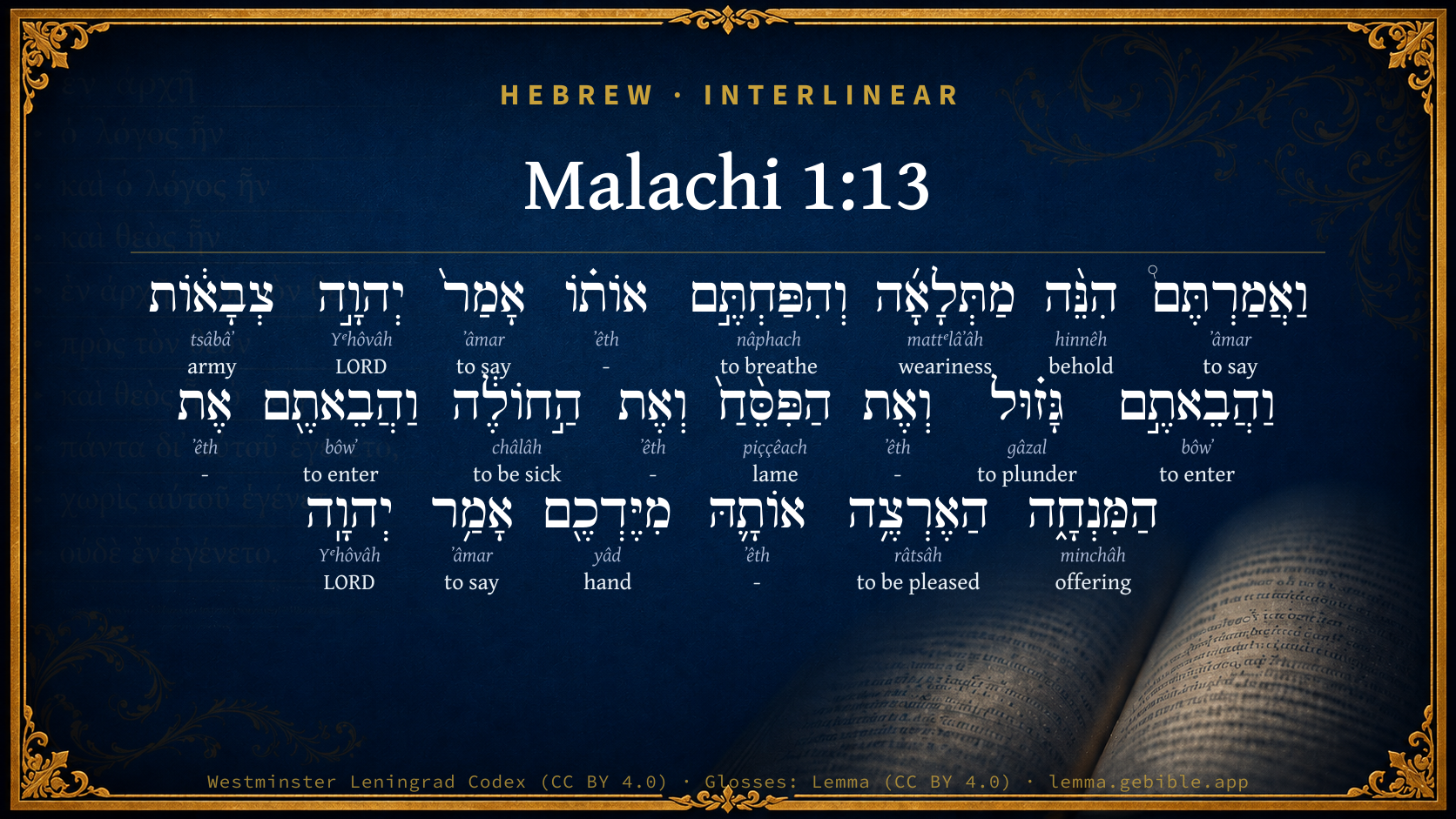
Hebrew (Westminster Leningrad Codex) Malachi 1:13 appears in the Hebrew Old Testament. The text above is from the Westminster Leningrad Codex. Each word links to its Strong’s number, a concise gloss, and parsing drawn from the Open Scriptures Hebrew Bible morphology. Click any word for its full Brown-Driver-Briggs (BDB) entry.
Download image
Cite this verse

Malachi 1:13 (World English Bible). Public Domain. Lemma interlinear Bible study tool, https://lemma.gebible.app/v/malachi/1/13.

Show BibTeX & RIS
BibTeX
RIS
English Translation
You say also, 'Behold, what a weariness it is!' and you have sniffed at it," says Yahweh of Hosts; "and you have brought that which was taken by violence, the lame, and the sick; thus you bring the offering. Should I accept this at your hand?" says Yahweh.
World English Bible · Public Domain
Highlights
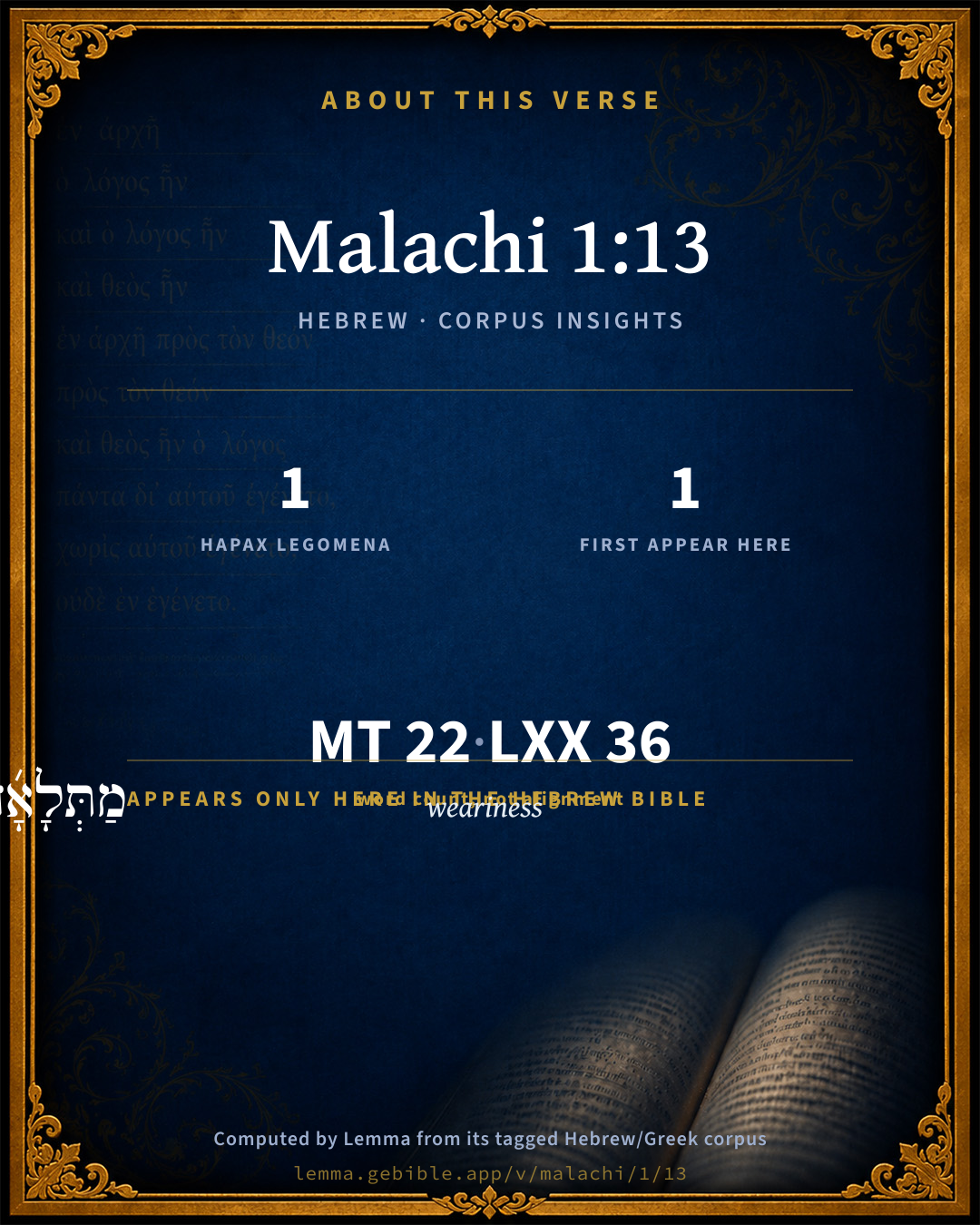
  • 1 hapax legomenon — only here in the Hebrew Bible
  • 1 first appearance in the Hebrew Bible
Full analysis ↓
Download a study sheet

One document with this verse’s original text, its word-by-word gloss line, the meaning frame, cross-references with their text, attributed commentary, and full source and license credits — printable, and it pastes into notes with its structure intact.

This verse Autodidact and up

Study sheet (.html) Plain text (.txt)

A passage Seminary Student

Up to 50 verses in one chapter. A passage sheet keeps up to 6 commentary sources and 12 cross-references per verse, in the order this page ranks them, and says so on the sheet whenever that leaves anything out. Ask for a single verse and you get the Autodidact verse sheet above.

Everything on this page stays free to read, with no account — the sheet is a download of what is already on screen, not access to it.

Want to remove ads? Support Godless Engineer
Compare translations 3

The same verse in 3 English versions, stacked beneath the original-language interlinear above. Click any original word for its lexicon entry.

Each is an independent rendering of the whole verse — the interlinear is not word-aligned to these translations.

Highlighted words mark where these versions differ — a whole-verse word diff, not a word-by-word alignment.

  • World English Bible Public Domain
    You say also, 'Behold, what a weariness it is!' and you have sniffed at it," says Yahweh of Hosts; "and you have brought that which was taken by violence, the lame, and the sick; thus you bring the offering. Should I accept this at your hand?" says Yahweh.
  • King James Version Public Domain
    Ye said also, Behold, what a weariness is it! and ye have snuffed at it, saith the LORD of hosts; and ye brought that which was torn, and the lame, and the sick; thus ye brought an offering: should I accept this of your hand? saith the LORD.
  • unfoldingWord Literal Text CC BY-SA 4.0
    But you say, ‘Behold, what a weariness!’ And you puff at it,” says Yahweh of Armies. “And you bring the stolen and the lame and the sick—thus you bring the offering! Should I accept this from your hand?” says Yahweh.

unfoldingWord Literal Text — © unfoldingWord, licensed CC BY-SA 4.0. Word-aligned USFM3 via Door43 (git.door43.org/unfoldingWord/en_ult).

Versions to compare (up to 4)

3 of 4 selected

Show all 18 translations

Every available English version of this verse, each an independent rendering of the whole verse.

  • World English Bible Public Domain
    You say also, 'Behold, what a weariness it is!' and you have sniffed at it," says Yahweh of Hosts; "and you have brought that which was taken by violence, the lame, and the sick; thus you bring the offering. Should I accept this at your hand?" says Yahweh.
  • Berean Standard Bible Public Domain
    You also say: ‘Oh, what a nuisance!’ And you turn up your nose at it,” says the LORD of Hosts. “You bring offerings that are stolen, lame, or sick! Should I accept these from your hands?” asks the LORD.
  • Majority Standard Bible Public Domain
    You also say: ‘Oh, what a nuisance!’ And you turn up your nose at it,” says the LORD of Hosts. “You bring offerings that are stolen, lame, or sick! Should I accept these from your hands?” asks the LORD.
  • King James Version Public Domain
    Ye said also, Behold, what a weariness is it! and ye have snuffed at it, saith the LORD of hosts; and ye brought that which was torn, and the lame, and the sick; thus ye brought an offering: should I accept this of your hand? saith the LORD.
  • American Standard Version (1901) Public Domain
    Ye say also, Behold, what a weariness is it! and ye have snuffed at it, saith Jehovah of hosts; and ye have brought that which was taken by violence, and the lame, and the sick; thus ye bring the offering: should I accept this at your hand? saith Jehovah.
  • Revised Version (1885) Public Domain
    Ye say also, Behold, what a weariness is it! and ye have snuffed at it, saith the LORD of hosts; and ye have brought that which was taken by violence, and the lame, and the sick; thus ye bring the offering: should I accept this of your hand? saith the LORD.
  • Geneva Bible (1599) Public Domain
    Ye said also, Beholde, it is a wearines, and ye haue snuffed at it, sayth the Lord of hostes, and ye offred that which was torne, and the lame and the sicke: thus yee offred an offring: shoulde I accept this of your hand, sayth the Lord?
  • Douay-Rheims (1899) Public Domain
    And you have said: Behold of our labour, and you puffed it away, saith the Lord of hosts, and you brought in of rapine the lame, and the sick, and brought in an offering: shall I accept it at your hands, saith the Lord?
  • Young's Literal Translation Public Domain
    And ye have said, `Lo, what a weariness,' And ye have puffed at it, said Jehovah of Hosts, And ye have brought in plunder, And the lame and the sick, And ye have brought in the present! Do I accept it from your hand? said Jehovah.
  • Literal Standard Version CC BY-SA 4.0
    And you have said, Behold, what a weariness, || And you have puffed at it,” said YHWH of Hosts, || “And you have brought in plunder, || And the lame and the sick, || And you have brought in the present! Do I accept it from your hand?” said YHWH.
  • Unlocked Literal Bible CC BY-SA 4.0
    You also say, 'How tiresome this is,' and you snort at it,” says Yahweh of hosts. “You bring what has been taken by a wild animal or is lame or sick; and this you bring as your offering. Should I accept this from your hand?” says Yahweh.
  • unfoldingWord Literal Text CC BY-SA 4.0
    But you say, ‘Behold, what a weariness!’ And you puff at it,” says Yahweh of Armies. “And you bring the stolen and the lame and the sick—thus you bring the offering! Should I accept this from your hand?” says Yahweh.
  • Darby Bible Public Domain
    And ye say, Behold, what a weariness! And ye have puffed at it, saith Jehovah of hosts, and ye bring [that which was] torn, and the lame, and the sick; thus ye bring the oblation: should I accept this of your hand? saith Jehovah.
  • World Messianic Bible Public Domain
    You say also, ‘Behold, what a weariness it is!’ And you have sniffed at it”, says the LORD of Hosts; “and you have brought that which was taken by violence, the lame, and the sick; thus you bring the offering. Should I accept this at your hand?” says the LORD.
  • Webster's Bible Public Domain
    Ye said also, Behold, what a weariness is it! and ye have snuffed at it, saith the LORD of hosts; and ye brought that which was torn, and the lame, and the sick; thus ye brought an offering: should I accept this from your hand? saith the LORD.
  • Free Bible Version CC BY-SA 4.0
    You say, “All this is too much trouble!” and you sniff scornfully at it, says the Lord Almighty. But when you bring animals that are stolen or crippled or sick and offer them as sacrifices, should I accept what you're giving? asks the Lord.
  • Bible in Basic English Public Domain
    And you say, See, what a weariness it is! and you let out your breath at it, says the Lord of armies; and you have given what has been cut about by beasts, and what is damaged in its feet and ill; this is the offering you give: will this be pleasing to me from your hands? says the Lord.
  • JPS Tanakh (1917) Public Domain
    Ye say also: 'Behold, what a weariness is it!' and ye have snuffed at it, saith the LORD of hosts; and ye have brought that which was taken by violence, and the lame, and the sick; thus ye bring the offering; should I accept this of your hand? saith the LORD.

Literal Standard Version (2020), Covenant Press — licensed CC BY-SA 4.0. Text via the HelloAO Bible API (eBible.org). Unlocked Literal Bible (unfoldingWord) — licensed CC BY-SA 4.0. Text via the HelloAO Bible API (eBible.org). unfoldingWord Literal Text — © unfoldingWord, licensed CC BY-SA 4.0. Word-aligned USFM3 via Door43 (git.door43.org/unfoldingWord/en_ult). Free Bible Version, Dr. Jonathan Gallagher — licensed CC BY-SA 4.0. Text via the HelloAO Bible API (eBible.org).

Word by word

More ways to search: Search by grammar → Find every occurrence → Compare this word →

Practice this passage: Drill this verse → Learn its vocabulary →

מַתְּלָאָ֜ה
mattᵉlâʼâh
H4972
“weariness”
Particle, Interrogative + Noun, Common, Feminine, Singular, Absolute
Part of Speech
Particle + Noun
Type
Common
Gender
Feminine
Number
Singular
State
Absolute
Full BDB Definition

Origin: from H4100 and H8513

TWOT: 1066a

what a weariness, toil, hardship, weariness
  1. וַאֲמַרְתֶּם֩ ʼâmar H559 “and · to say” Conjunction + Verb, Qal, Sequential Perfect, 2nd Person, Masculine, Plural
  2. הִנֵּ֨ה hinnêh H2009 “behold” Particle, Demonstrative
  3. וְהִפַּחְתֶּ֣ם nâphach H5301 “and · to breathe” Conjunction + Verb, Hiphil, Sequential Perfect, 2nd Person, Masculine, Plural
  4. אוֹת֗וֹ ʼêth H853 “- · him” Particle, Direct Object + Suffix, Personal, 3rd Person, Masculine, Singular
  5. אָמַר֙ ʼâmar H559 “to say” Verb, Qal, Perfect, 3rd Person, Masculine, Singular
  6. יְהוָ֣ה Yᵉhôvâh H3068 “LORD” Noun, Proper
  7. צְבָא֔וֹת tsâbâʼ H6635 “armies” Noun, Common, Both, Plural, Absolute
  8. וַהֲבֵאתֶ֣ם bôwʼ H935 “and · to enter” Conjunction + Verb, Hiphil, Sequential Perfect, 2nd Person, Masculine, Plural
  9. גָּז֗וּל gâzal H1497 “plundered” Verb, Qal, Participle Passive, Masculine, Singular, Absolute
  10. וְאֶת ʼêth H853 “and · -” Conjunction + Particle, Direct Object
  11. הַפִּסֵּ֨חַ֙ piççêach H6455 “the · lame” Particle, Definite Article + Adjective, Adjective, Masculine, Singular, Absolute
  12. וְאֶת ʼêth H853 “and · -” Conjunction + Particle, Direct Object
  13. הַ֣חוֹלֶ֔ה châlâh H2470 “the · being sick” Particle, Definite Article + Verb, Qal, Participle Active, Masculine, Singular, Absolute
  14. וַהֲבֵאתֶ֖ם bôwʼ H935 “and · to enter” Conjunction + Verb, Hiphil, Sequential Perfect, 2nd Person, Masculine, Plural
  15. אֶת ʼêth H853 “-” Particle, Direct Object
  16. הַמִּנְחָ֑ה minchâh H4503 “the · offering” Particle, Definite Article + Noun, Common, Feminine, Singular, Absolute
  17. הַאֶרְצֶ֥ה râtsâh H7521 “to be pleased” Particle, Interrogative + Verb, Qal, Imperfect, 1st Person, Common, Singular
  18. אוֹתָ֛הּ ʼêth H853 “- · her” Particle, Direct Object + Suffix, Personal, 3rd Person, Feminine, Singular
  19. מִיֶּדְכֶ֖ם yâd H3027 “from · hand · your” Preposition + Noun, Common, Both, Singular, Construct + Suffix, Personal, 2nd Person, Masculine, Plural
  20. אָמַ֥ר ʼâmar H559 “to say” Verb, Qal, Perfect, 3rd Person, Masculine, Singular
  21. יְהוָֽה Yᵉhôvâh H3068 “LORD” Noun, Proper

About this verse

These counts appear in no published source. They are computed here, from the morphology-tagged text and Lemma’s own curated glosses. What Lemma adds →

22
words
14
distinct lemmas
Prophets
section

Notable vocabulary

1 hapax legomenon — a word that appears only here in the entire Hebrew Bible:

  • מַתְּלָאָ֜ה weariness H4972

First appearance in Scripture

This word makes its first canonical appearance in the Hebrew Bible here:

  • מַתְּלָאָ֜ה weariness H4972

Shared distinctive vocabulary

וְהִפַּחְתֶּ֣ם to breathe H5301 occurs in 12 verses of the Hebrew Bible. Also found in:

Grammatical profile

  • 9 verbs
  • 6 nouns
  • 1 adjective
  • 6 particles

Verb forms

  • וַאֲמַרְתֶּם֩ Qal · Sequential Perfect
  • וְהִפַּחְתֶּ֣ם Hiphil · Sequential Perfect
  • אָמַר֙ Qal · Perfect
  • וַהֲבֵאתֶ֣ם Hiphil · Sequential Perfect
  • גָּז֗וּל Qal · Participle Passive
  • הַ֣חוֹלֶ֔ה Qal · Participle Active
  • וַהֲבֵאתֶ֖ם Hiphil · Sequential Perfect
  • הַאֶרְצֶ֥ה Qal · Imperfect
  • אָמַ֥ר Qal · Perfect

Repetition

Words recur within this verse — often emphatic in Hebrew:

  • וַאֲמַרְתֶּם֩ to say H559 ×3
  • יְהוָ֣ה LORD H3068 ×2
  • וַהֲבֵאתֶ֣ם to enter H935 ×2

Hebrew & Septuagint length

In English translation the verse runs 48 words from the Hebrew and 47 from the Septuagint (LXX English) — closely comparable.

A rough comparison of the two English renderings, which tokenize alike — not a word-level alignment.

Word counts can differ between the Hebrew and the Greek without any difference in meaning — e.g. the Hebrew direct-object marker אֵת has no separate Greek word, and Greek often adds the article ὁ.

In the original languages it is 22 Hebrew tokens and 36 Greek tokens — but the two are counted differently (Hebrew bundles its prefixes and suffixes into one token; the Greek is in lemma form), so that isn’t a like-for-like length.

Cross-references

22

Topical passages linked to Malachi 1:13 in the Treasury of Scripture Knowledge — connected by theme and wording, ordered by reader-vote popularity; previews shown in the World English Bible.

  • Micah 6:3 My people, what have I done to you? How have I burdened you? Answer me!
  • Mark 14:37–38 He came and found them sleeping, and said to Peter, "Simon, are you sleeping? Couldn't you watch one hour?
  • Leviticus 22:19–23 that you may be accepted, you shall offer a male without blemish, of the bulls, of the sheep, or of the goats.
  • Malachi 1:7–8 You offer polluted bread on my altar. You say, 'How have we polluted you?' In that you say, 'Yahweh's table contemptible.'
  • 1 Samuel 2:29 Why kick you at my sacrifice and at my offering, which I have commanded in [my] habitation, and honor your sons above me, to make yourselves fat with the best of all the offerings of Israel my people?
  • Isaiah 1:12 When you come to appear before me, Who has required this at your hand, to trample my courts?
  • Isaiah 43:22–23 Yet you have not called on me, Jacob; but you have been weary of me, Israel.
  • Isaiah 57:6 Among the smooth [stones] of the valley is your portion; they, they are your lot; even to them have you poured a drink-offering, you have offered an offering. Shall I be appeased for these things?
  • Jeremiah 7:9–11 Will you steal, murder, and commit adultery, and swear falsely, and burn incense to Baal, and walk after other gods that you have not known,
  • Jeremiah 7:21–24 Thus says Yahweh of Hosts, the God of Israel: Add your burnt offerings to your sacrifices, and eat you flesh.
  • Ezekiel 4:14 Then said I, Ah Lord Yahweh! behold, my soul has not been polluted; for from my youth up even until now have I not eaten of that which dies of itself, or is torn of animals; neither came there abominable flesh into my mouth.
  • Ezekiel 44:31 The priests shall not eat of anything that dies of itself, or is torn, whether it be bird or animal.
  • Amos 5:21–23 I hate, I despise your feasts, And I can't stand your solemn assemblies.
  • Amos 8:5 Saying, 'When will the new moon be gone, that we may sell grain? And the Sabbath, that we may market wheat, Making the ephah small, and the shekel large, And dealing falsely with balances of deceit;
  • Zechariah 7:5–6 "Speak to all the people of the land, and to the priests, saying, 'When you fasted and mourned in the fifth and in the seventh month for these seventy years, did you at all fast to me, really to me?
  • Malachi 2:13 This again you do: you cover the altar of Yahweh with tears, with weeping, and with sighing, because he doesn't regard the offering any more, neither receives it with good will at your hand.
  • Matthew 6:1–2 "Be careful that you don't do your charitable giving before men, to be seen by them, or else you have no reward from your Father who is in heaven.
  • Matthew 6:5 "When you pray, you shall not be as the hypocrites, for they love to stand and pray in the synagogues and in the corners of the streets, that they may be seen by men. Most assuredly, I tell you, they have received their reward.
  • Matthew 6:16 "Moreover when you fast, don't be like the hypocrites, with sad faces. For they disfigure their faces, that they may be seen by men to be fasting. Most assuredly I tell you, they have received their reward.
  • Mark 14:4–5 But there were some who were indignant among themselves, saying, "Why has this ointment been wasted?
  • Leviticus 22:8 That which dies of itself, or is torn by animals, he shall not eat, defiling himself by it. I am Yahweh.
  • Deuteronomy 15:21 If it have any blemish, [as if it be] lame or blind, any ill blemish whatever, you shall not sacrifice it to Yahweh your God.

Cross-references courtesy of OpenBible.info (CC BY 4.0).

Hebrew and Greek witnesses Masoretic Hebrew ↔ Greek Septuagint

The same verse in the two great witnesses to the Old Testament, shown verse-for-verse.

These are two independent witnesses, not word-aligned to each other, and the Septuagint is shown in lemma (dictionary) form.

Hebrew Malachi 1:13 Masoretic · Westminster Leningrad Codex

וַאֲמַרְתֶּם֩ הִנֵּ֨ה מַתְּלָאָ֜ה וְהִפַּחְתֶּ֣ם אוֹת֗וֹ אָמַר֙ יְהוָ֣ה צְבָא֔וֹת וַהֲבֵאתֶ֣ם גָּז֗וּל וְאֶת הַפִּסֵּ֨חַ֙ וְאֶת הַ֣חוֹלֶ֔ה וַהֲבֵאתֶ֖ם אֶת הַמִּנְחָ֑ה הַאֶרְצֶ֥ה אוֹתָ֛הּ מִיֶּדְכֶ֖ם אָמַ֥ר יְהוָֽה

You say also, 'Behold, what a weariness it is!' and you have sniffed at it," says Yahweh of Hosts; "and you have brought that which was taken by violence, the lame, and the sick; thus you bring the offering. Should I accept this at your hand?" says Yahweh.

World English Bible · Public Domain

Greek LXX Malachi 1:13 Septuagint · lemma form

καί εἶπον οὗτος ἐκ κακοπάθεια εἰμί καί ἐκφυσάω αὐτός λέγω κύριος παντοκράτωρ καί εἰςφέρω ἅρπαγμα καί ὁ χωλός καί ὁ ἐνὀχλέω καί ἐάν φέρω ὁ θυσία εἰ προςδέχομαι αὐτός ἐκ ὁ χείρ σύ λέγω κύριος παντοκράτωρ

And you⌃ said, These services are troublesome: therefore I have utterly rejected them with scorn, says the Lord Almighty: and you⌃ brought in torn victims, and lame, and sick: if then you⌃ should bring an offering, shall I accept them at your hands? says the Lord Almighty.

LXX2012 (modern English Septuagint) · Public Domain

On this verse, John Gill's Exposition discusses the Septuagint’s reading. Read the note in Commentary ↓

Hebrew: Westminster Leningrad Codex (CC BY 4.0). Greek: Septuagint (public domain); English from LXX2012 (modern English Septuagint) (Public Domain). How the Septuagint differs from the Hebrew →

Targum (Aramaic paraphrase)

1

The Targum is the ancient Jewish Aramaic paraphrase of the Hebrew Scriptures — an interpretive translation, not the Hebrew text itself. Onkelos (literal) and Pseudo-Jonathan (expansive) render the Torah, and Jonathan the Prophets. Coverage is partial: where no permissively-licensed English translation exists for a verse, only the Aramaic is shown. This is verse-level text, not a word-by-word alignment to the Hebrew.

  1. Targum Jonathan Prophets (Joshua–Malachi)
    וְאִם תֵּימְרוּן הָא דְאַיְתֵינָא מִלֵאוּתָנָא וְשַׁנֵיקְתּוּן יָתֵיהּ אֲמַר יְיָ צְבָאוֹת וּמַיְתָן אַתּוּן דַאֲנִיס וְדַחֲגִיר וְדִמְרִיעַ וּמַיְתָן אַתּוּן לֵיהּ בְּקוּרְבָּנָא הֲאַקַבֵּל יָתֵיהּ בְּרַעֲוָא מִיֶדְכוֹן אֲמַר יְיָ:

    (no public-domain English translation for this verse)

    Targum Jonathan — Aramaic: “Mikraot Gedolot” (public domain). English: “Sefaria Community Translation” (CC0 1.0 (public-domain dedication)); “London "Chaldee Paraphrase," 1871” (public domain). Text via Sefaria.

Commentary

Notes on Malachi 1:13 from classic Christian and Jewish commentators (each source and its license shown beneath its notes). The classic Christian expositions comment on the surrounding passage and are grouped to its opening verse, so a note may address several verses; the Jewish commentaries on the Tanakh (Rashi and others) are per-verse, so they appear only where the commentator wrote on this verse.

Lemma curates 59 commentaries, every one of them public domain or Creative Commons licensed, each selected and text-cleaned for this edition rather than reprinted as found. About our sources →

Trapp's Complete Commentary

John Trapp

Mal 1:13 Ye said also, Behold, what a weariness [is it]! and ye have snuffed at it, saith the LORD of hosts; and ye brought [that which was] torn, and the lame, and the sick; thus ye brought an offering: should I accept this of your hand? saith the LORD.

Ver. 13. And ye have said also, Behold, what a weariness is it! and ye have snuffed at it, &c.] At what? At the chiding you have had for your lame and lean sacrifices. A little offensive breath hath blown you up into rage. This is a kind of blasphemy, Eze 20:27, when graceless men fall into a fustian fume, as they say, by hearing of their faults; and bristle against a reproof, though never so just. Or thus, Ye have puffed and blown, as almost breathless, by carrying some carrion sheep for a sacrifice; as if it were so fat and full of flesh that you could hardly bring it without breaking your wind; whereas ye might have blown it away, it is so thin and light. Hateful hypocrisy! And it sped accordingly. For should I accept this at your hand? No, no: Sapiens nummularius est Deus: nummum fictum non recipiet (Bernard). God is a wise mint man; he will take no counterfeit coin. He not only detects the deceiver, and detests him, as here, but curseth him bitterly in the next verse. He rejects the hypocrite’s sacrifice, and plagueth such Prometheuses; when as he wipes not out any of the good services of his sincere people, Neh 13:4, but abundantly blesseth them.

Labour, therefore, for that "truth in the inward parts," Psa 51:6, that we may be with "Apelles approved in Christ," Rom 16:10, and with Nathanael, "an Israelite indeed," Joh 1:47. Be we the same that we would seem to be; and if not, as the windows of the temple were, wider within than without, yet to be no more in show than we are in truth. It stands us in hand when to deal with God to have the greater part of our ware in the inner part of the shop, and not all on the foreside, on the board or stall; and to see, that though our work be but mean, yet it may be clean; though not fine, yet not foul, soiled and slubbered with the slur of a rotten heart. Sweet powders can make even leather an ornament, when the sanies of a plaguesore will render a rich robe loathsome and infectious.

John Trapp, A Commentary or Exposition upon All the Books of the Old and New Testament (1647–1656) — public domain. Text from a community e-Sword module.

The Biblical Illustrator

Joseph S. Exell

Mal_1:13-14

Should I accept this of your hand?

saith the Lord.

Vain oblations

(taken with Isa_1:13):--Each age has its characteristic. No two are just alike; and though history repeats itself, yet there is progress. Its processes are those of a spiral.

I. In the age of Isaiah the Jews were full of religiosity. Sacrifices were not neglected--a multitude were offered. They brought the best of all kinds, not as in the days of Malachi, the lean and the poor, but abundantly they brought the blood of bullocks, of lambs, and of he-goats. Clouds of incense arose; they carefully kept the new moons, the Sabbaths, the assemblies, and the solemn meeting, not only all appointed feasts, but even others they observed in an intense devotion to the forms of religion. Why were their oblations vain? Why were they not regarded in their sacrifices and accepted in their persons?

1. As in the days of the Saviour, so now, whilst they were careful to tithe, mint, anise and cummin, they omitted the weightier matters of the law, judgment, mercy, and faith.

2. They were offered without faith. This whole chapter shows such to be the case. This was just what made the difference between Abels sacrifice and Cains offering.

3. Their offerings were unaccompanied with repentance; for repentance implies confession of sin, the forsaking it, and the reformation of life.

II. This positive sinfulness is clearly made out.

1. They were laden with iniquity.

2. There was no soundness in them, from the sole of the foot even unto the head.

3. Their rulers were like the princes of Sodom, and themselves like the men of Gomorrah.

4. Their hands were full of blood. The rulers did not punish the people, and reciprocally the people abetted their rulers in their blood-guiltiness.

5. The times were full of evils, unredressed and unavenged. Their princes had become companions of thieves and bribe-takers.

III. On the other hand, god still remembers grace and mercy.

1. There was still a remnant left (verse 9).

2. All are called to repentance (verses 16, 17).

3. Those that repent shall obtain mercy, but the contumacious shall not be spared (verses 18-24).

4. And still further, God holds up the gracious promise to send times of reformation and refreshing (verses 25-27).

Reflections--

1. Do we preach and pray, and is there no answering fruit--no conversions, and no increase of piety?

2. Can the reason be found in devotion to the forms of religion and the neglect of its spirit?

3. Are our people characterised by an absorbing devotion to the world?

4. Then to us as to Israel is the call to repentance; to us as to them, the hope of forgiveness; to us as to them, the promise of revival upon repentance and reformation. God forbid that we should merely possess the forms of religion and be destitute of its life-giving power. (L. O. Thomson.)

Hypocrisy in public worship

All that wears the appearance of religion is not sincere piety. This remark will particularly apply to those acts which constitute what we call public worship. For in privacy, where no eye is upon us but that of the Omniscient, there is less temptation to, and less danger of insincerity. Malachi is here remonstrating with the people for the iniquity of their holy things.

I. The criminal charge he fixes on this professing community. It is aggravated by three things.

1. By the salutary discipline to which they had recently been subjected for their backslidings and rebellions against God.

2. By the fact that they thus sinned against the clearest knowledge.

3. By the majesty of the object against whom their offence was directed. We censure and condemn the Jews, but are we better than they?

II. The uses to be made of this remonstrance.

1. Here are materials for your deepest humiliation and penitence.

2. How incompetent are all the rites and ceremonies of religion to save the soul!

3. See the fallacy of pharisaism.

4. How welcome, then, is the evangelical intelligence which is brought to us, to awaken a hope of the acceptance of our persons and services in the sight of a holy God. (J. Clayton.)

The Biblical Illustrator, edited by Joseph S. Exell (c. 1880s–1900s) — public domain. Text from a community e-Sword module.

Whedon's Commentary on the Bible

Daniel D. Whedon

Mal_1:13 continues the thought of Mal_1:12. Their faithlessness and corruption is seen in their attitude toward the entire sacrificial service. The tenses should be translated, with R.V., as present tenses, for the prophet condemns present sacrifices.

What a weariness is it! — Not the eating of their portion of the sacrificial meat, but the priestly office and the service at the sanctuary. It they consider a trouble and a burden instead of an honor and a privilege, as they should.

Ye have snuffed at it — At the service or table of Jehovah. An expression of contempt. Here is found one of the emendations of the scribes (see on Hab_1:12); and following the Masoretic suggestion that at it is a change from an original at me, some commentators read “ye have snuffed at me,” but the thought remains essentially the same. The contempt finds expression in the offering of unfit animals as sacrifices.

Torn — Better, R.V., “taken by violence”; that is, something stolen. They were too selfish to give of their own (Compare 2Sa_12:1 ff.), and when they did give of their own they gave only what was of no use to them. An additional thought may be implied, namely, that by giving stolen goods to Jehovah they would make him a participant in the crime, and thus make it impossible for him to punish them. Some scholars, following Mal_1:8, read “blind.”

Lame,… sick — See on Mal_1:8. The rebuke closes with a question similar to the one in Mal_1:8.

Should I accept this of your hand? — Simply because you are priests. He cannot do this. Sacrifice of this sort is an abomination to him (compare Amo_5:21-24; Isa_1:10-15).

Daniel D. Whedon (gen. ed.), Commentary on the Old and New Testaments (1874–1909) — public domain. Text from a community e-Sword module.

Geneva Bible (1599)

Geneva Bible translators

The Priests and people were both weary with serving God, and passed not what manner of sacrifice and service they gave to God: for that which was least profitable, was thought good enough for the Lord.

Geneva Bible (1599) marginal notes — public domain. Text via Bolls.life.

Jamieson, Fausset & Brown

Robert Jamieson, A. R. Fausset & David Brown

what a weariness is it!--Ye regard God's service as irksome, and therefore try to get it over by presenting the most worthless offerings. Compare Mic 6:3, where God challenges His people to show wherein is the "weariness" or hardship of His service. Also Isa 43:22-24, wherein He shows that it is they who have "wearied" Him, not He who has wearied them.

snuffed at--despised.

it--the table of the Lord, and the meat on it (Mal 1:12).

torn--namely, by beasts, which it was not lawful to eat, much less to offer (Exo 22:31).

thus . . . offering--Hebrew, mincha; the unbloody offering of flour, &c. Though this may have been of ordinary ingredients, yet the sacrifices of blemished animals accompanying it rendered it unacceptable.

Jamieson, Fausset & Brown — Commentary Critical and Explanatory on the Whole Bible (1871) — public domain (CC PDM 1.0). Text via the HelloAO Bible API.

Adam Clarke's Commentary

Verse 13. Ye have snuffed at it] A metaphor taken from cattle which do not like their fodder. They blow strongly through their nose upon it; and after this neither they nor any other cattle will eat it.

Ye brought that which was torn, and the lame, and the sick] There had never been such abominations in the Divine worship before. What was of no worth in itself, and what could not be used by its owner, was brought to God's altar, and offered for sacrifice! Was not the punishment of these wretches less than their crimes?

Adam Clarke's Commentary on the Bible (1810–1826) — public domain. Text from a community e-Sword/MySword module.

John Calvin's Commentaries

He pursues the same subject — that the worship of God was despised by them and regarded as almost worthless. We must bear in mind what I have before stated — that the Jews are not reprehended here as though they had openly and avowedly spoken reproachfully of God’s worship; but that this was sufficiently evident from their conduct; for they allowed themselves so much licentiousness, that it was quite manifest that they were trifling with God, inasmuch as they had cast off every fear of him and all reverence towards him.

Ye have said, Behold, labor. This may apply to the whole people, or to the priests alone. It is commonly explained of the priests — that they complained that they had a hard office, because they were continually in the temple and constantly watched there, and were much occupied in cleaning the vessels.

The monks at this day under the Papacy, and the priests, boasting of themselves, say, “While all others sleep, we are watching; for we are constant in prayers.” Forsooth! they howl at midnight in their temples; and then by massing and by doing other strange things they imagine that they are seriously engaged in pacifying God. In this sense do some understand this passage, as though the priests, in order to commend their work, alleged that they labored much in God’s service, and as though God had enjoined on them many and difficult things. But I prefer applying this to the whole people, and yet I do not exclude the priests; for the Prophet here condemns both, and shows that it was wearisome to them to spend labor in worshipping God, that they considered it weariness, as we commonly say, Tu le fais par courvee.

And the import of what follows is the same, Ye have snuffed at it, that is, through disdain. Some give this rendering, “With sorrow have ye moved him;” and the verb is in Hiphil, and is often taken in this sense. The verb, נפח, nephech, is properly to snuff; and it is here in another conjugation; but even in Hiphil it has this meaning, and cannot be taken otherwise. Now they who render it, to move or touch with sorrow, are under the necessity of turning the words of the Prophet to a sense the most foreign and remote, even that the priests, extremely greedy of gain, compelled the common people to bring sacrifices, and thus extorted sacrifices, but not without sorrow and lamentation. We see how forced this is: I therefore wholly reject it. Some have hammered out a very refined sense, which is by no means suitable, “Ye have snuffed at it,” that is, Ye have said indeed that the victims are good and sufficiently fat; and yet ye may by breath blow them into the air. Others render it, to cast down, because they threw the sacrifices on the ground. But what need there is of departing from the common meaning of the word, since it is easy to conclude that both the priests and the people are here condemned, because the worship of God was a weariness to them, as we snuff at a thing when it displeases us. The behavior then of the fastidious is what the Prophet meant here to express. The passage will thus be very appropriate, Ye have said, Behold weariness! Ye have snuffed at it: then he adds, —

Ye have offered the torn, and the lame, and the weak. These words prove the same thing — that they performed their duty towards God in a trifling manner by offering improper victims: when they had anything defective or diseased, they said that it was sacred to God, as we find it stated in the next verse. Some improperly render, גזול, gazul, a prey, what had been unjustly procured, as though he had said, that they offered victims obtained by plunder: but I wonder how they could thus distort the words of the Prophet without any pretense. He mentions here three kinds — the torn, the lame, and the maimed or the feeble. Who then does not see that the torn was an animal which had been torn by wild beasts? When therefore they had an animal half dead, having been torn by wolves, they thought that they had a suitable victim: “I am constrained to offer a sacrifice to God, this lamb is very suitable, for the wolf has devoured a part of it, and it has hardly escaped: as then it is maimed, I will bring it.” The Prophet then calls those torn victims which had been lacerated by the teeth of wild beasts.

We now understand the import of the words; but we must remember what I have said — that God required not the performance of external rites, because he had need of meat and drink, or because he set a great value on these sacrifices, but on account of their design. The sacrifices then which God demanded from his ancient people had in themselves nothing that promoted true religion; nor could the odour of sacrifices of itself delight God; but the end was to be regarded. As then God ordered and commanded sacrifices to be offered to him, that he might exercise his people in penitence and faith, it was for this reason that he valued them. But when the people had fallen into gross contempt of them, that they brought to God, as it were to insult him, the maimed and the lame, their extremely base and intolerable impiety, as I have already said, was made fully evident. This is the reason why the Prophet now so vehemently chides the priests and the whole people; they offered to God such sacrifices as man would have rejected, according to what we noticed yesterday. It then follows —

John Calvin's Commentaries (1540-1563) — public domain. Text from the Calvin Translation Society English edition (1840s-50s) via the Christian Classics Ethereal Library (ccel.org). Calvin's coverage is partial (roughly two-thirds of the Bible); uncommented books and verses are honest gaps, never fabricated. The 19th-century editor's footnotes and remarks are omitted so the notes are faithfully Calvin's own voice.

Ellicott's Commentary for English Readers

(13) Said.—Better, say.

And ye have snuffed at it.—Better, and ye puff at it—that is, treat it with contempt, “pooh-pooh it,” as we say. The service of the Temple, which they ought to have regarded as their highest privilege and pleasure, they look on as burdensome and contemptible. For “brought,” read bring.

Torn.—The word Gâzûl elsewhere means “stolen” (Deu_28:31), or “robbed “—i.e., “spoiled” (Deu_28:29). It is perhaps not impossible that it may here be a later word for trêphâh, “torn” (comp. the cogn. Arabic ajzal, “galled on the back”), but it is not so used in post-Biblical Jewish writings. On the contrary, Rabbinic tradition uses our word when expressly mentioning that which is stolen as unfit to be offered as a burnt offering—e.g., the Sifrâ, (Vayyikrâ, Perek 6, Parashta 5, ed. Weis 7b), commenting on the words of Lev_1:10, says: “ ‘From the flock,’ and ‘from the sheep,’ and ‘from the goats:’ These words are limitations—viz., to exclude the sick (comp. also Mal_1:8), and the aged, and that which has been dedicated in thought to an idol, and that which is defiled with its own filth; ‘its offering’ [English Version, his offering, comp. Note on Zec_4:2], to exclude that which is stolen.” (See also Talmud Babli, Baba Kamma 66b.) The English Version has the same in view in its rendering of Isa_61:8, where it has the authority of Talmud Babli, Sukkah 30a, and of Jerome and Luther. Perhaps the reason why people were inclined to offer a stolen animal may be, that it might very likely have a mark on it, which would render it impossible for the thief to offer it for sale, and so realise money on it, for fear of detection; so then he makes a virtue of a necessity, and brings as an offering to God that which he could not otherwise dispose of.

A Bible Commentary for English Readers, edited by Charles John Ellicott (1878–1897) — public domain. Text from a community e-Sword module.

The Cambridge Bible for Schools and Colleges

gen. ed. J. J. S. Perowne

13. what a weariness is it!] i.e. the service of the Sanctuary.

torn] Rather, taken by violence. R.V.

ye brought an offering] Rather, ye bring the offering, R.V. The reference is perhaps to “the (stated, public) offerings,” which the priests provided out of the Temple funds entrusted to them (Neh_10:32-33). Comp. “the offering of Judah and Jerusalem,” Mal_3:4. By purchasing cheap and unworthy animals they would increase their own portion of the fund. But Mal_1:12; Mal_1:14 make it clear that similar abuses were tolerated in the private sacrifices of individuals.

The Cambridge Bible for Schools and Colleges (gen. ed. J. J. S. Perowne; Cambridge University Press, 1878–1918) — public domain. Text from a community e-Sword module.

John Gill's Exposition

Ye said also, Behold, what a weariness is it?.... These are either the words of the priests, saying what a wearisome and fatiguing business the temple service was to them, for which they thought they were poorly paid; such as slaying the sacrifices; removing the ashes from the altar; putting the wood in order; kindling the fire, and laying the sacrifice on it: or of the people that brought the sacrifice, who, when they brought a lamb upon their shoulders, and laid it down, said, how weary are we with bringing it, suggesting it was so fat and fleshy; so Kimchi and Abarbinel, to which sense the Targum seems to agree; which paraphrases it,

"but if ye say, lo, what we have brought is from our labour;''

and so the Syriac version, "and ye say, this is from our labour"; and the Vulgate Latin version, "and ye say, lo, from labour"; and the Septuagint version, "and ye say, these are from affliction"; meaning that what they brought was with great toil and labour, out of great poverty, misery, and affliction:

and ye have snuffed at it, saith the Lord of hosts; or, "blown it" (p); filled it with wind, that it might seem fat and fleshy, when it was poor and lean; so Abarbinel and Abendana: or ye have puffed, and panted, and blown, as persons weary with bringing such a heavy lamb, when it was so poor and light, that, if it was blown at, it would fall to the ground; so R. Joseph Kimchi: or ye have puffed at it, thrown it upon the ground by way of contempt; so David Kimchi: or, "ye have grieved him" (q); the owner of the lamb, from whom they stole it; which sense is mentioned by Kimchi and Ben Melech; taking the word rendered "torn", in the next clause, for that which was "stolen". Jarchi says this is one of the eighteen words corrected by the scribes; and that instead of "it", it should be read "me": and the whole rendered, "and ye have grieved me"; the Lord, by bringing such sacrifices, and complaining of weariness, and by their hypocrisy and deceitfulness. Cocceius renders the words, "ye have made him to expire"; meaning the Messiah, whom the Jews put to death:

and ye have brought that which was torn, and the lame, and the sick; See Gill on Mal 1:8 and if the first word is rendered "stolen", as it may, this offering was an abomination to the Lord, Isa 61:8,

thus ye brought an offering; such an one as it was: or a "minchah", a meat offering, along with these abominable ones:

should I accept this of your hands? saith the Lord; which, when offered to a civil governor, would not be acceptable, Mal 1:8 and when contrary to the express law of God.

(p) "et efflastis illam", Montanus; "anheli isto estis", Tigurine version; "exsufflare possetis", Junius & Tremellius, Piscator, "difflatis", Drusius; "sufflavistis illud", Burkius. (q) "Et contristastis illum"; so some in Vatablus.

John Gill's Exposition of the Whole Bible (1746–1763) — public domain (CC PDM 1.0). Text via the HelloAO Bible API.

Albert Barnes' Notes on the Bible

What a weariness! - What an onerous service it is! The service of God is its own reward. If not, it becomes a greater toil, with less reward from this earth, than the things of this earth. Our only choice is between love and weariness.

And ye have snuffed - (puffed) at it , i. e., at the altar; as a thing contemptible. “Ye, have brought that which was taken by violence.” In despising any positive law of God, they despised the lawgiver; and so, from contempt of the ceremonial law, they went on to break the moral law. It were indeed a mockery of God, to break a law whereby He bound man to man, and therefrom to seek to appease Himself. Yet in rough times, people, even in Christianity, have made their account with their souls, by giving to the poor a portion of what they had taken from the rich. “God,” it was said to such an one, “rejects the gifts obtained by violence and robbery. He loves mercy, justice and humanity, and by the lovers of these only will He be worshiped.” (Ecclesiasticus 34:18-20.) “He that sacrificeth of a thing wrongfully gotten, his offering is ridiculous, and the gifts of unjust men are not accepted. The Most High is not pleased with the offerings of the wicked, neither is He pacified for sin by the multitude of sacrifices. Whoso bringeth an offering of the goods of the poor doeth as one that killeth the son before the father’s eyes.”

Albert Barnes' Notes on the Bible (1834–1885) — public domain. Text from a community e-Sword/MySword module.

Haydock's Catholic Bible Commentary

Behold of our labour, &c. You pretended labour and weariness, when you brought your offering; and so made it of no value, by offering it with an evil mind. Moreover, what you offered was both defective in itself, and gotten by rapine and extortion. (Challoner) --- These were two defects. (Worthington) --- Hebrew, "what fatigue, or if we change one letter, and read (Calmet) mothlae, (Haydock) it stinks, and you." &c. Some copies of [the] Septuagint, Arabic, &c., "I blew them away," with disgust. --- Rapine. Ecclesiasticus xxxiv. 24. --- Offering. Mincha, ver. 11. (Calmet) --- Such victims and presents as are lame or strange, are rejected. (Pliny, [Natural History?] viii. 45.

George Leo Haydock (1774–1849), Haydock's Catholic Family Bible and Commentary, 1859 edition — public domain. Excludes Psalms (Douay-Rheims chapter numbering differs from Protestant) and Deuterocanonical books (Catholic canon only).

Matthew Poole's English Annotations

Ye said also; to those sins before mentioned, the priests chiefly, and the people with them, added this also, that they openly complained of God’s service.

Behold, what a weariness! what a toil and drudgery is it to observe every point of the law about ordering ourselves and the sacrifices!

Ye have snuffed at it, in token of discontent, and that you thought it was all needless labour; would not examine your sacrifices as you should.

Ye brought that which was torn, & c.: for want of value for the ordinance, and patience in examining whether the sacrifice were perfect and according to law, you priests accepted and offered the torn, and blind, &c., which are expressly forbidden to be made sacrifices: see Mal 1:8.

Thus ye brought an offering; with such minds, snuffing at my service, and with such sacrifices, unfit for mine altar, have they wearied themselves somewhat, but their God more.

Should I accept this of your hands? saith the Lord, i.e. it is not at all fit to be accepted, nor will our God receive it.

Matthew Poole's English Annotations on the Holy Bible (1683–1685) — public domain. Text from a community e-Sword/MySword module.

The Pulpit Commentary

What a weariness is it! The reference is to the table of the Lord. Despising the altar, and performing their duties without heart or faith, the priests found the services an intolerable burden. Vulgate, ecce de labore, which seems to be an excuse of the people, urging that they offer such things as their toil and poverty allow. Septuagint, tauta ek kakopayeiav esti , which has much the same meaning. The present Hebrew text is represented by the Authorized Version. Ye have snuffed at it; i.e. at the altar. The phrase expresses contempt. "It" has been supposed to be a "scribes" correction" for "me." The Septuagint and Syriac give, "I snorted at them." That which was torn; rather, that which was taken by violence that which was stolen or unjustly taken. Septuagint, arpagmata : Ecc 34:18 (31:21), "He that sacrificeth of a thing wrongfully gotten, his offering is ridiculous ( memwkhmenh ) Lame... sick. (Lev_22:19-25) Thus ye brought (bring the) an offering (minchah). Subject to analogous defects is even your meat offering, the accessory to other sacrifices, and therefore it is unacceptable.

Religion a weariness.

"Ye said also, Behold, what a weariness is it!" It is clearly a bad sign when the people find the worship of God to be a weariness; but it is a much worse sign when the ministers of religion both feel the worship to be a weariness, and show that they feel it to be such.

I IN THE NATURE OF THINGS RELIGIOUS WORSHIP SHOULD NOT BE A WEARINESS.

1. Take it as the proper and fitting expression of the creature"s dependence on his Creator. It ought to be full of the joy of thankfulness.

2. Take it as the natural impulse of the sinner"s love to his Saviour. Man fallen should feel a joy in worship even beyond that of man unfallen. The song of the redeemed is an altogether nobler song than the innocent can ever sing. And religious worship, kept within the lines of Divine claims, never need be a weariness. It is religion with the multiplied added demands of men that is in danger of proving a weariness. No reasonable man could say that Mosaism was a weariness, so far as it was a Divine institution. But every man could say that Rabbinism was a weariness; for it laded men with burdens too grievous to be borne. Spiritual religion is always simplifying worship. As spirituality fails, exacting demands are increased, and religion tends to become a weariness.

II THROUGH THE MOODS OF MEN RELIGIOUS WORSHIP BECOMES A WEARINESS. What the priests of earlier times had done gladly and joyfully, the priests of Malachi"s time dragged through. The joy of Levites in their work is expressed in the Korahite psalms, (Ps 42, etc.) which are full of longings for restoration to the temple service. There was no difference in the worship. The difference was in the moods of the men. Their spiritual life was low. They had no personal joy in God, so they could have no joy in the routine of God"s worship. The sadness of the restored Judaism of the exiles was that, to so large an extent, it was the restoration of the Jewish formalities, without the restoration of that spiritual life which would have vitalized the formalities. And still the weariness men feel at the length of Christian services, etc., is the revelation of their wrong mood; of their lost personal joy in God their Saviour. R.T.

The Pulpit Commentary (1880–1919), ed. H.D.M. Spence-Jones & Joseph S. Exell — public domain. Text from a community e-Sword module.

John Wesley's Explanatory Notes

What a weariness - What a toil and drudgery to observe every point of the law. This - With such minds snuffing at my service, and with such sacrifices, unfit for mine altar.

John Wesley, Explanatory Notes Upon the Whole Bible (1754–1765) — public domain. Text via the GEBible commentary corpus.

unfoldingWord translationNotes

Door43 World Missions Community

snort at it

show great disrespect by making noises through the nose (See: Idiom)

Should I accept this from your hand?

Here Yahweh is asking a question in order to make a statement of rebuke. AT: "I should certainly not accept this from you!" (See: Rhetorical Question)

from your hand

Here "your hand" stands for "you." AT: "from you" (See: Synecdoche)

my name will be honored among the nations

This may be expressed in active form. AT: "people in the other nations honor my name" (See: Active or Passive)

my name will be honored

Here "my name" stands for Yahweh. AT: "I will be honored" (See: Metonymy)

translationWords

curse

deceive

vow

name

unfoldingWord translationNotes — © Distant Shores Media and the Door43 World Missions Community, licensed CC BY-SA 4.0. Source: git.door43.org/Door43/en_tn.

Rashi

Rabbi Shlomo Yitzchaki (Rashi)

And you say, “Here is a weary one” An emaciated animal, and we are poor and cannot afford the choicest for [our] vows. So did Jonathan render: This is what we have brought from our toil.

and you cause it pain This is one of the eighteen words [in all of Scripture known as] the emendations of the scribes. וְהִפַּחְתֶּם אוֹתוֹ should have been written: אוֹתִי, and you cause Me pain. Scripture, however, euphemized, writing אוֹתוֹ it. and you cause pain and you cause pain, an expression of despair (Job 11: 20).

it My table.

Rashi on the Tanakh — English translations: “The Judaica Press complete Tanach with Rashi, translated by A. J. Rosenberg” (CC BY 4.0); “Pentateuch with Rashi's commentary by M. Rosenbaum and A.M. Silbermann, 1929-1934” (public domain); “The Metsudah Tanach series, Lakewood, N.J” (CC BY 4.0); and “The Book of Joshua, Metsudah Publications, 1997” (CC BY 4.0). Text via Sefaria.

Lesson kit

Teaching starters — assembled from the data on this page, not authored interpretation. Every prompt links to the verse data it draws on. Edit before teaching.

Malachi, in the Prophets, opens this verse with 22 words (14 distinct Hebrew lemmas). Its most distinctive word is mattᵉlâʼâh (“weariness”). A historical commentator’s framing appears above. Read the whole chapter for the surrounding context.

Discussion questions

  1. The word mattᵉlâʼâh carries the sense “weariness.” How does it shape the verse?
  2. This verse holds 1 word here found nowhere else in the Hebrew Bible. What might the rare word draw attention to?
  3. The word “weariness” first appears here in Scripture. What is being introduced at this debut?
  4. Genesis 2:7 shares the word «to breathe» with this verse. How do the two illuminate each other?
  5. “to say” occurs 3× in this one verse. What is the effect of the repetition?
  6. The translations on this page render this verse differently — a whole-verse word diff, not a word-by-word alignment. What might account for the different wordings?
  7. The verb «וַאֲמַרְתֶּם֩» is Qal Sequential Perfect. How does its form color the action?
  8. Reading how Trapp's Complete Commentary and The Biblical Illustrator read this verse, where do the two commentators agree and where do they part?

Things to notice

  • 1 word in this verse appears nowhere else in the Hebrew Bible.
  • 1 word makes its first canonical appearance in Scripture here.
  • This verse counts 22 Hebrew ↔ 36 Greek words.
  • These translations choose different wording for 23 words in this verse.
  • “to say” occurs 3× in this single verse.

Reading settings

Reading text

Shown beneath each verse's original-language words.

Old Testament
Old Testament edition

Read the OT as the Masoretic Hebrew (MT) or the Greek Septuagint (LXX).

English shown for the Greek Septuagint (in the Hebrew ↔ Greek comparison).

Comparing translations? Open the Compare panel on any verse page to stack up to four side by side.