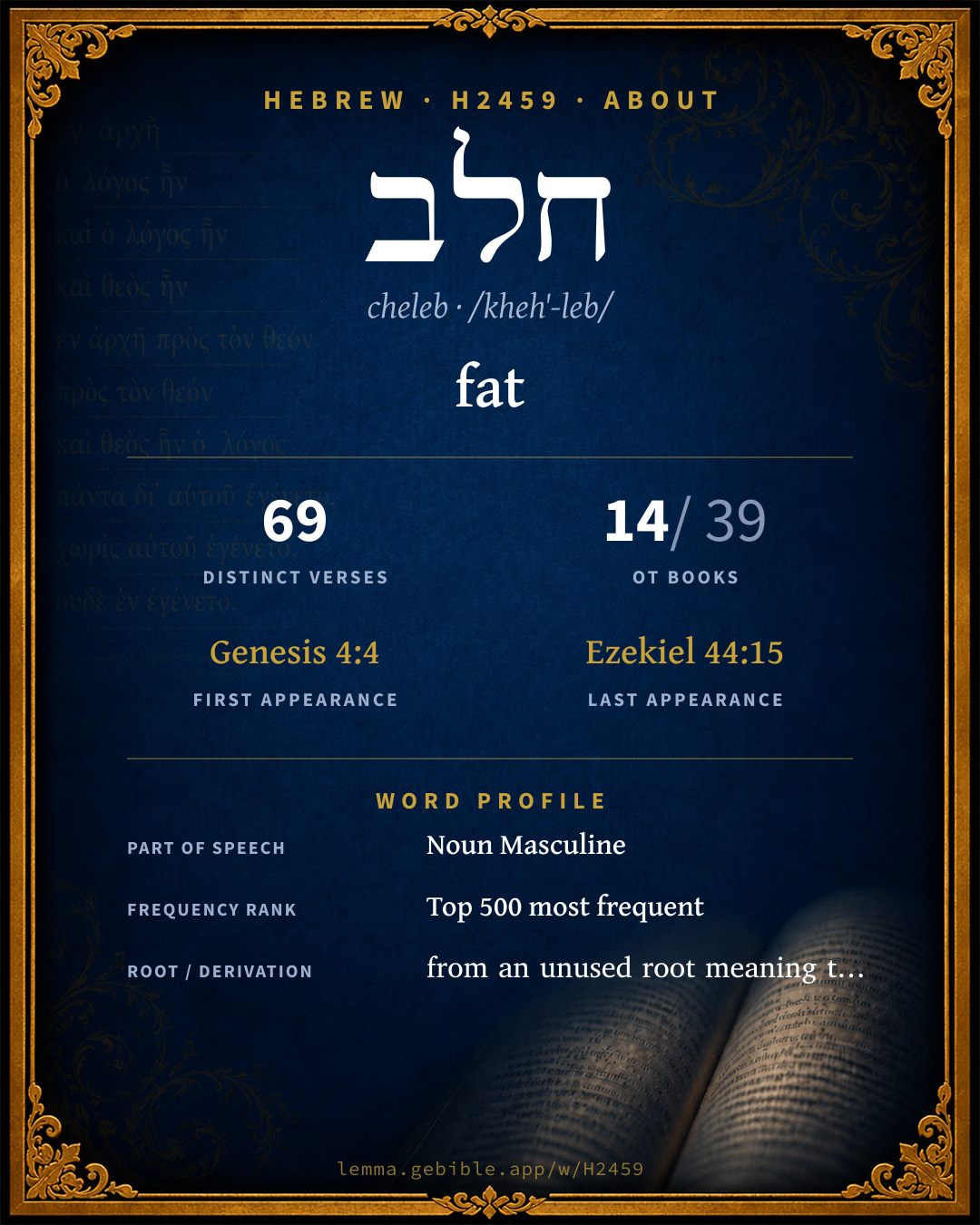
חֵ֫לֶב
fat
‘fat’ is one of 4 main senses fuller range ↓
Full lexicon entry — Brown-Driver-Briggs (BDB)
From Brown-Driver-Briggs (BDB)
Where this word appears
See every Absolute-state word in the Hebrew Bible →
Grammar key — what these labels mean
Part of speech
- Noun
- A naming word — a person, place, thing, or idea.
Noun type
- Common
- A common noun — a general class of person, place, or thing (“king,” “city,” “water”), not a specific name.
State
- Absolute
- The independent form of a noun, not bound to a following word.
- Construct
- A noun bound to a following noun in a possessive / “of” relationship (the construct chain).
Gender
- Masculine
- Grammatically masculine.
Number
- Singular
- One.
- Plural
- More than one (in Hebrew, generally three or more).
Grammatical forms
- Noun, Common, Masculine, Singular, Absolute 43 times (47%)
- Noun, Common, Masculine, Singular, Construct 35 times (38%)
- Noun, Common, Masculine, Plural, Absolute 8 times (9%)
- Noun, Common, Masculine, Plural, Construct 6 times (7%)
Parsed forms decoded from the imported morphology (morphhb / Westminster Leningrad Codex — WLC text public domain, morphhb tagging CC BY 4.0), counted across 92 parsed occurrences — not distinct verses.
Every verse where H2459 appears — 69 distinct verses across 14 books. Click any verse to open its interlinear word-by-word view. Verse text shown in the World English Bible for context — . Each verse’s Hebrew form is shown with its reference; the English is not keyword-highlighted, since the data carries no word-level English alignment. Use “Compare translations” on any verse to read it across multiple English versions. This concordance covers the Hebrew Bible; Septuagint (Greek Old Testament) occurrences are not indexed here.
Genesis 2 verses
- Genesis 4:4 וּ/מֵֽ/חֶלְבֵ/הֶ֑ן conj + prep + n c mp cs + sfx pers 3fp Abel also brought some of the firstborn of his flock and of the fat of it. Yahweh respected Abel and his offering,
- Genesis 45:18 חֵ֥לֶב n c ms cs Take your father and your households, and come to me, and I will give you the good of the land of Egypt, and you will eat the fat of the land.'
Exodus 3 verses
- Exodus 23:18 חֵֽלֶב n c ms cs "You shall not offer the blood of my sacrifice with leavened bread, neither shall the fat of my feast remain all night until the morning.
- Exodus 29:13 הַ/חֵלֶב֮ הַ/חֵ֖לֶב ptcl def.art + n c ms ptcl def.art + n c ms You shall take all the fat that covers the innards, the cover of the liver, the two kidneys, and the fat that is on them, and burn them on the altar.
- Exodus 29:22 הַ/חֵ֨לֶב הַ/חֵ֣לֶב הַ/חֵ֨לֶב֙ ptcl def.art + n c ms ptcl def.art + n c ms ptcl def.art + n c ms Also you shall take some of the ram's fat, the fat tail, the fat that covers the innards, the cover of the liver, the two kidneys, the fat that is on them, and the right thigh (for it is a ram of consecration),
Leviticus 33 verses
- Leviticus 3:3 הַ/חֵ֨לֶב֙ הַ/חֵ֔לֶב ptcl def.art + n c ms ptcl def.art + n c ms He shall offer of the sacrifice of peace offerings an offering made by fire to Yahweh; the fat that covers the innards, and all the fat that is on the innards,
- Leviticus 3:4 הַ/חֵ֨לֶב֙ ptcl def.art + n c ms and the two kidneys, and the fat that is on them, which is by the loins, and the cover on the liver, with the kidneys, he shall take away.
- Leviticus 3:9 חֶלְבּ/וֹ֙ הַ/חֵ֨לֶב֙ הַ/חֵ֔לֶב n c ms cs + sfx pers 3ms ptcl def.art + n c ms ptcl def.art + n c ms He shall offer from the sacrifice of peace offerings an offering made by fire to Yahweh; its fat, the entire tail fat, he shall take away close to the backbone; and the fat that covers the inwards, and all the fat that is on the inwards,
- Leviticus 3:10 הַ/חֵ֨לֶב֙ ptcl def.art + n c ms and the two kidneys, and the fat that is on them, which is by the loins, and the cover on the liver, with the kidneys, he shall take away.
- Leviticus 3:14 הַ/חֵ֨לֶב֙ הַ/חֵ֔לֶב ptcl def.art + n c ms ptcl def.art + n c ms He shall offer from it as his offering, an offering made by fire to Yahweh; the fat that covers the innards, and all the fat that is on the innards,
- Leviticus 3:15 הַ/חֵ֨לֶב֙ ptcl def.art + n c ms and the two kidneys, and the fat that is on them, which is by the loins, and the cover on the liver, with the kidneys, he shall take away.
- Leviticus 3:16 חֵ֖לֶב n c ms The priest shall burn them on the altar: it is the food of the offering made by fire, for a sweet savor; all the fat is Yahweh's.
- Leviticus 3:17 חֵ֥לֶב n c ms "'It shall be a perpetual statute throughout your generations in all your dwellings, that you shall eat neither fat nor blood.'"
- Leviticus 4:8 חֵ֛לֶב הַ/חֵ֨לֶב֙ הַ/חֵ֔לֶב n c ms cs ptcl def.art + n c ms ptcl def.art + n c ms He shall take all the fat of the bull of the sin offering off of it; the fat that covers the innards, and all the fat that is on the innards,
- Leviticus 4:9 הַ/חֵ֨לֶב֙ ptcl def.art + n c ms and the two kidneys, and the fat that is on them, which is by the loins, and the cover on the liver, with the kidneys, he shall take away,
- Leviticus 4:19 חֶלְבּ֖/וֹ n c ms cs + sfx pers 3ms All its fat he shall take from it, and burn it on the altar.
- Leviticus 4:26 חֶלְבּ/וֹ֙ כְּ/חֵ֖לֶב n c ms cs + sfx pers 3ms prep + n c ms cs All its fat he shall burn on the altar, like the fat of the sacrifice of peace offerings; and the priest shall make atonement for him concerning his sin, and he will be forgiven.
- Leviticus 4:31 חֶלְבָּ֣/הּ חֵלֶב֮ n c ms cs + sfx pers 3fs n c ms All its fat he shall take away, like the fat is taken away from off of the sacrifice of peace offerings; and the priest shall burn it on the altar for a sweet savor to Yahweh; and the priest shall make atonement for him, and he will be forgiven.
- Leviticus 4:35 חֶלְבָּ֣/ה חֵֽלֶב n c ms cs + sfx pers 3fs n c ms cs All its fat he shall take away, like the fat of the lamb is taken away from the sacrifice of peace offerings; and the priest shall burn them on the altar, on the offerings of Yahweh made by fire; and the priest shall make atonement for him concerning his sin that he has sinned, and he will be forgiven.
- Leviticus 6:12 חֶלְבֵ֥י n c mp cs The fire on the altar shall be kept burning on it, it shall not go out; and the priest shall burn wood on it every morning: and he shall lay the burnt offering in order upon it, and shall burn on it the fat of the peace offerings.
- Leviticus 7:3 חֶלְבּ֖/וֹ הַ/חֵ֖לֶב n c ms cs + sfx pers 3ms ptcl def.art + n c ms He shall offer all of its fat: the fat tail, and the fat that covers the innards,
- Leviticus 7:4 הַ/חֵ֨לֶב֙ ptcl def.art + n c ms and the two kidneys, and the fat that is on them, which is by the loins, and the cover on the liver, with the kidneys, shall he take away;
- Leviticus 7:23 חֵ֜לֶב n c ms cs "Speak to the children of Israel, saying, 'You shall eat no fat, of ox, or sheep, or goat.
- Leviticus 7:24 וְ/חֵ֤לֶב וְ/חֵ֣לֶב conj + n c ms cs conj + n c ms cs The fat of that which dies of itself, and the fat of that which is torn of animals, may be used for any other service, but you shall in no way eat of it.
- Leviticus 7:25 חֵ֔לֶב n c ms For whoever eats the fat of the animal, of which men offer an offering made by fire to Yahweh, even the soul who eats it shall be cut off from his people.
- Leviticus 7:30 הַ/חֵ֤לֶב ptcl def.art + n c ms With his own hands he shall bring the offerings of Yahweh made by fire. He shall bring the fat with the breast, that the breast may be waved for a wave offering before Yahweh.
- Leviticus 7:31 הַ/חֵ֖לֶב ptcl def.art + n c ms The priest shall burn the fat on the altar, but the breast shall be Aaron's and his sons'.
- Leviticus 7:33 הַ/חֵ֖לֶב ptcl def.art + n c ms He among the sons of Aaron who offers the blood of the peace offerings, and the fat, shall have the right thigh for a portion.
- Leviticus 8:16 הַ/חֵלֶב֮ חֶלְבְּ/הֶ֑ן ptcl def.art + n c ms n c ms cs + sfx pers 3fp He took all the fat that was on the innards, and the cover of the liver, and the two kidneys, and their fat; and Moses burned it on the altar.
- Leviticus 8:25 הַ/חֵ֣לֶב הַ/חֵלֶב֮ חֶלְבְּ/הֶ֑ן ptcl def.art + n c ms ptcl def.art + n c ms n c ms cs + sfx pers 3fp He took the fat, and the fat tail, and all the fat that was on the innards, and the cover of the liver, and the two kidneys, and their fat, and the right thigh;
- Leviticus 8:26 הַ֣/חֲלָבִ֔ים ptcl def.art + n c mp and out of the basket of unleavened bread, that was before Yahweh, he took one unleavened cake, and one cake of oiled bread, and one wafer, and placed them on the fat, and on the right thigh.
- Leviticus 9:10 הַ/חֵ֨לֶב ptcl def.art + n c ms but the fat, and the kidneys, and the cover from the liver of the sin offering, he burned upon the altar; as Yahweh commanded Moses.
- Leviticus 9:19 הַ/חֲלָבִ֖ים ptcl def.art + n c mp and the fat of the ox and of the ram, the fat tail, and that which covers the innards, and the kidneys, and the cover of the liver:
- Leviticus 9:20 הַ/חֲלָבִ֖ים הַ/חֲלָבִ֖ים ptcl def.art + n c mp ptcl def.art + n c mp and they put the fat upon the breasts, and he burned the fat on the altar:
- Leviticus 9:24 הַ/חֲלָבִ֑ים ptcl def.art + n c mp There came forth fire from before Yahweh, and consumed the burnt offering and the fat upon the altar: and when all the people saw it, they shouted, and fell on their faces.
- Leviticus 10:15 הַ/חֲלָבִים֙ ptcl def.art + n c mp The heaved thigh and the waved breast they shall bring with the offerings made by fire of the fat, to wave it for a wave offering before Yahweh: and it shall be yours, and your sons' with you, as a portion forever; as Yahweh has commanded."
- Leviticus 16:25 חֵ֥לֶב n c ms cs The fat of the sin offering he shall burn on the altar.
- Leviticus 17:6 הַ/חֵ֔לֶב ptcl def.art + n c ms The priest shall sprinkle the blood on the altar of Yahweh at the door of the Tent of Meeting, and burn the fat for a sweet savor to Yahweh.
Numbers 5 verses
- Numbers 18:12 חֵ֣לֶב חֵ֖לֶב n c ms cs n c ms cs All the best of the oil, and all the best of the vintage, and of the grain, the first fruits of them which they give to Yahweh, to you have I given them.
- Numbers 18:17 חֶלְבָּ֣/ם n c ms cs + sfx pers 3mp But the firstborn of a cow, or the firstborn of a sheep, or the firstborn of a goat, you shall not redeem; they are holy: you shall sprinkle their blood on the altar, and shall burn their fat for an offering made by fire, for a sweet savor to Yahweh.
- Numbers 18:29 חֶלְבּ֔/וֹ n c ms cs + sfx pers 3ms Out of all your gifts you shall offer every heave-offering of Yahweh, of all the best of it, even the holy part of it out of it.
- Numbers 18:30 חֶלְבּ/וֹ֙ n c ms cs + sfx pers 3ms Therefore you shall tell them, When you heave the best of it from it, then it shall be reckoned to the Levites as the increase of the threshing floor, and as the increase of the wine-press.
- Numbers 18:32 חֶלְבּ֖/וֹ n c ms cs + sfx pers 3ms You shall bear no sin by reason of it, when you have heaved from it the best of it: and you shall not profane the holy things of the children of Israel, that you not die.
Deuteronomy 2 verses
- Deuteronomy 32:14 חֵ֨לֶב חֵ֖לֶב n c ms cs n c ms cs Butter of the herd, and milk of the flock, With fat of lambs, Rams of the breed of Bashan, and goats, With the finest of the wheat; Of the blood of the grape you drank wine.
- Deuteronomy 32:38 חֵ֤לֶב n c ms cs Which ate the fat of their sacrifices, And drank the wine of their drink-offering? Let them rise up and help you, Let them be your protection.
Judges 1 verse
1 Samuel 3 verses
- 1 Samuel 2:15 הַ/חֵלֶב֒ ptcl def.art + n c ms Yes, before they burnt the fat, the priest's servant came, and said to the man who sacrificed, Give flesh to roast for the priest; for he will not have boiled flesh of you, but raw.
- 1 Samuel 2:16 הַ/חֵ֔לֶב ptcl def.art + n c ms If the man said to him, They will surely burn the fat first, and then take as much as your soul desires; then he would say, No, but you shall give it me now: and if not, I will take it by force.
- 1 Samuel 15:22 מֵ/חֵ֥לֶב prep + n c ms cs Samuel said, Has Yahweh as great delight in burnt offerings and sacrifices, as in obeying the voice of Yahweh? Behold, to obey is better than sacrifice, and to listen than the fat of rams.
2 Samuel 1 verse
1 Kings 1 verse
2 Chronicles 3 verses
- 2 Chronicles 7:7 חֶלְבֵ֣י הַ/חֲלָבִֽים n c mp cs ptcl def.art + n c mp Moreover Solomon made the middle of the court holy that was before the house of Yahweh; for there he offered the burnt offerings, and the fat of the peace-offerings, because the brazen altar which Solomon had made was not able to receive the burnt offering, and the meal-offering, and the fat.
- 2 Chronicles 29:35 בְּ/חֶלְבֵ֧י prep + n c mp cs Also the burnt offerings were in abundance, with the fat of the peace-offerings, and with the drink-offerings for every burnt offering. So the service of the house of Yahweh was set in order.
- 2 Chronicles 35:14 וְ/הַ/חֲלָבִ֖ים conj + ptcl def.art + n c mp Afterward they prepared for themselves, and for the priests, because the priests the sons of Aaron [were busied] in offering the burnt offerings and the fat until night: therefore the Levites prepared for themselves, and for the priests the sons of Aaron.
Job 1 verse
Psalms 6 verses
- Psalms 17:10 חֶלְבָּ֥/מוֹ n c ms cs + sfx pers 3mp They close up their callous hearts. With their mouth they speak proudly.
- Psalms 63:5 חֵ֣לֶב n c ms My soul shall be satisfied as with the richest food. My mouth shall praise you with joyful lips,
- Psalms 73:7 מֵ/חֵ֣לֶב prep + n c ms Their eyes bulge with fat. Their minds pass the limits of conceit.
- Psalms 81:16 מֵ/חֵ֣לֶב prep + n c ms cs But he would have also fed them with the finest of the wheat. I will satisfy you with honey out of the rock."
- Psalms 119:70 כַּ/חֵ֣לֶב prep det + n c ms Their heart is as callous as the fat, But I delight in your law.
- Psalms 147:14 חֵ֥לֶב n c ms cs He makes peace in your borders. He fills you with the finest of the wheat.
Isaiah 4 verses
- Isaiah 1:11 וְ/חֵ֣לֶב conj + n c ms cs "What are the multitude of your sacrifices to me?," says Yahweh. "I have had enough of the burnt offerings of rams, And the fat of fed animals. I don't delight in the blood of bulls, Or of lambs, Or of male goats.
- Isaiah 34:6 מֵ/חֵ֔לֶב מֵ/חֵ֖לֶב prep + n c ms prep + n c ms cs The sword of Yahweh is filled with blood, it is made fat with fatness, with the blood of lambs and goats, with the fat of the kidneys of rams; for Yahweh has a sacrifice in Bozrah, and a great slaughter in the land of Edom.
- Isaiah 34:7 מֵ/חֵ֥לֶב prep + n c ms The wild-oxen shall come down with them, and the bulls with the bulls: and their land shall be drunken with blood, and their dust made fat with fatness.
- Isaiah 43:24 וְ/חֵ֥לֶב conj + n c ms cs You have bought me no sweet cane with money, neither have you filled me with the fat of your sacrifices; but you have burdened me with your sins, you have wearied me with your iniquities.
Ezekiel 4 verses
- Ezekiel 34:3 הַ/חֵ֤לֶב ptcl def.art + n c ms You eat the fat, and you clothe you with the wool, you kill the fatlings; but you don't feed the sheep.
- Ezekiel 39:19 חֵ֣לֶב n c ms You shall eat fat until you be full, and drink blood until you be drunken, of my sacrifice which I have sacrificed for you.
- Ezekiel 44:7 חֵ֣לֶב n c ms in that you have brought in foreigners, uncircumcised in heart and uncircumcised in flesh, to be in my sanctuary, to profane it, even my house, when you offer my bread, the fat and the blood, and they have broken my covenant, [to add] to all your abominations.
- Ezekiel 44:15 חֵ֣לֶב n c ms But the priests the Levites, the sons of Zadok, who kept the charge of my sanctuary when the children of Israel went astray from me, they shall come near to me to minister to me; and they shall stand before me to offer to me the fat and the blood, says the Lord Yahweh:
About this entry
At a glance — auto-summarized from this page’s data, not written by a person. Every figure links to its source below. This summary describes the numbers; it doesn’t interpret them.
At its core, חלב (cheleb) means “fat.” Not a single-sense word: explore its full sense range. It turns up in 69 verses across 14 books, a moderately common footprint. The word gravitates to Leviticus (48%), then Psalms and Numbers. It first appears in Genesis 4:4. Each statement above links to its evidence; the full detail follows below.
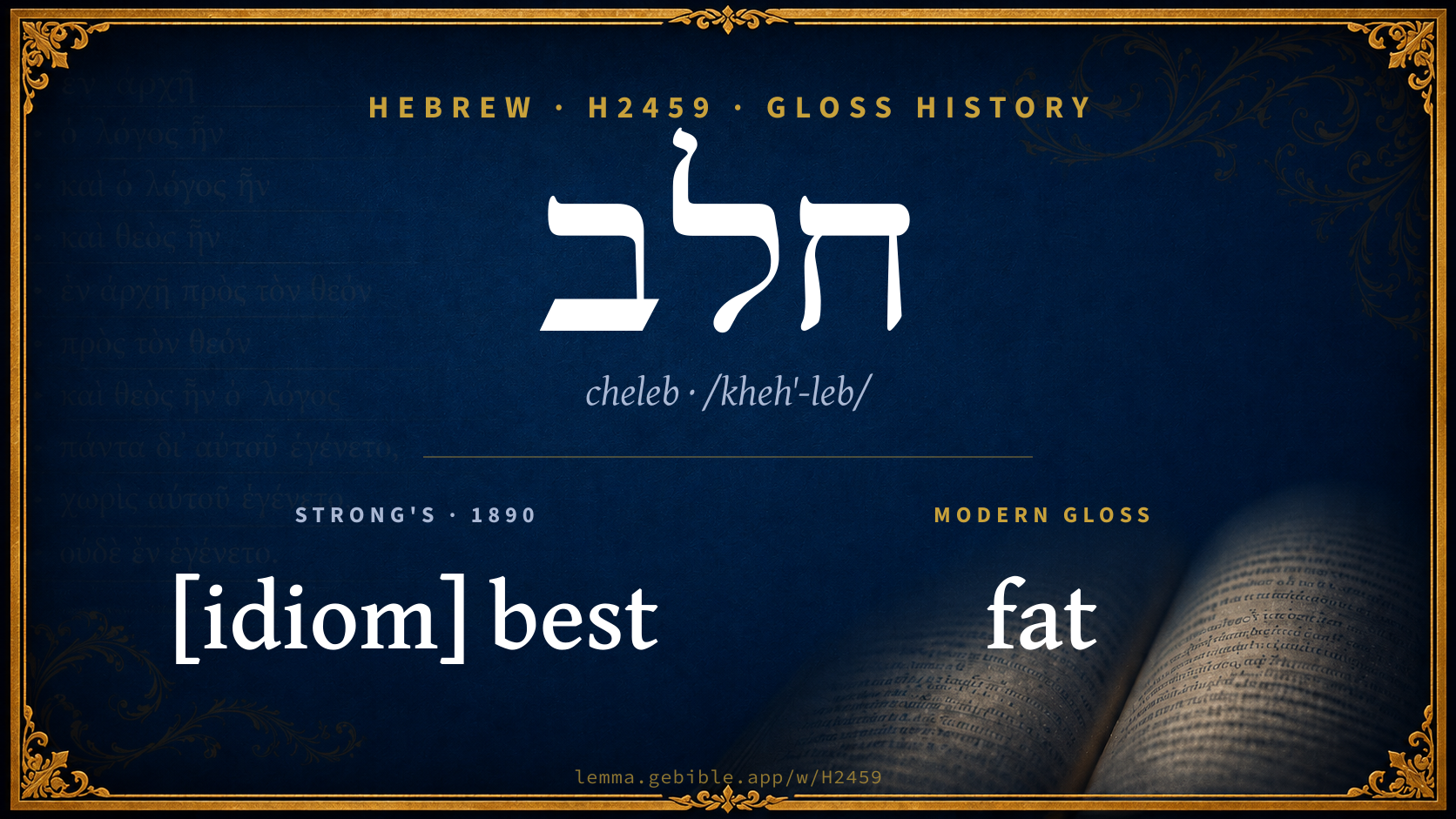
Gloss history
Strong's 1890 vs modern scholarship
About this word
Strong's H2459 catalogs a Hebrew word from the Hebrew Old Testament.
These counts are not copied from any lexicon or concordance. They are computed here, from the morphology-tagged Hebrew Old Testament. What Lemma adds →
- 69
- distinct verses
- The word appears in 69 distinct verses.
- 14 / 39
- OT books
- The word appears in 14 of 39 Old Testament books.
- #450
- by frequency
- Top 500 most frequent Hebrew words (rank 450 of 8,640 Hebrew words by occurrence).
View all 69 occurrences in the concordance →
By section of the Old Testament
By traditional corpus
Conventional, traditional groupings — biblical authorship is debated, so this is a traditional corpus grouping, not an authorship claim. Each share is this word’s portion of its verses in that division of the Hebrew canon. Each figure is a share of the word’s 69 distinct verses.
- Torah (Pentateuch) 45 verses · 65%
- Prophets (Nevi'im) 14 verses · 20%
- Writings (Ketuvim) 10 verses · 14%
How translations render this word
Counts come from each version’s own published word-to-Strong’s tagging or interlinear alignment — an approximate guide to how each version renders this word, not a word-level alignment the data otherwise carries. Because each total is that version’s own tagged count, the per-version totals vary from one another and need not match the appearance or distinct-verse counts above. These counts may also differ from a printed concordance because Lemma counts each distinctly tagged rendering and does not collapse phrase taggings into a single head-word total. This is a fixed set of word-tagged versions (KJV, ASV, BSB, ULT) and does not change with the reading translation you choose elsewhere. Each version’s license is shown beside its name below (and on Sources).
BDB lists this Strong’s number as 2 distinct words (homographs). Each count above pools all of them and is not split by sense — see the Senses section below. A low-frequency rendering may belong to a different one of those words, not the primary meaning.
- King James Version†: Fat 58×, All the fat 12×, Fatness 4×
- American Standard Version†: Fat 56×, All the fat 14×, Fatness 4×
- Berean Standard Bible†: Fat 63×, Fat portions 5×, Finest 3×
- unfoldingWord Literal Text†: Fat 58×, Fat of 22×, Fat portions 3×
King James Version Public Domain
Renders H2459 across 92† tagged occurrences — most commonly:
Plus 9 renderings that appear only once — usually multi-word phrases or single function words the recovered tagging swept in, not distinct renderings.
American Standard Version Public Domain
Renders H2459 across 92† tagged occurrences — most commonly:
Plus 15 renderings that appear only once — usually multi-word phrases or single function words the recovered tagging swept in, not distinct renderings.
Berean Standard Bible Public Domain
Renders H2459 across 88† tagged occurrences — most commonly:
Plus 15 renderings that appear only once — usually multi-word phrases or single function words the recovered tagging swept in, not distinct renderings. Not rendered by a distinct English word in 4 further occurrences.
unfoldingWord Literal Text CC BY-SA 4.0
Renders H2459 across 94† tagged occurrences — most commonly:
Plus 9 renderings that appear only once — usually multi-word phrases or single function words the recovered tagging swept in, not distinct renderings.
Senses in the full BDB
What do BDB’s symbols mean?
BDB uses these scholarly abbreviations:
| Symbol | Meaning |
|---|---|
| 𝔊 | the Septuagint (the ancient Greek translation, LXX) |
| 𝔙 | the Vulgate (the Latin translation) |
| 𝔖 | the Syriac version (the Peshitta) |
| 𝔗 | the Targum (the Aramaic translation) |
| ψ | the Psalms |
| √ | root (the underlying root or stem) |
| ‖ | parallel passage (a synonymous or contrasted parallel) |
| † | the dagger: every passage where the word occurs is cited |
The 5 senses and sub-senses the full Brown-Driver-Briggs lexicon distinguishes for this word, in lexicon order (not ranked by frequency), with BDB’s own verbatim wording and sub-sense lettering. Shown in Hebrew script with BDB’s own scholarly abbreviations. The condensed entry is in the Lexicon Entry tab. See also the Forms in the corpus table below.
חלב I
- 1. fat of human body Ju 3:22 (covering intestines); ח׳גִּבּוֹרִים 2 S 1:22 as smearing warrior’s shield; of grossness of wicked כִּסָּה פָּנָיו בְּחֶלְבּוֹ Jb 15:27; fat (of midriff) fig. of unreceptive heart ח׳ סָֽגְרוּ ψ 17:10, v. also 73:7 (read מֵחֵלֶב עֲוֹנָמוֹ for מחלב עֵינֵמוֹ 𝔊 𝔖 Hi Ew Ol De Che Bae al.); טָפַשׁ כַּח׳ לִבָּם ψ 119:70 i.e. their heart is as unresponsive as the midriff-fat near it. e.g. Judges 3:22
- 2. fat of beasts:
- a. as rich food (poet.) Dt 32:14 and in sim. ψ 63:6 (‖ דֶּשֶׁן); so MT Ez 34:3 (but read הֶחָלָב, v. חָלָב), 39:19 (𝔖 Co בשׂר). e.g. Deuteronomy 32:14
- b. especially as offered in sacrifice, sg., to י׳ Ex 23:18 (JE), 1 S 2:15, 16 Ex 29:13(×2), 22(×3) Lv 3:3(×2), 4, 9(×3), 10, 14(×2), 15 + 23 times Lv, Nu 18:17 (all P), Lv 17:6 (H), 1 S 15:22 Is 1:11; 43:24 Ez 44:7, 15; v. Is 34:6(×2), 7 of fat of Edomites slaughtered by י׳’s sword (under fig. of lambs, rams, and bulls); as eaten by (strange) gods Dt 32:38; (poet.), not to be eaten by men Lv 3:17; 7:23, 24(×2), 25 (all P); also pl., fat parts or pieces Gn 4:4 (J) Lv 6:5 + 8 times Lv, 1 K 8:64(×2) 2 Ch 7:7(×2); 29:35; 35:14. e.g. Exodus 23:18
- 3. choicest, best part of products of land Gn 45:18 (E), specif. of oil Nu 18:12 and wine v 12; of corn and oil v 29, 30, 32; also (poet.) ח׳ כִּלְיוֹת חִטָּה Dt 32:14 kidney-fat of wheat (i.e. the very choicest, cf. Is 34:6), ח׳ חִטָּה ψ 81:17, ח׳ חִטִּים 147:14. e.g. Genesis 45:18
חלב II m. (Sab. n.pr.m. חֿלבן = the crafty one Sab.Denkm. 27. 28)
Senses from the full Brown-Driver-Briggs lexicon (Brown, Driver, Briggs; Oxford 1906 — public domain), digitized via Sefaria, supplemented by the OpenScriptures HebrewLexicon (CC BY 4.0). Full attribution on Sources.
Word origin
I. n.m. Ex 29:13 fat (NH id., fat, so Ph. חלב (prob.); Aramaic ܚܶܠܒܳܐ (also diaphragm in Lexx., v. PS1274) orig. diaphragm, midriff; Arabic خِلْبٌ, incl. midriff-fat, RSSem i. 360);—ח׳ abs. Lv 3:16 + 40 times; cstr. Gn 45:18 + 21 times; sf. חֶלְבּוֹ Lv 3:9 + 6 times; חֶלְבָּהּ Lv 4:31, 35, חֶלְבָּם Nu 18:17, חֶלְבָּ֫מוֹ ψ 17:10, חֶלְבְּהֶ֑ן Lv 8:16, 25 (read n.pl. חלביהן Sam. Di); pl. הַחֲלָבִים Lv 8:26 + 7 times; cstr. חֶלְבֵי Lv 6:5 + 4 times; sf. חֶלְבֵהֶן Gn 4:4 (חלביהן Sam. Di, cf. Lv 8:16, 25 supr.);—
II. n.pr.m. (Sab. n.pr.m. חֿלבן = the crafty one Sab.Denkm. 27. 28)—one of David’s heroes 2 S 23:29 (but read חלד(י), v. Dr), 𝔊 Εσθαει, A Αλαφ, 𝔊L Αλλαν (= חֵלֶד 1 Ch 11:30 = חֶלְדַּי 27:15).
— Brown-Driver-Briggs (Oxford 1906, public domain), digitized via Sefaria, supplemented by the OpenScriptures HebrewLexicon (CC BY 4.0). See Sources.
Origin: from an unused root meaning to be fat
Jastrow Dictionary
A second Hebrew/Aramaic lexicon for comparison, covering Aramaic and post-biblical (Talmudic, Targumic, Midrashic) usage that the biblical-Hebrew BDB does not. Matched by lemma rather than by Strong’s number, so a lemma may carry more than one Jastrow headword (shown separately below), and the entries cover usage well beyond the Bible.
חָלָב
- (b. h.) [secretion,] milk. Ab. Zar. II, 6 ח׳ שחֲלָבוֹ וכ׳ milk (of a cow) milked by a gentile. Makhsh. VI, 5 מי ח׳ serum of milk; a. fr.—בשר בח׳ the boiling of meat with milk, the prohibitory law concerning &c. (Ex. XXIV, 19; XXXIV, 26; Deut. XIV, 21). Pes. 54ᵇ, v. חִידּוּשׁ.—Ḥull. 110ᵃ לא גמירי דב׳ בח׳ אסור they did not know that boiling meat with milk was forbidden; a. fr.—חֲלֵב בֵּיצִים white of eggs. Y. Ter. X, 47ᵇ bot., cmp. חֶלְבּוֹן.—נֵץ (ה)ח׳ ornithogalum, Star of Bethlehem, a bulbous plant. Shebi. VII, 1, v. חֶלְבֵּצִין; Ukts. III, 2.—Trnsf. הח׳ white wine. Gen. R. s. 98, opp. אדום. e.g. Exodus 24:19
חֲלָב
- Targ. Gen. XVIII, 8. Targ. Job X, 10; a. fr.—Y. Ter. VIII, 46ᵃ חַלְבּוּן חֲ׳ milked. Ḥull. 109ᵇ, v. בִּשְׂרָא I. Ib. 110ᵃ; a. e.
חָלַב
- (denom. of חָלָב) to milk; to yield milk. Ab. Zar. II, 6, v. חָלָב. Bekh. 20ᵇ רוב … חוֹלְבוֹת וכ׳ the majority of animals secrete no milk unless they have given birth; a. fr.
- to be milked. Sabb. 53ᵇ לֵיחָלֵב when the bag is tied on for milking purposes (to support the udders), opp. ליבש for drying up.
חֲלַב
- Y. Ter. VIII, 46ᵃ, v. חֲלָב
חֵלֶב
- (b. h.) fatty concretion (cmp. חַלָּא), esp. that abdominal fat of cattle which it is forbidden to eat, ḥeleb (Lev. III, 17), contrad. to שומן. Kerith. III, 1. Ḥull. 113ᵇ המבשל חֵ׳ בחָלָב if one boils fat with milk. Snh. 4ᵇ חֵלֶב וחָלָב דכי וכ׳ ḥeleb a. ḥalab which are written alike, v. אֵם; a. fr.—Pl. חֲלָבִים, חֲלָבִין. Ber. I, 1 ח׳ ואברים the pieces of fat and the limbs belonging to the altar; Tam. VII, 3 שלחן הח׳ the (marble) table designated for the fat-pieces (and limbs).—Ker. 12ᵃ, sq. חֲלָבִין laws concerning the eating of ḥeleb; Y. Yeb. X, 11ᵃ top מדמי לה לח׳ (not לחלבון); a. fr.—[Y. Ter. X, 47ᵇ bot. לובן חלבין, v. חֶלְבּוֹן.]—גוּשׁ הֵ׳, v. גּוּשׁ. e.g. Leviticus 3:17
*חֵלֶב
- ch. m. (preced.) a viscous substance, glair. Ḥull. 120ᵃ ח׳ דקריש ed. (v. Rashi); v. חָלָא III.
A Dictionary of the Targumim, the Talmud Babli and Yerushalmi, and the Midrashic Literature (Marcus Jastrow; London, Luzac, 1903) — Public Domain. Digitized via Sefaria. Digitized via Sefaria. Full attribution on Sources.
Forms in the corpus
The 47 distinct written forms H2459 takes in the Hebrew Bible, most frequent first — each parse links to that state’s occurrences in the concordance. Hebrew forms include their vowel points and cantillation, so a single lemma takes many written forms.
Same root — word family
Other BDB entries built from the same root as H2459, grouped by Strong’s listed origin. These share a root / origin per the lexicon — not necessarily a shared meaning. Each links to that word’s own entry.
Derived from this word
Proper names from this root
People and places named from this root — a name, not an additional meaning of the word.
- אחלב ʼAchlâb H303 Ahlab
- חלב Chêleb H2460 Heleb
- חלבה Chelbâh H2462 Helbah
- חלבון Chelbôwn H2463 Helbon
Compare all same-root words → Showing 4 of 7 — not the complete family. 4 of the same-root words are proper names (people or places). They share a root, not necessarily a meaning.
Septuagint verse parallels
This word appears in 66 verses that also exist in the Greek Old Testament (Septuagint), out of the 69 Hebrew verses it occurs in. You can read those verses in Greek by switching the Old Testament edition to the Septuagint.
Read these verses in the Septuagint
- Genesis 4:4
- Exodus 23:18
- Leviticus 3:3
- Numbers 18:12
- Deuteronomy 32:14
- Judges 3:22
- 1 Samuel 2:15
- 2 Samuel 1:22
- 1 Kings 8:64
- 2 Chronicles 7:7
- Job 15:27
- Psalms 17:10
This is a verse-level parallel only — the same verses exist in both the Hebrew and Greek Old Testaments. No word-level Hebrew↔Greek correspondence is claimed: the data carries no such alignment, so no Greek word is shown as this Hebrew word’s translation. Coverage is not total — the Septuagint omits the deuterocanon and renumbers the Psalms, so some Hebrew verses have no direct Greek parallel.