
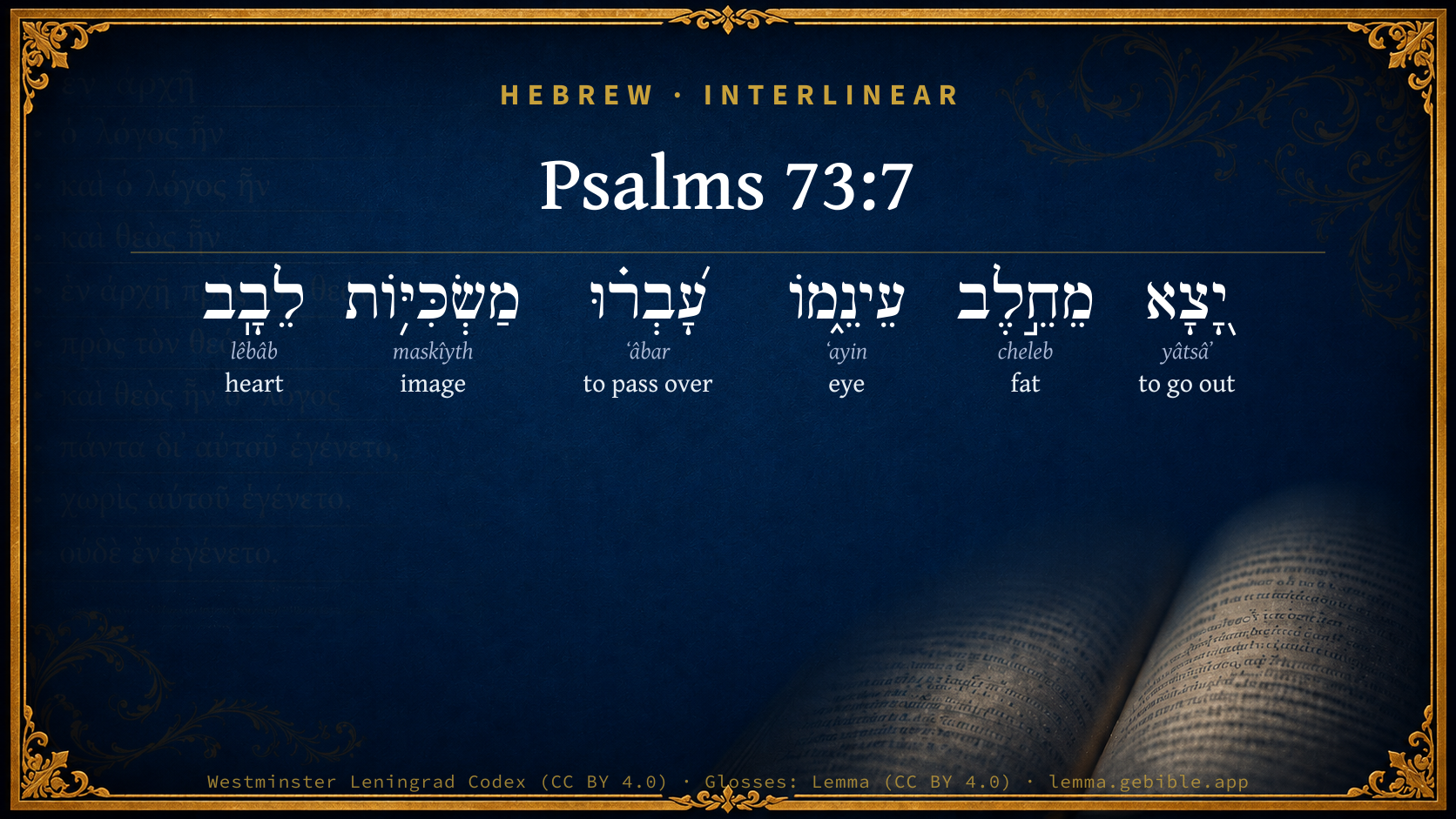
Psalms 73:7

Hebrew (Westminster Leningrad Codex) Psalms 73:7 appears in the Hebrew Old Testament. The text above is from the Westminster Leningrad Codex. Each word links to its Strong’s number, a concise gloss, and parsing drawn from the Open Scriptures Hebrew Bible morphology. Click any word for its full Brown-Driver-Briggs (BDB) entry.
Download image
Cite this verse

Psalms 73:7 (World English Bible). Public Domain. Lemma interlinear Bible study tool, https://lemma.gebible.app/v/psalms/73/7.

Show BibTeX & RIS
BibTeX
RIS
English Translation
Their eyes bulge with fat. Their minds pass the limits of conceit.
World English Bible · Public Domain
Download a study sheet

One document with this verse’s original text, its word-by-word gloss line, the meaning frame, cross-references with their text, attributed commentary, and full source and license credits — printable, and it pastes into notes with its structure intact.

This verse Autodidact and up

Study sheet (.html) Plain text (.txt)

A passage Seminary Student

Up to 50 verses in one chapter. A passage sheet keeps up to 6 commentary sources and 12 cross-references per verse, in the order this page ranks them, and says so on the sheet whenever that leaves anything out. Ask for a single verse and you get the Autodidact verse sheet above.

Everything on this page stays free to read, with no account — the sheet is a download of what is already on screen, not access to it.

Want to remove ads? Support Godless Engineer
Compare translations 3

The same verse in 3 English versions, stacked beneath the original-language interlinear above. Click any original word for its lexicon entry.

Each is an independent rendering of the whole verse — the interlinear is not word-aligned to these translations.

Highlighted words mark where these versions differ — a whole-verse word diff, not a word-by-word alignment.

  • World English Bible Public Domain
    Their eyes bulge with fat. Their minds pass the limits of conceit.
  • King James Version Public Domain
    Their eyes stand out with fatness: they have more than heart could wish.
  • unfoldingWord Literal Text CC BY-SA 4.0
    Their eyes bulge out from fatness; the imaginations of heart overflow.

unfoldingWord Literal Text — © unfoldingWord, licensed CC BY-SA 4.0. Word-aligned USFM3 via Door43 (git.door43.org/unfoldingWord/en_ult).

Versions to compare (up to 4)

3 of 4 selected

Show all 18 translations

Every available English version of this verse, each an independent rendering of the whole verse.

  • World English Bible Public Domain
    Their eyes bulge with fat. Their minds pass the limits of conceit.
  • Berean Standard Bible Public Domain
    From their prosperity proceeds iniquity; the imaginations of their hearts run wild.
  • Majority Standard Bible Public Domain
    From their prosperity proceeds iniquity; the imaginations of their hearts run wild.
  • King James Version Public Domain
    Their eyes stand out with fatness: they have more than heart could wish.
  • American Standard Version (1901) Public Domain
    Their eyes stand out with fatness: They have more than heart could wish.
  • Revised Version (1885) Public Domain
    Their eyes stand out with fatness: they have more than heart could wish.
  • Geneva Bible (1599) Public Domain
    Their eyes stande out for fatnesse: they haue more then heart can wish.
  • Douay-Rheims (1899) Public Domain
    Their iniquity hath come forth, as it were from fatness: they have passed into the affection of the heart.
  • Young's Literal Translation Public Domain
    Their eye hath come out from fat. The imaginations of the heart transgressed;
  • Literal Standard Version CC BY-SA 4.0
    Their eye has come out from fat. The imaginations of the heart transgressed;
  • Unlocked Literal Bible CC BY-SA 4.0
    Out of such blindness comes sin; evil thoughts pass through their hearts.
  • unfoldingWord Literal Text CC BY-SA 4.0
    Their eyes bulge out from fatness; the imaginations of heart overflow.
  • Darby Bible Public Domain
    Their eyes stand out from fatness, they exceed the imaginations of their heart:
  • World Messianic Bible Public Domain
    Their eyes bulge with fat. Their minds pass the limits of conceit.
  • Webster's Bible Public Domain
    Their eyes stand out with fatness: they have more than heart could wish.
  • Free Bible Version CC BY-SA 4.0
    Their eyes bulge out because they're so fat; their minds are full of selfish vanity.
  • Bible in Basic English Public Domain
    Their eyes are bursting with fat; they have more than their heart's desire.
  • JPS Tanakh (1917) Public Domain
    Their eyes stand forth from fatness; they are gone beyond the imaginations of their heart.

Literal Standard Version (2020), Covenant Press — licensed CC BY-SA 4.0. Text via the HelloAO Bible API (eBible.org). Unlocked Literal Bible (unfoldingWord) — licensed CC BY-SA 4.0. Text via the HelloAO Bible API (eBible.org). unfoldingWord Literal Text — © unfoldingWord, licensed CC BY-SA 4.0. Word-aligned USFM3 via Door43 (git.door43.org/unfoldingWord/en_ult). Free Bible Version, Dr. Jonathan Gallagher — licensed CC BY-SA 4.0. Text via the HelloAO Bible API (eBible.org).

Word by word

More ways to search: Search by grammar → Find every occurrence → Compare this word →

Practice this passage: Drill this verse → Learn its vocabulary →

About this verse

These counts appear in no published source. They are computed here, from the morphology-tagged text and Lemma’s own curated glosses. What Lemma adds →

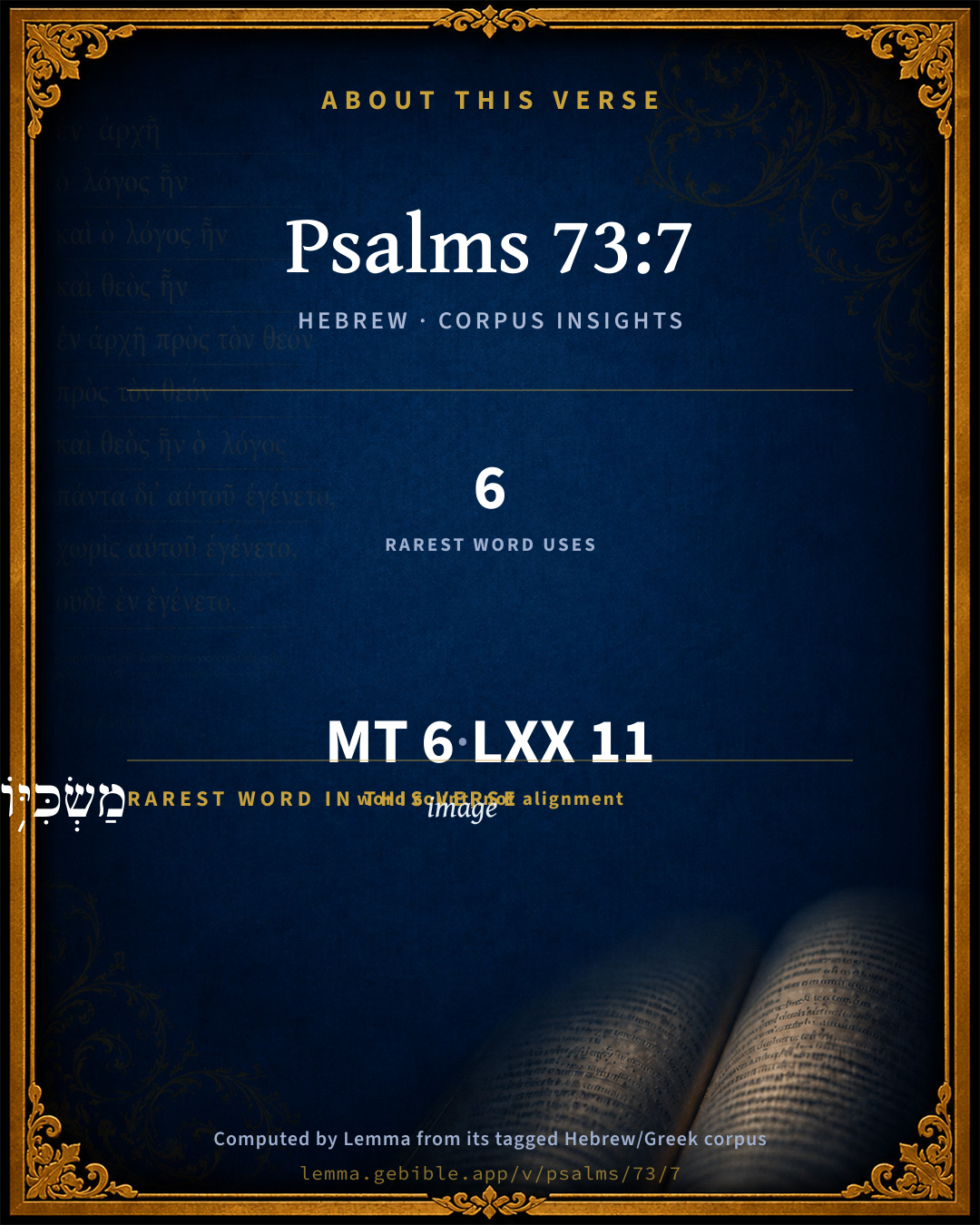
6
words
6
distinct lemmas
Wisdom
section

Notable vocabulary

The rarest word here is מַשְׂכִּיּ֥וֹת image H4906 — appearing just 6 times in the whole Hebrew Bible.

Shared distinctive vocabulary

מַשְׂכִּיּ֥וֹת image H4906 occurs in 6 verses of the Hebrew Bible. Also found in:

Grammatical profile

  • 2 verbs
  • 4 nouns

Verb forms

  • יָ֭צָא Qal · Perfect
  • עָ֝בְר֗וּ Qal · Perfect

Hebrew & Septuagint length

In English translation the verse runs 12 words from the Hebrew and 14 from the Septuagint (LXX English) — closely comparable.

A rough comparison of the two English renderings, which tokenize alike — not a word-level alignment.

Word counts can differ between the Hebrew and the Greek without any difference in meaning — e.g. the Hebrew direct-object marker אֵת has no separate Greek word, and Greek often adds the article ὁ.

In the original languages it is 6 Hebrew tokens and 11 Greek tokens — but the two are counted differently (Hebrew bundles its prefixes and suffixes into one token; the Greek is in lemma form), so that isn’t a like-for-like length.

Cross-references

11

Topical passages linked to Psalms 73:7 in the Treasury of Scripture Knowledge — connected by theme and wording, ordered by reader-vote popularity; previews shown in the World English Bible.

  • Job 15:27 Because he has covered his face with his fatness, And gathered fat on his loins.
  • Psalms 17:10 They close up their callous hearts. With their mouth they speak proudly.
  • Jeremiah 5:28 They are grew fat, they shine: yes, they overpass in deeds of wickedness; they don't plead the cause, the cause of the fatherless, that they may prosper; and the right of the needy they don't judge.
  • Psalms 73:12 Behold, these are the wicked. Being always at ease, they increase in riches.
  • 1 Samuel 25:2 There was a man in Maon, whose possessions were in Carmel; and the man was very great, and he had three thousand sheep, and a thousand goats: and he was shearing his sheep in Carmel.
  • 1 Samuel 25:36 Abigail came to Nabal; and, behold, he held a feast in his house, like the feast of a king; and Nabal's heart was merry within him, for he was very drunken: therefore she told him nothing, less or more, until the morning light.
  • Psalms 17:14 From men by your hand, Yahweh, From men of the world, whose portion is in this life. You fill the belly of your cherished ones. Your sons have plenty, And they store up wealth for their children.
  • Psalms 119:70 Their heart is as callous as the fat, But I delight in your law.
  • Isaiah 3:9 The look of their faces testify against them. They parade their sin like Sodom. They don't hide it. Woe to their soul! For they have brought disaster upon themselves.
  • Ezekiel 16:49 Behold, this was the iniquity of your sister Sodom: pride, fullness of bread, and prosperous ease was in her and in her daughters; neither did she strengthen the hand of the poor and needy.
  • Luke 12:16–19 He spoke a parable to them, saying, "The ground of a certain rich man brought forth abundantly.

Cross-references courtesy of OpenBible.info (CC BY 4.0).

Hebrew and Greek witnesses Masoretic Hebrew ↔ Greek Septuagint

The same verse in the two great witnesses to the Old Testament, shown verse-for-verse.

You’re reading Greek Psalm 72 (Hebrew Psalm 73). The Septuagint counts the superscription, so verse numbers can differ from the Hebrew — chapter-level alignment, not verse-by-verse. Numbering follows Rahlfs.

These are two independent witnesses, not word-aligned to each other, and the Septuagint is shown in lemma (dictionary) form.

Hebrew Psalms 73:7 Masoretic · Westminster Leningrad Codex

יָ֭צָא מֵחֵ֣לֶב עֵינֵ֑מוֹ עָ֝בְר֗וּ מַשְׂכִּיּ֥וֹת לֵבָֽב

Their eyes bulge with fat. Their minds pass the limits of conceit.

World English Bible · Public Domain

Greek LXX Greek Psalm 72:7 Septuagint · lemma form

ἐκἔρχομαι ὡς ἐκ στέαρ ὁ ἀδικία αὐτός διαἔρχομαι εἰς διάθεσις καρδία

Their injustice shall go forth as out of fatness: they have fulfilled their intention.

LXX2012 (modern English Septuagint) · Public Domain

On this verse, The Cambridge Bible for Schools and Colleges discusses the Septuagint’s reading. Read the note in Commentary ↓

Hebrew: Westminster Leningrad Codex (CC BY 4.0). Greek: Septuagint (public domain); English from LXX2012 (modern English Septuagint) (Public Domain). How the Septuagint differs from the Hebrew →

Commentary

Notes on Psalms 73:7 from classic Christian and Jewish commentators (each source and its license shown beneath its notes). The classic Christian expositions comment on the surrounding passage and are grouped to its opening verse, so a note may address several verses; the Jewish commentaries on the Tanakh (Rashi and others) are per-verse, so they appear only where the commentator wrote on this verse.

Lemma curates 59 commentaries, every one of them public domain or Creative Commons licensed, each selected and text-cleaned for this edition rather than reprinted as found. About our sources →

Trapp's Complete Commentary

John Trapp

Psa 73:7 Their eyes stand out with fatness: they have more than heart could wish.

Ver. 7. Their eyes stand out with fatness] The Chaldee hath it, the similitude of their face is changed through fatness. See Job 15:27. The Greek, for the wealth which they have, their eyes are lifted up. The Latin, their iniquity proceedeth as it were from fatness.

They have more than heart can wish] Heb. They pass the thoughts of the heart; which the Greek rendereth, no man think how wicked they are; those stall fed Sodomites, for instance. See Jer 5:28. So Aben Ezra, Transgressiones perpetrant quas cogitare nefas est, they are more wicked than can be imagined; others, they covet beyond measure, and are insatiable, thinking to enclose the whole world in their net, as Timothy the Athenian did cities and towns in his toils (Plut. in Sulla). Our translation is not to be disliked; neither yet are all to be accounted wicked that have move than heart could wish. Bonus Dens Constantinum magnum tantis terrenis implevit muneribus, quanta optare nullus auderet, saith Augustine (De Civ. Dei, lib. 5, c. 25).

John Trapp, A Commentary or Exposition upon All the Books of the Old and New Testament (1647–1656) — public domain. Text from a community e-Sword module.

J. A. Alexander on Psalms

Joseph Addison Alexander

Psa 73:7. Their eyes stand out with fatness; the imaginations of the heart pass (out, come forth, or are disclosed). The common version of the last clause, they have more than heart could wish, assumes as the literal meaning of the words, they surpass the desires of their heart. According to the other construction above given, the meaning is that as their eyes stand out with fatness, so their hearts overflow with evil thoughts. Compare Mat 12:35; Mat 15:19, Mar 7:21, Luk 2:35; Luk 6:45.

Joseph Addison Alexander, The Psalms Translated and Explained (1850) — public domain. Text from a community e-Sword module.

Geneva Bible (1599)

Geneva Bible translators

Hebrew, they pass the desires of the heart.

Geneva Bible (1599) marginal notes — public domain. Text via Bolls.life.

Adam Clarke's Commentary

Verse 7. Their eyes stand out with fatness] "Their countenance is changed because of fatness."-Chaldee. By fatness, or corpulency, the natural lines of the face are changed, or rather obliterated. The characteristic distinctions are gone; and we see little remaining besides the human hog.

They have more than heart could wish.] I doubt this translation. Whose heart ever said, I have enough, which had not its portion with God? It would be more literal to say, "They surpass the thoughts of their heart." They have more than they expected, though not more than they wish.

Adam Clarke's Commentary on the Bible (1810–1826) — public domain. Text from a community e-Sword/MySword module.

John Calvin's Commentaries

7. Their eye goeth out for fatness. He now adds, that it is not wonderful to see the ungodly breaking forth with such violence and cruelty, since, by reason of fatness and pampering, their eyes are ready to start out of their heads. Some explain the words goeth out as meaning, that their eyes being covered and hidden with fat, were, so to speak, lost, and could not be perceived in their sockets. But as fat causes the eyes to project from the head, I prefer retaining the proper meaning of the words. Let it, however, be observed, that David is not to be understood as speaking of the bodily countenance, but as expressing metaphorically the pride with which the ungodly are inflated on account of the abundance which they possess. They so glut and intoxicate themselves with their prosperity, that afterwards they are ready to burst with pride. The last clause of the verse is also explained in two ways. Some think that by the verb עבר, abar, which we have translated passed beyond, is denoted unbridled presumption; for the ungodly are not contented to keep themselves within ordinary bounds, but in their wild and extravagant projects mount above the clouds. We know, in fact, that they often deliberate with themselves how they may take possession of the whole world; yea, they would wish God to create new worlds for them. In short, being altogether insatiable, they pass beyond heaven and earth in their wild and unbounded desires. It would certainly not be inappropriate to explain the verb as meaning, that their foolish thoughts can be regulated by no law, nor kept within any bounds. But there is another exposition which is also very suitable, namely, that the prosperity and success which they meet with exceed all the flattering prospects which they had pictured in their imaginations. We certainly see some of them who obtain more than ever they had desired, as if, whilst they were asleep, Fortune laid nets and fished for them, — the device under which king Demetrius was in old time wittily painted, who had taken so many cities, although otherwise he was neither skillful nor vigilant, nor of great foresight. If we are inclined to take this view of the words, this clause will be added by way of exposition, to teach us what is meant by that fatness, spoken of before — that it means that God heaps upon the wicked, and fills them with, an abundance of all good things, beyond what they had ever either desired or thought of.

John Calvin's Commentaries (1540-1563) — public domain. Text from the Calvin Translation Society English edition (1840s-50s) via the Christian Classics Ethereal Library (ccel.org). Calvin's coverage is partial (roughly two-thirds of the Bible); uncommented books and verses are honest gaps, never fabricated. The 19th-century editor's footnotes and remarks are omitted so the notes are faithfully Calvin's own voice.

Ellicott's Commentary for English Readers

(7) Stand out with fatness.—Literally, go out from fat. Which, if referring to the appearance, is exactly the opposite to what we should expect. Sunken in fat would express the idea of gross sensuality. The eyes and heart are evidently used as in Jer_22:17, the eyes as giving the outward index of what the heart wishes; and if we take the eyes here to mean not the organs of sight, but, by metonymy, the looks (comp. Son_4:9), “they look out of fatness,” the expression is intelligible enough. Or we might perhaps take the eyes to stand for the countenance. (See Gesenius, sub voc.), their countenance stands out because of fatness. Or, by taking this clause in direct parallelism with the following, we might understand that restless looking about for fresh excitement which comes of satiety. The following lines illustrate the whole verse:

“Triumphant plenty, with a cheerful grace,

Basks in their eyes, and sparkles in their face;

How sleek they look, how goodly is their mien,

When big they strut behind a double chin.”

—DRYDEN.

They have more.—See margin. Or the verb may be intransitive: the imaginations of their hearts overflow.

A Bible Commentary for English Readers, edited by Charles John Ellicott (1878–1897) — public domain. Text from a community e-Sword module.

The Cambridge Bible for Schools and Colleges

gen. ed. J. J. S. Perowne

7. According to the Massoretic Text the first line describes the insolent look of these sleek-faced villains. Cp. Job_15:27. But the LXX and Syr. represent a different reading, which suits the probable sense of the next line better, and gets rid of a grammatical anomaly. Render

Their Iniquity cometh forth from the heart:

The imaginations of their mind overflow.

The word for heart is the same as that in Psa_17:10, which according to Robertson Smith (Religion of the Semites, p. 360) means properly the midriff. The verse is thus a continuation of Psa_73:6. “Out of the abundance of the heart the mouth speaketh”; and no fear or shame controls their utterance of their thoughts. Cp. Jer_5:28.

The Cambridge Bible for Schools and Colleges (gen. ed. J. J. S. Perowne; Cambridge University Press, 1878–1918) — public domain. Text from a community e-Sword module.

John Gill's Exposition

Or their face, the eyes being put for the whole face; so the Targum,

"their face is changed, because of fatness;''

see Job 15:27, otherwise through fatness the eyes are almost enclosed: or "it goes forth out of the fatness of their eyes" (i); that is, either "pride", which shows itself in haughty looks and scornful airs, through the abundance possessed; or "violence", seen in the fierceness of the eyes, and fury of the countenance; or "their eyes go out through fatness" (k) that is, through the plenty they enjoy, their eyes go out in lust after lawful objects:

they have more than heart could wish; that they themselves could have wished for heretofore, though not now; for what is it that a worldly covetous heart cannot and does not wish for? if it had all the world, it would not satisfy it: or "the imaginations of the heart go on" (l); that is, after more, not being content with such things as they have; or "they", i.e. their pride and violence,

exceed the imaginations of the heart (m); they are more than can be conceived of, they overpass the deeds of the wicked, Jer 5:28 or "they transgress by the imaginations of the heart" (n); which are evil, and that continually.

(i) "prodit vel exit e pinguedine oculorum eorum", Michaelis. (k) "Exivit prae adipe oculus eorum", Montanus; "egreditur prae pinguedine", Gejerus. (l) "pergunt cogitationes cordis eorum", Piscator. (m) "Excesserunt imaginationes cordis", Cocceius; "excedunt", Michaelis. (n) "Transgrediuntur cogitationibus cordis", Gejerus.

John Gill's Exposition of the Whole Bible (1746–1763) — public domain (CC PDM 1.0). Text via the HelloAO Bible API.

Albert Barnes' Notes on the Bible

Their eyes stand out with fatness - As the fruit of their high living. They are not weakened and emaciated by toil and want, as other men often are. Compare the notes at Psa 17:10.

They have more than heart could wish - Margin, “they pass the thoughts of the heart.” Literally, “the imaginations or thoughts of the heart pass;” pass along; pass forth. The meaning seems to be, not that they have more than heart could desire, as in our translation - for that would not probably be true; nor, that the thoughts of the heart are “disclosed,” as Prof. Alexander supposes - for that idea does not seem to be in the language; but that their thoughts, their plans, their purposes, pass freely along without any obstruction; their wishes are all gratified; their purposes are accomplished; they have all that they wish. Whatever comes into the mind as an object of desire is obtained without hindrance or trouble. They seem only to wish for a thing, or to think of a thing, and they have it.

Albert Barnes' Notes on the Bible (1834–1885) — public domain. Text from a community e-Sword/MySword module.

Matthew Poole's English Annotations

Their eyes stand out with fatness; as they do in some fat persons, though not in others. The meaning is, they live in great plenty and prosperity, as the next clause explains it.

Matthew Poole's English Annotations on the Holy Bible (1683–1685) — public domain. Text from a community e-Sword/MySword module.

The Treasury of David

Charles H. Spurgeon

Ver. 7. Their eyes stand out with fatness. In cases of obesity the eyes usually appear to be enclosed in fat, but sometimes they protrude; in either case the countenance is changed, loses its human form, and is assimilated to that of fatted swine. The face is here the index of the man: the man has more than suffices him; he is glutted and surfeited with wealth, and yet is one of the wicked whom God abhorreth.

They have more than heart could wish. Their wishes are gratified, and more; their very greediness is exceeded; they call for water, and the world gives them milk; they ask for hundreds, and thousands are lavished at their feet. The heart is beyond measure gluttonous, and yet in the case of certain ungodly millionaires, who have rivalled Sardanapalus both in lust and luxury, it has seemed as if their wishes were exceeded, and their meat surpassed their appetite.

Ver. 7. Their eyes. "A man may be known by his look, "saith the son of Sirach, Ecclus. 19:29. The choleric, the lascivious, the melancholy, the cunning, etc., frequently bear their tempers and ruling passions strongly marked on their countenances: but more especially doth the soul of a man look forth at his eyes. George Horne.

Ver. 7. (first clause). They sink others' eyes into their heads with leanness, while their own eyes stand out with fatness. Thomas Adams.

Ver. 7. The dangers of opulence and luxury.

Psalms 73:8*

Charles H. Spurgeon's The Treasury of David (1869–1885) — public domain. Psalms only. Text from a community e-Sword/MySword module.

Whedon's Commentary on the Bible

Daniel D. Whedon

7. They have more than heart could wish—Literally, They have surpassed the images of the heart. What the imagination or the corrupt heart pictures forth as desirable, they have even exceeded. Marginal reading: “They pass the thoughts of the heart.”

Daniel D. Whedon (gen. ed.), Commentary on the Old and New Testaments (1874–1909) — public domain. Text from a community e-Sword module.

The Pulpit Commentary

Their eyes stand out with fatness. Their eyes, which gloat upon the luxuries around them, seem to stand out from their fat and bloated faces. (comp. Job_15:27 Psa_17:10) They have mere than heart could wish; literally, the imaginations of their heart overflew. The exact meaning is doubtful.

The Pulpit Commentary (1880–1919), ed. H.D.M. Spence-Jones & Joseph S. Exell — public domain. Text from a community e-Sword module.

Keil & Delitzsch

C. F. Keil & F. Delitzsch

The reading עונמו, ἡ ἀδικία αὐτῶν (lxx (cf. in Zac 5:6 the עינם, which is rendered by the lxx in exactly the same way), in favour of which Hitzig, Bצttcher, and Olshausen decide, "their iniquity presses forth out of a fat heart, out of a fat inward part," is favoured by Psa 17:10, where חלב obtains just this signification by combination with סגר, which it would obtain here as being the place whence sin issues; cf. ἐξέρχεσθαι ἐκ τῆς καρδίας, Mat 15:18.; and the parallelism decides its superiority. Nevertheless the traditional reading also gives a suitable sense; not (since the fat tends to make the eyes appear to be deeper in) "their eyes come forward prae adipe," but, "they stare forth ex adipe, out of the fat of their bloated visage," מחלב being equivalent to מחלב פּניהם, Job 15:27. This is a feature of the character faithfully drawn after nature. Further, just as in general τὸ περίσσευμα τῆς καρδίας wells over in the gestures and language (Mat 12:34), so is it also with their "views or images of the heart" (from שׂכה, like שׂכוי, the cock with its gift of divination as speculator): the illusions of their unbounded self-confidence come forth outwardly, they overflow after the manner of a river,

(Note: On the other hand, Redslob (Deutsch. Morgenlהnd. Zeitschr. 1860, S. 675) interprets it thus: they run over the fencings of the heart, from שׂכה in the signification to put or stick through, to stick into (infigere), by comparing קירות לבּי, Jer 4:19, and ἕρκος ὀδόντων. He regards משׂכית sdrag and mosaic as one word, just as the Italian ricamare (to stitch) and רקם is one word. Certainly the root זך, Arab. zk, ḏk, has the primary notion of piercing (cf. זכר), and also the notion of purity, which it obtains, proceeds from the idea of the brilliance which pierces into the eye; but the primary notion of שׂכה is that of cutting through (whence שׂכּין, like מחלף, a knife, from חלף, Jdg 5:26).)

viz., as Psa 73:8 says, in words that are proud beyond measure (Jer 5:28). Luther: "they destroy everything" (synon. they make it as or into rottenness, from מקק). But חמיק is here equivalent to the Aramaic מיּק (μωκᾶσθαι): they mock and openly speak ברע (with ā in connection with Munach transformed from Dech), with evil disposition (cf. Exo 32:12), oppression; i.e., they openly express their resolve which aims at oppression. Their fellow-man is the sport of their caprice; they speak or dictate ממּרום, down from an eminence, upon which they imagine themselves to be raised high above others. Even in the heavens above do they set (שׁתּוּ as in Psa 49:15 instead of שׁתוּ, - there, in accordance with tradition, Milel; here at the commencement of the verse Milra) their mouth; even these do not remain untouched by their scandalous language (cf. Jde 1:16); the Most High and Holy One, too, is blasphemed by them, and their tongue runs officiously and imperiously through the earth below, everywhere disparaging that which exists and giving new laws. תּהלך, as in Exo 9:23, a Kal sounding much like Hithpa., in the signification grassari. In Psa 73:10 the Chethb ישׁיב (therefore he, this class of man, turns a people subject to him hither, i.e., to himself) is to be rejected, because הלם is not appropriate to it. עמּו is the subject, and the suffix refers not to God (Stier), whose name has not been previously mentioned, but to the kind of men hitherto described: what is meant is the people which, in order that it may turn itself hither (שׁוּב, not: to turn back, but to turn one's self towards, as e.g., in Jer 15:19)

(Note: In general שׁוּב does not necessarily signify to turn back, but, like the Arabic ‛âda, Persic gashten, to enter into a new (active or passive) state.))

becomes his, i.e., this class's people (cf. for this sense of the suffix as describing the issue or event, Psa 18:24; Psa 49:6; Psa 65:12). They gain adherents (Psa 49:14) from those who leave the fear of God and turn to them; and מי מלא, water of fulness, i.e., of full measure (cf. Psa 74:15, streams of duration = that do not dry up), which is here an emblem of their corrupt principles (cf. Job 15:16), is quaffed or sucked in (מצה, root מץ, whence first of all מצץ, Arab. mṣṣ, to suck) by these befooled ones (למו, αὐτοῖς = ὑπ ̓ αὐτῶν). This is what is meant to be further said, and not that this band of servile followers is in fulness absorbed by them (Sachs). Around the proud free-thinkers there gathers a rabble submissive to them, which eagerly drinks in everything that proceeds from them as though it were the true water of life. Even in David's time (Psa 10:4; Psa 14:1; Psa 36:2) there were already such stout spirits (Isa 46:12) with a servûm imitatorum pecus. A still far more favourable soil for these לצים was the worldly age of Solomon.

Keil & Delitzsch — Biblical Commentary on the Old Testament (1861–1891) — public domain (CC PDM 1.0). Text via the HelloAO Bible API. (Old Testament only.)

Rashi

Rabbi Shlomo Yitzchaki (Rashi)

Because of their fat, their eyes bulge Their eyes bulge because of the abundant fat, for in an emaciated person, the eyes are sunken.

they surpassed the imaginings of their heart More than what their heart hopes for and awaits, came to them. In the attainment of their hand, they surpassed the desire of their heart.

Rashi on the Tanakh — English translations: “The Judaica Press complete Tanach with Rashi, translated by A. J. Rosenberg” (CC BY 4.0); “Pentateuch with Rashi's commentary by M. Rosenbaum and A.M. Silbermann, 1929-1934” (public domain); “The Metsudah Tanach series, Lakewood, N.J” (CC BY 4.0); and “The Book of Joshua, Metsudah Publications, 1997” (CC BY 4.0). Text via Sefaria.

Lesson kit

Teaching starters — assembled from the data on this page, not authored interpretation. Every prompt links to the verse data it draws on. Edit before teaching.

Psalms, in the Wisdom, opens this verse with 6 words (6 distinct Hebrew lemmas). Its most distinctive word is maskîyth (“image”). A historical commentator’s framing appears above. Read the whole chapter for the surrounding context.

Discussion questions

  1. The word maskîyth carries the sense “image.” How does it shape the verse?
  2. How does Leviticus 26:1, which shares the word «image», read alongside this verse?
  3. These translations render this verse differently; the difference is in the English rendering, not the original. What questions does that raise?
  4. «יָ֭צָא» is a Qal Perfect verb. How does that grammatical form shape the action described?
  5. Compare how Trapp's Complete Commentary and J. A. Alexander on Psalms read this verse. Where do they agree or differ?

Things to notice

Reading settings

Reading text

Shown beneath each verse's original-language words.

Old Testament
Old Testament edition

Read the OT as the Masoretic Hebrew (MT) or the Greek Septuagint (LXX).

English shown for the Greek Septuagint (in the Hebrew ↔ Greek comparison).

Comparing translations? Open the Compare panel on any verse page to stack up to four side by side.