
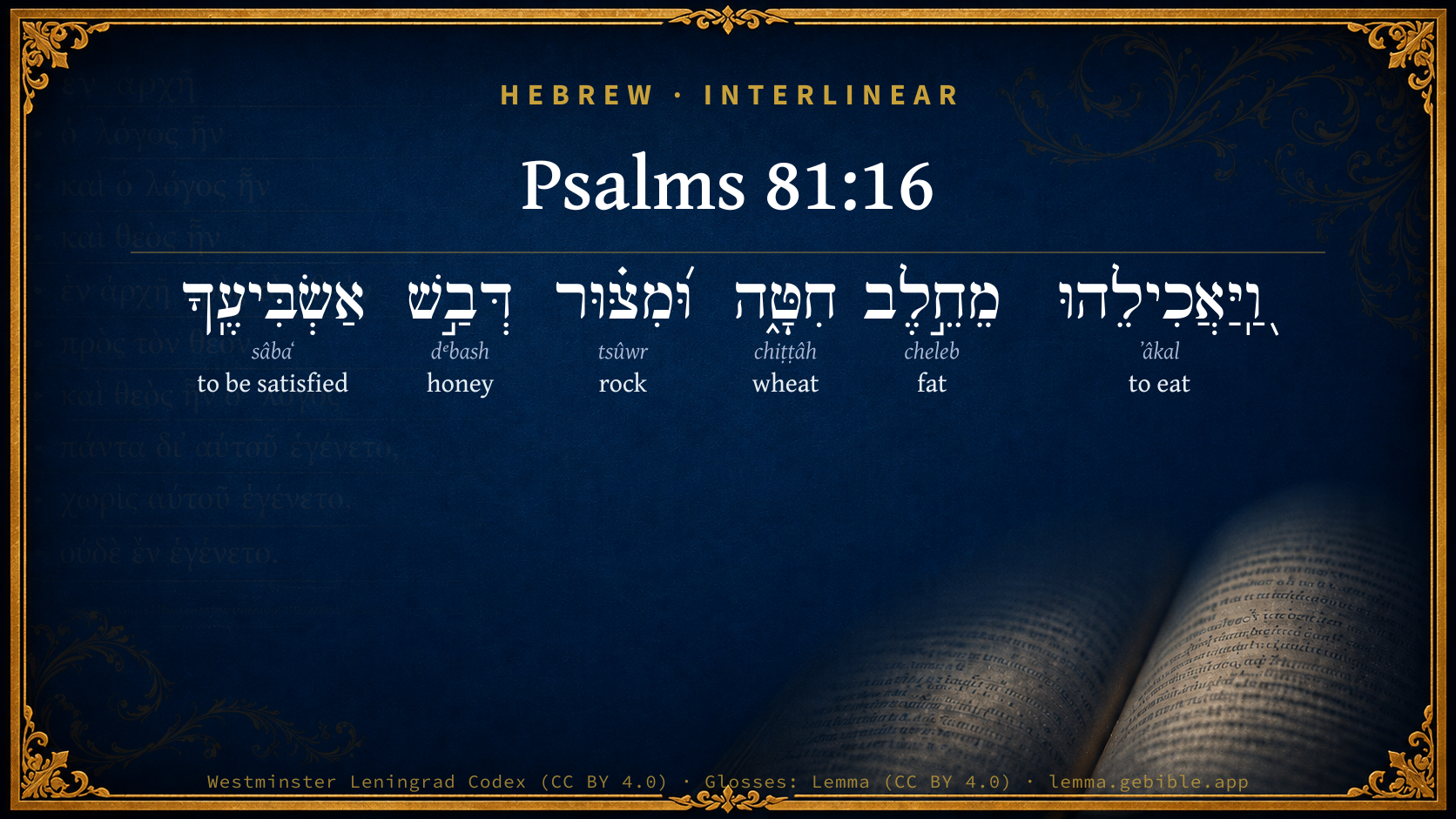
Psalms 81:16

Hebrew (Westminster Leningrad Codex) Psalms 81:16 appears in the Hebrew Old Testament. The text above is from the Westminster Leningrad Codex. Each word links to its Strong’s number, a concise gloss, and parsing drawn from the Open Scriptures Hebrew Bible morphology. Click any word for its full Brown-Driver-Briggs (BDB) entry.
Download image
Cite this verse

Psalms 81:16 (World English Bible). Public Domain. Lemma interlinear Bible study tool, https://lemma.gebible.app/v/psalms/81/16.

Show BibTeX & RIS
BibTeX
RIS
English Translation
But he would have also fed them with the finest of the wheat. I will satisfy you with honey out of the rock."
World English Bible · Public Domain
Download a study sheet

One document with this verse’s original text, its word-by-word gloss line, the meaning frame, cross-references with their text, attributed commentary, and full source and license credits — printable, and it pastes into notes with its structure intact.

This verse Autodidact and up

Study sheet (.html) Plain text (.txt)

A passage Seminary Student

Up to 50 verses in one chapter. A passage sheet keeps up to 6 commentary sources and 12 cross-references per verse, in the order this page ranks them, and says so on the sheet whenever that leaves anything out. Ask for a single verse and you get the Autodidact verse sheet above.

Everything on this page stays free to read, with no account — the sheet is a download of what is already on screen, not access to it.

Want to remove ads? Support Godless Engineer
Compare translations 3

The same verse in 3 English versions, stacked beneath the original-language interlinear above. Click any original word for its lexicon entry.

Each is an independent rendering of the whole verse — the interlinear is not word-aligned to these translations.

Highlighted words mark where these versions differ — a whole-verse word diff, not a word-by-word alignment.

  • World English Bible Public Domain
    But he would have also fed them with the finest of the wheat. I will satisfy you with honey out of the rock."
  • King James Version Public Domain
    He should have fed them also with the finest of the wheat: and with honey out of the rock should I have satisfied thee.
  • unfoldingWord Literal Text CC BY-SA 4.0
    And he would feed him with the fat of the wheat, and I would satisfy you with honey from the rock.”

unfoldingWord Literal Text — © unfoldingWord, licensed CC BY-SA 4.0. Word-aligned USFM3 via Door43 (git.door43.org/unfoldingWord/en_ult).

Versions to compare (up to 4)

3 of 4 selected

Show all 18 translations

Every available English version of this verse, each an independent rendering of the whole verse.

  • World English Bible Public Domain
    But he would have also fed them with the finest of the wheat. I will satisfy you with honey out of the rock."
  • Berean Standard Bible Public Domain
    But I would feed you the finest wheat; with honey from the rock I would satisfy you.”
  • Majority Standard Bible Public Domain
    But I would feed you the finest wheat; with honey from the rock I would satisfy you.”
  • King James Version Public Domain
    He should have fed them also with the finest of the wheat: and with honey out of the rock should I have satisfied thee.
  • American Standard Version (1901) Public Domain
    He would feed them also with the finest of the wheat; And with honey out of the rock would I satisfy thee. Psalm 82 A Psalm of Asaph.
  • Revised Version (1885) Public Domain
    He should feed them also with the finest of the wheat: and with honey out of the rock should I satisfy thee.
  • Geneva Bible (1599) Public Domain
    And God would haue fedde them with the fatte of wheat, and with honie out of the rocke would I haue sufficed thee.
  • Douay-Rheims (1899) Public Domain
    The enemies of the Lord have lied to him: and their time shall be for ever.
  • Young's Literal Translation Public Domain
    He causeth him to eat of the fat of wheat, And `with' honey from a rock I satisfy thee!
  • Literal Standard Version CC BY-SA 4.0
    He causes him to eat of the fat of wheat, || And I satisfy you [with] honey from a rock!
  • Unlocked Literal Bible CC BY-SA 4.0
    I would feed Israel with the finest wheat; I would satisfy you with honey out of the rock.”
  • unfoldingWord Literal Text CC BY-SA 4.0
    And he would feed him with the fat of the wheat, and I would satisfy you with honey from the rock.”
  • Darby Bible Public Domain
    And he would have fed them with the finest of wheat; yea, with honey out of the rock would I have satisfied thee.
  • World Messianic Bible Public Domain
    But he would have also fed them with the finest of the wheat. I will satisfy you with honey out of the rock.”
  • Webster's Bible Public Domain
    \\81:15\\The haters of the LORD should have submitted themselves to him: and their time should have endured for ever.
  • Free Bible Version CC BY-SA 4.0
    But I would feed you the best wheat and satisfy you with honey from the rock.”
  • Bible in Basic English Public Domain
    I would give them the best grain for food; you would be full of honey from the rock.
  • JPS Tanakh (1917) Public Domain
    (81-17) They should also be fed with the fat of wheat; and with honey out of the rock would I satisfy thee.'

Literal Standard Version (2020), Covenant Press — licensed CC BY-SA 4.0. Text via the HelloAO Bible API (eBible.org). Unlocked Literal Bible (unfoldingWord) — licensed CC BY-SA 4.0. Text via the HelloAO Bible API (eBible.org). unfoldingWord Literal Text — © unfoldingWord, licensed CC BY-SA 4.0. Word-aligned USFM3 via Door43 (git.door43.org/unfoldingWord/en_ult). Free Bible Version, Dr. Jonathan Gallagher — licensed CC BY-SA 4.0. Text via the HelloAO Bible API (eBible.org).

Word by word

More ways to search: Search by grammar → Find every occurrence → Compare this word →

Practice this passage: Drill this verse → Learn its vocabulary →

About this verse

These counts appear in no published source. They are computed here, from the morphology-tagged text and Lemma’s own curated glosses. What Lemma adds →

6
words
6
distinct lemmas
Wisdom
section

Shared distinctive vocabulary

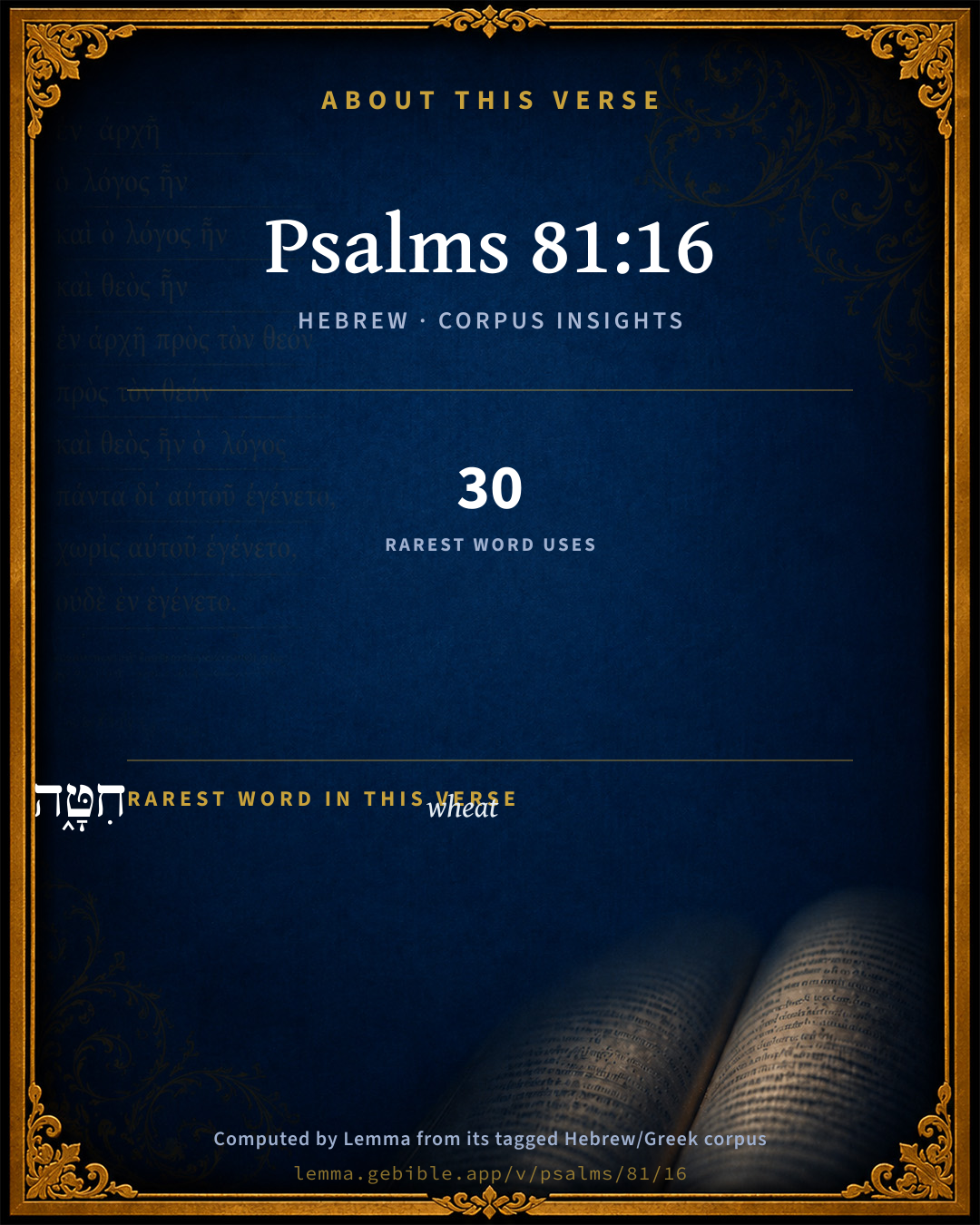
חִטָּ֑ה wheat H2406 occurs in 30 verses of the Hebrew Bible. Also found in:

Grammatical profile

  • 2 verbs
  • 4 nouns

Verb forms

  • וַֽ֭יַּאֲכִילֵהוּ Hiphil · Sequential Imperfect
  • אַשְׂבִּיעֶֽךָ Hiphil · Imperfect

Hebrew & Septuagint length

In English translation the verse runs 23 words from the Hebrew and 18 from the Septuagint (LXX English) — closely comparable.

A rough comparison of the two English renderings, which tokenize alike — not a word-level alignment.

Word counts can differ between the Hebrew and the Greek without any difference in meaning — e.g. the Hebrew direct-object marker אֵת has no separate Greek word, and Greek often adds the article ὁ.

Cross-references

7

Topical passages linked to Psalms 81:16 in the Treasury of Scripture Knowledge — connected by theme and wording, ordered by reader-vote popularity; previews shown in the World English Bible.

  • Deuteronomy 32:13–14 He made him ride on the high places of the earth, He ate the increase of the field; He made him to suck honey out of the rock, Oil out of the flinty rock;
  • Psalms 147:14 He makes peace in your borders. He fills you with the finest of the wheat.
  • 1 Samuel 14:25–26 All the people came into the forest; and there was honey on the ground.
  • Joel 2:24 The threshing floors will be full of wheat, And the vats will overflow with new wine and oil.
  • Judges 14:18 The men of the city said to him on the seventh day before the sun went down, What is sweeter than honey? and what is stronger than a lion? He said to them, If you hadn't plowed with my heifer, You wouldn't have found out my riddle.
  • Judges 14:8–9 After a while he returned to take her; and he turned aside to see the carcass of the lion: and, behold, there was a swarm of bees in the body of the lion, and honey.
  • Job 29:6 When my steps were washed with butter, And the rock poured out streams of oil for me!

Cross-references courtesy of OpenBible.info (CC BY 4.0).

Hebrew and Greek witnesses Masoretic Hebrew ↔ Greek Septuagint

The same verse in the two great witnesses to the Old Testament, shown verse-for-verse.

You’re reading Greek Psalm 80 (Hebrew Psalm 81). The Septuagint counts the superscription, so verse numbers can differ from the Hebrew — chapter-level alignment, not verse-by-verse. Numbering follows Rahlfs.

These are two independent witnesses, not word-aligned to each other, and the Septuagint is shown in lemma (dictionary) form.

Hebrew Psalms 81:16 Masoretic · Westminster Leningrad Codex

וַֽ֭יַּאֲכִילֵהוּ מֵחֵ֣לֶב חִטָּ֑ה וּ֝מִצּ֗וּר דְּבַ֣שׁ אַשְׂבִּיעֶֽךָ

But he would have also fed them with the finest of the wheat. I will satisfy you with honey out of the rock."

World English Bible · Public Domain

Greek LXX Greek Psalm 80:16 Septuagint · lemma form

ὁ ἐχθρός κύριος ψεύδομαι αὐτός καί εἰμί ὁ καιρός αὐτός εἰς ὁ αἰών

And he fed them with the fat of wheat; and satisfied them with honey out of the rock.

LXX2012 (modern English Septuagint) · Public Domain

On this verse, The Cambridge Bible for Schools and Colleges discusses the Septuagint’s reading. Read the note in Commentary ↓

Hebrew: Westminster Leningrad Codex (CC BY 4.0). Greek: Septuagint (public domain); English from LXX2012 (modern English Septuagint) (Public Domain). How the Septuagint differs from the Hebrew →

Commentary

Notes on Psalms 81:16 from classic Christian and Jewish commentators (each source and its license shown beneath its notes). The classic Christian expositions comment on the surrounding passage and are grouped to its opening verse, so a note may address several verses; the Jewish commentaries on the Tanakh (Rashi and others) are per-verse, so they appear only where the commentator wrote on this verse.

Lemma curates 59 commentaries, every one of them public domain or Creative Commons licensed, each selected and text-cleaned for this edition rather than reprinted as found. About our sources →

Trapp's Complete Commentary

John Trapp

Psa 81:16 He should have fed them also with the finest of the wheat: and with honey out of the rock should I have satisfied thee.

Ver. 16. With the finest of the wheat] Heb. With the fat or marrow of wheat, with the choicest of picked nourishment.

And with honey, &c.] Hyperbole incomparabilis felicitatis et foecunditatis. See Deu 32:13, shadowing out the sweetness of the word and sacraments.

John Trapp, A Commentary or Exposition upon All the Books of the Old and New Testament (1647–1656) — public domain. Text from a community e-Sword module.

The Biblical Illustrator

Joseph S. Exell

Psa_81:16

With honey out of the rock should I have satisfied thee.

A little but wise teacher

You know it was said of the Holy Land, long before God led His people into it, that it was a land flowing with milk and honey. Such it was and still is. That bees swarmed abundantly in the East many years ago, we may infer from the honey found in the dried remains of the lion which was killed by Samson. And in these modern days the wandering Arabs who live in tents, especially those who dwell in the wilderness of Judea, are said to support themselves by bee-hunting, bringing into Jerusalem jars of wild honey like that on which John the Baptist fed in the wilderness. The visitor to the Holy Land, when he sees the busy multitude of bees about its cliffs, cannot but recall to mind the promise, With honey out of the rock should I have satisfied thee. But then these words of Asaph mean far more than that those who love and serve the Lord shall be thus fed. They mean that God will surely supply all the wants of His people; that He offers all His infinite resources as a security that they shall not be left to want any good thing; and that, as honey in abundance is gathered out of the hard and flinty rock, so He will provide for those who love Him, even though they are brought into the hardest trials, where it might seem as if they were beyond the reach of help. But a promise so large and rich as this we cannot expect to have made good unto us, no matter what we are, or do. No! this is a promise with a condition. That is, there are some things which we must do, if we would claim the fulfilment of this promise for ourselves. The bee which stores up honey that is gathered out of the rock may so teach us that we shall be truly wise, and be able to secure all the earthly blessings and all the spiritual riches which are promised by the text.

I. Obedience. Do you know that in every hive of bees there is one which is called the Queen Bee? Those who have studied most carefully the habits of bees tell us that the Queen Bee is beloved and obeyed by all the others, who show in all ways that bees have a desire to please her. And if bees are thus obedient and devoted to their queen, how much more ought children to obey their parents in the Lord!

II. Cheerful and happy industry. How diligent and industrious the bees are in building the cells of the honey-comb, in storing them with honey, and in taking care of their young. They are not satisfied to work an hour a week, or an hour a day, and then dance away all the rest of the time in the warm and bright sunshine. They are not like some children that I have seen, who are hardly satisfied unless they can give themselves up to all play and no work, which, as the rhyme says, makes Jack a mere toy. But the bee works all the day long, day after day, bringing home full loads of honey. It finds pleasure in its work, singing continually as it goes about it. What a fine example for boys and girls! Our blessed Lord Himself, when still a little child, felt that He must be about His Fathers business. Every community of bees is apt to be afflicted for a time with what are called drones--that is, with bees that wont work. But the working bees very soon get rid of them, either by putting them to death, or by driving them out of the hive. And is not something like this the law of the Bible? Paul declared that, if any would not work, neither should he eat, and Solomon says that an idle soul shall suffer hunger. Idleness, then, brings a blight and a curse both upon the body and upon the soul.

III. We should guard watchfully and well what treasures we have. The bee uses all possible care and skill to protect from its enemies its stores of honey, and the wonderful cells in which that honey is laid up. It has many enemies, such as wasps, hornets, spiders, dragonflies, lizards, toads, and a kind of winged moth. This last is a very dangerous enemy, for at night, when the bees are asleep, it creeps in at the door of the hive, and lays its eggs, from which little worm-like caterpillars are soon hatched, and these crawling things soon make such havoc with the waxen cells that the bees are obliged to desert. They do the best they can to defend their treasures from enemies wit, hour, but sometimes they are overpowered. My children, learn a lesson from them to guard and keep such treasures as you have; for you, unlike the bees, may effectually do this, with such help as God will give you, if you seek help of Him.

IV. From the bee, again, we may learn the lesson that we can serve but one ruler and sovereign at a time. I have spoken of the Queen Bee. It is the supreme ruler of the hive, whom all the bees delight to obey. Not till one queen dies do they transfer their allegiance to another. You know that there is only One who has a right to demand, as He does demand, that you shall serve and love Him with all your heart, and with all your soul, and with all your mind, and with all your strength. Jesus Christ Himself has said, No man can serve two masters, etc.

V. Another lesson, and a most important one, for us to learn from the bee, is, not to trust too much to appearances. Many a bright and most attractive-looking flower does the bee pass by, to alight perhaps upon some plain and humble one that we would have thought altogether unworthy of notice. All is not gold that glitters, and not even the marvellous skill of the bee can extract honey from flowers which, though they may appear very beautiful, have no sweetness, and perhaps only deadly poison in them. There are many things which, to young eyes, and sometimes to eyes not so young, appear very beautiful indeed. Not having them, we greatly covet, and having, we greatly prize them.

VI. We should make wise and timely provision for the future. The bees do not eat their honey as fast as they make it, but they lay by a store for winter. In this, they are unlike some young people, who are inclined to spend everything as fast as they make it, and sometimes faster. They lay up nothing at all to fall back upon in a time of need. This is more especially and sadly true with respect to religion. How many are there among the young who spend the best part of their lives in worldly pleasure. They think not of a future day, and are making no provision for needs of which they will soon, and may be suddenly, be made aware, when it will be too late to provide for them. (G. C. Noyes, D. D.)

.

Psa_82:1-8

The Biblical Illustrator, edited by Joseph S. Exell (c. 1880s–1900s) — public domain. Text from a community e-Sword module.

Joseph Benson's Commentary

Psa 81:16. He should have fed them with the finest wheat — He would have made their country exceedingly fruitful and productive, especially of wheat and other grain, in the highest perfection. And with honey out of the rock should I have satisfied thee — That is, with all pleasant and precious fruits, and with all delights; as all necessaries may be expressed in the former clause under the name of wheat. Or honey may be here taken literally; for the land of Canaan abounded with excellent honey; and the bees used to be collected in the clefts and holes of the rocks, as in hives, and there made their honey in such plenty that it often flowed down upon the ground in considerable quantities: see Deu 32:13; 1Sa 14:25-26.

Joseph Benson's Commentary on the Old and New Testaments (1811–1818) — public domain. Text from a community e-Sword module.

J. A. Alexander on Psalms

Joseph Addison Alexander

17. (Psa 81:16) And he would feed him with the fat of wheat, and from the rock with honey sate him. The first verb is a causative, and means would let (or make) him eat. The fat of wheat, its richest part or finest quality, another transfer of animal attributes to vegetable objects. See above, on Psa 80:15. Honey from the rock, some suppose to mean wild honey; others, with more probability, honey supplied by miracle, like the water from the rock in the desert. All these strong expressions are borrowed from Deu 32:13-14, and are imitated likewise in Psa 147:14, Isa 34:16. Wheat and honey, by a natural and primitive association, are here put for the necessaries and the luxuries of human sustenance, and these again for the highest enjoyment and prosperity. The English version refers these four verses all to past time, had hearkened, had walked, should have subdued, should have submitted, should have endured, should have fed, should have satisfied. This is in fact the true construction of the similar passage in Isa 48:18; but there the conditional or optative particle is construed with the preterite, and not with the future tense as here, which makes an essential difference of syntax. See Nordheimer's Hebrew Grammar, § 1078.

Joseph Addison Alexander, The Psalms Translated and Explained (1850) — public domain. Text from a community e-Sword module.

Geneva Bible (1599)

Geneva Bible translators

That is, with most fine wheat and abundance of honey.

Geneva Bible (1599) marginal notes — public domain. Text via Bolls.life.

Adam Clarke's Commentary

Verse 16. With the finest of the wheat] מחלב חטה mecheleb chittah; literally, with the fat of wheat, as in the margin.

Honey out of the rock] And he fed thaim of the grese of whete: And of the hony stane he thaim filled. Old Psalter. Thus paraphrased: "He fed thaim with the body of Criste and gastely understandyng; and of hony that ran of the stane, that is, of the wisedome that is swete to the hert." Several of the fathers understand this place of Christ.

ANALYSIS OF THE EIGHTY-FIRST PSALM

The contents of this Psalm are the following: -

I. The psalmist exhorts them to celebrate God's name in their festivals, Ps 81:1-4.

II. The reasons why they should do this: God's benefits conferred on Israel, Ps 81:5-10.

III. Israel's ingratitude, and its consequences, Ps 81:11-12.

IV. God's love and call to amendment, with the reasons for obedience, Ps 81:13-16.

I. He exhorts them to rejoice: but this must be, 1. In God, Ps 81:1. 2. At his festivals, Ps 81:2-3.

II. The reasons. 1. It was God's command, Ps 81:4. 2. It was an ancient ordinance, Ps 81:5. 3. Their deliverance from base servitude, Ps 81:6. 4. When in deep affliction, Ps 81:7. 5. In a miraculous manner, Ps 81:7. 6. His mercy shown at the waters of Meribah, Ps 81:7. 7. His giving them his law, Ps 81:8-9.

He then inculcates obedience, for which he gives three reasons: 1. "I am the Lord thy God," Ps 81:10. 2. Who redeemed thee from bondage, Ps 81:10. 3. He will make thee truly happy: "Open thy mouth wide, and I will fill it," Ps 81:10.

III. Israel's ingratitude, and its consequences. 1. God gave them up; left them to themselves, Ps 81:12. 2. They walked in their own counsels, Ps 81:12. And came to ruin.

IV. God's love and call, c.

He calls them to repentance, Ps 81:13. The fruits of which would be three great benefits. 1. The subjugation of their enemies, Ps 81:14. 2. A long uninterrupted prosperity. 3. An abundance of all temporal and spiritual blessings, Ps 81:15-16.

Under the emblems of the finest wheat, and the purest honey from the hives of bees in the rocks, where they abounded in Judea, he shows them that his followers should have so much of earthly and spiritual blessings, that they should be satisfied and say, It is enough. But, alas! Israel would not be obedient and, therefore, Israel is under the curse.

Adam Clarke's Commentary on the Bible (1810–1826) — public domain. Text from a community e-Sword/MySword module.

Ellicott's Commentary for English Readers

(16) Finest of the wheat.—See margin, and comp. Psa_147:14. The construction of this verse is matter of difficulty. Properly we should render, And he fed them with the finest of the wheat, and with honey out of the rock satisfied thee. The change of person is harsh, though perhaps it may be illustrated by Psa_22:27, &c, but the past tense seems out of keeping with the context. The conclusions of Psalms 77, 78 are hardly analogous. The pointing should be slightly changed to give, “And I would feed them also,” &c

A Bible Commentary for English Readers, edited by Charles John Ellicott (1878–1897) — public domain. Text from a community e-Sword module.

The Cambridge Bible for Schools and Colleges

gen. ed. J. J. S. Perowne

16. Tense and person both present serious difficulties, and it seems necessary to emend the text of the first line, and read:

Yea, I would feed him with the fat of wheat,

And with honey out of the rock would I satisfy thee.

Him = Israel. The transition to direct address in Psa_50:2 (‘thee’) seems harsh, but is not uncommon in Heb. The third person ‘them’ or ‘him’ in LXX, Jer., Syr., is probably only a correction to avoid it. We have here another reminiscence of Deuteronomy 32, vv13, 14. Cp. Psa_147:14. To an obedient people God would fulfil His ancient promises of blessing. Cp. Exo_3:8; Deu_7:12-13; Deu_8:6 ff.

The Cambridge Bible for Schools and Colleges (gen. ed. J. J. S. Perowne; Cambridge University Press, 1878–1918) — public domain. Text from a community e-Sword module.

Albert Barnes' Notes on the Bible

He should have fed them also - He would have given them prosperity, and their land would have produced abundantly of the necessities - even of the luxuries - of life. This is in accordance with the usual promises of the Scriptures, that obedience to God will be followed by national temporal prosperity. See Deu 32:13-14; 1Ti 4:8; Psa 37:11. Compare the notes at Mat 5:5.

With the finest of the wheat - Margin, as in Hebrew, with the fat of wheat. The meaning is, the best of the wheat - as the words fat and fatness are often used to denote excellence and abundance. Gen 27:28, Gen 27:39; Job 36:16; Psa 36:8; Psa 63:5; Psa 65:11.

And with honey out of the rock should I have satisfied thee - Palestine abounded with bees, and honey was a favorite article of food. Gen 43:11; Deu 8:8; Deu 32:13; 1Sa 14:25-26; Isa 7:15; Eze 16:13; Mat 3:4. Much of that which was obtained was wild honey, deposited by the bees in the hollows of trees, and as it would seem in the caverns of the rocks. Much of it was gathered also from rocky regions, and this was regarded as the most delicate and valuable. I do not know the cause of this, nor why honey in high and rocky countries should be more pure and white than that obtained from other places; but the whitest and the most pure and delicate honey that I have ever seen I found at Chamouni in Switzerland. Dr. Thomson (land and the Book, vol. ii. p. 362) says of the rocky region in the vicinity of Timnath, that “bees were so abundant in a wood at no great distance from this spot that the honey dropped down from the trees on the ground;” and that “he explored densely-wooded gorges in Hermon and in Southern Lebanon where wild bees are still found, both in trees and in the clefts of the rocks.”

The meaning here is plain, that, if Israel had been obedient to God, he would have blessed them with abundance - with the richest and most coveted productions of the field. Pure religion - obedience to God - morality - temperance, purity, honesty, and industry, such as religion requires - are always eminently favorable to individual and national prosperity; and if a man or a nation desired to be most prospered, most successful in the lawful and proper objects of individual or national existence, and most happy, nothing would tend more to conduce to it than those virtues which piety enjoins and cultivates. Individuals and nations, even in respect to temporal prosperity, are most unwise, as well as most wicked, when they disregard the laws of God, and turn away from the precepts and the spirit of religion. It is true of nations, as it is of individuals, that “Godliness is profitable unto all things, having promise of the life that now is,” 1Ti 4:8.

Albert Barnes' Notes on the Bible (1834–1885) — public domain. Text from a community e-Sword/MySword module.

Matthew Poole's English Annotations

With honey; either,

1. Metaphorically, with all pleasant and precious fruits, and with all delights, as all necessaries may be expressed under the name of wheat. Or rather,

2. Properly; this land of Canaan being commended for its excellent and plentiful honey; and the bees there did oft-times harbour and make their honey in the holes of rocks and such-like places, from which it flowed down upon the ground. See Deu 32:13; 1Sa 14:25,26.

Matthew Poole's English Annotations on the Holy Bible (1683–1685) — public domain. Text from a community e-Sword/MySword module.

The Treasury of David

Charles H. Spurgeon

Ver. 16. He should have fed them also with the finest of the wheat. Famine would have been an unknown word, they would have been fed on the best of the best food, and have had abundance of it as their every day diet.

And with honey out of the rock should I have satisfied thee. Luxuries as well as necessaries would be forthcoming, the very rocks of the land would yield abundant and sweet supplies; the bees would store the clefts of the rocks with luscious honey, and so turn the most sterile part of the land to good account. The Lord can do great things for an obedient people. When his people walk in the light of his countenance, and maintain unsullied holiness, the joy and consolation which he yields them are beyond conception. To them the joys of heaven have begun even upon earth. They can sing in the ways of the Lord. The spring of the eternal summer has commenced with them; they are already blest, and they look for brighter things. This shows us by contrast how sad a thing it is for a child of God to sell himself into captivity to sin, and bring his soul into a state of famine by following after another god. O Lord, for ever bind us to thyself alone, and keep us faithful unto the end.

Ver. 16. Honey out of the rock. The rock spiritually and mystically designs Christ, the Rock of salvation, 1Co 10:4; the honey out of the rock, the fulness of grace in him, and the blessings of it, the sure mercies of David, and the precious promises of the everlasting covenant; and the gospel, which is sweeter than the honey or the honeycomb, and with these such are filled and satisfied who hearken to Christ and walk in his ways; for, as the whole of what is here said shows what Israel lost by disobedience, it clearly suggests what such enjoy who hear and obey. John Gill.

Ver. 16. Honey out of the rock. God extracts honey out of the rockthe sweetest springs and pleasures from the hardness of afflictions; from mount Calvary and the cross, the blessings that give greatest delight; whereas the world makes from the fountains of pleasure stones and rocks of torment. Thomas Le Blanc.

Ver. 16. Honey out of the rock. Most travellers who have visited Palestine in summer have had their attention directed to the abundance of honey, which the bees of the land have stored up in the hollows of trees and in crevices of the rock. In localities where the bare rocks of the desert alone break the sameness of the scene, and all around is suggestive of desolation and death, the traveller has God's care of his chosen people vividly brought to mind, as he sees the honey which the bees had treasured up beyond his reach, trickling in shining drops down the face of the rock. John Duns.

Ver. 16. When once a people or a person are accepted of God, he spares no cost, nor thinks anything too costly for them. He would have fed them also with the finest of the wheat: and with honey out of the rock should I have satisfied thee. I would not have fed thee with wheat only, that's good; but with the finest wheat, that's the best. We put in the margin, with the fat of wheat; they should not have had the bran, but the flour, and the finest of the flour; they should have had not only honey, but honey out of the rock, which, as naturalists observe, is the best and purest honey. Surely God cannot think anything of this world too good for his people, who hath not thought the next world too good for them; certainly God cannot think any of these outward enjoyments too good for his people, who hath not thought his Son too good for his people; that's the apostle's argument, Ro 8:32: He that spared not his own Son, but delivered him up for us all, how shall he not with him also freely give us all things? even the best of outward good things, when he seeth it good for us. Joseph Caryl.

Ver. 16.

I. Spiritual dainties.

II. By whom provided.

III. To whom given.

IV. With what result"satisfied."

Charles H. Spurgeon's The Treasury of David (1869–1885) — public domain. Psalms only. Text from a community e-Sword/MySword module.

Whedon's Commentary on the Bible

Daniel D. Whedon

16. He should have fed them—The excellent quality and abundant supply of food here stand generically for all needful things. The expression, honey out of the rock, is not to be taken literally, as in 1Sa_14:27, but figuratively, as denoting the richest supplies from the most sterile and unpropitious sources. The fundamental passage is Deu_32:13, where both “honey” and “oil” are made to flow from the rock, the “oil,” probably referring to the olive tree. See note on Psa_92:14; Psa_128:3 : compare, also, Job_29:6. The stern admonition and the life giving promise go hand in hand. “God assures them, that if Israel of the present would hearken to the Lawgiver of Sinai, then would he renew to it the miraculous gifts of the time of the redemption under Moses.”—Delitzsch.

Daniel D. Whedon (gen. ed.), Commentary on the Old and New Testaments (1874–1909) — public domain. Text from a community e-Sword module.

The Pulpit Commentary

He should have fed them also; rather, he should Feed. with the finest of the wheat; literally, with the fat of the wheat. (comp. Deu_32:14 and Psa_147:14) And with honey out of the rock should I have satisfied thee; rather, would I satisfy thee. The expression, "honey out of the rock," is taken from Deu_32:13. It evidently means "honey of the best native honey, stored by the bees in clefts of the rocks. Of course, both the "wheat" and the "honey" are metaphors, which we are to regard as shadowing forth all temporal and spiritual blessings.

The Pulpit Commentary (1880–1919), ed. H.D.M. Spence-Jones & Joseph S. Exell — public domain. Text from a community e-Sword module.

John Wesley's Explanatory Notes

Honey - With all pleasant and precious fruits.

John Wesley, Explanatory Notes Upon the Whole Bible (1754–1765) — public domain. Text via the GEBible commentary corpus.

Rashi

Rabbi Shlomo Yitzchaki (Rashi)

The enemies of the Lord would lie to Him, and their time would be [The time of] their retribution [would be] forever.

Rashi on the Tanakh — English translations: “The Judaica Press complete Tanach with Rashi, translated by A. J. Rosenberg” (CC BY 4.0); “Pentateuch with Rashi's commentary by M. Rosenbaum and A.M. Silbermann, 1929-1934” (public domain); “The Metsudah Tanach series, Lakewood, N.J” (CC BY 4.0); and “The Book of Joshua, Metsudah Publications, 1997” (CC BY 4.0). Text via Sefaria.

Lesson kit

Teaching starters — assembled from the data on this page, not authored interpretation. Every prompt links to the verse data it draws on. Edit before teaching.

Psalms, in the Wisdom, opens this verse with 6 words (6 distinct Hebrew lemmas). Its most distinctive word is chiṭṭâh (“wheat”). A historical commentator’s framing appears above. Read the whole chapter for the surrounding context.

Discussion questions

  1. What does “wheat” (chiṭṭâh) contribute to the verse as a whole?
  2. Genesis 30:14 shares the word «wheat» with this verse. How do the two illuminate each other?
  3. These translations render this verse differently; the difference is in the English rendering, not the original. What questions does that raise?
  4. The verb «וַֽ֭יַּאֲכִילֵהוּ» is Hiphil Sequential Imperfect. How does its form color the action?
  5. Reading how Trapp's Complete Commentary and The Biblical Illustrator read this verse, where do the two commentators agree and where do they part?

Things to notice

Reading settings

Reading text

Shown beneath each verse's original-language words.

Old Testament
Old Testament edition

Read the OT as the Masoretic Hebrew (MT) or the Greek Septuagint (LXX).

English shown for the Greek Septuagint (in the Hebrew ↔ Greek comparison).

Comparing translations? Open the Compare panel on any verse page to stack up to four side by side.