
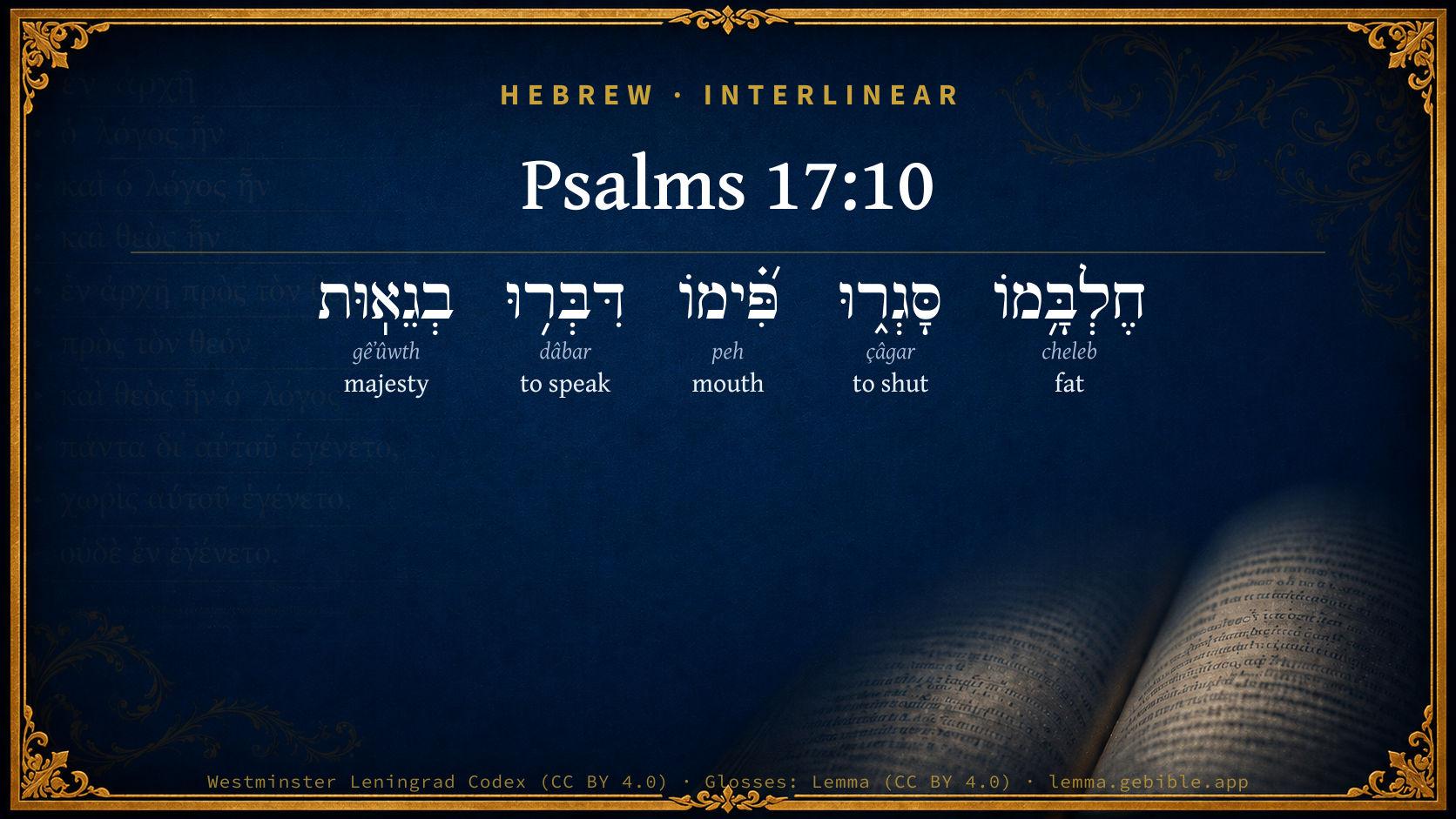
Psalms 17:10

Hebrew (Westminster Leningrad Codex) Psalms 17:10 appears in the Hebrew Old Testament. The text above is from the Westminster Leningrad Codex. Each word links to its Strong’s number, a concise gloss, and parsing drawn from the Open Scriptures Hebrew Bible morphology. Click any word for its full Brown-Driver-Briggs (BDB) entry.
Download image
Cite this verse

Psalms 17:10 (World English Bible). Public Domain. Lemma interlinear Bible study tool, https://lemma.gebible.app/v/psalms/17/10.

Show BibTeX & RIS
BibTeX
RIS
English Translation
They close up their callous hearts. With their mouth they speak proudly.
World English Bible · Public Domain
Highlights
  • 1 first appearance in the Hebrew Bible
Full analysis ↓
Download a study sheet

One document with this verse’s original text, its word-by-word gloss line, the meaning frame, cross-references with their text, attributed commentary, and full source and license credits — printable, and it pastes into notes with its structure intact.

This verse Autodidact and up

Study sheet (.html) Plain text (.txt)

A passage Seminary Student

Up to 50 verses in one chapter. A passage sheet keeps up to 6 commentary sources and 12 cross-references per verse, in the order this page ranks them, and says so on the sheet whenever that leaves anything out. Ask for a single verse and you get the Autodidact verse sheet above.

Everything on this page stays free to read, with no account — the sheet is a download of what is already on screen, not access to it.

Want to remove ads? Support Godless Engineer
Compare translations 3

The same verse in 3 English versions, stacked beneath the original-language interlinear above. Click any original word for its lexicon entry.

Each is an independent rendering of the whole verse — the interlinear is not word-aligned to these translations.

Highlighted words mark where these versions differ — a whole-verse word diff, not a word-by-word alignment.

  • World English Bible Public Domain
    They close up their callous hearts. With their mouth they speak proudly.
  • King James Version Public Domain
    They are inclosed in their own fat: with their mouth they speak proudly.
  • unfoldingWord Literal Text CC BY-SA 4.0
    Their fat they have closed up; with their mouths they speak with pride.

unfoldingWord Literal Text — © unfoldingWord, licensed CC BY-SA 4.0. Word-aligned USFM3 via Door43 (git.door43.org/unfoldingWord/en_ult).

Versions to compare (up to 4)

3 of 4 selected

Show all 18 translations

Every available English version of this verse, each an independent rendering of the whole verse.

  • World English Bible Public Domain
    They close up their callous hearts. With their mouth they speak proudly.
  • Berean Standard Bible Public Domain
    They have closed their callous hearts; their mouths speak with arrogance.
  • Majority Standard Bible Public Domain
    They have closed their callous hearts; their mouths speak with arrogance.
  • King James Version Public Domain
    They are inclosed in their own fat: with their mouth they speak proudly.
  • American Standard Version (1901) Public Domain
    They are inclosed in their own fat: With their mouth they speak proudly.
  • Revised Version (1885) Public Domain
    They are enclosed in their own fat: with their mouth they speak proudly.
  • Geneva Bible (1599) Public Domain
    They are inclosed in their owne fat, and they haue spoken proudely with their mouth.
  • Douay-Rheims (1899) Public Domain
    they have shut up their fat: their mouth hath spoken proudly.
  • Young's Literal Translation Public Domain
    Their fat they have closed up, Their mouths have spoken with pride:
  • Literal Standard Version CC BY-SA 4.0
    They have closed up their fat, || Their mouths have spoken with pride:
  • Unlocked Literal Bible CC BY-SA 4.0
    They have no mercy on anyone; their mouths speak with pride.
  • unfoldingWord Literal Text CC BY-SA 4.0
    Their fat they have closed up; with their mouths they speak with pride.
  • Darby Bible Public Domain
    They are enclosed in their own fat; with their mouth they speak proudly.
  • World Messianic Bible Public Domain
    They close up their callous hearts. With their mouth they speak proudly.
  • Webster's Bible Public Domain
    They are inclosed in their own fat: with their mouth they speak proudly.
  • Free Bible Version CC BY-SA 4.0
    They have no compassion, and all they have to say is pure arrogance.
  • Bible in Basic English Public Domain
    They are shut up in their fat: with their mouths they say words of pride.
  • JPS Tanakh (1917) Public Domain
    Their gross heart they have shut tight, with their mouth they speak proudly.

Literal Standard Version (2020), Covenant Press — licensed CC BY-SA 4.0. Text via the HelloAO Bible API (eBible.org). Unlocked Literal Bible (unfoldingWord) — licensed CC BY-SA 4.0. Text via the HelloAO Bible API (eBible.org). unfoldingWord Literal Text — © unfoldingWord, licensed CC BY-SA 4.0. Word-aligned USFM3 via Door43 (git.door43.org/unfoldingWord/en_ult). Free Bible Version, Dr. Jonathan Gallagher — licensed CC BY-SA 4.0. Text via the HelloAO Bible API (eBible.org).

Word by word

More ways to search: Search by grammar → Find every occurrence → Compare this word →

Practice this passage: Drill this verse → Learn its vocabulary →

About this verse

These counts appear in no published source. They are computed here, from the morphology-tagged text and Lemma’s own curated glosses. What Lemma adds →

5
words
5
distinct lemmas
Wisdom
section

Notable vocabulary

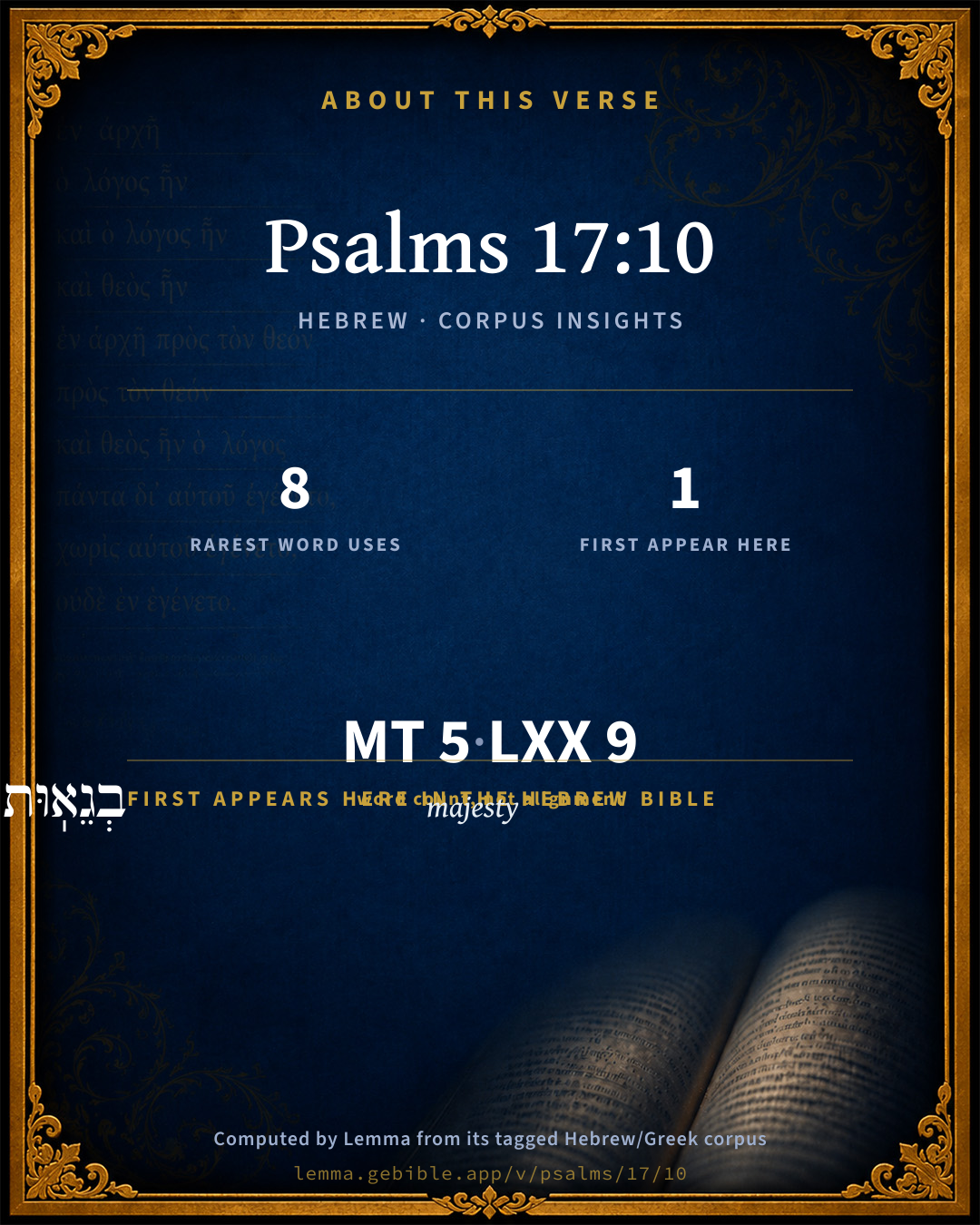
The rarest word here is בְגֵאֽוּת majesty H1348 — appearing just 8 times in the whole Hebrew Bible.

First appearance in Scripture

This word makes its first canonical appearance in the Hebrew Bible here:

  • בְגֵאֽוּת majesty H1348

Shared distinctive vocabulary

בְגֵאֽוּת majesty H1348 occurs in 8 verses of the Hebrew Bible. Also found in:

Grammatical profile

  • 2 verbs
  • 3 nouns

Verb forms

  • סָּגְר֑וּ Qal · Perfect
  • דִּבְּר֥וּ Piel · Perfect

Hebrew & Septuagint length

In English translation the verse runs 12 words from the Hebrew and 13 from the Septuagint (LXX English) — closely comparable.

A rough comparison of the two English renderings, which tokenize alike — not a word-level alignment.

Word counts can differ between the Hebrew and the Greek without any difference in meaning — e.g. the Hebrew direct-object marker אֵת has no separate Greek word, and Greek often adds the article ὁ.

In the original languages it is 5 Hebrew tokens and 9 Greek tokens — but the two are counted differently (Hebrew bundles its prefixes and suffixes into one token; the Greek is in lemma form), so that isn’t a like-for-like length.

Cross-references

15

Topical passages linked to Psalms 17:10 in the Treasury of Scripture Knowledge — connected by theme and wording, ordered by reader-vote popularity; previews shown in the World English Bible.

  • 1 Samuel 2:3 Talk no more so exceeding proudly; Don't let arrogance come out of your mouth; For Yahweh is a God of knowledge, By him actions are weighed.
  • Psalms 31:18 Let the lying lips be mute, Which speak against the righteous insolently, with pride and contempt.
  • Psalms 123:4 Our soul is exceedingly filled with the scoffing of those who are at ease, With the contempt of the proud.
  • Matthew 13:15 For this people's heart has grown callous, Their ears are dull of hearing, They have closed their eyes; Or else perhaps they might perceive with their eyes, Hear with their ears, Understand with their heart, And should turn again; And I would heal them.'
  • Revelation 13:5–6 A mouth speaking great things and blasphemy was given to him. Authority to make war for forty-two months was given to him.
  • Exodus 5:2 Pharaoh said, "Who is Yahweh, that I should listen to his voice to let Israel go? I don't know Yahweh, and moreover I will not let Israel go."
  • Exodus 15:9 The enemy said, 'I will pursue, I will overtake, I will divide the spoil. My desire shall be satisfied on them. I will draw my sword, my hand shall destroy them.'
  • Job 15:27 Because he has covered his face with his fatness, And gathered fat on his loins.
  • Psalms 73:7–9 Their eyes bulge with fat. Their minds pass the limits of conceit.
  • Psalms 119:70 Their heart is as callous as the fat, But I delight in your law.
  • Isaiah 6:10 Make the heart of this people fat; Make their ears heavy, and shut their eyes; Lest they see with their eyes, And hear with their ears, And understand with their heart, And turn again, and be healed."
  • Acts 28:27 For this people's heart has grown callous. Their ears are dull of hearing. Their eyes they have closed. Lest they should see with their eyes, Hear with their ears, Understand with their heart, And would turn again, And I would heal them.'
  • 2 Peter 2:18 For, uttering great swelling words of emptiness, they entice in the lusts of the flesh, by licentiousness, those who are indeed escaping from those who live in error;
  • Deuteronomy 32:15 But Jeshurun grew fat, and kicked: You have grown fat, you are grown thick, you are become sleek; Then he forsook God who made him, Lightly esteemed the Rock of his salvation.
  • Psalms 12:3–4 May Yahweh cut off all flattering lips, And the tongue that boasts,

Cross-references courtesy of OpenBible.info (CC BY 4.0).

Hebrew and Greek witnesses Masoretic Hebrew ↔ Greek Septuagint

The same verse in the two great witnesses to the Old Testament, shown verse-for-verse.

You’re reading Greek Psalm 16 (Hebrew Psalm 17). The Septuagint counts the superscription, so verse numbers can differ from the Hebrew — chapter-level alignment, not verse-by-verse. Numbering follows Rahlfs.

These are two independent witnesses, not word-aligned to each other, and the Septuagint is shown in lemma (dictionary) form.

Hebrew Psalms 17:10 Masoretic · Westminster Leningrad Codex

חֶלְבָּ֥מוֹ סָּגְר֑וּ פִּ֝֗ימוֹ דִּבְּר֥וּ בְגֵאֽוּת

They close up their callous hearts. With their mouth they speak proudly.

World English Bible · Public Domain

Greek LXX Greek Psalm 16:10 Septuagint · lemma form

ὁ στέαρ αὐτός συνκλείω ὁ στόμα αὐτός λαλέω ὑπερηφανία

They have enclosed themselves with their own fat: their mouth has spoken pride.

LXX2012 (modern English Septuagint) · Public Domain

On this verse, Ellicott's Commentary for English Readers discusses the Septuagint’s reading. Read the note in Commentary ↓

Hebrew: Westminster Leningrad Codex (CC BY 4.0). Greek: Septuagint (public domain); English from LXX2012 (modern English Septuagint) (Public Domain). How the Septuagint differs from the Hebrew →

Commentary

Notes on Psalms 17:10 from classic Christian and Jewish commentators (each source and its license shown beneath its notes). The classic Christian expositions comment on the surrounding passage and are grouped to its opening verse, so a note may address several verses; the Jewish commentaries on the Tanakh (Rashi and others) are per-verse, so they appear only where the commentator wrote on this verse.

Lemma curates 59 commentaries, every one of them public domain or Creative Commons licensed, each selected and text-cleaned for this edition rather than reprinted as found. About our sources →

Trapp's Complete Commentary

John Trapp

Psa 17:10 They are inclosed in their own fat: with their mouth they speak proudly.

Ver. 10. They are inclosed in their own fat] See Job 15:27, {See Trapp on "Job 15:27"} They abound in all delights, and therefore soare not to speak proudly. They have closed up their eyes in their fulsome fat, ut non videant nec timeant te, saith R. Solomon, that they cau neither see nor fear thee. Adipem suum obesant (Tram.).

With their mouth they speak proudly] Heb. in pride, that is, Palam et pleats buccis; openly and with full mouth they condemn God and men; they belch out blasphemies, and do what they please.

John Trapp, A Commentary or Exposition upon All the Books of the Old and New Testament (1647–1656) — public domain. Text from a community e-Sword module.

The Biblical Illustrator

Joseph S. Exell

Psa_17:10

They are enclosed in their own fat.

A figure for self-complacency

To be enclosed in ones own fat means, to be wrapped up in pride and self-complacency, the effect upon weak and ignoble minds of worldly prosperity. It is said that the purely fatty part of the human body, having no nerves of sensation, can be cut and pierced without experiencing any feeling of pain. Hence, in Scripture phraseology, to say that ones heart is fat is equivalent to saying that it is hard and insensible, void of moral and sympathetic feeling, and not to be affected by any appeal made to its pity or sense of right. It indicates a haughtiness and insolence of bearing towards others that is hard to be borne by them. Alas! how a little worldly elevation sometimes changes the best character into the worst! How it renders the man proud who before was humble; the heart hard that before was tender! To be delivered from the tender mercies of mindless wealth, of heartless prosperity, is a prayer that others besides David have breathed into the ear of Divine mercy. It was not the poor, but the proud, the prosperous, the high in station and authority, that chased the Son of God to the Cross, and reviled Him there. (David Caldwell, A. M.)

The Biblical Illustrator, edited by Joseph S. Exell (c. 1880s–1900s) — public domain. Text from a community e-Sword module.

Joseph Benson's Commentary

Psa 17:10. They are enclosed in their own fat — They live in great splendour and prosperity, while I am exercised with many sore troubles. A similar phrase occurs Job 15:27; Psa 73:1. Dr. Dodd considers it as “a poetical, or proverbial speech, to signify haughtiness, as caused by wealth or great prosperity; together with that indulgence of the sensual appetites, and disregard to the duties of religion, which are a consequence of such haughtiness.” Jeshurun waxed fat, that is, rich and prosperous; and the consequence was, that he kicked, grew refractory, proud, and insolent, and would not submit to the yoke of God’s law, but lifted up the heel against him. The psalmist adds here, They speak proudly — Boasting of their own power, and of the great things they had done, or would do. “Pride,” says Dr. Horne, “is the child of plenty, begotten by self- indulgence, which hardens the hearts of men against the fear of God and the love of their neighbours; rendering them insensible of the judgments of the former and the miseries of the latter. Let every man take care,” adds he, “that by pampering the flesh, he do not raise up an enemy of this stamp against himself.”

Joseph Benson's Commentary on the Old and New Testaments (1811–1818) — public domain. Text from a community e-Sword module.

Keil & Delitzsch

C. F. Keil & F. Delitzsch

Psa 17:10 tell what sort of people these persecutors are. Their heart is called fat, adeps, not as though חלב could in itself be equivalent to לב, more especially as both words are radically distinct (חלב from the root לב, λιπ; לב from the root לב, לף to envelope: that which is enveloped, the kernel, the inside), but (without any need for von Ortenberg's conjecture חלב לבּמו סגרוּ "they close their heart with fat") because it is, as it were, entirely fat (Psa 119:70, cf. Psa 73:7), and because it is inaccessible to any feeling of compassion, and in general incapable of the nobler emotions. To shut up the fat = the heart (cf. κλείειν τὰ σπλάγχνα Jo1 3:17), is equivalent to: to fortify one's self wilfully in indifference to sympathy, tender feeling, and all noble feelings (cf. השׁמין לב = to harden, Isa 6:10). The construction of פּימו (which agrees in sound with פּימה, Job 15:27) is just the same as that of קולי, Psa 3:5. On the other hand, אשּׁוּרנוּ (after the form עמּוּד and written plene) is neither such an accusative of the means or instrument, nor the second accusative, beside the accusative of the object, of that by which the object is surrounded, that is usually found with verbs of surrounding (e.g., Ps 5:13; Psa 32:7); for "they have surrounded me (us) with our step" is unintelligible. But אשׁורנו can be the accusative of the member, as in Psa 3:8, cf. Psa 22:17, Gen 3:15, for "it is true the step is not a member" (Hitz.), but since "step" and "foot" are interchangeable notions, Psa 73:2, the σχῆμα καθ ̓ ὅλον καὶ μέρος is applicable to the former, and as, e.g., Homer says, Iliad vii. 355: σὲ μάλιστα πόνος φρένας ἀμφιβέβηκεν, the Hebrew poet can also say: they have encompassed us (and in fact) our steps, each of our steps (so that we cannot go forwards or backwards with our feet). The Ker סבבוּנוּ gets rid of the change in number which we have with the Chethb סבבוני; the latter, however, is admissible according to parallels like Psa 62:5, and corresponds to David's position, who is hunted by Saul and at the present time driven into a strait at the head of a small company of faithful followers. Their eyes - he goes on to say in Psa 17:11 - have they set to fell, viz., us, who are encompassed, to the earth, i.e., so that we shall be cast to the ground. נטה is transitive, as in Psa 18:10; Psa 62:4, in the transitively applied sense of Psa 73:2 (cf. Psa 37:31): to incline to fall (whereas in Psa 44:19, Job 31:7, it means to turn away from); and בּארץ (without any need fore the conjecture בּארח) expresses the final issue, instead of לארץ, Psa 7:6. By the expression דּמינו one is prominently singled out from the host of the enemy, viz., its chief, the words being: his likeness is as a lion, according to the peculiarity of the poetical style, of changing verbal into substantival clauses, instead of דּמה כּאריה. Since in Old Testament Hebrew, as also in Syriac and Arabic, כ is only a preposition, not a connective conjunction, it cannot be rendered: as a lion longs to prey, but: as a lion that is greedy or hungry (cf. Arab. ksf, used of sinking away, decline, obscuring or eclipsing, growing pale, and Arab. chsf, more especially of enfeebling, hunger, distinct from חשׂף = Arab. ks̆f, to peel off, make bare) to ravin. In the parallel member of the verse the participle alternates with the attributive clause. כּפיר is (according to Meier) the young lion as being covered with thicker hair.

Keil & Delitzsch — Biblical Commentary on the Old Testament (1861–1891) — public domain (CC PDM 1.0). Text via the HelloAO Bible API. (Old Testament only.)

J. A. Alexander on Psalms

Joseph Addison Alexander

10. (Psa 17:10) Their fat they have closed; (with) their mouth they have spoken in pride. The first clause, though not exactly rendered, is correctly paraphrased in the English Bible; they are enclosed in their own fat. This is no uncommon metaphor in Scripture for moral and spiritual insensibility; see Deu 32:15, Job 15:27, Psa 73:7; Psa 119:70. The literal sense of the expressions derives some illustration from Jdg 3:22. Some give to fat the specific sense of heart, which is said to have in Arabic, "their heart they have closed." But the other explanation yields the same sense in a more emphatic form, and with closer conformity to Hebrew usage.

Joseph Addison Alexander, The Psalms Translated and Explained (1850) — public domain. Text from a community e-Sword module.

Geneva Bible (1599)

Geneva Bible translators

They are puffed up with pride, as the stomach that is choked with fat.

Geneva Bible (1599) marginal notes — public domain. Text via Bolls.life.

Jamieson, Fausset & Brown

Robert Jamieson, A. R. Fausset & David Brown

enclosed . . . fat--are become proud in prosperity, and insolent to God (Deu 32:15; Psa 73:7).

Jamieson, Fausset & Brown — Commentary Critical and Explanatory on the Whole Bible (1871) — public domain (CC PDM 1.0). Text via the HelloAO Bible API.

Adam Clarke's Commentary

Verse 10. They are enclosed in their own fat] Dr. Kennicott, Bishop Horsley, Houbigant, and others, read the passage thus: עלי חבלמו סגרו alai chablamo sageru, "They have closed their net upon me." This continues the metaphor which was introduced in the preceding verse, and which is continued in the two following: and requires only that עלי ali, "upon me," should began this verse instead of end the preceding; and that חלב cheleb, which signifies fat, should be read חבל chebel, which signifies rope, cable, or net. This important reading requires only the interchange of two letters. The Syriac translates it, shut their mouth: but the above emendation is most likely to be true.

They speak proudly.] Having compassed the mountain on which I had taken refuge, they now exult, being assured that they will soon be in possession of their prey.

Adam Clarke's Commentary on the Bible (1810–1826) — public domain. Text from a community e-Sword/MySword module.

John Calvin's Commentaries

10. They have inclosed themselves in their own fat If the translation which is given by others is considered preferable, They have inclosed their own fat, the meaning will be quite the same. Some Jewish interpreters explain the words thus: that being stuffed with fat, and their throat being, as it were, choked with it, they were unable to speak freely; but this is a very meagre and unsatisfactory exposition. By the word fat, I think, is denoted the pride with which they were filled and swollen, as it were, with fatness. It is a very appropriate and expressive metaphor to represent them as having their hearts choked up with pride, in the manner in which corpulent persons are affected from the fat within them. “Comme les gens replets se trouvent saisis de leur graisse au dedans.” — Fr. “The sacred writers employ this term [fat] to signify a body pampered to excess by luxury and self-indulgence, Psalm 73:7; 119:70; Job 15:27.” - French and Skinner’s Translation of the Book of Psalms. There may no doubt be a reference to the personal appearance and sensual indulgence of David’s enemies. But something more is implied. “We know that, in the figurative language of Scripture fatness denotes pride. This connection of ideas is still maintained in the East, where, when it is intended to indicate a proud man, he is said to be fat, or to look fat, whether really so or not.” — Illustrated Commentary upon the Bible.

Dr Geddes translates the clause, “Their hearts have they hardened.” “Literally,” says he, “they have closed their midriff; — shut out all compassion from their hearts.” The Hebrew word which is rendered fat is explained by Gesenius, when used figuratively, as denoting a fat, that is, an unfeeling heart.

John Calvin's Commentaries (1540-1563) — public domain. Text from the Calvin Translation Society English edition (1840s-50s) via the Christian Classics Ethereal Library (ccel.org). Calvin's coverage is partial (roughly two-thirds of the Bible); uncommented books and verses are honest gaps, never fabricated. The 19th-century editor's footnotes and remarks are omitted so the notes are faithfully Calvin's own voice.

Ellicott's Commentary for English Readers

(10) They are inclosed . . .—Literally, Their fat have they shut up. So LXX. and Vulgate, without indicating the meaning. But the “proudly” of the next clause suggests that “fat” is only a figure for the conceit of prosperity, and as that verb is active, the word mouth should be joined with it as object from the next clause, “In their conceit they shut their mouth; (when they do speak) they speak proudly.

A Bible Commentary for English Readers, edited by Charles John Ellicott (1878–1897) — public domain. Text from a community e-Sword module.

The Cambridge Bible for Schools and Colleges

gen. ed. J. J. S. Perowne

10. Prosperity has resulted in obtuse self-complacency and contemptuous arrogance. Cp. Psa_73:7-8; Job_15:27. The right rendering of 10 a is however probably (cp. R.V. marg.) Their heart (lit. midriff) have they shut up. They have closed it against every influence for good and all sympathy. Cp. 1Jn_3:17. See for this explanation Prof. Robertson Smith’s Religion of the Semites, p. 360.

they speak proudly] Cp. Psa_12:3 ff.; Psa_10:2; Psa_31:18; Psa_73:6.

10–12. The character of his enemies.

The Cambridge Bible for Schools and Colleges (gen. ed. J. J. S. Perowne; Cambridge University Press, 1878–1918) — public domain. Text from a community e-Sword module.

John Gill's Exposition

They are enclosed in their own fat,.... Or "their fat has enclosed them"; either their eyes, that they can hardly see out of them, or their hearts, so that they are stupid and senseless, and devoid of the fear of God; the phrase is expressive of the multitude of their wealth and increase of power, by which they were swelled with pride and vanity, and neither feared God nor regarded man; so the Targum paraphrases it,

"their riches are multiplied, their fat covers them;''

see Deu 32:15; some read it, "their fat shuts their mouths", so Aben Ezra and Kimchi; or "with their fat they shut them" (h); but the accent "athnach" will not admit of this reading; the last word belongs to the next clause;

with their mouth they speak proudly; against God and his people, belching out blasphemies against the one, and severe menaces and threatenings against the other.

(h) So De Dieu.

John Gill's Exposition of the Whole Bible (1746–1763) — public domain (CC PDM 1.0). Text via the HelloAO Bible API.

Albert Barnes' Notes on the Bible

They are enclosed in their own fat - The meaning here is, that they were prosperous, and that they were consequently self-confident and proud, and were regardless of others. The phrase occurs several times as descriptive of the wicked in a state of prosperity, and as, therefore, insensible to the rights, the wants, and the sufferings of others. Compare Deu 32:15, “But Jeshurun waxed fat and kicked: thou art waxed fat, thou art grown thick, thou art covered with fatness; then he forsook God which made him,” etc. Job 15:27, “because he covereth his face with his fatness, and maketh collops of fat on his flanks.” Psa 73:7, “their eyes stand out with fatness.” Psa 119:70, “their heart is as fat as grease.”

With their mouth they speak proudly - Haughtily; in an arrogant tone; as a consequence of their prosperity.

Albert Barnes' Notes on the Bible (1834–1885) — public domain. Text from a community e-Sword/MySword module.

Matthew Poole's English Annotations

They live in great splendour and prosperity, whilst I am exercised with many and sore troubles. The like phrase we have Job 15:27; Psa 73:7.

They speak proudly; not only against us, whom they scorn, but even against God himself, whom they despise, boasting of their own power, and what great things they will certainly effect against me.

Matthew Poole's English Annotations on the Holy Bible (1683–1685) — public domain. Text from a community e-Sword/MySword module.

The Treasury of David

Charles H. Spurgeon

Ver. 10. They are inclosed in their own fat. Luxury and gluttony beget vainglorious fatness of heart, which shuts up its gates against all compassionate emotions and reasonable judgments. The old proverb says that full bellies make empty skulls, and it is yet more true that they frequently make empty hearts. The rankest weeds grow out of the fattest soil. Riches and self indulgence are the fuel upon which some sins feed their flames. Pride and fulness of bread were Sodom's twin sins. (Eze 16:49.) Fed hawks forget their masters; and the moon at its fullest is furthest from the sun. Eglon was a notable instance that a well fed corporation is no security to life, when a sharp message comes from God, addressed to the inward vitals of the body.

With their mouth they speak proudly. He who adores himself, will have no heart to adore the Lord. Full of selfish pleasure within his heart, the wicked man fills his mouth with boastful and arrogant expressions. Prosperity and vanity often lodge together. Woe to the fed ox when it bellows at its owner, the poleax is not far off.

Ver. 10. They are inclosed in their own fat, or their fat has inclosed them; either their eyes, that they can hardly see out of them, or their hearts, so that they are stupid and senseless, and devoid of the fear of God; the phrase is expressive of the multitude of their wealth, and increase of power, by which they were swelled with pride and vanity, and neither feared God nor regarded man; so the Targum paraphrases it, "their riches are multiplied, their fat covers them." John Gill.

Ver. 10. They are inclosed in their own fat. Their worldly prosperity puffeth them up, and makes them insensible and obdurate against all reason and just fear; and the Scripture doth use this term of a fattened heart in this sense, because that the fat of man hath no feeling in it, and those that are very fat are less subject to the passion of fear. John Diodati.

Ver. 10. They are inclosed in their own fat. To say a man is fat, often means he is very proud. Of one who speaks pompously it is said, "What can we do?" tassi kullap inal, that is, "from the fat of his flesh he declares himself." "Oh, the fat of his mouth! how largely he talks!" "Take care, fellow! or I will restrain the fat of thy mouth." J. Roberts, in "Oriental Illustrations, "1844.

None.

Psalms 17:11*

Charles H. Spurgeon's The Treasury of David (1869–1885) — public domain. Psalms only. Text from a community e-Sword/MySword module.

Whedon's Commentary on the Bible

Daniel D. Whedon

10. From this to Psa_17:14 the character and deadly purposes of the writer’s enemies are described.

Enclosed in their own fat—A phrase to be understood figuratively for haughty, insubordinate, and selfish persons, who have become wanton by prosperity.

Daniel D. Whedon (gen. ed.), Commentary on the Old and New Testaments (1874–1909) — public domain. Text from a community e-Sword module.

The Pulpit Commentary

They are enclosed in their own fat. (comp. Deu_32:15 Job_15:27 Psa_119:70) Self-indulgence has hardened their feelings and dulled their souls. An organ enclosed in fat cannot work freely. So their feelings cannot work as nature intended through the coarseness and hardness in which they are, as it were, embedded. With their mouth they speak proudly. (comp. Psa_12:3, 4 86:14)

The Pulpit Commentary (1880–1919), ed. H.D.M. Spence-Jones & Joseph S. Exell — public domain. Text from a community e-Sword module.

John Wesley's Explanatory Notes

They - They live in splendour and prosperity.

John Wesley, Explanatory Notes Upon the Whole Bible (1754–1765) — public domain. Text via the GEBible commentary corpus.

Rashi

Rabbi Shlomo Yitzchaki (Rashi)

[With] their fat, they closed themselves up With their fat, they closed their heart and their eyes from looking at Your deeds, in fear of You.

Rashi on the Tanakh — English translations: “The Judaica Press complete Tanach with Rashi, translated by A. J. Rosenberg” (CC BY 4.0); “Pentateuch with Rashi's commentary by M. Rosenbaum and A.M. Silbermann, 1929-1934” (public domain); “The Metsudah Tanach series, Lakewood, N.J” (CC BY 4.0); and “The Book of Joshua, Metsudah Publications, 1997” (CC BY 4.0). Text via Sefaria.

Radak

Rabbi David Kimhi (Radak)

With their fat they have enclosed their mouth; they speak proudly. – Their great sleekness has enclosed their mouth. By reason of their great luxury they speak proudly.

Radak on the Tanakh — English translations: “Sefaria Community Translation” (CC0 1.0 (public-domain dedication)); “Eliyahu Munk, HaChut Hameshulash” (CC BY 4.0); “Rabbi Mike Feuer, Jerusalem Anthology” (CC BY 4.0); and “R. David Kimhi on the first book of Psalms, Translated by R.G. Finch, London, 1919” (public domain). Text via Sefaria.

Lesson kit

Teaching starters — assembled from the data on this page, not authored interpretation. Every prompt links to the verse data it draws on. Edit before teaching.

Psalms, in the Wisdom, opens this verse with 5 words (5 distinct Hebrew lemmas). Its most distinctive word is gêʼûwth (“majesty”). A historical commentator’s framing appears above. Read the whole chapter for the surrounding context.

Discussion questions

  1. The word gêʼûwth carries the sense “majesty.” How does it shape the verse?
  2. This is the first place “majesty” appears in Scripture (first appears here). What does its debut here establish?
  3. How does Psalms 89:9, which shares the word «majesty», read alongside this verse?
  4. The translations on this page render this verse differently — a whole-verse word diff, not a word-by-word alignment. What might account for the different wordings?
  5. «סָּגְר֑וּ» is a Qal Perfect verb. How does that grammatical form shape the action described?
  6. Compare how Trapp's Complete Commentary and The Biblical Illustrator read this verse. Where do they agree or differ?

Things to notice

Reading settings

Reading text

Shown beneath each verse's original-language words.

Old Testament
Old Testament edition

Read the OT as the Masoretic Hebrew (MT) or the Greek Septuagint (LXX).

English shown for the Greek Septuagint (in the Hebrew ↔ Greek comparison).

Comparing translations? Open the Compare panel on any verse page to stack up to four side by side.