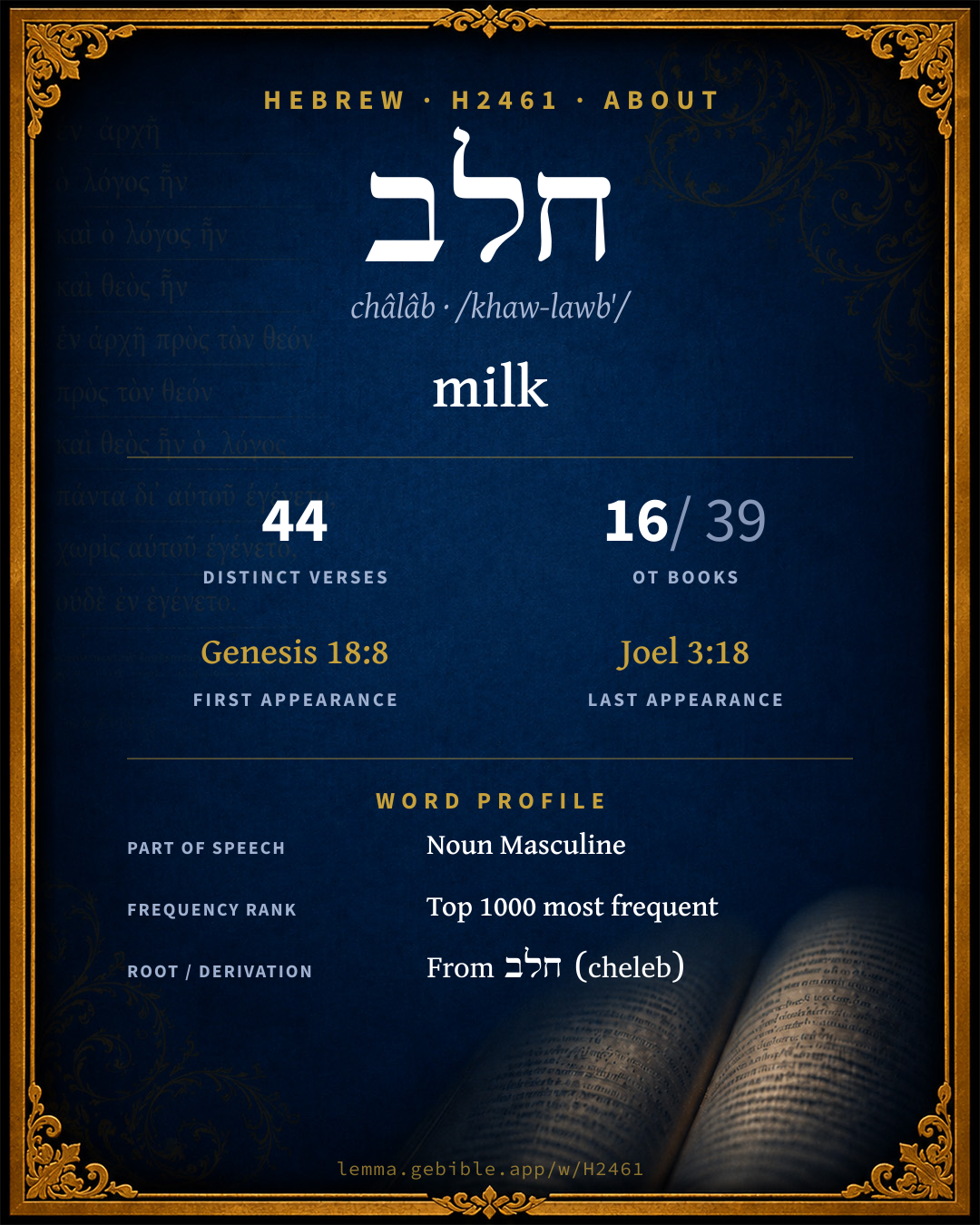
חָלָב
milk
also: sour milk, cheese fuller range ↓
Full lexicon entry — Brown-Driver-Briggs (BDB)
From Brown-Driver-Briggs (BDB)
Where this word appears
See every Absolute-state word in the Hebrew Bible →
Grammar key — what these labels mean
Part of speech
- Noun
- A naming word — a person, place, thing, or idea.
Noun type
- Common
- A common noun — a general class of person, place, or thing (“king,” “city,” “water”), not a specific name.
State
- Absolute
- The independent form of a noun, not bound to a following word.
- Construct
- A noun bound to a following noun in a possessive / “of” relationship (the construct chain).
Gender
- Masculine
- Grammatically masculine.
Number
- Singular
- One.
Grammatical forms
- Noun, Common, Masculine, Singular, Absolute 36 times (82%)
- Noun, Common, Masculine, Singular, Construct 8 times (18%)
Parsed forms decoded from the imported morphology (morphhb / Westminster Leningrad Codex — WLC text public domain, morphhb tagging CC BY 4.0), counted across 44 parsed occurrences — not distinct verses.
Every verse where H2461 appears — 44 distinct verses across 16 books. Click any verse to open its interlinear word-by-word view. Verse text shown in the World English Bible for context — . Each verse’s Hebrew form is shown with its reference; the English is not keyword-highlighted, since the data carries no word-level English alignment. Use “Compare translations” on any verse to read it across multiple English versions. This concordance covers the Hebrew Bible; Septuagint (Greek Old Testament) occurrences are not indexed here.
Genesis 2 verses
Exodus 6 verses
- Exodus 3:8 חָלָ֖ב n c ms I have come down to deliver them out of the hand of the Egyptians, and to bring them up out of that land to a good and large land, to a land flowing with milk and honey; to the place of the Canaanite, the Hittite, the Amorite, the Perizzite, the Hivite, and the Jebusite.
- Exodus 3:17 חָלָ֖ב n c ms and I have said, I will bring you up out of the affliction of Egypt to the land of the Canaanite, the Hittite, the Amorite, the Perizzite, the Hivite, and the Jebusite, to a land flowing with milk and honey."'
- Exodus 13:5 חָלָ֖ב n c ms It shall be, when Yahweh shall bring you into the land of the Canaanite, and the Hittite, and the Amorite, and the Hivite, and the Jebusite, which he swore to your fathers to give you, a land flowing with milk and honey, that you shall keep this service in this month.
- Exodus 23:19 בַּ/חֲלֵ֥ב prep + n c ms cs The first of the first fruits of your ground you shall bring into the house of Yahweh your God. "You shall not boil a kid in its mother's milk.
- Exodus 33:3 חָלָ֖ב n c ms to a land flowing with milk and honey: for I will not go up in the midst of you, for you are a stiff-necked people, lest I consume you in the way."
- Exodus 34:26 בַּ/חֲלֵ֥ב prep + n c ms cs You shall bring the first of the first fruits of your ground to the house of Yahweh your God. You shall not boil a young goat in its mother's milk."
Leviticus 1 verse
Numbers 4 verses
- Numbers 13:27 חָלָ֥ב n c ms They told him, and said, We came to the land where you sent us; and surely it flows with milk and honey; and this is the fruit of it.
- Numbers 14:8 חָלָ֖ב n c ms If Yahweh delight in us, then he will bring us into this land, and give it to us; a land which flows with milk and honey.
- Numbers 16:13 חָלָב֙ n c ms is it a small thing that you have brought us up out of a land flowing with milk and honey, to kill us in the wilderness, but you must needs make yourself also a prince over us?
- Numbers 16:14 חָלָ֤ב n c ms Moreover you haven't brought us into a land flowing with milk and honey, nor given us inheritance of fields and vineyards: will you put out the eyes of these men? we won't come up.
Deuteronomy 8 verses
- Deuteronomy 6:3 חָלָ֖ב n c ms Hear therefore, Israel, and observe to do it; that it may be well with you, and that you may increase mightily, as Yahweh, the God of your fathers, has promised to you, in a land flowing with milk and honey.
- Deuteronomy 11:9 חָלָ֖ב n c ms and that you may prolong your days in the land, which Yahweh swore to your fathers to give to them and to their seed, a land flowing with milk and honey.
- Deuteronomy 14:21 בַּ/חֲלֵ֥ב prep + n c ms cs You shall not eat of anything that dies of itself: you may give it to the foreigner living among you who is within your gates, that he may eat it; or you may sell it to a foreigner: for you are a holy people to Yahweh your God. You shall not boil a kid in its mother's milk.
- Deuteronomy 26:9 חָלָ֖ב n c ms and he has brought us into this place, and has given us this land, a land flowing with milk and honey.
- Deuteronomy 26:15 חָלָ֖ב n c ms Look down from your holy habitation, from heaven, and bless your people Israel, and the ground which you have given us, as you swore to our fathers, a land flowing with milk and honey.
- Deuteronomy 27:3 חָלָב֙ n c ms and you shall write on them all the words of this law, when you are passed over; that you may go in to the land which Yahweh your God gives you, a land flowing with milk and honey, as Yahweh, the God of your fathers, has promised you.
- Deuteronomy 31:20 חָלָב֙ n c ms For when I shall have brought them into the land which I swore to their fathers, flowing with milk and honey, and they shall have eaten and filled themselves, and grown fat; then will they turn to other gods, and serve them, and despise me, and break my covenant.
- Deuteronomy 32:14 וַ/חֲלֵ֣ב conj + n c ms cs Butter of the herd, and milk of the flock, With fat of lambs, Rams of the breed of Bashan, and goats, With the finest of the wheat; Of the blood of the grape you drank wine.
Joshua 1 verse
Judges 2 verses
1 Samuel 2 verses
- 1 Samuel 7:9 חָלָב֙ n c ms Samuel took a sucking lamb, and offered it for a whole burnt-offering to Yahweh: and Samuel cried to Yahweh for Israel; and Yahweh answered him.
- 1 Samuel 17:18 הֶֽ/חָלָב֙ ptcl def.art + n c ms and bring these ten cheeses to the captain of their thousand, and look how your brothers fare, and take their pledge.
Job 2 verses
Proverbs 2 verses
- Proverbs 27:27 חֲלֵ֬ב n c ms cs There will be plenty of goats' milk for your food, For your family's food, And for the nourishment of your servant girls.
- Proverbs 30:33 חָלָ֡ב n c ms For as the churning of milk brings forth butter, And the wringing of the nose brings forth blood; So the forcing of wrath brings forth strife."
Song of Solomon 3 verses
- Song of Solomon 4:11 וְ/חָלָב֙ conj + n c ms Your lips, my bride, drip like the honeycomb. Honey and milk are under your tongue. The smell of your garments is like the smell of Lebanon.
- Song of Solomon 5:1 חֲלָבִ֑/י n c ms cs + sfx pers 1cs I have come into my garden, my sister, my bride. I have gathered my myrrh with my spice; I have eaten my honeycomb with my honey; I have drunk my wine with my milk. Friends Eat, friends! Drink, yes, drink abundantly, beloved. Beloved
- Song of Solomon 5:12 בֶּֽ/חָלָ֔ב prep + n c ms His eyes are like doves beside the water brooks, Washed with milk, mounted like jewels.
Isaiah 4 verses
- Isaiah 7:22 חָלָ֖ב n c ms and it shall happen, that because of the abundance of milk which they shall give he shall eat butter: for everyone will eat butter and honey that is left in the midst of the land.
- Isaiah 28:9 מֵֽ/חָלָ֔ב prep + n c ms Whom will he teach knowledge? and whom will he make to understand the message? those who are weaned from the milk, and drawn from the breasts?
- Isaiah 55:1 וְ/חָלָֽב conj + n c ms Ho, everyone who thirsts, come you to the waters, and he who has no money; come you, buy, and eat; yes, come, buy wine and milk without money and without price.
- Isaiah 60:16 חֲלֵ֣ב n c ms cs You shall also suck the milk of the nations, and shall suck the breast of kings; and you shall know that I, Yahweh, am your Savior, and your Redeemer, the Mighty One of Jacob.
Jeremiah 2 verses
- Jeremiah 11:5 חָלָ֛ב n c ms that I may establish the oath which I swore to your fathers, to give them a land flowing with milk and honey, as at this day. Then answered I, and said, Amen, Yahweh.
- Jeremiah 32:22 חָלָ֖ב n c ms and gave them this land, which you did swear to their fathers to give them, a land flowing with milk and honey;
Lamentations 1 verse
Ezekiel 3 verses
- Ezekiel 20:6 חָלָב֙ n c ms in that day I swore to them, to bring them forth out of the land of Egypt into a land that I had searched out for them, flowing with milk and honey, which is the glory of all lands.
- Ezekiel 20:15 חָלָב֙ n c ms Moreover also I swore to them in the wilderness, that I would not bring them into the land which I had given them, flowing with milk and honey, which is the glory of all lands;
- Ezekiel 25:4 חֲלָבֵֽ/ךְ n c ms cs + sfx pers 2fs therefore, behold, I will deliver you to the children of the east for a possession, and they shall set their encampments in you, and make their dwellings in you; they shall eat your fruit, and they shall drink your milk.
Joel 1 verse
About this entry
At a glance — auto-summarized from this page’s data, not written by a person. Every figure links to its source below. This summary describes the numbers; it doesn’t interpret them.
חלב — transliterated châlâb — is a Hebrew noun carrying the sense “milk.” Not a single-sense word: its full sense range also takes in “sour milk” and “cheese”. With 44 verses in 16 books, it is a moderately common word in the Hebrew Bible. It first appears in Genesis 18:8. From the same root come חלב, חלבנה and אחלב. Dig into 44-verse concordance and the renderings breakdown below.
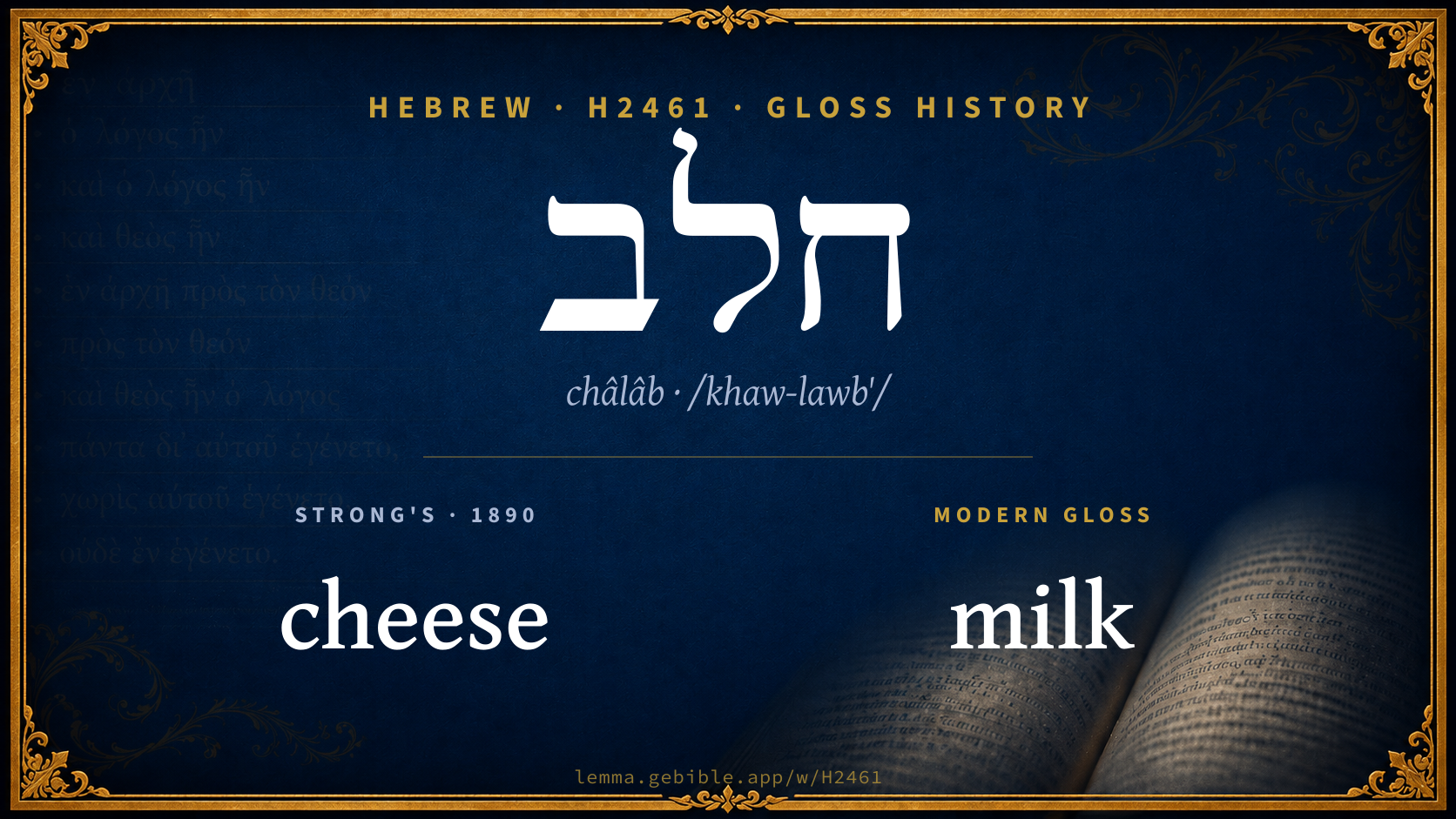
Gloss history
Strong's 1890 vs modern scholarship
About this word
Strong's H2461 catalogs a Hebrew word from the Hebrew Old Testament.
These counts are not copied from any lexicon or concordance. They are computed here, from the morphology-tagged Hebrew Old Testament. What Lemma adds →
- 44
- distinct verses
- The word appears in 44 distinct verses.
- 16 / 39
- OT books
- The word appears in 16 of 39 Old Testament books.
- #819
- by frequency
- Top 1000 most frequent Hebrew words (rank 819 of 8,640 Hebrew words by occurrence).
View all 44 occurrences in the concordance →
Most concentrated in
- Deuteronomy 8 verses 18%
- Exodus 6 verses 14%
- Numbers 4 verses 9%
By section of the Old Testament
By traditional corpus
Conventional, traditional groupings — biblical authorship is debated, so this is a traditional corpus grouping, not an authorship claim. Each share is this word’s portion of its verses in that division of the Hebrew canon. Each figure is a share of the word’s 44 distinct verses.
- Torah (Pentateuch) 21 verses · 48%
- Prophets (Nevi'im) 15 verses · 34%
- Writings (Ketuvim) 8 verses · 18%
How translations render this word
Counts come from each version’s own published word-to-Strong’s tagging or interlinear alignment — an approximate guide to how each version renders this word, not a word-level alignment the data otherwise carries. Because each total is that version’s own tagged count, the per-version totals vary from one another and need not match the appearance or distinct-verse counts above. These counts may also differ from a printed concordance because Lemma counts each distinctly tagged rendering and does not collapse phrase taggings into a single head-word total. This is a fixed set of word-tagged versions (KJV, ASV, BSB, ULT) and does not change with the reading translation you choose elsewhere. Each version’s license is shown beside its name below (and on Sources).
- King James Version: Milk 41×
- American Standard Version: Milk 33×, 's milk 3×, Flowing with milk 2×
- Berean Standard Bible: Milk 38×, Than milk 2×
- unfoldingWord Literal Text: Milk 34×, Milk of 6×
King James Version Public Domain
Renders H2461 across 44 tagged occurrences — most commonly:
Plus 3 renderings that appear only once — usually multi-word phrases or single function words the recovered tagging swept in, not distinct renderings.
American Standard Version Public Domain
Renders H2461 across 44 tagged occurrences — most commonly:
Plus 6 renderings that appear only once — usually multi-word phrases or single function words the recovered tagging swept in, not distinct renderings.
Berean Standard Bible Public Domain
Renders H2461 across 43 tagged occurrences — most commonly:
Plus 3 renderings that appear only once — usually multi-word phrases or single function words the recovered tagging swept in, not distinct renderings. Not rendered by a distinct English word in 1 further occurrence.
unfoldingWord Literal Text CC BY-SA 4.0
Renders H2461 across 44 tagged occurrences — most commonly:
Plus 4 renderings that appear only once — usually multi-word phrases or single function words the recovered tagging swept in, not distinct renderings.
Senses in the full BDB
What do BDB’s symbols mean?
BDB uses these scholarly abbreviations:
| Symbol | Meaning |
|---|---|
| 𝔊 | the Septuagint (the ancient Greek translation, LXX) |
| 𝔙 | the Vulgate (the Latin translation) |
| 𝔖 | the Syriac version (the Peshitta) |
| 𝔗 | the Targum (the Aramaic translation) |
| ψ | the Psalms |
| √ | root (the underlying root or stem) |
| ‖ | parallel passage (a synonymous or contrasted parallel) |
| † | the dagger: every passage where the word occurs is cited |
The 2 senses and sub-senses the full Brown-Driver-Briggs lexicon distinguishes for this word, in lexicon order (not ranked by frequency), with BDB’s own verbatim wording and sub-sense lettering. Shown in Hebrew script with BDB’s own scholarly abbreviations. The condensed entry is in the Lexicon Entry tab. See also the Forms in the corpus table below.
- a. as common food Gn 18:8 (J; distinct from חֶמְאָה curd, q.v.), חֲלֵב צֹאן Dt 32:14 (poet.; distinct from חֶמְאַת בָּקָר); in Ju 5:25 חָלָב is used parallel with חֶמְאָה; elsewhere חֶמְאָה seems to be produced from חָלָב:—מִיץ חָלָב יוֹצִיא חֶמְאָה Pr 30:33 a pressing (squeezing) of milk produces curd; מֵרֹב עֲשׂוֹת חָלָב יֹאכַל חֶמְאָה Is 7:22 because of abundant yield of milk he shall eat curd; cf. also חֲרִצֵי הֶחָלָב 1 S 17:18 cuts of milk, i.e. cheeses; it was received in buckets or pails (עֲטִינָיו) Jb 21:24 (v. Ew De Di VB), and kept in skins (נֹאוד ח׳) Ju 4:19; men drank it (שׁתה) Ez 25:4 (cf. השׁקה Ju 4:19), but also ate it (אכל), if emend. הֶחָלָב Ez 34:3 (for הַחֵלֶב) is right, 𝔊 𝔙 Bö Hi-Sm Co, al.; it was poured out, v. sim. of formation of the embryo הֲלֹא כֶח׳ תַּתִּיכֵנִי Jb 10:10 hast thou not poured me out like milk? specif. (1) חֲלֵב עִזִּים לְלַחְמְךָ Pr 27:27 milk of goats for thy food (RSSem i. 204). (2) c. אֵם mother’s milk: of kid לֹא־תְבַשֵּׁל גְּדִי בַּחֲלֵב אִמּוֹ Ex 23:19 = 34:26 (JE) = Dt 14:21, cf. טְלֵה ח׳ 1 S 7:9 sucking lamb (for sacrif.); but also of human beings גְּמוּלֵי מֵח׳ Is 28:9 weaned from milk (‖ עַתִּיקֵי מִשָּׁדָ֑יִם); fig. in promise to Zion וְיָנַקְתְּ חֲלֵב גּוֹיִם Is 60:16 and thou shalt suck the milk of nations (‖ וְשֹׁד מְלָכִים תִּינָ֑קִי). (3) ח׳ with wine, as especially delicacy Ct 5:1 (v. De), fig. of י׳’s choicest blessings Is 55:1. (4) often in phr. of productiveness of land of Canaan זָבַת חָלָב וּדְבָ֑שׁ (דְּבַשׁ) flowing with milk and honey Ex 3:8, 17; 13:5; 33:3 Nu 13:27; 14:8; 16:14 (all JE), Lv 20:24 (H), Dt 6:3; 11:9; 26:9, 15; 27:3; 31:20 Jos 5:6 Je 11:5; 32:22 Ez 20:6, 15, of Egypt Nu 16:13; the hills תֵּלַכְנָה ח׳ Jo 4:18 (‖ יִטְּפוּ הֶהָרִים עָסִיס); fig. of charms of loved one דְּבַשׁ וְח׳ תַּחַת לְשׁוֹנֵךְ Ct 4:12 honey and milk are under thy tongue. e.g. Genesis 18:8
- b. milk as white לְבֶן־שִׁנַּיִם מֵח׳ Gn 49:12 white of teeth, from milk; צַחוּ מֵח׳ La 4:7 they were whiter than milk (‖ זַכּוּ מִשֶּׁלֶג); so also prob. of eyes (iris) רֹחֲצוֹת בֶּח׳ Ct 5:12 bathed in milk, i.e. the white of the eye.—On milk as not used by Israel in sacrifice v. RSSem 204. e.g. Genesis 49:12
Senses from the full Brown-Driver-Briggs lexicon (Brown, Driver, Briggs; Oxford 1906 — public domain), digitized via Sefaria, supplemented by the OpenScriptures HebrewLexicon (CC BY 4.0). Full attribution on Sources.
Word origin
n.m. milk (NH id. (and vb. denom.); Aramaic חַלְבָּא, ܚܰܠܒܳܐ, Ph. חלב; Arabic حَليبٌ n. fresh milk, حَلَبَ vb. milk; Assyrian alibu, milk, v. DlPr 174; Ethiopic ሐሊብ )—ח׳ abs. Gn 18:18 + 35 times + Ez 34:3 (v. infr.); cstr. חֲלֵב Ex 23:19 + 5 times; sf. חֲלָבִי Ct 5:1, חֲלָבֵךְ Ez 25:4;—milk:
— Brown-Driver-Briggs (Oxford 1906, public domain), digitized via Sefaria, supplemented by the OpenScriptures HebrewLexicon (CC BY 4.0). See Sources.
Derived from חלב (cheleb) (H2459) — fat.
Jastrow Dictionary
A second Hebrew/Aramaic lexicon for comparison, covering Aramaic and post-biblical (Talmudic, Targumic, Midrashic) usage that the biblical-Hebrew BDB does not. Matched by lemma rather than by Strong’s number, so a lemma may carry more than one Jastrow headword (shown separately below), and the entries cover usage well beyond the Bible.
חָלָב
- (b. h.) [secretion,] milk. Ab. Zar. II, 6 ח׳ שחֲלָבוֹ וכ׳ milk (of a cow) milked by a gentile. Makhsh. VI, 5 מי ח׳ serum of milk; a. fr.—בשר בח׳ the boiling of meat with milk, the prohibitory law concerning &c. (Ex. XXIV, 19; XXXIV, 26; Deut. XIV, 21). Pes. 54ᵇ, v. חִידּוּשׁ.—Ḥull. 110ᵃ לא גמירי דב׳ בח׳ אסור they did not know that boiling meat with milk was forbidden; a. fr.—חֲלֵב בֵּיצִים white of eggs. Y. Ter. X, 47ᵇ bot., cmp. חֶלְבּוֹן.—נֵץ (ה)ח׳ ornithogalum, Star of Bethlehem, a bulbous plant. Shebi. VII, 1, v. חֶלְבֵּצִין; Ukts. III, 2.—Trnsf. הח׳ white wine. Gen. R. s. 98, opp. אדום. e.g. Exodus 24:19
חֲלָב
- Targ. Gen. XVIII, 8. Targ. Job X, 10; a. fr.—Y. Ter. VIII, 46ᵃ חַלְבּוּן חֲ׳ milked. Ḥull. 109ᵇ, v. בִּשְׂרָא I. Ib. 110ᵃ; a. e.
חָלַב
- (denom. of חָלָב) to milk; to yield milk. Ab. Zar. II, 6, v. חָלָב. Bekh. 20ᵇ רוב … חוֹלְבוֹת וכ׳ the majority of animals secrete no milk unless they have given birth; a. fr.
- to be milked. Sabb. 53ᵇ לֵיחָלֵב when the bag is tied on for milking purposes (to support the udders), opp. ליבש for drying up.
חֲלַב
- Y. Ter. VIII, 46ᵃ, v. חֲלָב
חֵלֶב
- (b. h.) fatty concretion (cmp. חַלָּא), esp. that abdominal fat of cattle which it is forbidden to eat, ḥeleb (Lev. III, 17), contrad. to שומן. Kerith. III, 1. Ḥull. 113ᵇ המבשל חֵ׳ בחָלָב if one boils fat with milk. Snh. 4ᵇ חֵלֶב וחָלָב דכי וכ׳ ḥeleb a. ḥalab which are written alike, v. אֵם; a. fr.—Pl. חֲלָבִים, חֲלָבִין. Ber. I, 1 ח׳ ואברים the pieces of fat and the limbs belonging to the altar; Tam. VII, 3 שלחן הח׳ the (marble) table designated for the fat-pieces (and limbs).—Ker. 12ᵃ, sq. חֲלָבִין laws concerning the eating of ḥeleb; Y. Yeb. X, 11ᵃ top מדמי לה לח׳ (not לחלבון); a. fr.—[Y. Ter. X, 47ᵇ bot. לובן חלבין, v. חֶלְבּוֹן.]—גוּשׁ הֵ׳, v. גּוּשׁ. e.g. Leviticus 3:17
*חֵלֶב
- ch. m. (preced.) a viscous substance, glair. Ḥull. 120ᵃ ח׳ דקריש ed. (v. Rashi); v. חָלָא III.
A Dictionary of the Targumim, the Talmud Babli and Yerushalmi, and the Midrashic Literature (Marcus Jastrow; London, Luzac, 1903) — Public Domain. Digitized via Sefaria. Digitized via Sefaria. Full attribution on Sources.
Forms in the corpus
The 25 distinct written forms H2461 takes in the Hebrew Bible, most frequent first — each parse links to that state’s occurrences in the concordance. Hebrew forms include their vowel points and cantillation, so a single lemma takes many written forms.
Same root — word family
Other BDB entries built from the same root as H2461, grouped by Strong’s listed origin. These share a root / origin per the lexicon — not necessarily a shared meaning. Each links to that word’s own entry.
Derives from
Shares the same root
Proper names from this root
People and places named from this root — a name, not an additional meaning of the word.
- אחלב ʼAchlâb H303 Ahlab
- חלב Chêleb H2460 Heleb
- חלבה Chelbâh H2462 Helbah
- חלבון Chelbôwn H2463 Helbon
Compare all same-root words → Showing 4 of 7 — not the complete family. 4 of the same-root words are proper names (people or places). They share a root, not necessarily a meaning.
Septuagint verse parallels
This word appears in 43 verses that also exist in the Greek Old Testament (Septuagint), out of the 44 Hebrew verses it occurs in. You can read those verses in Greek by switching the Old Testament edition to the Septuagint.
Read these verses in the Septuagint
- Genesis 18:8
- Exodus 3:8
- Leviticus 20:24
- Numbers 13:27
- Deuteronomy 6:3
- Joshua 5:6
- Judges 4:19
- 1 Samuel 7:9
- Job 10:10
- Proverbs 27:27
- Song of Solomon 4:11
- Isaiah 7:22
This is a verse-level parallel only — the same verses exist in both the Hebrew and Greek Old Testaments. No word-level Hebrew↔Greek correspondence is claimed: the data carries no such alignment, so no Greek word is shown as this Hebrew word’s translation. Coverage is not total — the Septuagint omits the deuterocanon and renumbers the Psalms, so some Hebrew verses have no direct Greek parallel.