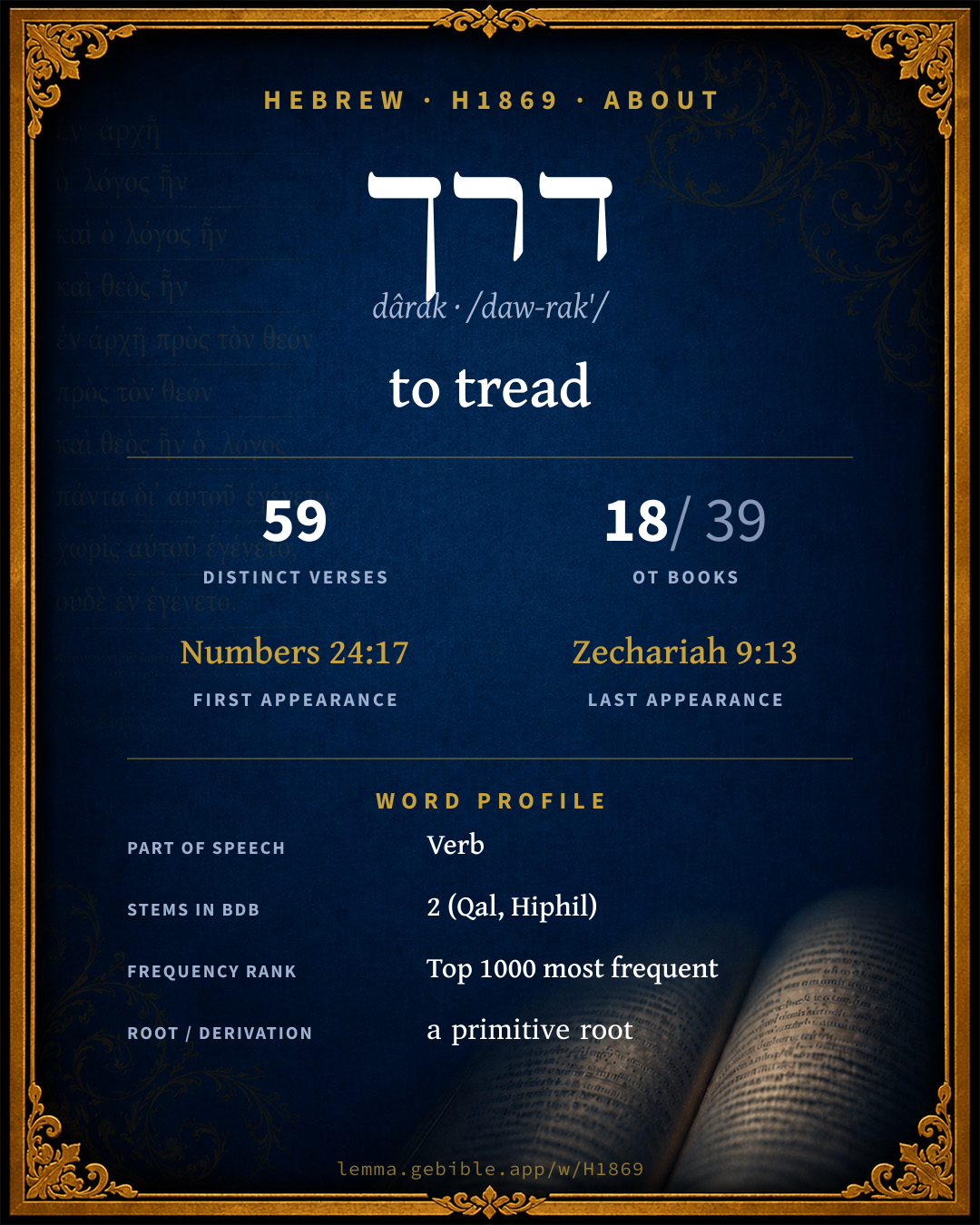
דָּרַךְ
to tread
also: bend, lead, march fuller range ↓
Full lexicon entry — Brown-Driver-Briggs (BDB)
From Brown-Driver-Briggs (BDB)
Where this word appears
Grammar key — what these labels mean
Part of speech
- Verb
- An action or state-of-being word.
Stem
- Qal
- The basic, simple active stem — the plain form of the verb (“he wrote”). Here: ‘tread’
- Hiphil
- The causative active stem (“he caused / brought about”). Here: ‘tread’
Form
- Imperfect
- An incomplete, ongoing, or future action (“he will / would write”).
- Perfect
- A completed action or state — Hebrew marks aspect (completeness) more than strict tense (“he wrote”).
- Participle Active
- A verbal adjective expressing ongoing or characteristic action (“writing / one who writes”).
- Imperative
- A direct command (“write!”).
- Sequential Perfect
- A perfect with prefixed waw continuing a preceding imperfect or command (waw-consecutive perfect).
- Sequential Imperfect
- An imperfect with prefixed waw — the standard past-narrative form (waw-consecutive imperfect).
- Participle Passive
- A verbal adjective expressing action received (“written”).
State
- Construct
- A noun bound to a following noun in a possessive / “of” relationship (the construct chain).
- Absolute
- The independent form of a noun, not bound to a following word.
Person
- 3rd Person
- The one spoken about (“he / she / it / they”).
- 2nd Person
- The one addressed (“you”).
- 1st Person
- The speaker (“I / we”).
Gender
- Masculine
- Grammatically masculine.
- Common
- Either gender — not distinguished for this form.
- Feminine
- Grammatically feminine.
Number
- Singular
- One.
- Plural
- More than one (in Hebrew, generally three or more).
Every verse where H1869 appears in the Book of Proverbs — 1 distinct verse. Click any verse to open its interlinear word-by-word view. Verse text shown in the World English Bible for context — . Each verse’s Hebrew form is shown with its reference; the English is not keyword-highlighted, since the data carries no word-level English alignment. Use “Compare translations” on any verse to read it across multiple English versions. This concordance covers the Hebrew Bible; Septuagint (Greek Old Testament) occurrences are not indexed here.
Proverbs
About this entry
At a glance — auto-summarized from this page’s data, not written by a person. Every figure links to its source below. This summary describes the numbers; it doesn’t interpret them.
“to tread” is the headline sense of the Hebrew verb דרך (dârak). First canonically at Numbers 24:17, it enters the text early. It appears 59 verses across 18 books of the Hebrew Bible, among its moderately common vocabulary. Read the stem: it spans 2 stems, including Qal and Hiphil. Related forms include דרך and מדרך. The sections below give every sense, occurrence, and version rendering.
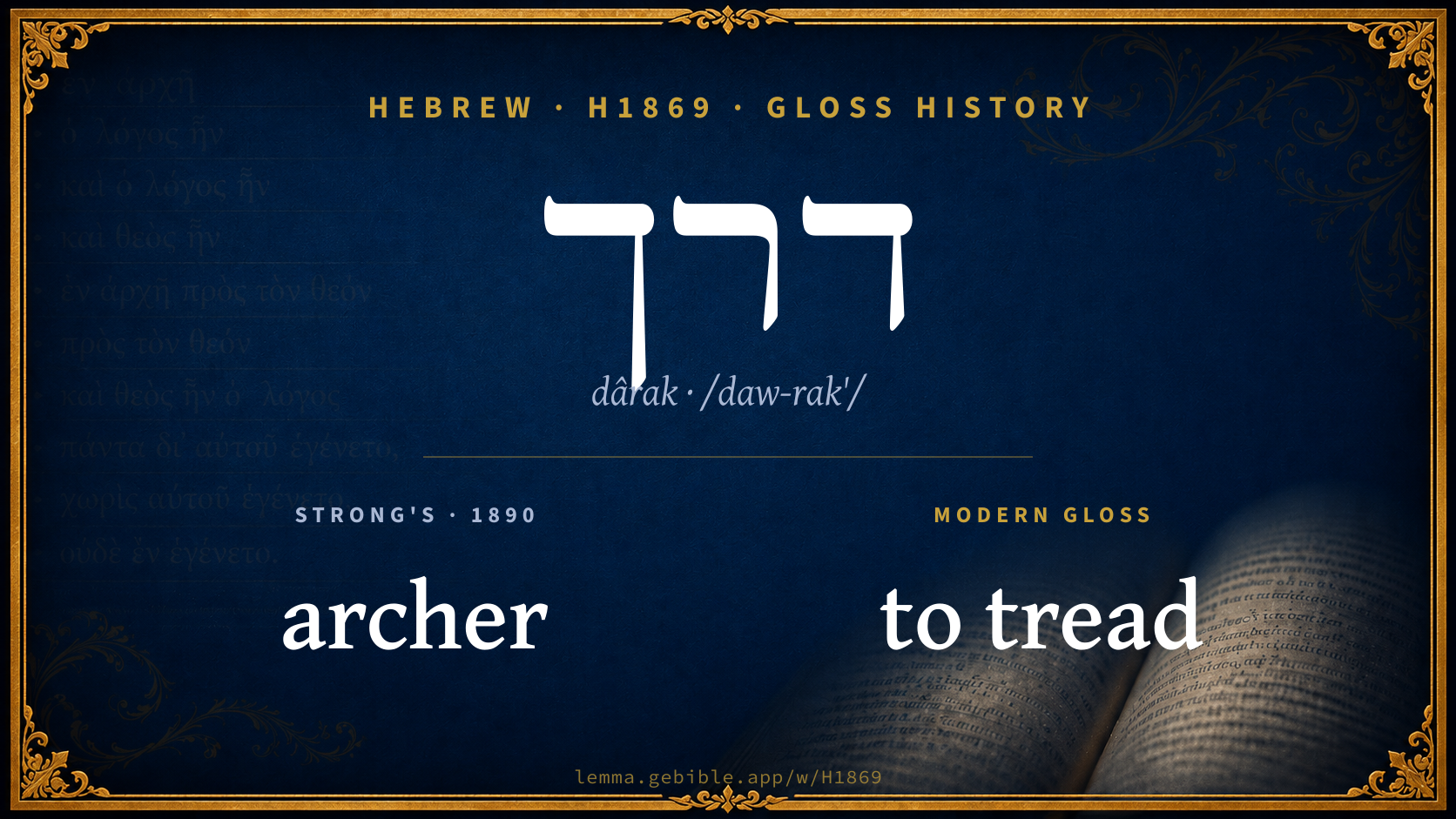
Gloss history
Strong's 1890 vs modern scholarship
About this word
Strong's H1869 catalogs a Hebrew word from the Hebrew Old Testament.
These counts are not copied from any lexicon or concordance. They are computed here, from the morphology-tagged Hebrew Old Testament. What Lemma adds →
- 59
- distinct verses
- The word appears in 59 distinct verses.
- 18 / 39
- OT books
- The word appears in 18 of 39 Old Testament books.
- #611
- by frequency
- Top 1000 most frequent Hebrew words (rank 611 of 8,640 Hebrew words by occurrence).
View all 59 occurrences in the concordance →
By section of the Old Testament
By traditional corpus
Conventional, traditional groupings — biblical authorship is debated, so this is a traditional corpus grouping, not an authorship claim. Each share is this word’s portion of its verses in that division of the Hebrew canon. Each figure is a share of the word’s 59 distinct verses.
- Prophets (Nevi'im) 32 verses · 54%
- Writings (Ketuvim) 22 verses · 37%
- Torah (Pentateuch) 5 verses · 8%
How translations render this word
Counts come from each version’s own published word-to-Strong’s tagging or interlinear alignment — an approximate guide to how each version renders this word, not a word-level alignment the data otherwise carries. Because each total is that version’s own tagged count, the per-version totals vary from one another and need not match the appearance or distinct-verse counts above. These counts may also differ from a printed concordance because Lemma counts each distinctly tagged rendering and does not collapse phrase taggings into a single head-word total. This is a fixed set of word-tagged versions (KJV, ASV, BSB, ULT) and does not change with the reading translation you choose elsewhere. Each version’s license is shown beside its name below (and on Sources).
- King James Version: Bend 4×, He hath bent 3×, Tread 3×
- American Standard Version: He hath bent 3×, Bend 2×, Bent 2×
- Berean Standard Bible: Treads 3×, Bend 2×, Drawing 2×
- unfoldingWord Literal Text: Tread 5×, He treads 3×, Will tread 3×
King James Version Public Domain
Renders H1869 across 63 tagged occurrences — most commonly:
Plus 43 renderings that appear only once — usually multi-word phrases or single function words the recovered tagging swept in, not distinct renderings.
American Standard Version Public Domain
Renders H1869 across 61 tagged occurrences — most commonly:
Plus 46 renderings that appear only once — usually multi-word phrases or single function words the recovered tagging swept in, not distinct renderings.
Berean Standard Bible Public Domain
Renders H1869 across 61 tagged occurrences — most commonly:
Plus 52 renderings that appear only once — usually multi-word phrases or single function words the recovered tagging swept in, not distinct renderings. Not rendered by a distinct English word in 1 further occurrence.
unfoldingWord Literal Text CC BY-SA 4.0
Renders H1869 across 65 tagged occurrences — most commonly:
Plus 42 renderings that appear only once — usually multi-word phrases or single function words the recovered tagging swept in, not distinct renderings.
9 senses and sub-senses in the full BDB
Hebrew verbs can shift meaning by stem (binyan): Qal is the basic action, Niphal is often passive or reflexive, Piel often intensifies or makes it factitive, and Hiphil is typically causative. The senses below are grouped under the stem BDB assigns to each.
What do BDB’s symbols mean?
BDB uses these scholarly abbreviations:
| Symbol | Meaning |
|---|---|
| 𝔊 | the Septuagint (the ancient Greek translation, LXX) |
| 𝔙 | the Vulgate (the Latin translation) |
| 𝔖 | the Syriac version (the Peshitta) |
| 𝔗 | the Targum (the Aramaic translation) |
| ψ | the Psalms |
| √ | root (the underlying root or stem) |
| ‖ | parallel passage (a synonymous or contrasted parallel) |
| † | the dagger: every passage where the word occurs is cited |
The 9 senses and sub-senses the full Brown-Driver-Briggs lexicon distinguishes for this word, in lexicon order (not ranked by frequency), with BDB’s own verbatim wording and sub-sense lettering. Shown in Hebrew script with BDB’s own scholarly abbreviations. The condensed entry is in the Lexicon Entry tab. See also the Forms in the corpus table below.
Qal
- Pf. 3 ms. דָּרַךְ Nu 24:17 + 6 times; 3 fs. דָּרְֽכָה Jos 14:9; 2 ms. דָּרַכְתָּ Hb 3:15; 1 s. דָּרַכְתִּי Is 63:3 Zc 9:13; pl. דָּֽרְכוּ Jb 22:15 + 3 times; Impf. 3 ms. יִדְרֹךְ Mi 5:4 + 6 times + ידרך Je 51:3 (כתיב ולא קוי); 3 fs. תִּדְרֹךְ Dt 11:24 Jos 1:3; 2 ms. תִּדְרֹךְ Dt 33:29 + 2 times; 2 fs. תִּדְרְכִי Ju 5:21; 1 s. sf. וְאֶדְרְכֵם Is 63:3; 3 mpl. יִדְרְכוּ 1 S 5:5, יִדְרְכוּן ψ 11:2, וַיִּדְרְכוּ Ju 9:27; 2 mpl. תִּדְרְכוּ Dt 11:25; Pt. act. דֹּרֵךְ Am 4:13 + 5 times; דּוֹרֵךְ Jb 9:8; דֹּרְכִים Je 25:30 Ne 13:15; דֹּרְכֵי Je 46:9 + 5 times; pass. f. דְּרוּכָה Is 21:15; דְּרֻכוֹת 5:28;— e.g. Numbers 24:17
- 1. tread, march, march forth, abs., תִּדְרְכִי נַפְשִׁי עֹז Ju 5:21; cf. דָּרַךְ כּוֹכָב מִיַּעֲקֹב Nu 24:17 (poem) a star hath marched forth from Jacob. e.g. Judges 5:21
- 2. tread upon (land), sq. בְּ Dt 1:36; 11:25 (subj. pers.), Jos 14:9 (subj. רֶגֶל) cf. Dt 11:24 = Jos 1:3 (subj. כַּף רַגְלְכֶם); tread in a path, sq. בְּ Is 59:8 (fig. of mode of life); tread in (on) the sea, sq. בְּ Hb 3:15 (but text dub. cf. VB); of an invader יִדְרֹךְ בְּאַרְמְנוֹתֵינוּ Mi 5:4 (‖ יָבוֹא בְּאַרְצֵנוּ); יִד׳ בִּגְבוּלֵינוּ v 5 (‖ id.); sq. עַל 1 S 5:5 (עַל־מִפְתַּן דָּגוֹן); ψ 91:13 (עַל־שַׁחַל וָפֶתֶן); especially (poet.) עַל־בָּמֳו֯תֵי אֶרֶץ Mi 1:3, of י׳, so Am 4:13, & (עַל־בָּמֳתֵי יָ֑ם) Jb 9:8; of Isr. treading on heights of enemies, i.e. subduing them Dt 33:29. Once sq. acc. (אֲשֶׁר ref. אֹרַח) Jb 22:15. In technical senses e.g. Deuteronomy 1:36
- 3. tread wine- (or oil-) press, sq. acc. יְקָבִים Jb 24:11 (‖ יַצְהִירוּ), גִּתּוֹת Ne 13:15; sq. acc. of thing pressed ד׳עֲנָבִים Am 9:13; also of product תִּדְרֹךְ־זַיִת … וְתִירוֹשׁ Mi 6:15; יַיִן בַּיְקָבִים לֹא יִדְרֹךְ הַדֹּרֵךְ Is 16:10; sq. בְּגַת Is 63:2 (in sim.); abs. Je 25:30 (sim.) 48:33; fig. of judgment Is 63:3 sq. acc. פּוּרָה winepress, subj. י׳, cf. v וְאֶדְרְכֵם בְּאַפִּי (‖ רמס) i.e. tread them down; so גַּת דָּרַךְ אֲדֹנָי לִבְתוּלַת בַּת־יְהוּדָה La 1:15. e.g. Job 24:11
- 4. tread (i.e. bend) the bow, sq. acc. קֶשֶׁת Je 51:3 (אֶל־יִדְרֹךְ יד֯רך הַדֹּרֵךְ קַשְׁתּוֹ); fig. of assaults of wicked ψ 11:2; 37:14, of judgments of י׳ ψ 7:13 La 2:4; 3:12; also fig. of Judah as bow in hand of י׳, כִּי דָרַכְתִּי לִי יְהוּדָה Zc 9:13 (‖ קֶשֶׁת מִלֵּאתִי אֶפְרַיִם); twice in like meaning c. obj. חֵץ arrow ψ 58:8 (but on text cf. Checrit. n.) 64:4; דֹּרְכֵי קֶשֶׁת = bow-benders, archers 46:9 Je 50:14, 29 1 Ch 5:18; 8:40 2 Ch 14:7; קֶשֶׁת דְּרוּכָה bent bow Is 21:15, קַשְׁתֹֿתָיו דְּרֻכוֹת 5:28. e.g. Jeremiah 51:3
Hiphil
- Pf. וְהִדְרִיךְ Is 11:15; sf. הִדְרִיכָהּ Je 51:33 (where many Inf. cstr.). cf. RSJ Ph. xvi. (1888) 72; 1 s. sf. הִדְרַכְתִּיךָ Pr 4:11; 3 pl. sf. הִדְרִיכֻ֑הוּ Ju 20:43, הִדְרִיכוּהוּ Jb 28:8; Impf. יַדְרֵךְ ψ 25:9; sf. יַדְרִכֵנִי Hb 3:19; וַיַּדְרִיכֵם ψ 107:7; 1 s. sf. אַדְרִיכֵם Is 42:16; וַיַּדְרְכוּ Je 9:2 (cf. Ges§ 53 n); Imv. ms. sf. הַדְרִיכֵנִי ψ 25:5; 119:35; Inf. cstr. v. supr.; Pt. sf. מַדְרִיכְךָ Is 48:17;— e.g. Isaiah 11:15
- 1. tread, tread down, of treading down enemy in battle Ju 20:43; of treading a path Jb 28:8; levelling threshing-floor Je 51:33 (all sq. sf.). e.g. Judges 20:43
- 2. tread (bend) the bow (= Qal 4), only fig. וַיַּדְרְכוּ אֶת־לְשׁוֹנָם קַשְׁתָּם שֶׁקֶר Je 9:2 and they have bent their tongue as their bow in falsehood. e.g. Jeremiah 9:2
- 3. causat. cause to tread or march, lead, returning exiles Is 11:15 (subj. י׳; no obj. expressed); cf. וַיַּדְרִיכֵם בְּדֶרֶךְ יְשָׁרָה ψ 107:7 and he led them in a straight way; v. also Is 42:16 (‖ הוֹלִיךְ); with a moral application הִדְרַכְתִּיךָ בְּמַעְגְּלֵי־ישֶׁר Pr 4:11; cf. ψ 119:35 הַדְרִיכֵנִי בִּנְתִיב מִצְוֹתֶיךָ lead me in the path of thy commandments; ψ 25:5 בַּאֲמִתֶּ֑ךָ (‖ לַמְּדֵנִי) cf. v 9 בַּמִּשְׁפָּט (‖ יְלַמֵּד דַּרְכּוֹ) Is 48:17 בְּדֶרֶךְ תֵּלֵךְ (‖ מְלַמֶּדְךָ לְהוֹעִל); once of giving security & truimph עַל־בָּמוֹתַי יַדְרִכֵנִי Hb 3:19 upon mine heights he maketh me tread (cf. Qal 2). e.g. Isaiah 11:15
Senses from the full Brown-Driver-Briggs lexicon (Brown, Driver, Briggs; Oxford 1906 — public domain), digitized via Sefaria, supplemented by the OpenScriptures HebrewLexicon (CC BY 4.0). Full attribution on Sources.
Word origin
vb. tread, march (Aramaic דְּרַךְ, ܕܪܶܟ NH Hiph. lead, conduct; Arabic iv. ادرك reach, overtake; Ethiopic ደረከ be rough, severe (from calcavit, Di); መድረክ threshold, vestibule)—
— Brown-Driver-Briggs (Oxford 1906, public domain), digitized via Sefaria, supplemented by the OpenScriptures HebrewLexicon (CC BY 4.0). See Sources.
Origin: a primitive root
Jastrow Dictionary
A second Hebrew/Aramaic lexicon for comparison, covering Aramaic and post-biblical (Talmudic, Targumic, Midrashic) usage that the biblical-Hebrew BDB does not. Matched by lemma rather than by Strong’s number, so a lemma may carry more than one Jastrow headword (shown separately below), and the entries cover usage well beyond the Bible.
דָּרַךְ
- (b. h.) to tread, stamp, walk. Ter. I, 9 ונמלך לדוֹרְכָן and after consideration decided to use them for pressing. Ex. R. s. 15 עתיד לִדְרוֹךְ וכ׳ He will tread with His shoe upon &c.; a. fr.
- to be trodden, pressed. Ter. I, 8 ענבים הנִדְרָכוֹת (Mish. ed. הנִדְרָכִים) grapes in the press or intended for the press.
- to lead, rear, train. Snh. 76ᵇ; Yeb. 62ᵇ המַּדְרִיךְ בניו וכ׳ he who leads his sons … on the right path.
דְּרַךְ
- 1. same. Targ. O. Deut. I, 36. Targ. Is. LIX, 8; a. fr.—Keth. 60ᵇ bot. דדָרְכָא על וכ׳ who stepped upon &c. Sabb. 109ᵃ דדרכא ליה וכ׳ Ms. M. (ed. דדריכא) that an ass had stepped on his foot. [Y. Maas. Sh. IV, 55ᶜ top יתיב מדרך, read: מְרַמֵּךְ, v. דְּמַךְ.—Lev. R. s. 27 דרכת עד, read: אוֹרְכַת, v. אֲרִיךְ I.]
- 2. to overtake, v. infra.
- 1. to thresh. Targ. Is. XXVIII, 27 sq.; a. e.
- 2. to lead. Targ. Prov. XXII, 6, v. דְּכִי Af.—Targ. Ps. XXV, 9; a. e.
- 3. to trace, overtake. Targ. Prov. VI, 11; XXIV, 34 ותַדְרְכָיךְ (ed. Lag. ותִידְ׳, Var. ותדרוך, ותדכיך, ותרכיך, h. text כמהלך).—Keth. 60ᵇ; Ab. Zar. 15ᵇ ולא אַדְרְכֵיה and did not find him.
דֶּרֶךְ
- c. (b. h.; preced.) way, road; method, manner. Kidd. 2ᵇ ד׳ לשון וכ׳ derekh is feminine gender &c. Ib. דַרְכּוֹ של אישׁ וכ׳ it is man’s way to carry war, and not woman’s.—Y. Ned. I, beg. 36ᶜ, a. e. התורה דיברה כדַרְכָּהּ, v. לָשׁוֹן. Succ. II, 1 לפי דַרְכֵּינוּ by our way (incidentally). Ab. Zar. 15ᵇ כד׳ שאסור … כך וכ׳ Ms. M. (ed. כד׳ שאמרו אסור) on the same principle that &c.; a. v. fr.—דֶּ׳ אֶרֶץ (abbrev. ד׳'א) the way of the land, a) good manners; b) secular occupation, trade; c) (euphem.) sexual connection. Ab. II, 2 study עם ד׳'א combined with a trade. Tosef. Sot. VII, 20 לימדה … ד׳'א וכ׳ the Torah teaches incidentally the proper conduct that one must first build a house &c.—Gitt. 70ᵃ bot. ד׳ וד׳'א וכ׳ travelling, marital connection &c. Gen. R. s. 18, end. Gen. R. s. 22, beg.—Ib. s. 80 כדַרְכָּהּ natural gratification of sexual appetite, שלא כד׳ unnatural. Ib. s. 18, end; a. fr.—Snh. 31ᵇ העביר עלי את הד׳ mutilated me (oth. interpret.: wronged me in business).—Pl. דְּרָכִים. Kidd. I, 1. R. Hash. 17ᵃ פירשו מדַּרְכֵי ציבור they deviated from the ways of the community, became heretics.—דרכי אמורי, v. אֱמוֹרִי.—דרכי שלום ways of peace (ref. to Prov. III, 17); מפני ד׳ ש׳ because the ways of the Law are ways of peace (differ. fr. משים איבה, v. אֵיבָה), i.e. it is a demand of equity, good manners &c., though no special law can be quoted for it. Gitt. V, 8 sq.; a. fr.—(ד׳'א) דרך ארץ Derekh Erets (Manners), name of a treatise attached to Talmud editions, divided into Rabba (Large), and Zuta (Small). e.g. Proverbs 3:17
A Dictionary of the Targumim, the Talmud Babli and Yerushalmi, and the Midrashic Literature (Marcus Jastrow; London, Luzac, 1903) — Public Domain. Digitized via Sefaria. Digitized via Sefaria. Full attribution on Sources.
Forms in the corpus
The 57 distinct written forms H1869 takes in the Hebrew Bible, most frequent first — each parse links to that stem’s occurrences in the concordance. Hebrew forms include their vowel points and cantillation, so a single lemma takes many written forms.
Same root — word family
Other BDB entries built from the same root as H1869, grouped by Strong’s listed origin. These share a root / origin per the lexicon — not necessarily a shared meaning. Each links to that word’s own entry.
Derived from this word
Compare all same-root words → They share a root, not necessarily a meaning.
Septuagint verse parallels
This word appears in 52 verses that also exist in the Greek Old Testament (Septuagint), out of the 59 Hebrew verses it occurs in. You can read those verses in Greek by switching the Old Testament edition to the Septuagint.
Read these verses in the Septuagint
- Numbers 24:17
- Deuteronomy 1:36
- Joshua 1:3
- Judges 5:21
- 1 Samuel 5:5
- 1 Chronicles 5:18
- 2 Chronicles 14:8
- Job 9:8
- Psalms 7:12
- Proverbs 4:11
- Isaiah 5:28
- Jeremiah 9:3
This is a verse-level parallel only — the same verses exist in both the Hebrew and Greek Old Testaments. No word-level Hebrew↔Greek correspondence is claimed: the data carries no such alignment, so no Greek word is shown as this Hebrew word’s translation. Coverage is not total — the Septuagint omits the deuterocanon and renumbers the Psalms, so some Hebrew verses have no direct Greek parallel.