
Jeremiah 25:30

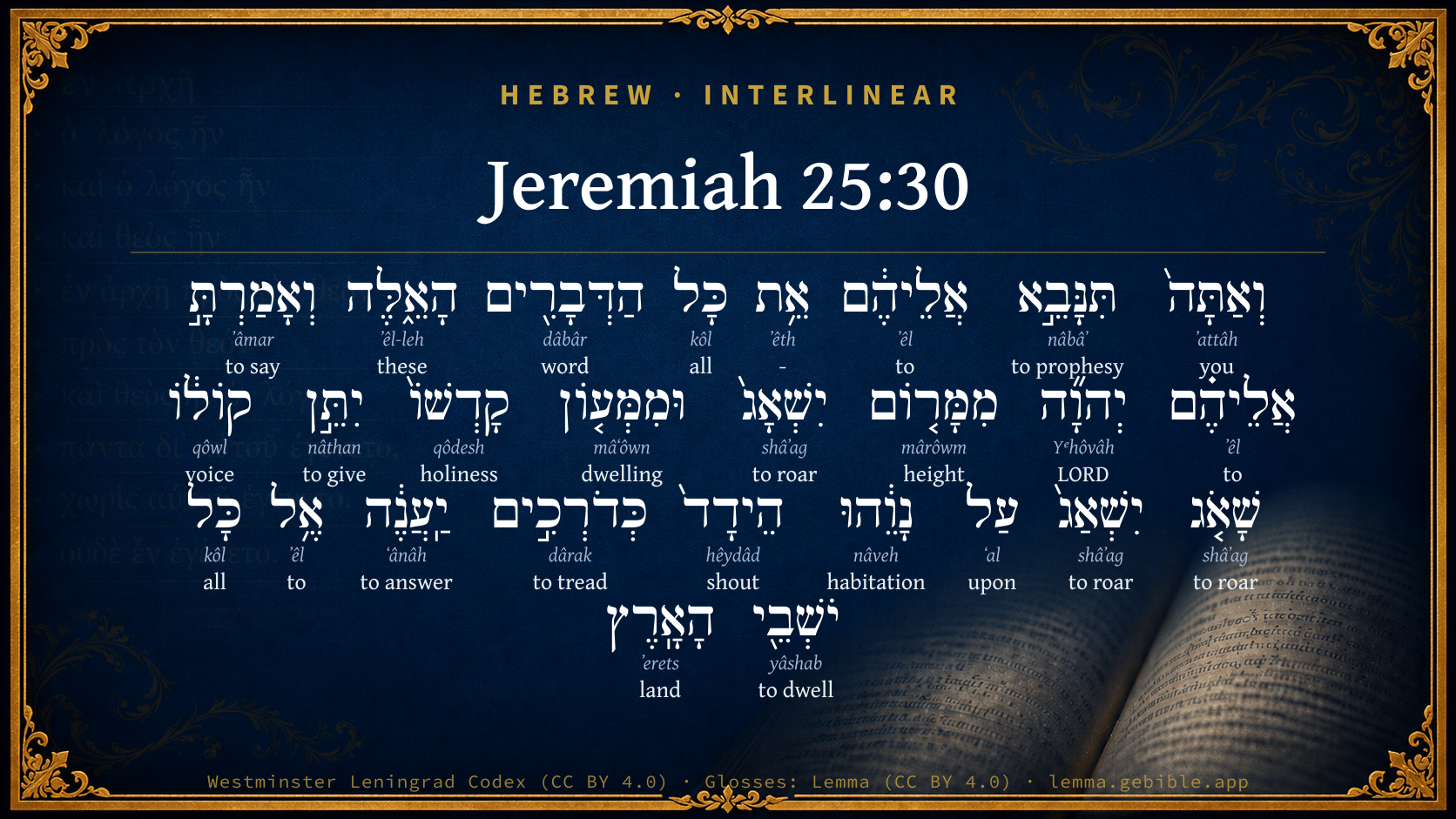
Hebrew (Westminster Leningrad Codex) Jeremiah 25:30 appears in the Hebrew Old Testament. The text above is from the Westminster Leningrad Codex. Each word links to its Strong’s number, a concise gloss, and parsing drawn from the Open Scriptures Hebrew Bible morphology. Click any word for its full Brown-Driver-Briggs (BDB) entry.
Download image
Cite this verse

Jeremiah 25:30 (World English Bible). Public Domain. Lemma interlinear Bible study tool, https://lemma.gebible.app/v/jeremiah/25/30.

Show BibTeX & RIS
BibTeX
RIS
English Translation
Therefore prophesy you against them all these words, and tell them, Yahweh will roar from on high, and utter his voice from his holy habitation; he will mightily roar against his fold; he will give a shout, as those who tread [the grapes], against all the inhabitants of the earth.
World English Bible · Public Domain
Download a study sheet

One document with this verse’s original text, its word-by-word gloss line, the meaning frame, cross-references with their text, attributed commentary, and full source and license credits — printable, and it pastes into notes with its structure intact.

This verse Autodidact and up

Study sheet (.html) Plain text (.txt)

A passage Seminary Student

Up to 50 verses in one chapter. A passage sheet keeps up to 6 commentary sources and 12 cross-references per verse, in the order this page ranks them, and says so on the sheet whenever that leaves anything out. Ask for a single verse and you get the Autodidact verse sheet above.

Everything on this page stays free to read, with no account — the sheet is a download of what is already on screen, not access to it.

Want to remove ads? Support Godless Engineer
Compare translations 3

The same verse in 3 English versions, stacked beneath the original-language interlinear above. Click any original word for its lexicon entry.

Each is an independent rendering of the whole verse — the interlinear is not word-aligned to these translations.

Highlighted words mark where these versions differ — a whole-verse word diff, not a word-by-word alignment.

  • World English Bible Public Domain
    Therefore prophesy you against them all these words, and tell them, Yahweh will roar from on high, and utter his voice from his holy habitation; he will mightily roar against his fold; he will give a shout, as those who tread [the grapes], against all the inhabitants of the earth.
  • King James Version Public Domain
    Therefore prophesy thou against them all these words, and say unto them, The LORD shall roar from on high, and utter his voice from his holy habitation; he shall mightily roar upon his habitation; he shall give a shout, as they that tread the grapes, against all the inhabitants of the earth.
  • unfoldingWord Literal Text CC BY-SA 4.0
    “And you, you will prophesy to them all of these words and say to them, ‘Yahweh will roar from the height, and from the habitation of his holiness he will give his voice. Roaring, he will roar against his pasture; a shout like who are treading, he will sing to all of the dwellers of the earth.

unfoldingWord Literal Text — © unfoldingWord, licensed CC BY-SA 4.0. Word-aligned USFM3 via Door43 (git.door43.org/unfoldingWord/en_ult).

Versions to compare (up to 4)

3 of 4 selected

Show all 18 translations

Every available English version of this verse, each an independent rendering of the whole verse.

  • World English Bible Public Domain
    Therefore prophesy you against them all these words, and tell them, Yahweh will roar from on high, and utter his voice from his holy habitation; he will mightily roar against his fold; he will give a shout, as those who tread [the grapes], against all the inhabitants of the earth.
  • Berean Standard Bible Public Domain
    So you are to prophesy all these words against them and say to them: ‘The LORD will roar from on high; He will raise His voice from His holy habitation. He will roar loudly over His pasture; like those who tread the grapes, He will call out with a shout against all the inhabitants of the earth.
  • Majority Standard Bible Public Domain
    So you are to prophesy all these words against them and say to them: ‘The LORD will roar from on high; He will raise His voice from His holy habitation. He will roar loudly over His pasture; like those who tread the grapes, He will call out with a shout against all the inhabitants of the earth.
  • King James Version Public Domain
    Therefore prophesy thou against them all these words, and say unto them, The LORD shall roar from on high, and utter his voice from his holy habitation; he shall mightily roar upon his habitation; he shall give a shout, as they that tread the grapes, against all the inhabitants of the earth.
  • American Standard Version (1901) Public Domain
    Therefore prophesy thou against them all these words, and say unto them, Jehovah will roar from on high, and utter his voice from his holy habitation; he will mightily roar against his fold; he will give a shout, as they that tread `the grapes', against all the inhabitants of the earth.
  • Revised Version (1885) Public Domain
    Therefore prophesy thou against them all these words, and say unto them, The LORD shall roar from on high, and utter his voice from his holy habitation; he shall mightily roar against his fold; he shall give a shout, as they that tread the grapes, against all the inhabitants of the earth.
  • Geneva Bible (1599) Public Domain
    Therefore prophecie thou against them al these words, and say vnto them, The Lord shall roare from aboue, and thrust out his voyce from his holy habitation: he shall roare vpon his habitation, and crie aloude, as they that presse the grapes, against all the inhabitants of the earth.
  • Douay-Rheims (1899) Public Domain
    And thou shalt prophesy unto them all these words, and thou shalt say to them: The Lord shall roar from on high, and shall utter his voice from his holy habitation: roaring he shall roar upon the place of his beauty: the shout as it were of them that tread grapes shall be given out against all the inhabitants of the earth.
  • Young's Literal Translation Public Domain
    And thou, thou dost prophesy unto them all these words, and hast said unto them: Jehovah from the high place doth roar, And from His holy habitation giveth forth His voice, He surely roareth for His habitation, A shout as of treaders down, God answereth all the inhabitants of the land,
  • Literal Standard Version CC BY-SA 4.0
    “And you, you prophesy all these words to them, and have said to them: YHWH roars from the high place, || And gives forth His voice from His holy habitation, || He surely roars for His habitation, || A shout as those treading [the grapes], || God answers all the inhabitants of the land,
  • Unlocked Literal Bible CC BY-SA 4.0
    You must prophesy all these words against them, and say to them, 'Yahweh will roar from the heights and he will shout with his voice from his holy dwelling, and he will roar mightily against his fold; and he will shout, like those who tread the grapes against all those who live on the earth.
  • unfoldingWord Literal Text CC BY-SA 4.0
    “And you, you will prophesy to them all of these words and say to them, ‘Yahweh will roar from the height, and from the habitation of his holiness he will give his voice. Roaring, he will roar against his pasture; a shout like who are treading, he will sing to all of the dwellers of the earth.
  • Darby Bible Public Domain
    And thou, prophesy unto them all these words, and say unto them, Jehovah will roar from on high, and utter his voice from his holy habitation; he will mightily roar upon his dwelling-place, he will give a shout, as they that tread [the vintage], against all the inhabitants of the earth.
  • World Messianic Bible Public Domain
    “Therefore prophesy against them all these words, and tell them, “‘The LORD will roar from on high, and utter his voice from his holy habitation. He will mightily roar against his fold. He will give a shout, as those who tread grapes, against all the inhabitants of the earth.
  • Webster's Bible Public Domain
    Therefore prophesy thou against them all these words, and say to them, The LORD shall roar from on high, and utter his voice from his holy habitation; he shall mightily roar upon his habitation; he shall give a shout, as they that tread the grapes, against all the inhabitants of the earth.
  • Free Bible Version CC BY-SA 4.0
    Give this whole message as a prophecy against them. Tell them: The Lord will thunder from high above. He will thunder loudly from the holy place where he lives. He will give a great roar against the sheepfolds. He will give a loud shout like people treading the grapes, frightening everyone who lives on earth.
  • Bible in Basic English Public Domain
    So, as a prophet, give out these words among them, and say to them, The voice of the Lord will be sounding like a lion from on high; he will send out his voice from his holy place, like the loud voice of a lion, against his flock; he will give a cry, like those who are crushing the grapes, against all the people of the earth.
  • JPS Tanakh (1917) Public Domain
    Therefore prophesy thou against them all these words, and say unto them: The LORD doth roar from on high, and utter His voice from His holy habitation; He doth mightily roar because of His fold; He giveth a shout, as they that tread the grapes, against all the inhabitants of the earth.

Literal Standard Version (2020), Covenant Press — licensed CC BY-SA 4.0. Text via the HelloAO Bible API (eBible.org). Unlocked Literal Bible (unfoldingWord) — licensed CC BY-SA 4.0. Text via the HelloAO Bible API (eBible.org). unfoldingWord Literal Text — © unfoldingWord, licensed CC BY-SA 4.0. Word-aligned USFM3 via Door43 (git.door43.org/unfoldingWord/en_ult). Free Bible Version, Dr. Jonathan Gallagher — licensed CC BY-SA 4.0. Text via the HelloAO Bible API (eBible.org).

Word by word

More ways to search: Search by grammar → Find every occurrence → Compare this word →

Practice this passage: Drill this verse → Learn its vocabulary →

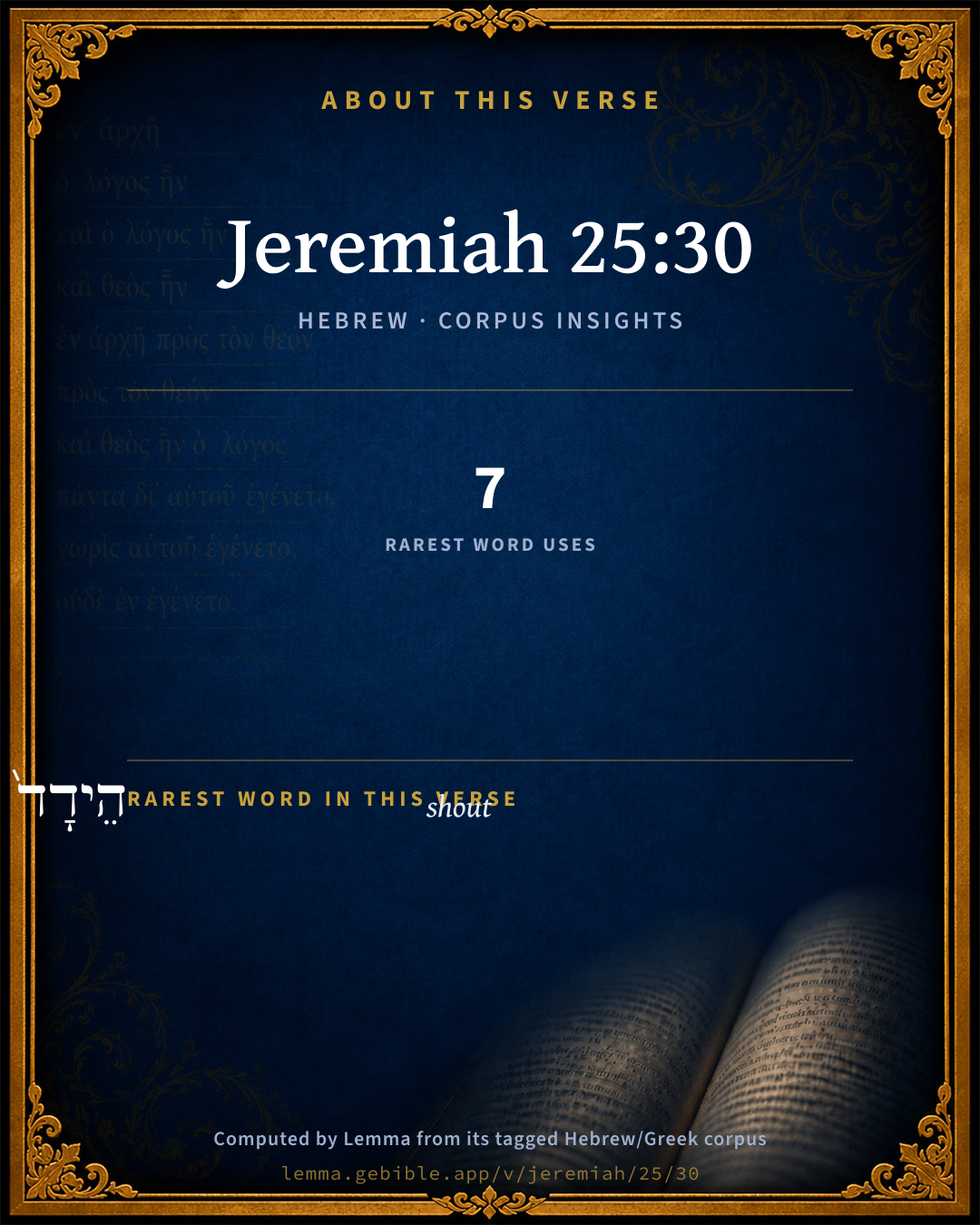
הֵידָד֙
hêydâd
H1959
“shout”
Noun, Common, Masculine, Singular, Absolute
Part of Speech
Noun
Type
Common
Gender
Masculine
Number
Singular
State
Absolute
Full BDB Definition

Origin: from an unused root (meaning to shout)

TWOT: 471a

a shout, cheer, shouting - shouting - shout (of the foe)
  1. וְאַתָּה֙ ʼattâh H859 “and · you” Conjunction + Pronoun, Personal, 2nd Person, Masculine, Singular
  2. תִּנָּבֵ֣א nâbâʼ H5012 “to prophesy” Verb, Niphal, Imperfect, 2nd Person, Masculine, Singular
  3. אֲלֵיהֶ֔ם ʼêl H413 “to · them” Preposition + Suffix, Personal, 3rd Person, Masculine, Plural
  4. אֵ֥ת ʼêth H853 “-” Particle, Direct Object
  5. כָּל kôl H3605 “all of” Noun, Common, Masculine, Singular, Construct
  6. הַדְּבָרִ֖ים dâbâr H1697 “the · words” Particle, Definite Article + Noun, Common, Masculine, Plural, Absolute
  7. הָאֵ֑לֶּה ʼêl-leh H428 “the · these” Particle, Definite Article + Pronoun, Demonstrative, Common, Plural
  8. וְאָמַרְתָּ֣ ʼâmar H559 “and · to say” Conjunction + Verb, Qal, Sequential Perfect, 2nd Person, Masculine, Singular
  9. אֲלֵיהֶ֗ם ʼêl H413 “to · them” Preposition + Suffix, Personal, 3rd Person, Masculine, Plural
  10. יְהוָ֞ה Yᵉhôvâh H3068 “LORD” Noun, Proper
  11. מִמָּר֤וֹם mârôwm H4791 “from · height” Preposition + Noun, Common, Masculine, Singular, Absolute
  12. יִשְׁאָג֙ shâʼag H7580 “to roar” Verb, Qal, Imperfect, 3rd Person, Masculine, Singular
  13. וּמִמְּע֤וֹן mâʻôwn H4583 “and · from · dwelling of” Conjunction + Preposition + Noun, Common, Both, Singular, Construct
  14. קָדְשׁוֹ֙ qôdesh H6944 “holiness · his” Noun, Common, Masculine, Singular, Construct + Suffix, Personal, 3rd Person, Masculine, Singular
  15. יִתֵּ֣ן nâthan H5414 “to give” Verb, Qal, Imperfect, 3rd Person, Masculine, Singular
  16. קוֹל֔וֹ qôwl H6963 “voice · his” Noun, Common, Masculine, Singular, Construct + Suffix, Personal, 3rd Person, Masculine, Singular
  17. שָׁאֹ֤ג shâʼag H7580 “to roar” Verb, Qal, Infinitive Absolute
  18. יִשְׁאַג֙ shâʼag H7580 “to roar” Verb, Qal, Imperfect, 3rd Person, Masculine, Singular
  19. עַל ʻal H5921 “upon” Preposition
  20. נָוֵ֔הוּ nâveh H5116 “habitation · his” Noun, Common, Both, Singular, Construct + Suffix, Personal, 3rd Person, Masculine, Singular
  21. כְּדֹרְכִ֣ים dârak H1869 “like/as · treading” Preposition + Verb, Qal, Participle Active, Masculine, Plural, Absolute
  22. יַֽעֲנֶ֔ה ʻânâh H6030 “to answer” Verb, Qal, Imperfect, 3rd Person, Masculine, Singular
  23. אֶ֥ל ʼêl H413 “to” Preposition
  24. כָּל kôl H3605 “all of” Noun, Common, Masculine, Singular, Construct
  25. יֹשְׁבֵ֖י yâshab H3427 “dwelling” Verb, Qal, Participle Active, Masculine, Plural, Construct
  26. הָאָֽרֶץ ʼerets H776 “the · land” Particle, Definite Article + Noun, Common, Both, Singular, Absolute

About this verse

These counts appear in no published source. They are computed here, from the morphology-tagged text and Lemma’s own curated glosses. What Lemma adds →

27
words
22
distinct lemmas
Prophets
section

Notable vocabulary

The rarest word here is הֵידָד֙ shout H1959 — appearing just 7 times in the whole Hebrew Bible.

Shared distinctive vocabulary

הֵידָד֙ shout H1959 occurs in 5 verses of the Hebrew Bible. Also found in:

Grammatical profile

  • 9 verbs
  • 11 nouns
  • 2 pronouns
  • 4 prepositions
  • 1 particle

Verb forms

  • תִּנָּבֵ֣א Niphal · Imperfect
  • וְאָמַרְתָּ֣ Qal · Sequential Perfect
  • יִשְׁאָג֙ Qal · Imperfect
  • יִתֵּ֣ן Qal · Imperfect
  • שָׁאֹ֤ג Qal · Infinitive Absolute
  • יִשְׁאַג֙ Qal · Imperfect
  • כְּדֹרְכִ֣ים Qal · Participle Active
  • יַֽעֲנֶ֔ה Qal · Imperfect
  • יֹשְׁבֵ֖י Qal · Participle Active

Repetition

Words recur within this verse — often emphatic in Hebrew:

  • יִשְׁאָג֙ to roar H7580 ×3
  • כָּל all H3605 ×2
  • אֲלֵיהֶ֔ם to H413 ×3

Cross-references

20

Topical passages linked to Jeremiah 25:30 in the Treasury of Scripture Knowledge — connected by theme and wording, ordered by reader-vote popularity; previews shown in the World English Bible.

  • Amos 1:2 He said: "Yahweh will roar from Zion, And utter his voice from Jerusalem; And the pastures of the shepherds will mourn, And the top of Carmel will wither."
  • Isaiah 42:13 Yahweh will go forth as a mighty man; he will stir up [his] zeal like a man of war: he will cry, yes, he will shout aloud; he will do mightily against his enemies.
  • Joel 3:16 Yahweh will roar from Zion, And thunder from Jerusalem; And the heavens and the earth will shake; But Yahweh will be a refuge to his people, And a stronghold to the children of Israel.
  • Psalms 78:65 Then the Lord awakened as one out of sleep, Like a mighty man who shouts by reason of wine.
  • Isaiah 16:9 Therefore I will weep with the weeping of Jazer for the vine of Sibmah; I will water you with my tears, Heshbon, and Elealeh: for on your summer fruits and on your harvest the [battle] shout is fallen.
  • Deuteronomy 26:15 Look down from your holy habitation, from heaven, and bless your people Israel, and the ground which you have given us, as you swore to our fathers, a land flowing with milk and honey.
  • 1 Kings 9:3 Yahweh said to him, I have heard your prayer and your supplication, that you have made before me: I have made this house holy, which you have built, to put my name there forever; and my eyes and my heart shall be there perpetually.
  • 2 Chronicles 30:27 Then the priests the Levites arose and blessed the people: and their voice was heard, and their prayer came up to his holy habitation, even to heaven.
  • Psalms 11:4 Yahweh is in his holy temple. Yahweh is on his throne in heaven. His eyes observe. His eyes examine the children of men.
  • Psalms 58:5 Which doesn't listen to the voice of charmers, No matter how skillful the charmer may be.
  • Psalms 132:14 "This is my resting place forever. Here I will live, for I have desired it.
  • Jeremiah 17:12 A glorious throne, [set] on high from the beginning, is the place of our sanctuary.
  • Jeremiah 48:33 Gladness and joy is taken away from the fruitful field and from the land of Moab; and I have caused wine to cease from the wine presses: none shall tread with shouting; the shouting shall be no shouting.
  • Hosea 5:14 For I will be to Ephraim like a lion, And like a young lion to the house of Judah. I myself will tear in pieces and go away. I will carry off, and there will be no one to deliver.
  • Hosea 13:7–8 Therefore am I to them like a lion; Like a leopard I will lurk by the path.
  • Joel 2:11–13 Yahweh thunders his voice before his army; For his forces are very great; For he is strong who obeys his command; For the day of Yahweh is great and very awesome, And who can endure it?
  • Amos 3:8 The lion has roared. Who will not fear? The Lord Yahweh has spoken. Who can but prophesy?
  • Zechariah 2:13 Be silent, all flesh, before Yahweh; for he has roused himself from his holy habitation!"
  • Revelation 14:18–20 Another angel came out from the altar, he who has power over fire, and he called with a great voice to him who had the sharp sickle, saying, "Send forth your sharp sickle, and gather the clusters of the vine of the earth, for the earth's grapes are fully ripe!"
  • Revelation 19:15 Out of his mouth proceeds a sharp, double-edged sword, that with it he should strike the nations. He will rule them with a rod of iron. He treads the winepress of the fierceness of the wrath of God, the Almighty.

Cross-references courtesy of OpenBible.info (CC BY 4.0).

Hebrew and Greek witnesses Masoretic Hebrew ↔ Greek Septuagint

The same verse in the two great witnesses to the Old Testament, shown verse-for-verse.

These are two independent witnesses, not word-aligned to each other, and the Septuagint is shown in lemma (dictionary) form.

Hebrew Jeremiah 25:30 Masoretic · Westminster Leningrad Codex

וְאַתָּה֙ תִּנָּבֵ֣א אֲלֵיהֶ֔ם אֵ֥ת כָּל הַדְּבָרִ֖ים הָאֵ֑לֶּה וְאָמַרְתָּ֣ אֲלֵיהֶ֗ם יְהוָ֞ה מִמָּר֤וֹם יִשְׁאָג֙ וּמִמְּע֤וֹן קָדְשׁוֹ֙ יִתֵּ֣ן קוֹל֔וֹ שָׁאֹ֤ג יִשְׁאַג֙ עַל נָוֵ֔הוּ הֵידָד֙ כְּדֹרְכִ֣ים יַֽעֲנֶ֔ה אֶ֥ל כָּל יֹשְׁבֵ֖י הָאָֽרֶץ

Therefore prophesy you against them all these words, and tell them, Yahweh will roar from on high, and utter his voice from his holy habitation; he will mightily roar against his fold; he will give a shout, as those who tread [the grapes], against all the inhabitants of the earth.

World English Bible · Public Domain

Greek LXX Structure differs

In the Septuagint, Jeremiah is about an eighth shorter than the Hebrew and arranges its material differently — the Oracles Against the Nations (Hebrew chapters 46–51) appear in the middle of the Greek book, after 25:13. Because the chapter and verse boundaries do not line up, a verse-for-verse comparison with the Hebrew is not shown.

A verse-for-verse comparison isn’t shown here because the chapters and verses don’t line up. Switch to the LXX edition with the MT / LXX toggle above to read the Greek directly.

On this verse, Keil & Delitzsch discusses the Septuagint’s reading. Read the note in Commentary ↓

Hebrew: Westminster Leningrad Codex (CC BY 4.0). Greek: Septuagint (public domain); English from a public-domain English Septuagint. How the Septuagint differs from the Hebrew →

Targum (Aramaic paraphrase)

1

The Targum is the ancient Jewish Aramaic paraphrase of the Hebrew Scriptures — an interpretive translation, not the Hebrew text itself. Onkelos (literal) and Pseudo-Jonathan (expansive) render the Torah, and Jonathan the Prophets. Coverage is partial: where no permissively-licensed English translation exists for a verse, only the Aramaic is shown. This is verse-level text, not a word-by-word alignment to the Hebrew.

  1. Targum Jonathan Prophets (Joshua–Malachi)
    וְאַתְּ תִּתְנַבֵּי לְהוֹן יַת כָּל פִּתְגָמַיָא הָאִלֵין וְתֵימַר לְהוֹן יְיָ מִמְרוֹמָא יַכְלֵי וּמִמְדוֹר קוּדְשֵׁיהּ יָרִים מֵימְרֵיהּ אַכְלָאָה יַכְלֵי דְיֵיתוּן בָּזוֹזִין עַל אֲרַע בֵּית שְׁכִנְתִּי הָא כְּנָחֲתֵי מַעֲצָרָא דִמְרִימִין קָלְהוֹן כֵּן יֵיתֵי זַעֲוָא לְכָל יַתְבֵי אַרְעָא:

    (no public-domain English translation for this verse)

    Targum Jonathan — Aramaic: “Mikraot Gedolot” (public domain). English: “Sefaria Community Translation” (CC0 1.0 (public-domain dedication)); “London "Chaldee Paraphrase," 1871” (public domain). Text via Sefaria.

Commentary

Notes on Jeremiah 25:30 from classic Christian and Jewish commentators (each source and its license shown beneath its notes). The classic Christian expositions comment on the surrounding passage and are grouped to its opening verse, so a note may address several verses; the Jewish commentaries on the Tanakh (Rashi and others) are per-verse, so they appear only where the commentator wrote on this verse.

Lemma curates 59 commentaries, every one of them public domain or Creative Commons licensed, each selected and text-cleaned for this edition rather than reprinted as found. About our sources →

Matthew Henry's Commentary

We have, in these verses, a further description of those terrible desolations which the king of Babylon with his armies should make in all the countries and nations round about Jerusalem. In Jerusalem God had erected his temple; there were his oracles and ordinances, which the neighbouring nations should have attended to and might have received benefit by; thither they should have applied for the knowledge of God and their duty, and then they might have had reason to bless God for their neighbourhood to Jerusalem; but they, instead of that, taking all opportunities either to debauch or to disturb that holy city, when God came to reckon with Jerusalem because it learned so much of the way of the nations, he reckoned with the nations because they learned so little of the way of Jerusalem.

They will soon be aware of Nebuchadrezzar's making war upon them; but the prophet is here directed to tell them that it is God himself that makes war upon them, a God with whom there is no contending. 1. The war is here proclaimed (Jer 25:30): The Lord shall roar from on high; not from Mount Zion and Jerusalem (as Joe 3:16, Amo 1:2), but from heaven, from his holy habitation there; for now Jerusalem is one of the places against which he roars. He shall mightily roar upon his habitation on earth from that above. He has been long silent, and seemed not to take notice of the wickedness of the nations; the times of this ignorance God winked at; but now he shall give a shout, as the assailants in battle do, against all the inhabitants of the earth, to whom it shall be a shout of terror, and yet a shout of joy in heaven, as theirs that tread the grapes; for, when God is reckoning with the proud enemies of his kingdom among men, there is a great voice of much people heard in heaven, saying, Hallelujah, Rev 19:1. He roars as a lion (Amo 3:4, Amo 3:8), as a lion that has forsaken his covert (Jer 25:38), and is going abroad to seek his prey, upon which he roars, that he may the more easily seize it. 2. The manifesto is here published, showing the causes and reasons why God proclaims this war (Jer 25:31): The Lord has a controversy with the nations; he has just cause to contend with them, and he will take this way of pleading with them. His quarrel with them is, in one word, for their wickedness, their contempt of him, and his authority over them and kindness to them. He will give those that are wicked to the sword. They have provoked God to anger, and thence comes all this destruction; it is because of the fierce anger of the Lord (Jer 25:37 and again Jer 25:38), the fierceness of the oppressor, or (as it might better be read) the fierceness of the oppressing sword (for the word is feminine) is because of his fierce anger; and we are sure that he is never angry without cause; but who knows the power of his anger? 3. The alarm is here given and taken: A noise will come even to the ends of the earth, so loud shall it roar, so far shall it reach, Jer 25:31. The alarm is not given by sound of trumpet, or beat of drum, but by a whirlwind, a great whirlwind, storm, or tempest, which shall be raised up from the coasts, the remote coasts of the earth, Jer 25:32. The Chaldean army shall be like a hurricane raised in the north, but thence carried on with incredible fierceness and swiftness, bearing down all before it. It is like the whirlwind out of which God answered Job, which was exceedingly terrible, Job 37:1; Job 38:1. And, when the wrath of God thus roars like a lion from heaven, no marvel if it be echoed with shrieks from earth; for who can choose but tremble when God thus speaks in displeasure? See Hos 11:10. Now the shepherds shall howl and cry, the kings, and princes, and the great ones of the earth, the principal of the flock. They used to be the most courageous and secure, but now their hearts shall fail them; they shall wallow themselves in the ashes, Jer 25:34. Seeing themselves utterly unable to make head against the enemy, and seeing their country, which they have the charge of and a concern for, inevitably ruined, they shall abandon themselves to sorrow. There shall be a voice of the cry of the shepherds, and a howling of the principal of the flock shall be heard, Jer 25:36. Those are great calamities indeed that strike such a terror upon the great men, and put them into this consternation. The Lord hath spoiled their pasture, in which they fed their flock, and out of which they fed themselves; the spoiling of that makes them cry-out thus. Perhaps, carrying on the metaphor of a lion roaring, it alludes to the great fright that shepherds are in when they hear a roaring lion coming towards their flocks, and find they have no way to flee (Jer 25:35) for their own safety, neither can the principal of their flock escape. The enemy will be so numerous, so furious, so sedulous, and the extent of their armies so vast, that it will be impossible to avoid falling into their hands. Note, As we cannot out-face, so we cannot out-run, the judgments of God. This is that for which the shepherds howl and cry. 4. The progress of this war is here described (Jer 25:32): Behold, evil shall go forth from nation to nation; as the cup goes round, every nation shall have its share and take warning by the calamities of another to repent and reform. Nay, as if this ere to be a little representation of the last and general judgment, it shall reach from one end of the earth even unto the other end of the earth, Jer 25:33. The day of vengeance is in his heart, and now his hand shall find out all his enemies, wherever they are, Psa 21:8. Note, When our neighbour's house is on fire it is time to be concerned for our own. When one nation is a seat of war every neighbouring nation should hear, and fear, and make its peace with God. 5. The dismal consequences of this war are here foretold: The days of slaughter and dispersions are accomplished, that is, they are fully come (Jer 25:34), the time fixed in the divine counsel for the slaughter of some and the dispersion of the rest, which will make the nations completely desolate. Multitudes shall fall by the sword of the merciless Chaldeans, so that the slain of the Lord shall be every where found: they are slain by commission from him, and are sacrificed to his justice. The slain for sin are the slain of the Lord. To complete the misery of their slaughter, they shall not be lamented in particular, so general shall the matter of lamentation be. Nay, they shall not be gathered up, nor buried, for they shall have no friends left to bury them, and the enemies shall not have so much humanity in them as to do it; and then they shall be as dung upon the earth, so vile and noisome: and it is well if, as dung manures the earth and makes it fruitful, so these horrid spectacles, which lie as monuments of divine justice, might be a means to awaken the inhabitants of the earth to learn righteousness. The effect of this war will be the desolation of the whole land that is the seat of it (Jer 25:38), one land after another. But here are two expressions more that seem to make the case in a particular manner piteous. (1.) You shall fall like a pleasant vessel, Jer 25:34. The most desirable persons among them, who most valued themselves and were most valued, who were looked upon as vessels of honour, shall fall by the sword. You shall fall as a Venice glass or a China dish, which is soon broken all to pieces. Even the tender and delicate shall share in the common calamity; the sword devours one as well as another. (2.) Even the peaceable habitations are cut down. Those that used to be quiet, and not molested, the habitations in which you have long dwelt in peace, shall now be no longer such, but cut down by the war. Or, Those who used to be quiet, and not molesting any of their neighbours, those who lived in peace, easily, and gave no provocation to any, even those shall not escape. This is one of the direful effects of war, that even those who were most harmless and inoffensive suffer hard things. Blessed be God, there is a peaceable habitation above for all the sons of peace, which is out of the reach of fire and sword.

Matthew Henry's Commentary on the Whole Bible (1708–1710) — public domain (CC PDM 1.0). Text via the HelloAO Bible API.

Trapp's Complete Commentary

John Trapp

Jer 25:30 Therefore prophesy thou against them all these words, and say unto them, The LORD shall roar from on high, and utter his voice from his holy habitation; he shall mightily roar upon his habitation; he shall give a shout, as they that tread [the grapes], against all the inhabitants of the earth.

Ver. 30. The Lord shall roar from on high.] As a lusty lion, having discovered his prey, runneth upon it, roaring so horribly that he astonisheth the creatures and sets them at a stand.

He will mightily roar upon his habitation.] Pliny reporteth of the lioness, that she bringeth forth her whelps dead, and so they remain for the space of three days, until the lion, coming near to the den where they lie, lifteth up his voice, and roareth so fiercely, that presently they revive and rise. The "Lion of the tribe of Judah" will roar to like purpose at the last day; and doth afore, when he pleaseth, roar terribly upon his enemies, to their utter amazement. {Joe 3:16 Amo 1:2; Amo 3:8}

He shall give a shout, as those that tread the grapes.] When they have their feet in the winepress, and the new liquor in their heads, as one phraseth it.

John Trapp, A Commentary or Exposition upon All the Books of the Old and New Testament (1647–1656) — public domain. Text from a community e-Sword module.

Joseph Benson's Commentary

Jer 25:30-33. The Lord shall roar from on high — Shall manifest his anger from heaven. God speaks by his judgments, and those, when they are very terrible, may be fitly compared to the roaring of a lion, which strikes a consternation into those that hear it. He shall mightily roar upon his habitation — He shall pronounce and execute a terrible judgment upon his temple, the place on earth which he hath chosen for his residence: see 1Ki 8:29. He shall give a shout as they that tread the grapes — That is, He shall utter his voice before his army, as Joel expresses it, Joe 2:11. Like a leader or general, he shall encourage them to give the onset upon their enemies, which is usually performed with a shout, as great as that which the treaders of grapes use at the time of the vintage. A noise shall come to the ends of the earth — The report of these calamities and confusions shall reach the most distant countries. For the Lord hath a controversy with the nations — God enters into judgment with men for their impieties, as being so many injuries to his honour, for which he demands satisfaction, Hos 4:1; Mic 6:2. He will plead with all flesh — Namely, with fire and sword, as Isaiah expresses it, Isa 66:16. He will give the wicked to the sword — His quarrel with men is for their wickedness, for their contempt of him, of his authority over them, and kindness to them. They have provoked him to anger, and thence comes all this destruction. Behold, evil shall go forth from nation to nation — As the cup of God’s wrath goes round, every nation shall have its share, and take its turn, because one doth not take warning, by the calamities of another, to repent and reform. A great whirlwind shall be raised up, &c. — The Chaldean army shall come like a hurricane, raised in the north, and thence carried forward with incredible fierceness and swiftness, bearing down all before it. God’s vengeance is often compared to a whirlwind, and is here said to come from the coasts, or sides of the earth, because Chaldea was, at that time, thought to be one of the most remote regions. And the slain of the Lord, &c. — Multitudes shall fall by the sword of the merciless Chaldeans, so that the dead shall be everywhere found, here termed, the slain of the Lord, because slain by commission from him, and sacrificed to his justice. They shall not be lamented — They shall fall in such great numbers that the usual funeral rites and lamentations shall not be paid them, and many of them will lie unburied.

Joseph Benson's Commentary on the Old and New Testaments (1811–1818) — public domain. Text from a community e-Sword module.

Whedon's Commentary on the Bible

Daniel D. Whedon

THE JUDGMENT ON THE WORLD, Jer_25:30-38.

30. The Lord shall roar — As a lion furious for his prey, (see Joe_3:16; Amo_1:2,) before whom sheep and shepherds (Jer_25:34-36) fall helplessly on the ground in consternation and despair.

They that tread the grapes — Who raise the vintage-shout, keeping time, as was the custom, by the alternate raising and pushing down of the feet.

Daniel D. Whedon (gen. ed.), Commentary on the Old and New Testaments (1874–1909) — public domain. Text from a community e-Sword module.

Keil & Delitzsch

C. F. Keil & F. Delitzsch

"But do thou prophesy to them all these words, and say unto them: Jahveh will roar from on high, and from His holy habitation let His voice resound; He will roar against His pasture, raise a shout like treaders of grapes against all the inhabitants of the earth. Jer 25:31. Noise reacheth to the end of the earth, for controversy hath Jahveh with the nations; contend will He with all flesh; the wicked He gives to the sword, is the saying of Jahveh. Jer 25:32. Thus saith Jahveh of hosts: Behold, evil goeth forth from nation to nation, and (a) great storm shall raise itself from the utmost coasts of the earth. Jer 25:33. And the slain of Jahveh shall lie on that day from one end of the earth unto the other, shall not be lamented, neither gathered nor buried; for dung shall they be upon the ground. Jer 25:34. Howl, ye shepherds, and cry! and sprinkle you (with ashes), ye lordliest of the flock! For your days are filled for the slaughter; and I scatter you so that ye shall fall like a precious vessel. Jer 25:35. Lost is flight to the shepherds, and escape to the lordliest of the flock. Jer 25:36. Hark! Crying of the shepherds and howling of the lordliest of the flock; for Jahveh layeth waste their pasture. Jer 25:37. Desolated are the pastures of peace because of the heat of Jahveh's anger. Jer 25:38. He hath forsaken like a young lion his covert; for their land is become a desert, because of the oppressing sword, and because of the heath of His anger."

In this passage the emblem of the cup of the Lord's anger (Jer 25:25-29) is explained by a description of the dreadful judgment God is to inflict on all the inhabitants of the earth. This is not the judgment on the world at large as distinguished from that proclaimed in Jer 25:15-29 against the kingdom of God and the kingdoms of the world, as Ng. supposes. It is the nature of this same judgment that is here discussed, not regard being here paid to the successive steps of its fulfilment. Jer 25:30 and Jer 25:31 are only a further expansion of the second half of Jer 25:29. "All these words" refers to what follows. The clause"Jahveh will roar" to "let His voice resound" is a reminiscence from Joe 3:16 and Amo 1:2; but instead of "out of Zion and out of Jerusalem" in those passages, we have here "from on high," i.e., heaven, and out of His holy habitation (in heaven), because the judgment is not to fall on the heathen only, but on the theocracy in a special manner, and on the earthly sanctuary, the temple itself, so that it can come only from heaven or the upper sanctuary. Jahveh will roar like a lion against His pasture (the pasture or meadow where His flock feeds, cf. Jer 10:25); a name for the holy land, including Jerusalem and the temple; not: the world subject to Him (Ew.). 'הידד , He will answer Hedad like treaders of grapes; i.e., raise a shout as they do. Answer; inasmuch as the shout or wary-cry of Jahveh is the answer to the words and deeds of the wicked. Grammatically הידד is accus. and object to the verb: Hedad he gives as answer. The word is from הדד, crash, and signifies the loud cry with which those that tread grapes keep time in the alternate raising and thrusting of the feet. Ew. is accordingly correct, though far from happy, in rendering the word "tramping-song;" see on Isa 16:9. As to the figure of the treader of grapes, cf. Isa 63:3.

Jer 25:31

שׁאון is the din of war, the noise of great armies, cf. Isa 17:12., etc. For the Lord conducts a controversy, a cause at law, with the nations, with all flesh, i.e., with all mankind; cf. Jer 2:9, Jer 2:35. - הרשׁעים is for the sake of emphasis put first and resumed again in the suffix to נתנם. "Give to the sword" as in Jer 15:9.

Jer 25:32-33

As a fierce storm (cf. Jer 23:19) rises from the ends of the earth on the horizon, so will evil burst forth and seize on one nation after another. Those slain by Jahveh will then lie, unmourned and unburied, from one end of the earth to the other; cf. Jer 8:2; Jer 16:4. With "slain of Jahveh," cf. Isa 66:16. Jahveh slays them by the sword in war.

Jer 25:34-35

No rank is spared. This is intimated in the summons to howl and lament addressed to the shepherds, i.e., the kings and rulers on earth (cf. Jer 10:21; Jer 22:22, etc.), and to the lordly or glorious of the flock, i.e., to the illustrious, powerful, and wealthy. With "sprinkle you," cf. Jer 6:26. Your days are full or filled for the slaughter, i.e., the days of your life are full, so that ye shall be slain; cf. Lam 4:18. וּתפוצותיכם is obscure and hard to explain. It is so read by the Masora, while many codd. and editt. have וּתפוּצותיכם. According to this latter form, Jerome, Rashi, Kimchi, lately Maur. and Umbr., hold the word for a substantive: your dispersions. But whether we connect this with what precedes or what follows, we fail to obtain a fitting sense from it. Your days are full and your dispersions, for: the time is come when ye shall be slain and dispersed, cannot be maintained, because "dispersions" is not in keeping with "are full." Again: as regards your dispersions, ye shall fall, would give a good meaning, only if "your dispersions" meant: the flock dispersed by the fault of the shepherds; and with this the second pers. "ye shall fall" does not agree. The sig. of fatness given by Ew. to the word is wholly arbitrary. Hitz., Gr. and Ng. take the word to be a Tiphil (like תהרה, Jer 12:5; Jer 22:15), and read תּפיצותיכם, I scatter you. This gives a suitable sense; and there is no valid reason for attaching to the word, as Hitz. and Gr. do, the force of פּצץ or נפץ, smite in pieces. The thought, that one part of the flock shall be slain, the other scattered, seems quite apt; so also is that which follows, that they are scattered shall fall and break like precious, i.e., fine, ornamental vases. Hence there was no occasion for Ew.'s conjectural emendation, כּכרי, like precious lambs. Nor does the lxx rendering: ἥωσπερ οἱ κριοὶ οἱ ἐκλεκτοί, give it any support; for כּרים does not mean rams, but lambs. The similar comparison of Jechoniah to a worthless vessel (22:28) tells in favour of the reading in the text (Graf). - In Jer 25:35 the threatening is made more woeful by the thought, that the shepherds shall find no refuge, and that no escape will be open to the sheep.

Jer 25:36-38

The prophet is already hearing in spirit the lamentation to which in Jer 25:34 he has called them, because Jahveh has laid waste the pastures of the shepherds and their flocks, and destroyed the peaceful meadows by the heat of His anger. - In Jer 25:38, finally, the discourse is rounded off by a repetition and expansion of the thought with which the description of the judgment was begun in Jer 25:30. As a young lion forsakes his covert to seek for prey, so Jahveh has gone forth out of His heavenly habitation to hold judgment on the people; for their (the shepherds') land becomes a desert. The perff. are prophetic. כּי has grounding force. The desolation of the land gives proof that the Lord has arisen to do judgment. חרון היּונה seems strange, since the adjective היּונה never occurs independently, but only in connection with חרב (Jer 46:16; Jer 50:16, and with עיר, Zac 3:1). חרון, again, is regularly joined with 'אף י, and only three times besides with a suffix referring to Jahveh (Exo 15:7; Psa 2:5; Eze 7:14). In this we find justification for the conjecture of Hitz., Ew., Gr., etc., that we should read with the lxx and Chald. חרב . The article with the adj. after the subst. without one, here and in Jer 46:16; Jer 50:16, is to be explained by the looseness of connection between the participle and its noun; cf. Ew. ֗335, a.

Keil & Delitzsch — Biblical Commentary on the Old Testament (1861–1891) — public domain (CC PDM 1.0). Text via the HelloAO Bible API. (Old Testament only.)

Tyndale Open Study Notes

Tyndale Open Resources

25:30-31 First, the Lord spoke through Jeremiah against his own land, Judah; then Jeremiah delivered the messages of God’s judgment against everyone on earth.

Tyndale Open Study Notes — © Tyndale Open Resources, licensed CC BY-SA 4.0. Text via the HelloAO Bible API.

Jamieson, Fausset & Brown

Robert Jamieson, A. R. Fausset & David Brown

roar--image from a destructive lion (Isa 42:13; Joe 3:16).

upon his habitation--rather, "His pasturage"; keeping up the image of a lion roaring against the flock in the pasture. The roar was first to go forth over Judea wherein were "the sheep of His pasture" (Psa 100:3), and thence into heathen lands.

shout . . . tread . . . grapes-- (Jer 48:33; Isa 16:9-10).

Jamieson, Fausset & Brown — Commentary Critical and Explanatory on the Whole Bible (1871) — public domain (CC PDM 1.0). Text via the HelloAO Bible API.

John Calvin's Commentaries

The word הידד, eidad, is rendered celeusma, a shout; but some render it a mournful singing; and it often occurs when the vintage is spoken of. Celeusma, as it is well known, is the shout of sailors. Its etymology is indeed general in its meaning; for κελεύειν is to exhort, to encourage; and then the noun is exhortation. But as this word is only used as to sailors, I prefer to adopt the word sound, or a loud noise.

Then he says, Prophesy thou against them all these words, and say to them, etc. I have already reminded you that no command was given to the Prophet to go to the heathens and to address each nation among them, or, in other words, to perform among them his prophetic office. But though he did not move a foot from the city, yet the influence of his prophecy reached through every region of the earth. The preaching therefore of Jeremiah was not in vain, for the Jews understood by what happened, that there was in the language of the holy man the power of the Spirit for the salvation of all the godly, and for the destruction of all the unbelieving. It is, then, in this sense that God bids and commands him again to prophesy against all nations, and to speak to them, not that he actually addressed them; but when he taught the Jews, his doctrine had an influence on all nations.

And he says, Jehovah from on high shall roar, and from the habitation of his holiness shall send forth his voice The metaphor of roaring is sufficiently common. It seems indeed unsuitable to apply it to God; but we know how tardy men are, and how they indulge themselves in their own insensibility, even when God threatens them. Hence God, adopting a hyperbolical mode of speaking, reproves their stupidity, as he cannot move them except he exceeds the limits of moderation. This then is the reason why he compares himself to a lion, not that we are to imagine that there is anything savage or cruel in him; but as I have said, men cannot be moved, except God puts on another character and comes forth as a lion, while yet he testifies not in vain elsewhere, that he is slow to wrath, inclined to mercy and long-suffering. (Psalm 86:5, 15.) Let us then know that the impious contempt, by which most men are fascinated, is thus condemned, when God does as it were in this manner transform himself, and is constrained to represent himself as a lion.

Roar, then, he says, shall Jehovah, from on high, and from the habitation of his holiness shall he send forth his voice When he speaks of on high, it is probable that heaven is meant; and the habitation of his holiness is often taken for the sanctuary or the Temple; but in other places, when the same words are repeated, heaven is also meant by the habitation of his holiness. There is yet nothing unsuitable, if we say that the Prophet here refers to the Temple, and that he thus refers to it, that he might raise upwards the minds of the Jews, who had their thoughts fixed on the visible Temple: nay, this seems to be required by the context. They indeed foolishly thought that God was bound to them, because it had been said,

“Here is my rest for ever; here will my name and power dwell.” (Psalm 132:14)

They strangely thought that there was no God but he who was inclosed in that visible and external sanctuary. Hence was that pride which Isaiah reproves and severely condemns when he says,

“Where is the place for my rest? the heaven is my throne, and the earth is my footstool; what place then will you build for me?” (Isaiah 66:1.)

The Prophet there does not merely speak, as many think, against superstition; but he rather beats down that foolish arrogance, because the people thought that God could never be separated from the material Temple. And yet it was not for nothing that the Temple had the name of being the royal throne of God, provided vices were removed. So now the Prophet, though he exalts God above the heavens, yet alludes to the visible sanctuary, when he says, “Roar shall Jehovah from on high, and from the habitation of his holiness shall he send forth his voice;” that is, though the Gentiles think that God sits and rests in a corner, yet his throne is in heaven: that he has chosen for himself a terrestrial habitation, is no reason why the government of the whole earth should not be in his hands; and therefore he manifests proofs of his vengeance towards all nations; but for the sake of his Church he will go forth as it were from his Temple: and he repeats again, Roaring he shall roar on his dwelling, or habitation. Jerome usually renders the last word ornament, beauty; and yet this passage sufficiently proves that it cannot mean any other thing than habitation, as well as many other passages.

He afterwards proceeds to another comparison, He will respond a shout, as those who tread the wine-press against all the inhabitants of the earth This repetition and variety confirm what I have said, — that God hyperbolically set forth the vehemence of his voice in order to fill with terror the secure and the torpid. And the Prophet seems here to intimate, that though there would be none to cheer, yet God’s voice would be sufficiently powerful. For they who tread the wine-press mutually encourage one another by shouting; one calls on another, and thus they rouse themselves to diligence. There is also a mutual concord among sailors, when they give their shouts, as well as among the workmen who tread the grapes in the wine-press. But though God would have no one to rouse him, yet he himself would be sufficient; he will respond a shout The Prophet might have used another word; but he says, he will respond — to whom? even to himself; that is, though all united to extinguish God’s vengeance, yet he will come forth a conqueror, nor will he have any need of help. It then follows, —

John Calvin's Commentaries (1540-1563) — public domain. Text from the Calvin Translation Society English edition (1840s-50s) via the Christian Classics Ethereal Library (ccel.org). Calvin's coverage is partial (roughly two-thirds of the Bible); uncommented books and verses are honest gaps, never fabricated. The 19th-century editor's footnotes and remarks are omitted so the notes are faithfully Calvin's own voice.

Ellicott's Commentary for English Readers

(30) He shall mightily roar upon his habitation.—The use of the same English word for two Hebrew words of very different meaning is here singularly infelicitous. The first “habitation” is the dwelling-place of Jehovah, from which the thunders of His wrath are heard. The second is the “pasture” or dwelling-place of the flock and its shepherds, as in Jer_6:2; Jer_10:25; Psa_79:7, upon whom the storm falls. Possibly, under its association with this new word, the roaring becomes to the prophet’s mind as that of the lion which attacks the flock. The same bold imagery for the Divine judgments meets us in Joe_3:16; Amo_1:2; Amo_3:8.

A shout, as they that tread the grapes.—The image is reproduced from Isa_63:3. The “shout” of those who tread the wine-press, crushing the grapes beneath their feet (Isa_16:10), is as the victorious war-cry of the Lord of Hosts, working through human conquerors, and crushing the nations of the earth in His avenging wrath.

A Bible Commentary for English Readers, edited by Charles John Ellicott (1878–1897) — public domain. Text from a community e-Sword module.

The Cambridge Bible for Schools and Colleges

gen. ed. J. J. S. Perowne

30. The Lord shall roar] as a lion coming forth from his covert, and terrifying by his approach the shepherds and their flocks. There is no escape and the slain cover the earth. Cp. Amo_1:2.

fold] For mg. pasture cp. Jer_10:25, Jer_23:3.

a shout] lit. a vintage shout, the cry with which the treaders of the grapes used to cheer their toil. So Jehovah will trample down the nations. Cp. Jer_48:33, where see note; Isa_16:10. Here, however, it is the battle shout. Cp. Jer_51:14.

30–38. The judgement to come upon all the peoples of the earth. The description is characterized by Oriental hyperbole. A considerable amount is adapted from elsewhere, and the eschatological character of the whole tends to throw serious doubts upon the genuineness of the passage.

The Cambridge Bible for Schools and Colleges (gen. ed. J. J. S. Perowne; Cambridge University Press, 1878–1918) — public domain. Text from a community e-Sword module.

John Gill's Exposition

A noise shall come up even to the ends of the earth,.... Wars, and rumours of wars, everywhere, till the cup has gone round, and all nations have drank of it, and have felt the power of divine wrath for their sins:

for the Lord hath a controversy with the nations; will enter into a judicial process with them; will litigate the point with them, and try it openly; that it may be seen who is in the right, and who in the wrong:

he will plead with all flesh; or enter into judgment with them, as Kimchi; or reprove them in judgment, as Jarchi; he will be too many for them; he will carry his case, overcome them in judgment, and reprove and condemn them. Or the words may be rendered, "he will be judged by all flesh" (s); he will submit it to the judgment of the whole world, if it is not a righteous thing in him to do what he is about to do, and will do; he will make it clear and manifest that he does nothing unjustly, but all according to the strict rules of justice and equity:

he will give them that are wicked to the sword, saith the Lord; to be destroyed by it, and none but them; and seeing they are such that deserve it, he is not to be charged with unrighteousness in so doing.

(s) "judicium subibit ipse cum omni carne", Tigurine version.

John Gill's Exposition of the Whole Bible (1746–1763) — public domain (CC PDM 1.0). Text via the HelloAO Bible API.

Albert Barnes' Notes on the Bible

Yahweh has risen like a lion from His covert, and at His roaring the whole world is filled with terror and confusion.

Upon his habitation - Against His pasture; i. e., Judaea. Yahweh comes forth as the lion to destroy the sheep which lie terrified within the circle of the tents.

A shout - The vintage-shout, here used for the war-cry. Compare Isa 16:9; Isa 63:3.

Albert Barnes' Notes on the Bible (1834–1885) — public domain. Text from a community e-Sword/MySword module.

Haydock's Catholic Bible Commentary

Beauty. The temple, which was like the palace (Calmet) of the great king. (Haydock) --- Grapes. Great feasting was then customary. The soldiers rushing to battle, "answer" the Lord. (Septuagint) (Calmet) --- People encouraged one another by songs under the labour of the vine-press, as those in distress must do. (Worthington)

George Leo Haydock (1774–1849), Haydock's Catholic Family Bible and Commentary, 1859 edition — public domain. Excludes Psalms (Douay-Rheims chapter numbering differs from Protestant) and Deuterocanonical books (Catholic canon only).

Matthew Poole's English Annotations

Reveal my will unto them presently, to revenge myself upon them, in words to this sense or purpose; tell them that I, who hitherto have been toward them as a lamb, will now be to them as a lion; so Joe 3:16; Amo 1:2; 3:8; and, as a lion, will roar from heaven; for though the temple be sometimes called his holy habitation, yet the foregoing words, from, on high, expound this term in this place otherwise. Upon his habitation, or in his habitation, which is more likely to be understood, in heaven, (as the former,) than, in Jerusalem, as divers would have it; for God is here revealing his wrath against foreign nations, upon some of which these judgments came after God had done roaring in or upon Jerusalem.

He shall give a shout, as they that tread the grapes, against all the inhabitants of the earth; a shout, such as soldiers use to give when they storm a city, or assault their enemies, to encourage their fellows, and to dishearten their enemies; like the shout of those that tread the grapes, singing one to another, or rejoicing and triumphing in the vintage.

Matthew Poole's English Annotations on the Holy Bible (1683–1685) — public domain. Text from a community e-Sword/MySword module.

The Pulpit Commentary

Vers. 30-38. The judgment upon the world.

Therefore prophesy thou, etc. Babylon, like the smaller kingdoms which it absorbed, has fallen, and nothing remains (for nothing had been revealed to the prophet concerning an interval to elapse previously) but to picture the great assize from which no flesh should be exempt. As the lion suddenly bursts, roaring, from his lair, so Jehovah, no longer the "good Shepherd," shall roar from on high (comp. Joe_3:16) even upon his habitation, or rather, against his pasture, where his flock (Jer_23:1) has been feeding so securely. He shall give a shout. It is the technical term used at once for the vintage-shout and for the battle-cry. In Isa_16:9, Isa_16:10, there is a beautiful allusion to this double meaning, and so perhaps there is here. (comp. Jer_51:14)

Vers. 30-38. The vision of final judgment.

A sublime and terrible description; corresponding with many others throughout the Old and New Testaments.

I IT SERVES A GREAT ETHICAL PURPOSE. The sense of wrongdoing is thereby intensified, and some idea is given of the awful consequences of sin and its hatefulness to the mind of God.

II AN EVIDENCE OF THE HISTORIC SIGNIFICANCE OF SIN AND SALVATION. By such visions as these the ages of the world are linked together and shown to be convergent in one point. There are not to be so many judgments of isolated offences, but one judgment, towards which all the world has looked forward. Sin increases with the lapse of time, and develops into a more pronounced opposition to truth and goodness only in final judgment can all its significance be comprehended and its issues be stayed.

III AS EVIDENCE OF THE REALITY OF THE PROPHETIC GIFT AND ITS SPIRITUAL END. This vision is corroborated by the universal instincts of man, on the one hand, and by the endorsement of Christ on the other. The various minor judgments which have intervened between that time and this are so many proofs of the correctness of the prophet"s intuition. And the manner in which he and other seers have laid chief emphasis upon this event exhibits the fundamental moral purpose of all prophecy. Its intention is to reveal the righteousness of God, and to lead men into its practice and love. M.

The Pulpit Commentary (1880–1919), ed. H.D.M. Spence-Jones & Joseph S. Exell — public domain. Text from a community e-Sword module.

Kretzmann's Popular Commentary

Paul E. Kretzmann

The Judgment upon the World

v. 30. Therefore prophesy thou against them all these words, all nations being included in this address, and say unto them, The Lord shall roar from on high, with an angry voice, and utter His voice from His holy habitation, heaven being regarded as His dwelling-place. He shall mightily roar upon His habitation, or "against His pasturage," the picture of a lion roaring against the flock in the pasture being continued. He shall give a shout, a clear cry of exultation, as they that tread the grapes, to the accompaniment of a regular shout enabling them to keep time, against all the inhabitants of the earth, that is, of the land of Judah as beginning the judgment upon the whole world.

v. 31. A noise shall come even to the ends of the earth, that is, the tumult of enormous armies; for the Lord hath a controversy with the nations, a cause at issue before the tribunal of His justice; He will plead with all flesh, Cf Isa 66:16; He will, as the result of this just trial, give them that are wicked to the sword, saith the Lord, to be executed in battle at His command.

v. 32. Thus saith the Lord of hosts, the Commander of the heavenly armies. Behold, evil shall go forth from nation to nation, in a continual progress, and a great whirlwind shall be raised up from the coasts of the earth, a storm arising at its extremities, which gradually expands to cover the whole world and to sweep through all nations.

v. 33. And the slain of the Lord, those who have become the victims of His sword in the war brought upon them, shall be at that day from one end of the earth even unto the other end of the earth, their corpses lying everywhere; they shall not be lamented, neither gathered nor burled, Cf. Jer 16:4-6; they shall be dung upon the ground, their decaying bodies acting as fertilizer. Since neither rank nor station escapes the fury of the Lord, the prophet now addresses himself to the leaders of the people, bidding them mourn.

v. 34. Howl, ye shepherds, the kings and rulers of the earth, and cry, and wallow yourselves in the ashes, as a token of great sorrow, ye principal of the flock, the strong ones, the nobles, the wealthy among the people; for the days of your slaughter and of your dispersion are accomplished, rather, "And I scatter you, so that one part of the flock is dispersed, the other part slaughtered"; and ye shall fall like a pleasant vessel, like a dainty piece of pottery, to be utterly shattered.

v. 35. And the shepherds shall have no way to flee, literally, "And there vanishes the refuge away from the shepherds," so that they cannot depend upon it, nor the principal of the flock to escape, the flock being destroyed together with its leaders.

v. 36. A voice of the cry of the shepherds and an howling of the principal of the flock shall be heard; for the Lord hath spoiled their pasture, utterly destroying the meadows which they thought inexhaustible by the blast of His burning wrath.

v. 37. And the peaceable habitations are cut down because of the fierce anger of the Lord, rendered desolate as He gave vent to His fury. The description once more returns to the picture of a lion.

v. 38. He hath forsaken His covert as the lion, leaving the thicknesses where his den is located; for their land is desolate because of the fierceness of the oppressor, before the fury of the destroyer sent by God, and because of His fierce anger, the Lord Himself having gone forth to punish His enemies.

Paul E. Kretzmann, Popular Commentary of the Bible (1921–1924) — public domain. Text from a community e-Sword module.

unfoldingWord translationNotes

Door43 World Missions Community

Yahweh will roar

Jeremiah speaks of Yahweh shouting very loudly as if he were roaring like a lion. (See: Metaphor)

from the heights

This phrase is a metonym for heaven. AT: "from heaven" (See: Metonymy)

he will roar mightily against his fold

Jeremiah speaks of Yahweh as if he were a lion and his people were a flock of sheep. The people will be helpless when Yahweh comes to punish them, as sheep are helpless when a lion attacks. (See: Metaphor)

those who tread the grapes

This refers to people who crush grapes in a winepress with their feet in order to make wine.

to the ends of the earth

This is an idiom that means the farthest places on the earth. By referencing both ends, it refers to everywhere in between. AT: "to the farthest places on the earth" or "to everywhere on earth" (See: Idiom and Merism)

on all flesh

Here the word "flesh" represents humanity. AT: "on all mankind" or "on all people" (See: Metonymy)

the wicked ones he will put to the sword

Here the word "sword" represents war, in which soldiers use swords as weapons, and "put to the sword" represents causing people to die in battle. AT: "He will cause wicked people to die in battle" (See: Metonymy and Metaphor)

this is Yahweh's declaration

Yahweh speaks of himself by name to express the certainty of what he is declaring. See how you translated this in Jeremiah 1:8. AT: "this is what Yahweh has declared" or "this is what I, Yahweh, have declared" (See: First, Second, or Third Person)

translationWords

Jeremiah

prophet

word

voice

grape

flesh

hand

evil

sword

unfoldingWord translationNotes — © Distant Shores Media and the Door43 World Missions Community, licensed CC BY-SA 4.0. Source: git.door43.org/Door43/en_tn.

Rashi

Rabbi Shlomo Yitzchaki (Rashi)

over His habitation He mourns over the destruction of His house.

“Hedad!” A cry of “Ha!” that those engaged in hard work cry out aloud to urge each other on to strengthen themselves, and those who tread the winepresses are accustomed to it.

He shall call out Every expression of עֲנִיָה, is an expression of a cry with a loud voice.

Rashi on the Tanakh — English translations: “The Judaica Press complete Tanach with Rashi, translated by A. J. Rosenberg” (CC BY 4.0); “Pentateuch with Rashi's commentary by M. Rosenbaum and A.M. Silbermann, 1929-1934” (public domain); “The Metsudah Tanach series, Lakewood, N.J” (CC BY 4.0); and “The Book of Joshua, Metsudah Publications, 1997” (CC BY 4.0). Text via Sefaria.

Lesson kit

Teaching starters — assembled from the data on this page, not authored interpretation. Every prompt links to the verse data it draws on. Edit before teaching.

Jeremiah, in the Prophets, opens this verse with 27 words (22 distinct Hebrew lemmas). Its most distinctive word is hêydâd (“shout”). A historical commentator’s framing appears above. Read the whole chapter for the surrounding context.

Discussion questions

  1. The word hêydâd carries the sense “shout.” How does it shape the verse?
  2. How does Isaiah 16:9, which shares the word «shout», read alongside this verse?
  3. What does the repetition of “to roar” (3× in this one verse) do in this verse?
  4. These translations render this verse differently. What is at stake in choosing one wording over another?
  5. «תִּנָּבֵ֣א» is a Niphal Imperfect verb. How does that grammatical form shape the action described?
  6. Compare how Matthew Henry's Commentary and Trapp's Complete Commentary read this verse. Where do they agree or differ?

Things to notice

Reading settings

Reading text

Shown beneath each verse's original-language words.

Old Testament
Old Testament edition

Read the OT as the Masoretic Hebrew (MT) or the Greek Septuagint (LXX).

English shown for the Greek Septuagint (in the Hebrew ↔ Greek comparison).

Comparing translations? Open the Compare panel on any verse page to stack up to four side by side.