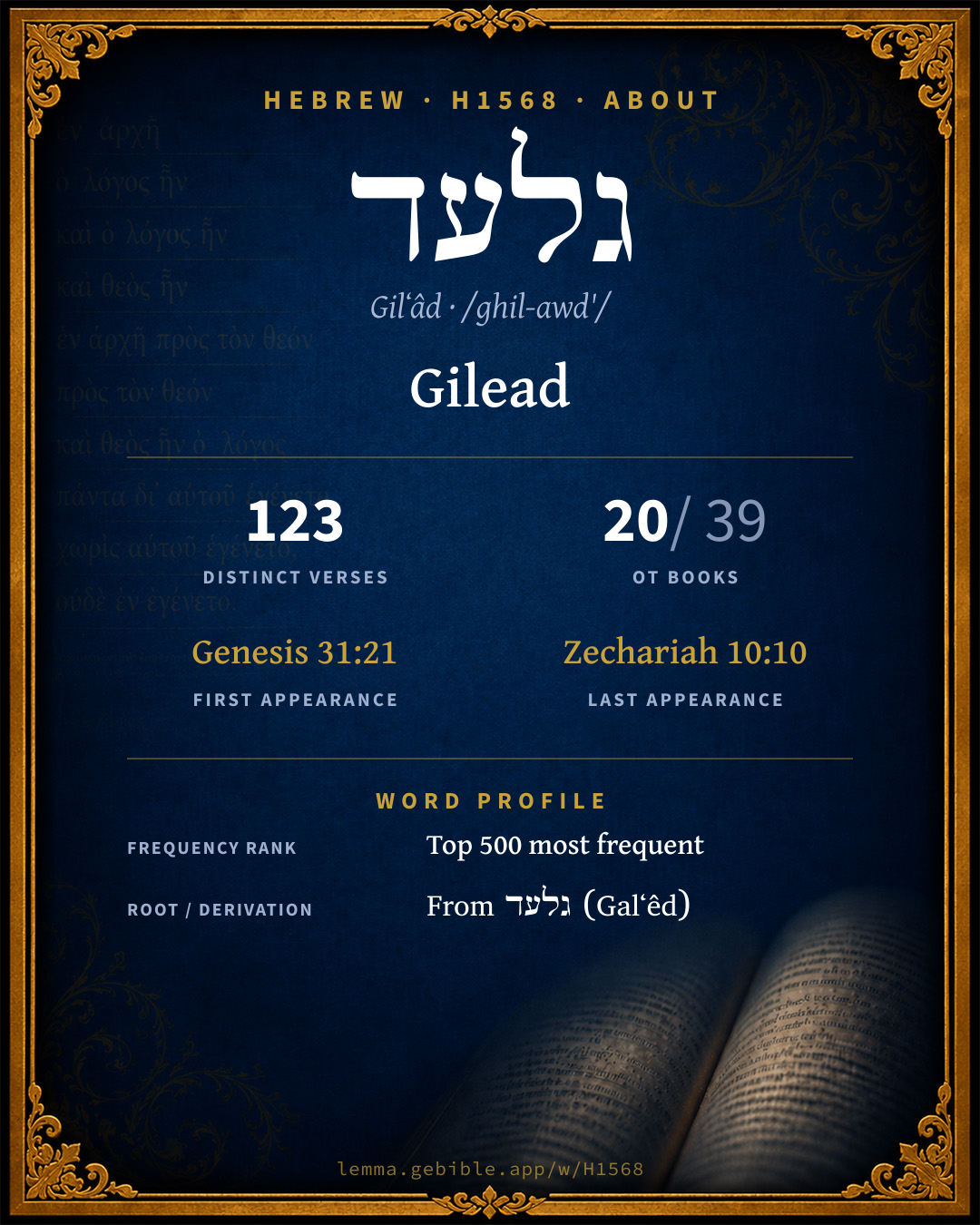
גִּלְעָד
Gilead
BDB lists 7 entries for ‘Gilead’ fuller range ↓
Full lexicon entry — Brown-Driver-Briggs (BDB)
From Brown-Driver-Briggs (BDB)
Where this word appears
Grammar key — what these labels mean
Part of speech
- Noun
- A naming word — a person, place, thing, or idea.
Noun type
- Proper
- A name of a specific person, place, or people (e.g. Abraham, Zion, Israel).
Every verse where H1568 appears in the Book of Song of Solomon — 2 distinct verses. Click any verse to open its interlinear word-by-word view. Verse text shown in the World English Bible for context — . Each verse’s Hebrew form is shown with its reference; the English is not keyword-highlighted, since the data carries no word-level English alignment. Use “Compare translations” on any verse to read it across multiple English versions. This concordance covers the Hebrew Bible; Septuagint (Greek Old Testament) occurrences are not indexed here.
Song of Solomon
- Song of Solomon 4:1 גִּלְעָֽד n Proper Behold, you are beautiful, my love. Behold, you are beautiful. Your eyes are doves behind your veil. Your hair is as a flock of goats, That descend from Mount Gilead.
- Song of Solomon 6:5 הַ/גִּלְעָֽד ptcl def.art + n Proper Turn away your eyes from me, For they have overcome me. Your hair is like a flock of goats, That lie along the side of Gilead.
About this entry
At a glance — auto-summarized from this page’s data, not written by a person. Every figure links to its source below. This summary describes the numbers; it doesn’t interpret them.
“Gilead” is the headline sense of the Hebrew name גלעד (Gilʻâd). First canonically at Genesis 31:21, it enters the text early. It appears 123 verses across 20 books of the Hebrew Bible, among its common vocabulary. The sections below give every occurrence and version rendering.
Gloss history
Strong's 1890 vs modern scholarship
About this word
Strong's H1568 catalogs a Hebrew word from the Hebrew Old Testament.
These counts are not copied from any lexicon or concordance. They are computed here, from the morphology-tagged Hebrew Old Testament. What Lemma adds →
- 123
- distinct verses
- The word appears in 123 distinct verses.
- 20 / 39
- OT books
- The word appears in 20 of 39 Old Testament books.
- #332
- by frequency
- Top 500 most frequent Hebrew words (rank 332 of 8,640 Hebrew words by occurrence).
View all 123 occurrences in the concordance →
Most concentrated in
- Judges 24 verses 20%
- Joshua 15 verses 12%
- 1 Chronicles 13 verses 11%
By section of the Old Testament
By traditional corpus
Conventional, traditional groupings — biblical authorship is debated, so this is a traditional corpus grouping, not an authorship claim. Each share is this word’s portion of its verses in that division of the Hebrew canon. Each figure is a share of the word’s 123 distinct verses.
- Prophets (Nevi'im) 77 verses · 63%
- Writings (Ketuvim) 25 verses · 20%
- Torah (Pentateuch) 21 verses · 17%
How translations render this word
Counts come from each version’s own published word-to-Strong’s tagging or interlinear alignment — an approximate guide to how each version renders this word, not a word-level alignment the data otherwise carries. Because each total is that version’s own tagged count, the per-version totals vary from one another and need not match the appearance or distinct-verse counts above. These counts may also differ from a printed concordance because Lemma counts each distinctly tagged rendering and does not collapse phrase taggings into a single head-word total. This is a fixed set of word-tagged versions (KJV, ASV, BSB, ULT) and does not change with the reading translation you choose elsewhere. Each version’s license is shown beside its name below (and on Sources).
- King James Version: Gilead 92×
- American Standard Version: Gilead 90×
- Berean Standard Bible: Gilead 90×, Gileadites 4×
- unfoldingWord Literal Text: Gilead 118×, Jabesh gilead 6×, Ramoth gilead 4×
King James Version Public Domain
Renders H1568 across 104 tagged occurrences — most commonly:
Plus 12 renderings that appear only once — usually multi-word phrases or single function words the recovered tagging swept in, not distinct renderings. Not rendered by a distinct English word in 30 further occurrences.
American Standard Version Public Domain
Renders H1568 across 104 tagged occurrences — most commonly:
Plus 14 renderings that appear only once — usually multi-word phrases or single function words the recovered tagging swept in, not distinct renderings.
Berean Standard Bible Public Domain
Renders H1568 across 99 tagged occurrences — most commonly:
Plus 5 renderings that appear only once — usually multi-word phrases or single function words the recovered tagging swept in, not distinct renderings. Not rendered by a distinct English word in 35 further occurrences.
unfoldingWord Literal Text CC BY-SA 4.0
Renders H1568 across 131 tagged occurrences — most commonly:
Plus 3 renderings that appear only once — usually multi-word phrases or single function words the recovered tagging swept in, not distinct renderings.
20 senses and sub-senses in the full BDB
What do BDB’s symbols mean?
BDB uses these scholarly abbreviations:
| Symbol | Meaning |
|---|---|
| 𝔊 | the Septuagint (the ancient Greek translation, LXX) |
| 𝔙 | the Vulgate (the Latin translation) |
| 𝔖 | the Syriac version (the Peshitta) |
| 𝔗 | the Targum (the Aramaic translation) |
| ψ | the Psalms |
| √ | root (the underlying root or stem) |
| ‖ | parallel passage (a synonymous or contrasted parallel) |
| † | the dagger: every passage where the word occurs is cited |
The 20 senses and sub-senses the full Brown-Driver-Briggs lexicon distinguishes for this word, in lexicon order (not ranked by frequency), with BDB’s own verbatim wording and sub-sense lettering. Shown in Hebrew script with BDB’s own scholarly abbreviations. The condensed entry is in the Lexicon Entry tab. See also the Forms in the corpus table below.
- 1. territory S. of Jabboḳ,
- a. אֶרֶץ הַגּ׳ Nu 32:29 (P), אֶרֶץ ג׳ v1 (JE), both connected with Reuben and Gad; so חֲצִי הַר הַגּ׳ Dt 3:12; אֶרֶץ ג׳ also 1 Ch 5:9 (of Reuben); 1 K 4:19 (of Sihon and Og); cf. אֶרֶץ גַּד וְג׳ 1 S 13:7; further, e.g. Numbers 32:29
- b. הַגּ׳ alone, Ju 10:17 (or possibly here name of city?), 11:29 (prob.); also 1 Ch 5:10 (of Reuben) v 16 (of Gad); cf. חֲצִי הַגּ׳ וְעַד יַבֹּק Jos 12:2 (of Sihon), so v 5 (both D); e.g. Judges 10:17
- c. similarly ג׳ alone (without art.) in poet. ψ 60:9 (‖ Manasseh) = 108:9; but also in prose in phrases שָׂרֵי ג׳ Ju 10:18, ישְׁבֵי ג׳ v 18 11:8, זִקְנֵי ג׳ Ju 11:5, 7, 8, 9, 10, 11, אַנְשֵׁי ג׳ Ju 12:4(×2), 5; cf. also e.g. Psalms 60:9
- d. עָרֵי הַגּ׳ Nu 32:26 (JE; of Reuben and Gad); so of Jephthah’s burial-place Ju 12:7; even כָּל־עָרֵי הַגּ׳ Jos 13:25 (P; of Gad); besides these, of particular cities, especially רָאמֹת בַּגּ׳ Dt 4:43 (of Gad); cf. רָאמוֹת בַּגּ׳ Jos 20:8 (P), 1 Ch 6:65 (of Gad), and רָמֹת בַּגּ׳ Jos 21:38 (P); usually רָמֹת ג׳ 1 K 4:13; 22:3, 4, 6, 12, 15, 20, 29 = 2 Ch 18:2, 3, 5, 11, 14, 19, 28; 2 K 8:28; 9:1, 4, 14 2 Ch 22:5; also מִצְפֵּה ג׳ Ju 11:29(×2); further יַעְזֵיר ג׳ 1 Ch 26:31. e.g. Numbers 32:26
- 2. Northern Gilead,
- a. אֶרֶץ הַגּ׳ Jos 17:5, 6 (JE; of Manasseh) cf. Ju 10:4 1 Ch 2:22 (both of Jair); הַר הַגּ׳ Gn 31:21, 23, 25 (E); prob. also הַר ג׳ (no art.) Ct 4:1 (cf. 6:5 infr.). e.g. Joshua 17:5
- b. הַגּ׳ alone Nu 32:40 (JE; of Machir) Jos 17:1 (JE; id.) cf. 13:11 (D) Dt 2:36 1 K 4:13 (of Jair); Dt 3:15, 16 (boundary of Reuben and Gad); prob. also Ct 6:5 (cf. 4:1 supr.); cf. יֶתֶר הַגּ׳ Dt 3:13; & חֲצִי הַגּ׳ Jos 13:31 (P; of Machir); הַגִּלְעָ֫דָה 2 S 24:6 (prob.); cf. also e.g. Numbers 32:40
- c. ג׳ (no art.) prob. Je 8:22; 46:11 (in both ref. to צֳרִי balm, prob. from the wooded Northern Gilead); similarly 22:6; and גִּלְעָ֫דָה 1 Ch 27:21, also Nu 32:39 (JE; of Machir). e.g. Jeremiah 8:22
- d. in combination יָבֵשׁ ג׳ (city) Ju 21:8, 9, 10, 12, 14 1 S 11:1, 9 (‖ יָבֵשׁ alone) 31:11 (‖ id.) = 1 Ch 10:11 2 S 2:4, 5; 21:12; perhaps also (מִ)תִּשְׁבֵּה ג׳ 1 K 17:1 (emend., after 𝔊, Ew Th al. see VB);—cf. further sub 6. n.pr.m. infr.—Ju 7:3 וְיִצְפֹּר מֵהַר הַגּ׳ and let him depart from Mt. Gilead, appar. belongs here, but מֵהַר הַגִּלְבֹּעַ is read by Cler Hi Gr Ke Be; against this cf. Stu BuRS 112. e.g. Judges 21:8
- 3. more generally, of all Gilead,
- a. אֶרֶץ הַגּ׳ Jos 22:9, 13, 15, 32 (P; of Reuben, Gad and Manasseh; opp. land of Canaan); cf. 2 S 17:26; so כָּל־אֶרֶץ הַגּ׳ 2 K 10:33. e.g. Joshua 22:9
- b. אֶרֶץ ג׳ (no art.) Zc 10:10; cf. הַר אֶפְרַיִם וְג׳ Je 50:19 (‖ Carmel and Bashan); ג׳ alone, also Gn 37:25; likewise Mi 7:14 (‖ Carmel & Bashan, reference to fertility). e.g. Zechariah 10:10
- c. הַגּ׳ alone, of Isr. territ. in gen. E. of Jordan, Ju 10:8; cf. 2 S 2:9 2 K 10:33 (of Reuben, Gad and Manasseh); כָּל־הַגּ׳ Dt 3:10; אֶת־כָּל־הָאָרֶץ אֶת־הַגּ׳ Dt 34:1; הַגּ׳ also in general sense Ez 47:18 2 K 15:29(?) Ob 19. e.g. Judges 10:8
- 4. ג׳, name of a city Ho 6:8 (& Ju 10:17? cf. 1 a. supr.);—on the ruined cities Jilʿâd, Jilʿaud on the Jebel Jilʿâd, N. of Es-Salṭ, and S. of Jabboḳ v. Di Gn 31:54 & reff. e.g. Hosea 6:8
- 5. אֶרֶץ הַגּ׳ of Israelites living E. of Jordan (as a whole) Ju 20:1; הַגּ׳ of people of Gilead Am 1:3, 13; so ג׳ Ju 5:17 (= גַּד), 12:4, 5 (‖ אַנְשֵׁי ג׳ v 4(×2), 5) Ho 12:12. Cf. also גִּלְעָדִי infr. e.g. Judges 20:1
- 6. treated as n.pr.m.
- a. ג׳, son of Machir & grandson of Manasseh Nu 26:29(×2), 30; 27:1; 36:1 Jos 17:3 (all P) 1 Ch 2:21, 23; 7:14, 17; once הַגּ׳ Jos 17:1 (JE) cf. Di;—ref. in all these to Northern Gilead. e.g. Numbers 26:29
- b. father of Jephthah Ju 11:1, 2;—ref. to Gad (cf. supr. especially sub 5). e.g. Judges 11:1
- c. 1 Ch 5:14 (a Gadite). e.g. 1 Chronicles 5:14
Senses from the full Brown-Driver-Briggs lexicon (Brown, Driver, Briggs; Oxford 1906 — public domain), digitized via Sefaria, supplemented by the OpenScriptures HebrewLexicon (CC BY 4.0). Full attribution on Sources.
Word origin
n.pr.loc. of mountain-range or hill-country, land & city, E. of Jordan (cf. Arabic جَلْعَدٌ durus, fortis Frey, so Thes; HiGesch. Isr. 26 comp. same √ used of camel (جَلْعَادٌ camelus robustus ac firmus, cf. HomNS 144), whence camel hump, orig. name of mt)—ג׳ Gn 37:25 + 79 times (mostly as n.pr.m. and in combin. with other n.pr.loc. cf. infr.); הַגּ׳ Gn 31:21 + 50 times (so usually as name of mt. and land); גִּלְעָ֫דָה Nu 32:39 1 Ch 27:21; הִגְּלְעָ֫דָה 2 S 24:6;—Gilead, used of territory between the Arnon and the Jabboḳ, mod. Belḳa; also of that between the Jabboḳ and the Jarmuk, mod. Jebel Ajlûn; also of the entire E.-Jordan land occupied by Israel, including both the parts just named (cf. Di Gn 31:54 Stu Ju 10:4; BdPal. 178; also L. OliphantLand of Gilead, 1880);—
— Brown-Driver-Briggs (Oxford 1906, public domain), digitized via Sefaria, supplemented by the OpenScriptures HebrewLexicon (CC BY 4.0). See Sources.
Derived from גלעד (Galʻêd) (H1567) — Galeed.
Jastrow Dictionary
A second Hebrew/Aramaic lexicon for comparison, covering Aramaic and post-biblical (Talmudic, Targumic, Midrashic) usage that the biblical-Hebrew BDB does not. Matched by lemma rather than by Strong’s number, so a lemma may carry more than one Jastrow headword (shown separately below), and the entries cover usage well beyond the Bible.
גִּלְעָד
- , v. גָּלַשׁ
A Dictionary of the Targumim, the Talmud Babli and Yerushalmi, and the Midrashic Literature (Marcus Jastrow; London, Luzac, 1903) — Public Domain. Digitized via Sefaria. Digitized via Sefaria. Full attribution on Sources.
Forms in the corpus
The 48 distinct written forms H1568 takes in the Hebrew Bible, most frequent first — each parse links to that state’s occurrences in the concordance. Hebrew forms include their vowel points and cantillation, so a single lemma takes many written forms.
| Form | Parsing | Example | Uses |
|---|---|---|---|
| גִּלְעָ֑ד | Noun, Proper | 1 Chronicles 10:11 | 16 |
| הַ/גִּלְעָֽד | Noun, Proper | Amos 1:3 | 11 |
| גִלְעָ֔ד | Noun, Proper | 1 Chronicles 2:21 | 9 |
| גִּלְעָֽד | Noun, Proper | 1 Chronicles 5:9 | 9 |
| הַ/גִּלְעָ֔ד | Noun, Proper | Amos 1:13 | 9 |
| גִּלְעָ֛ד | Noun, Proper | 1 Kings 22:6 | 6 |
| הַ/גִּלְעָד֙ | Noun, Proper | Deuteronomy 3:10 | 6 |
| גִלְעָֽד | Noun, Proper | 1 Chronicles 2:23 | 5 |
| גִּלְעָד֙ | Noun, Proper | 1 Kings 22:12 | 4 |
| הַ/גִּלְעָ֑ד | Noun, Proper | Joshua 22:13 | 4 |
| גִלְעָד֙ | Noun, Proper | Jeremiah 46:11 | 3 |
| גִּלְעָ֔ד | Noun, Proper | 1 Samuel 11:9 | 3 |
| גִּלְעָ֗ד | Noun, Proper | 2 Kings 9:14 | 3 |
| הַ/גִּלְעָ֖ד | Noun, Proper | Deuteronomy 34:1 | 3 |
| בַּ/גִּלְעָ֖ד | Noun, Proper | 1 Chronicles 6:80 | 2 |
| בַּ/גִּלְעָד֙ | Noun, Proper | Deuteronomy 4:43 | 2 |
| גִלְעָ֜ד | Noun, Proper | Judges 11:8 | 2 |
| גִלְעָ֨ד | Noun, Proper | Psalms 60:7 | 2 |
| גִּלְעָ֕ד | Noun, Proper | Hosea 6:8 | 2 |
| גִּלְעָ֖ד | Noun, Proper | Judges 11:1 | 2 |
| גִּלְעָ֥ד | Noun, Proper | Hosea 12:11 | 2 |
| הַ/גִּלְעָ֗ד | Noun, Proper | Joshua 17:1 | 2 |
| וְ/הַ/גִּלְעָ֖ד | Noun, Proper | 2 Kings 10:33 | 2 |
| בְּ/גִלְעָ֔ד | Noun, Proper | Jeremiah 8:22 | 1 |
| בַּ/גִּלְעָ֑ד | Noun, Proper | Judges 10:17 | 1 |
| בַּ/גִּלְעָ֗ד | Noun, Proper | 1 Kings 4:13 | 1 |
| בַּ/גִּלְעָ֥ד | Noun, Proper | 1 Chronicles 5:16 | 1 |
| בַּ/גִּלְעָֽד | Noun, Proper | Judges 10:8 | 1 |
| גִלְעָ֖ד | Noun, Proper | Judges 11:10 | 1 |
| גִלְעָ֗ד | Noun, Proper | Judges 11:9 | 1 |
| גִלְעָ֛ד | Noun, Proper | Judges 12:5 | 1 |
| גִלְעָד֮ | Noun, Proper | 1 Kings 17:1 | 1 |
| גִּלְעָ֔דָ/ה | Noun, Proper | 1 Chronicles 27:21 | 1 |
| גִּלְעָ֖דָ/ה | Noun, Proper | Numbers 32:39 | 1 |
| גִּלְעָ֜ד | Noun, Proper | Joshua 17:3 | 1 |
| גִּלְעָ֤ד | Noun, Proper | Zechariah 10:10 | 1 |
| גִּלְעָ֧ד | Noun, Proper | 1 Chronicles 5:14 | 1 |
| הַ/גִּלְעָ֔דָ/ה | Noun, Proper | 2 Samuel 24:6 | 1 |
| הַ/גִּלְעָ֛ד | Noun, Proper | Joshua 22:32 | 1 |
| הַ/גִּלְעָ֜ד | Noun, Proper | Ezekiel 47:18 | 1 |
| הַ/גִּלְעָ֤ד | Noun, Proper | Deuteronomy 3:13 | 1 |
| הַ/גִּלְעָ֥ד | Noun, Proper | Joshua 17:1 | 1 |
| וְ/גִלְעָ֑ד | Noun, Proper | 1 Samuel 13:7 | 1 |
| וְ/גִלְעָ֖ד | Noun, Proper | Micah 7:14 | 1 |
| וְ/הַ/גִּלְעָ֞ד | Noun, Proper | Joshua 13:11 | 1 |
| לְ/גִלְעָ֕ד | Noun, Proper | Numbers 26:29 | 1 |
| לַ/גִּלְעָֽד | Noun, Proper | 1 Chronicles 5:10 | 1 |
| מִ/גִּלְעָ֑ד | Noun, Proper | Genesis 37:25 | 1 |
Same root — word family
Other BDB entries built from the same root as H1568, grouped by Strong’s listed origin. These share a root / origin per the lexicon — not necessarily a shared meaning. Each links to that word’s own entry.
Derives from
Proper names from this root
People and places named from this root — a name, not an additional meaning of the word.
Compare all same-root words → 2 of the same-root words are proper names (people or places). They share a root, not necessarily a meaning.
Bible dictionary
Public-domain dictionary articles matched to this entry by name (Gilead). A biblical name can be shared by more than one person or place, so an article may treat several.
Easton's Bible Dictionary · M. G. Easton, 1897
Hill of testimony, (Gen. 31:21), a mountainous region east of Jordan. From its mountainous character it is called "the mount of Gilead" (Gen. 31:25). It is called also "the land of Gilead" (Num. 32:1), and sometimes simply "Gilead" (Ps. 60:7; Gen. 37:25). It comprised the possessions of the tribes of Gad and Reuben and the south part of Manasseh (Deut. 3:13; Num. 32:40). It was bounded on the north by Bashan, and on the south by Moab and Ammon (Gen. 31:21; Deut. 3:12-17). "Half Gilead" was possessed by Sihon, and the other half, separated from it by the river Jabbok, by Og, king of Bashan. The deep ravine of the river Hieromax (the modern Sheriat el-Mandhur) separated Bashan from Gilead, which was about 60 miles in length and 20 in breadth, extending from near the south end of the Lake of Gennesaret to the north end of the Dead Sea. Abarim, Pisgah, Nebo, and Peor are its mountains mentioned in Scripture.
Smith's Bible Dictionary · William Smith, 1863
(rocky region).
+ A mountainous region bounded on the west by the Jordan, on the north by Bashan, on the east by the Arabian plateau, and on the south by Moab and Ammon. (Genesis 31:21; 3:12-17) It is sometimes called "Mount Gilead," (Genesis 31:25) sometimes "the land of Gilead," (Numbers 32:1) and sometimes simply "Gilead." (Psalms 60:7; Genesis 37:25) The name Gilead, as is usual in Palestine, describes the physical aspect of the country: it signifies "a hard rocky region." The mountains of Gilead, including Pisgah, Abarim and Peor, have a real elevation of from 2000 to 3000 feet; but their apparent elevation on the western side is much greater, owing to the depression of the Jordan valley, which averages about 3000 feet. Their outline is singularly uniform, resembling a massive wall running along the horizon. Gilead was specially noted for its balm collected from "balm of Gilead" trees, and worth twice its weight in silver. + Possibly the name of a mountain west of the Jordan, near Jezreel. (Judges 7:3) We are inclined, however, to think that the true reading in this place should be Gilboa. + Son of Machir, grandson of Manasseh. (Numbers 26:29,30) + The father of Jephthah. (Judges 11:1,2)
Hitchcock's Bible Names Dictionary · Roswell D. Hitchcock, 1869
the heap or mass of testimony
Classic public-domain reference works; full attribution on Sources.
Septuagint verse parallels
This word appears in 119 verses that also exist in the Greek Old Testament (Septuagint), out of the 123 Hebrew verses it occurs in. You can read those verses in Greek by switching the Old Testament edition to the Septuagint.
Read these verses in the Septuagint
- Genesis 31:21
- Numbers 26:29
- Deuteronomy 2:36
- Joshua 12:2
- Judges 5:17
- 1 Samuel 11:1
- 2 Samuel 2:4
- 1 Kings 4:13
- 2 Kings 8:28
- 1 Chronicles 2:21
- 2 Chronicles 18:2
- Psalms 60:7
This is a verse-level parallel only — the same verses exist in both the Hebrew and Greek Old Testaments. No word-level Hebrew↔Greek correspondence is claimed: the data carries no such alignment, so no Greek word is shown as this Hebrew word’s translation. Coverage is not total — the Septuagint omits the deuterocanon and renumbers the Psalms, so some Hebrew verses have no direct Greek parallel.