
2 Kings 9:14

Hebrew (Westminster Leningrad Codex) 2 Kings 9:14 appears in the Hebrew Old Testament. The text above is from the Westminster Leningrad Codex. Each word links to its Strong’s number, a concise gloss, and parsing drawn from the Open Scriptures Hebrew Bible morphology. Click any word for its full Brown-Driver-Briggs (BDB) entry.
Download image
Cite this verse

2 Kings 9:14 (World English Bible). Public Domain. Lemma interlinear Bible study tool, https://lemma.gebible.app/v/2-kings/9/14.

Show BibTeX & RIS
BibTeX
RIS
English Translation
So Jehu the son of Jehoshaphat the son of Nimshi conspired against Joram. (Now Joram was keeping Ramoth-gilead, he and all Israel, because of Hazael king of Syria;
World English Bible · Public Domain
Download a study sheet

One document with this verse’s original text, its word-by-word gloss line, the meaning frame, cross-references with their text, attributed commentary, and full source and license credits — printable, and it pastes into notes with its structure intact.

This verse Autodidact and up

Study sheet (.html) Plain text (.txt)

A passage Seminary Student

Up to 50 verses in one chapter. A passage sheet keeps up to 6 commentary sources and 12 cross-references per verse, in the order this page ranks them, and says so on the sheet whenever that leaves anything out. Ask for a single verse and you get the Autodidact verse sheet above.

Everything on this page stays free to read, with no account — the sheet is a download of what is already on screen, not access to it.

Want to remove ads? Support Godless Engineer
Compare translations 3

The same verse in 3 English versions, stacked beneath the original-language interlinear above. Click any original word for its lexicon entry.

Each is an independent rendering of the whole verse — the interlinear is not word-aligned to these translations.

Highlighted words mark where these versions differ — a whole-verse word diff, not a word-by-word alignment.

  • World English Bible Public Domain
    So Jehu the son of Jehoshaphat the son of Nimshi conspired against Joram. (Now Joram was keeping Ramoth-gilead, he and all Israel, because of Hazael king of Syria;
  • King James Version Public Domain
    So Jehu the son of Jehoshaphat the son of Nimshi conspired against Joram. (Now Joram had kept Ramothgilead, he and all Israel, because of Hazael king of Syria.
  • unfoldingWord Literal Text CC BY-SA 4.0
    So Jehu, the son of Jehoshaphat, the son of Nimshi, conspired against Joram. Now Joram had been guarding in Ramoth Gilead, he and all of Israel, from the face of Hazael, the king of Aram.

unfoldingWord Literal Text — © unfoldingWord, licensed CC BY-SA 4.0. Word-aligned USFM3 via Door43 (git.door43.org/unfoldingWord/en_ult).

Versions to compare (up to 4)

3 of 4 selected

Show all 18 translations

Every available English version of this verse, each an independent rendering of the whole verse.

  • World English Bible Public Domain
    So Jehu the son of Jehoshaphat the son of Nimshi conspired against Joram. (Now Joram was keeping Ramoth-gilead, he and all Israel, because of Hazael king of Syria;
  • Berean Standard Bible Public Domain
    Thus Jehu son of Jehoshaphat, the son of Nimshi, conspired against Joram. (Now Joram and all Israel had been defending Ramoth-gilead against Hazael king of Aram,
  • Majority Standard Bible Public Domain
    Thus Jehu son of Jehoshaphat, the son of Nimshi, conspired against Joram. (Now Joram and all Israel had been defending Ramoth-gilead against Hazael king of Aram,
  • King James Version Public Domain
    So Jehu the son of Jehoshaphat the son of Nimshi conspired against Joram. (Now Joram had kept Ramothgilead, he and all Israel, because of Hazael king of Syria.
  • American Standard Version (1901) Public Domain
    So Jehu the son of Jehoshaphat the son of Nimshi conspired against Joram. (Now Joram was keeping Ramoth-gilead, he and all Israel, because of Hazael king of Syria;
  • Revised Version (1885) Public Domain
    So Jehu the son of Jehoshaphat the son of Nimshi conspired against Joram. (Now Joram kept Ramoth-gilead, he and all Israel, because of Hazael king of Syria:
  • Geneva Bible (1599) Public Domain
    So Iehu ye sonne of Iehoshaphat the sonne of Nimshi conspired against Ioram: (Now Ioram kept Ramoth Gilead, he and all Israel, because of Hazael King of Aram.
  • Douay-Rheims (1899) Public Domain
    So Jehu the son of Josaphat the son of Namsi conspired against Joram. Now Joram had besieged Ramoth Galaad, he and all Israel fighting with Hazael king of Syria:
  • Young's Literal Translation Public Domain
    And Jehu son of Jehoshaphat, son of Nimshi, conspireth against Joram -- (and Joram was keeping in Ramoth-Gilead, he and all Israel, from the presence of Hazael king of Aram,
  • Literal Standard Version CC BY-SA 4.0
    And Jehu son of Jehoshaphat, son of Nimshi, conspires against Joram. And Joram was keeping in Ramoth-Gilead, he and all Israel, from the presence of Hazael king of Aram,
  • Unlocked Literal Bible CC BY-SA 4.0
    In this way Jehu son of Jehoshaphat son of Nimshi conspired against Joram. Now Joram had been defending Ramoth Gilead, he and all Israel, because of Hazael king of Aram,
  • unfoldingWord Literal Text CC BY-SA 4.0
    So Jehu, the son of Jehoshaphat, the son of Nimshi, conspired against Joram. Now Joram had been guarding in Ramoth Gilead, he and all of Israel, from the face of Hazael, the king of Aram.
  • Darby Bible Public Domain
    And Jehu the son of Jehoshaphat, son of Nimshi, conspired against Joram. (Now Joram kept Ramoth-Gilead, he and all Israel, because of Hazael king of Syria;
  • World Messianic Bible Public Domain
    So Jehu the son of Jehoshaphat the son of Nimshi conspired against Joram. (Now Joram was defending Ramoth Gilead, he and all Israel, because of Hazael king of Syria;
  • Webster's Bible Public Domain
    So Jehu the son of Jehoshaphat the son of Nimshi conspired against Joram. (Now Joram had kept Ramoth-gilead, he and all Israel, because of Hazael king of Syria.
  • Free Bible Version CC BY-SA 4.0
    So Jehu, son of Jehoshaphat, son of Nimshi, plotted rebellion against Joram. Joram and the whole Israelite army had been defending Ramoth-gilead against Hazael, king of Aram.
  • Bible in Basic English Public Domain
    So Jehu, the son of Jehoshaphat, the son of Nimshi, made designs against Joram. (Now Joram and all the army of Israel were keeping watch on Ramoth-gilead because of Hazael, king of Aram:
  • JPS Tanakh (1917) Public Domain
    So Jehu the son of Jehoshaphat the son of Nimshi conspired against Joram. — Now Joram had been guarding Ramoth-gilead, he and all Israel, because of Hazael king of Aram;

Literal Standard Version (2020), Covenant Press — licensed CC BY-SA 4.0. Text via the HelloAO Bible API (eBible.org). Unlocked Literal Bible (unfoldingWord) — licensed CC BY-SA 4.0. Text via the HelloAO Bible API (eBible.org). unfoldingWord Literal Text — © unfoldingWord, licensed CC BY-SA 4.0. Word-aligned USFM3 via Door43 (git.door43.org/unfoldingWord/en_ult). Free Bible Version, Dr. Jonathan Gallagher — licensed CC BY-SA 4.0. Text via the HelloAO Bible API (eBible.org).

Word by word

More ways to search: Search by grammar → Find every occurrence → Compare this word →

Practice this passage: Drill this verse → Learn its vocabulary →

נִמְשִׁ֖י
Nimshîy
H5250
“Nimshi”
Noun, Proper
Part of Speech
Noun
Type
Proper
Full BDB Definition

Origin: probably from H4871

TWOT: None

Nimshi = "rescued" - grandfather of Jehu
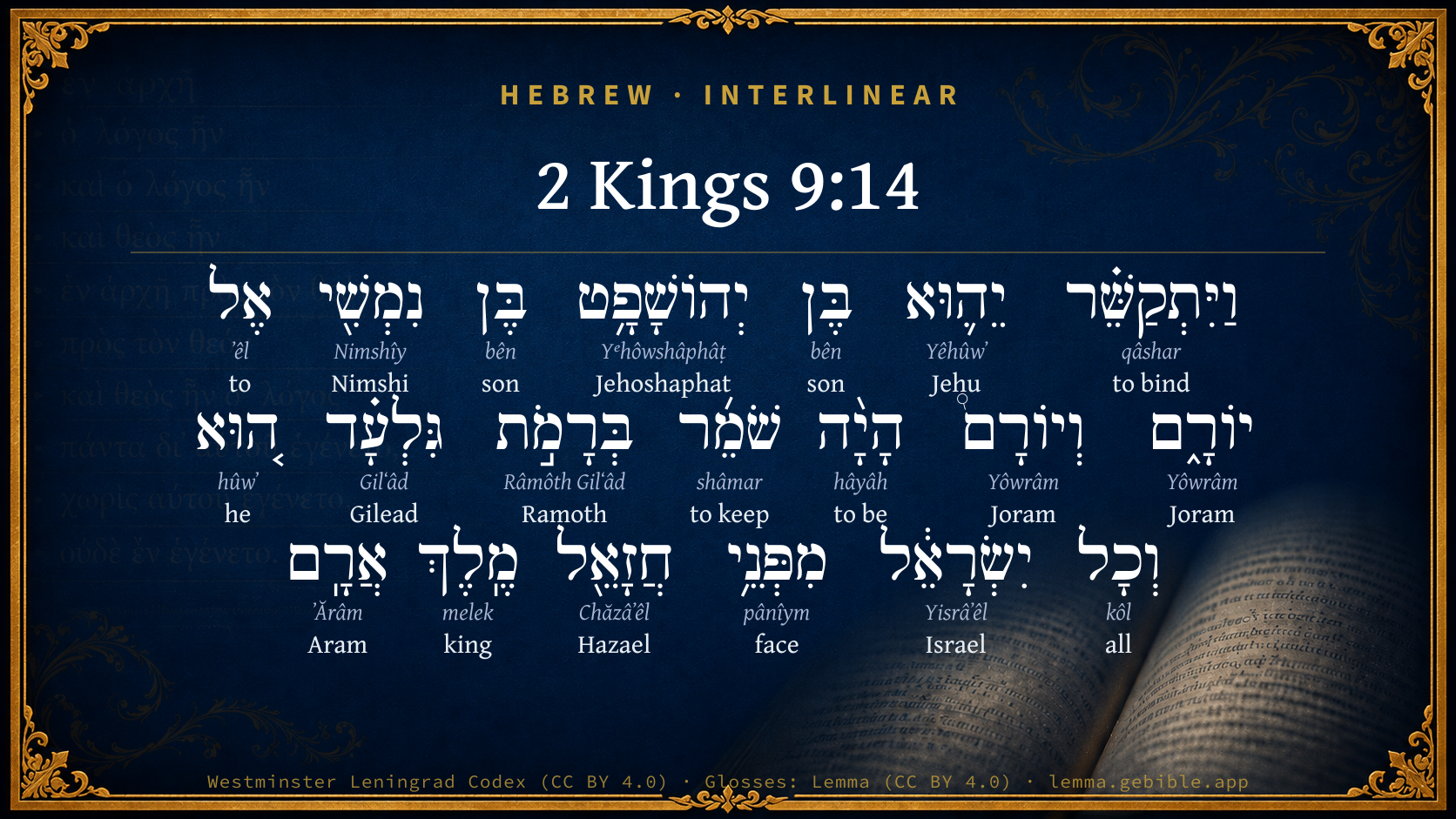
  1. וַיִּתְקַשֵּׁ֗ר qâshar H7194 “and · to bind” Conjunction + Verb, Hithpael, Sequential Imperfect, 3rd Person, Masculine, Singular
  2. יֵה֛וּא Yêhûwʼ H3058 “Jehu” Noun, Proper
  3. בֶּן bên H1121 “son of” Noun, Common, Masculine, Singular, Construct
  4. יְהוֹשָׁפָ֥ט Yᵉhôwshâphâṭ H3092 “Jehoshaphat” Noun, Proper
  5. בֶּן bên H1121 “son of” Noun, Common, Masculine, Singular, Construct
  6. אֶל ʼêl H413 “to” Preposition
  7. יוֹרָ֑ם Yôwrâm H3141 “Joram” Noun, Proper
  8. וְיוֹרָם֩ Yôwrâm H3141 “and · Joram” Conjunction + Noun, Proper
  9. הָיָ֨ה hâyâh H1961 “to be” Verb, Qal, Perfect, 3rd Person, Masculine, Singular
  10. שֹׁמֵ֜ר shâmar H8104 “keeping” Verb, Qal, Participle Active, Masculine, Singular, Absolute
  11. בְּרָמֹ֣ת Râmôth Gilʻâd H7433 “in/at · Ramoth” Preposition + Noun, Proper
  12. גִּלְעָ֗ד Gilʻâd H1568 “Gilead” Noun, Proper
  13. ה֚וּא hûwʼ H1931 “he” Pronoun, Personal, 3rd Person, Masculine, Singular
  14. וְכָל kôl H3605 “and · all of” Conjunction + Noun, Common, Masculine, Singular, Construct
  15. יִשְׂרָאֵ֔ל Yisrâʼêl H3478 “Israel” Noun, Proper
  16. מִפְּנֵ֥י pânîym H6440 “from · face(s) of” Preposition + Noun, Common, Both, Plural, Construct
  17. חֲזָאֵ֖ל Chăzâʼêl H2371 “Hazael” Noun, Proper
  18. מֶֽלֶךְ melek H4428 “king of” Noun, Common, Masculine, Singular, Construct
  19. אֲרָֽם ʼĂrâm H758 “Aram” Noun, Proper

About this verse

These counts appear in no published source. They are computed here, from the morphology-tagged text and Lemma’s own curated glosses. What Lemma adds →

20
words
18
distinct lemmas
Historical
section

Notable vocabulary

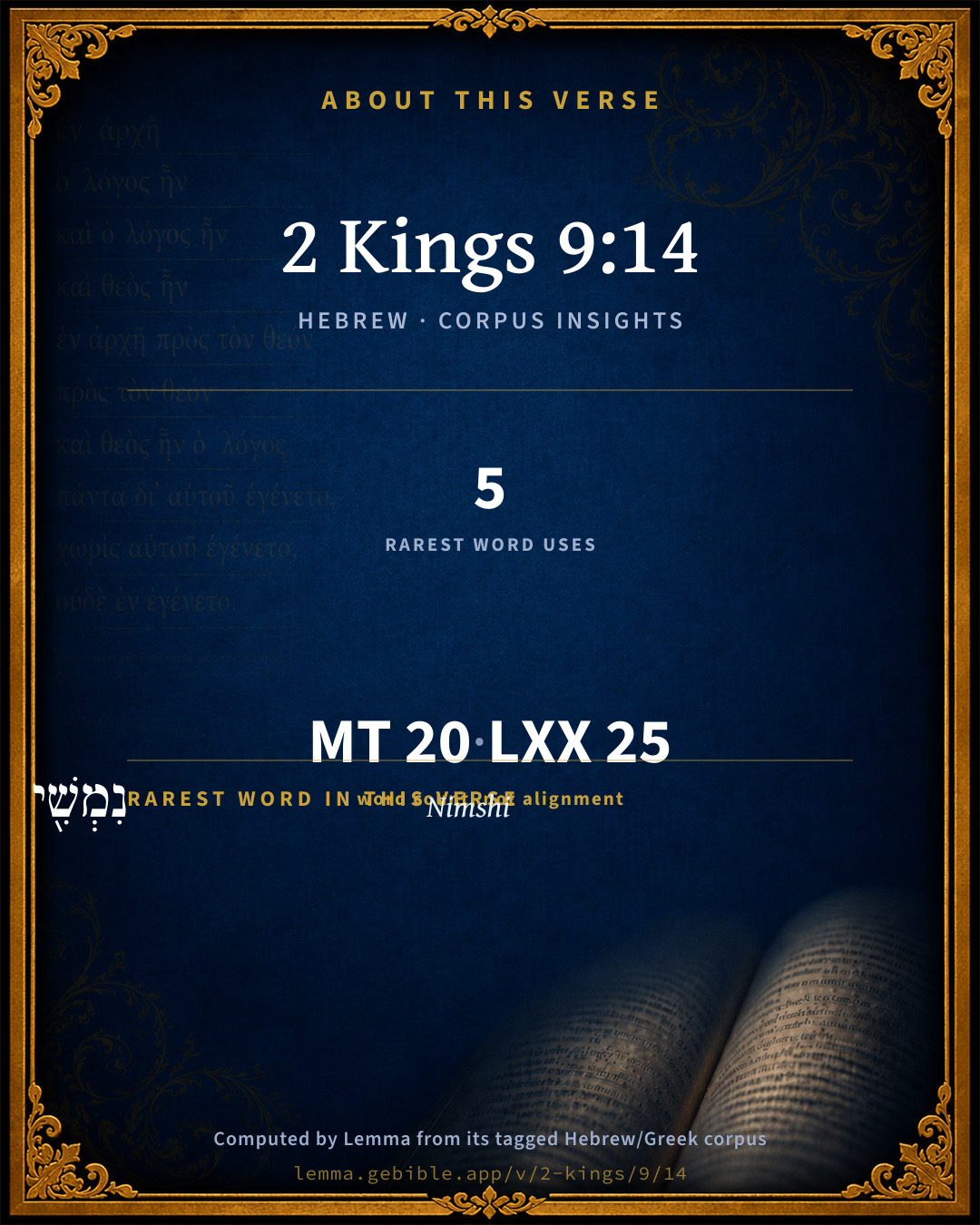
The rarest word here is נִמְשִׁ֖י Nimshi H5250 — appearing just 5 times in the whole Hebrew Bible.

Shared distinctive vocabulary

נִמְשִׁ֖י Nimshi H5250 occurs in 5 verses of the Hebrew Bible. Also found in:

Grammatical profile

  • 3 verbs
  • 15 nouns
  • 1 pronoun
  • 1 preposition

Verb forms

  • וַיִּתְקַשֵּׁ֗ר Hithpael · Sequential Imperfect
  • הָיָ֨ה Qal · Perfect
  • שֹׁמֵ֜ר Qal · Participle Active

Repetition

Words recur within this verse — often emphatic in Hebrew:

  • בֶּן son H1121 ×2
  • יוֹרָ֑ם Joram H3141 ×2

Hebrew & Septuagint length

In English translation the verse runs 28 words from the Hebrew and 29 from the Septuagint (LXX English) — closely comparable.

A rough comparison of the two English renderings, which tokenize alike — not a word-level alignment.

Word counts can differ between the Hebrew and the Greek without any difference in meaning — e.g. the Hebrew direct-object marker אֵת has no separate Greek word, and Greek often adds the article ὁ.

In the original languages it is 20 Hebrew tokens and 25 Greek tokens — but the two are counted differently (Hebrew bundles its prefixes and suffixes into one token; the Greek is in lemma form), so that isn’t a like-for-like length.

Cross-references

10

Topical passages linked to 2 Kings 9:14 in the Treasury of Scripture Knowledge — connected by theme and wording, ordered by reader-vote popularity; previews shown in the World English Bible.

  • 2 Kings 8:28 He went with Joram the son of Ahab to war against Hazael king of Syria at Ramoth-gilead: and the Syrians wounded Joram.
  • 1 Kings 22:3 The king of Israel said to his servants, "You know that Ramoth-gilead is ours, and we are still, and don't take it out of the hand of the king of Syria?"
  • 1 Kings 15:27 Baasha the son of Ahijah, of the house of Issachar, conspired against him; and Baasha struck him at Gibbethon, which belonged to the Philistines; for Nadab and all Israel were laying siege to Gibbethon.
  • 1 Kings 16:7 Moreover by the prophet Jehu the son of Hanani came the word of Yahweh against Baasha, and against his house, both because of all the evil that he did in the sight of Yahweh, to provoke him to anger with the work of his hands, in being like the house of Jeroboam, and because he struck him.
  • 1 Kings 16:9 His servant Zimri, captain of half his chariots, conspired against him. Now he was in Tirzah, drinking himself drunk in the house of Arza, who was over the household in Tirzah:
  • 1 Kings 16:16 The people who were encamped heard say, Zimri has conspired, and has also struck the king: therefore all Israel made Omri, the captain of the host, king over Israel that day in the camp.
  • 2 Kings 8:12–15 Hazael said, Why weeps my lord? He answered, Because I know the evil that you will do to the children of Israel: their strongholds will you set on fire, and their young men will you kill with the sword, and will dash in pieces their little ones, and rip up their women with child.
  • 2 Kings 9:31 As Jehu entered in at the gate, she said, Is it peace, you Zimri, your master's murderer?
  • 2 Kings 10:9 It happened in the morning, that he went out, and stood, and said to all the people, You are righteous: behold, I conspired against my master, and killed him; but who struck all these?
  • 2 Kings 15:30 Hoshea the son of Elah made a conspiracy against Pekah the son of Remaliah, and struck him, and killed him, and reigned in his place, in the twentieth year of Jotham the son of Uzziah.

Cross-references courtesy of OpenBible.info (CC BY 4.0).

Hebrew and Greek witnesses Masoretic Hebrew ↔ Greek Septuagint

The same verse in the two great witnesses to the Old Testament, shown verse-for-verse.

These are two independent witnesses, not word-aligned to each other, and the Septuagint is shown in lemma (dictionary) form.

Hebrew 2 Kings 9:14 Masoretic · Westminster Leningrad Codex

וַיִּתְקַשֵּׁ֗ר יֵה֛וּא בֶּן יְהוֹשָׁפָ֥ט בֶּן נִמְשִׁ֖י אֶל יוֹרָ֑ם וְיוֹרָם֩ הָיָ֨ה שֹׁמֵ֜ר בְּרָמֹ֣ת גִּלְעָ֗ד ה֚וּא וְכָל יִשְׂרָאֵ֔ל מִפְּנֵ֥י חֲזָאֵ֖ל מֶֽלֶךְ אֲרָֽם

So Jehu the son of Jehoshaphat the son of Nimshi conspired against Joram. (Now Joram was keeping Ramoth-gilead, he and all Israel, because of Hazael king of Syria;

World English Bible · Public Domain

Greek LXX 2 Kings 9:14 Septuagint · lemma form

καί συνστρέφω ιου υἱός ιωσαφατ υἱός ναμεσσι πρός ιωραμ καί ιωραμ αὐτός φυλάσσω ἐν ρεμμωθ γαλαάδ αὐτός καί πᾶς ἰσραήλ ἀπό πρόσωπον αζαηλ βασιλεύς συρία

So Ju the son of Josaphat the son of Namessi conspired against Joram, and Joram was defending Remmoth Galaad, he and all Israel, because of Azael king of Syria.

LXX2012 (modern English Septuagint) · Public Domain

Hebrew: Westminster Leningrad Codex (CC BY 4.0). Greek: Septuagint (public domain); English from LXX2012 (modern English Septuagint) (Public Domain). How the Septuagint differs from the Hebrew →

Targum (Aramaic paraphrase)

1

The Targum is the ancient Jewish Aramaic paraphrase of the Hebrew Scriptures — an interpretive translation, not the Hebrew text itself. Onkelos (literal) and Pseudo-Jonathan (expansive) render the Torah, and Jonathan the Prophets. Coverage is partial: where no permissively-licensed English translation exists for a verse, only the Aramaic is shown. This is verse-level text, not a word-by-word alignment to the Hebrew.

  1. Targum Jonathan Prophets (Joshua–Malachi)
    וּמְרִיד יֵהוּא בַּר יְהוֹשָׁפָט בַּר נִמְשִׁי עַל יוֹרָם וְיוֹרָם הֲוָה נָטֵיר בְּרָמוֹת גִלְעָד הוּא וְכָל יִשְׂרָאֵל מִן קֳדָם חֲזָאֵל מַלְכָּא דַאֲרָם:

    (no public-domain English translation for this verse)

    Targum Jonathan — Aramaic: “Mikraot Gedolot” (public domain). English: “Sefaria Community Translation” (CC0 1.0 (public-domain dedication)); “London "Chaldee Paraphrase," 1871” (public domain). Text via Sefaria.

Commentary

Notes on 2 Kings 9:14 from classic Christian and Jewish commentators (each source and its license shown beneath its notes). The classic Christian expositions comment on the surrounding passage and are grouped to its opening verse, so a note may address several verses; the Jewish commentaries on the Tanakh (Rashi and others) are per-verse, so they appear only where the commentator wrote on this verse.

Lemma curates 59 commentaries, every one of them public domain or Creative Commons licensed, each selected and text-cleaned for this edition rather than reprinted as found. About our sources →

Trapp's Complete Commentary

John Trapp

2Ki 9:14 So Jehu the son of Jehoshaphat the son of Nimshi conspired against Joram. (Now Joram had kept Ramothgilead, he and all Israel, because of Hazael king of Syria.

Ver. 14. Now Joram had kept Ramothgilead.] Which he had newly won from the Syrians in this expedition, but had somewhat to do to hold it.

John Trapp, A Commentary or Exposition upon All the Books of the Old and New Testament (1647–1656) — public domain. Text from a community e-Sword module.

Joseph Benson's Commentary

2Ki 9:14-15. So Jehu conspired against Joram — Contrived with the rest of the captains how to destroy Joram: for which they had the fairer opportunity, because he was gone from the army to Jezreel. Now Joram had kept Ramoth-gilead — That is, kept a strong garrison there, upon the frontiers of his kingdom, it having been taken by him before this time, although the taking of it be not mentioned. He and all Israel, because of Hazael, &c. — He left an army also there, or in the neighbouring parts, to watch Hazael’s motions; so that Jehu had the army with him which Joram had left, being gone home to Jezreel, ill wounded. Jehu said, Let none go forth out of the city — Or, from the city: that is, from within it, or from before it; from the siege or army; to go tell it in Jezreel — For he knew how necessary secrecy was to the execution of such great designs as he had in hand.

Joseph Benson's Commentary on the Old and New Testaments (1811–1818) — public domain. Text from a community e-Sword module.

Whedon's Commentary on the Bible

Daniel D. Whedon

DEATH OF JEHORAM, 2Ki_9:14-26.

14. Joram had kept Ramoth-gilead — Rather, was keeping watch in Ramoth-gilead. He had forcibly taken it out of the hands of the Syrians, and now had all the army there to guard it lest it should be retaken by Hazael. The king himself, as we have already seen, (2Ki_8:28,) had been wounded during the siege by the Syrian archers, but after having taken it, he left it in charge of the army under command of Jehu, and returned to Jezreel to be healed of his wounds.

Daniel D. Whedon (gen. ed.), Commentary on the Old and New Testaments (1874–1909) — public domain. Text from a community e-Sword module.

Tyndale Open Study Notes

Tyndale Open Resources

9:14-15 led a conspiracy: Because Jezreel, where Joram was recovering from his wounds, lay about forty-five miles away, Jehu’s coup needed to be carried out swiftly and inconspicuously.

Tyndale Open Study Notes — © Tyndale Open Resources, licensed CC BY-SA 4.0. Text via the HelloAO Bible API.

Jamieson, Fausset & Brown

Robert Jamieson, A. R. Fausset & David Brown

Joram had kept Ramoth-gilead--rather, "was keeping," guarding, or besieging it, with the greater part of the military force of Israel. The king's wounds had compelled his retirement from the scene of action, and so the troops were left in command of Jehu.

Jamieson, Fausset & Brown — Commentary Critical and Explanatory on the Whole Bible (1871) — public domain (CC PDM 1.0). Text via the HelloAO Bible API.

Adam Clarke's Commentary

Verse 14. Joram had kept Ramoth-gilead] The confederate armies appear to have taken this city; but they were obliged to watch their conquests, as they perceived that Hazael was determined to retake it if possible.

Adam Clarke's Commentary on the Bible (1810–1826) — public domain. Text from a community e-Sword/MySword module.

Ellicott's Commentary for English Readers

(14, 15) Now Joram had kept Ramoth-gilead . . . But king Joram was returned.—Rather, Now Joram had been on guard in Ramoth-gilead . . . And Jehoram the king returned. The whole is a parenthesis intended to explain Jehu’s words in 2Ki_9:15 : “Let none go forth . . . to tell it in Jezreel.” Although substantially a repetition of 2Ki_8:28-29, it was hardly “superfluous” (Thenius) to remind the reader at this point of Joram’s absence—a material element in the success of the conspiracy. Graf’s conjecture that Jehu should be read instead of Joram is an obvious one, but hardly correct.

Because of Hazael.—Rather, against Hazael.

A Bible Commentary for English Readers, edited by Charles John Ellicott (1878–1897) — public domain. Text from a community e-Sword module.

The Cambridge Bible for Schools and Colleges

gen. ed. J. J. S. Perowne

14. conspired against Joram] The verb has the notion of ‘binding’. Hence it implies here that Jehu made a league with the other generals to carry out the deposition and slaying of Joram. The word in the form here used is found again 2Ch_24:25-26 of those who combined ‘to execute judgement’ on Joash king of Judah.

Now Joram had kept [R.V. omits had] Ramoth-gilead] The reference is to the existing state of the war. The army of Israel was in Ramoth, to protect the place against the threatened invasion of the Syrians.

he and all Israel] Meaning the greater part of the army, all the soldiery which could come into the field. Syria was clearly a most formidable enemy. Hazael was carrying out to the full the predictions of Elisha (2Ki_8:12).

The Cambridge Bible for Schools and Colleges (gen. ed. J. J. S. Perowne; Cambridge University Press, 1878–1918) — public domain. Text from a community e-Sword module.

John Gill's Exposition

So Jehu rode in a chariot,.... In great pomp and majesty as a king:

and went to Jezreel: set forward on a march thither with his captains, and part of his army at least, from Ramothgilead; which, according to Bunting (n), was twenty four miles:

for Jordan lay there; to be cured of his wounds, as before observed:

and Ahaziah king of Judah was come down to see Joram; see Kg2 8:29.

(n) Travels, &c. p. 166.

John Gill's Exposition of the Whole Bible (1746–1763) — public domain (CC PDM 1.0). Text via the HelloAO Bible API.

Albert Barnes' Notes on the Bible

Had kept - Rather, “was keeping watch.” The city had been taken: but the war continuing, and there being a danger of the Syrians recovering it, Joram and all Israel (i. e., the whole military force) were guarding the recent conquest, while Hazael threatened it.

Albert Barnes' Notes on the Bible (1834–1885) — public domain. Text from a community e-Sword/MySword module.

Haydock's Catholic Bible Commentary

Conspired, with the captains. (Menochius) -- Besieged, as it is observed above, chap. xxviii. 29. Hebrew, "had kept (Haydock) or observed;" watching the motions of Hazael, lest he should return, or succour the citadel.

George Leo Haydock (1774–1849), Haydock's Catholic Family Bible and Commentary, 1859 edition — public domain. Excludes Psalms (Douay-Rheims chapter numbering differs from Protestant) and Deuterocanonical books (Catholic canon only).

Matthew Poole's English Annotations

Joram had kept Ramoth-gilead; which interpreters conclude to have been taken by Joram before this time, though the taking of it be not mentioned. This they gather, first, from the mention of the inner chamber, 2Ki 9:2, and of the top of the stairs here; secondly, from 2Ki 9:15, Let none go forth out of the city. But these arguments seem not to be cogent. Not the former, because there might be some suburbs or outbuildings belonging to the city, or not far from it, which the Israelite might have in their possession. Nor the latter, as we shall there see. And if it was taken, why should all Israel be there to keep it, for which a strong garrison was sufficient? The words therefore may be otherwise rendered, exactly according to the Hebrew,

Joram had kept, or did keep, (to wit, by his army left there,) or put guards, or laid siege at, or to, (for so the particle beth is oft used,)

Ramoth-gilead. And therefore he had all Israel, i.e. all the military force of Israel, with him, that he might both maintain the siege, and withal oppose Hazael, who sought to relieve it.

Matthew Poole's English Annotations on the Holy Bible (1683–1685) — public domain. Text from a community e-Sword/MySword module.

The Pulpit Commentary

So Jehu the son of Jehoshaphat the son of Nimshi (see the comment on ver. 2) conspired against Joram. It is not meant that there was a secret conspiracy previous to the prophet"s coming, but that, by the open acts which followed on his coming, Jehu and the captains were guilty of a "conspiracy." Now Joram had kept Ra-moth-Gilead; rather, now Joram was keeping Ramoth-Gilead. Joram, in his capacity of chief ruler, was keeping, i.e. defending, Ramoth-Gilead against the Syrians with the bulk of his forces. He and all Israel, because of Hazael King of Syria; since Hazael wished to win the city back, and would have done so, had it not been stoutly defended. The writer speaks of Joram as the defender, though he was absent, because the defense was made under his orders. Then, to lore-vent misunderstanding, he repeats what he had already said in 2Ki_8:29 with respect to Joram"s wounds, and his retirement to Jezreel to be healed of them.

Vers. 14-37. Jehu as avenger.

No sooner is Jehu proclaimed king than, with characteristic decision, he gives orders that no one be permitted to leave the city to carry news to Jehoram; then, mounting his chariot, he drives off furiously to Jezreel. Whatever Jehu did, he did "with all his might". (Ecc_9:10) It is this vigorous decision of character which made him so suitable an instrument in executing God"s vengeance on the house of Ahab,

I JEHU"S APPROACH TO JEZREEL.

1. The watchmans announcement. In the far distance the watchman on the tower of Jezreel beholds a company of horsemen rapidly approaching. What can it portend? The report is brought to the king, who unsuspiciously sends out a messenger on horseback to inquire. Towers and watchmen are for the protection of a city and its inhabitants. But except the Lord keep the city, the watchman waketh but in vain". (Psa_127:1) And if the Lord decrees the destruction of a city, or of those in it, towers and watchmen will do little to protect them.

2. Successive messengers. These verses are chiefly interesting as illustrating the character of Jehu. The messenger sent by Jehoram soon reaches the company, and asks, "Is it peace?" The idea probably is, "What tidings from the field of battle?" Jehu does not even answer him civilly, but, with a rude "What hast thou to do with peace?" he orders him to turn behind him. A man this who will brook no delay, submit to no curb, endure no check, in his imperious course. He sweeps obstacles from his path, and bends them to his will. This messenger returns not, and a second, sent out from the king, meets a like reception, and is also compelled to ride behind.

3. Jehu recognized. At length the horsemen are near enough for the watchman to get a closer view, and he has no difficulty in recognizing the furious driving of the leading figure as the driving of Jehu. It is familiar to all that character imprints itself on manner. Physiognomy, walk, gesture, handwriting even, are windows through which, to an observant eye, the soul looks out. Hypocrisy may create a mask behind which the real character seeks to hide itself. But hypocrisy, too, has characteristic ways of betraying its presence, and the mask cannot always be kept on. If we wish habitually to appear true, we must be true.

II JEHORAM AND AHAZIAH SLAIN.

1. The fateful meeting. On learning that Jehu was approaching, King Jehoram, now convalescent, prepared his chariot, and, accompanied by Ahaziah of Judah, went out to meet his captain.

(1) The two encountered at the portion of Naboth the Jezreelite. Strange coincidence, only, as we shall see below, more than coincidence. As the chariots meet, the king puts the anxious question, "Is it peace, Jehu?" Alas! the day of peace is over; it is now the day of vengeance.

(2) Jehu throws no disguise over his intentions. With his usual vehement abruptness he at once bursts forth, "What peace, so long as the whoredoms of thy mother Jezebel and her witchcrafts are so many?" Jehu was right: there can be no peace in a state when the foundations of religion and morality are everywhere subverted. When fountains of immorality are opened at head-quarters, their poisonous influence speedily infects the whole nation. (Hos_4:5) They who are responsible for the subversion of righteousness in a state, must bear the penalty.

(3) Jehoram needed to hear no more. He saw at a glance the situation, and with a shout, "Treachery, O Ahaziah!" he turned and fled. But there was no grain of pity in Jehu. With fierce promptitude he seizes his bow, fits one arrow to the string, and, taking sure aim, smites the flying king right through the heart. Jehoram falls is dead.

1. Blood for blood. The tragedy thus transacted was in the immediate neighborhood of Naboth"s vineyard. On that very spot, or near it, Naboth"s own blood had been shed, (1Ki_21:13) and, as this verse shows (ver. 26), not his alone, but the blood of his sons. Thither, after the murder, Ahab went down to take possession of the vineyard, and there, when he arrived, he found Elijah standing, waiting to denounce upon him the doom of blood. This was not all, for among those who rode with Ahab that day were two of his captains, one of them Bidkar, the other this Jehu, who heard the prophetic announcements against Ahab and his family. (1Ki_21:19-24) Ahab himself was subsequently spared, but the doom predicted against him had now fallen on his son: "In the place where dogs licked the blood of Naboth shall dogs lick thy blood, even thine". (1Ki_21:19) That prophecy, probably, had never altogether left the mind of Jehu, but now it came home to him with fresh force as he saw it actually fulfilled by his own hand. Bidkar, too, as it chanced, was there, and Jehu recalled to him the prophetic oracle. Then, to give it literal accomplishment, he bade Bidkar give orders that the corpse of Jehoram should be thrown into the plat of ground which formerly belonged to

2. Naboth. Startling correspondences often thus occur between sin and its mode of punishment. When they occur in fiction, we speak of them as instances of "poetic justice." But poetry, in this as in other cases, is "unconscious philosophy," and is not opposed to truth. Its truth in such representations lies rather in seizing and bringing to light actual laws in the moral government of the world. There is a singular tendency in events in history to fold back on each other even dates and places presenting a series of marvelous coincidences.

3. A partner in doom. The King of Judah had, the moment the alarm was given, sought his own safety. He fled "by the way of the garden house was it the "garden of herbs," into which Naboth"s vineyard had been converted? (1Ki_21:2) But in vain. The peremptory Jehu allows nothing to escape his vigilance, and immediately he is on Ahaziah"s track. His command was, "Smite him also in the chariot," and this was done, "at the going up to Gur, which is by Ibleam." Ahaziah continued his flight to Megiddo, where he died. A slightly different account of the manner of his death is given in 2Ch_22:9. Whatever the precise circumstances of the death, we cannot but see in it

1. a righteous retribution for his own sins; and

2. an example of the end of evil association.

Through his mother Athallah, daughter of Jezebel, he was brought into close and friendly relations with the court of Samaria, and, sharing in the crimes of Ahab"s house, shared also in their fate. It was his visit to King Jehoram which immediately brought down this doom upon him,

III THE FATE OF JEZEBEL.

1. Her daring defiance. When Jehoram had been slain, the end of Jezebel, the prime mover and presiding spirit in all the wickedness that had been wrought in Israel, could not be far distant. Jezebel perfectly apprehended this herself, for, on hearing that Jehu had come to Jezreel, she prepared to give him a defiant reception. While one loathes the character of the woman, it is impossible not to admire the boldness and spirit with which she faces the inevitable. Her proud, imperious nature comes out in her last actions. She paints her eyelids with antimony, tires her head, and adorns her person, as if she was preparing for some festal celebration. Then she plants herself at the window, and, when Jehu appears, assails him with bitter taunting words. "Is it peace, thou Zimri, thy master"s murderer?" she mockingly asked. What a power for evil this woman had been in Israel! What a power, with her strong intellect and will, she might have been for good!

2. Her ghastly end. If Jezebel thought, by this show of imperious defiance, to produce any effect on Jehu, perhaps to disarm him by sheer admiration of her boldness, she had mistaken the man. Jehu"s impetuous nature was not to be thus shaken from its purpose. He quickly brought the scene to a conclusion. "Who is on my side? who?" he cried, lifting up his eyes to the windows. Two or three eunuchs, no friends of Jezebel, and anxious only to please the new ruler, gave the needful sign. "Throw her down," was the pitiless order; and in another instant the painted Jezebel was hurled from the palace window, and, dashed on the ground, was being trodden by the hoofs of the horses. Pitiless herself, she now met with no compassion. One who had shed much blood, and rejoiced in it, her own blood was now bespattered on the wall and on the horses. Jehu had no compunctions, but, fresh from the dreadful spectacle, entered the palace, and sat down to eat and drink. But the climax was yet to come. As if even he felt that, vengeance being now sated, some respect was due to one who had so long held sway in Israel, he bade his servants "Go, see now this cursed woman, and bury her: for," he said, "she is a king"s daughter." The servants went, but soon returned with a shocking tale. Attracted by the scent of blood, the prowling city dogs had found their way into the enclosure, and, short as the time had been, all that remained of haughty Jezebel was the skull, and feet, and palms of the hands, strewn about the court.

3. A prophecy fulfilled. Such was the dreadful end of this haughty, domineering, evil woman. Possibly even Jehu could not restrain a shudder when he heard of it. He had not thought of it before, but now he recalled the close of that awful prophecy of Elijah to Ahab, "The dogs shall eat Jezebel by the wall of Jezreel", (1Ki_21:23) the terms of which had been repeated to him by Elisha"s messenger, (ver. 10). That word of God had been fulfilled with ghastly literalness. Would that men would lay to heart the lemon, and believe that all God"s threatenings will be as certainly fulfilled! J.O.

The Pulpit Commentary (1880–1919), ed. H.D.M. Spence-Jones & Joseph S. Exell — public domain. Text from a community e-Sword module.

unfoldingWord translationNotes

Door43 World Missions Community

Nimshi

Translate the name of this man the same as you did in 2 Kings 9:2. (See: How to Translate Names)

Now Joram

This word is used here to mark a break in the main story line. Here the author tells background information about about how Joram was wounded and went to recover in Jezreel. (See: Background Information)

all Israel

These refers only to the Israelite army and not to everyone who lives in Israel. AT: "he and his army" or "he and the Israelite army" (See: Synecdoche)

to be healed of

This can be stated in active form. AT: "to recover from" (See: Active or Passive)

the wounds that the Arameans had given him

This means that he was wounded in battle with the Arameans. AT: "wounds that Joram got during the battle with the Aramean army" (See: Assumed Knowledge and Implicit Information)

against Hazael king of Aram

This refers to Hazael and his army. AT: "against Hazael king of Aram and his army" (See: Synecdoche)

Hazael

Translate the name of this man the same as you did in 2 Kings 8:8. (See: How to Translate Names)

Jehu said to the servants of Joram

This refers to the officers who were with Joram at Ramoth Gilead.

If this is your opinion

"If you are in agreement with me" Jehu uses this phrase to refer to if people are supportive of him being king and of his decisions. AT: "If you truly want me to be your king" (See: Assumed Knowledge and Implicit Information)

in order to go tell this news in Jezreel

This refers to telling Joram and his army of Jehu's plans. AT: "to warn king Joram and his army in Jezreel" (See: Assumed Knowledge and Implicit Information)

Now Ahaziah

The word "now" is used here to mark a break in the main story line. Here the author tells background information about Ahaziah visiting Joram. (See: Background Information)

translationWords

Joram

Aram

cure

chariot

rest

kingdom of Judah

unfoldingWord translationNotes — © Distant Shores Media and the Door43 World Missions Community, licensed CC BY-SA 4.0. Source: git.door43.org/Door43/en_tn.

Lesson kit

Teaching starters — assembled from the data on this page, not authored interpretation. Every prompt links to the verse data it draws on. Edit before teaching.

2 Kings, in the Historical, opens this verse with 20 words (18 distinct Hebrew lemmas). Its most distinctive word is Nimshîy (“Nimshi”). A historical commentator’s framing appears above. Read the whole chapter for the surrounding context.

Discussion questions

  1. The word Nimshîy carries the sense “Nimshi.” How does it shape the verse?
  2. 1 Kings 19:16 shares the word «Nimshi» with this verse. How do the two illuminate each other?
  3. “son” occurs 2× in this one verse. What is the effect of the repetition?
  4. These translations render this verse differently; the difference is in the English rendering, not the original. What questions does that raise?
  5. The verb «וַיִּתְקַשֵּׁ֗ר» is Hithpael Sequential Imperfect. How does its form color the action?
  6. Reading how Trapp's Complete Commentary and Joseph Benson's Commentary read this verse, where do the two commentators agree and where do they part?

Things to notice

Reading settings

Reading text

Shown beneath each verse's original-language words.

Old Testament
Old Testament edition

Read the OT as the Masoretic Hebrew (MT) or the Greek Septuagint (LXX).

English shown for the Greek Septuagint (in the Hebrew ↔ Greek comparison).

Comparing translations? Open the Compare panel on any verse page to stack up to four side by side.