

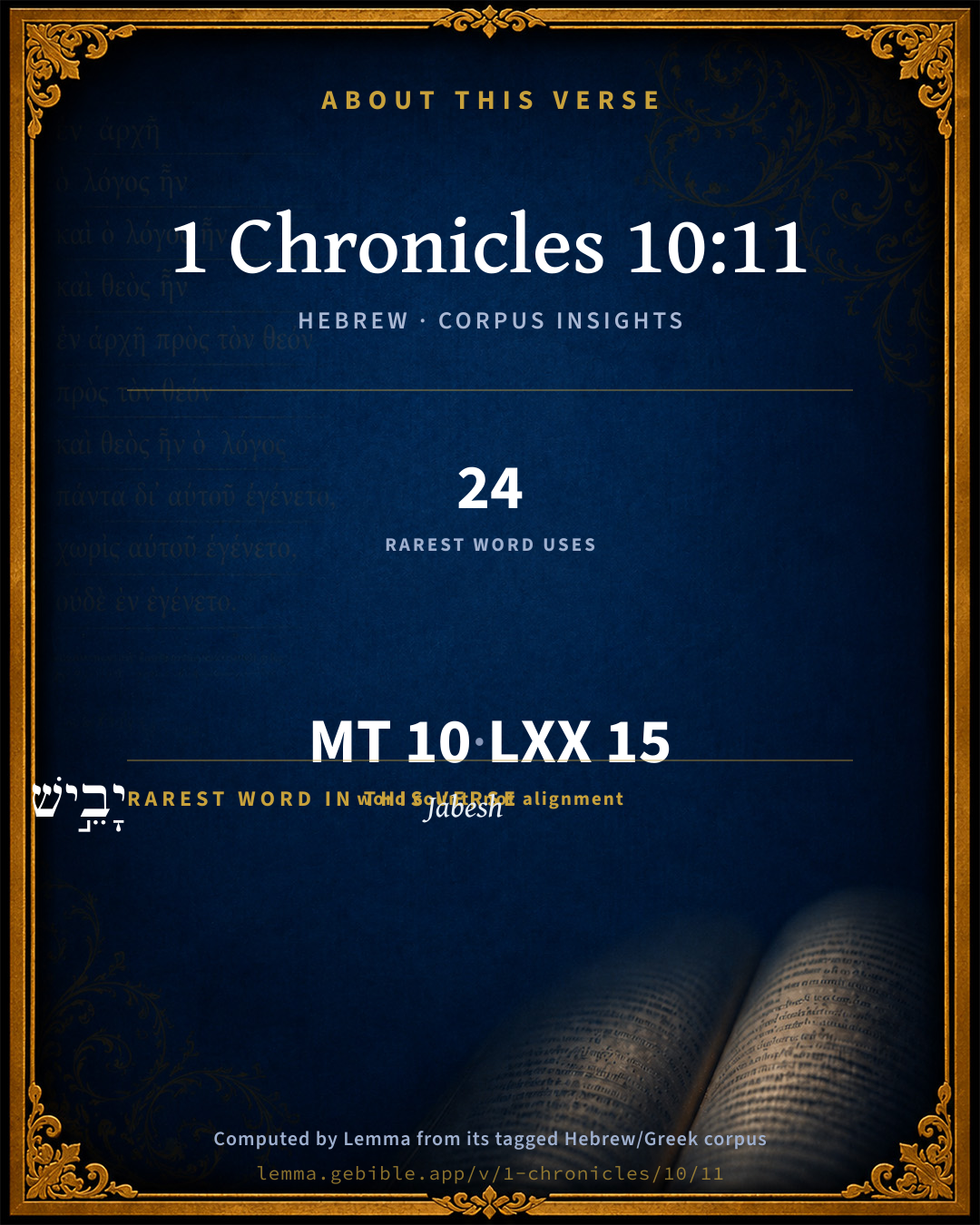
1 Chronicles 10:11

Hebrew (Westminster Leningrad Codex) 1 Chronicles 10:11 appears in the Hebrew Old Testament. The text above is from the Westminster Leningrad Codex. Each word links to its Strong’s number, a concise gloss, and parsing drawn from the Open Scriptures Hebrew Bible morphology. Click any word for its full Brown-Driver-Briggs (BDB) entry.
Download image
Cite this verse

1 Chronicles 10:11 (World English Bible). Public Domain. Lemma interlinear Bible study tool, https://lemma.gebible.app/v/1-chronicles/10/11.

Show BibTeX & RIS
BibTeX
RIS
English Translation
When all Jabesh Gilead heard all that the Philistines had done to Saul,
World English Bible · Public Domain
Download a study sheet

One document with this verse’s original text, its word-by-word gloss line, the meaning frame, cross-references with their text, attributed commentary, and full source and license credits — printable, and it pastes into notes with its structure intact.

This verse Autodidact and up

Study sheet (.html) Plain text (.txt)

A passage Seminary Student

Up to 50 verses in one chapter. A passage sheet keeps up to 6 commentary sources and 12 cross-references per verse, in the order this page ranks them, and says so on the sheet whenever that leaves anything out. Ask for a single verse and you get the Autodidact verse sheet above.

Everything on this page stays free to read, with no account — the sheet is a download of what is already on screen, not access to it.

Want to remove ads? Support Godless Engineer
Compare translations 3

The same verse in 3 English versions, stacked beneath the original-language interlinear above. Click any original word for its lexicon entry.

Each is an independent rendering of the whole verse — the interlinear is not word-aligned to these translations.

Highlighted words mark where these versions differ — a whole-verse word diff, not a word-by-word alignment.

  • World English Bible Public Domain
    When all Jabesh Gilead heard all that the Philistines had done to Saul,
  • King James Version Public Domain
    And when all Jabeshgilead heard all that the Philistines had done to Saul,
  • unfoldingWord Literal Text CC BY-SA 4.0
    And all of Jabesh Gilead heard all that the Philistines had done to Saul.

unfoldingWord Literal Text — © unfoldingWord, licensed CC BY-SA 4.0. Word-aligned USFM3 via Door43 (git.door43.org/unfoldingWord/en_ult).

Versions to compare (up to 4)

3 of 4 selected

Show all 18 translations

Every available English version of this verse, each an independent rendering of the whole verse.

  • World English Bible Public Domain
    When all Jabesh Gilead heard all that the Philistines had done to Saul,
  • Berean Standard Bible Public Domain
    When the people of Jabesh-gilead heard about everything the Philistines had done to Saul,
  • Majority Standard Bible Public Domain
    When all the people of Jabesh-gilead heard about everything the Philistines had done to Saul,
  • King James Version Public Domain
    And when all Jabeshgilead heard all that the Philistines had done to Saul,
  • American Standard Version (1901) Public Domain
    And when all Jabesh-gilead heard all that the Philistines had done to Saul,
  • Revised Version (1885) Public Domain
    And when all Jabesh-gilead heard all that the Philistines had done to Saul,
  • Geneva Bible (1599) Public Domain
    When all they of Iabesh Gilead heard all that the Philistims had done to Saul,
  • Douay-Rheims (1899) Public Domain
    And when the men of Jabes Galaad had heard this, to wit, all that the Philistines had done to Saul,
  • Young's Literal Translation Public Domain
    And all Jabesh-Gilead hear of all that the Philistines have done to Saul,
  • Literal Standard Version CC BY-SA 4.0
    And all Jabesh-Gilead hears of all that the Philistines have done to Saul,
  • Unlocked Literal Bible CC BY-SA 4.0
    When all Jabesh Gilead heard of all that the Philistines had done to Saul,
  • unfoldingWord Literal Text CC BY-SA 4.0
    And all of Jabesh Gilead heard all that the Philistines had done to Saul.
  • Darby Bible Public Domain
    And when all they of Jabesh-Gilead heard of all that the Philistines had done to Saul,
  • World Messianic Bible Public Domain
    When all Jabesh Gilead heard all that the Philistines had done to Saul,
  • Webster's Bible Public Domain
    And when all Jabesh-gilead heard all that the Philistines had done to Saul,
  • Free Bible Version CC BY-SA 4.0
    However, when everyone in Jabesh-gilead heard everything the Philistines had done to Saul,
  • Bible in Basic English Public Domain
    And when the news came to Jabesh-gilead of what the Philistines had done to Saul,
  • JPS Tanakh (1917) Public Domain
    And when all Jabesh-gilead heard all that the Philistines had done to Saul,

Literal Standard Version (2020), Covenant Press — licensed CC BY-SA 4.0. Text via the HelloAO Bible API (eBible.org). Unlocked Literal Bible (unfoldingWord) — licensed CC BY-SA 4.0. Text via the HelloAO Bible API (eBible.org). unfoldingWord Literal Text — © unfoldingWord, licensed CC BY-SA 4.0. Word-aligned USFM3 via Door43 (git.door43.org/unfoldingWord/en_ult). Free Bible Version, Dr. Jonathan Gallagher — licensed CC BY-SA 4.0. Text via the HelloAO Bible API (eBible.org).

Word by word

More ways to search: Search by grammar → Find every occurrence → Compare this word →

Practice this passage: Drill this verse → Learn its vocabulary →

יָבֵ֣ישׁ
Yâbêsh
H3003
“Jabesh”
Noun, Proper
Part of Speech
Noun
Type
Proper
Full BDB Definition

Origin: the same as H3002 (also Yabeysh yaw-bashe')

TWOT: None

Jabesh = "dry" - a town in the territory of Gilead; according to Eusebius, it is beyond the Jordan, 6 miles (10 kilometers) from Pella, on the mountain road to Gerasa; site unknown but may be modern 'Wadi Yabes' (noun proper locative) - father of Shallum, the 15th king of the northern kingdom (noun proper masculine)
  1. וַֽיִּשְׁמְע֔וּ shâmaʻ H8085 “and · to hear” Conjunction + Verb, Qal, Sequential Imperfect, 3rd Person, Masculine, Plural
  2. כֹּ֖ל kôl H3605 “all of” Noun, Common, Masculine, Singular, Construct
  3. גִּלְעָ֑ד Gilʻâd H1568 “Gilead” Noun, Proper
  4. אֵ֛ת ʼêth H853 “-” Particle, Direct Object
  5. כָּל kôl H3605 “all of” Noun, Common, Masculine, Singular, Construct
  6. אֲשֶׁר ʼăsher H834 “which” Particle, Relative
  7. עָשׂ֥וּ ʻâsâh H6213 “to do” Verb, Qal, Perfect, 3rd Person, Common, Plural
  8. פְלִשְׁתִּ֖ים Pᵉlishtîy H6430 “Philistines” Noun, Gentilic, Masculine, Plural, Absolute
  9. לְשָׁאֽוּל Shâʼûwl H7586 “to/for · Saul” Preposition + Noun, Proper

About this verse

These counts appear in no published source. They are computed here, from the morphology-tagged text and Lemma’s own curated glosses. What Lemma adds →

10
words
9
distinct lemmas
Historical
section

Notable vocabulary

The rarest word here is יָבֵ֣ישׁ Jabesh H3003 — appearing just 24 times in the whole Hebrew Bible.

Shared distinctive vocabulary

יָבֵ֣ישׁ Jabesh H3003 occurs in 21 verses of the Hebrew Bible. Also found in:

Grammatical profile

  • 2 verbs
  • 6 nouns
  • 2 particles

Verb forms

  • וַֽיִּשְׁמְע֔וּ Qal · Sequential Imperfect
  • עָשׂ֥וּ Qal · Perfect

Repetition

A word recurs within this verse — often emphatic in Hebrew:

  • כֹּ֖ל all H3605 ×2

Hebrew & Septuagint length

In English translation the verse runs 13 words from the Hebrew and 19 from the Septuagint (LXX English) — the Septuagint runs noticeably longer here. See the side-by-side →

A rough comparison of the two English renderings, which tokenize alike — not a word-level alignment.

Word counts can differ between the Hebrew and the Greek without any difference in meaning — e.g. the Hebrew direct-object marker אֵת has no separate Greek word, and Greek often adds the article ὁ.

In the original languages it is 10 Hebrew tokens and 15 Greek tokens — but the two are counted differently (Hebrew bundles its prefixes and suffixes into one token; the Greek is in lemma form), so that isn’t a like-for-like length.

Cross-references

3

Topical passages linked to 1 Chronicles 10:11 in the Treasury of Scripture Knowledge — connected by theme and wording, ordered by reader-vote popularity; previews shown in the World English Bible.

  • 2 Samuel 2:4–7 The men of Judah came, and there they anointed David king over the house of Judah. They told David, saying, The men of Jabesh Gilead were those who buried Saul.
  • 1 Samuel 11:1–11 Then Nahash the Ammonite came up, and encamped against Jabesh Gilead: and all the men of Jabesh said to Nahash, Make a covenant with us, and we will serve you.
  • 1 Samuel 31:11–13 When the inhabitants of Jabesh Gilead heard concerning him that which the Philistines had done to Saul,

Cross-references courtesy of OpenBible.info (CC BY 4.0).

Hebrew and Greek witnesses Masoretic Hebrew ↔ Greek Septuagint

The same verse in the two great witnesses to the Old Testament, shown verse-for-verse.

Here the Septuagint runs noticeably longer than the Hebrew — LXX2012 (modern English Septuagint) 19 words vs World English Bible 13. A rough length comparison of the two English translations, not a word-level alignment — read both below.

These are two independent witnesses, not word-aligned to each other, and the Septuagint is shown in lemma (dictionary) form.

Hebrew 1 Chronicles 10:11 Masoretic · Westminster Leningrad Codex

וַֽיִּשְׁמְע֔וּ כֹּ֖ל יָבֵ֣ישׁ גִּלְעָ֑ד אֵ֛ת כָּל אֲשֶׁר עָשׂ֥וּ פְלִשְׁתִּ֖ים לְשָׁאֽוּל

When all Jabesh Gilead heard all that the Philistines had done to Saul,

World English Bible · Public Domain

Greek LXX 1 Chronicles 10:11 Septuagint · lemma form

καί ἀκούω πᾶς ὁ καταοἰκέω γαλαάδ ἅπας ὅς ποιέω ἀλλόφυλος ὁ σαούλ καί ὁ ἰσραήλ

And all the dwellers in Galaad heard of all that the Philistines had done to Saul and to Israel.

LXX2012 (modern English Septuagint) · Public Domain

Hebrew: Westminster Leningrad Codex (CC BY 4.0). Greek: Septuagint (public domain); English from LXX2012 (modern English Septuagint) (Public Domain). How the Septuagint differs from the Hebrew →

Commentary

Notes on 1 Chronicles 10:11 from classic Christian and Jewish commentators (each source and its license shown beneath its notes). The classic Christian expositions comment on the surrounding passage and are grouped to its opening verse, so a note may address several verses; the Jewish commentaries on the Tanakh (Rashi and others) are per-verse, so they appear only where the commentator wrote on this verse.

Lemma curates 59 commentaries, every one of them public domain or Creative Commons licensed, each selected and text-cleaned for this edition rather than reprinted as found. About our sources →

Trapp's Complete Commentary

John Trapp

1Ch 10:11 And when all Jabeshgilead heard all that the Philistines had done to Saul,

Ver. 11. And when all Jabeshgilead.] See 1Sa 31:11. Jabeshgilead had not many inhabitants; but being all of a mind, they did great matters.

John Trapp, A Commentary or Exposition upon All the Books of the Old and New Testament (1647–1656) — public domain. Text from a community e-Sword module.

Adam Clarke's Commentary

Verse 11. When all Jabesh-gilead heard] For a general account of the principles of heroism and gratitude from which this action of the men of Jabesh-gilead proceeded, see the note on 1Sa 31:11-12.

By the kindness of a literary friend, I am enabled to lay a farther illustration of this noble act before the reader, which he will find at the conclusion of the chapter. 1Ch 10:14.

Adam Clarke's Commentary on the Bible (1810–1826) — public domain. Text from a community e-Sword/MySword module.

The Cambridge Bible for Schools and Colleges

gen. ed. J. J. S. Perowne

11. Jabesh-Gilead] See 1Sa_11:1-11; 2Sa_2:4-7.

The Cambridge Bible for Schools and Colleges (gen. ed. J. J. S. Perowne; Cambridge University Press, 1878–1918) — public domain. Text from a community e-Sword module.

The Pulpit Commentary

Vers. 11-14.

The moral of misfortune.

The setting of the sun of the first King of Israel in such dark clouds has its truth to tell as well as its shadows to throw. We may learn

I THAT OUR WORST MISFORTUNES BRING OUT THE BEST FEELINGS OF OUR FRIENDS. "When all Jabesh-gilead heard," etc. (vers. 11, 12). Saul, in his earlier and better days, had risen to the height of a noble opportunity and delivered this city from impending ruin by an act of great energy and courage. (1Sa 11) And when the last misfortune had befallen their deliverer, and the worst indignities were practised on his dead body, the men of Jabesh-gilead remembered what they owed him, gave free play to their gratitude, summoned up their courage, and rescued his dishonoured remains from the hands of the insolent enemy. It was worthily done; their best traits were drawn out by the dire calamity of their friend. So it is always and everywhere. It is one of the mitigations of our misery that the kindest and most generous feelings are then displayed toward us by those who love us. Sickness, loss, disappointment, bereavement, the larger and deeper sorrows of human life, evoke all that is most tender, gracious, and Christ-like in the human soul. In truth, we do not know the depth of the affection with which our kindred and our friends are loving us until some saddening experience calls out all the latent sympathy that lies within their hearts. Better things as well as worse things than we ordinarily suppose reside within us; when the occasion comes they rise to the surface and show themselves to the eyes of men. The crushing blow which strikes us to the ground is one of these occasions. Then human love comes forth to render its truest and choicest ministry.

II THAT TRANSGRESSION WILL CERTAINLY BE OVERTAKEN BY PENALTY IN DUE TIME. "Saul died for his transgression" (ver. 13). Retribution may have seemed tardy; it may have seemed to Saul as if he would "escape the judgment of God." Days, months, years, passed by and the blow fell not. The thought of his heart may have been, "I am safe now; the wrath of God would have descended if it were coming; I am secure; my mountain stands strong." But if he thus thought he was mistaken. Penalty was on its way, "leaden-footed but iron-handed," slow of step but sure of stroke, and the days of his life and of his power were numbered. His transgression was twofold.

1. Disobedience: he "kept not the word of the Lord" (ver. 13).

2. Departure from God: he "inquired not of the Lord," but he "askedcounsel of one that had a familiar spirit" (vers. 13, 14). Instead of resorting to God through his prophet, "as he did aforetime," he had recourse to the forbidden and dangerous arts of necromancy thus forsaking the Lord and putting his trust in a miserable and delusive system of imposture. His punishment, like his sin, was twofold.

1. His own death: the Lord "slew him.

2. The overthrow of all his hopes and plans: "he turned the kingdom untoDavid" (ver. 14). Our transgression and our penalty often take these two forms.

1. First come disobedience and departure. We do not the things which God enjoins; neglecting that which, above all things, is his will concerning. (Joh_6:39, Joh_6:40) We depart from his side and his service, seeking ourwell-being in other sources of joy. (Jer_2:13)

2. Then come death and overthrow. Our soul dies; its finer feelings disappear, its truer thoughts give place to false imaginings, its better hopes die down, its wiser aspirations sink and are lost; the shadows of spiritual death fall upon us. And with our own destruction comes the dispersion of our plans and expectations: the "kingdom is turned away;" the "wood, hay, and stubble" of a false life are consumed in the fires of God. Our life-work is overthrown and lost. The tower we took so long to build is in the dust.

C.

Vers. 11, 12.

A deed of honour.

when all Jabesh-gilead heard all that the Philistines had done to Saul, they arose, all the valiant men, and took away the body of Saul, and the bodies of his sons, and brought them to Jabesh, and buried their bones under the oak in Jabesh, and fasted seven days." It is well to study deeds of honour. Honour is integrity, gratitude, or courage in its finest bloom. If we aim no higher than the fulfilment of our legal obligations, our action will be apt to droop beneath that meagre level. Courage is an essential quality of faith. Gratitude a fine grace, which fosters the growth of every other. So that to aim at honourable action is essential if we would live a worthy life. Sometimes a Falstaff gives us a philosophy of honour, sounding very shrewd, but really very shallow. Sometimes Judas is followed in his example of cynical criticism, and we begin to ask, Cui bono? "To what purpose is this waste?" Mary"s anointing of the Saviour "for his burial;" the honour done here, at great risk, to the dead Saul; the honour done David, when men cut their way through a host to bring him a draught of water from the well of Bethlehem; are above such critics. They see no use in such activities. They believe in money and in power, in avoiding injuries and gathering comforts. But fine enthusiasms, high devotion, costly tributes of affection, they cannot understand. But some can. The writer of the Book of Samuel could see a beauty in this act of Jabesh-gilead, and relates it as something that gives a little relief to the darkness of the field of Gilboa. The author of the Chronicles felt it worth recording. David blessed them for their courage and their gratitude. It is worth our while simply to ponder the noble deed. To make this victory as crushing in its humiliation for Israel as proud for the cities of the Philistines, Saul"s head is put in the temple of Dagon, and his body, dismembered, is hung insultingly on the walls of Beth-shah. Jabesh-gilead was a city about six miles to the east, as Beth-shah was about six miles to the west of Jordan. It had owed to the energy of Saul, immediately on his accession to the kingdom, that it was saved from the cruel fate which Nahash the Ammonite intended and seemed able to inflict. When shame, grief, a tender memory of the service rendered by Saul in the days of his youth rise up within them, they resolve that, whatever risk has to be faced, whatever dangerous eminence their very success may make for them, they will do honour to the dead. If they cannot save his life, they can risk their own to give him a worthy burial. And so, not tarrying, they rise up by night, and by the morning the dead bodies of Saul and his heroic sons are in a friendly city. All the honour that can be shown is given in the decent burial and the week of fasting. The poor, spiteful triumph of the Philistines is curtailed, and the nation, beginning to sink in despondency, wakes up to feel there are still heroic spirits in its midst, that can beard the enemy even when flushed with victory. Several things are noteworthy here.

I DEATH IS NOT ALTOGETHER LOSS. It ended Saul"s life, but it increased his influence. Yesterday criticized, censured, object of apprehension; to-day he is revered even in his deepest failure. All now is forgotten of visitations of evil spirit, envy of David, unfortunate division which lost them the help of David in this time of their nation"s need. Instead of which they remember him as he delivered Gibeon and conquered the Philistines; how sometimes he prophesied; how no family in the land had shown itself more brave than his; how, when he was really himself, none was manlier or more generous. And now Saul, dead, takes his place once more in the heart of a nation"s love. And as David forgot all his injuries to celebrate his praise, so Jabesh-gilead forgets her weakness and the absence of all help, to rise and do him honour. Mark Antony spoke wrongly when he said

The evil that men do lives after them; The good is oft interred with their bones?

It is the good men do lives after them, and all their faults are buried in their graves. Remember the canonizing touch of death; how it rounds off the memory of the life, softens ill feeling, lets the better nature have its proper influence over others.

II DEEDS OF KINDLY SERVICE ARE LONG REMEMBERED, It is nearly forty years since Saul had saved Jabesh-gilead from the hand of Nahash. Most of those then saved from the ignominy and mutilation which were to be the terms of capitulation, had died. It was another generation that had risen, and you would hardly have been surprised if they had felt no particular gratitude for so remote a favour. But with all its defects, human nature is not so void of finer feelings as some would paint it. In estimating the deficiency of gratitude, it has to be remembered how exaggerated sometimes are our estimates of service rendered, and how we expect shillings" worth of service to be requited by pounds" worth of gratitude. We must remember, too, how often the service is mixed with disservice; the graciousness of the act of help destroyed in the way of rendering it; a gift is accompanied with a scold, or with a threat, or with an intimation of the reluctance with which it is done, or with a degree of patronage that humiliates the receiver. In such cases grateful return is hardly due. The persons rendering help have taken out their payment for it in self-complacency or superiority. But when these faults do not mar the graciousness of help. is gratitude so rare? Kindly natures, whose experience is most large, are never found complaining of ingratitude. They rather agree with the poet, who reports that the gratitude of men had oftener left him mourning. The true benefactors of a nation, what gratitude invests their memory! The kindly natured have a reward which they at least feel far surpassing all their merits. If in a humble position, love flows forth toward them for their modest offices of neighbourly affection, they are honoured by the confidence of men, and their character is that which their fellows copy. If in somewhat higher position, how does the reverence and kindly feeling of a whole city invest the life of honourable kindness! Here this distant act of Saul"s is remembered. And a sort of service which one would fancy would follow with soothing influence the spirit of the dead, is the beautiful fruit of their grateful recollection. Nor is this the only fruit; for you will observe that, in the subsequent history, the house of Saul has nowhere more devoted adherents than the inhabitants of Gilead. Do not fear your good will ever be unrequited. Say neither to God nor man, "Thou art a bard master, and therefore I bury my talent in the earth;" for the world is froward to the froward, honourable to the honourable, grateful to the good; a sort of mirror, in which we find the face we bring to it. With this difference, however, that God working on the side of all that is good, the reward of any goodness is always vastly larger than the retribution of any ill. Covet the beautiful rewards of kindness. Scores of years after they have been rendered they will return with a blessing into your bosom.

III A DEED OF HONOUR ALWAYS BEARS SOME FRUITS OF GRAND ADVANTAGE. Judas thought there was no reply possible to his question of cynical utilitarianism. And some like him in Jabesh doubtless asked, Cui bono? and protested that the project was rash; that the dead were not bettered by any attentions shown them; that they should rather look after the substantial advantages of their wives and families than risk their lives in sentimental expeditions. But if some argued thus, the event might convince even such that the project was not quite so unwise as it seemed. What were the results? They were at least these.

1. An increase of their own self-respect. Self-respect is as valuable as self-esteem is weakening. It is a force daily lifting men higher in purpose and in action, a restraint on what is unworthy, a stimulus to all that is good. These people had approval of their own hearts. Their act saved them from self

2. contempt; set a pattern for them which they would copy and excel. Never lower yourself in your own esteem, nor do that for which you will have to excuse yourself to yourself. Your deeds of honour will raise your self-respect, and by doing so will raise your whole future character.

3. It had another result in the good esteem in which all Israel held them. All the tribes honoured them for their faithfulness; David solemnly blessed them for their nobility; a kindly reverence moved all hearts towards them, and an enduring fame. Even the Judases can appreciate such an advantage, only they stickle always at the way that leads to it, because the fame cannot be guaranteed beforehand. We are members one of another. So act that the esteem of your fellows shall be yours. Only second to God"s approval is that of your fellow-men.

4. This act inspired Israel with fresh power to resist the Philistines. The spirit and success of this act took the gilding off the great victory; made the Philistines feel that the end was not quite so absolute as they had thought. The inspiration of the noble deed crept into innumerable hearts; invigorated and nerved them for the task of undoing the mischief wrought; permitted the feeble to breathe more freely, and the brave to make their plans for further struggle. Such are some not by any means all of the services of this deed of honour. Are they not very high and noble? "Go and do thou likewise." In your action towards your Saviour, do all that honour bids you; and in your action towards your fellow-men, let honour rather than advantage be the principle of all your actions. G.

Vers. 11, 12.

The time for returning kindness is sure to come.

Recall the deliverance which, very early in his kingship, Saul had wrought for the men of Jabesh-gilead. (1Sa 11) It seemed most unlikely that those rescued citizens would ever be able to do anything for Saul which would publicly testify their gratitude; and yet time passed on, and presently brought them their golden opportunity. When the stripped and dismembered bodies of Saul and his sons hung in front of the gates of Beth-shun, the men of Jabesh-gilead felt they could at least stop such dishonouring of the dead; so they made a sudden foray in the dead of night, seized the bodies, gave them honourable burning, and burial under a tree. (1Sa_31:11-13) We may learn from this incident that

I WE CAN HELP OTHERS IN THEIR EXTREMITIES. For precisely this we are knit together in the human brotherhood; and there are no possible forms of human need and trouble for which there are not human alleviations; and these are at our command.

II QUICKNESS TO HELP OTHERS IS CHARACTERISTICALLY CHRISTIAN. Sensitiveness to human suffering, and sense of personal responsibility in relation to its relief, are necessary features of Christian character, and essential elements of true Christ-likeness. "Himself bare our infirmities and carried our sorrows." We are to "bear one another"s burdens, and so fulfil the law of Christ.

III MEMORY OF HELP RECEIVED SHOULD BE LOVINGLY CHERISHED. Ingratitude is a sin of peculiar baseness. There may be long delay ere gratitude can find its opportunity, but it should be well nourished and kept for its occasion.

IV TIME BRINGS ROUND THE OPPORTUNITY FOR ALL WHO KEEP THE WILL. Illustrate from incident of text, and from the care of our parents. We seem unable to show our gratitude for the hallowing care of our childhood; but their helpless old age comes, and we get our opportunity. Lead on to that sense of indebtedness we should feel to Christ for his redeeming work; and to the duty of keeping ever watchful of opportunities for serving him as we may do, by serving some of the least of his brethren. See McCheyne"s hymn, "When this passing world is done," etc. R.T.

The Pulpit Commentary (1880–1919), ed. H.D.M. Spence-Jones & Joseph S. Exell — public domain. Text from a community e-Sword module.

unfoldingWord translationNotes

Door43 World Missions Community

When all Jabesh Gilead heard of all that the Philistines

Both instances of the word "all" are generalizations. The name of the town is a metonym for the people who live in the town, and the people group name is a metonym for that people group's soldiers. AT: "When the people of Jabesh Gilead heard what the soldiers of the Philistine army" (See: Hyperbole and Generalization and Metonymy)

Jabesh Gilead

This is the name of a town in the region of Gilead. (See: How to Translate Names)

their bones

The bones are a synecdoche for the dead bodies. AT: "their bodies" (See: Synecdoche)

seven days

"7 days" (See: Numbers)

translationWords

Gilead

Philistines

Saul (OT)

body

bury

oak

fast

unfoldingWord translationNotes — © Distant Shores Media and the Door43 World Missions Community, licensed CC BY-SA 4.0. Source: git.door43.org/Door43/en_tn.

Lesson kit

Teaching starters — assembled from the data on this page, not authored interpretation. Every prompt links to the verse data it draws on. Edit before teaching.

1 Chronicles, in the Historical, opens this verse with 10 words (9 distinct Hebrew lemmas). Its most distinctive word is Yâbêsh (“Jabesh”). The Greek Septuagint runs longer here. A historical commentator’s framing appears above. Read the whole chapter for the surrounding context.

Discussion questions

  1. The word Yâbêsh carries the sense “Jabesh.” How does it shape the verse?
  2. Judges 21:8 shares the word «Jabesh» with this verse. How do the two illuminate each other?
  3. “all” occurs 2× in this one verse. What is the effect of the repetition?
  4. Compared with the Hebrew, the Septuagint runs longer here. What questions does that raise?
  5. These translations render this verse differently; the difference is in the English rendering, not the original. What questions does that raise?
  6. The verb «וַֽיִּשְׁמְע֔וּ» is Qal Sequential Imperfect. How does its form color the action?
  7. Reading how Trapp's Complete Commentary and Adam Clarke's Commentary read this verse, where do the two commentators agree and where do they part?

Things to notice

Reading settings

Reading text

Shown beneath each verse's original-language words.

Old Testament
Old Testament edition

Read the OT as the Masoretic Hebrew (MT) or the Greek Septuagint (LXX).

English shown for the Greek Septuagint (in the Hebrew ↔ Greek comparison).

Comparing translations? Open the Compare panel on any verse page to stack up to four side by side.