
Judges 10:8

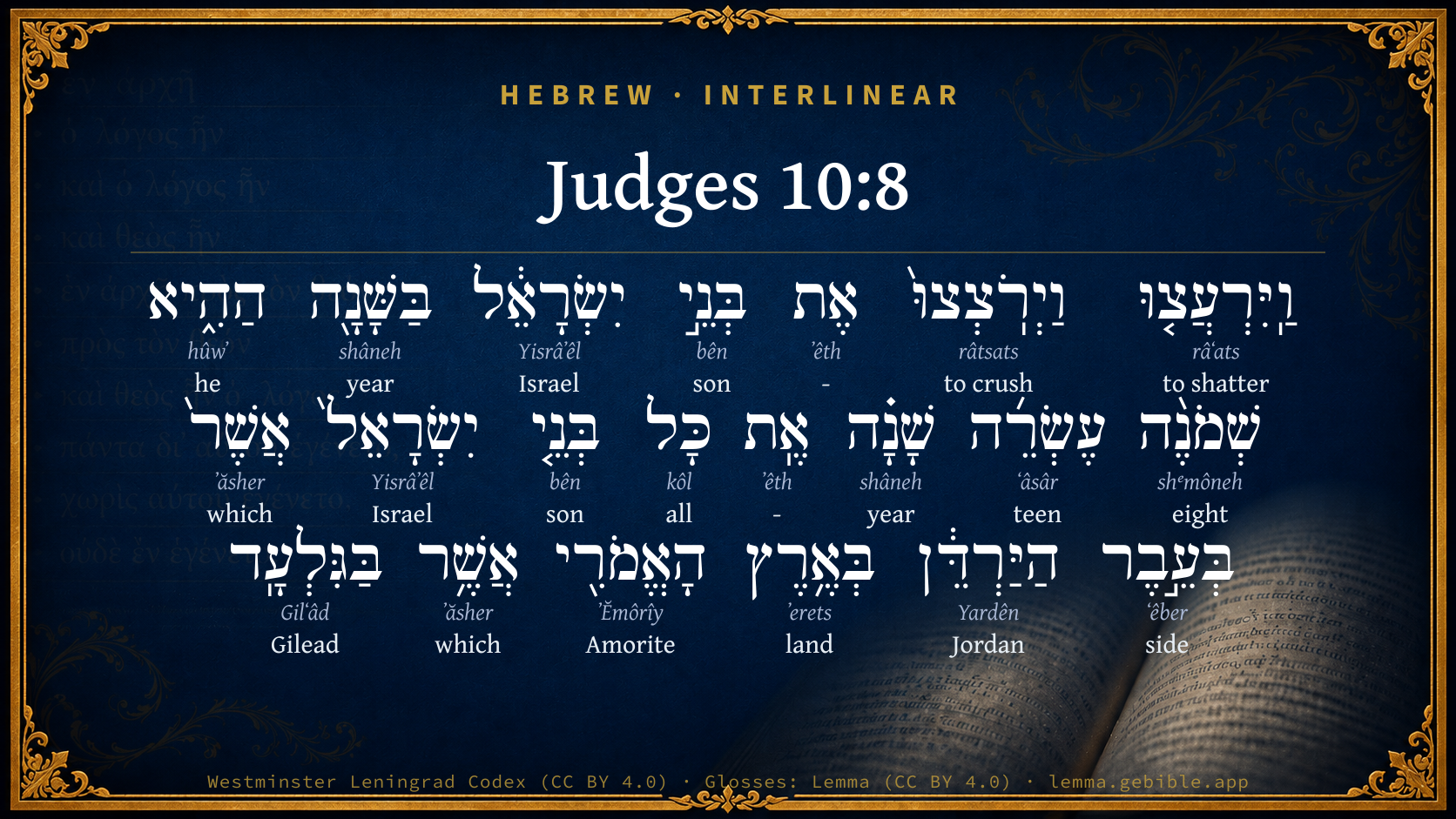
Hebrew (Westminster Leningrad Codex) Judges 10:8 appears in the Hebrew Old Testament. The text above is from the Westminster Leningrad Codex. Each word links to its Strong’s number, a concise gloss, and parsing drawn from the Open Scriptures Hebrew Bible morphology. Click any word for its full Brown-Driver-Briggs (BDB) entry.
Download image
Cite this verse

Judges 10:8 (World English Bible). Public Domain. Lemma interlinear Bible study tool, https://lemma.gebible.app/v/judges/10/8.

Show BibTeX & RIS
BibTeX
RIS
English Translation
They vexed and oppressed the children of Israel that year: eighteen years [oppressed they] all the children of Israel that were beyond the Jordan in the land of the Amorites, which is in Gilead.
World English Bible · Public Domain
Download a study sheet

One document with this verse’s original text, its word-by-word gloss line, the meaning frame, cross-references with their text, attributed commentary, and full source and license credits — printable, and it pastes into notes with its structure intact.

This verse Autodidact and up

Study sheet (.html) Plain text (.txt)

A passage Seminary Student

Up to 50 verses in one chapter. A passage sheet keeps up to 6 commentary sources and 12 cross-references per verse, in the order this page ranks them, and says so on the sheet whenever that leaves anything out. Ask for a single verse and you get the Autodidact verse sheet above.

Everything on this page stays free to read, with no account — the sheet is a download of what is already on screen, not access to it.

Want to remove ads? Support Godless Engineer
Compare translations 3

The same verse in 3 English versions, stacked beneath the original-language interlinear above. Click any original word for its lexicon entry.

Each is an independent rendering of the whole verse — the interlinear is not word-aligned to these translations.

Highlighted words mark where these versions differ — a whole-verse word diff, not a word-by-word alignment.

  • World English Bible Public Domain
    They vexed and oppressed the children of Israel that year: eighteen years [oppressed they] all the children of Israel that were beyond the Jordan in the land of the Amorites, which is in Gilead.
  • King James Version Public Domain
    And that year they vexed and oppressed the children of Israel: eighteen years, all the children of Israel that were on the other side Jordan in the land of the Amorites, which is in Gilead.
  • unfoldingWord Literal Text CC BY-SA 4.0
    And they shattered and crushed the sons of Israel in that year. 18 years, all the sons of Israel who on the other side of the Jordan in the land of the Amorites, which in Gilead.

unfoldingWord Literal Text — © unfoldingWord, licensed CC BY-SA 4.0. Word-aligned USFM3 via Door43 (git.door43.org/unfoldingWord/en_ult).

Versions to compare (up to 4)

3 of 4 selected

Show all 18 translations

Every available English version of this verse, each an independent rendering of the whole verse.

  • World English Bible Public Domain
    They vexed and oppressed the children of Israel that year: eighteen years [oppressed they] all the children of Israel that were beyond the Jordan in the land of the Amorites, which is in Gilead.
  • Berean Standard Bible Public Domain
    who that very year harassed and oppressed the Israelites, and did so for eighteen years to all the Israelites on the other side of the Jordan in Gilead, the land of the Amorites.
  • Majority Standard Bible Public Domain
    who that very year harassed and oppressed the Israelites, and they did so for eighteen years to all the Israelites on the other side of the Jordan in Gilead, the land of the Amorites.
  • King James Version Public Domain
    And that year they vexed and oppressed the children of Israel: eighteen years, all the children of Israel that were on the other side Jordan in the land of the Amorites, which is in Gilead.
  • American Standard Version (1901) Public Domain
    And they vexed and oppressed the children of Israel that year: eighteen years `oppressed they' all the children of Israel that were beyond the Jordan in the land of the Amorites, which is in Gilead.
  • Revised Version (1885) Public Domain
    And they vexed and oppressed the children of Israel that year: eighteen years oppressed they all the children of Israel that were beyond Jordan in the land of the Amorites, which is in Gilead.
  • Geneva Bible (1599) Public Domain
    Who from that yere vexed and oppressed the children of Israel eighteene yeres, euen all the children of Israel that were beyond Iorden, in the land of the Amorites, which is in Gilead.
  • Douay-Rheims (1899) Public Domain
    And they were afflicted, and grievously oppressed for eighteen years, all they that dwelt beyond the Jordan in the land of the Amorrhite, who is in Galaad:
  • Young's Literal Translation Public Domain
    and they crush and oppress the sons of Israel in that year -- eighteen years all the sons of Israel `who' are beyond the Jordan, in the land of the Amorite, which `is' in Gilead.
  • Literal Standard Version CC BY-SA 4.0
    and they crush and oppress the sons of Israel in that year; [and for] eighteen years—all the sons of Israel [who] are beyond the Jordan, in the land of the Amorite, which [is] in Gilead.
  • Unlocked Literal Bible CC BY-SA 4.0
    They crushed and oppressed the people of Israel that year, and for eighteen years they oppressed all the people of Israel who were beyond the Jordan in the land of the Amorites, which is in Gilead.
  • unfoldingWord Literal Text CC BY-SA 4.0
    And they shattered and crushed the sons of Israel in that year. 18 years, all the sons of Israel who on the other side of the Jordan in the land of the Amorites, which in Gilead.
  • Darby Bible Public Domain
    and they crushed and oppressed the children of Israel that year. For eighteen years they oppressed all the people of Israel that were beyond the Jordan in the land of the Amorites, which is in Gilead.
  • World Messianic Bible Public Domain
    They troubled and oppressed the children of Israel that year. For eighteen years they oppressed all the children of Israel that were beyond the Jordan in the land of the Amorites, which is in Gilead.
  • Webster's Bible Public Domain
    And that year they harassed and oppressed the children of Israel eighteen years, all the children of Israel that were on the other side of Jordan in the land of the Amorites, which is in Gilead.
  • Free Bible Version CC BY-SA 4.0
    That year and for eighteen more years they harassed and oppressed the Israelites, all the Israelites that lived on the east side of the Jordan in Gilead, the land of the Amorites.
  • Bible in Basic English Public Domain
    And that year the children of Israel were crushed under their yoke; for eighteen years all the children of Israel on the other side of Jordan, in the land of the Amorites which is in Gilead, were cruelly crushed down.
  • JPS Tanakh (1917) Public Domain
    And they oppressed and crushed the children of Israel that year; eighteen years oppressed they all the children of Israel that were beyond the Jordan in the land of the Amorites, which is in Gilead.

Literal Standard Version (2020), Covenant Press — licensed CC BY-SA 4.0. Text via the HelloAO Bible API (eBible.org). Unlocked Literal Bible (unfoldingWord) — licensed CC BY-SA 4.0. Text via the HelloAO Bible API (eBible.org). unfoldingWord Literal Text — © unfoldingWord, licensed CC BY-SA 4.0. Word-aligned USFM3 via Door43 (git.door43.org/unfoldingWord/en_ult). Free Bible Version, Dr. Jonathan Gallagher — licensed CC BY-SA 4.0. Text via the HelloAO Bible API (eBible.org).

Word by word

More ways to search: Search by grammar → Find every occurrence → Compare this word →

Practice this passage: Drill this verse → Learn its vocabulary →

וַֽיִּרְעֲצ֤וּ
râʻats
H7492
“and · to shatter”
Conjunction + Verb, Qal, Sequential Imperfect, 3rd Person, Masculine, Plural
Part of Speech
Conjunction + Verb
Stem
Qal
Form
Sequential Imperfect
Person
3rd Person
Gender
Masculine
Number
Plural
Full BDB Definition

Origin: a primitive root

TWOT: 2194

(Qal) to shatter
  1. וַיְרֹֽצְצוּ֙ râtsats H7533 “and · to crush” Conjunction + Verb, Poel, Sequential Imperfect, 3rd Person, Masculine, Plural
  2. אֶת ʼêth H853 “-” Particle, Direct Object
  3. בְּנֵ֣י bên H1121 “sons of” Noun, Common, Masculine, Plural, Construct
  4. יִשְׂרָאֵ֔ל Yisrâʼêl H3478 “Israel” Noun, Proper
  5. בַּשָּׁנָ֖ה shâneh H8141 “in/at the · year” Preposition, Determined + Noun, Common, Feminine, Singular, Absolute
  6. הַהִ֑יא hûwʼ H1931 “the · he” Particle, Definite Article + Pronoun, Personal, 3rd Person, Feminine, Singular
  7. שְׁמֹנֶ֨ה shᵉmôneh H8083 “eight” Adjective, Cardinal number, Feminine, Singular, Absolute
  8. עֶשְׂרֵ֜ה ʻâsâr H6240 “teen” Adjective, Cardinal number, Feminine, Singular, Absolute
  9. שָׁנָ֗ה shâneh H8141 “year” Noun, Common, Feminine, Singular, Absolute
  10. אֶֽת ʼêth H853 “-” Particle, Direct Object
  11. כָּל kôl H3605 “all of” Noun, Common, Masculine, Singular, Construct
  12. בְּנֵ֤י bên H1121 “sons of” Noun, Common, Masculine, Plural, Construct
  13. יִשְׂרָאֵל֙ Yisrâʼêl H3478 “Israel” Noun, Proper
  14. אֲשֶׁר֙ ʼăsher H834 “which” Particle, Relative
  15. בְּעֵ֣בֶר ʻêber H5676 “in/at · side of” Preposition + Noun, Common, Masculine, Singular, Construct
  16. הַיַּרְדֵּ֔ן Yardên H3383 “the · Jordan” Particle, Definite Article + Noun, Proper
  17. בְּאֶ֥רֶץ ʼerets H776 “in/at · land of” Preposition + Noun, Common, Both, Singular, Construct
  18. הָאֱמֹרִ֖י ʼĔmôrîy H567 “the · Amorite” Particle, Definite Article + Noun, Gentilic, Masculine, Singular, Absolute
  19. אֲשֶׁ֥ר ʼăsher H834 “which” Particle, Relative
  20. בַּגִּלְעָֽד Gilʻâd H1568 “in/at the · Gilead” Preposition, Determined + Noun, Proper

About this verse

These counts appear in no published source. They are computed here, from the morphology-tagged text and Lemma’s own curated glosses. What Lemma adds →

21
words
16
distinct lemmas
Historical
section

Notable vocabulary

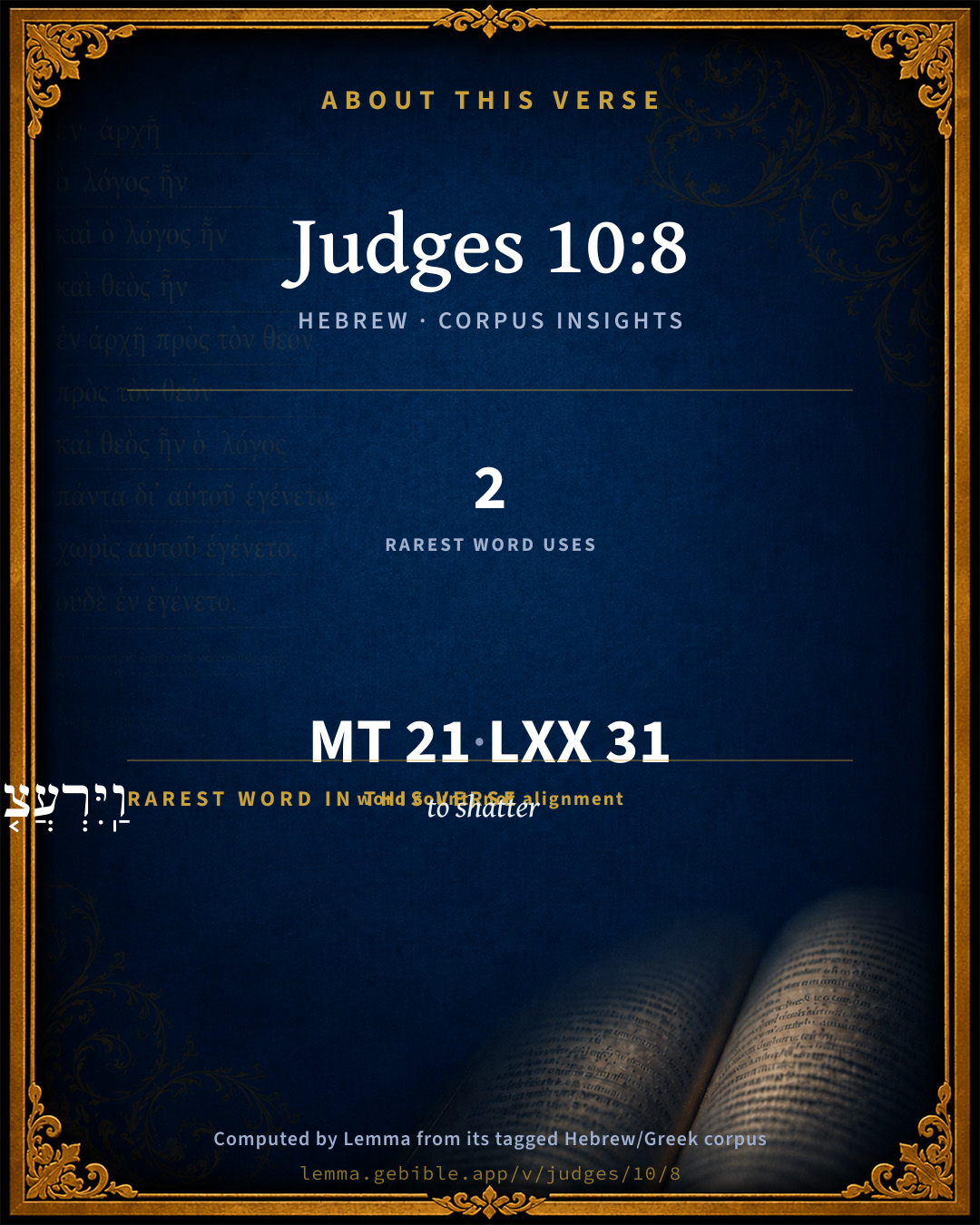
The rarest word here is וַֽיִּרְעֲצ֤וּ to shatter H7492 — appearing just 2 times in the whole Hebrew Bible.

Shared distinctive vocabulary

וַֽיִּרְעֲצ֤וּ to shatter H7492 occurs in 2 verses of the Hebrew Bible. Also found in:

Grammatical profile

  • 2 verbs
  • 12 nouns
  • 2 adjectives
  • 1 pronoun
  • 4 particles

Verb forms

  • וַֽיִּרְעֲצ֤וּ Qal · Sequential Imperfect
  • וַיְרֹֽצְצוּ֙ Poel · Sequential Imperfect

Repetition

Words recur within this verse — often emphatic in Hebrew:

  • בְּנֵ֣י son H1121 ×2
  • יִשְׂרָאֵ֔ל Israel H3478 ×2
  • בַּשָּׁנָ֖ה year H8141 ×2
  • אֲשֶׁר֙ which H834 ×2

Hebrew & Septuagint length

In English translation the verse runs 34 words from the Hebrew and 29 from the Septuagint (LXX English) — closely comparable.

A rough comparison of the two English renderings, which tokenize alike — not a word-level alignment.

Word counts can differ between the Hebrew and the Greek without any difference in meaning — e.g. the Hebrew direct-object marker אֵת has no separate Greek word, and Greek often adds the article ὁ.

In the original languages it is 21 Hebrew tokens and 31 Greek tokens — but the two are counted differently (Hebrew bundles its prefixes and suffixes into one token; the Greek is in lemma form), so that isn’t a like-for-like length.

Cross-references

3

Topical passages linked to Judges 10:8 in the Treasury of Scripture Knowledge — connected by theme and wording, ordered by reader-vote popularity; previews shown in the World English Bible.

  • Isaiah 30:13 therefore this iniquity shall be to you as a breach ready to fall, swelling out in a high wall, whose breaking comes suddenly in an instant.
  • 1 Thessalonians 5:3 For when they are saying, "Peace and safety," then sudden destruction will come on them, like birth pains on a pregnant woman; and they will in no way escape.
  • Judges 10:5 Jair died, and was buried in Kamon.

Cross-references courtesy of OpenBible.info (CC BY 4.0).

Hebrew and Greek witnesses Masoretic Hebrew ↔ Greek Septuagint

The same verse in the two great witnesses to the Old Testament, shown verse-for-verse.

These are two independent witnesses, not word-aligned to each other, and the Septuagint is shown in lemma (dictionary) form.

Hebrew Judges 10:8 Masoretic · Westminster Leningrad Codex

וַֽיִּרְעֲצ֤וּ וַיְרֹֽצְצוּ֙ אֶת בְּנֵ֣י יִשְׂרָאֵ֔ל בַּשָּׁנָ֖ה הַהִ֑יא שְׁמֹנֶ֨ה עֶשְׂרֵ֜ה שָׁנָ֗ה אֶֽת כָּל בְּנֵ֤י יִשְׂרָאֵל֙ אֲשֶׁר֙ בְּעֵ֣בֶר הַיַּרְדֵּ֔ן בְּאֶ֥רֶץ הָאֱמֹרִ֖י אֲשֶׁ֥ר בַּגִּלְעָֽד

They vexed and oppressed the children of Israel that year: eighteen years [oppressed they] all the children of Israel that were beyond the Jordan in the land of the Amorites, which is in Gilead.

World English Bible · Public Domain

Greek LXX Judges 10:8 Septuagint · lemma form

καί θλίβω καί θλάω ὁ υἱός ἰσραήλ ἐν ὁ καιρός ἐκεῖνος δέκα ὀκτώ ἔτος ὁ πᾶς υἱός ἰσραήλ ὁ ἐν ὁ πέραν ὁ ἰορδάνης ἐν γῆ ὁ αμορρι ὁ ἐν γαλαάδ

And they afflicted and bruised the children of Israel at that time eighteen years, all the children of Israel beyond Jordan in the land of the Amorite in Galaad.

LXX2012 (modern English Septuagint) · Public Domain

On this verse, Haydock's Catholic Bible Commentary discusses the Septuagint’s reading. Read the note in Commentary ↓

Hebrew: Westminster Leningrad Codex (CC BY 4.0). Greek: Septuagint (public domain); English from LXX2012 (modern English Septuagint) (Public Domain). How the Septuagint differs from the Hebrew →

Targum (Aramaic paraphrase)

1

The Targum is the ancient Jewish Aramaic paraphrase of the Hebrew Scriptures — an interpretive translation, not the Hebrew text itself. Onkelos (literal) and Pseudo-Jonathan (expansive) render the Torah, and Jonathan the Prophets. Coverage is partial: where no permissively-licensed English translation exists for a verse, only the Aramaic is shown. This is verse-level text, not a word-by-word alignment to the Hebrew.

  1. Targum Jonathan Prophets (Joshua–Malachi)
    וּדְחַקוּ וְשַׁעֲבִּידוּ יַת בְּנֵי יִשְׂרָאֵל בְּשַׁתָּא הַהִיא תְּמַנְיָא עַסְרֵי שְׁנִין יַת כָּל בְּנֵי יִשְׂרָאֵל דִבְעִבְרָא דְיַרְדְנָא בְּאַרְעָא אֱמוֹרָאָה דִי בְגִלְעָד:

    (no public-domain English translation for this verse)

    Targum Jonathan — Aramaic: “Mikraot Gedolot” (public domain). English: “Sefaria Community Translation” (CC0 1.0 (public-domain dedication)); “London "Chaldee Paraphrase," 1871” (public domain). Text via Sefaria.

Commentary

Notes on Judges 10:8 from classic Christian and Jewish commentators (each source and its license shown beneath its notes). The classic Christian expositions comment on the surrounding passage and are grouped to its opening verse, so a note may address several verses; the Jewish commentaries on the Tanakh (Rashi and others) are per-verse, so they appear only where the commentator wrote on this verse.

Lemma curates 59 commentaries, every one of them public domain or Creative Commons licensed, each selected and text-cleaned for this edition rather than reprinted as found. About our sources →

Trapp's Complete Commentary

John Trapp

Jdg 10:8 And that year they vexed and oppressed the children of Israel: eighteen years, all the children of Israel that [were] on the other side Jordan in the land of the Amorites, which [is] in Gilead.

Ver. 8. And that year they vexed and crushed the children, &c.] That year, quo scilicet desciverunt a cultu divino, {a} wherein they fell off from God’s true worship, {b} their bonds were increased: the Ammonites before, and the Philistines behind, devoured Israel with open mouth. "For all this his anger was not turned away, but his hand was stretched out still." {Isa 9:12} We read in the Turkish history, that when Solyman II saw a company of his Christian subjects, many thousands, fall down before him, and hold up the forefinger, as their manner of conversion to Mohammedanism is, he asked, What moved them to turn? They replied, It was to be eased of their heavy taxations. He, disdaining that baseness, or not willing to lose in tribute for an unsound accession in religion, rejected their conversion, and doubled their taxations.

{a} Vatab.

{b} Or, that year, that is, the last of the eighteen of their oppressing Israel

John Trapp, A Commentary or Exposition upon All the Books of the Old and New Testament (1647–1656) — public domain. Text from a community e-Sword module.

Geneva Bible (1599)

Geneva Bible translators

As the Reubenites, Gadites, and half the tribe of Manasseh.

Geneva Bible (1599) marginal notes — public domain. Text via Bolls.life.

Ellicott's Commentary for English Readers

(8) That year.—The narrative is evidently imperfect, as no year is specified.

Vexed and oppressed.—This again is a paronomasia, or assonance, like “broke to yoke” in English,

The land of the Amorites.—The kingdoms of Og and Sihon.

A Bible Commentary for English Readers, edited by Charles John Ellicott (1878–1897) — public domain. Text from a community e-Sword module.

The Cambridge Bible for Schools and Colleges

gen. ed. J. J. S. Perowne

8. they vexed] The subject is ‘the children of Ammon’ (see on Jdg_10:17).

that year: eighteen years] cannot be right; either that year (marking the beginning of the oppression, Jdg_11:4) has slipped in from some other place, or eighteen years belonged originally to the end of Jdg_10:7, cf. Jdg_3:14. The extension of the oppression to all the children of I. on both sides of the Jordan is probably due to the latest editor.

The Cambridge Bible for Schools and Colleges (gen. ed. J. J. S. Perowne; Cambridge University Press, 1878–1918) — public domain. Text from a community e-Sword module.

John Gill's Exposition

And that year they vexed and oppressed the children of Israel,.... The Philistines on one side, and the children of Ammon on the other; meaning either that year in which Jair died, as Jarchi; or the first year they began to bring them into bondage, as R. Isaiah: "and from that year", as Kimchi and Ben Melech, that they vexed and distressed them, they continued to vex and distress them

eighteen years; or, as Abarbinel interprets it, "with that year", they vexed and oppressed them eighteen years, that is, so many more, or reckoning that into the number of them; and these eighteen years of their oppression are not to be reckoned into the years of Jair's government, and as commencing from the fourth of it, as Bishop Usher, Lightfoot, and others; for it does not appear that there was any oppression in his days, but from the time of his death to the raising up of Jephthah a new judge: and the people oppressed by the children of Ammon during that time

were all the children of Israel that were on the other side Jordan, in the land of the Ammonites, which is in Gilead; even the tribes of Reuben and Gad, and the half tribe of Manasseh.

John Gill's Exposition of the Whole Bible (1746–1763) — public domain (CC PDM 1.0). Text via the HelloAO Bible API.

Albert Barnes' Notes on the Bible

That year - Perhaps the closing year of the oppression, when the Ammonites passed over the Jordan. For it was this crowning oppression which brought the Israelites to repentance Jdg 10:10, Jdg 10:15-16, and so prepared the way for the deliverance. Possibly in the original narrative from which this portion of the Book of Judges is compiled, “that year” was defined.

The land of the Amorites - Namely, of Sihon king of the Amorites, Num 21:21; Deu 1:4; Jos 13:10; Psa 135:11.

Albert Barnes' Notes on the Bible (1834–1885) — public domain. Text from a community e-Sword/MySword module.

Haydock's Catholic Bible Commentary

Years by the Ammonites, whose dominion was suppressed by the victory of Jephte. When the servitude commenced is uncertain, ver. 4. Hebrew, "and that year they vexed," &c. (Calmet) --- Roman Septuagint, "at that time." Grabe’s copy has "in that year;" and though the former expression appear to be more indefinite, yet it must refer to some period, (Haydock) either prior to the death of Jair, (Salien) or subsequent to that event. (Eusebius; Genebrard.) --- The text will not decide with certainty. How long the Philistines harassed Israel is specified, chap. xiii. 1.

George Leo Haydock (1774–1849), Haydock's Catholic Family Bible and Commentary, 1859 edition — public domain. Excludes Psalms (Douay-Rheims chapter numbering differs from Protestant) and Deuterocanonical books (Catholic canon only).

Matthew Poole's English Annotations

Or, that year they had vexed and oppressed the children of Israel eighteen years. Or, they vexed them in that year, that was the eighteenth year, to wit, of that vexation. This was the eighteenth year from the beginning of that oppression. And these eighteen years are not to be reckoned from Jair’s death, because that would enlarge the time of the judges beyond the just bounds, as may appear from 1Ki 6:1; nor from Jephthah’s beginning to reign, because he reigned but six years, and in the beginning thereof put an end to this persecution; but from the fourth year of Jair’s reign; so that the greatest part of Jair’s reign was contemporary with this affliction. And although this oppression of the Ammonites and Philistines, and the cause of it, the idolatry of the Israelites, be not mentioned till after Jair’s death, because the sacred penman would deliver the whole history of this calamity entirely and together; yet they both happened before it; and Jair’s death is mentioned before that only by a prolepsis or anticipation than which nothing is more frequent in Scripture. The case of Jair and Samson seem to be much alike. For as it is said of Samson, that he judged Israel in the days of the tyranny of the Philistines twenty years, Jdg 15:20, by which it is evident that his judicature and their dominion were contemporary; the like is to be conceived of Jair, that he began to judge Israel, and endeavoured to reform religion and purge out all abuses; but being unable to effect this, through the backwardness and baseness of the people, God would not enable him to deliver the people, but gave them up to this sad oppression; so that Jair could only perform one half of his office, which was to determine differences amongst the Israelites, but could not deliver them from their enemies.

Matthew Poole's English Annotations on the Holy Bible (1683–1685) — public domain. Text from a community e-Sword/MySword module.

Whedon's Commentary on the Bible

Daniel D. Whedon

8. Vexed and oppressed — Literally, broken and crushed. Henry forcibly suggests that with the Philistines on one side and the Ammonites on the other, Israel was miserably crushed as between two millstones.

That year… eighteen years — The oppression commenced that very year in which they were sold into the hands of their enemies, and continued eighteen years; not, as some say, that year completed eighteen years of oppression. The bitterness of the oppression was enhanced by the fact that it came not on gradually, but a breaking and crushing tyranny over them began with the very first year of their subjection.

Israel… on the other side Jordan — So this oppression distressed especially the tribes east of the Jordan.

Land of the Amorites — Which Israel had formerly taken from their king, Sihon. See at Num_21:21-32. “Gilead, being a more precise epithet for the land of the Amorites, is here used in a wider sense to denote the whole of the country east of the Jordan, so far as it had been taken from the Amorites and occupied by the Israelites, as in Num_32:29; Jos_22:9.” — Keil.

Daniel D. Whedon (gen. ed.), Commentary on the Old and New Testaments (1874–1909) — public domain. Text from a community e-Sword module.

The Pulpit Commentary

That year. It does not appear clearly what particular year is meant. Jarchi explains it as the year in which,air died. It may mean the very year in which the idolatries spoken of in ver. 6 were set up, so as to mark how closely God"s chastisement followed the apostasy from him. They, i.e. the children of Ammon. Eighteen years. The same length as that of the Moabite servitude. (Jud_1:3:18) The land of the Amorites , i.e. the territory of Sihon king of the Amorites, and Og the king of Bashan. (Num_32:33) In Gilead in its widest acceptation, including, as in Deu 34:1Jo Deu_22:9, Deu_22:13, 15 Jud_1:20:1, the whole country held by the Amorites on the east of Jordan, and given to Reuben, Gad, and the half-tribe of Manasseh. But in its narrower and stricter sense Gilead was bounded on the north by Bashan proper, and on the south by the Mishor, or plain of Medeba, which lay between the valley of Heshbon and the river Arnon, thus excluding that part of the territory of Reuben from Gilead. (see Jos_13:9-11) Originally, as we learn from Jud 11:13-22, the territory bounded by the Arnon on the south, by the Jabbok on the north, by the wilderness on the east, and by the Jordan on the west, had belonged to Moab, but the Amorites had taken it from them before the conquest of Sihon by the Israelites.

The Pulpit Commentary (1880–1919), ed. H.D.M. Spence-Jones & Joseph S. Exell — public domain. Text from a community e-Sword module.

John Wesley's Explanatory Notes

That year - Or, that year they had vexed and oppressed the children of Israel eighteen years - This was the eighteenth year from the beginning of that oppression. And these eighteen years are not to be reckoned from Jair's death, because that would enlarge the time of the Judges beyond the just bounds; but from the fourth year of Jair's reign: so that the greatest part of Jair's reign was contemporary with this affliction. The case of Jair and Samson seem to be much alike. For as it is said of Samson, that he judged Israel in the days of the tyranny of the Philistines, twenty years, chap. xv, 20, by which it is evident, that his judicature, and their dominion, were contemporary; the like is to be conceived of Jair, that he began to judge Israel, and endeavoured to reform religion, and purge out all abuses; but being unable to effect this through the backwardness of the, people, God would not enable him to deliver the people, but gave them up to this sad oppression; so that Jair could only determine differences amongst the Israelites, but could not deliver them from their enemies.

John Wesley, Explanatory Notes Upon the Whole Bible (1754–1765) — public domain. Text via the GEBible commentary corpus.

unfoldingWord translationNotes

Door43 World Missions Community

crushed and oppressed

These two words basically mean the same and emphasize how much the Israelites suffered. AT: "terribly oppressed" (See: Doublet)

eighteen years

"18 years" (See: Numbers)

who were beyond the Jordan

This means on the east side of the Jordan River.

which is in Gilead

"this region is also called Gilead"

Judah ... Benjamin

"Judah" and "Benjamin" refer to the people belonging to those tribes. AT: "the people of the tribe of Judah ... the people of the tribe of Benjamin" (See: Metonymy)

house of Ephraim

The "house" refers to the people of the tribe of Ephraim. AT: "the people of the tribe of Ephraim" (See: Metonymy)

so that Israel was greatly distressed

"Israel" refers to the people of Israel. AT: "so that the people of Israel suffered much" (See: Metonymy)

translationWords

oppress

Israel

year

Jordan River

Amorite

Gilead

Ammon

Judah

Benjamin

house

Ephraim

unfoldingWord translationNotes — © Distant Shores Media and the Door43 World Missions Community, licensed CC BY-SA 4.0. Source: git.door43.org/Door43/en_tn.

Rashi

Rabbi Shlomo Yitzchaki (Rashi)

That year when Yair died.

Across the Yardein. The territory of Reuven, Gad, and half of Menasheh; they were neighbors.

Rashi on the Tanakh — English translations: “The Judaica Press complete Tanach with Rashi, translated by A. J. Rosenberg” (CC BY 4.0); “Pentateuch with Rashi's commentary by M. Rosenbaum and A.M. Silbermann, 1929-1934” (public domain); “The Metsudah Tanach series, Lakewood, N.J” (CC BY 4.0); and “The Book of Joshua, Metsudah Publications, 1997” (CC BY 4.0). Text via Sefaria.

Lesson kit

Teaching starters — assembled from the data on this page, not authored interpretation. Every prompt links to the verse data it draws on. Edit before teaching.

Judges, in the Historical, opens this verse with 21 words (16 distinct Hebrew lemmas). Its most distinctive word is râʻats (“to shatter”). A historical commentator’s framing appears above. Read the whole chapter for the surrounding context.

Discussion questions

  1. The word râʻats carries the sense “to shatter.” How does it shape the verse?
  2. How does Exodus 15:6, which shares the word «to shatter», read alongside this verse?
  3. What does the repetition of “son” (2× in this one verse) do in this verse?
  4. These translations render this verse differently; the difference is in the English rendering, not the original. What questions does that raise?
  5. «וַֽיִּרְעֲצ֤וּ» is a Qal Sequential Imperfect verb. How does that grammatical form shape the action described?
  6. Compare how Trapp's Complete Commentary and Geneva Bible (1599) read this verse. Where do they agree or differ?

Things to notice

Reading settings

Reading text

Shown beneath each verse's original-language words.

Old Testament
Old Testament edition

Read the OT as the Masoretic Hebrew (MT) or the Greek Septuagint (LXX).

English shown for the Greek Septuagint (in the Hebrew ↔ Greek comparison).

Comparing translations? Open the Compare panel on any verse page to stack up to four side by side.