1 Chronicles 5:14

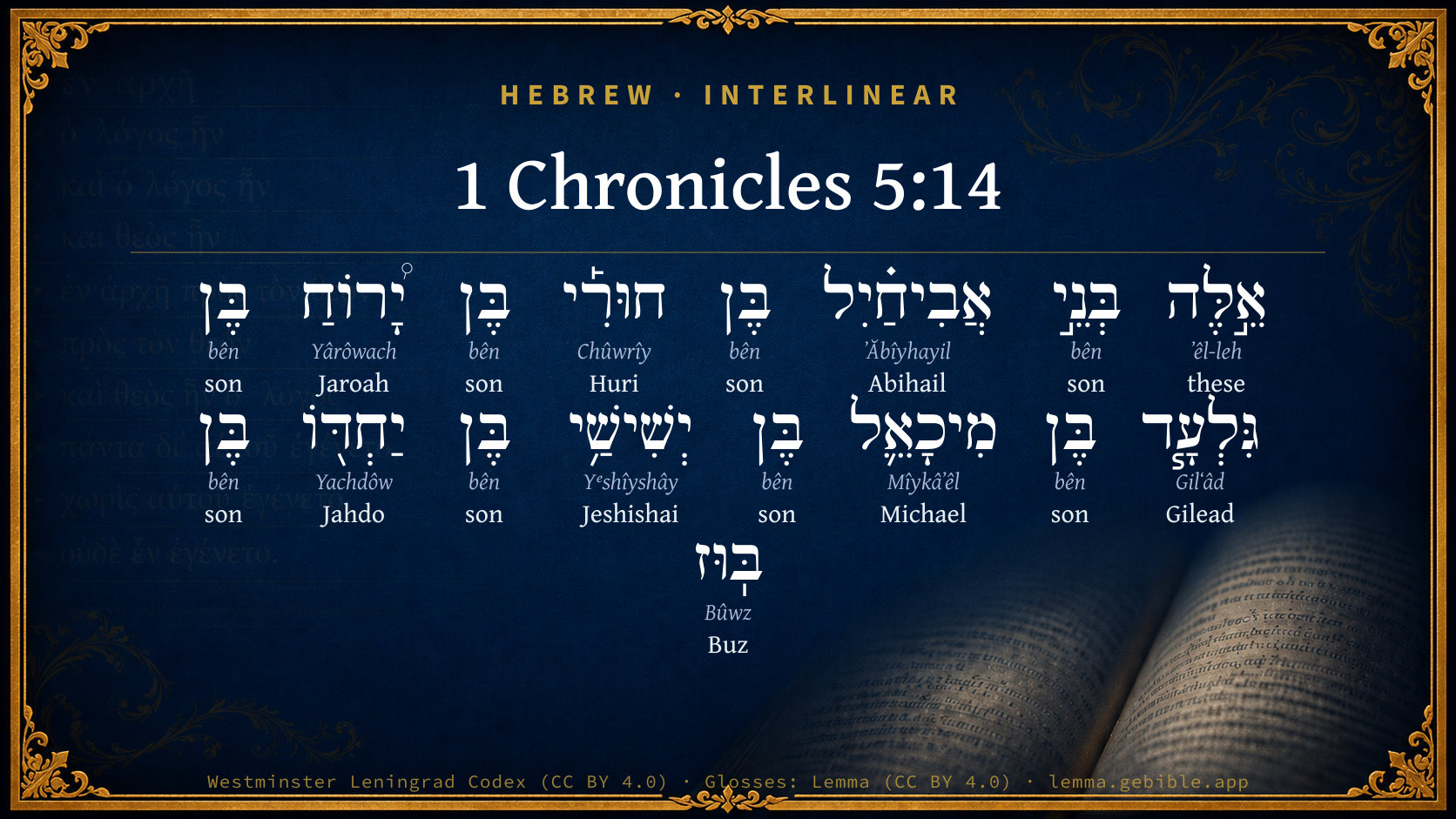
Hebrew (Westminster Leningrad Codex) 1 Chronicles 5:14 appears in the Hebrew Old Testament. The text above is from the Westminster Leningrad Codex. Each word links to its Strong’s number, a concise gloss, and parsing drawn from the Open Scriptures Hebrew Bible morphology. Click any word for its full Brown-Driver-Briggs (BDB) entry.
Download image
Cite this verse

1 Chronicles 5:14 (World English Bible). Public Domain. Lemma interlinear Bible study tool, https://lemma.gebible.app/v/1-chronicles/5/14.

Show BibTeX & RIS
BibTeX
RIS
English Translation
These were the sons of Abihail, the son of Huri, the son of Jaroah, the son of Gilead, the son of Michael, the son of Jeshishai, the son of Jahdo, the son of Buz;
World English Bible · Public Domain
Highlights
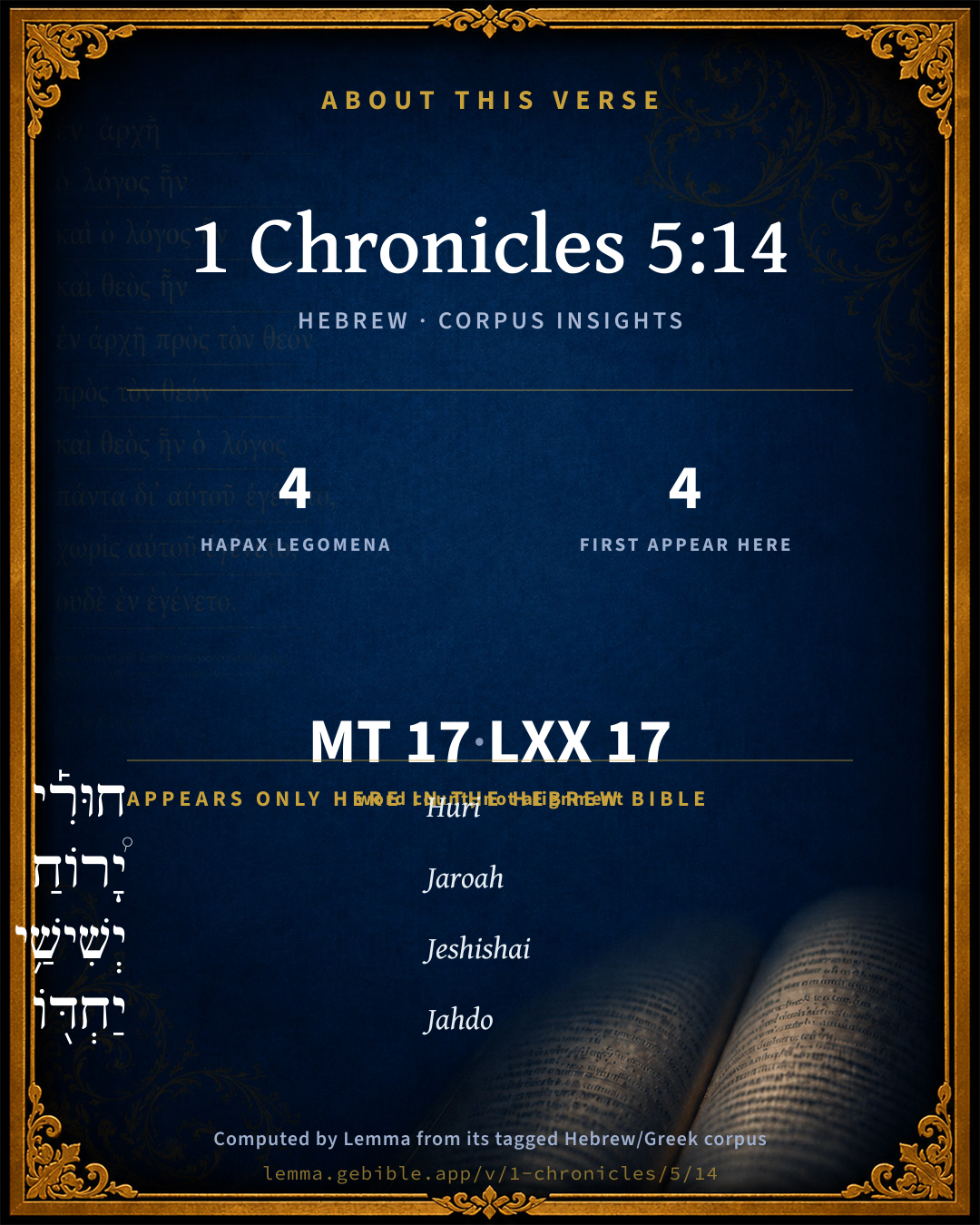
  • 4 hapax legomena — only here in the Hebrew Bible
  • 4 first appearances in the Hebrew Bible
Full analysis ↓
Download a study sheet

One document with this verse’s original text, its word-by-word gloss line, the meaning frame, cross-references with their text, attributed commentary, and full source and license credits — printable, and it pastes into notes with its structure intact.

This verse Autodidact and up

Study sheet (.html) Plain text (.txt)

A passage Seminary Student

Up to 50 verses in one chapter. A passage sheet keeps up to 6 commentary sources and 12 cross-references per verse, in the order this page ranks them, and says so on the sheet whenever that leaves anything out. Ask for a single verse and you get the Autodidact verse sheet above.

Everything on this page stays free to read, with no account — the sheet is a download of what is already on screen, not access to it.

Want to remove ads? Support Godless Engineer
Compare translations 3

The same verse in 3 English versions, stacked beneath the original-language interlinear above. Click any original word for its lexicon entry.

Each is an independent rendering of the whole verse — the interlinear is not word-aligned to these translations.

Highlighted words mark where these versions differ — a whole-verse word diff, not a word-by-word alignment.

  • World English Bible Public Domain
    These were the sons of Abihail, the son of Huri, the son of Jaroah, the son of Gilead, the son of Michael, the son of Jeshishai, the son of Jahdo, the son of Buz;
  • King James Version Public Domain
    These are the children of Abihail the son of Huri, the son of Jaroah, the son of Gilead, the son of Michael, the son of Jeshishai, the son of Jahdo, the son of Buz;
  • unfoldingWord Literal Text CC BY-SA 4.0
    These the sons of Abihail, the son of Huri, the son of Jaroah, the son of Gilead, the son of Michael, the son of Jeshisha, the son of Jahdo, the son of Buz.

unfoldingWord Literal Text — © unfoldingWord, licensed CC BY-SA 4.0. Word-aligned USFM3 via Door43 (git.door43.org/unfoldingWord/en_ult).

Versions to compare (up to 4)

3 of 4 selected

Show all 18 translations

Every available English version of this verse, each an independent rendering of the whole verse.

  • World English Bible Public Domain
    These were the sons of Abihail, the son of Huri, the son of Jaroah, the son of Gilead, the son of Michael, the son of Jeshishai, the son of Jahdo, the son of Buz;
  • Berean Standard Bible Public Domain
    These were the sons of Abihail son of Huri, the son of Jaroah, the son of Gilead, the son of Michael, the son of Jeshishai, the son of Jahdo, the son of Buz.
  • Majority Standard Bible Public Domain
    These were the sons of Abihail son of Huri, the son of Jaroah, the son of Gilead, the son of Michael, the son of Jeshishai, the son of Jahdo, the son of Buz.
  • King James Version Public Domain
    These are the children of Abihail the son of Huri, the son of Jaroah, the son of Gilead, the son of Michael, the son of Jeshishai, the son of Jahdo, the son of Buz;
  • American Standard Version (1901) Public Domain
    These were the sons of Abihail, the son of Huri, the son of Jaroah, the son of Gilead, the son of Michael, the son of Jeshishai, the son of Jahdo, the son of Buz;
  • Revised Version (1885) Public Domain
    These were the sons of Abihail the son of Huri, the son of Jaroah, the son of Gilead, the son of Michael, the son of Jeshishai, the son of Jahdo, the son of Buz;
  • Geneva Bible (1599) Public Domain
    These are the childre of Abihail, the sonne of Huri, the sonne of Iaroah, the sonne of Gilead, the sonne of Michael, the sonne of Ieshishai, the sonne of Iahdo, the sonne of Buz.
  • Douay-Rheims (1899) Public Domain
    These were the sons of Abihail, the son of Hurl, the son of Jara, the son of Galaad, the son of Michael, the son of Jesisi, the son of Jeddo, the son of But.
  • Young's Literal Translation Public Domain
    These `are' sons of Abihail son of Huri, son of Jaroah, son of Gilead, son of Michael, son of Jeshishai, son of Jahdo, son of Buz;
  • Literal Standard Version CC BY-SA 4.0
    These [are] sons of Abihail son of Huri, son of Jaroah, son of Gilead, son of Michael, son of Jeshishai, son of Jahdo, son of Buz;
  • Unlocked Literal Bible CC BY-SA 4.0
    These persons named above were the descendants of Abihail, and Abihail was the son of Huri. Huri was the son of Jaroah. Jaroah was the son of Gilead. Gilead was the son of Michael. Michael was the son of Jeshishai. Jeshishai was the son of Jahdo. Jahdo was the son of Buz.
  • unfoldingWord Literal Text CC BY-SA 4.0
    These the sons of Abihail, the son of Huri, the son of Jaroah, the son of Gilead, the son of Michael, the son of Jeshisha, the son of Jahdo, the son of Buz.
  • Darby Bible Public Domain
    -- These were the sons of Abihail, the son of Huri, the son of Jaroah, the son of Gilead, the son of Michael, the son of Jeshishai, the son of Jahdo, the son of Buz:
  • World Messianic Bible Public Domain
    These were the sons of Abihail, the son of Huri, the son of Jaroah, the son of Gilead, the son of Michael, the son of Jeshishai, the son of Jahdo, the son of Buz;
  • Webster's Bible Public Domain
    These are the children of Abihail the son of Huri, the son of Jaroah, the son of Gilead, the son of Michael, the son of Jeshishai, the son of Jahdo, the son of Buz;
  • Free Bible Version CC BY-SA 4.0
    These were the sons of Abihail, son of Huri, son of Jaroah, son of Gilead, son of Michael, son of Jeshishai, son of Jahdo, son of Buz.
  • Bible in Basic English Public Domain
    These were the sons of Abihail, the son of Huri, the son of Jaroah, the son of Gilead, the son of Michael, the son of Jeshishai, the son of Jahdo, the son of Buz;
  • JPS Tanakh (1917) Public Domain
    These were the sons of Abihail the son of Huri, the son of Jaroah, the son of Gilead, the son of Michael, the son of Jehishai, the son of Jahdo, the son of Buz;

Literal Standard Version (2020), Covenant Press — licensed CC BY-SA 4.0. Text via the HelloAO Bible API (eBible.org). Unlocked Literal Bible (unfoldingWord) — licensed CC BY-SA 4.0. Text via the HelloAO Bible API (eBible.org). unfoldingWord Literal Text — © unfoldingWord, licensed CC BY-SA 4.0. Word-aligned USFM3 via Door43 (git.door43.org/unfoldingWord/en_ult). Free Bible Version, Dr. Jonathan Gallagher — licensed CC BY-SA 4.0. Text via the HelloAO Bible API (eBible.org).

Word by word

More ways to search: Search by grammar → Find every occurrence → Compare this word →

Practice this passage: Drill this verse → Learn its vocabulary →

חוּרִ֡י
Chûwrîy
H2359
“Huri”
Noun, Proper
Part of Speech
Noun
Type
Proper
Full BDB Definition

Origin: probably from H2353

TWOT: None

Huri = "linen-weaver" - a Gadite, father of Abihail
  1. אֵ֣לֶּה ʼêl-leh H428 “these” Pronoun, Demonstrative, Common, Plural
  2. בְּנֵ֣י bên H1121 “sons of” Noun, Common, Masculine, Plural, Construct
  3. אֲבִיחַ֗יִל ʼĂbîyhayil H32 “Abihail” Noun, Proper
  4. בֶּן bên H1121 “son of” Noun, Common, Masculine, Singular, Construct
  5. בֶּן bên H1121 “son of” Noun, Common, Masculine, Singular, Construct
  6. יָ֠רוֹחַ Yârôwach H3386 “Jaroah” Noun, Proper
  7. בֶּן bên H1121 “son of” Noun, Common, Masculine, Singular, Construct
  8. גִּלְעָ֧ד Gilʻâd H1568 “Gilead” Noun, Proper
  9. בֶּן bên H1121 “son of” Noun, Common, Masculine, Singular, Construct
  10. מִיכָאֵ֛ל Mîykâʼêl H4317 “Michael” Noun, Proper
  11. בֶּן bên H1121 “son of” Noun, Common, Masculine, Singular, Construct
  12. יְשִׁישַׁ֥י Yᵉshîyshây H3454 “Jeshishai” Noun, Proper
  13. בֶּן bên H1121 “son of” Noun, Common, Masculine, Singular, Construct
  14. יַחְדּ֖וֹ Yachdôw H3163 “Jahdo” Noun, Proper
  15. בֶּן bên H1121 “son of” Noun, Common, Masculine, Singular, Construct
  16. בּֽוּז Bûwz H938 “Buz” Noun, Proper

About this verse

These counts appear in no published source. They are computed here, from the morphology-tagged text and Lemma’s own curated glosses. What Lemma adds →

17
words
10
distinct lemmas
Historical
section

Notable vocabulary

4 hapax legomena — words that appear only here in the entire Hebrew Bible:

  • חוּרִ֡י Huri H2359
  • יָ֠רוֹחַ Jaroah H3386
  • יְשִׁישַׁ֥י Jeshishai H3454
  • יַחְדּ֖וֹ Jahdo H3163

First appearance in Scripture

These words make their first canonical appearance in the Hebrew Bible here:

  • חוּרִ֡י Huri H2359
  • יָ֠רוֹחַ Jaroah H3386
  • יְשִׁישַׁ֥י Jeshishai H3454
  • יַחְדּ֖וֹ Jahdo H3163

Shared distinctive vocabulary

בּֽוּז Buz H938 occurs in 3 verses of the Hebrew Bible. Also found in:

Grammatical profile

  • 16 nouns
  • 1 pronoun

Repetition

A word recurs within this verse — often emphatic in Hebrew:

  • בְּנֵ֣י son H1121 ×8

Hebrew & Septuagint length

In English translation the verse runs 34 words from the Hebrew and 34 from the Septuagint (LXX English) — the same length.

A rough comparison of the two English renderings, which tokenize alike — not a word-level alignment.

Word counts can differ between the Hebrew and the Greek without any difference in meaning — e.g. the Hebrew direct-object marker אֵת has no separate Greek word, and Greek often adds the article ὁ.

In the original languages it is 17 Hebrew tokens and 17 Greek tokens — but the two are counted differently (Hebrew bundles its prefixes and suffixes into one token; the Greek is in lemma form), so that isn’t a like-for-like length.

Hebrew and Greek witnesses Masoretic Hebrew ↔ Greek Septuagint

The same verse in the two great witnesses to the Old Testament, shown verse-for-verse.

These are two independent witnesses, not word-aligned to each other, and the Septuagint is shown in lemma (dictionary) form.

Hebrew 1 Chronicles 5:14 Masoretic · Westminster Leningrad Codex

אֵ֣לֶּה בְּנֵ֣י אֲבִיחַ֗יִל בֶּן חוּרִ֡י בֶּן יָ֠רוֹחַ בֶּן גִּלְעָ֧ד בֶּן מִיכָאֵ֛ל בֶּן יְשִׁישַׁ֥י בֶּן יַחְדּ֖וֹ בֶּן בּֽוּז

These were the sons of Abihail, the son of Huri, the son of Jaroah, the son of Gilead, the son of Michael, the son of Jeshishai, the son of Jahdo, the son of Buz;

World English Bible · Public Domain

Greek LXX 1 Chronicles 5:14 Septuagint · lemma form

οὗτος υἱός αβιχαιλ υἱός ουρι υἱός ιδαι υἱός γαλαάδ υἱός μιχαηλ υἱός ισαι υἱός ιουρι υἱός ζαβουχαμ

These are the sons of Abichaia the son of Uri, the son of Idai, the son of Galaad, the son of Michael, the son of Jesai, the son of Jeddai, the son of Buz,

LXX2012 (modern English Septuagint) · Public Domain

On this verse, The Pulpit Commentary discusses the Septuagint’s reading. Read the note in Commentary ↓

Hebrew: Westminster Leningrad Codex (CC BY 4.0). Greek: Septuagint (public domain); English from LXX2012 (modern English Septuagint) (Public Domain). How the Septuagint differs from the Hebrew →

Commentary

Notes on 1 Chronicles 5:14 from classic Christian and Jewish commentators (each source and its license shown beneath its notes). The classic Christian expositions comment on the surrounding passage and are grouped to its opening verse, so a note may address several verses; the Jewish commentaries on the Tanakh (Rashi and others) are per-verse, so they appear only where the commentator wrote on this verse.

Lemma curates 59 commentaries, every one of them public domain or Creative Commons licensed, each selected and text-cleaned for this edition rather than reprinted as found. About our sources →

Joseph Benson's Commentary

1Ch 5:14-15. These are the children of Abihail — These seven last named. Ahi, chief of the house of their fathers — Ahi was the head or chief of the houses or families of those seven named 1Ch 5:13.

Joseph Benson's Commentary on the Old and New Testaments (1811–1818) — public domain. Text from a community e-Sword module.

John Gill's Exposition

And they dwelt in Gilead,.... In that part of it which belonged to the tribe of Gad:

in Bashan, and in her towns; See Gill on Ch1 5:11,

and in all the suburbs of Sharon, upon their borders; there were two Sharons, one to the west of the land of Israel near the Mediterranean sea, which is mentioned in Act 9:35 as near Lydda and Joppa; and the other to the east or northeast, beyond Jordan, which is here meant.

John Gill's Exposition of the Whole Bible (1746–1763) — public domain (CC PDM 1.0). Text via the HelloAO Bible API.

Matthew Poole's English Annotations

These are the children; these seven last named.

Matthew Poole's English Annotations on the Holy Bible (1683–1685) — public domain. Text from a community e-Sword/MySword module.

The Pulpit Commentary

Vers. 14, 15. These are the children of Abihail; i.e. the seven "brethren" of the preceding verse. A rapid line of descent, or rather of ascent, consisting of ten generations, from Abihail to Guni , here follows. The division between these verses has unfortunately cut in half one name, i.e. Buzaki. The translators of the Septuagint saw that the two verses composed one line of ascent, but instead of piecing "Aki" to "Buz," translated it as" brother." Though this line takes us some way back, we find nowhere else any clue or identification of any of these ten persons. Of the twenty-one persons in all, therefore, named as belonging to the tribe of Gad, nothing else is known; and we have nothing to guide us to connect them with any one rather than another of the original" sons of Gad" (Gen_46:16; Num_16:15-18)

The Pulpit Commentary (1880–1919), ed. H.D.M. Spence-Jones & Joseph S. Exell — public domain. Text from a community e-Sword module.

John Wesley's Explanatory Notes

These - These seven last named.

John Wesley, Explanatory Notes Upon the Whole Bible (1754–1765) — public domain. Text via the GEBible commentary corpus.

Keil & Delitzsch

C. F. Keil & F. Delitzsch

And they dwelt in Gilead,.... In that part of it which belonged to the tribe of Gad:

in Bashan, and in her towns; See Gill on Ch1 5:11,

and in all the suburbs of Sharon, upon their borders; there were two Sharons, one to the west of the land of Israel near the Mediterranean sea, which is mentioned in Act 9:35 as near Lydda and Joppa; and the other to the east or northeast, beyond Jordan, which is here meant.

Keil & Delitzsch — Biblical Commentary on the Old Testament (1861–1891) — public domain (CC PDM 1.0). Text via the HelloAO Bible API. (Old Testament only.)

unfoldingWord translationNotes

Door43 World Missions Community

Abihail ... Huri ... Jaroah ... Gilead ... Michael ... Jeshishai ... Jahdo ... Buz ... Ahi ... Abdiel ... Guni

These are the names of men. (See: How to Translate Names)

translationWords

descend

ancestor

family

unfoldingWord translationNotes — © Distant Shores Media and the Door43 World Missions Community, licensed CC BY-SA 4.0. Source: git.door43.org/Door43/en_tn.

Lesson kit

Teaching starters — assembled from the data on this page, not authored interpretation. Every prompt links to the verse data it draws on. Edit before teaching.

1 Chronicles, in the Historical, opens this verse with 17 words (10 distinct Hebrew lemmas). Its most distinctive word is Chûwrîy (“Huri”). A historical commentator’s framing appears above. Read the whole chapter for the surrounding context.

Discussion questions

  1. The word Chûwrîy carries the sense “Huri.” How does it shape the verse?
  2. 4 words here appear nowhere else in the Hebrew Bible. Why might the author reach for such rare wording?
  3. 4 words make their first appearance in Scripture here. What does this debut establish?
  4. How does Genesis 22:21, which shares the word «Buz», read alongside this verse?
  5. What does the repetition of “son” (8× in this one verse) do in this verse?
  6. The translations on this page render this verse differently — a whole-verse word diff, not a word-by-word alignment. What might account for the different wordings?
  7. Compare how Joseph Benson's Commentary and John Gill's Exposition read this verse. Where do they agree or differ?

Things to notice

  • 4 words in this verse appear nowhere else in the Hebrew Bible.
  • 4 words make their first canonical appearance in Scripture here.
  • This verse counts 17 Hebrew ↔ 17 Greek words.
  • These translations choose different wording for 4 words in this verse.
  • “son” occurs 8× in this single verse.

Reading settings

Reading text

Shown beneath each verse's original-language words.

Old Testament
Old Testament edition

Read the OT as the Masoretic Hebrew (MT) or the Greek Septuagint (LXX).

English shown for the Greek Septuagint (in the Hebrew ↔ Greek comparison).

Comparing translations? Open the Compare panel on any verse page to stack up to four side by side.