
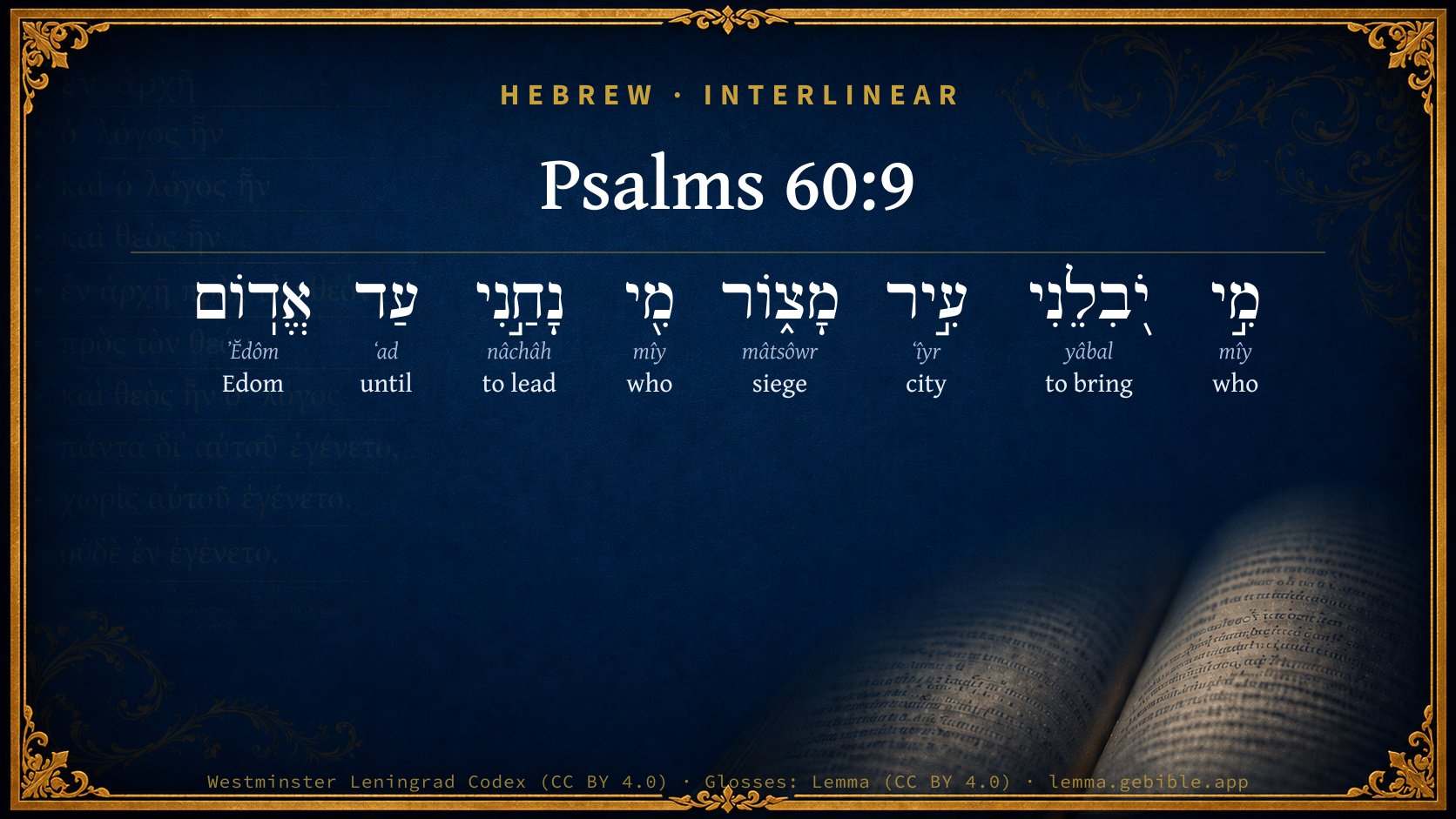
Psalms 60:9

Hebrew (Westminster Leningrad Codex) Psalms 60:9 appears in the Hebrew Old Testament. The text above is from the Westminster Leningrad Codex. Each word links to its Strong’s number, a concise gloss, and parsing drawn from the Open Scriptures Hebrew Bible morphology. Click any word for its full Brown-Driver-Briggs (BDB) entry.
Download image
Cite this verse

Psalms 60:9 (World English Bible). Public Domain. Lemma interlinear Bible study tool, https://lemma.gebible.app/v/psalms/60/9.

Show BibTeX & RIS
BibTeX
RIS
English Translation
Who will bring me into the strong city? Who has led me to Edom?
World English Bible · Public Domain
Download a study sheet

One document with this verse’s original text, its word-by-word gloss line, the meaning frame, cross-references with their text, attributed commentary, and full source and license credits — printable, and it pastes into notes with its structure intact.

This verse Autodidact and up

Study sheet (.html) Plain text (.txt)

A passage Seminary Student

Up to 50 verses in one chapter. A passage sheet keeps up to 6 commentary sources and 12 cross-references per verse, in the order this page ranks them, and says so on the sheet whenever that leaves anything out. Ask for a single verse and you get the Autodidact verse sheet above.

Everything on this page stays free to read, with no account — the sheet is a download of what is already on screen, not access to it.

Want to remove ads? Support Godless Engineer
Compare translations 3

The same verse in 3 English versions, stacked beneath the original-language interlinear above. Click any original word for its lexicon entry.

Each is an independent rendering of the whole verse — the interlinear is not word-aligned to these translations.

Highlighted words mark where these versions differ — a whole-verse word diff, not a word-by-word alignment.

  • World English Bible Public Domain
    Who will bring me into the strong city? Who has led me to Edom?
  • King James Version Public Domain
    Who will bring me into the strong city? who will lead me into Edom?
  • unfoldingWord Literal Text CC BY-SA 4.0
    Who will bring me the city of fortification? Who will lead me to Edom?

unfoldingWord Literal Text — © unfoldingWord, licensed CC BY-SA 4.0. Word-aligned USFM3 via Door43 (git.door43.org/unfoldingWord/en_ult).

Versions to compare (up to 4)

3 of 4 selected

Show all 18 translations

Every available English version of this verse, each an independent rendering of the whole verse.

  • World English Bible Public Domain
    Who will bring me into the strong city? Who has led me to Edom?
  • Berean Standard Bible Public Domain
    Who will bring me to the fortified city? Who will lead me to Edom?
  • Majority Standard Bible Public Domain
    Who will bring me to the fortified city? Who will lead me to Edom?
  • King James Version Public Domain
    Who will bring me into the strong city? who will lead me into Edom?
  • American Standard Version (1901) Public Domain
    Who will bring me into the strong city? Who hath led me unto Edom?
  • Revised Version (1885) Public Domain
    Who will bring me into the strong city? who hath led me unto Edom?
  • Geneva Bible (1599) Public Domain
    Who will leade me into the strong citie? who will bring me vnto Edom?
  • Douay-Rheims (1899) Public Domain
    Galaad is mine, and Manasses is mine: and Ephraim is the strength of my head. Juda is my king:
  • Young's Literal Translation Public Domain
    Who doth bring me `to' a city of bulwarks? Who hath led me unto Edom?
  • Literal Standard Version CC BY-SA 4.0
    Who brings me [to] a city of bulwarks? Who has led me to Edom?
  • Unlocked Literal Bible CC BY-SA 4.0
    Who will bring me into the strong city? Who will lead me to Edom?
  • unfoldingWord Literal Text CC BY-SA 4.0
    Who will bring me the city of fortification? Who will lead me to Edom?
  • Darby Bible Public Domain
    Who will bring me into the strong city? who will lead me unto Edom?
  • World Messianic Bible Public Domain
    Who will bring me into the strong city? Who has led me to Edom?
  • Webster's Bible Public Domain
    \\60:7\\Gilead is mine, and Manasseh is mine; Ephraim also is the strength of my head; Judah is my lawgiver;
  • Free Bible Version CC BY-SA 4.0
    Who will bring me into the fortified city? Who will lead me into Edom?
  • Bible in Basic English Public Domain
    Who will take me into the strong town? who will be my guide into Edom?
  • JPS Tanakh (1917) Public Domain
    (60-11) Who will bring me into the fortified city? Who will lead me unto Edom?

Literal Standard Version (2020), Covenant Press — licensed CC BY-SA 4.0. Text via the HelloAO Bible API (eBible.org). Unlocked Literal Bible (unfoldingWord) — licensed CC BY-SA 4.0. Text via the HelloAO Bible API (eBible.org). unfoldingWord Literal Text — © unfoldingWord, licensed CC BY-SA 4.0. Word-aligned USFM3 via Door43 (git.door43.org/unfoldingWord/en_ult). Free Bible Version, Dr. Jonathan Gallagher — licensed CC BY-SA 4.0. Text via the HelloAO Bible API (eBible.org).

Word by word

More ways to search: Search by grammar → Find every occurrence → Compare this word →

Practice this passage: Drill this verse → Learn its vocabulary →

About this verse

These counts appear in no published source. They are computed here, from the morphology-tagged text and Lemma’s own curated glosses. What Lemma adds →

8
words
7
distinct lemmas
Wisdom
section

Notable vocabulary

The rarest word here is יֹ֭בִלֵנִי to bring H2986 — appearing just 18 times in the whole Hebrew Bible.

Shared distinctive vocabulary

יֹ֭בִלֵנִי to bring H2986 occurs in 18 verses of the Hebrew Bible. Also found in:

Grammatical profile

  • 2 verbs
  • 3 nouns
  • 1 preposition
  • 2 particles

Verb forms

  • יֹ֭בִלֵנִי Hiphil · Imperfect
  • נָחַ֣נִי Qal · Perfect

Repetition

A word recurs within this verse — often emphatic in Hebrew:

Hebrew & Septuagint length

In English translation the verse runs 14 words from the Hebrew and 16 from the Septuagint (LXX English) — closely comparable.

A rough comparison of the two English renderings, which tokenize alike — not a word-level alignment.

Word counts can differ between the Hebrew and the Greek without any difference in meaning — e.g. the Hebrew direct-object marker אֵת has no separate Greek word, and Greek often adds the article ὁ.

Cross-references

6

Topical passages linked to Psalms 60:9 in the Treasury of Scripture Knowledge — connected by theme and wording, ordered by reader-vote popularity; previews shown in the World English Bible.

  • 2 Samuel 12:26–31 Now Joab fought against Rabbah of the children of Ammon, and took the royal city.
  • 2 Samuel 11:1 It happened, at the return of the year, at the time when kings go out [to battle], that David sent Joab, and his servants with him, and all Israel; and they destroyed the children of Ammon, and besieged Rabbah. But David stayed at Jerusalem.
  • Judges 1:12 Caleb said, He who strikes Kiriath Sepher, and takes it, to him will I give Achsah my daughter as wife.
  • 1 Chronicles 11:6 David said, Whoever strikes the Jebusites first shall be chief and captain. Joab the son of Zeruiah went up first, and was made chief.
  • 1 Chronicles 11:17–19 David longed, and said, Oh that one would give me water to drink of the well of Bethlehem, which is by the gate!
  • Judges 1:24–25 The watchers saw a man come forth out of the city, and they said to him, Show us, we pray you, the entrance into the city, and we will deal kindly with you.

Cross-references courtesy of OpenBible.info (CC BY 4.0).

Hebrew and Greek witnesses Masoretic Hebrew ↔ Greek Septuagint

The same verse in the two great witnesses to the Old Testament, shown verse-for-verse.

You’re reading Greek Psalm 59 (Hebrew Psalm 60). The Septuagint counts the superscription, so verse numbers can differ from the Hebrew — chapter-level alignment, not verse-by-verse. Numbering follows Rahlfs.

These are two independent witnesses, not word-aligned to each other, and the Septuagint is shown in lemma (dictionary) form.

Hebrew Psalms 60:9 Masoretic · Westminster Leningrad Codex

מִ֣י יֹ֭בִלֵנִי עִ֣יר מָצ֑וֹר מִ֖י נָחַ֣נִי עַד אֱדֽוֹם

Who will bring me into the strong city? Who has led me to Edom?

World English Bible · Public Domain

Greek LXX Greek Psalm 59:9 Septuagint · lemma form

ἐμός εἰμί γαλαάδ καί ἐμός εἰμί μανασσή καί εφράιμ κραταίωσις ὁ κεφαλή ἐγώ ἰούδας βασιλεύς ἐγώ

Who will lead me into the fortified city? who will guide me as far a Idumea?

LXX2012 (modern English Septuagint) · Public Domain

Hebrew: Westminster Leningrad Codex (CC BY 4.0). Greek: Septuagint (public domain); English from LXX2012 (modern English Septuagint) (Public Domain). How the Septuagint differs from the Hebrew →

Commentary

Notes on Psalms 60:9 from classic Christian and Jewish commentators (each source and its license shown beneath its notes). The classic Christian expositions comment on the surrounding passage and are grouped to its opening verse, so a note may address several verses; the Jewish commentaries on the Tanakh (Rashi and others) are per-verse, so they appear only where the commentator wrote on this verse.

Lemma curates 59 commentaries, every one of them public domain or Creative Commons licensed, each selected and text-cleaned for this edition rather than reprinted as found. About our sources →

Trapp's Complete Commentary

John Trapp

Psa 60:9 Who will bring me [into] the strong city? who will lead me into Edom?

Ver. 9. Who will bring me into the strong city?] Into Rabbah of the Ammonites, which at length he got, 2Sa 12:29-31, and now wisheth for. Kimchi readeth it in the perfect tense, Who has led me into the strong cities? who has brought me into Edom? Hast not thou, O God? &c.

John Trapp, A Commentary or Exposition upon All the Books of the Old and New Testament (1647–1656) — public domain. Text from a community e-Sword module.

The Biblical Illustrator

Joseph S. Exell

Psa_60:9

Who will bring me into the strong city?

The Christian warfare

We are all familiar with the idea that the life of the Christian and the progressive advance of the kingdom of heaven involves a conflict, a never-ceasing warfare. We are, however, I think, sometimes unmindful that that warfare must assume very various phases according to the varying conditions and circumstances; and that much watchfulness, skill, determination and patience is needed for the frequent re-organization of forces, the re-adaptation of resources, and the revision of methods. Thus, with the individual, there are often constitutional tendencies which can only be counteracted by, it may be, a lifelong watchfulness and sustained assault; there are often strongholds of confirmed habit which have been allowed to entrench themselves within us, and which nothing short of a tedious system of siege operations can reduce. How true it is, we must all know, that spiritual growth and development of the Christian character are retarded because we have left such-like strongholds unreduced. Our forgetfulness of this aspect of our militant position may arise from a yielding to the temptation that these tedious siege operations can be dispensed with. We hope that if left alone these strongholds of evil tendency and habit will surrender while we make the easier conquests; or we hope that we may enter into possession of our promised land and leave these fortresses standing, content with a resolution to watch them; or we decide that, as we cannot hope to reduce them absolutely, we will make, as we think, safe terms with them, so that they shall not molest us or disturb our peace. Or it may be that we fail to gain permanent possession of them because we are tempted to evade the truth that no stronghold carried by assault is secured unless we are ready at once to occupy the position and to hold it. Evil habits are not eradicated until they are permanently replaced by good habits; it is only the gradual intrusion and establishment of good habits that ousts the evil and at last permanently excludes them. And this securing a permanent footing for habits of acting aright is an exceeding slow process. In order to form a habit, a series of individual actions must be persistently repeated for a considerable time, and before the habit has become irrevocably established we must expect to meet many reverses and engage in many desperate rallies. We live in impatient days; there is a tendency to resort to methods of spiritual warfare which seem to produce speedy results; adventurous raids are made here and there, while the strongholds stand unassailed, and ground gained is not held for want of those less showy operations which are needful if we would make each step secure. To my younger hearers especially I would say, Be not deceived; steady, persevering effort is needed if you would become real masters of yourselves. Depend upon it, as with Israel of old, you cannot advance far towards getting possession of your promised land, possession and control of your passions, your will, without finding a fortress to be subdued. What is true of the individual growth in grace, is true also with the extension of Christs kingdom upon earth. There are occasions where the Church finds herself confronted by towering strongholds of formidable strength which have long held captive the minds and hearts of her fellow-men, strongholds which cannot be carried by simple assault, but which must be reduced by the slow and persistent advance of regular approaches. At such times there is a demand made upon the Churchs faith, and the same temptation to shirk the trying duty presents itself. It is also true that in regard to the Churchs advances, much unpretending monotonous labour has to be expended in securing the ground gained. We have need not only of men who will carry on the message, but also of men who will unobtrusively sacrifice themselves to the often unexciting and sometimes very trying, but most important work of slowly building up the new life in the new believers; helping them by slow degrees to assimilate the life, the character, the habits, personal, domestic, and social, of the new man which they have newly put on. Who will lead us into these strong cities? We answer, Christ; and then, when we further ask, How can we best bring the power of Christ to bear upon them? we reply, First endeavour to secure that the fountain shall be pure, that the stream of life going forth from your English shores shall be living, and strong, and clear; then let us have men devoted, who can explain the nature of the living stream, and direct inquiries to the source of its virtue as a healing power; thirdly, let the consecrated intellect of England help us to express Divine truth more truly and exhaustively; and then such a threefold cord may well be expected to be a mighty instrument for the pulling down of the strongholds. (Bishop E. R. Johnson.)

The inspiration of a great leader

The inspiration of a leaders presence and courage has turned many a defeat into a victory. Marlborough, Henry of Navarre, and Napoleon are instances, with Garibaldi and our own Gordon. But the memory of a great leader is inspiring also. The last words of Hedley Vicars were, This way, 97th! and although the captain fell, his men rushed forward and repulsed a force ten times their number. We are to arm ourselves with that panoply of perfect trust and perfect obedience which our Divine Leader put on, and in which He endured and conquered. Many a child has borne pain and contumely with fortitude and patience, upheld by the thought of the Saviours sufferings.

Christ the invincible warrior

It has been said of Edward, the Black Prince, that he never fought a battle which he did not win, and of the great Duke of Marlborough, that he never besieged a city that he did not take. Shall that be said of men which we deny concerning the Most High God? Is He less successful than some human generals? Shall these invincibly prevail, and grade be liable to defeat? Impossible.

The Biblical Illustrator, edited by Joseph S. Exell (c. 1880s–1900s) — public domain. Text from a community e-Sword module.

Joseph Benson's Commentary

Psa 60:9-10. Who will bring me into the strong city, &c. — As if he had said, These are difficult things indeed; and I may well ask, when I consider how potent these nations are, By what power shall I enter that strongly fenced city? (or, cities rather, the singular number being put for the plural.) Who is it that will conduct me into Idumea, and make me master of it? None can do it but God. Having beaten his enemies out of the field, he desires God’s assistance to take their strong holds, and so secure himself from further attempts. Edom was a high and rocky country, Obadiah Psa 60:3, fortified by nature, as well as by art, and therefore not to be subdued without a divine hand. Wilt not thou, &c., who didst not go out with our armies — Namely, in former times; but now hast graciously returned to us. He brings to his own mind, and to the minds of the people, their former calamities, that they might be more thankful for present mercies and deliverances.

Joseph Benson's Commentary on the Old and New Testaments (1811–1818) — public domain. Text from a community e-Sword module.

J. A. Alexander on Psalms

Joseph Addison Alexander

11. (Psa 60:9). Who will bring me (to) the fenced city? Who has led me up to Edom? In reliance on God's promise, and in the possession of the hope and courage just expressed, his people are ready to go forward, and only waiting, as it were, for some one to conduct them into the enemy's country, nay, into his very citadel. The fenced city, literally, city of defence, or fortification, a phrase already used in Psa 31:21, is Petra, the famous capital of Idumea, hewn in the rock, and almost perfectly impregnable. See Robinson's Palestine, vol. ii. pp. 573-580. The past tense in the last clause represents the question as already answered. Up to, even to, as far as, implying not mere motion or direction, but actual arrival.

Joseph Addison Alexander, The Psalms Translated and Explained (1850) — public domain. Text from a community e-Sword module.

Tyndale Open Study Notes

Tyndale Open Resources

60:9 Destroying a defeated invader’s capital (the fortified city) would help to ensure that they would not attack again. The capital of Edom was Bozrah, located to the southeast of Israel. Only God could grant victory.

Tyndale Open Study Notes — © Tyndale Open Resources, licensed CC BY-SA 4.0. Text via the HelloAO Bible API.

Geneva Bible (1599)

Geneva Bible translators

He was assured that God would give him the strong cities of his enemies, wherein they thought themselves sure.

Geneva Bible (1599) marginal notes — public domain. Text via Bolls.life.

Jamieson, Fausset & Brown

Robert Jamieson, A. R. Fausset & David Brown

He feels assured that, though once angry, God is now ready to favor His people.

who will lead me-- or, who has led me, as if the work were now begun.

Jamieson, Fausset & Brown — Commentary Critical and Explanatory on the Whole Bible (1871) — public domain (CC PDM 1.0). Text via the HelloAO Bible API.

Adam Clarke's Commentary

Verse 9. Who will bring me into the strong city?] If this part of the Psalm, from the sixth to the twelfth verse, refer to the return of the captives from Babylon, as I think probable; then the strong city may mean either Petra, the capital of Idumea; Bozra, in Arabia, near the mountains of Gilead; Rabba, the capital of the Ammonites; or Tyre, according to the Chaldee, the capital of Phoenicia; or Jerusalem itself, which, although dismantled, had long been one of the strongest cities of the east. Or it may imply, Who shall give me the dominion over the countries already mentioned? who will lead me into Edom? who will give me the dominion over that people?

Adam Clarke's Commentary on the Bible (1810–1826) — public domain. Text from a community e-Sword/MySword module.

John Calvin's Commentaries

9 Who will bring me into the fortified city? Anticipating an objection which might be alleged, he proceeds to state that he looked to God for the accomplishment of what remained to be done in the capture of the fortified places of his enemies, and the consolidation of his victories. It might be said, that as a considerable number continued to resist his claims, the confident terms which he had used were premature. God, however, had pledged his word that every nation which set itself in opposition to him would be brought under his power, and in the face of remaining difficulties and dangers he advances with certainty of success. By the fortified city, some understand Rabbah, the capital of the Moabites. Others, with more probability, consider that the singular is used for the plural number, and that David alludes in general to the different cities under protection of which his enemies were determined to stand out. He declares, that the same God who had crowned his arms with victory in the open field would lead him on to the siege of these cities. With a view to prove his legitimate call to the government, he amplifies a second time the marks of the divine favor which it had received, by contrasting it with that which preceded. “The God,” he says, “who had formerly cast us off, and abandoned us to unsuccessful warfare, will now lay open before me the gates of hostile cities, and enable me to break through all their fortifications.”

John Calvin's Commentaries (1540-1563) — public domain. Text from the Calvin Translation Society English edition (1840s-50s) via the Christian Classics Ethereal Library (ccel.org). Calvin's coverage is partial (roughly two-thirds of the Bible); uncommented books and verses are honest gaps, never fabricated. The 19th-century editor's footnotes and remarks are omitted so the notes are faithfully Calvin's own voice.

Ellicott's Commentary for English Readers

(9) Who will . . .—i.e., how can this ancient Divine oracle be fulfilled now in present circumstances? This is the poet’s question. He may be a king himself eager for triumph, or more probably Israel personified. (See the plural in Psa_60:10-12.) Edom is the particular foe in view, and as the difficulties of the undertaking present themselves, misgivings arise and the assurance gained from the triumphs of olden time turns into prayer, half plaintive, half confident, that the Divine favour and power may be once more on the side of the chosen people.

The strong city.—As in the Hebrew the article is wanting, any strongly fortified city might be intended, were it not for the parallelism. Here it must stand for Selah or Petra, the capital of Edom. For its impregnable position (see Note Oba_1:3). The question, “Who will lead me into Petra?” is explained by the fact that there are only two possible approaches to the city, each a long narrow tortuous defile, and that the place itself is so buried in its ravines that it cannot be seen from any spot in its neighbourhood far or near.

A Bible Commentary for English Readers, edited by Charles John Ellicott (1878–1897) — public domain. Text from a community e-Sword module.

The Cambridge Bible for Schools and Colleges

gen. ed. J. J. S. Perowne

9. the strong city] Probably Sela or Petra, the capital of Edom, famous for its inaccessibility (Oba_1:3). See Stanley’s Sinai and Pal., p. 89, for a description of the wonderful defile, which in ancient times was the only usual approach to Petra.

Who will lead me into Edom] The verb is in the perfect tense, which is sometimes used in questions to express a sense of difficulty or hopelessness. Who could lead me, or, who could have led me, right into (the preposition is emphatic) Edom? The difficulties are almost insuperable. But possibly the text is faulty. The restoration of one letter with a change in the vocalisation would give the future tense. In any case the rendering of R.V., Who hath led me unto Edom? as a reference to some previous successful invasion, does not suit the context.

9–12. None but God can give help, and though for the moment He has abandoned His people, He will surely once more lead them to victory.

The Cambridge Bible for Schools and Colleges (gen. ed. J. J. S. Perowne; Cambridge University Press, 1878–1918) — public domain. Text from a community e-Sword module.

John Gill's Exposition

Who will bring me into the strong city?.... Which some understand of Rabbah of the Ammonites, which Joab besieged, and sent to David to come and take it in person, Sa2 12:26. The Targum interprets it of Tyre, which was a strong fortified city, Eze 26:4. It rather seems to be the same with Edom, or the metropolis of the Edomites; since it follows:

who will lead me into Edom? which was situated in the clefts of the rock, and on the height of the hill, Jer 49:16; but is mystically to be understood of the city of Rome, the great and mighty city, as it is often called in the book of the Revelation, Rev 11:8; whose destruction is certain, being predicted; and after which there have been desires raised in the hearts of God's people in all ages; and particularly just before the time God will put it into the hearts of the kings of the earth to burn it with fire; who are here represented by David, as desirous of entering into it in triumph to destroy it, Rev 17:16.

John Gill's Exposition of the Whole Bible (1746–1763) — public domain (CC PDM 1.0). Text via the HelloAO Bible API.

Albert Barnes' Notes on the Bible

Who will bring me into the strong city? - The strong city - the fenced, the fortified city - referred to here is doubtless the capital of Idumea. This was the celebrated city Petra, situated in the rocks, and so difficult to be taken by an enemy. For a description of it, see the notes at Isa 16:1. It was this city, as the capital of the land of Edom, which David was now so anxious to secure; and he asks, therefore, with interest, who among his captains, his mighty men, would undertake the task of conducting his armies there.

Who will lead me into Edom? - Into the capital, and thence into the whole land to subdue it. This was done under the combined command of Joab and Abishai his brother. See the notes at the title to the psalm.

Albert Barnes' Notes on the Bible (1834–1885) — public domain. Text from a community e-Sword/MySword module.

Matthew Poole's English Annotations

Who will bring me? None can do it but God, as he declareth in the following verses.

Into the strong city, i.e. the cities; the singular number for the plural, which is usual. Having beaten his enemies out of the field, and into their strong cities, from whence they hoped to renew the war, he desires God’s assistance, whereby he may take their strong holds, and so secure himself from further attempts against him.

Into Edom; which was a high and rocky country, Oba 1:3, fortified by nature as well as by art, and therefore not to be invaded and subdued without a Divine hand.

Matthew Poole's English Annotations on the Holy Bible (1683–1685) — public domain. Text from a community e-Sword/MySword module.

The Treasury of David

Charles H. Spurgeon

Ver. 9. As yet the interior fortresses of Edom had not been subdued. Their invading bands had been slain in the valley of salt, and David intended to push his conquests even to Petra the city of the rock, deemed to be impregnable.

Who will bring me into the strong city? It was all but inaccessible, and hence the question of David. When we have achieved great success it must be a stimulus to greater efforts, but it must not become a reason for self confidence. We must look to the strong for strength as much at the close of a campaign as at its beginning.

Who will lead me into Edom? High up among the stars stood the city of stone, but God could lead his servant up to it. No heights of grace are too elevated for us, the Lord being our leader, but we must beware of high things attempted in self reliance. EXCELSIOR is well enough as a cry, but we must look to the highest of all for guidance. Joab could not bring David into Edom. The veterans of the valley of salt could not force the passage, yet was it to be attempted, and David looked to the Lord for help. Heathen nations are yet to be subdued. The city of the seven hills must yet hear the gospel. Who will give the church the power to accomplish this? The answer is not far to seek.

Ver. 9. Who will lead me into Edom? The entrance to Petra is by a narrow gorge, lined by lofty precipices, formed by the channel of a rivulet. This defile is nearly two miles in length. At some places the overhanging rocks approach so near to each other that only two horsemen can proceed abreast. Dr. Tweedie, in "Ruined Cities of the East, "1859.

Ver. 9. The believer, when he promises to himself great things, must neither be senseless of the difficulties of opposition which he is to meet with, nor of his own inability to overcome difficulties; but being sensible of both, must look to God for assistance and furniture to overcome; for when David considered the strength of the fenced royal cities of the enemy, he saith, Who will bring me into the strong city? who will lead me into Edom? Wilt not thou, O God? David Dickson.

Ver. 9. The soul winner's question.

I. The object of attack; the strong city of man's heart,

barricaded by depravity, ignorance, prejudice,

custom, etc.

II. Our main design. To penetrate, to reach the citadel

for Jesus.

III. Our great enquiry. Eloquence, learning, wit, none of

these can force the gate, but there is One who can.

Psalms 60:10*

Charles H. Spurgeon's The Treasury of David (1869–1885) — public domain. Psalms only. Text from a community e-Sword/MySword module.

Whedon's Commentary on the Bible

Daniel D. Whedon

9. Strong city—That is, Selah, the rock, afterwards called Petra, the capital of Edom. It was situated in the eastern mountains of the Arabah, about fifty miles south, bearing east, from the Dead Sea, and about seventy miles from the head of the Gulf of Akaba. It was captured by David and by Amaziah. In 2Ki_14:7, and Isa_16:1, it is translated “Selah” in our English Bible, and in 2Ch_25:12, “the Rock.” Three hundred years before Christ it became the great transit point of commerce between the East and the West across the Arabian Desert, and was renowned for its wealth and strength.

Who will bring me into the strong city—Selah was situated in a hollow of the mountains, two thousand feet above the Arabah valley, surrounded east and west by high cliffs, with no military roads on the west, and approached on the east by caravans only through a narrow, though famous, ravine, the Sik. It was deemed impregnable.

Who will lead me—Who has led me unto Edom? The change of tense, in the Hebrew, would more naturally explain itself by remembering God had directed the army of Israel to the border of Edom by an oracle from the priest; and the interrogatory form, on which the prayer and faith of David are founded, is suitable to an unfinished act. They now stood in the border of Edom, checked and baffled, but hopeful. The strong city, the key to the whole kingdom, lies beyond them, and the argument of the prayer is, that as God had already led them into Edom, so he would bring them into the capital or strong city. See more in introductory note to Psalms 108.

Daniel D. Whedon (gen. ed.), Commentary on the Old and New Testaments (1874–1909) — public domain. Text from a community e-Sword module.

The Pulpit Commentary

Ver. 9-12. Rehearsal of God"s promises has raised the psalmist out of despondency, and he can now confidently call God to his assistance. Edom is to be conquered, for so God has premised (ver. 8). But how? Who will lead out Israel"s armies? Will God, who has lately "cast Israel off"? If not, it must he man. But "vain is the help of man" (ver. 11). So the call is made that God will give help in the trouble and with the call comes full confidence and the triumphant cry goes forth, "Through God we shall do valiantly; for he it is that shall tread down our enemies" (ver. 12).

Who will bring me into the strong city? The "strong city" of Edom was Sela, "The Cliff now Petra. And it was a city of enormous strength, rock hewn in the main, and guarded by frightful precipices. Who will conduct me through its strong natural and artificial defences, and give me possession of the place? Who will lead me into Edom? Who will even bring me into the country? The Edomites, flushed with their recent victory, will, of course, dispute my entrance. Who will enable me to overcome their resistance?

The Pulpit Commentary (1880–1919), ed. H.D.M. Spence-Jones & Joseph S. Exell — public domain. Text from a community e-Sword module.

John Wesley's Explanatory Notes

Who - None can do it but God. City - The cities; the singular number for the plural. Having beaten his enemies out of the field, he desires God's assistance to take their strong-holds, and so secure himself from farther attempts. Edom - Which was an high and rocky country, Obad 1-3, fortified by nature, as well as by art, and therefore not to be subdued without a Divine hand.

John Wesley, Explanatory Notes Upon the Whole Bible (1754–1765) — public domain. Text via the GEBible commentary corpus.

Keil & Delitzsch

C. F. Keil & F. Delitzsch

The third strophe reverts to prayer; but the prayer now breathes more freely with a self-conscious courage for the strife. The fortified city (עיר מצור) is not Rabbath Ammon; but, as becomes evident from the parallel member of the verse and Kg2 14:7, the Idumaean chief city of Sela' (סלע) or Petra (vid., Knobel on Gen 36:42, cf. Psa 31:22; Ch2 8:5; Ch2 11:5 together with Psa 14:5). The wish: who will conduct me = Oh that one would conduct me (Ges. 136, 1)! expresses a martial desire, joyful at the prospect of victory; concerning מי נחני, quis perduxerit me, vid., on Psa 11:3. What follows is not now to be rendered: Not Thou (who but Thou), Elohim, who...(Hitzig) - for in order to have been understood thus and not as in Psa 60:3, Psa 44:10, the poet could not have omitted אשׁר - on the contrary, the interrogatory הלא is the foundation on which the supplicatory הבה is raised. The king of Israel is hard pressed in the battle, but he knows that victory comes from above, from the God who has hitherto in anger refused it to His people, inasmuch as He has given power to Edom to break through the defensive forces of Israel (vid., Psa 44:10). עזרת (not עזרת = עזרה) is, as in Psa 108:13, equivalent to עזרתה. The view that it is equal to עזרתי, the suffix being cast away, is not confirmed in this instance, vid., on Psa 16:6, cf. Psa 3:3. How vain is human succour, has been seen only very recently in the case of the kings of Zobah and Ammon, who have succumbed in spite of their confederates. Israel prays for its victorious power from above, and also obtains it thence, as is most confidently expressed in v. 14. עשׂה חיל, to do valiantly, to show valour, is equivalent to: to be victorious, as in Psa 118:16. In God does Israel conquer, and God, who is in Israel, will by means of Israel tread down Edom in accordance with its deserts.

Keil & Delitzsch — Biblical Commentary on the Old Testament (1861–1891) — public domain (CC PDM 1.0). Text via the HelloAO Bible API. (Old Testament only.)

Rashi

Rabbi Shlomo Yitzchaki (Rashi)

Gilead is mine to reign over them.

my lawgiver My ministers. מחקקי is an expression of administration, that he makes the law and sends scrolls and commands, as (Gen. 49:10): “The scepter will not turn away from Judah, nor the lawgiver from between his feet.”

Rashi on the Tanakh — English translations: “The Judaica Press complete Tanach with Rashi, translated by A. J. Rosenberg” (CC BY 4.0); “Pentateuch with Rashi's commentary by M. Rosenbaum and A.M. Silbermann, 1929-1934” (public domain); “The Metsudah Tanach series, Lakewood, N.J” (CC BY 4.0); and “The Book of Joshua, Metsudah Publications, 1997” (CC BY 4.0). Text via Sefaria.

Lesson kit

Teaching starters — assembled from the data on this page, not authored interpretation. Every prompt links to the verse data it draws on. Edit before teaching.

Psalms, in the Wisdom, opens this verse with 8 words (7 distinct Hebrew lemmas). Its most distinctive word is yâbal (“to bring”). A historical commentator’s framing appears above. Read the whole chapter for the surrounding context.

Discussion questions

  1. How does “to bring” (yâbal) shape what this verse is saying?
  2. How does Job 10:19, which shares the word «to bring», read alongside this verse?
  3. What does the repetition of “who” (2× in this one verse) do in this verse?
  4. These translations render this verse differently. What is at stake in choosing one wording over another?
  5. «יֹ֭בִלֵנִי» is a Hiphil Imperfect verb. How does that grammatical form shape the action described?
  6. Compare how Trapp's Complete Commentary and The Biblical Illustrator read this verse. Where do they agree or differ?

Things to notice

Reading settings

Reading text

Shown beneath each verse's original-language words.

Old Testament
Old Testament edition

Read the OT as the Masoretic Hebrew (MT) or the Greek Septuagint (LXX).

English shown for the Greek Septuagint (in the Hebrew ↔ Greek comparison).

Comparing translations? Open the Compare panel on any verse page to stack up to four side by side.