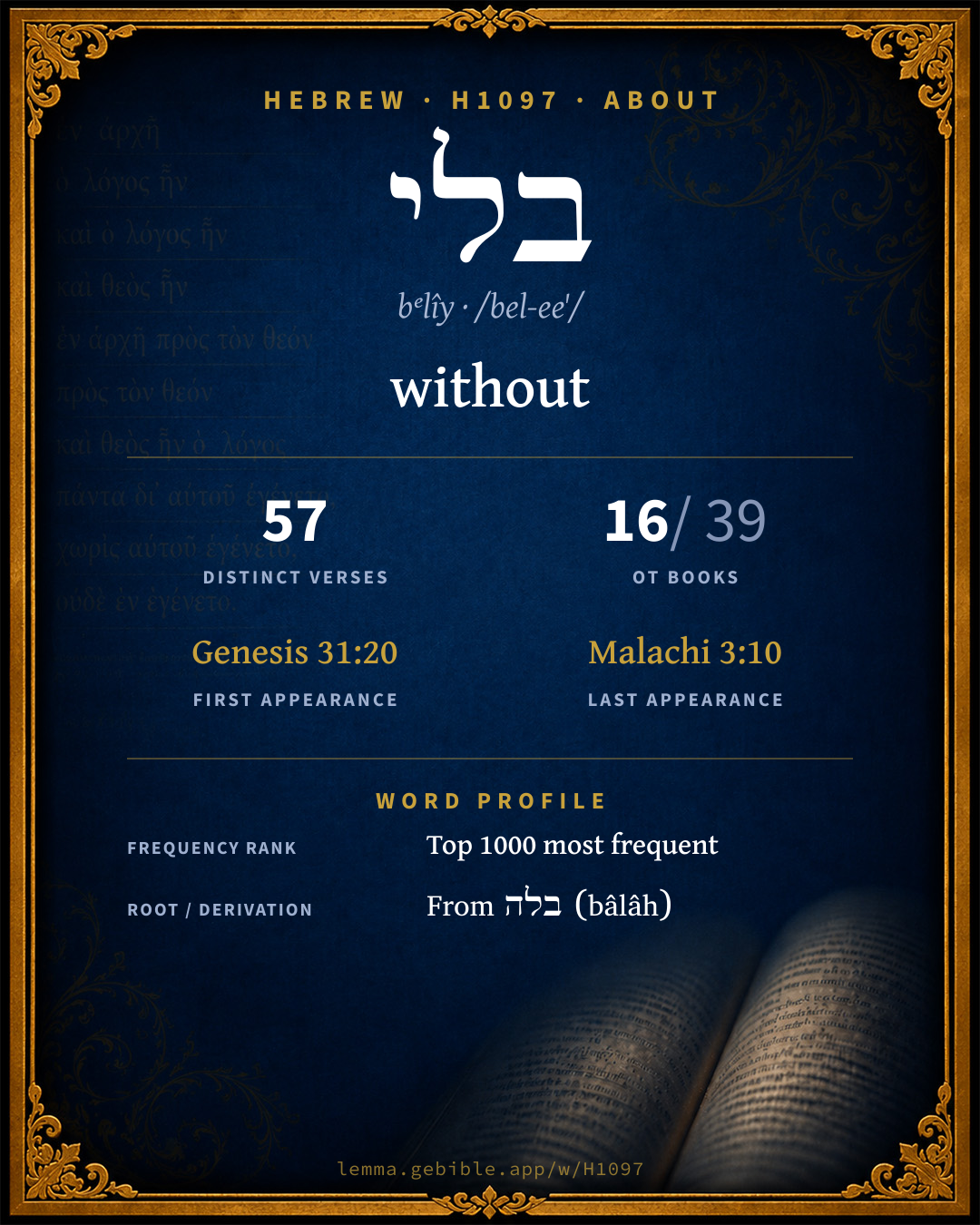
בְּלִי
without
‘without’ is one of 2 main senses fuller range ↓
Full lexicon entry — Brown-Driver-Briggs (BDB)
From Brown-Driver-Briggs (BDB)
Where this word appears
Grammar key — what these labels mean
Part of speech
- Particle
- A short function word — article, negation, interrogative, the sign of the direct object, and the like.
Noun type
- Common
- A common noun — a general class of person, place, or thing (“king,” “city,” “water”), not a specific name.
State
- Construct
- A noun bound to a following noun in a possessive / “of” relationship (the construct chain).
Gender
- Masculine
- Grammatically masculine.
Number
- Singular
- One.
Grammatical forms
- Particle, Negative 31 times (53%)
- Noun, Common, Masculine, Singular, Construct 24 times (41%)
- Adverb 3 times (5%)
Parsed forms decoded from the imported morphology (morphhb / Westminster Leningrad Codex — WLC text public domain, morphhb tagging CC BY 4.0), counted across 58 parsed occurrences — not distinct verses.
Every verse where H1097 appears — 57 distinct verses across 16 books. Click any verse to open its interlinear word-by-word view. Verse text shown in the World English Bible for context — . Each verse’s Hebrew form is shown with its reference; the English is not keyword-highlighted, since the data carries no word-level English alignment. Use “Compare translations” on any verse to read it across multiple English versions. This concordance covers the Hebrew Bible; Septuagint (Greek Old Testament) occurrences are not indexed here.
Genesis 1 verse
Exodus 1 verse
Deuteronomy 4 verses
- Deuteronomy 4:42 בִּ/בְלִי prep + n c ms cs that the manslayer might flee there, who kills his neighbor unawares, and didn't hate him in time past; and that fleeing to one of these cities he might live:
- Deuteronomy 9:28 מִ/בְּלִי֙ prep + n c ms cs lest the land whence you brought us out say, Because Yahweh was not able to bring them into the land which he promised to them, and because he hated them, he has brought them out to kill them in the wilderness.
- Deuteronomy 19:4 בִּ/בְלִי prep + n c ms cs This is the case of the manslayer, that shall flee there and live: whoever kills his neighbor unawares, and didn't hate him in time past;
- Deuteronomy 28:55 מִ/בְּלִ֥י prep + n c ms cs so that he will not give to any of them of the flesh of his children whom he shall eat, because he has nothing left him, in the siege and in the distress with which your enemy shall distress you in all your gates.
Joshua 2 verses
- Joshua 20:3 בִּ/בְלִי prep + n c ms cs that the manslayer who kills any person unwittingly [and] unawares may flee there: and they shall be to you for a refuge from the avenger of blood.
- Joshua 20:5 בִ/בְלִי prep + ptcl neg If the avenger of blood pursue after him, then they shall not deliver up the manslayer into his hand; because he struck his neighbor unawares, and didn't hate him before.
2 Samuel 1 verse
2 Kings 3 verses
- 2 Kings 1:3 הַֽ/מִ/בְּלִ֤י ptcl inter + prep + adv But the angel of Yahweh said to Elijah the Tishbite, Arise, go up to meet the messengers of the king of Samaria, and tell them, Is it because there is no God in Israel, that you go to inquire of Baal Zebub, the god of Ekron?
- 2 Kings 1:6 הַֽ/מִ/בְּלִ֤י ptcl inter + prep + adv They said to him, There came up a man to meet us, and said to us, Go, turn again to the king who sent you, and tell him, Thus says Yahweh, Is it because there is no God in Israel, that you send to inquire of Baal Zebub, the god of Ekron? therefore you shall not come down from the bed where you are gone up, but shall surely die.
- 2 Kings 1:16 הַֽ/מִ/בְּלִ֤י ptcl inter + prep + adv He said to him, Thus says Yahweh, Because you have sent messengers to inquire of Baal Zebub, the god of Ekron, is it because there is no God in Israel to inquire of his word? therefore you shall not come down from the bed where you are gone up, but shall surely die.
Job 21 verses
- Job 4:11 מִ/בְּלִי prep + n c ms cs The old lion perishes for lack of prey, The cubs of the lioness are scattered abroad.
- Job 4:20 מִ/בְּלִ֥י prep + n c ms cs Between morning and evening they are destroyed. They perish forever without any regarding it.
- Job 6:6 מִ/בְּלִי prep + n c ms cs Can that which has no flavor be eaten without salt? Or is there any taste in the white of an egg?
- Job 8:11 בְלִי ptcl neg "Can the papyrus grow up without mire? Can the rushes grow without water?
- Job 18:15 מִ/בְּלִי prep + n c ms cs There shall dwell in his tent that which is none of his. Sulfur shall be scattered on his habitation.
- Job 24:7 מִ/בְּלִ֣י prep + n c ms cs They lie all night naked without clothing, And have no covering in the cold.
- Job 24:8 וּֽ/מִ/בְּלִ֥י conj + prep + ptcl neg They are wet with the showers of the mountains, And embrace the rock for lack of a shelter.
- Job 24:10 בְּלִ֣י ptcl neg So that they go around naked without clothing. Being hungry, they carry the sheaves.
- Job 30:8 בְלִי ptcl neg They are children of fools, yes, children of base men. They were flogged out of the land.
- Job 31:19 מִ/בְּלִ֣י prep + n c ms cs If I have seen any perish for want of clothing, Or that the needy had no covering;
- Job 31:39 בְלִי ptcl neg If I have eaten the fruits of it without money, Or have caused the owners of it to lose their life:
- Job 33:9 בְּֽלִ֫י ptcl neg 'I am clean, without disobedience. I am innocent, neither is there iniquity in me:
- Job 34:6 בְלִי ptcl neg Notwithstanding my right I am considered a liar; My wound is incurable, though I am without disobedience.'
- Job 35:16 בִּ/בְלִי prep + n c ms cs Therefore Job opens his mouth with empty talk, And he multiplies words without knowledge."
- Job 36:12 כִּ/בְלִי prep + ptcl neg But if they don't listen, they shall perish by the sword; They shall die without knowledge.
- Job 38:2 בְּֽלִי ptcl neg "Who is this who darkens counsel By words without knowledge?
- Job 38:41 לִ/בְלִי prep + ptcl neg Who provides for the raven his prey, When his young ones cry to God, And wander for lack of food?
- Job 39:16 בְּלִי ptcl neg She deals harshly with her young ones, as if they were not hers. Though her labor is in vain, she is without fear,
- Job 41:26 בְּלִ֣י ptcl neg If one lay at him with the sword, it can't avail; Nor the spear, the dart, nor the pointed shaft.
- Job 41:33 לִ/בְלִי prep + ptcl neg On earth there is not his equal, That is made without fear.
- Job 42:3 בְּֽלִ֫י ptcl neg You asked, 'Who is this who hides counsel without knowledge?' Therefore I have uttered that which I did not understand, Things too wonderful for me, which I didn't know.
Psalms 4 verses
- Psalms 19:3 בְּ֝לִ֗י ptcl neg There is no speech nor language, Where their voice is not heard.
- Psalms 59:4 בְּֽלִי ptcl neg I have done no wrong, yet they are ready to attack me. Rise up, behold, and help me!
- Psalms 63:1 בְּלִי ptcl neg God, you are my God. I will earnestly seek you. My soul thirsts for you, My flesh longs for you, In a dry and weary land, where there is no water.
- Psalms 72:7 בְּלִ֥י ptcl neg In his days, the righteous shall flourish, And abundance of peace, until the moon is no more.
Ecclesiastes 1 verse
Isaiah 6 verses
- Isaiah 5:13 מִ/בְּלִי prep + n c ms cs Therefore my people go into captivity for lack of knowledge; Their honorable men are famished, And their multitudes are parched with thirst.
- Isaiah 5:14 לִ/בְלִי conj + ptcl neg Therefore Sheol has enlarged its desire, And opened its mouth without measure; And their glory, their multitude, their pomp, and he who rejoices among them, descend into it.
- Isaiah 14:6 בְּלִ֥י ptcl neg who struck the peoples in wrath with a continual stroke, who ruled the nations in anger, with a persecution that none restrained.
- Isaiah 28:8 בְּלִ֖י ptcl neg For all tables are full of vomit [and] filthiness, [so that there is] no place [clean].
- Isaiah 32:10 בְּלִ֥י ptcl neg For days beyond a year shall you be troubled, you careless women; for the vintage shall fail, the harvest shall not come.
- Isaiah 38:17 בְּלִ֔י ptcl neg Behold, [it was] for [my] peace [that] I had great bitterness: But you have in love to my soul delivered it from the pit of corruption; For you have cast all my sins behind your back.
Jeremiah 4 verses
- Jeremiah 2:15 מִ/בְּלִ֥י prep + n c ms cs The young lions have roared on him, and yelled; and they have made his land waste: his cities are burned up, without inhabitant.
- Jeremiah 9:10 מִ/בְּלִי prep + n c ms cs For the mountains will I take up a weeping and wailing, and for the pastures of the wilderness a lamentation, because they are burned up, so that none passes through; neither can men hear the voice of the cattle; both the birds of the sky and the animals are fled, they are gone.
- Jeremiah 9:11 מִ/בְּלִ֖י prep + n c ms cs I will make Jerusalem heaps, a dwelling-place of jackals; and I will make the cities of Judah a desolation, without inhabitant.
- Jeremiah 9:12 מִ/בְּלִ֖י prep + n c ms cs Who is the wise man, that may understand this? and [who is] he to whom the mouth of Yahweh has spoken, that he may declare it? why is the land perished and burned up like a wilderness, so that none passes through?
Lamentations 1 verse
Ezekiel 2 verses
- Ezekiel 14:15 מִ/בְּלִ֣י prep + n c ms cs If I cause evil animals to pass through the land, and they ravage it, and it be made desolate, so that no man may pass through because of the animals;
- Ezekiel 34:5 מִ/בְּלִ֣י prep + n c ms cs They were scattered, because there was no shepherd; and they became food to all the animals of the field, and were scattered.
Hosea 4 verses
- Hosea 4:6 מִ/בְּלִ֣י prep + n c ms cs My people are destroyed for lack of knowledge. Because you have rejected knowledge, I will also reject you, That you may be no priest to me. Because you have your God's law, I will also forget your children.
- Hosea 7:8 בְּלִ֥י ptcl neg Ephraim, he mixes himself among the nations. Ephraim is a pancake not turned over.
- Hosea 8:7 בְּלִ֣י ptcl neg For they sow the wind, And they will reap the whirlwind. He has no standing grain. The stalk will yield no head. If it does yield, strangers will swallow it up.
- Hosea 9:16 בלי ptcl neg Ephraim is struck. Their root has dried up. They will bear no fruit. Even though they bring forth, yet I will kill the beloved ones of their womb."
Zephaniah 1 verse
Malachi 1 verse
About this entry
At a glance — auto-summarized from this page’s data, not written by a person. Every figure links to its source below. This summary describes the numbers; it doesn’t interpret them.
“without” is the headline sense of the Hebrew word בלי (bᵉlîy). First canonically at Genesis 31:20, it enters the text early. It turns up in 57 verses across 16 books, a moderately common footprint. It concentrates in Job, which alone accounts for 37% of its uses. Carrying more than one sense, it rewards its full sense range. The sections below give every sense, occurrence, and version rendering.
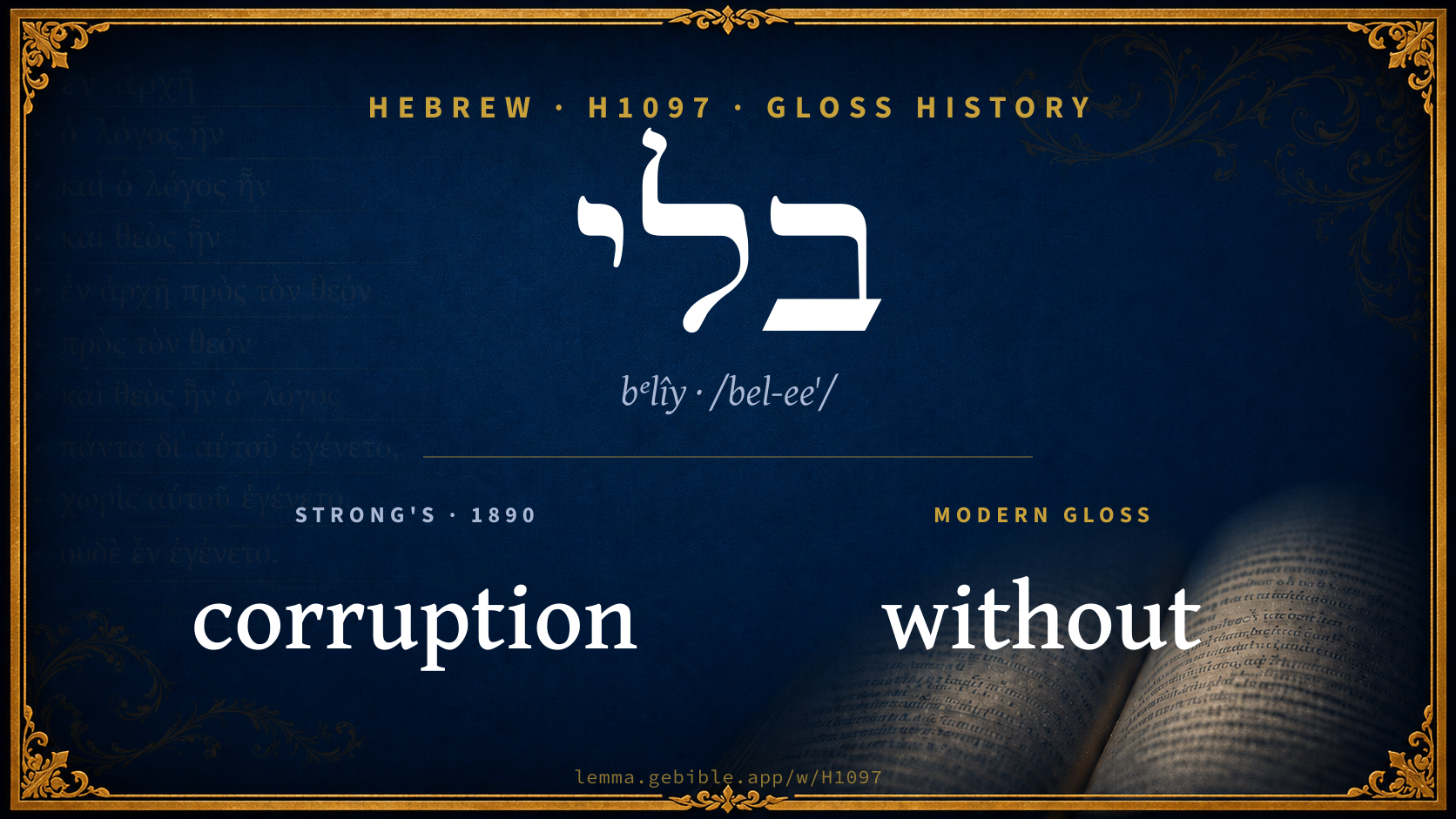
Gloss history
Strong's 1890 vs modern scholarship
About this word
Strong's H1097 catalogs a Hebrew word from the Hebrew Old Testament.
These counts are not copied from any lexicon or concordance. They are computed here, from the morphology-tagged Hebrew Old Testament. What Lemma adds →
- 57
- distinct verses
- The word appears in 57 distinct verses.
- 16 / 39
- OT books
- The word appears in 16 of 39 Old Testament books.
- #658
- by frequency
- Top 1000 most frequent Hebrew words (rank 658 of 8,640 Hebrew words by occurrence).
View all 57 occurrences in the concordance →
Most concentrated in
- Job 21 verses 37%
- Isaiah 6 verses 11%
- Deuteronomy 4 verses 7%
By section of the Old Testament
By traditional corpus
Conventional, traditional groupings — biblical authorship is debated, so this is a traditional corpus grouping, not an authorship claim. Each share is this word’s portion of its verses in that division of the Hebrew canon. Each figure is a share of the word’s 57 distinct verses.
- Writings (Ketuvim) 27 verses · 47%
- Prophets (Nevi'im) 24 verses · 42%
- Torah (Pentateuch) 6 verses · 11%
How translations render this word
Counts come from each version’s own published word-to-Strong’s tagging or interlinear alignment — an approximate guide to how each version renders this word, not a word-level alignment the data otherwise carries. Because each total is that version’s own tagged count, the per-version totals vary from one another and need not match the appearance or distinct-verse counts above. These counts may also differ from a printed concordance because Lemma counts each distinctly tagged rendering and does not collapse phrase taggings into a single head-word total. This is a fixed set of word-tagged versions (KJV, ASV, BSB, ULT) and does not change with the reading translation you choose elsewhere. Each version’s license is shown beside its name below (and on Sources).
BDB lists this Strong’s number as 2 distinct words (homographs). Each count above pools all of them and is not split by sense — see the Senses section below. A low-frequency rendering may belong to a different one of those words, not the primary meaning.
- King James Version†: Without 3×, Lack 2×
- American Standard Version†: Unawares 3×, Without 3×, Lack 2×
- Berean Standard Bible†: Without 15×, No 5×, Lack 4×
- unfoldingWord Literal Text†: Without 29×, Not 8×, Is not 4×
King James Version Public Domain
Renders H1097 across 14† tagged occurrences — most commonly:
Plus 9 renderings that appear only once — usually multi-word phrases or single function words the recovered tagging swept in, not distinct renderings.
American Standard Version Public Domain
Renders H1097 across 15† tagged occurrences — most commonly:
Plus 5 renderings that appear only once — usually multi-word phrases or single function words the recovered tagging swept in, not distinct renderings.
Berean Standard Bible Public Domain
Renders H1097 across 55† tagged occurrences — most commonly:
Plus 25 renderings that appear only once — usually multi-word phrases or single function words the recovered tagging swept in, not distinct renderings. Not rendered by a distinct English word in 2 further occurrences.
unfoldingWord Literal Text CC BY-SA 4.0
Renders H1097 across 62† tagged occurrences — most commonly:
Plus 8 renderings that appear only once — usually multi-word phrases or single function words the recovered tagging swept in, not distinct renderings.
8 senses and sub-senses in the full BDB
What do BDB’s symbols mean?
BDB uses these scholarly abbreviations:
| Symbol | Meaning |
|---|---|
| 𝔊 | the Septuagint (the ancient Greek translation, LXX) |
| 𝔙 | the Vulgate (the Latin translation) |
| 𝔖 | the Syriac version (the Peshitta) |
| 𝔗 | the Targum (the Aramaic translation) |
| ψ | the Psalms |
| √ | root (the underlying root or stem) |
| ‖ | parallel passage (a synonymous or contrasted parallel) |
| † | the dagger: every passage where the word occurs is cited |
The 8 senses and sub-senses the full Brown-Driver-Briggs lexicon distinguishes for this word, in lexicon order (not ranked by frequency), with BDB’s own verbatim wording and sub-sense lettering. Shown in Hebrew script with BDB’s own scholarly abbreviations. The condensed entry is in the Lexicon Entry tab. See also the Forms in the corpus table below.
- 1. fig. destruction Is 38:17 שַׁחַת בְּלִי pit of destruction (of She’ôl). e.g. Isaiah 38:17
- 2. defect, failure, hence adv. of negation (cf. אֶפֶס), chiefly poet. for לֹא, אֵין—
- a. with finite vb. rare and only once in prose, Gn 31:20 (E) עַל־בְּלִי הִגִּיד לוֹ because he told him not, Is 14:6; 32:10 Ho 8:7; 9:16 (Kt) Jb 41:18. e.g. Genesis 31:20
- b. used to negative an adj. or ptcp. 2 S 1:21 בְּלִי מָשִׁיחַ not anointed, ψ 19:4 Ho 7:8: more freq., especially in Job, joined with a subst. in sense of without, Jb 8:11 will the reed-grass grow בְּלִי־מָ֑יִם without water? 24:10 they go about naked בְּלִי לְבוּשׁ without clothing, 31:39; 33:9; 34:6; 38:2 words בְּלִי־דַעַת without knowledge, 39:16; 42:3 ψ 59:5 בְּלִי־עָוֹן יְרוּצוּן without (my) iniquity they run (against me), cf. v 4 לֹא, 63:2 a dry land בְּלִי מָ֑יִם without water, Is 28:8; Jb 30:8 בְּנֵי בְלִי־שֵׁם children of (men of) no name. e.g. 2 Samuel 1:21
With preps
- a. †בִּבְלִי, in בִּבְלִי דַעַת Dt 4:42; 19:4 Jos 20:3, 5 D (= unawares: all in D’s law of homicide); without knowledge Jb 35:16; 36:12. e.g. Deuteronomy 4:42
- b. †לִבְלִי in a state of (v. sub לְ) no …, i.e. without, Is 5:14 לִבְלִי־חֹק regardless of, without measure, Jb 38:41; 41:25 that is made לִבְלִי־חָֽת (to be) in a state of no fear, i.e. to be fearless. e.g. Isaiah 5:14
- c. †מִבְּלִי (α) from want of, followed by a subst. or infin., מִן expressing causation, Dt 9:28 מִבְּלִי יְכֹלֶת י׳ on account of Jehovah’s not being able … (in Nu 14:16 מִבִּלְתִּי), 28:25 (Ew238 d; but also RSJPh. xvi.72), Is 5:13 unawares (= suddenly); Ho 4:6 Ez 34:5 La 1:4 מִבְּלִי בָּאֵי מוֹעֵד for lack of comers to the stated feast. Followed by a pleon. אֵין in the phrase הֲמִבְּלִי אֵין … is it on account of there being no …? (lit. is it from the deficiency of no …? cf. ܡܶܢ ܒܠܰܝ ܕܠܰܝܬ in Syriac; PS528), Ex 14:11 2 K 1:3, 6, 16. (β) so that there is no … (lit. away from there being no …, מִן expressing negation, and בְּלִי being pleon., as in מֵאֵין, v. sub אַיִן 6 d β); Je 2:15 its cities are burnt מִבְּלִי יוֹשֵׁב so that there is no inhabitant, 9:9–11 Ez 14:15 Zp 3:6. Once as a conj. מִבְּלִי אֲשֶׁר, with pleon. לֹא, so that not … Ec 3:11. In Job מִבְּלִי is used more freely = without, the connexion with a preceding verb being no longer distinctly felt: 4:20 without any heeding, they perish for ever, 6:6; 24:7, 8; prob. also 4:11; 31:19 (though here the sense) (α) would be admissible). (γ) in Jb 18:15 תִּשְׁכּוֹן בְּאָהֳלוֹ מִבְּלִי־לוֹ, מִן is prob. partitive (so Hi): there shall dwell in his tent what is naught of his: Ew§ 323 a De less probably even naught, cf. sub אַיִן 6 d γ; Ges ‘t error (supplied from v 14) shall dwell in his tent so that it is no more his.’ e.g. Deuteronomy 9:28
- d. †עַד־בְּלִי till there be no … ψ 72:7 Mal 3:10. e.g. Psalms 72:7
Senses from the full Brown-Driver-Briggs lexicon (Brown, Driver, Briggs; Oxford 1906 — public domain), digitized via Sefaria, supplemented by the OpenScriptures HebrewLexicon (CC BY 4.0). Full attribution on Sources.
Word origin
subst. wearing out (بِلًى, ܒܠܳܝ wearing out of a garment), hence
— Brown-Driver-Briggs (Oxford 1906, public domain), digitized via Sefaria, supplemented by the OpenScriptures HebrewLexicon (CC BY 4.0). See Sources.
Derived from בלה (bâlâh) (H1086) — to wear out.
Jastrow Dictionary
A second Hebrew/Aramaic lexicon for comparison, covering Aramaic and post-biblical (Talmudic, Targumic, Midrashic) usage that the biblical-Hebrew BDB does not. Matched by lemma rather than by Strong’s number, so a lemma may carry more than one Jastrow headword (shown separately below), and the entries cover usage well beyond the Bible.
בלי
- , Y. Ned. III, 38ᵃ top, v. בריכסון.—Pesik. Baḥod. p. 107ᵇ, v. כִּילִי.
בלי ²
- , v. בלל; cmp. נבל) to be crumbled; to be worn out, to fail, decay, perish. Koh. R. to I, 4 הוא בוֹלֶה it (the generation of man) decays (dies out), אינה בוֹלָה it (the earth) does not grow old. Taan. 9ᵃ (play on עד בלי די Mal. III, 10) עד שיִבְלוּ שפתותיכם מלומר די until your lips grow tired from saying, It is enough; (Y. ib. III, 66ᵈ bot. שיבללו, v. בָּלַל); a. fr.—Part. pass. בָּלוּי outworn. Pl. בְּלוּיִים. Midr. Till. to Ps. XXV, 1. e.g. Malachi 3:10
- to wear out, outlive, survive. Lev. R. s. 4 הנפש מְבַלָּה וכ׳ the soul survives the body. Lev. R. s. 19 (play on אין בלתך, I Sam. II, 2) אין לְבַלֹּותֶךָ there is none to outlive thee. Koh. R. l. c.; Cant. R. to V, 15 one erects a building ואחר מְבַלֶּה אותו (not מכלה) and another man ruins it. Snh. 105ᵃ, v. בִּלְעָם. e.g. 1 Samuel 2:2
- , Nithpa. נִתְבַּלָּה to become outworn, fade away. Esth. R. introd. עתידין לְהִבָּלוֹת (Gen. R. s. 42 לִבְלוֹת) are destined to decay. Deut. R. s. 7, end נִתְבַּלּוּ (the garments) were worn out. B. Mets. 87ᵃ נ׳ הבשר her body was withered. B. Bath. 146ᵃ עשויין לִיבָּלוֹת made to be used up.
בְּלֵי I
- Targ. Deut. VIII, 4; Targ. Y. Deut. XXIX, 4 בלמו, Var. כלמו, read בלת; a. fr.—Lev. R. s. 19 כולו בלה all goes to ruin. Ber. 5ᵇ, v. בְּכָא. Ib. 6ᵃ. Bekh. 9ᵃ ובלו להו ואזול they failed and went to destruction. Ab. V, 22 סיב ובְלֵה בה grow old and frail in it (the study of the Law).—[Targ. Ps. LXII, 11; XCI, 2 Ms., v. כְּלִי I.]
- as preced. Pi.—Targ. Is. III, 15; a. e.—Ab. Zar. 20ᵃ that this beauty ב׳ עפרא dust will destroy.—Part. pass. f. מְבַלְּיָא. Lev. R. s. 33 (interpret. בלה נאפים Ezek. XXIII, 43) Aquila translates παλαιὰ πόρνη (old harlot), דהוא מבליא גייארא ed. (Ar. דהיא מב׳ גיירייא, Yalk. Dan. 1061 only דהיא מבליא) which means, a wasted harlot (wasted through fornication). e.g. Ezekiel 23:43
*בְּלֵי II
- constr. (preced., cmp. בְּלָאוֹת, בְּלוֹיִים) rotten pieces of (wood). Targ. Is. XLIV, 19 (h. text בּוּל, v. Rashi a. l.; Var. יִבְלֵי).
בְּלִי
- v. preced. ws.) prop. destruction, naught; not; v. בְּלִימָה. Ber. 44ᵇ מב׳ בשר if without meat.
A Dictionary of the Targumim, the Talmud Babli and Yerushalmi, and the Midrashic Literature (Marcus Jastrow; London, Luzac, 1903) — Public Domain. Digitized via Sefaria. Digitized via Sefaria. Full attribution on Sources.
Forms in the corpus
The 23 distinct written forms H1097 takes in the Hebrew Bible, most frequent first — each parse links to that state’s occurrences in the concordance. Hebrew forms include their vowel points and cantillation, so a single lemma takes many written forms.
| Form | Parsing | Example | Uses |
|---|---|---|---|
| מִ/בְּלִ֣י | Noun, Common, Masculine, Singular, Construct | Ezekiel 14:15 | 6 |
| מִ/בְּלִי | Noun, Common, Masculine, Singular, Construct | Isaiah 5:13 | 6 |
| הַֽ/מִ/בְּלִ֤י | Adverb | 2 Kings 1:3 | 4 |
| בְלִי | Particle, Negative | Job 8:11 | 4 |
| בְּלִ֥י | Particle, Negative | Hosea 7:8 | 4 |
| בִּ/בְלִי | Noun, Common, Masculine, Singular, Construct | Deuteronomy 4:42 | 4 |
| לִ/בְלִי | Particle, Negative | Job 38:41 | 3 |
| בְּלִ֣י | Particle, Negative | Hosea 8:7 | 3 |
| בְּלִי | Particle, Negative | Job 39:16 | 3 |
| מִ/בְּלִ֥י | Noun, Common, Masculine, Singular, Construct | Deuteronomy 28:55 | 3 |
| בְּֽלִ֫י | Particle, Negative | Job 33:9 | 2 |
| בְּֽלִי | Particle, Negative | Job 38:2 | 2 |
| בְּלִ֖י | Particle, Negative | 2 Samuel 1:21 | 2 |
| מִ/בְּלִ֖י | Noun, Common, Masculine, Singular, Construct | Jeremiah 9:11 | 2 |
| מִ/בְּלִי֙ | Noun, Common, Masculine, Singular, Construct | Deuteronomy 9:28 | 2 |
| בִ/בְלִי | Particle, Negative | Joshua 20:5 | 1 |
| בְּ֝לִ֗י | Particle, Negative | Psalms 19:3 | 1 |
| בְּלִ֔י | Particle, Negative | Isaiah 38:17 | 1 |
| בְּלִי֙ | Particle, Negative | Genesis 31:20 | 1 |
| בלי | Particle, Negative | Hosea 9:16 | 1 |
| וּֽ/מִ/בְּלִ֥י | Particle, Negative | Job 24:8 | 1 |
| כִּ/בְלִי | Particle, Negative | Job 36:12 | 1 |
| מִ/בְּלִ֞י | Noun, Common, Masculine, Singular, Construct | Ecclesiastes 3:11 | 1 |
Same root — word family
Other BDB entries built from the same root as H1097, grouped by Strong’s listed origin. These share a root / origin per the lexicon — not necessarily a shared meaning. Each links to that word’s own entry.
Derives from
Shares the same root
- בל bal H1077 not
- בלא bᵉlâʼ H1080 to wear out
- בלה bâleh H1087 worn out
- בלו bᵉlôw H1093 tribute
- בלוא bᵉlôwʼ H1094 rags
- בלתי biltîy H1115 except
- תבלית tablîyth H8399 destruction
Derived from this word
Compare all same-root words → Showing 4 of 11 — not the complete family. They share a root, not necessarily a meaning.
Septuagint verse parallels
This word appears in 56 verses that also exist in the Greek Old Testament (Septuagint), out of the 57 Hebrew verses it occurs in. You can read those verses in Greek by switching the Old Testament edition to the Septuagint.
Read these verses in the Septuagint
- Genesis 31:20
- Exodus 14:11
- Deuteronomy 4:42
- Joshua 20:3
- 2 Samuel 1:21
- 2 Kings 1:3
- Job 4:11
- Psalms 19:3
- Ecclesiastes 3:11
- Isaiah 5:13
- Jeremiah 2:15
- Lamentations 1:4
This is a verse-level parallel only — the same verses exist in both the Hebrew and Greek Old Testaments. No word-level Hebrew↔Greek correspondence is claimed: the data carries no such alignment, so no Greek word is shown as this Hebrew word’s translation. Coverage is not total — the Septuagint omits the deuterocanon and renumbers the Psalms, so some Hebrew verses have no direct Greek parallel.