
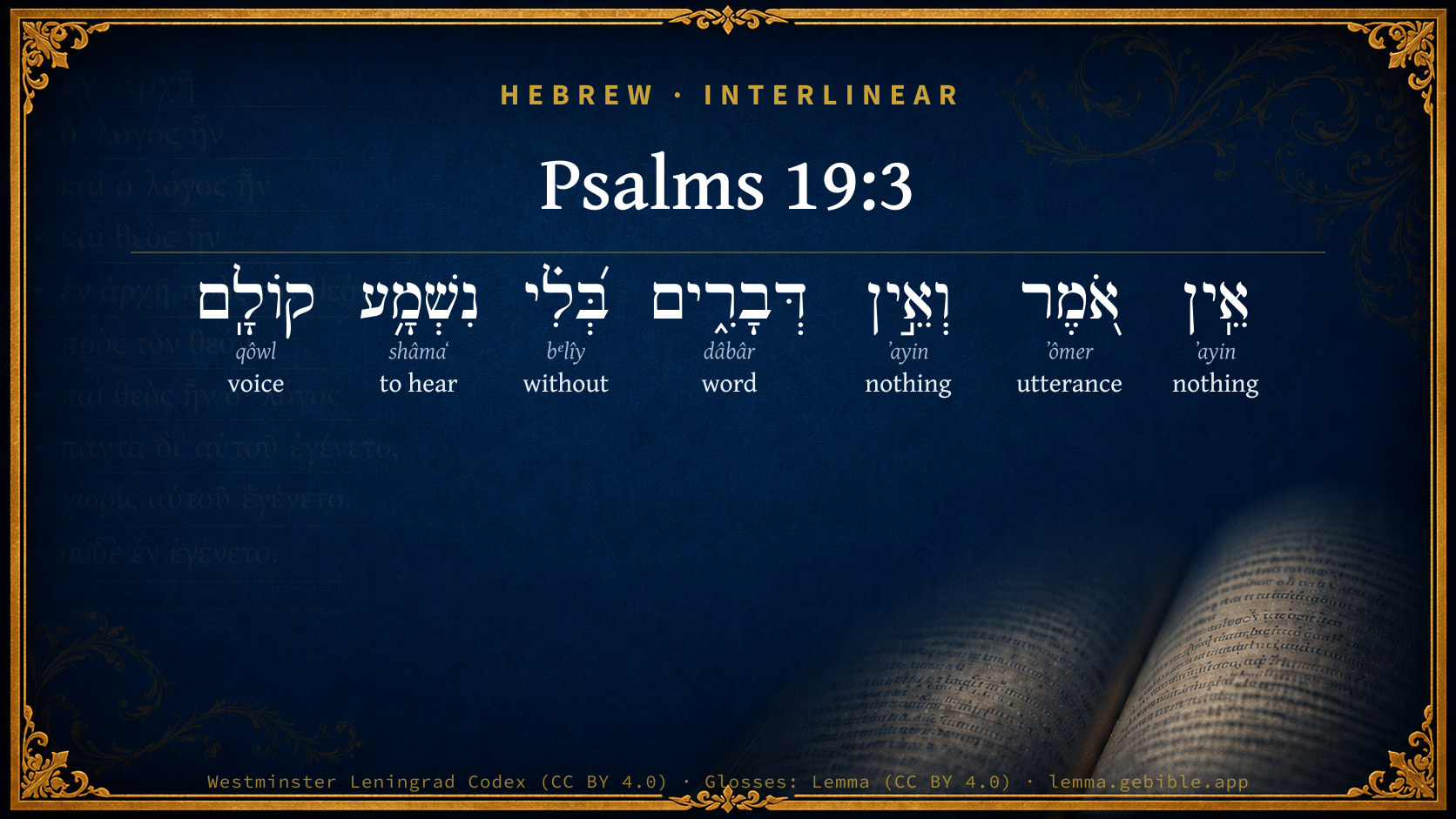
Psalms 19:3

Hebrew (Westminster Leningrad Codex) Psalms 19:3 appears in the Hebrew Old Testament. The text above is from the Westminster Leningrad Codex. Each word links to its Strong’s number, a concise gloss, and parsing drawn from the Open Scriptures Hebrew Bible morphology. Click any word for its full Brown-Driver-Briggs (BDB) entry.
Download image
Cite this verse

Psalms 19:3 (World English Bible). Public Domain. Lemma interlinear Bible study tool, https://lemma.gebible.app/v/psalms/19/3.

Show BibTeX & RIS
BibTeX
RIS
English Translation
There is no speech nor language, Where their voice is not heard.
World English Bible · Public Domain
Download a study sheet

One document with this verse’s original text, its word-by-word gloss line, the meaning frame, cross-references with their text, attributed commentary, and full source and license credits — printable, and it pastes into notes with its structure intact.

This verse Autodidact and up

Study sheet (.html) Plain text (.txt)

A passage Seminary Student

Up to 50 verses in one chapter. A passage sheet keeps up to 6 commentary sources and 12 cross-references per verse, in the order this page ranks them, and says so on the sheet whenever that leaves anything out. Ask for a single verse and you get the Autodidact verse sheet above.

Everything on this page stays free to read, with no account — the sheet is a download of what is already on screen, not access to it.

Want to remove ads? Support Godless Engineer
Compare translations 3

The same verse in 3 English versions, stacked beneath the original-language interlinear above. Click any original word for its lexicon entry.

Each is an independent rendering of the whole verse — the interlinear is not word-aligned to these translations.

Highlighted words mark where these versions differ — a whole-verse word diff, not a word-by-word alignment.

  • World English Bible Public Domain
    There is no speech nor language, Where their voice is not heard.
  • King James Version Public Domain
    There is no speech nor language, where their voice is not heard.
  • unfoldingWord Literal Text CC BY-SA 4.0
    is no speech and are no words, their voice is not being heard.

unfoldingWord Literal Text — © unfoldingWord, licensed CC BY-SA 4.0. Word-aligned USFM3 via Door43 (git.door43.org/unfoldingWord/en_ult).

Versions to compare (up to 4)

3 of 4 selected

Show all 18 translations

Every available English version of this verse, each an independent rendering of the whole verse.

  • World English Bible Public Domain
    There is no speech nor language, Where their voice is not heard.
  • Berean Standard Bible Public Domain
    Without speech or language, without a sound to be heard,
  • Majority Standard Bible Public Domain
    Without speech or language, without a sound to be heard,
  • King James Version Public Domain
    There is no speech nor language, where their voice is not heard.
  • American Standard Version (1901) Public Domain
    There is no speech nor language; Their voice is not heard.
  • Revised Version (1885) Public Domain
    There is no speech nor language; their voice cannot be heard.
  • Geneva Bible (1599) Public Domain
    There is no speach nor language, where their voyce is not heard.
  • Douay-Rheims (1899) Public Domain
    Day to day uttereth speech, and night to night sheweth knowledge.
  • Young's Literal Translation Public Domain
    There is no speech, and there are no words. Their voice hath not been heard.
  • Literal Standard Version CC BY-SA 4.0
    There is no speech, and there are no words. Their voice has not been heard.
  • Unlocked Literal Bible CC BY-SA 4.0
    There is no speech or spoken words; their voice is not heard.
  • unfoldingWord Literal Text CC BY-SA 4.0
    is no speech and are no words, their voice is not being heard.
  • Darby Bible Public Domain
    There is no speech and there are no words, yet their voice is heard.
  • World Messianic Bible Public Domain
    There is no speech nor language where their voice is not heard.
  • Webster's Bible Public Domain
    \\19:2\\Day to day uttereth speech, and night to night showeth knowledge.
  • Free Bible Version CC BY-SA 4.0
    They speak without speech or words; their voice is not audible;
  • Bible in Basic English Public Domain
    There are no words or language; their voice makes no sound.
  • JPS Tanakh (1917) Public Domain
    (19-4) There is no speech, there are no words, neither is their voice heard.

Literal Standard Version (2020), Covenant Press — licensed CC BY-SA 4.0. Text via the HelloAO Bible API (eBible.org). Unlocked Literal Bible (unfoldingWord) — licensed CC BY-SA 4.0. Text via the HelloAO Bible API (eBible.org). unfoldingWord Literal Text — © unfoldingWord, licensed CC BY-SA 4.0. Word-aligned USFM3 via Door43 (git.door43.org/unfoldingWord/en_ult). Free Bible Version, Dr. Jonathan Gallagher — licensed CC BY-SA 4.0. Text via the HelloAO Bible API (eBible.org).

Word by word

More ways to search: Search by grammar → Find every occurrence → Compare this word →

Practice this passage: Drill this verse → Learn its vocabulary →

About this verse

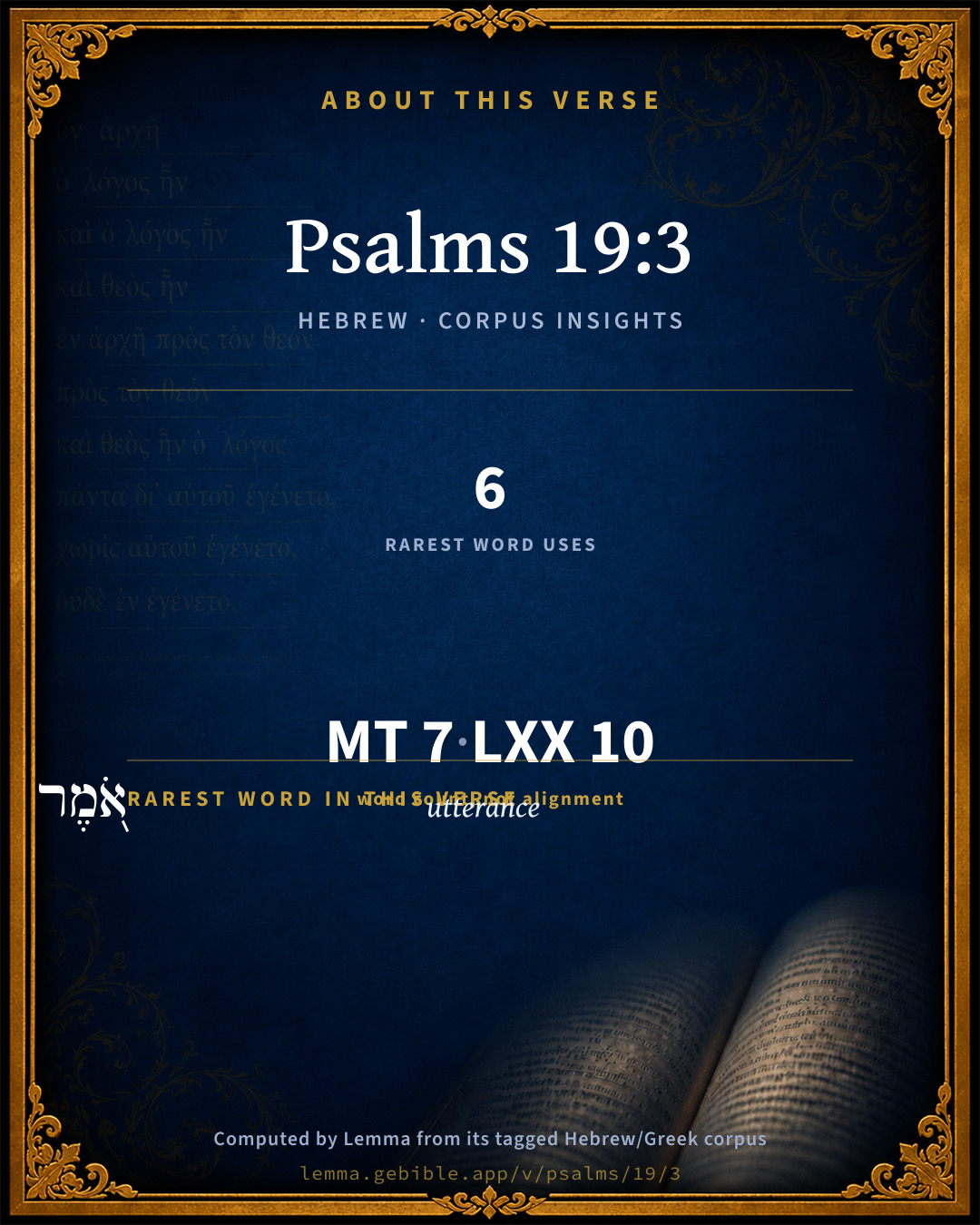
These counts appear in no published source. They are computed here, from the morphology-tagged text and Lemma’s own curated glosses. What Lemma adds →

7
words
6
distinct lemmas
Wisdom
section

Notable vocabulary

The rarest word here is אֹ֭מֶר utterance H562 — appearing just 6 times in the whole Hebrew Bible.

Shared distinctive vocabulary

אֹ֭מֶר utterance H562 occurs in 6 verses of the Hebrew Bible. Also found in:

Grammatical profile

  • 1 verb
  • 3 nouns
  • 3 particles

Verb forms

  • נִשְׁמָ֥ע Niphal · Participle Active

Repetition

A word recurs within this verse — often emphatic in Hebrew:

  • אֵֽין nothing H369 ×2

Hebrew & Septuagint length

In English translation the verse runs 12 words from the Hebrew and 13 from the Septuagint (LXX English) — closely comparable.

A rough comparison of the two English renderings, which tokenize alike — not a word-level alignment.

Word counts can differ between the Hebrew and the Greek without any difference in meaning — e.g. the Hebrew direct-object marker אֵת has no separate Greek word, and Greek often adds the article ὁ.

In the original languages it is 7 Hebrew tokens and 10 Greek tokens — but the two are counted differently (Hebrew bundles its prefixes and suffixes into one token; the Greek is in lemma form), so that isn’t a like-for-like length.

Cross-references

1

Topical passages linked to Psalms 19:3 in the Treasury of Scripture Knowledge — connected by theme and wording, ordered by reader-vote popularity; previews shown in the World English Bible.

  • Deuteronomy 4:19 and lest you lift up your eyes to the sky, and when you see the sun and the moon and the stars, even all the host of the sky, you are drawn away and worship them, and serve them, which Yahweh your God has allotted to all the peoples under the whole sky.

Cross-references courtesy of OpenBible.info (CC BY 4.0).

Hebrew and Greek witnesses Masoretic Hebrew ↔ Greek Septuagint

The same verse in the two great witnesses to the Old Testament, shown verse-for-verse.

You’re reading Greek Psalm 18 (Hebrew Psalm 19). The Septuagint counts the superscription, so verse numbers can differ from the Hebrew — chapter-level alignment, not verse-by-verse. Numbering follows Rahlfs.

These are two independent witnesses, not word-aligned to each other, and the Septuagint is shown in lemma (dictionary) form.

Hebrew Psalms 19:3 Masoretic · Westminster Leningrad Codex

אֵֽין אֹ֭מֶר וְאֵ֣ין דְּבָרִ֑ים בְּ֝לִ֗י נִשְׁמָ֥ע קוֹלָֽם

There is no speech nor language, Where their voice is not heard.

World English Bible · Public Domain

Greek LXX Greek Psalm 18:3 Septuagint · lemma form

ἡμέρα ὁ ἡμέρα ἐρεύγομαι ῥῆμα καί νύξ νύξ ἀναἀγγέλλω γνῶσις

There are no speeches or words, in which their voices are not heard.

LXX2012 (modern English Septuagint) · Public Domain

On this verse, Adam Clarke's Commentary discusses the Septuagint’s reading. Read the note in Commentary ↓

Hebrew: Westminster Leningrad Codex (CC BY 4.0). Greek: Septuagint (public domain); English from LXX2012 (modern English Septuagint) (Public Domain). How the Septuagint differs from the Hebrew →

Commentary

Notes on Psalms 19:3 from classic Christian and Jewish commentators (each source and its license shown beneath its notes). The classic Christian expositions comment on the surrounding passage and are grouped to its opening verse, so a note may address several verses; the Jewish commentaries on the Tanakh (Rashi and others) are per-verse, so they appear only where the commentator wrote on this verse.

Lemma curates 59 commentaries, every one of them public domain or Creative Commons licensed, each selected and text-cleaned for this edition rather than reprinted as found. About our sources →

Trapp's Complete Commentary

John Trapp

Psa 19:3 [There is] no speech nor language, [where] their voice is not heard.

Ver. 3. There is no speech nor language where their voice] And yet few hear these universal preachers, these Regii Professores, these real expositors of the divinity, as one styleth them, who do preach to all people at once, Non solum diserte sed et exerte, at surdis plerumque fabulam, they are by the most as little respected as is the cuckoo in June.

John Trapp, A Commentary or Exposition upon All the Books of the Old and New Testament (1647–1656) — public domain. Text from a community e-Sword module.

The Biblical Illustrator

Joseph S. Exell

Psa_19:3

No speech nor language; their voice cannot be heard.

Silent voices

The Psalmist, like a true poet, had a keen eye and ear. He saw in the firmament the glory of God, and he heard, around him and beneath, a chorus of praise to the Most High. Two interpretations have been put upon this verse. The first, that there is no country or clime, no speech or language, where the voice of the firmament, etc., is not heard, seeing their line or instruction is gone out through all the earth, and their words to the end of the world. The other is, that there is no audible voice, no sound that falls upon the ear. Addison writes, What though in solemn silence, etc.

I. Silent voices have often a most powerful influence.

1. They may move a man more than uttered words. The voices of nature, the music of the spheres, as it is called, is silence. Lectures have their place, but audible voices are not so soul-stirring as voices inaudible.

2. The spring, and every season of the year, brings many lessons, and yet there is no speech or language, its voice is not heard. No man ever heard, with his bodily ear, the language of either day or night, yet every day speaks of Gods infinite resources--of His goodness, of His power and glory--more articulate than any man could speak.

3. Solitude speaks to the soul. The mountain top, the dense forest, the restless sea; but their voice is not heard. The expression of human feeling is often more powerful when inarticulate.

II. In order to apprehend silent voices we must ourselves be silent. Put away distracting thoughts, and humbly listen only to God as He speaks to the soul and conscience. Men cannot even hear music unless they are still, silent, and undistracted. With the soul men hear God, and not with the physical ear, unless they are still and undistracted. It is very desirable that men should commune with God in their work, and be still before Him with their souls, and not with their intellects only. The active intellect is more often used against God than for Him. But God cannot be reached by intellectual processes any more than love, or than the beauties of a landscape can be explained by argument, or than music can be brought home to the soul by logical syllogism. (James S. Swan.)

The silent testimony

Language is always a difficulty, a snare, a temptation, an inconvenient convenience. It brings us into all our troubles; it is when we speak that we create heterodoxies; could we but be silently dumbly good--could we look our prayers, and cause our face to shine with our benevolence, and our hand do a quiet work of beneficence, how happy would the world be! Words do not mean the same thing to any two men; they may be accepted for momentary uses and for commercial purposes, but when it becomes a matter of life and death, time and eternity, truth and error, words are base counterfeits, that should be nailed to the counter of creation, as things by which a false commerce has been kept up amongst earnest and ardent men. Blessed be God for the silent testimony, for the radiant character, for the eloquent service. All history is silent; it is only the immediate day that chatters and talks and fusses about its little affairs. Yet the dead centuries are eloquent: the characters are all gone; the warriors are dead and buried, the orators have culminated their eloquence in the silence of death, the great solemn past is like a banquet hall deserted, but it is eloquent, instructive, silently monitorial. Silent history--great, sad, melancholy, impartial history--the spirit of the past should govern the unrest and the tumult of the present. (Joseph Parker, D. D.)

The Biblical Illustrator, edited by Joseph S. Exell (c. 1880s–1900s) — public domain. Text from a community e-Sword module.

Joseph Benson's Commentary

Psa 19:3. There is no speech nor language where their voice is not heard — There are divers nations in the world which have different languages, so that one nation cannot discourse with or be understood by another; but the heavens speak in a language which is universal and intelligible to them all. “No nation or people,” says that wise and learned heathen Tully, “is so barbarous and stupid as not to perceive, when they look up to the heavens, that there is a god; or to imagine, that these things, which have been made with such wonderful art and wisdom, are the effect of blind chance.” In short, the works of creation speak in the common voice of reason, and want no interpreter to explain their meaning; but are to be understood by people of all languages on the face of the earth. There is not a word or speech of theirs, (thus the verse may be translated,) the utterance of which is not heard. Dr. Waterland, however, renders it, They have neither speech nor words; that is, utter no articulate sounds; without these is their voice heard. Thus the margin. Others, again, interpret it thus: They have no speech nor word, nor is any voice, or sound, heard from, or among them; yet their line, &c., as in Psa 19:4. In one of these senses, the elegant author of the Spectator, in his beautiful ode on these verses, seems to have understood the passage:

What, though in solemn silence all

Move round this dark terrestrial ball?

What, though nor real voice nor sound

Amidst their radiant orbs be found?

In Reason’s ear they all rejoice,

And utter forth a glorious voice,

For ever singing as they shine,

“THE HAND THAT MADE US IS DIVINE.”

Joseph Benson's Commentary on the Old and New Testaments (1811–1818) — public domain. Text from a community e-Sword module.

J. A. Alexander on Psalms

Joseph Addison Alexander

4. (Psa 19:3). There is no speech, and there are no words; not at all is their voice heard. As the first clause might have seemed to contradict the first clause of Psa 19:3 (2), the Psalmist adds no words, to shew that he here uses speech in the strict sense of articulate language.—The first word of the last clause is properly a noun, meaning cessation or defect, non-entity, and here used as a more emphatic negative, expressed in the translation by the phrase not at all.—Their voice might either be referred exclusively to the heaven and firmament of Psa 19:2 (1), or extended to the day and night of Psa 19:3 (2). But the first is the true construction, as appears from the next verse. The absence of articulate language, far from weakening the testimony, makes it stronger. Even without speech or words, the heavens testify of God to all men. This construction of the sentence is much simpler, as well as more exact, than the ancient one, retained in the common version, "there is no speech nor language where their voice is not heard," or that preferred by others, "it is not a speech or language whose voice is not heard." The true sense is given in the margin of the English Bible.

Joseph Addison Alexander, The Psalms Translated and Explained (1850) — public domain. Text from a community e-Sword module.

Tyndale Open Study Notes

Tyndale Open Resources

19:3-4 God’s wisdom does not need to be spoken. Through creation, it is seen, felt, and experienced. Paul applied this text to condemn Israel for its lack of receptivity to Jesus Christ (Rom 10:18). • The sun is part of God’s creation, but it is not a deity, as people of other nations in the ancient Near East commonly believed.

Tyndale Open Study Notes — © Tyndale Open Resources, licensed CC BY-SA 4.0. Text via the HelloAO Bible API.

Geneva Bible (1599)

Geneva Bible translators

The heavens are a Schoolmaster to all nations, be they never so barbarous.

Geneva Bible (1599) marginal notes — public domain. Text via Bolls.life.

Jamieson, Fausset & Brown

Robert Jamieson, A. R. Fausset & David Brown

Though there is no articulate speech or words, yet without these their voice is heard (compare Margin).

Jamieson, Fausset & Brown — Commentary Critical and Explanatory on the Whole Bible (1871) — public domain (CC PDM 1.0). Text via the HelloAO Bible API.

Adam Clarke's Commentary

Verse 3. There is no speech nor language where their voice is not heard.] Leave out the expletives here, which pervert the sense; and what remains is a tolerable translation of the original: -

אין אמר ואין דברים בלי נשמע קולם

Ein omer veein debarim, beli nishma kolam.

"No speech, and no words; their voice without hearing."

בכל הארץ יצא קום ובקצה תבל מליהם

Bechol haarets yatsa kavvam: Ubiktsey thebel milleyhem.

"Into all the earth hath gone out their sound; and to the

extremity of the habitable world, their eloquence."

The word קו kau, which we translate line, is rendered sonus, by the Vulgate, and φθαγγος, sound, by the Septuagint; and St. Paul, Ro 10:18, uses the same term. Perhaps the idea here is taken from a stretched cord, that emits a sound on being struck; and hence both ideas may be included in the same word; and קום kavvam may be either their line, or cord, or their sound. But I rather think that the Hebrew word originally meant sound or noise; for in Arabic the verb [Arabic] kavaha signifies he called out, cried, clamavit. The sense of the whole is this, as Bishop Horne has well expressed it: -

"Although the heavens are thus appointed to teach, yet it is not by articulate sounds that they do it. They are not endowed, like man, with the faculty of speech; but they address themselves to the mind of the intelligent beholder in another way, and that, when understood, a no less forcible way, the way of picture or representation. The instruction which the heavens spread abroad is as universal as their substance, which extends itself in lines, or rays. By this means their words, or rather their significant actions or operations, מליהם, are everywhere present; and thereby they preach to all the nations the power and wisdom, the mercy and lovingkindness, of the Lord."

St. Paul applies this as a prophecy relative to the universal spread of the Gospel of Christ, Ro 10:18; for God designed that the light of the Gospel should be diffused wheresoever the light of the celestial luminaries shone; and be as useful and beneficent, in a moral point of view, as that is in a natural. All the inhabitants of the earth shall benefit by the Gospel of Christ, as they all benefit by the solar, lunar, and stellar light. And, indeed, all have thus benefited, even where the words are not yet come. "Jesus is the true Light that lighteth every man that cometh into the world." His light, and the voice of his Spirit, have already gone through the earth; and his words, and the words of his apostles, are by means of the Bible and missionaries going out to all the extremities of the habitable globe.

On these words I shall conclude with the translation of my old Psalter: -

Ver. 1. Hevens telles the joy of God; and the werkes of his handes schewis the firmament.

Ver. 2. Day til day riftes word; and nyght til nyght schewes conyng.

Ver. 3. Na speches er, ne na wordes, of the qwilk the voyces of thaim be noght herd.

Ver. 4. In al the land yede the soune of tham; and in endes of the wereld thair wordes.

Ver. 5. In the Soun he sett his tabernacle; and he as a spouse comand forth of his chaumber: he joyed als geaunt at ryn the way.

Ver. 6. Fra heest heven the gangyng of hym: and his gayne rase til the heest of hym: nane es that hym may hyde fra his hete.

All the versions, except the Chaldee, render the last clause of the fourth verse thus: "In the sun he hath placed his tabernacle;" as the old Psalter likewise does. They supposed that if the Supreme Being had a local dwelling, this must be it; as it was to all human appearances the fittest place. But the Hebrew is, "Among them hath he set a tabernacle for the sun." He is the centre of the universe; all the other heavenly bodies appear to serve him. He is like a general in his pavilion, surrounded by his troops, to whom he gives his orders, and by whom he is obeyed. So, the solar influence gives motion, activity, light, and heat to all the planets. To none of the other heavenly bodies does the psalmist assign a tabernacle, none is said to have a fixed dwelling, but the sun.

Adam Clarke's Commentary on the Bible (1810–1826) — public domain. Text from a community e-Sword/MySword module.

John Calvin's Commentaries

3. There is no language nor speech [where] their voice is not heard. This verse receives two almost contrary interpretations, each of which, however, has the appearance of probability. As the words, when rendered literally, read thus — No language, and no words, their voice is not heard — some connect the third and fourth verses together, as if this sentence were incomplete without the clause which follows in the beginning of the fourth verse, Their writing has gone forth through all the earth, etc. According to them, the meaning is this:— The heavens, it is true, are mute and are not endued with the faculty of speech; but still they proclaim the glory of God with a voice sufficiently loud and distinct. But if this was David’s meaning, what need was there to repeat three times that they have not articulate speech? It would certainly be spiritless and superfluous to insist so much upon a thing so universally known. The other exposition, therefore, as it is more generally received, seems also to be more suitable. In the Hebrew tongue, which is concise, it is often necessary to supply some word; and it is particularly a common thing in that language for the relatives to be omitted, that is to say, the words which, in which, etc., as here, There is no language, there is no speech, [where Both Calvin and the translators of our English version appear to have followed the Septuagint and Vulgate versions in inserting the word where, which is not in the Hebrew text.

“C’est as avoir ces mots, Lequel, Laquelle, etc., comme yci Il n’y a langage, il n’y a paroles esquelles la voix de ceux ne soit ouye.” — Fr.

בלי, beli, commonly signifies not; but it is also often used for all sort of exclusive particles, without, besides, unless. Hence Grotius renders it here without. As, בל bal, means in Arabic but, and as the Arabic is just a dialect of the Hebrew, Hammond concludes that this may have been its meaning among the Jews; and therefore proposes to render the verse thus:— “Not speech, nor words, but, or notwithstanding, [בלי, beli,] their voice is, or has been heard.”

4. Their writing has gone forth, etc. Here the inspired writer declares how the heavens preach to all nations indiscriminately, namely, because men, in all countries and in all parts of the earth, may understand that the heavens are set before their eyes as witnesses to bear testimony to the glory of God. As the Hebrew word קו, kav signifies sometimes a line, and sometimes a building, some deduce from it this meaning, that the fabric of the heavens being framed in a regular manner, and as it were by line, proclaims the glory of God in all parts of the world. But as David here metaphorically introduces the splendor and magnificence of the heavenly bodies, as preaching the glory of God like a teacher in a seminary of learning, it would be a meagre and unsuitable manner of speaking to say, that the line of the heavens goes forth to the uttermost ends of the earth. Besides, he immediately adds, in the following clause, that their words are every where heard; but what relation is there between words and the beauty of a building? If, however, we render קו, kav, writing, these two things will very well agree, first, that the glory of God is written and imprinted in the heavens, as in an open volume which all men may read; and, secondly, that, at the same time, they give forth a loud and distinct voice, which reaches the ears of all men, and causes itself to be heard in all places. “Et se fait ouir en totals endroits.” — Fr.

The reading in the English Geneva Bible is, “Their line is gone forth through all the earth, and their words unto the ends of the world.” The marginal note in explanation of this is, “The heavens are as a line of great capital letters to show unto us God’s glory.”

“For precept must be upon precept, precept upon precept; line upon line, line upon line; here a little, and there a little.”

In my judgment, therefore, the meaning is, that the glory of God is not written in small obscure letters, but richly engraven in large and bright characters, which all men may read, and read with the greatest ease. Hitherto I have explained the true and proper meaning of the inspired writer. Some have wrested this part of the psalm by putting upon it an allegorical interpretation; but my readers will easily perceive that this has been done without reason. I have shown in the commencement, and it is also evident from the scope of the whole discourse, that David, before coming to the law, sets before us the fabric of the world, that in it we might behold the glory of God. Now, if we understand the heavens as meaning the apostles, and the sun Christ, there will be no longer place for the division of which we have spoken; and, besides, it would be an improper arrangement to place the gospel first and then the law. It is very evident that the inspired poet here treats of the knowledge of God, which is naturally presented to all men in this world as in a mirror; and, therefore, I forbear discoursing longer on that point. As, however, these allegorical interpreters have supported their views from the words of Paul, this difficulty must be removed. Paul, in discoursing upon the calling of the Gentiles, lays down this as an established principle, that, “Whoever shall call upon the name of the Lord, shall be saved;” and then he adds, that it is impossible for any to call upon him until they know him by the teaching of the gospel. But as it seemed to the Jews to be a kind of sacrilege that Paul published the promise of salvation to the Gentiles, he asks whether the Gentiles themselves had not heard? And he answers, by quoting this passage, that there was a school open and accessible to them, in which they might learn to fear God, and serve him, inasmuch as “the writing Paul reads, “their sound,” quoting from the Septuagint, the version of the Old Testament then chiefly used, and it employs here the word φθόγγος.

“in times past, suffered all nations to walk in their own ways, he nevertheless left not himself without a witness,” (Acts 14:16, 17.)

Whence we conclude, that those who have imagined that Paul departed from the genuine and proper sense of David’s words are grossly mistaken. The reader will understand this still more clearly by reading my commentaries on the above passage of St. Paul.

He hath set in them a tabernacle [or pavilion] for the sun. As David, out of the whole fabric of the world, has especially chosen the heavens, in which he might exhibit to our view an image of God, because there it is more distinctly to be seen, even as a man is better seen when set on an elevated stage; so now he shows us the sun as placed in the highest rank, because in his wonderful brightness the majesty of God displays itself more magnificently than in all the rest. The other planets, it is true, have also their motions, and as it were the appointed places within which they run their race, “Quasi stadia.” — Lat. “Comme des lieues ordonnees dedans les quelles elles font leurs courses.” — Fr.

“Aucuns l’entendent de sa chaleur vegetative, qu’on appelle, c’est dire par laquelle ces choses basses ont vigueur, sont maintenues, et prenent accrossement.” — Fr.

John Calvin's Commentaries (1540-1563) — public domain. Text from the Calvin Translation Society English edition (1840s-50s) via the Christian Classics Ethereal Library (ccel.org). Calvin's coverage is partial (roughly two-thirds of the Bible); uncommented books and verses are honest gaps, never fabricated. The 19th-century editor's footnotes and remarks are omitted so the notes are faithfully Calvin's own voice.

Ellicott's Commentary for English Readers

(3) There is no speech.—The literal rendering is Not speech, not words, their voice is not heard. Explaining this is (1) the English version (Bible and Prayer Book) and (if intelligible at all) the LXX. and Vulg.: “There is no speech nor language without their (the heavens’) speech being heard (i.e., understood).” But this gives an inadmissible sense to davar, which does not mean language, but a spoken word. Besides, it was not a likely thought for the psalmist, that the Divine tradition of the heavens, while it travels over the whole earth, would be everywhere intelligible. (2) “It is not speech, it is not words whose voice is inaudible,” i.e., unintelligible, but, on the contrary, it is a manifestation to all the world. But the parallelism is against this. The line “their voice is not heard” is but the rhythmic echo of there is no speech nor word.” (3) We therefore keep close to the literal rendering, There is no speech, there are no (uttered) words, their voice is inaudible; understanding the poet to say, that the manifestation of the Creator’s glory, which he has just imagined the heavens proclaiming, and of which each succeeding day hands on the tale, is not made in audible words. The communication of the sky is eloquent, but mute; its voice is for the heart and emotion, not the ear. So Addison—

“What though in solemn silence all

Move round this dark terrestrial ball,

What though no real voice or sound

Amidst their radiant orbs be found?

In reason’s ear they all rejoice

And utter forth a glorious voice,

For ever singing as they shine

The hand that made us is Divine.”

A Bible Commentary for English Readers, edited by Charles John Ellicott (1878–1897) — public domain. Text from a community e-Sword module.

The Cambridge Bible for Schools and Colleges

gen. ed. J. J. S. Perowne

3. (a) The rendering of A.V. means that the message of the heavens reaches all nations of every language alike, and is intelligible to them. But the Heb. words rendered speech and language will not bear this explanation.

(b) The rendering

It is not a speech or words

Whose voice is unintelligible,

is that of most of the ancient versions (LXX, Aq., Symm., Theod., Vulg., Jer.). But it does not satisfy the parallelism, and it is unnatural to refer their voice to ‘speech and words’ rather than to ‘the heavens.’

(c) It is best to render (cp. R.V.)

There is neither speech nor words,

Unheard is their voice.

Their message though real is inarticulate. Thus understood, the verse qualifies Psa_19:2, and is in close connexion with Psa_19:4. Theirs is a silent eloquence, yet it reaches from one end of the world to the other. Comp. Addison’s paraphrase:

“What though in solemn silence all

Move round the dark terrestrial ball?

What though nor real voice nor sound

Amid their radiant orbs be found?

In reason’s ear they all rejoice,

And utter forth a glorious voice,

For ever singing, as they shine,

‘The hand that made us is divine’.”

The Cambridge Bible for Schools and Colleges (gen. ed. J. J. S. Perowne; Cambridge University Press, 1878–1918) — public domain. Text from a community e-Sword module.

John Gill's Exposition

There is no speech nor language where their voice is not heard,.... Not the voice of the day and night; as if the sense was, that there is no people, of any speech or language under the sun, but there is something said every day and night of the weather, what it is, or will be, as the face of the heavens appears morning and evening: but of the heavens and firmament; the meaning of which some take to be this; either that though they have no proper speech nor language, yet there is a voice in them which is heard, declaring the glory of God and his handiworks; and the words may very well be rendered, "they have no speech nor words, without these their voice is heard"; or that there is no people, nation, or language under the heavens; see Dan 3:4; though they are ever so different one from another, so as not to be able to understand each other; yet the voice of the heavens, uttering and proclaiming the glory of their Maker, is heard and understood by them all: but rather this is to be interpreted of the extent of the Gospel ministry by the apostles; who, according to their commission, went everywhere preaching the word, to men of all nations, of every speech and language; for which they were qualified, by having the gift of various tongues bestowed upon them; so that there were no nations, of ever so barbarous a speech and language, but they were capable of speaking to and of being understood by them; and though they could not understand one another, they all heard the apostles speak in their own tongues the wonderful works of God, Act 2:4. Their voice, in the ministration of the Gospel, was heard in every nation externally, and by many internally: faith came by hearing; and they received the word with gladness and readiness. This gives the Gospel revelation a superiority to the legal one; that was only made to one nation, to the nation of the Jews; the voice of that was not heard elsewhere; but the voice of the Gospel is heard in all nations; this revelation is published throughout the world: and this shows that these words belong to the times of the apostles, after they had received a commission from Christ, to go into, all the world, and preach the Gospel to every creature; which was done before the destruction of Jerusalem, Mat 24:14; and which is further confirmed by what follows.

; and which is further confirmed by what follows.

Psalms 19:4

psa 19:4

psa 19:4

psa 19:4Their line is gone out through all the earth,.... Not the line or writings in the book of the creatures, the heavens, and the earth, which lie open, and are legible, and to be seen and read of all men; nor the line and writings in the book of the Scriptures, called line upon line, and precept upon precept, Isa 28:13, which, though first given to the Jews, were written for the instruction of others, and have been communicated to them; but the line of the apostles: everyone had his line or measure; or the course he was to steer was measured out and directed to him; the line of one, where he was to go and preach the Gospel, reached so far one way, and the line of another reached so far another way; and what with one and another, their line reached throughout all the earth; see Co2 10:13; the apostle citing these words in Rom 10:18; renders them, "their sound went", &c. the sound of the Gospel, as published by them; which agrees with the next clause;

and their words to the end of the world; to the isles afar off, even to these northern and distant ones of England, Scotland, and Ireland, which were reached and visited with the Gospel, either by the apostles, or at least by some of the first ministers of the word;

in them hath he set a tabernacle for the sun; that is, in the heavens and firmament, where the natural sun is placed; and its habitation is fitly called a tabernacle, because it is always in motion and never stops: or this may have some respect to its setting, when, according to the common appearance, and to common understandings, it seems to be hid as in a tent or tabernacle; to be as it were gone to bed, and at rest; when in the morning it rises gay and cheerful, and comes forth like a bridegroom out of his chamber, as is said in Psa 19:5, but this is all to be understood, spiritually and mystically, of Christ the sun of righteousness, who has his tabernacle among his people, his churches; and particularly has a place, and the chief place, in the ministry of the Gospel, being the sum and substance of it; and this is of God's putting there, who committed to his apostles the word of reconciliation, the sum of which is Christ; and this is what makes the Gospel so glorious a light, so clear a revelation as it is: the nature, continuance, and extent of this revelation, are described in the foregoing verses; the perspicuity and clearness of it is set forth in this clause, and in what follows.

John Gill's Exposition of the Whole Bible (1746–1763) — public domain (CC PDM 1.0). Text via the HelloAO Bible API.

Albert Barnes' Notes on the Bible

There is no speech nor language where their voice is not heard - Margin, Without these their voice is heard. Hebrew, “without their voice heard.” The idea in the margin, which is adopted by Prof. Alexander, is, that when the heavens give expression to the majesty and glory of God, it is not by words - by the use of language such as is employed among men. That is, there is a silent but real testimony to the power and glory of their great Author. The same idea is adopted substantially by DeWette. So Rosenmuller renders it, “There is no speech to them, and no words, neither is their voice heard.” High as these authorities are, yet it seems to me that the idea conveyed by our common version is probably the correct one. This is the idea in the Septuagint and the Latin Vulgate. According to this interpretation the meaning is, “There is no nation, there are no men, whatever may be their language, to whom the heavens do not speak, declaring the greatness and glory of God. The language which they speak is universal; and however various the languages spoken by men, however impossible it may be for them to understand each other, yet all can understand the language of the heavens, proclaiming the perfections of the Great Creator. That is a universal language which does not need to be expressed in the forms of human speech, but which conveys great truths alike to all mankind.”

That the passage cannot mean that there is no speech, that there are no words, or that there is no language in the lessons conveyed by the heavens, seems to me to be clear from the fact that alike in the previous verse Psa 19:2, and in the following verse Psa 19:4, the psalmist says that they do use speech or language, “Day unto day uttereth speech;” “their words unto the end of the world.” The phrase “their voice” refers to the heavens Psa 19:1. They utter a clear and distinct voice to mankind; that is, they convey to people true and just notions of the greatness of the Creator. The meaning, then, it seems to me, is that the same great lessons about God are conveyed by the heavens, in their glory and their revolutions, to all nations; that these lessons are conveyed to them day by day, and night by night; that however great may be the diversities of Speech among men, these convey lessons in a universal language understood by all mankind; and that thus God is making himself constantly known to all the dwellers on the earth. All people can understand the language of the heavens, though they may not be able to understand the language of each other. Of the truth of this no one can doubt; and its beauty is equal to its truth.

Albert Barnes' Notes on the Bible (1834–1885) — public domain. Text from a community e-Sword/MySword module.

Matthew Poole's English Annotations

Or, understood, as the verb oft signifies, as Gen 11:7; 42:23; 2Ki 18:26; 1Co 14:2; for the hearing of it would have been insignificant without the understanding of it, in which the force of the argument lies. The sense is, There are divers nations in the world, which have several languages, so that one cannot discourse with or be understood by another; but the heavens are such a universal and admirable teacher, that they can speak to all people under them, and be clearly understood by all. No nation, or people, saith that wise and learned heathen, Tully, is so barbarous and sottish, as, when they look up to the heavens, not to perceive that there is a, God, or to imagine that those things are the effect of blind chance, which are made with such wonderful art and wisdom, that it requires extraordinary art to understand their excellent orders and course. But this verse is by divers learned men otherwise translated, not without an elegant gradation, as some observe. They have no speech nor word, nor is any voice or heard in or from them. Then follow the next verse by way of opposition, yet their line, &c. Or thus, They have no speech nor words, (which is supposed to be here said by way of prolepsis, to soften and explain his former expressions of the heavens, declaring and speaking,) yet (or, but without them) their voice is heard or understood.

Matthew Poole's English Annotations on the Holy Bible (1683–1685) — public domain. Text from a community e-Sword/MySword module.

The Treasury of David

Charles H. Spurgeon

Ver. 3. There is no speech nor language, where their voice is not heard. Every man may hear the voices of the stars. Many are the languages of terrestrials, to celestials there is but one, and that one may be understood by every willing mind. The lowest heathen are without excuse, if they do not discover the invisible things of God in the works which he has made. Sun, moon, and stars are God's travelling preachers; they are apostles upon their journey confirming those who regard the Lord, and judges on circuit condemning those who worship idols. The margin gives us another rendering, which is more literal, and involves less repetition; "no speech, no words, their voice is not heard; "that is to say, their teaching is not addressed to the ear, and is not uttered in articulate sounds; it is pictorial, and directed to the eye and heart; it touches not the sense by which faith comes, for faith cometh by hearing. Jesus Christ is called the Word, for he is a far more distinct display of Godhead than all the heavens can afford; they are, after all, but dumb instructors; neither star nor sun can arrive at a word, but Jesus is the express image of Jehovah's person, and his name is the Word of God.

Ver. 3. There is no speech, etc. The sunset was one of the most glorious I ever beheld, and the whole earth seemed so still that the voice of neither God nor man was heard. There was not a ripple upon the waters, not the leaf of a tree, nor even of a blade of grass moving, and the rocks upon the opposite shore reflected the sun's "after glow, "and were again themselves reflected from or in the river during the brief twilight, in a way I do not remember ever to have beheld before. No! I will not say the voice of God was not heard; it spoke in the very stillness as loud as in roaring thunder, in the placid scene as in rocks and cliffs impassable, and louder still in the heavens and in the firmament, and in the magnificent prospect around me. His wondrous works declared him to be near, and I felt as if the very ground upon which I was treading was holy. John Gadsby.

Ver. 3. The marginal reading, coupled with verse four, suggests the eloquence of an unobtrusive lifesilent, yet heard.

Psalms 19:4*

Charles H. Spurgeon's The Treasury of David (1869–1885) — public domain. Psalms only. Text from a community e-Sword/MySword module.

Whedon's Commentary on the Bible

Daniel D. Whedon

3. There is no speech nor language—Literally, no speech and no words; not heard is their voice. The words translated speech, language, and voice, apply only to the human voice and to articulate speech. These the heavenly bodies have not, yet they are said to declare, publish, show, utter forth, great truths of God. They speak to the reason. See Rom_1:19; Act_14:17

Daniel D. Whedon (gen. ed.), Commentary on the Old and New Testaments (1874–1909) — public domain. Text from a community e-Sword module.

The Pulpit Commentary

There is no speech nor language, where their voice is not heard; rather, there is no speech, there are no words; their voles is not heard; i.e. the speech which they utter is not common speech it is without sound, without language; no articulate voice is to be heard. (So Ewald, Hup-feld, Perowne, Kay, Hengstenberg, Alexander, and our Revisers)

The Pulpit Commentary (1880–1919), ed. H.D.M. Spence-Jones & Joseph S. Exell — public domain. Text from a community e-Sword module.

John Wesley's Explanatory Notes

Heard - Or, understood; there are divers nations in the world, which have several languages, so that one cannot discourse with, or be understood by another, but the heavens are such an universal teacher, that they can speak to all people, and be clearly understood by all.

John Wesley, Explanatory Notes Upon the Whole Bible (1754–1765) — public domain. Text via the GEBible commentary corpus.

Rashi

Rabbi Shlomo Yitzchaki (Rashi)

Day to day utters speech The Creation is renewed from day to day. In the evening, the sun sets, and in the morning it rises. Thereby, the people utter sayings of praise throughout these days and nights, for they teach the people to praise and to give thanks. Menachem interprets [the word] יביע as an expression of a gushing fountain (מעין נובע).

tells knowledge Heb. יחוה, an expression of telling.

Rashi on the Tanakh — English translations: “The Judaica Press complete Tanach with Rashi, translated by A. J. Rosenberg” (CC BY 4.0); “Pentateuch with Rashi's commentary by M. Rosenbaum and A.M. Silbermann, 1929-1934” (public domain); “The Metsudah Tanach series, Lakewood, N.J” (CC BY 4.0); and “The Book of Joshua, Metsudah Publications, 1997” (CC BY 4.0). Text via Sefaria.

Radak

Rabbi David Kimhi (Radak)

Day to day uttereth speech, And night unto night sheweth knowledge. – יביע, uttereth, i.e. “speaks,” as “Behold, they utter (speak) (יביעון) ivith their mouth” (Ps. 59:8); “Let my lips utter (תנענה) praise” (ibid. 119:171). The interpretation of the verse is: To-day speaks for the sake of the day that comes after it, and to-night for the sake of the night which shall follow it; meaning, in the orderly sequence of the movements (of the heavenly bodies) by day and night as it has been since the six days of Creation, so it is now, and so it shall be for ever: nothing is changed or altered. If so, to-day tells for the sake of to-morrow, for it is certain that so it shall be.

Radak on the Tanakh — English translations: “Sefaria Community Translation” (CC0 1.0 (public-domain dedication)); “Eliyahu Munk, HaChut Hameshulash” (CC BY 4.0); “Rabbi Mike Feuer, Jerusalem Anthology” (CC BY 4.0); and “R. David Kimhi on the first book of Psalms, Translated by R.G. Finch, London, 1919” (public domain). Text via Sefaria.

Lesson kit

Teaching starters — assembled from the data on this page, not authored interpretation. Every prompt links to the verse data it draws on. Edit before teaching.

Psalms, in the Wisdom, opens this verse with 7 words (6 distinct Hebrew lemmas). Its most distinctive word is ʼômer (“utterance”). A historical commentator’s framing appears above. Read the whole chapter for the surrounding context.

Discussion questions

  1. What does “utterance” (ʼômer) contribute to the verse as a whole?
  2. How does Job 22:28, which shares the word «utterance», read alongside this verse?
  3. What does the repetition of “nothing” (2× in this one verse) do in this verse?
  4. These translations render this verse differently. What is at stake in choosing one wording over another?
  5. «נִשְׁמָ֥ע» is a Niphal Participle Active verb. How does that grammatical form shape the action described?
  6. Compare how Trapp's Complete Commentary and The Biblical Illustrator read this verse. Where do they agree or differ?

Things to notice

Reading settings

Reading text

Shown beneath each verse's original-language words.

Old Testament
Old Testament edition

Read the OT as the Masoretic Hebrew (MT) or the Greek Septuagint (LXX).

English shown for the Greek Septuagint (in the Hebrew ↔ Greek comparison).

Comparing translations? Open the Compare panel on any verse page to stack up to four side by side.