
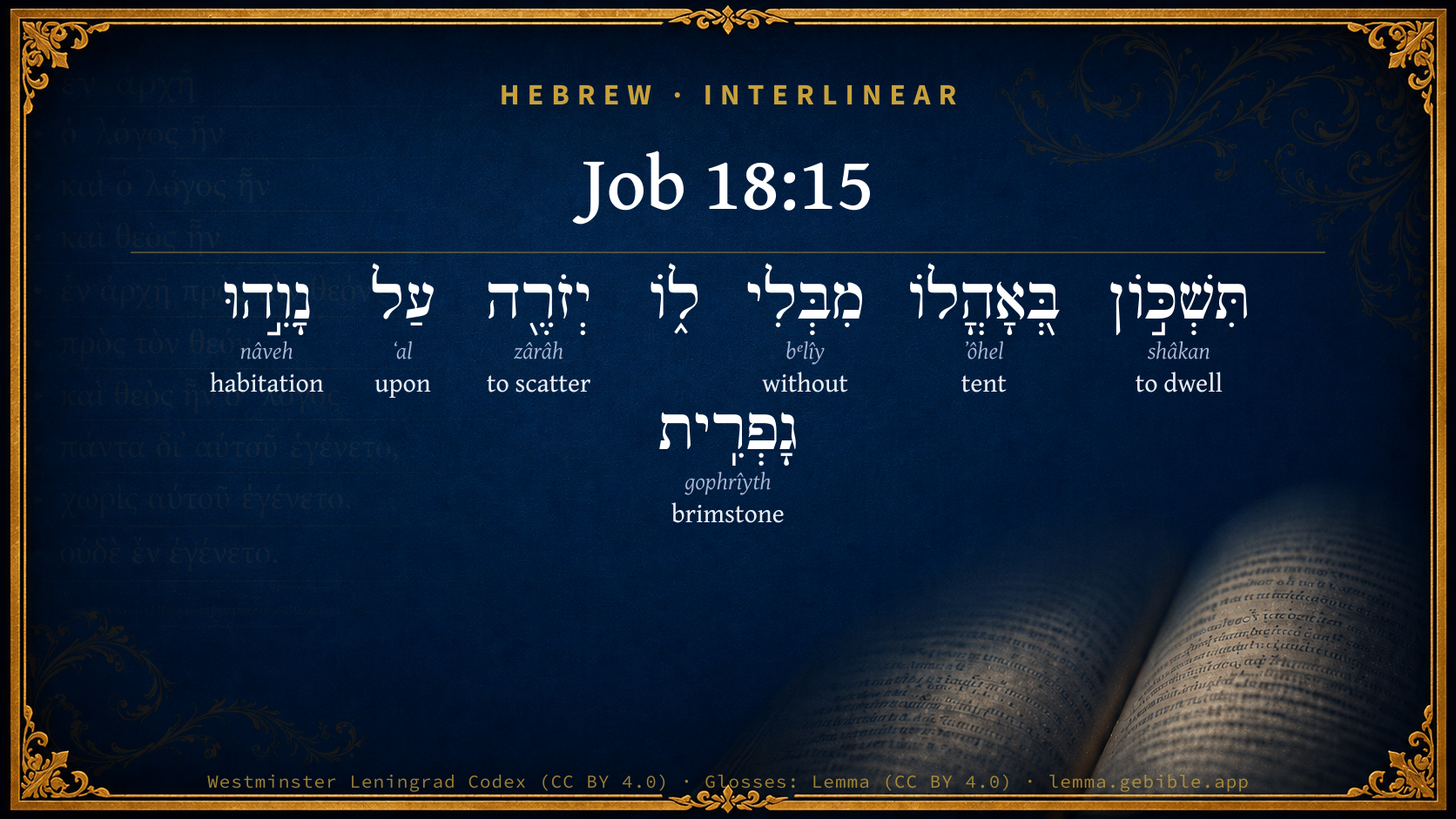
Job 18:15

Hebrew (Westminster Leningrad Codex) Job 18:15 appears in the Hebrew Old Testament. The text above is from the Westminster Leningrad Codex. Each word links to its Strong’s number, a concise gloss, and parsing drawn from the Open Scriptures Hebrew Bible morphology. Click any word for its full Brown-Driver-Briggs (BDB) entry.
Download image
Cite this verse

Job 18:15 (World English Bible). Public Domain. Lemma interlinear Bible study tool, https://lemma.gebible.app/v/job/18/15.

Show BibTeX & RIS
BibTeX
RIS
English Translation
There shall dwell in his tent that which is none of his. Sulfur shall be scattered on his habitation.
World English Bible · Public Domain
Download a study sheet

One document with this verse’s original text, its word-by-word gloss line, the meaning frame, cross-references with their text, attributed commentary, and full source and license credits — printable, and it pastes into notes with its structure intact.

This verse Autodidact and up

Study sheet (.html) Plain text (.txt)

A passage Seminary Student

Up to 50 verses in one chapter. A passage sheet keeps up to 6 commentary sources and 12 cross-references per verse, in the order this page ranks them, and says so on the sheet whenever that leaves anything out. Ask for a single verse and you get the Autodidact verse sheet above.

Everything on this page stays free to read, with no account — the sheet is a download of what is already on screen, not access to it.

Want to remove ads? Support Godless Engineer
Compare translations 3

The same verse in 3 English versions, stacked beneath the original-language interlinear above. Click any original word for its lexicon entry.

Each is an independent rendering of the whole verse — the interlinear is not word-aligned to these translations.

Highlighted words mark where these versions differ — a whole-verse word diff, not a word-by-word alignment.

  • World English Bible Public Domain
    There shall dwell in his tent that which is none of his. Sulfur shall be scattered on his habitation.
  • King James Version Public Domain
    It shall dwell in his tabernacle, because it is none of his: brimstone shall be scattered upon his habitation.
  • unfoldingWord Literal Text CC BY-SA 4.0
    One will dwell in his tent, not to him; sulfur is scattered upon his home.

unfoldingWord Literal Text — © unfoldingWord, licensed CC BY-SA 4.0. Word-aligned USFM3 via Door43 (git.door43.org/unfoldingWord/en_ult).

Versions to compare (up to 4)

3 of 4 selected

Show all 18 translations

Every available English version of this verse, each an independent rendering of the whole verse.

  • World English Bible Public Domain
    There shall dwell in his tent that which is none of his. Sulfur shall be scattered on his habitation.
  • Berean Standard Bible Public Domain
    Fire resides in his tent; burning sulfur rains down on his dwelling.
  • Majority Standard Bible Public Domain
    Fire resides in his tent; burning sulfur rains down on his dwelling.
  • King James Version Public Domain
    It shall dwell in his tabernacle, because it is none of his: brimstone shall be scattered upon his habitation.
  • American Standard Version (1901) Public Domain
    There shall dwell in his tent that which is none of his: Brimstone shall be scattered upon his habitation.
  • Revised Version (1885) Public Domain
    There shall dwell in his tent that which is none of his: brimstone shall be scattered upon his habitation.
  • Geneva Bible (1599) Public Domain
    Feare shall dwell in his house (because it is not his) and brimstone shalbe scattered vpon his habitation.
  • Douay-Rheims (1899) Public Domain
    Let the companions of him that is not, dwell in his tabernacle, let brimstone be sprinkled in his tent.
  • Young's Literal Translation Public Domain
    It dwelleth in his tent -- out of his provender, Scattered over his habitation is sulphur.
  • Literal Standard Version CC BY-SA 4.0
    It dwells in his tent—out of his provender, || Sulfur is scattered over his habitation.
  • Unlocked Literal Bible CC BY-SA 4.0
    People not his own will live in his tent after they see that sulfur is scattered within his home.
  • unfoldingWord Literal Text CC BY-SA 4.0
    One will dwell in his tent, not to him; sulfur is scattered upon his home.
  • Darby Bible Public Domain
    They who are none of his shall dwell in his tent; brimstone shall be showered upon his habitation:
  • World Messianic Bible Public Domain
    There will dwell in his tent that which is none of his. Sulfur will be scattered on his habitation.
  • Webster's Bible Public Domain
    It shall dwell in his tabernacle, because it is none of his: brimstone shall be scattered upon his habitation.
  • Free Bible Version CC BY-SA 4.0
    People they don't know will live in their homes; sulfur will be scattered where they used to live.
  • Bible in Basic English Public Domain
    In his tent will be seen that which is not his, burning stone is dropped on his house.
  • JPS Tanakh (1917) Public Domain
    There shall dwell in his tent that which is none of his; brimstone shall be scattered upon his habitation.

Literal Standard Version (2020), Covenant Press — licensed CC BY-SA 4.0. Text via the HelloAO Bible API (eBible.org). Unlocked Literal Bible (unfoldingWord) — licensed CC BY-SA 4.0. Text via the HelloAO Bible API (eBible.org). unfoldingWord Literal Text — © unfoldingWord, licensed CC BY-SA 4.0. Word-aligned USFM3 via Door43 (git.door43.org/unfoldingWord/en_ult). Free Bible Version, Dr. Jonathan Gallagher — licensed CC BY-SA 4.0. Text via the HelloAO Bible API (eBible.org).

Word by word

More ways to search: Search by grammar → Find every occurrence → Compare this word →

Practice this passage: Drill this verse → Learn its vocabulary →

About this verse

These counts appear in no published source. They are computed here, from the morphology-tagged text and Lemma’s own curated glosses. What Lemma adds →

8
words
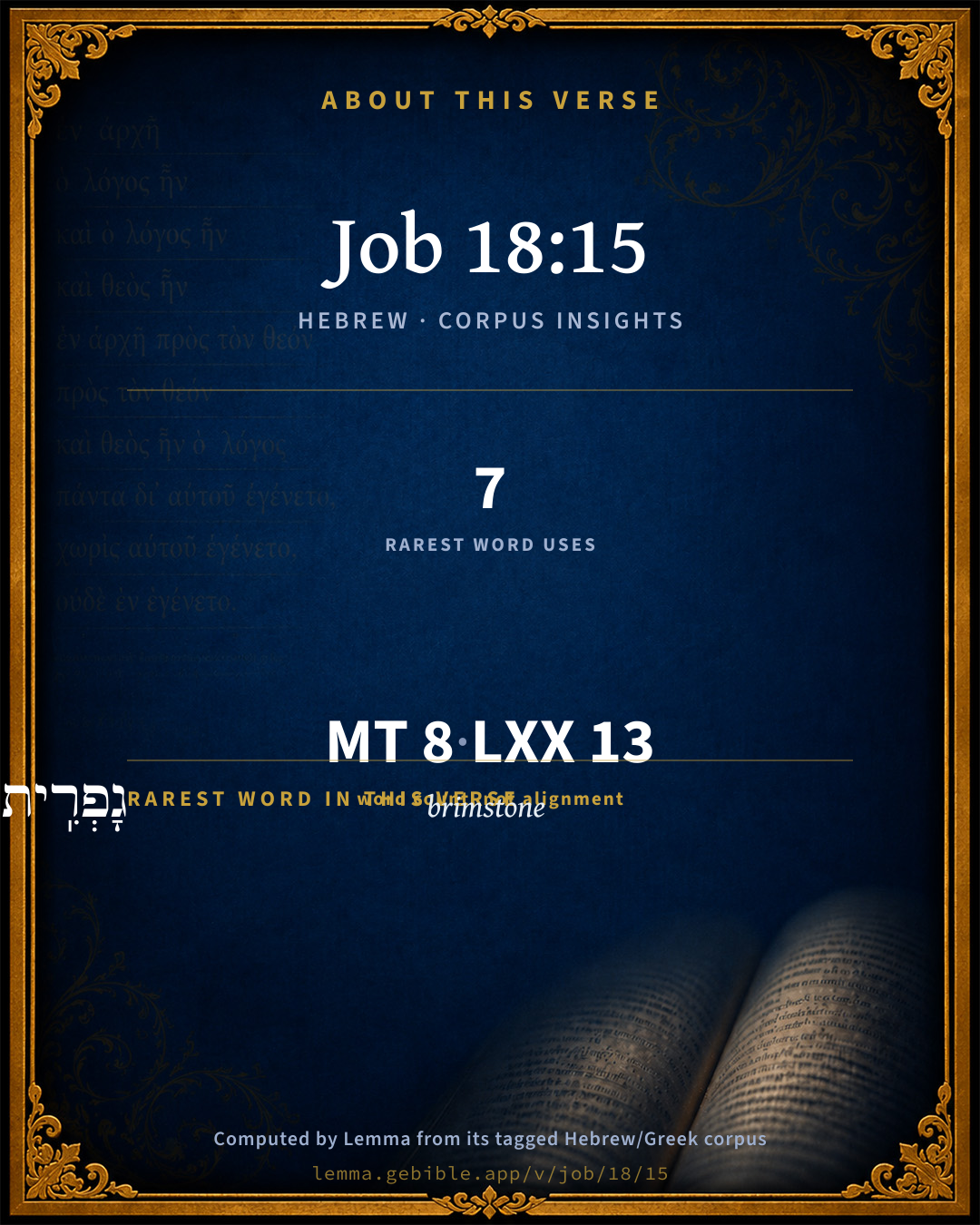
7
distinct lemmas
Wisdom
section

Notable vocabulary

The rarest word here is גָפְרִֽית brimstone H1614 — appearing just 7 times in the whole Hebrew Bible.

Shared distinctive vocabulary

גָפְרִֽית brimstone H1614 occurs in 7 verses of the Hebrew Bible. Also found in:

Grammatical profile

  • 2 verbs
  • 4 nouns
  • 2 prepositions

Verb forms

  • תִּשְׁכּ֣וֹן Qal · Imperfect
  • יְזֹרֶ֖ה Pual · Imperfect

Hebrew & Septuagint length

In English translation the verse runs 19 words from the Hebrew and 16 from the Septuagint (LXX English) — closely comparable.

A rough comparison of the two English renderings, which tokenize alike — not a word-level alignment.

Word counts can differ between the Hebrew and the Greek without any difference in meaning — e.g. the Hebrew direct-object marker אֵת has no separate Greek word, and Greek often adds the article ὁ.

In the original languages it is 8 Hebrew tokens and 13 Greek tokens — but the two are counted differently (Hebrew bundles its prefixes and suffixes into one token; the Greek is in lemma form), so that isn’t a like-for-like length.

Cross-references

12

Topical passages linked to Job 18:15 in the Treasury of Scripture Knowledge — connected by theme and wording, ordered by reader-vote popularity; previews shown in the World English Bible.

  • Psalms 11:6 On the wicked he will rain blazing coals; Fire, sulfur, and scorching wind shall be the portion of their cup.
  • Deuteronomy 29:23 [and that] the whole land of it is sulfur, and salt, [and] a burning, [that] it is not sown, nor bears, nor any grass grows therein, like the overthrow of Sodom and Gomorrah, Admah and Zeboiim, which Yahweh overthrew in his anger, and in his wrath:
  • Isaiah 34:9–10 The streams of [Edom] shall be turned into pitch, and the dust of it into sulfur, and the land of it shall become burning pitch.
  • Genesis 19:24 Then Yahweh rained on Sodom and on Gomorrah sulfur and fire from Yahweh out of the sky.
  • Job 18:12–13 His strength shall be famished, Calamity shall be ready at his side.
  • Job 20:18–21 That for which he labored he shall restore, and shall not swallow it down; According to the substance that he has gotten, he shall not rejoice.
  • Jeremiah 22:13 Woe to him who builds his house by unrighteousness, and his chambers by injustice; who uses his neighbor's service without wages, and doesn't give him his hire;
  • Habakkuk 2:6–11 Won't all these take up a parable against him, and a taunting proverb against him, and say, 'Woe to him who increases that which is not his, and who enriches himself by extortion! How long?'
  • Zechariah 5:4 I will cause it to go out," says Yahweh of Hosts, "and it will enter into the house of the thief, and into the house of him who swears falsely by my name; and it will remain in the midst of his house, and will destroy it with its timber and its stones."
  • Revelation 19:20 The beast was taken, and with him the false prophet who worked the signs in his sight, with which he deceived those who had received the mark of the beast and those who worshiped his image. These two were thrown alive into the lake of fire that burns with sulfur.
  • Revelation 21:8 But for the cowardly, unbelieving, sinners, abominable, murderers, sexually immoral, sorcerers, idolaters, and all liars, their part is in the lake that burns with fire and sulfur, which is the second death."
  • Job 31:38–39 If my land cries out against me, And the furrows of it weep together;

Cross-references courtesy of OpenBible.info (CC BY 4.0).

Hebrew and Greek witnesses Masoretic Hebrew ↔ Greek Septuagint

The same verse in the two great witnesses to the Old Testament, shown verse-for-verse.

These are two independent witnesses, not word-aligned to each other, and the Septuagint is shown in lemma (dictionary) form.

Hebrew Job 18:15 Masoretic · Westminster Leningrad Codex

תִּשְׁכּ֣וֹן בְּ֭אָהֳלוֹ מִבְּלִי ל֑וֹ יְזֹרֶ֖ה עַל נָוֵ֣הוּ גָפְרִֽית

There shall dwell in his tent that which is none of his. Sulfur shall be scattered on his habitation.

World English Bible · Public Domain

Greek LXX Job 18:15 Septuagint · lemma form

κατασκηνόω ἐν ὁ σκηνή αὐτός ἐν νύξ αὐτός κατασπείρω ὁ εὐπρεπής αὐτός θεῖον

It shall dwell in his tabernacle in his night: his excellency shall be sown with brimstone.

LXX2012 (modern English Septuagint) · Public Domain

Hebrew: Westminster Leningrad Codex (CC BY 4.0). Greek: Septuagint (public domain); English from LXX2012 (modern English Septuagint) (Public Domain). How the Septuagint differs from the Hebrew →

Commentary

Notes on Job 18:15 from classic Christian and Jewish commentators (each source and its license shown beneath its notes). The classic Christian expositions comment on the surrounding passage and are grouped to its opening verse, so a note may address several verses; the Jewish commentaries on the Tanakh (Rashi and others) are per-verse, so they appear only where the commentator wrote on this verse.

Lemma curates 59 commentaries, every one of them public domain or Creative Commons licensed, each selected and text-cleaned for this edition rather than reprinted as found. About our sources →

John Gill's Exposition

His roots shall be dried up beneath,.... Wicked men are sometimes compared to trees; to trees of the wood, barren, and unfruitful; to trees without fruit, twice dead, plucked up by the roots; and sometimes to green bay trees, very flourishing for a while, and which on a sudden perish, and come to nothing, see Sol 2:3, Jde 1:12; and such a simile is here used; and by his roots may be meant his family, from whence he sprung, which now should be extinct with him, see Isa 11:1; or his substance, which being greatly increased, he seemed to take root in the earth, and not only to be in a prosperous, but in a stable settled condition; but now, like Ephraim, he should be smitten, and his root dried up; all his wealth, and all the resources of it, should be exhausted, be no more, see Jer 12:2;

and above shall his branch be cut off; his children that sprung from him, as branches from a tree, and were his glory and beauty, these should be cut off; referring no doubt in both clauses to Job's present circumstances, whose root in the time of his prosperity was spread out by the waters, but now dried up, and on whose branches the dew lay all night, but now cut off, Job 29:19; so the Targum,

"his children shall be cut off out of the earth, and from heaven his destruction shall be decreed;''

both clauses signify the utter destruction of the family of the wicked man, root and branch, see Mal 4:1. It is a beautiful description of a tree struck with thunder and lightning, and burnt and shattered to pieces, and agrees with Job 18:15.

John Gill's Exposition of the Whole Bible (1746–1763) — public domain (CC PDM 1.0). Text via the HelloAO Bible API.

Trapp's Complete Commentary

John Trapp

Job 18:15 It shall dwell in his tabernacle, because [it is] none of his: brimstone shall be scattered upon his habitation.

Ver. 15. It shall dwell in his tabernacles, because it is none of his] Heb. Not his; Why? the king of terrors hath turned him out of it, and taken it up for a habitation for himself. Some render it thus, nothing, or have nothing (that is, want) shall dwell in his tabernacle, his house shall be replenished with emptiness, scarcity shall be the furniture of his habitation.

Brimstone shall be scattered upon his habitation] As is also threatened, Psa 11:6. And as was executed upon Sodom and her sisters; as also upon Dioclesian, the tyrant, who, giving over his empire, decreed to lead the rest of his life quietly. But he escaped not so, for after that his house was wholly consumed with lightning, and a flame of fire that fell from heaven, not without a sulphurous smell, he hiding himself for fear of the lightning, died a short time later. (Euseb. de Vita Const. lib. v.)

John Trapp, A Commentary or Exposition upon All the Books of the Old and New Testament (1647–1656) — public domain. Text from a community e-Sword module.

Joseph Benson's Commentary

Job 18:15. It shall dwell in his tabernacle — Destruction, expressed Job 18:12, shall fix its abode with him. Because it is none of his — Because it is none of his own, being got from others by deceit or violence. Brimstone shall be scattered on his habitation — It shall be utterly destroyed, as it were, by fire and brimstone. He seems to allude both to the destruction of Sodom, which happened not long before these times, and to the judgment which befell Job, chap. Job 1:16. When the stranger hath taken and rifled his dwelling, he shall forsake it as an accursed place, and shall burn it with fire and brimstone, that there may be no monument of so vile a person left upon the earth. Heath’s interpretation of this verse is, “They shall take up their habitation in his tent, because he hath no surviver: brimstone shall be sprinkled upon his habitation. As much as to say, ‘Since he hath no one to survive him, his posterity is utterly exterminated: horror takes possession of his habitation, and it is sprinkled with brimstone, that no person may ever after inhabit it; but that it may remain an object of terror to future ages.’ The image is grand, and worthy of the tragic style.”

Joseph Benson's Commentary on the Old and New Testaments (1811–1818) — public domain. Text from a community e-Sword module.

Tyndale Open Study Notes

Tyndale Open Resources

18:15 The image of burning sulfur recalls the fate of Sodom and Gomorrah (Gen 19:24) and suggests the fate of all the wicked (Ps 11:6; Rev 19:20; 21:8).

Tyndale Open Study Notes — © Tyndale Open Resources, licensed CC BY-SA 4.0. Text via the HelloAO Bible API.

Geneva Bible (1599)

Geneva Bible translators

Though all the world would favor him, yet God would destroy him and his.

Meaning, not truly come by.

Geneva Bible (1599) marginal notes — public domain. Text via Bolls.life.

Jamieson, Fausset & Brown

Robert Jamieson, A. R. Fausset & David Brown

It--"Terror" shall haunt, &c., and not as UMBREIT, "another," which the last clause of the verse disproves.

none of his--It is his no longer.

brimstone--probably comparing the calamity of Job by the "fire of God" (Job 1:16) to the destruction of guilty Sodom by fire and brimstone (Gen 19:24).

Jamieson, Fausset & Brown — Commentary Critical and Explanatory on the Whole Bible (1871) — public domain (CC PDM 1.0). Text via the HelloAO Bible API.

Adam Clarke's Commentary

Verse 15. It shall dwell in his tabernacle] Desolation is here personified, and it is said that it shall be the inhabitant, its former owner being destroyed. Brimstone shall be scattered upon his habitation, so that, like Sodom and Gomorrah, it may be an everlasting monument of the Divine displeasure.

In the Persian poet Saady, we find a couplet which contains a similar sentiment: -

[Persic]

[Persic]

Purdeh daree meekund dar keesri Keesar ankeboot

Boomee Noobat meezund ber kumbed Afraseeab.

"The spider holds the veil in the palace of Caesar;

The owl stands sentinel on the watchtower of Afrasiab."

The palaces of those mighty kings are so desolate that the spider is the only chamberlain, and the owl the only sentinel. The web of the former is all that remains as a substitute for the costly veil furnished by the chamberlain in the palace of the Roman monarch; and the hooting of the latter is the only remaining substitute for the sound of drums and trumpets by which the guards were accustomed to be relieved at the watchtower of the Persian king.

The word [Persic] Keesur, the same as καισαρ or Caesar, is the term which the Asiatics always use when they designate the Roman emperor.

Afrasiab was an ancient king who invaded and conquered Persia about seven hundred years before the Christian era. After having reigned twelve years, he was defeated and slain by Zalzer and his son, the famous Rustem. The present reigning family of Constantinople claim descent from this ancient monarch.

Brimstone shall be scattered upon his habitation.] This may either refer to the destruction of Sodom and Gomorrah, as has already been intimated, or to an ancient custom of fumigating houses with brimstone, in order to purify them from defilement. PLINY says, Hist. Nat., lib. xxxv., c. 15, speaking of the uses of sulphur, Habet et in religionibus locum ad expiandas suffitu domos; which Dr. Holland paraphrases thus: "Moreover brimstone is employed ceremoniously in hallowing of houses; for many are of opinion that the perfume and burning thereof will keep out all enchantments; yea, and drive away foul fiends and evil sprites that do haunt a place."

OVID refers to the same, De Arte. Am., lib. ii. ver. 329.

Et veniat, quae lustret anus lectumque locumque:

Praeferat et tremula sulphur et ova manu.

This alludes to the ceremony of purifying the bed or place in which a sick person was confined; an old woman or nurse was the operator, and eggs and sulphur were the instruments of purification.

On this and other methods of purgation see an excellent note in Servius on these words of Virgil, AEn. vi., ver. 740.

_______________Aliae panduntur inanes

Suspensae ad ventos: aliis sub gurgite vasto

Infectum eluitur scelus, aut exuritur igni.

"For this are various penances subjoin'd;

And some are hung to bleach upon the wind;

Some plunged in waters, others, plunged in fires."

Unde etiam, says Servius, in sacris Liberi omnibus tres sunt istae purgationes: nam aut taeda purgantur et sulphure, aut aqua abluuntur, aut aere ventilantur.

"These three kinds of purgation are used in the rites of Bacchus: they are purged by flame and sulphur, or washed in water, or ventilated by the winds."

But it is most likely that Bildad, in his usual uncharitable manner, alludes to the destruction of Job's property and family by winds and fire: for the FIRE OF GOD fell from heaven and burnt up the sheep and the servants, and CONSUMED them; and a great wind, probably the sulphureous suffocating simoom, smote the four corners of the house, where Job's children were feasting, and killed them; see Job 1:16; Job 1:19.

Adam Clarke's Commentary on the Bible (1810–1826) — public domain. Text from a community e-Sword/MySword module.

Ellicott's Commentary for English Readers

(15) It shall dwell in his tabernacle.—Or, “There shall dwell in his tent they that are none of his,” or “which is no longer his”: i.e., terrors shall dwell, or, “which is none of his” may hint that it had been violently taken from some one else. “Brimstone shall be scattered on his dwelling” is probably an allusion to the cities of the plain (Genesis 19).

A Bible Commentary for English Readers, edited by Charles John Ellicott (1878–1897) — public domain. Text from a community e-Sword module.

The Cambridge Bible for Schools and Colleges

gen. ed. J. J. S. Perowne

15. The sense probably is,

There shall dwell in his tent they that are not his,

Brimstone shall be showered upon his habitation.

So Conant excellently. The two clauses of the verse are not to be taken logically together, they describe the destiny awaiting the sinner’s possessions and dwelling under different conceptions—in the one case they pass into the hands of strangers, in the other they are accursed of God, like Sodom, (Gen_19:24) and Edom (Isa_34:9 seq.), and overwhelmed with a rain of brimstone from heaven.

15–17. The extinction of his name and race.

The Cambridge Bible for Schools and Colleges (gen. ed. J. J. S. Perowne; Cambridge University Press, 1878–1918) — public domain. Text from a community e-Sword module.

Albert Barnes' Notes on the Bible

It shall dwell in his tabernacle - It is uncertain what is to be understood as referred to here. Some suppose that the word to be understood is soul, and that the meaning is “his soul,” that is, he himself, “shall dwell in his tent.” Rosenmuller, Noyes, Wemyss, and others, suppose that the word is terror. “Terror (בלהה ballâhâh) shall dwell in his tent,” the same word which is used in the plural in the previous verse. This is undoubtedly the correct sense; and the idea is, that his forsaken tent shall be a place of terror - somewhat, perhaps, as we speak of a forsaken house as “haunted.” It may be that Bildad refers to some such superstitious fear as we sometimes, and almost always in childhood, connect with the idea of a house in which nobody lives.

Because it is none of his - It is no longer his. It is a forsaken, tenantless dwelling.

Brimstone shall be scattered - Brimstone has been always the image of desolation. Nothing will grow on a field that is covered with sulphur; and the meaning here is, that his house would be utterly desolate and forsaken. Rosenmuller and Noyes suppose that there is an allusion here to a sudden destruction, such as was that of Sodom and Gomorrha. Grotius doubts whether it refers to that or to lightning. Others suppose that lightning is referred to both here and in Gen 19:24; Deu 29:23. I can see no evidence here, however, that there is any reference to Sodom and Gomorrha, or that there is any allusion to lightning. If the allusion had been to Sodom, it would have been more full. That was a case “just in point” in the argument; and the fact that was exactly in point, and would have furnished to the friends of Job such an irrefragalbe proof of the position which they were defending, and that it is not worked into the very texture of their argument, is full demonstration, to my mind, that that remarkable event is not referred to in this place. The only thing necessarily implied in the language before us is, that sulphur, the emblem of desolation, would be scattered on his dwelling, and that his dwelling would be wholly desolate.

Albert Barnes' Notes on the Bible (1834–1885) — public domain. Text from a community e-Sword/MySword module.

Haydock's Catholic Bible Commentary

Tent, when he is gone to purify it. Et veniat quæ lustret anus lectumque locumque,

Præferat et tremula sulphur et ova manu. (Ovid, Art.)

--- Yet Moses does not mention sulphur as a thing proper for purifications. Some think that Baldad hints that his house will be destroyed with lightning, or rendered uninhabitable by a loathsome smell.

George Leo Haydock (1774–1849), Haydock's Catholic Family Bible and Commentary, 1859 edition — public domain. Excludes Psalms (Douay-Rheims chapter numbering differs from Protestant) and Deuterocanonical books (Catholic canon only).

Matthew Poole's English Annotations

It, i.e. destruction, expressed Job 18:12, and designed by this particle it, Job 18:13, shall not come upon him and his for a season, for then there might be some hopes of recovery; but it shall fix his abode with him.

It is none of his: this may be added, either,

1. By way of correction, Did I say

his tabernacle? I must retract the expression; for in truth, it is none of his, it is become another man’s. Or,

2. As a reason of the ruin of his tabernacle, because it is none of his own, but got from others by deceit or violence. But these words are and may be joined with the former, and both thus rendered, A stranger (Heb. one that is not his, that is not descended from him, and hath no relation to him)

shall dwell in his tabernacle, i.e. shall possess his house and goods.

Brimstone shall be scattered upon his habitation; it shall be utterly and prodigiously destroyed, as it were by fire and brimstone. He seems to allude both to the destruction of Sodom, upon which God did scatter brimstone and fire, which happened not long before these times, and could not be unknown to them, who lived near that place, and were diligent observers of God’s works; and to the judgment which befell Job, Job 1:16; when the stranger hath taken and rifled his dwelling, he shall forsake it as an accursed place, and shall burn it with fire and brimstone, that there may be no monument of so vile a person left upon the earth.

Matthew Poole's English Annotations on the Holy Bible (1683–1685) — public domain. Text from a community e-Sword/MySword module.

Whedon's Commentary on the Bible

Daniel D. Whedon

15. His tabernacle — After he has been snatched from it, there shall dwell in his tent that which is not his, to wit: wild beasts, (Isa_13:21,) or weeds and thorns, (Hos_9:6, Dillmann,) or strangers and aliens, (Hitzig.)

Brimstone — His doom shall be like that of Sodom and Gomorrah; the fires of heaven shall fall upon his habitation. The ancients fancied that lightning had the smell of brimstone. Thus Pliny, (Job_35:1,) “Lightning and thunder are attended with a strong smell of sulphur, and the light produced by them is of a sulplhureous complexion.” “The desolation of his house is the most terrible calamity for the Semite.… For the Bedawi especially, although his hair tent leaves no mark, the thought of the desolation of his house, the extinction of his hospitable health, is terrible.” — WETZSTEIN, in Del. The ancients had a custom of fumigating houses with sulphur for purposes of purification and exorcism. But notwithstanding Dr. Adam Clarke’s great authority, its application to the text is very questionable. (See Clarke, in loc.)

Daniel D. Whedon (gen. ed.), Commentary on the Old and New Testaments (1874–1909) — public domain. Text from a community e-Sword module.

The Pulpit Commentary

It shall dwell in his tabernacle, because it is none of his; either, it (i.e. terror) shall dwell in his tabernaclewhich is no longer his; or, they shall dwell in his tabernacle that are none of his; i.e. strangers at, all inhabit the place where he dwelt heretofore (compare the Revised Version). Brimstone shall be scattered upon his habitation. As God rained fire and brimstone out of heaven upon the cities of the plain, (Gen_19:24) so shall brimstone be scattered upon his habitation to ruin and destroy it. (comp. Deu_29:23 Psa_11:6)

The home of the wicked insecure.

The blessing of the Lord is upon "the habitation of the just." This is the reward of righteousness. But the Divine judgment against the wicked is shown in permitting his house to become desolate. One of the oft-repeated promises to Israel is the blessing of the Lord upon the habitation. But "the curse of the Lord is in the house of the wicked." The practice of iniquity tends to destruction. It has no element of stability in it. The habitation of the wicked is insecure because

I IT LACKS THE DEFENCE OF RIGHT PRINCIPLES. The righteousness which exalteth a nation establishes a house. On the health, the pursuits, the habits, the business, the family, right principles exert a beneficent influence. The absence of them is the precursor of evil of all kinds. The wall is broken down; protection is wanting. The home is a prey to evil.

II IT LACKS THE PROMISE OF THE DIVINE PROTECTION AND BLESSING. It is as a field unwatered. There is no spring of hope within it. In the blessing of the Lord lies hidden the secret germ of all true prosperity, and all safety and permanence. Where that blessing is not, the house is as a tender plant unsheltered beneath a scorching sups. The Divine providence cannot be expected to work for the promotion of ends directly contrary to its own. The whole world, with its innumerable laws and its wise administration, is on the side of right, on the side of virtue and goodness. The blessing of the Lord, which makes the field to be fruitful, makes the abode of the righteous to be an abode of safety, of peace, and of blessing. The home of wickedness has none of these things.

III The home of the wicked finds NO ENCOURAGEMENT TO ITS PROSPERITY IN THE GOOD WILL OF MEN AROUND. The evil companions are not trustworthy. They turn aside as a deceitful bow. They are as likely to rejoice and make sport out of their companion"s downfall as to pity him under it; while the ungodly, having separated himself from the righteous, can find no sympathetic spirit amongst them. That the home of evil should be broken up is rather a cause of rejoicing, for it is the putting aside a cause of evil. This is the portion of the man that maketh not God his trust. He fights against his own best interests. He forsakes the only true and safe way. He puts himself in opposition to the great forces of righteousness which ever in the end prevail. He links his interests with that on which the withering curse of God rests, and "brimstone shall be scattered upon his habitation." "His roots shall be dried up beneath, and above shall his branch be cut off. R.G.

The Pulpit Commentary (1880–1919), ed. H.D.M. Spence-Jones & Joseph S. Exell — public domain. Text from a community e-Sword module.

John Wesley's Explanatory Notes

It - Destruction, expressed ver. 12, shall fix its abode with him. Because - Because it is none of his own, being got from others by deceit or violence. Brimstone - It shall be utterly destroyed, as it were, by fire and brimstone. He seems to allude both to the destruction of Sodom, which happened not long before these times, and to the judgment which befell Job, chap. i, 16.

John Wesley, Explanatory Notes Upon the Whole Bible (1754–1765) — public domain. Text via the GEBible commentary corpus.

Rashi

Rabbi Shlomo Yitzchaki (Rashi)

She shall dwell in his tent as a widow.

not being his (that she will not be his) because he is dead, and ultimately brimstone shall be scattered on his dwelling.

Rashi on the Tanakh — English translations: “The Judaica Press complete Tanach with Rashi, translated by A. J. Rosenberg” (CC BY 4.0); “Pentateuch with Rashi's commentary by M. Rosenbaum and A.M. Silbermann, 1929-1934” (public domain); “The Metsudah Tanach series, Lakewood, N.J” (CC BY 4.0); and “The Book of Joshua, Metsudah Publications, 1997” (CC BY 4.0). Text via Sefaria.

Lesson kit

Teaching starters — assembled from the data on this page, not authored interpretation. Every prompt links to the verse data it draws on. Edit before teaching.

Job, in the Wisdom, opens this verse with 8 words (7 distinct Hebrew lemmas). Its most distinctive word is gophrîyth (“brimstone”). A historical commentator’s framing appears above. Read the whole chapter for the surrounding context.

Discussion questions

  1. What does “brimstone” (gophrîyth) contribute to the verse as a whole?
  2. Genesis 19:24 shares the word «brimstone» with this verse. How do the two illuminate each other?
  3. These translations render this verse differently. What is at stake in choosing one wording over another?
  4. The verb «תִּשְׁכּ֣וֹן» is Qal Imperfect. How does its form color the action?
  5. Reading how John Gill's Exposition and Trapp's Complete Commentary read this verse, where do the two commentators agree and where do they part?

Things to notice

Reading settings

Reading text

Shown beneath each verse's original-language words.

Old Testament
Old Testament edition

Read the OT as the Masoretic Hebrew (MT) or the Greek Septuagint (LXX).

English shown for the Greek Septuagint (in the Hebrew ↔ Greek comparison).

Comparing translations? Open the Compare panel on any verse page to stack up to four side by side.