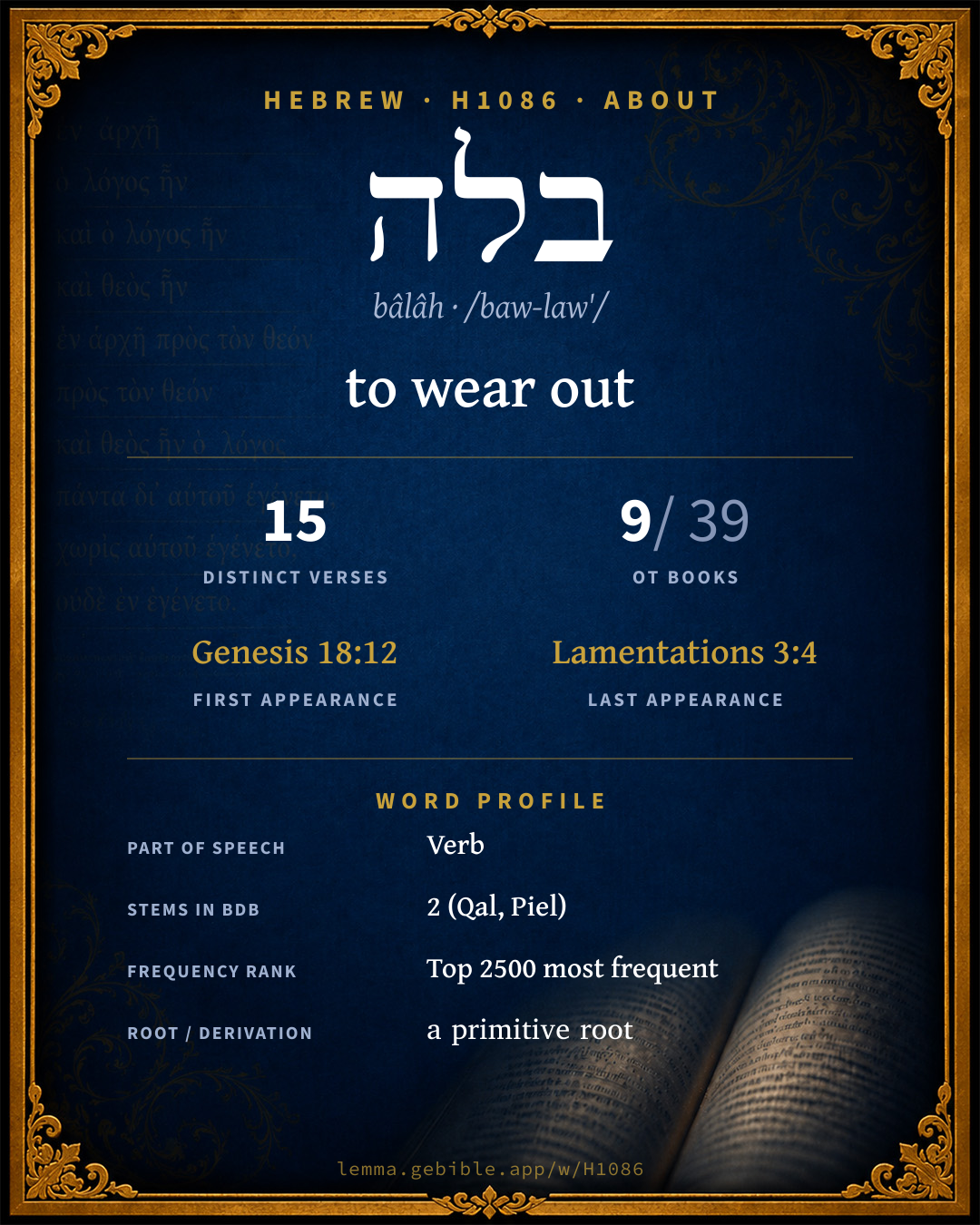
בָּלָה
to wear out
‘to wear out’ is one of 2 main senses fuller range ↓
Full lexicon entry — Brown-Driver-Briggs (BDB)
From Brown-Driver-Briggs (BDB)
Where this word appears
See every Qal verb in the Hebrew Bible →
Grammar key — what these labels mean
Part of speech
- Verb
- An action or state-of-being word.
Stem
- Qal
- The basic, simple active stem — the plain form of the verb (“he wrote”).
- Piel
- An intensive or resultative active stem. Here: ‘wear out’
Form
- Perfect
- A completed action or state — Hebrew marks aspect (completeness) more than strict tense (“he wrote”).
- Imperfect
- An incomplete, ongoing, or future action (“he will / would write”).
- Infinitive Construct
- A bound verbal noun, frequently with prepositions (“to write / in writing”).
Person
- 3rd Person
- The one spoken about (“he / she / it / they”).
Gender
- Common
- Either gender — not distinguished for this form.
- Masculine
- Grammatically masculine.
- Feminine
- Grammatically feminine.
Number
- Plural
- More than one (in Hebrew, generally three or more).
- Singular
- One.
Grammatical forms 9 distinct
- Verb, Qal, Perfect, 3rd Person, Common, Plural 4 times (25%)
- Verb, Piel, Imperfect, 3rd Person, Masculine, Plural 2 times (13%)
- Verb, Qal, Imperfect, 3rd Person, Masculine, Plural 2 times (13%)
- Verb, Qal, Perfect, 3rd Person, Feminine, Singular 2 times (13%)
- Verb, Piel, Infinitive Construct 2 times (13%)
- Verb, Piel, Perfect, 3rd Person, Masculine, Singular 1 time (6%)
- Verb, Qal, Infinitive Construct 1 time (6%)
- Verb, Qal, Imperfect, 3rd Person, Feminine, Singular 1 time (6%)
+1 more form (1 occurrence)
Parsed forms decoded from the imported morphology (morphhb / Westminster Leningrad Codex — WLC text public domain, morphhb tagging CC BY 4.0), counted across 16 parsed occurrences — not distinct verses.
Every verse where H1086 appears — 15 distinct verses across 9 books. Click any verse to open its interlinear word-by-word view. Verse text shown in the World English Bible for context — . Each verse’s Hebrew form is shown with its reference; the English is not keyword-highlighted, since the data carries no word-level English alignment. Use “Compare translations” on any verse to read it across multiple English versions. This concordance covers the Hebrew Bible; Septuagint (Greek Old Testament) occurrences are not indexed here.
Genesis 1 verse
Deuteronomy 2 verses
- Deuteronomy 8:4 בָֽלְתָה֙ Qal pf 3fs Your clothing didn't grow old on you, neither did your foot swell, these forty years.
- Deuteronomy 29:5 בָל֤וּ בָלְתָ֖ה Qal pf 3cp Qal pf 3fs I have led you forty years in the wilderness: your clothes have not grown old on you, and your shoe has not grown old on your foot.
Joshua 1 verse
1 Chronicles 1 verse
Nehemiah 1 verse
Job 2 verses
Psalms 3 verses
- Psalms 32:3 בָּל֣וּ Qal pf 3cp When I kept silence, my bones wasted away through my groaning all day long.
- Psalms 49:14 לְ/בַלּ֥וֹת prep + Piel inf.cs They are appointed as a flock for Sheol. Death shall be their shepherd. The upright shall have dominion over them in the morning. Their beauty shall decay in Sheol, Far from their mansion.
- Psalms 102:26 יִבְל֑וּ Qal impf 3mp They will perish, but you will endure. Yes, all of them will wear out like a garment. You will change them like a cloak, and they will be changed.
Isaiah 3 verses
- Isaiah 50:9 יִבְל֔וּ Qal impf 3mp Behold, the Lord Yahweh will help me; who is he who shall condemn me? Behold, all they shall wax old as a garment, the moth shall eat them up.
- Isaiah 51:6 תִּבְלֶ֔ה Qal impf 3fs Lift up your eyes to the heavens, and look on the earth beneath; for the heavens shall vanish away like smoke, and the earth shall wax old like a garment; and those who dwell therein shall die in like manner: but my salvation shall be forever, and my righteousness shall not be abolished.
- Isaiah 65:22 יְבַלּ֥וּ Piel impf 3mp They shall not build, and another inhabit; they shall not plant, and another eat: for as the days of a tree shall be the days of my people, and my chosen shall long enjoy the work of their hands.
Lamentations 1 verse
About this entry
At a glance — auto-summarized from this page’s data, not written by a person. Every figure links to its source below. This summary describes the numbers; it doesn’t interpret them.
בלה (bâlâh) is a Hebrew verb most often rendered “to wear out.” Scripture first uses it in Genesis 18:12. It turns up in 15 verses across 9 books, an uncommon footprint. The verb spans 2 stems, from Qal to Piel. It clusters with בל, בלא and בלה under a shared root. For the data behind this summary, explore the sense tree and the renderings breakdown below.
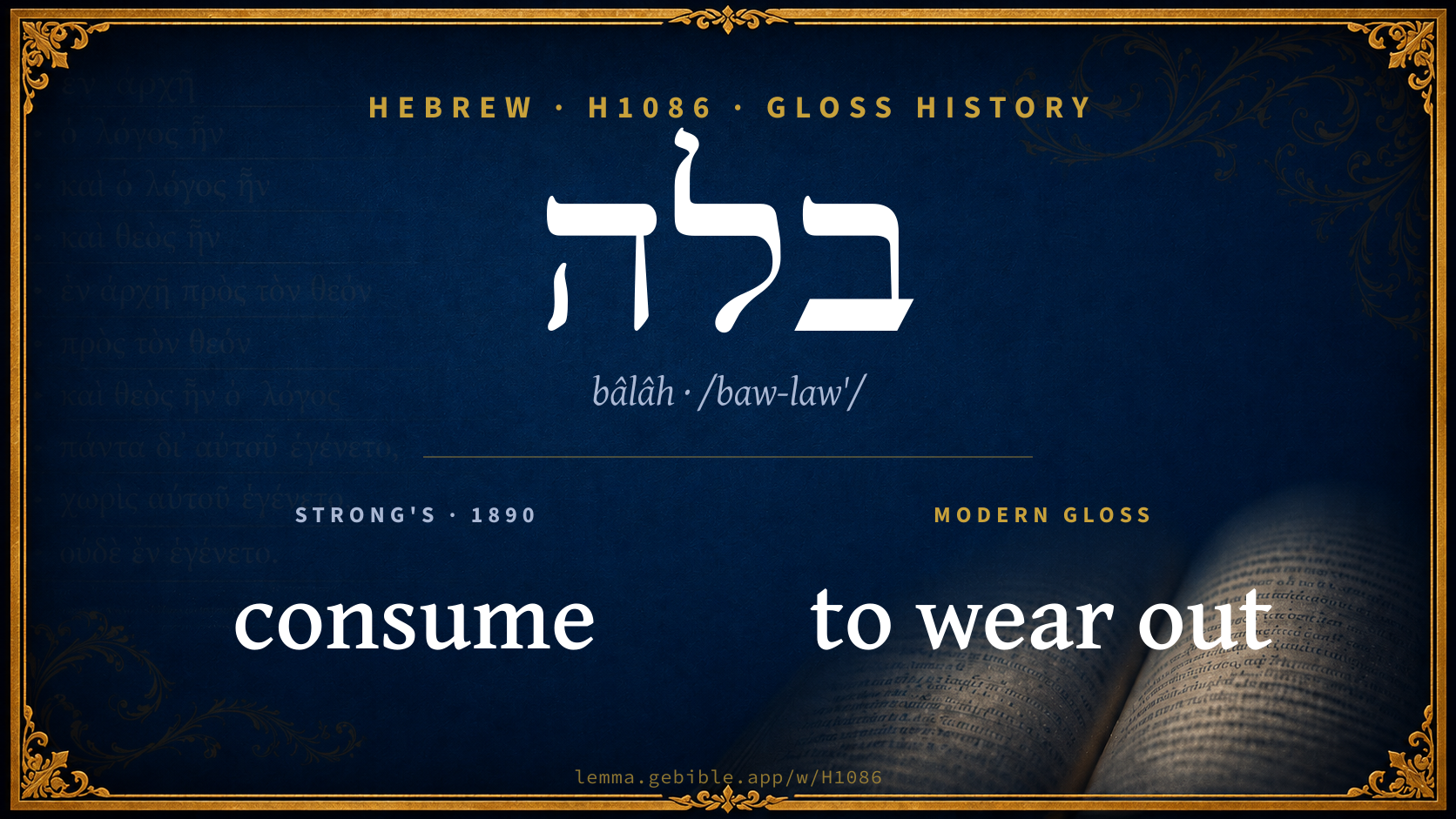
Gloss history
Strong's 1890 vs modern scholarship
About this word
Strong's H1086 catalogs a Hebrew word from the Hebrew Old Testament.
These counts are not copied from any lexicon or concordance. They are computed here, from the morphology-tagged Hebrew Old Testament. What Lemma adds →
- 15
- distinct verses
- The word appears in 15 distinct verses.
- 9 / 39
- OT books
- The word appears in 9 of 39 Old Testament books.
- #1,752
- by frequency
- Top 2500 most frequent Hebrew words (rank 1,752 of 8,640 Hebrew words by occurrence).
View all 15 occurrences in the concordance →
Most concentrated in
- Psalms 3 verses 20%
- Isaiah 3 verses 20%
- Deuteronomy 2 verses 13%
By section of the Old Testament
By traditional corpus
Conventional, traditional groupings — biblical authorship is debated, so this is a traditional corpus grouping, not an authorship claim. Each share is this word’s portion of its verses in that division of the Hebrew canon. Each figure is a share of the word’s 15 distinct verses.
- Writings (Ketuvim) 8 verses · 53%
- Prophets (Nevi'im) 4 verses · 27%
- Torah (Pentateuch) 3 verses · 20%
How translations render this word
Counts come from each version’s own published word-to-Strong’s tagging or interlinear alignment — an approximate guide to how each version renders this word, not a word-level alignment the data otherwise carries. Because each total is that version’s own tagged count, the per-version totals vary from one another and need not match the appearance or distinct-verse counts above. These counts may also differ from a printed concordance because Lemma counts each distinctly tagged rendering and does not collapse phrase taggings into a single head-word total. This is a fixed set of word-tagged versions (KJV, ASV, BSB, ULT) and does not change with the reading translation you choose elsewhere. Each version’s license is shown beside its name below (and on Sources).
BDB lists this Strong’s number as 2 distinct words (homographs). Each count above pools all of them and is not split by sense — see the Senses section below. A low-frequency rendering may belong to a different one of those words, not the primary meaning.
- King James Version†: Waxed not old 2×
- American Standard Version†: Are become old 1×, Are not waxed old 1×, Clothes waxed not old 1×
- Berean Standard Bible†: Wear out 5×
- unfoldingWord Literal Text†: Did 4×, Wear out 4×, Will wear out 4×
King James Version Public Domain
Renders H1086 across 15† tagged occurrences — most commonly:
Plus 13 renderings that appear only once — usually multi-word phrases or single function words the recovered tagging swept in, not distinct renderings. Not rendered by a distinct English word in 1 further occurrence.
American Standard Version Public Domain
Renders H1086 across 15† tagged occurrences — most commonly:
Plus other, less common renderings.
Berean Standard Bible Public Domain
Renders H1086 across 15† tagged occurrences — most commonly:
Plus 10 renderings that appear only once — usually multi-word phrases or single function words the recovered tagging swept in, not distinct renderings. Not rendered by a distinct English word in 1 further occurrence.
unfoldingWord Literal Text CC BY-SA 4.0
Renders H1086 across 20† tagged occurrences — most commonly:
Plus 8 renderings that appear only once — usually multi-word phrases or single function words the recovered tagging swept in, not distinct renderings.
Senses in the full BDB
Hebrew verbs can shift meaning by stem (binyan): Qal is the basic action, Niphal is often passive or reflexive, Piel often intensifies or makes it factitive, and Hiphil is typically causative. The senses below are grouped under the stem BDB assigns to each.
What do BDB’s symbols mean?
BDB uses these scholarly abbreviations:
| Symbol | Meaning |
|---|---|
| 𝔊 | the Septuagint (the ancient Greek translation, LXX) |
| 𝔙 | the Vulgate (the Latin translation) |
| 𝔖 | the Syriac version (the Peshitta) |
| 𝔗 | the Targum (the Aramaic translation) |
| ψ | the Psalms |
| √ | root (the underlying root or stem) |
| ‖ | parallel passage (a synonymous or contrasted parallel) |
| † | the dagger: every passage where the word occurs is cited |
The 4 senses and sub-senses the full Brown-Driver-Briggs lexicon distinguishes for this word, in lexicon order (not ranked by frequency), with BDB’s own verbatim wording and sub-sense lettering. Shown in Hebrew script with BDB’s own scholarly abbreviations. The condensed entry is in the Lexicon Entry tab. See also the Forms in the corpus table below.
בלה I loc. in Simeon Jos 19
בלה II become old and worn out (Arabic بَلِىَ, Aramaic בְּלֵי, ܒܠܴܐ, Ethiopic በልየ id.)
Qal
- Pf. בָּלְֽתָה Dt 8:4, בָּלוּ 29:4 +; Impf. יִבְלֶה Jb 13:28 etc.; Inf. c. sf. בְּלֹתִי Gn 18:12;—wear out (intr.), especially of garments Dt 8:4; 29:4(×2), all c. מֵעַל pregn. wear out (and fall) from upon … (hence Ne 9:21), Jos 9:13; fig. of the heavens (with sim. of garment) Is 50:9 ψ 102:27 כַּבֶּגֶד יִבְלוּ, the earth Is 51:6 כַּבֶּגֶד תִּבְלֶה; the bones (through suffering) ψ 32:3; afflicted man Jb 13:28 וְהוּא כְּרָקָב יִבְלֶה (‖ כְּבֶגֶד אֲכָלוֹ עָשׁ); of an aged and decrepit woman Gn 18:12 (J) אַחֲרֵי בְלֹתִי after I am worn out. e.g. Deuteronomy 8:4
Piel
- caus. of Qal.
- a. wear out (trans.), fig. La 3:4 בִּלָּה בְשָׂרִי וְעוֹרִי, ψ 49:15 and their form לְבַלּוֹת שְׁאוֹל is for She’ôl to consume away (others read לִבְלוֹת is for wasting away [Dr§ 204], connecting שׁ׳ with foll.), 1 Ch 17:9 לְבַלֹּתוֹ to wear it (Isr.) out (altered from לְעַנּוֹתוֹ 2 S 7:10), cf. Dn 7:25 Aramaic e.g. Lamentations 3:4
- b. wear out by use, use to the full, Is 65:22 and the work of their hands יְבַלּוּ they shall use to the full, enjoy, Jb 21:13 they wear out their days in prosperity (Qr here יְכַלּוּ complete, which perhaps is the true reading in both passages; cf. Ex 5:13 Jb 36:11).—On בַּ֜לּוֹתִ֗י ψ 92:11, v. sub בָּלַל. e.g. Isaiah 65:22
Senses from the full Brown-Driver-Briggs lexicon (Brown, Driver, Briggs; Oxford 1906 — public domain), digitized via Sefaria, supplemented by the OpenScriptures HebrewLexicon (CC BY 4.0). Full attribution on Sources.
Word origin
I. n.pr.loc. in Simeon Jos 19:3.
II. vb. become old and worn out (Arabic بَلِىَ, Aramaic בְּלֵי, ܒܠܴܐ, Ethiopic በልየ id.)—
— Brown-Driver-Briggs (Oxford 1906, public domain), digitized via Sefaria, supplemented by the OpenScriptures HebrewLexicon (CC BY 4.0). See Sources.
Origin: a primitive root
Jastrow Dictionary
A second Hebrew/Aramaic lexicon for comparison, covering Aramaic and post-biblical (Talmudic, Targumic, Midrashic) usage that the biblical-Hebrew BDB does not. Matched by lemma rather than by Strong’s number, so a lemma may carry more than one Jastrow headword (shown separately below), and the entries cover usage well beyond the Bible.
בָּלָה
- , v. בלי
בלי ²
- , v. בלל; cmp. נבל) to be crumbled; to be worn out, to fail, decay, perish. Koh. R. to I, 4 הוא בוֹלֶה it (the generation of man) decays (dies out), אינה בוֹלָה it (the earth) does not grow old. Taan. 9ᵃ (play on עד בלי די Mal. III, 10) עד שיִבְלוּ שפתותיכם מלומר די until your lips grow tired from saying, It is enough; (Y. ib. III, 66ᵈ bot. שיבללו, v. בָּלַל); a. fr.—Part. pass. בָּלוּי outworn. Pl. בְּלוּיִים. Midr. Till. to Ps. XXV, 1. e.g. Malachi 3:10
- to wear out, outlive, survive. Lev. R. s. 4 הנפש מְבַלָּה וכ׳ the soul survives the body. Lev. R. s. 19 (play on אין בלתך, I Sam. II, 2) אין לְבַלֹּותֶךָ there is none to outlive thee. Koh. R. l. c.; Cant. R. to V, 15 one erects a building ואחר מְבַלֶּה אותו (not מכלה) and another man ruins it. Snh. 105ᵃ, v. בִּלְעָם. e.g. 1 Samuel 2:2
- , Nithpa. נִתְבַּלָּה to become outworn, fade away. Esth. R. introd. עתידין לְהִבָּלוֹת (Gen. R. s. 42 לִבְלוֹת) are destined to decay. Deut. R. s. 7, end נִתְבַּלּוּ (the garments) were worn out. B. Mets. 87ᵃ נ׳ הבשר her body was withered. B. Bath. 146ᵃ עשויין לִיבָּלוֹת made to be used up.
בְּלֵי I
- Targ. Deut. VIII, 4; Targ. Y. Deut. XXIX, 4 בלמו, Var. כלמו, read בלת; a. fr.—Lev. R. s. 19 כולו בלה all goes to ruin. Ber. 5ᵇ, v. בְּכָא. Ib. 6ᵃ. Bekh. 9ᵃ ובלו להו ואזול they failed and went to destruction. Ab. V, 22 סיב ובְלֵה בה grow old and frail in it (the study of the Law).—[Targ. Ps. LXII, 11; XCI, 2 Ms., v. כְּלִי I.]
- as preced. Pi.—Targ. Is. III, 15; a. e.—Ab. Zar. 20ᵃ that this beauty ב׳ עפרא dust will destroy.—Part. pass. f. מְבַלְּיָא. Lev. R. s. 33 (interpret. בלה נאפים Ezek. XXIII, 43) Aquila translates παλαιὰ πόρνη (old harlot), דהוא מבליא גייארא ed. (Ar. דהיא מב׳ גיירייא, Yalk. Dan. 1061 only דהיא מבליא) which means, a wasted harlot (wasted through fornication). e.g. Ezekiel 23:43
A Dictionary of the Targumim, the Talmud Babli and Yerushalmi, and the Midrashic Literature (Marcus Jastrow; London, Luzac, 1903) — Public Domain. Digitized via Sefaria. Digitized via Sefaria. Full attribution on Sources.
Forms in the corpus
The 16 distinct written forms H1086 takes in the Hebrew Bible, most frequent first — each parse links to that stem’s occurrences in the concordance. Hebrew forms include their vowel points and cantillation, so a single lemma takes many written forms.
Same root — word family
Other BDB entries built from the same root as H1086, grouped by Strong’s listed origin. These share a root / origin per the lexicon — not necessarily a shared meaning. Each links to that word’s own entry.
Derived from this word
- בל bal H1077 not
- בלא bᵉlâʼ H1080 to wear out
- בלה bâleh H1087 worn out
- בלו bᵉlôw H1093 tribute
- בלוא bᵉlôwʼ H1094 rags
- בלי bᵉlîy H1097 without
- בלתי biltîy H1115 except
- תבלית tablîyth H8399 destruction
Compare all same-root words → Showing 4 of 9 — not the complete family. They share a root, not necessarily a meaning.
Septuagint verse parallels
This word appears in 13 verses that also exist in the Greek Old Testament (Septuagint), out of the 15 Hebrew verses it occurs in. You can read those verses in Greek by switching the Old Testament edition to the Septuagint.
Read these verses in the Septuagint
- Genesis 18:12
- Deuteronomy 8:4
- Joshua 9:13
- 1 Chronicles 17:9
- Job 13:28
- Psalms 32:3
- Isaiah 50:9
- Lamentations 3:4
This is a verse-level parallel only — the same verses exist in both the Hebrew and Greek Old Testaments. No word-level Hebrew↔Greek correspondence is claimed: the data carries no such alignment, so no Greek word is shown as this Hebrew word’s translation. Coverage is not total — the Septuagint omits the deuterocanon and renumbers the Psalms, so some Hebrew verses have no direct Greek parallel.