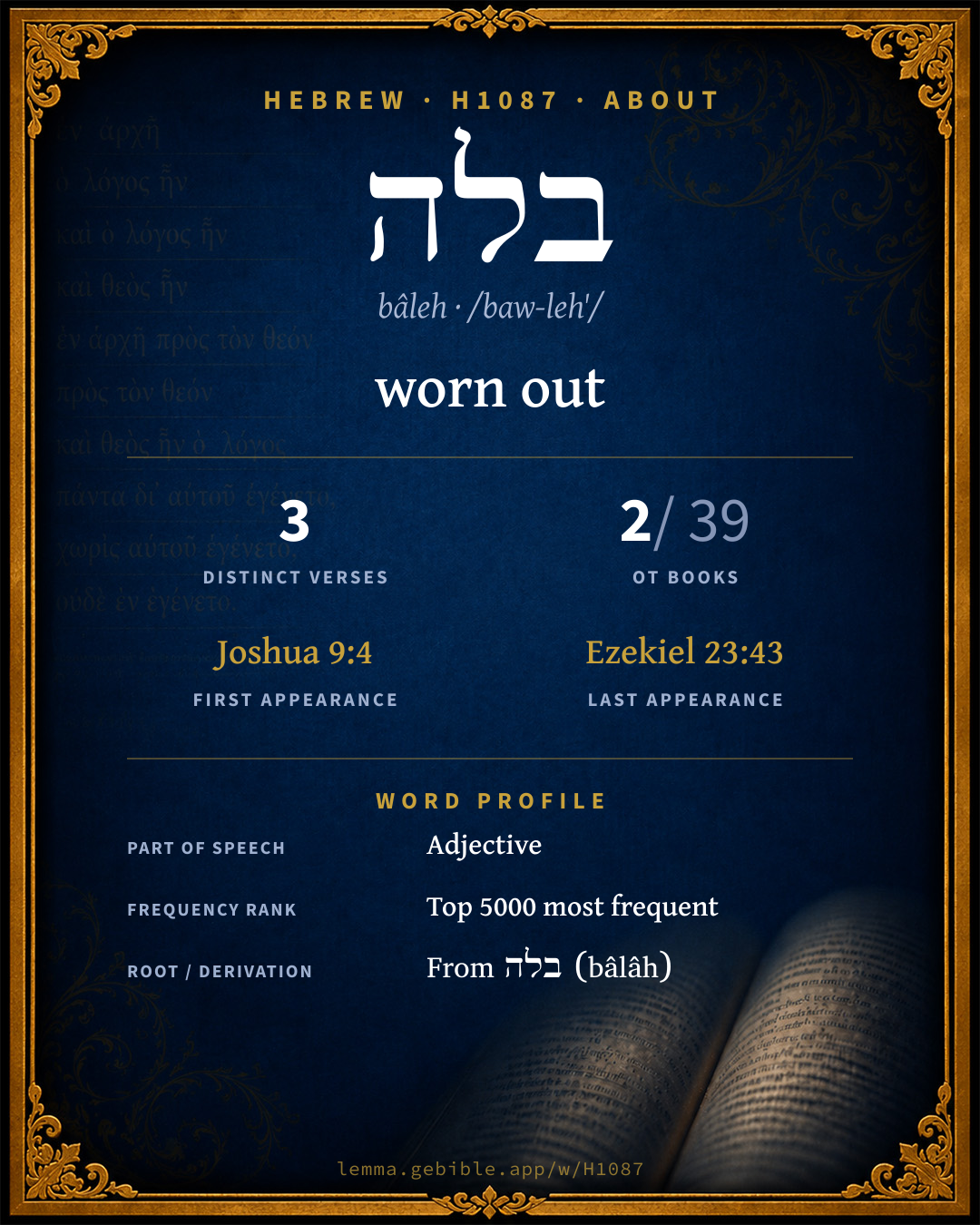
בָּלֶה
worn out
Full lexicon entry — Brown-Driver-Briggs (BDB)
From Brown-Driver-Briggs (BDB)
Where this word appears
Grammar key — what these labels mean
Part of speech
- Adjective
- A word that describes or qualifies a noun.
State
- Absolute
- The independent form of a noun, not bound to a following word.
Gender
- Feminine
- Grammatically feminine.
- Masculine
- Grammatically masculine.
Number
- Plural
- More than one (in Hebrew, generally three or more).
- Singular
- One.
Grammatical forms
- Adjective, Adjective, Feminine, Plural, Absolute 2 times (40%)
- Adjective, Adjective, Masculine, Plural, Absolute 2 times (40%)
- Adjective, Adjective, Feminine, Singular, Absolute 1 time (20%)
Parsed forms decoded from the imported morphology (morphhb / Westminster Leningrad Codex — WLC text public domain, morphhb tagging CC BY 4.0), counted across 5 parsed occurrences — not distinct verses.
Every verse where H1087 appears — 3 distinct verses across 2 books. Click any verse to open its interlinear word-by-word view. Verse text shown in the World English Bible for context — . Each verse’s Hebrew form is shown with its reference; the English is not keyword-highlighted, since the data carries no word-level English alignment. Use “Compare translations” on any verse to read it across multiple English versions. This concordance covers the Hebrew Bible; Septuagint (Greek Old Testament) occurrences are not indexed here.
Joshua 2 verses
- Joshua 9:4 בָּלִים֙ בָּלִ֔ים adj Adjective mp adj Adjective mp they also resorted to a ruse, and went and made as if they had been ambassadors, and took old sacks on their donkeys, and wine-skins, old and torn and bound up,
- Joshua 9:5 בָּל֤וֹת בָּל֖וֹת adj Adjective fp adj Adjective fp and old and patched shoes on their feet, and old garments on them; and all the bread of their provision was dry and was become moldy.
Ezekiel 1 verse
About this entry
At a glance — auto-summarized from this page’s data, not written by a person. Every figure links to its source below. This summary describes the numbers; it doesn’t interpret them.
בלה — transliterated bâleh — is a Hebrew adjective carrying the sense “worn out.” It occurs a mere 3 verses across Scripture. Its uses cluster heavily in Joshua (67% of all occurrences). Its earliest occurrence is Joshua 9:4. Sharing its root, it stands alongside בלה, בל and בלא. Each statement above links to its evidence; the full detail follows below.
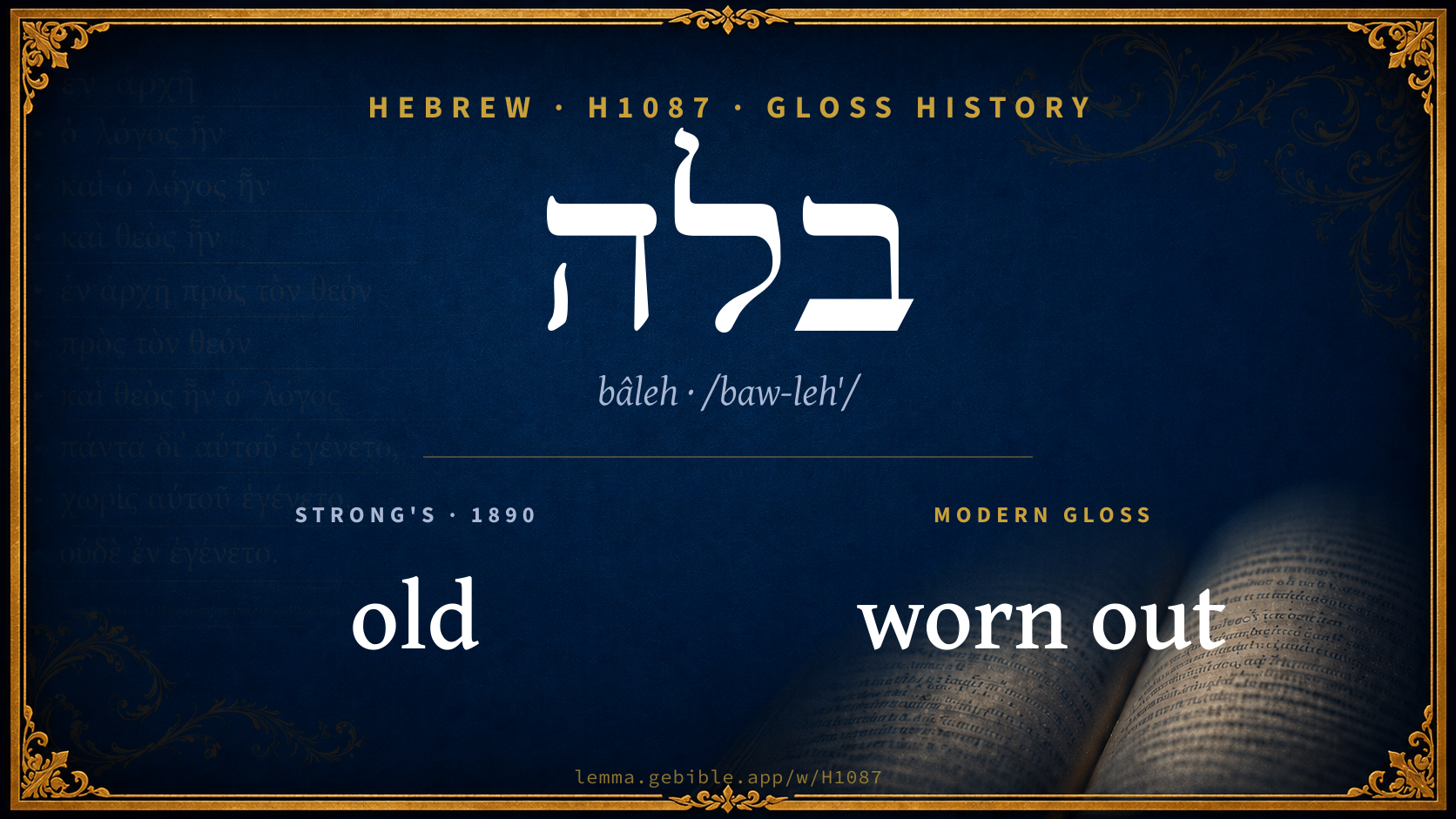
Gloss history
Strong's 1890 vs modern scholarship
About this word
Strong's H1087 catalogs a Hebrew word from the Hebrew Old Testament.
These counts are not copied from any lexicon or concordance. They are computed here, from the morphology-tagged Hebrew Old Testament. What Lemma adds →
- 3
- distinct verses
- The word appears in 3 distinct verses.
- 2 / 39
- OT books
- The word appears in 2 of 39 Old Testament books.
- #3,337
- by frequency
- Top 5000 most frequent Hebrew words (rank 3,337 of 8,640 Hebrew words by occurrence).
View all 3 occurrences in the concordance →
By traditional corpus
Conventional, traditional groupings — biblical authorship is debated, so this is a traditional corpus grouping, not an authorship claim. Each share is this word’s portion of its verses in that division of the Hebrew canon. Each figure is a share of the word’s 3 distinct verses.
- Prophets (Nevi'im) 3 verses · 100%
How translations render this word
Counts come from each version’s own published word-to-Strong’s tagging or interlinear alignment — an approximate guide to how each version renders this word, not a word-level alignment the data otherwise carries. Because each total is that version’s own tagged count, the per-version totals vary from one another and need not match the appearance or distinct-verse counts above. These counts may also differ from a printed concordance because Lemma counts each distinctly tagged rendering and does not collapse phrase taggings into a single head-word total. This is a fixed set of word-tagged versions (KJV, ASV, BSB, ULT) and does not change with the reading translation you choose elsewhere. Each version’s license is shown beside its name below (and on Sources).
- King James Version: Old 4×
- American Standard Version: Old 4×
- Berean Standard Bible: Old 2×
- unfoldingWord Literal Text: Worn out 4×
King James Version Public Domain
Renders H1087 across 5 tagged occurrences — most commonly:
Plus 1 rendering that appears only once — usually multi-word phrases or single function words the recovered tagging swept in, not distinct renderings.
American Standard Version Public Domain
Renders H1087 across 5 tagged occurrences — most commonly:
Plus 1 rendering that appears only once — usually multi-word phrases or single function words the recovered tagging swept in, not distinct renderings.
Berean Standard Bible Public Domain
Renders H1087 across 5 tagged occurrences — most commonly:
Plus 3 renderings that appear only once — usually multi-word phrases or single function words the recovered tagging swept in, not distinct renderings.
unfoldingWord Literal Text CC BY-SA 4.0
Renders H1087 across 5 tagged occurrences — most commonly:
Plus 1 rendering that appears only once — usually multi-word phrases or single function words the recovered tagging swept in, not distinct renderings.
Senses in BDB
The 1 sense BDB distinguishes for this word, in lexicon order (not ranked by frequency or importance). The full entry — with sub-senses — is in the Lexicon Entry tab.
- worn out, old
Word origin
[ בָּלֶה ] adj. worn out
— Brown-Driver-Briggs (Oxford 1906, public domain), digitized via Sefaria, supplemented by the OpenScriptures HebrewLexicon (CC BY 4.0). See Sources.
Derived from בלה (bâlâh) (H1086) — to wear out.
Jastrow Dictionary
A second Hebrew/Aramaic lexicon for comparison, covering Aramaic and post-biblical (Talmudic, Targumic, Midrashic) usage that the biblical-Hebrew BDB does not. Matched by lemma rather than by Strong’s number, so a lemma may carry more than one Jastrow headword (shown separately below), and the entries cover usage well beyond the Bible.
בָּלָה
- , v. בלי
בלי ²
- , v. בלל; cmp. נבל) to be crumbled; to be worn out, to fail, decay, perish. Koh. R. to I, 4 הוא בוֹלֶה it (the generation of man) decays (dies out), אינה בוֹלָה it (the earth) does not grow old. Taan. 9ᵃ (play on עד בלי די Mal. III, 10) עד שיִבְלוּ שפתותיכם מלומר די until your lips grow tired from saying, It is enough; (Y. ib. III, 66ᵈ bot. שיבללו, v. בָּלַל); a. fr.—Part. pass. בָּלוּי outworn. Pl. בְּלוּיִים. Midr. Till. to Ps. XXV, 1. e.g. Malachi 3:10
- to wear out, outlive, survive. Lev. R. s. 4 הנפש מְבַלָּה וכ׳ the soul survives the body. Lev. R. s. 19 (play on אין בלתך, I Sam. II, 2) אין לְבַלֹּותֶךָ there is none to outlive thee. Koh. R. l. c.; Cant. R. to V, 15 one erects a building ואחר מְבַלֶּה אותו (not מכלה) and another man ruins it. Snh. 105ᵃ, v. בִּלְעָם. e.g. 1 Samuel 2:2
- , Nithpa. נִתְבַּלָּה to become outworn, fade away. Esth. R. introd. עתידין לְהִבָּלוֹת (Gen. R. s. 42 לִבְלוֹת) are destined to decay. Deut. R. s. 7, end נִתְבַּלּוּ (the garments) were worn out. B. Mets. 87ᵃ נ׳ הבשר her body was withered. B. Bath. 146ᵃ עשויין לִיבָּלוֹת made to be used up.
בְּלֵי I
- Targ. Deut. VIII, 4; Targ. Y. Deut. XXIX, 4 בלמו, Var. כלמו, read בלת; a. fr.—Lev. R. s. 19 כולו בלה all goes to ruin. Ber. 5ᵇ, v. בְּכָא. Ib. 6ᵃ. Bekh. 9ᵃ ובלו להו ואזול they failed and went to destruction. Ab. V, 22 סיב ובְלֵה בה grow old and frail in it (the study of the Law).—[Targ. Ps. LXII, 11; XCI, 2 Ms., v. כְּלִי I.]
- as preced. Pi.—Targ. Is. III, 15; a. e.—Ab. Zar. 20ᵃ that this beauty ב׳ עפרא dust will destroy.—Part. pass. f. מְבַלְּיָא. Lev. R. s. 33 (interpret. בלה נאפים Ezek. XXIII, 43) Aquila translates παλαιὰ πόρνη (old harlot), דהוא מבליא גייארא ed. (Ar. דהיא מב׳ גיירייא, Yalk. Dan. 1061 only דהיא מבליא) which means, a wasted harlot (wasted through fornication). e.g. Ezekiel 23:43
A Dictionary of the Targumim, the Talmud Babli and Yerushalmi, and the Midrashic Literature (Marcus Jastrow; London, Luzac, 1903) — Public Domain. Digitized via Sefaria. Digitized via Sefaria. Full attribution on Sources.
Forms in the corpus
The 5 distinct written forms H1087 takes in the Hebrew Bible, most frequent first — each parse links to that state’s occurrences in the concordance. Hebrew forms include their vowel points and cantillation, so a single lemma takes many written forms.
| Form | Parsing | Example | Uses |
|---|---|---|---|
| בָּל֖וֹת | Adjective, Adjective, Feminine, Plural, Absolute | Joshua 9:5 | 1 |
| בָּל֤וֹת | Adjective, Adjective, Feminine, Plural, Absolute | Joshua 9:5 | 1 |
| בָּלִ֔ים | Adjective, Adjective, Masculine, Plural, Absolute | Joshua 9:4 | 1 |
| בָּלִים֙ | Adjective, Adjective, Masculine, Plural, Absolute | Joshua 9:4 | 1 |
| לַ/בָּלָ֖ה | Adjective, Adjective, Feminine, Singular, Absolute | Ezekiel 23:43 | 1 |
Same root — word family
Other BDB entries built from the same root as H1087, grouped by Strong’s listed origin. These share a root / origin per the lexicon — not necessarily a shared meaning. Each links to that word’s own entry.
Derives from
Shares the same root
- בל bal H1077 not
- בלא bᵉlâʼ H1080 to wear out
- בלו bᵉlôw H1093 tribute
- בלוא bᵉlôwʼ H1094 rags
- בלי bᵉlîy H1097 without
- בלתי biltîy H1115 except
- תבלית tablîyth H8399 destruction
Proper names from this root
People and places named from this root — a name, not an additional meaning of the word.
Compare all same-root words → Showing 4 of 10 — not the complete family. 1 of the same-root words is a proper name (a person or place). They share a root, not necessarily a meaning.
Septuagint verse parallels
This word appears in 3 verses that also exist in the Greek Old Testament (Septuagint), out of the 3 Hebrew verses it occurs in. You can read those verses in Greek by switching the Old Testament edition to the Septuagint.
Read these verses in the Septuagint
This is a verse-level parallel only — the same verses exist in both the Hebrew and Greek Old Testaments. No word-level Hebrew↔Greek correspondence is claimed: the data carries no such alignment, so no Greek word is shown as this Hebrew word’s translation. Coverage is not total — the Septuagint omits the deuterocanon and renumbers the Psalms, so some Hebrew verses have no direct Greek parallel.