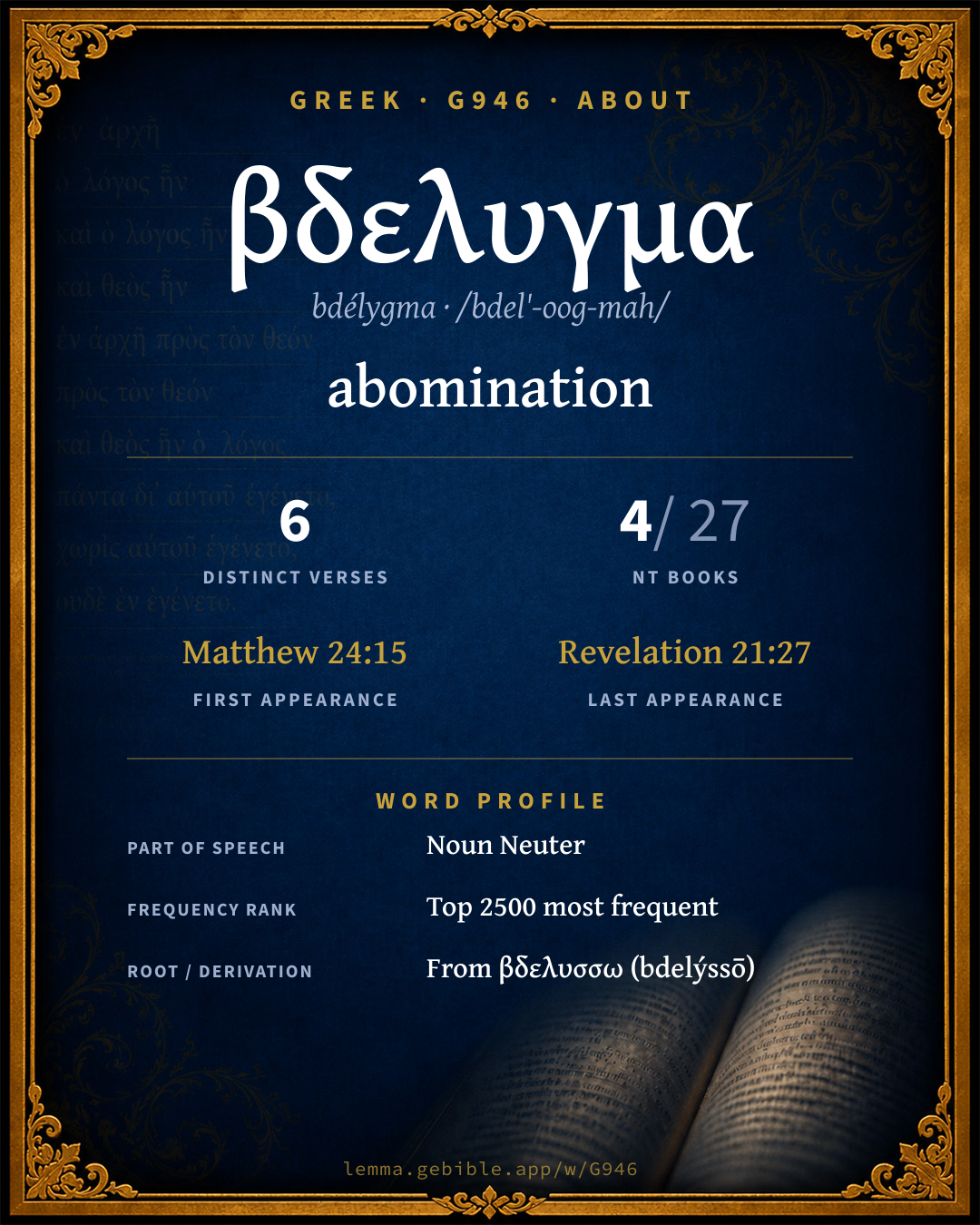
βδέλυγμα
abomination
Full lexicon entry — Thayer's Greek Lexicon
From Thayer's Greek Lexicon
Where this word appears
Grammar key — what these labels mean
Part of speech
- Noun
- A naming word — a person, place, thing, or idea.
Case
- Accusative
- The case of the direct object and of extent.
- Genitive
- The case of source, possession, or “of” — answers “whose / from what.”
- Nominative
- The case of the subject (and the predicate nominative).
Gender
- Neuter
- Grammatically neuter.
Number
- Singular
- One.
- Plural
- More than one.
Every verse where G946 appears in the Book of Mark — 1 distinct verse. Click any verse to open its interlinear word-by-word view. Verse text shown in the World English Bible for context — . Each verse’s Greek form is shown with its reference; the English is not keyword-highlighted, since the data carries no word-level English alignment. Use “Compare translations” on any verse to read it across multiple English versions. This concordance covers the Greek New Testament; Septuagint (Greek Old Testament) occurrences of this word are not indexed here.
Mark
About this entry
At a glance — auto-summarized from this page’s data, not written by a person. Every figure links to its source below. This summary describes the numbers; it doesn’t interpret them.
“abomination” is the headline sense of the Greek noun βδελυγμα (bdélygma). More than half of its appearances fall in Revelation. It appears 6 verses across 4 books of the Greek New Testament, among its uncommon vocabulary. Scripture first uses it in Matthew 24:15. It shares a root with βδελυσσω and βδελυκτος. See the sense tree, 6-verse concordance, and the renderings breakdown below.
Gloss history
Strong's 1890 vs modern scholarship
About this word
Strong's G946 catalogs a Greek word from the Greek New Testament.
These counts are not copied from any lexicon or concordance. They are computed here, from the morphology-tagged Greek New Testament. What Lemma adds →
- 6
- distinct verses
- The word appears in 6 distinct verses.
- 4 / 27
- NT books
- The word appears in 4 of 27 New Testament books.
- #1,476
- by frequency
- Top 2500 most frequent Greek words (rank 1,476 of 5,347 Greek words by occurrence).
View all 6 occurrences in the concordance →
Most concentrated in
- Revelation 3 verses 50%
- Matthew 1 verse 17%
- Mark 1 verse 17%
By section of the New Testament
By traditional corpus
Conventional, traditional groupings — biblical authorship is debated, so this is a traditional corpus grouping, not an authorship claim. Some books belong to more than one corpus (Luke is in both the Gospels and the Lukan corpus, and so on), so these shares overlap and need not total 100%. Each figure is a share of the word’s 6 distinct verses.
- Gospels 3 verses · 50%
- Johannine 3 verses · 50%
- Revelation 3 verses · 50%
- Lukan (Luke–Acts) 1 verse · 17%
How translations render this word
Counts come from each version’s own published word-to-Strong’s tagging or interlinear alignment — an approximate guide to how each version renders this word, not a word-level alignment the data otherwise carries. Because each total is that version’s own tagged count, the per-version totals vary from one another and need not match the appearance or distinct-verse counts above. These counts may also differ from a printed concordance because Lemma counts each distinctly tagged rendering and does not collapse phrase taggings into a single head-word total. This is a fixed set of word-tagged versions (KJV, ASV, BSB, ULT) and does not change with the reading translation you choose elsewhere. Each version’s license is shown beside its name below (and on Sources).
- King James Version: Abomination 4×, Abominations 2×
- American Standard Version: Abomination 4×, Abominations 2×
- Berean Standard Bible: Abomination 3×, Abominations 2×
- unfoldingWord Literal Text: Abomination 3×, Abominations 2×
King James Version Public Domain
Renders G946 across 6 tagged occurrences — most commonly:
American Standard Version Public Domain
Renders G946 across 7 tagged occurrences — most commonly:
Plus 1 rendering that appears only once — usually multi-word phrases or single function words the recovered tagging swept in, not distinct renderings.
Berean Standard Bible Public Domain
Renders G946 across 6 tagged occurrences — most commonly:
Plus 1 rendering that appears only once — usually multi-word phrases or single function words the recovered tagging swept in, not distinct renderings.
unfoldingWord Literal Text CC BY-SA 4.0
Renders G946 across 6 tagged occurrences — most commonly:
Plus 1 rendering that appears only once — usually multi-word phrases or single function words the recovered tagging swept in, not distinct renderings.
Senses in Thayer's
The 1 sense Thayer's distinguishes for this word, in lexicon order (not ranked by frequency or importance). The full entry — with sub-senses — is in the Lexicon Entry tab.
- a foul thing, a detestable thing
Word origin
Derived from βδελυσσω (bdelýssō) (G948) — to abhor.
From G948 ; a detestation that is (specifically) idolatry : - abomination.
— Strong’s Exhaustive Concordance (1890), public domain.
Forms in the corpus
The 2 distinct written forms G946 takes in the Greek New Testament, most frequent first — each parse links to that case’s occurrences in the concordance.
| Form | Parsing | Example | Uses |
|---|---|---|---|
| βδέλυγμα bdélygma | Noun, Accusative, Singular, Neuter | Matthew 24:15 | 4 |
| βδελυγμάτων bdelygmátōn | Noun, Genitive, Plural, Neuter | Revelation 17:4 | 2 |
Same root — word family
Other Thayer's entries built from the same root as G946, grouped by Strong’s listed origin. These share a root / origin per the lexicon — not necessarily a shared meaning. Each links to that word’s own entry.
Derives from
Shares the same root
Compare all same-root words → They share a root, not necessarily a meaning.
Septuagint usage
The same Greek word βδελυγμα appears 104 times in the Greek Old Testament (Septuagint), across 100 verses in 15 books.
- 104
- LXX occurrences
- Tagged occurrences of this Greek word in the Septuagint.
- 100
- verses
- Distinct Septuagint verses containing this word.
- 15 / 39
- OT books
- The word appears in 15 of the 39 Old Testament books.
Sample Septuagint occurrences
- Genesis 43:32 βδέλυγμα
- Exodus 8:22 βδέλυγμα
- Leviticus 5:2 βδέλυγμα
- Deuteronomy 7:25 βδέλυγμα
- 1 Kings 11:6 βδέλυγμα
- 2 Kings 16:3 βδέλυγμα
- 2 Chronicles 15:8 βδέλυγμα
- Psalms 87:9 βδέλυγμα
- Proverbs 11:1 βδέλυγμα
- Isaiah 1:13 βδέλυγμα
- Jeremiah 2:7 βδέλυγμα
- Ezekiel 5:9 βδέλυγμα
Septuagint occurrences (same lexeme)
Every verse where the same Strong’s number (G946) appears in the Greek Septuagint — showing the first 50 of 100. Verse text shown in the World English Bible for context; the Greek form is the matched word — the English is not keyword-highlighted.
- Genesis 43:32 βδέλυγμα They served him by himself, and them by themselves, and the Egyptians, that ate with him, by themselves, because the Egyptians don't eat bread with the Hebrews, for that is an abomination to the Egyptians.
- Genesis 46:34 βδέλυγμα that you shall say, 'Your servants have been keepers of cattle from our youth even until now, both we, and our fathers:' that you may dwell in the land of Goshen; for every shepherd is an abomination to the Egyptians."
- Exodus 8:22 βδέλυγμα I will set apart in that day the land of Goshen, in which my people dwell, that no swarms of flies shall be there; to the end you may know that I am Yahweh in the midst of the earth.
- Leviticus 5:2 βδέλυγμα "'Or if anyone touches any unclean thing, whether it is the carcass of an unclean animal, or the carcass of unclean cattle, or the carcass of unclean creeping things, and it is hidden from him, and he is unclean, then he shall be guilty.
- Leviticus 7:21 βδέλυγμα When anyone touches any unclean thing, the uncleanness of man, or an unclean animal, or any unclean abomination, and eats some of the flesh of the sacrifice of peace offerings, which belong to Yahweh, that soul shall be cut off from his people.'"
- Leviticus 11:10 βδέλυγμα All that don't have fins and scales in the seas, and in the rivers, of all that move in the waters, and of all the living creatures that are in the waters, they are an abomination to you,
- Leviticus 11:11 βδέλυγμα and you detest them. You shall not eat of their flesh, and you shall detest their carcasses.
- Leviticus 11:12 βδέλυγμα Whatever has no fins nor scales in the waters, that is an abomination to you.
- Leviticus 11:13 βδέλυγμα "'These you shall detest among the birds; they shall not be eaten, they are an abomination: the eagle, and the vulture, and the black vulture,
- Leviticus 11:20 βδέλυγμα "'All flying insects that walk on all fours are an abomination to you.
- Leviticus 11:23 βδέλυγμα But all winged creeping things which have four feet, are an abomination to you.
- Leviticus 11:41 βδέλυγμα "'Every creeping thing that creeps on the earth is an abomination. It shall not be eaten.
- Leviticus 11:42 βδέλυγμα Whatever goes on its belly, and whatever goes on all fours, or whatever has many feet, even all creeping things that creep on the earth, them you shall not eat; for they are an abomination.
- Leviticus 18:22 βδέλυγμα "'You shall not lie with a man, as with a woman. That is detestible.
- Leviticus 18:26 βδέλυγμα You therefore shall keep my statutes and my ordinances, and shall not do any of these abominations; neither the native-born, nor the stranger who lives as a foreigner among you;
- Leviticus 18:27 βδέλυγμα (for all these abominations have the men of the land done, that were before you, and the land became defiled);
- Leviticus 18:29 βδέλυγμα "'For whoever shall do any of these abominations, even the souls that do them shall be cut off from among their people.
- Leviticus 20:13 βδέλυγμα If a man lies with a male, as with a woman, both of them have committed an abomination: they shall surely be put to death; their blood shall be upon them.
- Deuteronomy 7:25 βδέλυγμα The engraved images of their gods shall you burn with fire: you shall not covet the silver or the gold that is on them, nor take it to you, lest you be snared therein; for it is an abomination to Yahweh your God.
- Deuteronomy 7:26 βδέλυγμα You shall not bring an abomination into your house, and become a devoted thing like it: you shall utterly detest it, and you shall utterly abhor it; for it is a devoted thing.
- Deuteronomy 12:31 βδέλυγμα You shall not do so to Yahweh your God: for every abomination to Yahweh, which he hates, have they done to their gods; for even their sons and their daughters do they burn in the fire to their gods.
- Deuteronomy 13:15 βδέλυγμα you shall surely strike the inhabitants of that city with the edge of the sword, destroying it utterly, and all that is therein and the cattle of it, with the edge of the sword.
- Deuteronomy 14:3 βδέλυγμα You shall not eat any abominable thing.
- Deuteronomy 17:1 βδέλυγμα You shall not sacrifice to Yahweh your God an ox, or a sheep, in which is a blemish, [or] anything evil; for that is an abomination to Yahweh your God.
- Deuteronomy 17:4 βδέλυγμα and it be told you, and you have heard of it, then shall you inquire diligently; and, behold, if it be true, and the thing certain, that such abomination is done in Israel,
- Deuteronomy 18:9 βδέλυγμα When you are come into the land which Yahweh your God gives you, you shall not learn to do after the abominations of those nations.
- Deuteronomy 18:12 βδέλυγμα For whoever does these things is an abomination to Yahweh: and because of these abominations Yahweh your God does drive them out from before you.
- Deuteronomy 20:18 βδέλυγμα that they not teach you to do after all their abominations, which they have done to their gods; so would you sin against Yahweh your God.
- Deuteronomy 22:5 βδέλυγμα A woman shall not wear men's clothing, neither shall a man put on women's clothing; for whoever does these things is an abomination to Yahweh your God.
- Deuteronomy 23:19 βδέλυγμα You shall not lend on interest to your brother; interest of money, interest of food, interest of anything that is lent on interest:
- Deuteronomy 24:4 βδέλυγμα her former husband, who sent her away, may not take her again to be his wife, after that she is defiled; for that is abomination before Yahweh: and you shall not cause the land to sin, which Yahweh your God gives you for an inheritance.
- Deuteronomy 25:16 βδέλυγμα For all who do such things, [even] all who do unrighteously, are an abomination to Yahweh your God.
- Deuteronomy 27:15 βδέλυγμα Cursed be the man who makes an engraved or molten image, an abomination to Yahweh, the work of the hands of the craftsman, and sets it up in secret. All the people shall answer and say, Amen.
- Deuteronomy 29:16 βδέλυγμα (for you know how we lived in the land of Egypt, and how we came through the midst of the nations through which you passed;
- Deuteronomy 32:16 βδέλυγμα They moved him to jealousy with strange [gods]; With abominations provoked they him to anger.
- 1 Kings 11:6 βδέλυγμα Solomon did that which was evil in the sight of Yahweh, and didn't go fully after Yahweh, as did David his father.
- 1 Kings 11:33 βδέλυγμα because that they have forsaken me, and have worshiped Ashtoreth the goddess of the Sidonians, Chemosh the god of Moab, and Milcom the god of the children of Ammon; and they have not walked in my ways, to do that which is right in my eyes, and [to keep] my statutes and my ordinances, as did David his father.
- 1 Kings 14:4 βδέλυγμα Jeroboam's wife did so, and arose, and went to Shiloh, and came to the house of Ahijah. Now Ahijah could not see; for his eyes were set by reason of his age.
- 1 Kings 20:26 βδέλυγμα It happened at the return of the year, that Ben Hadad mustered the Syrians, and went up to Aphek, to fight against Israel.
- 2 Kings 16:3 βδέλυγμα But he walked in the way of the kings of Israel, yes, and made his son to pass through the fire, according to the abominations of the nations, whom Yahweh cast out from before the children of Israel.
- 2 Kings 17:32 βδέλυγμα So they feared Yahweh, and made to them from among themselves priests of the high places, who sacrificed for them in the houses of the high places.
- 2 Kings 21:2 βδέλυγμα He did that which was evil in the sight of Yahweh, after the abominations of the nations whom Yahweh cast out before the children of Israel.
- 2 Kings 21:11 βδέλυγμα Because Manasseh king of Judah has done these abominations, and has done wickedly above all that the Amorites did, who were before him, and has made Judah also to sin with his idols;
- 2 Kings 23:13 βδέλυγμα The high places that were before Jerusalem, which were on the right hand of the mountain of corruption, which Solomon the king of Israel had built for Ashtoreth the abomination of the Sidonians, and for Chemosh the abomination of Moab, and for Milcom the abomination of the children of Ammon, did the king defile.
- 2 Chronicles 15:8 βδέλυγμα When Asa heard these words, and the prophecy of Oded the prophet, he took courage, and put away the abominations out of all the land of Judah and Benjamin, and out of the cities which he had taken from the hill-country of Ephraim; and he renewed the altar of Yahweh, that was before the porch of Yahweh.
- 2 Chronicles 28:3 βδέλυγμα Moreover he burnt incense in the valley of the son of Hinnom, and burnt his children in the fire, according to the abominations of the nations whom Yahweh cast out before the children of Israel.
- 2 Chronicles 33:2 βδέλυγμα He did that which was evil in the sight of Yahweh, after the abominations of the nations whom Yahweh cast out before the children of Israel.
- 2 Chronicles 34:33 βδέλυγμα Josiah took away all the abominations out of all the countries that pertained to the children of Israel, and made all who were found in Israel to serve, even to serve Yahweh their God. All his days they didn't depart from following Yahweh, the God of their fathers.
- 2 Chronicles 36:14 βδέλυγμα Moreover all the chiefs of the priests, and the people, trespassed very greatly after all the abominations of the nations; and they polluted the house of Yahweh which he had made holy in Jerusalem.
- Psalms 87:9 βδέλυγμα
These are occurrences of the same Greek lexeme (G946) in the Septuagint — not a translation of any one Hebrew word. The store carries no word-level Hebrew↔Greek alignment, so no Hebrew original is asserted here. Counts come from the recovered LXX Strong's tagging — high-frequency vocabulary is well covered, while rare or late forms may be untagged — so they reflect tagged occurrences and may slightly undercount.