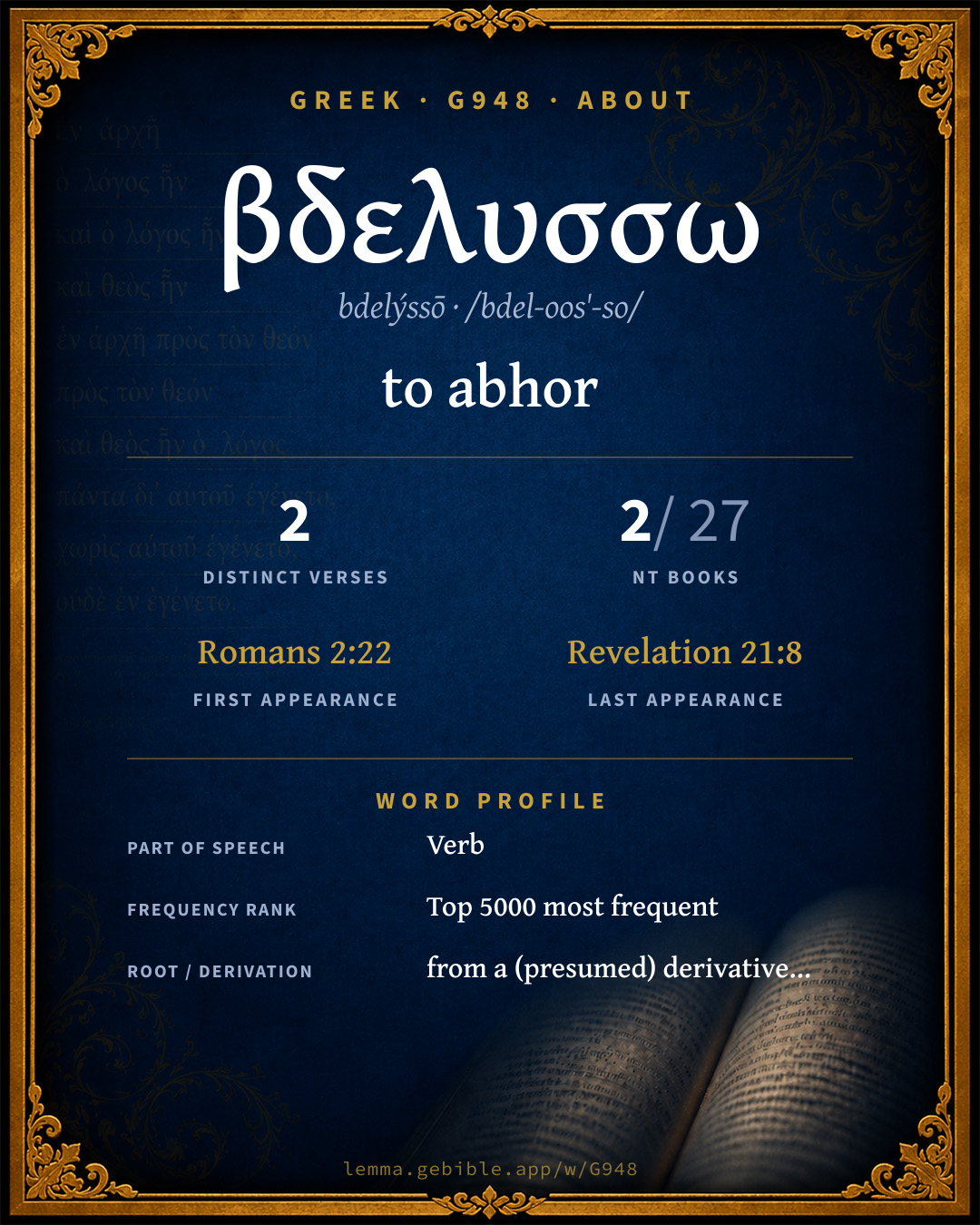
βδελύσσω
to abhor
‘to abhor’ is one of 4 main senses fuller range ↓
Full lexicon entry — Thayer's Greek Lexicon
From Thayer's Greek Lexicon
Where this word appears
See every Perfect-tense verb in the Greek New Testament →
Grammar key — what these labels mean
Part of speech
- Verb
- An action or state-of-being word.
Tense
- Present
- Ongoing or general action in present time (imperfective aspect).
- Perfect
- A completed past action with continuing present results.
Voice
- Middle or Passive deponent
- Middle/passive in form but active in meaning.
- Passive
- The subject receives the action.
Mood
- Participle
- A verbal adjective (“writing,” “having written”).
Case
- Nominative
- The case of the subject (and the predicate nominative).
- Dative
- The case of the indirect object, means, or location — “to / for / with / in.”
Gender
- Masculine
- Grammatically masculine.
Number
- Singular
- One.
- Plural
- More than one.
Grammatical forms
- Verb, Present, Middle or Passive deponent, Participle, Nominative, Singular, Masculine 1 time (50%)
- Verb, Perfect, Passive, Participle, Dative, Plural, Masculine 1 time (50%)
Parsed forms decoded from the imported morphology (Robinson–Tischendorf, public domain), counted across 2 parsed occurrences — not distinct verses.
Every verse where G948 appears — 2 distinct verses across 2 books. Click any verse to open its interlinear word-by-word view. Verse text shown in the World English Bible for context — . Each verse’s Greek form is shown with its reference; the English is not keyword-highlighted, since the data carries no word-level English alignment. Use “Compare translations” on any verse to read it across multiple English versions. This concordance covers the Greek New Testament; Septuagint (Greek Old Testament) occurrences of this word are not indexed here.
Romans 1 verse
Revelation 1 verse
About this entry
At a glance — auto-summarized from this page’s data, not written by a person. Every figure links to its source below. This summary describes the numbers; it doesn’t interpret them.
“to abhor” is the headline sense of the Greek verb βδελυσσω (bdelýssō). A scarce word — 2 verses in all of the Greek New Testament. It clusters heavily in Romans, which alone accounts for 50% of its uses. First canonically at Romans 2:22, it enters the text early. Lexicons map it across 4 senses. The sections below give every sense, occurrence, and version rendering.
Gloss history
Strong's 1890 vs modern scholarship
About this word
Strong's G948 catalogs a Greek word from the Greek New Testament.
These counts are not copied from any lexicon or concordance. They are computed here, from the morphology-tagged Greek New Testament. What Lemma adds →
- 2
- distinct verses
- The word appears in 2 distinct verses.
- 2 / 27
- NT books
- The word appears in 2 of 27 New Testament books.
- #2,678
- by frequency
- Top 5000 most frequent Greek words (rank 2,678 of 5,347 Greek words by occurrence).
View all 2 occurrences in the concordance →
Most concentrated in
- Romans 1 verse 50%
- Revelation 1 verse 50%
By section of the New Testament
By traditional corpus
Conventional, traditional groupings — biblical authorship is debated, so this is a traditional corpus grouping, not an authorship claim. Some books belong to more than one corpus (Luke is in both the Gospels and the Lukan corpus, and so on), so these shares overlap and need not total 100%. Each figure is a share of the word’s 2 distinct verses.
- Johannine 1 verse · 50%
- Pauline corpus 1 verse · 50%
- Revelation 1 verse · 50%
How translations render this word
Counts come from each version’s own published word-to-Strong’s tagging or interlinear alignment — an approximate guide to how each version renders this word, not a word-level alignment the data otherwise carries. Because each total is that version’s own tagged count, the per-version totals vary from one another and need not match the appearance or distinct-verse counts above. These counts may also differ from a printed concordance because Lemma counts each distinctly tagged rendering and does not collapse phrase taggings into a single head-word total. This is a fixed set of word-tagged versions (KJV, ASV, BSB, ULT) and does not change with the reading translation you choose elsewhere. Each version’s license is shown beside its name below (and on Sources).
- King James Version: Abominable 1×, Thou that abhorrest 1×
- American Standard Version: Abominable 1×, Thou that abhorrest 1×
- Berean Standard Bible: Abhor 1×, Abominable 1×
- unfoldingWord Literal Text: Abhorred 1×, Abhorring 1×
King James Version Public Domain
Renders G948 across 2 tagged occurrences — most commonly:
American Standard Version Public Domain
Renders G948 across 2 tagged occurrences — most commonly:
Berean Standard Bible Public Domain
Renders G948 across 2 tagged occurrences — most commonly:
unfoldingWord Literal Text CC BY-SA 4.0
Renders G948 across 2 tagged occurrences — most commonly:
Senses in Thayer's
The 4 senses Thayer's distinguishes for this word, in lexicon order (not ranked by frequency or importance). The full entry — with sub-senses — is in the Lexicon Entry tab.
- to render foul, to cause to be abhorred
- abominable
- to turn one's self away from on account of the stench
- metaph. to abhor, detest
Word origin
Origin: from a (presumed) derivative of bdeo (to stink)
From a (presumed) derivative of βδέω bdeō (to stink ); to be disgusted that is (by implication) detest (especially of idolatry): - abhor abominable.
— Strong’s Exhaustive Concordance (1890), public domain.
Forms in the corpus
The 2 distinct written forms G948 takes in the Greek New Testament, most frequent first — each parse links to that tense’s occurrences in the concordance.
| Form | Parsing | Example | Uses |
|---|---|---|---|
| βδελυσσόμενος bdelyssómenos | Verb, Present, Middle or Passive deponent, Participle, Nominative, Singular, Masculine | Romans 2:22 | 1 |
| ἐβδελυγμένοις ebdelygménois | Verb, Perfect, Passive, Participle, Dative, Plural, Masculine | Revelation 21:8 | 1 |
Same root — word family
Other Thayer's entries built from the same root as G948, grouped by Strong’s listed origin. These share a root / origin per the lexicon — not necessarily a shared meaning. Each links to that word’s own entry.
Derived from this word
Compare all same-root words → They share a root, not necessarily a meaning.
Septuagint usage
The same Greek word βδελυσσω appears 34 times in the Greek Old Testament (Septuagint), across 33 verses in 12 books.
- 34
- LXX occurrences
- Tagged occurrences of this Greek word in the Septuagint.
- 33
- verses
- Distinct Septuagint verses containing this word.
- 12 / 39
- OT books
- The word appears in 12 of the 39 Old Testament books.
Sample Septuagint occurrences
- Genesis 26:29 βδελύσσω
- Exodus 1:12 βδελύσσω
- Leviticus 11:11 βδελύσσω
- Deuteronomy 7:26 βδελύσσω
- 1 Kings 20:26 βδελύσσω
- Job 9:31 βδελύσσω
- Psalms 5:7 βδελύσσω
- Proverbs 28:9 βδελύσσω
- Isaiah 14:19 βδελύσσω
- Hosea 9:10 βδελύσσω
- Amos 5:10 βδελύσσω
- Micah 3:9 βδελύσσω
Septuagint occurrences (same lexeme)
Every verse where the same Strong’s number (G948) appears in the Greek Septuagint. Verse text shown in the World English Bible for context; the Greek form is the matched word — the English is not keyword-highlighted.
- Genesis 26:29 βδελύσσω that you will do us no harm, as we have not touched you, and as we have done to you nothing but good, and have sent you away in peace.' You are now the blessed of Yahweh."
- Exodus 1:12 βδελύσσω But the more they afflicted them, the more they multiplied and the more they spread out. They were grieved because of the children of Israel.
- Exodus 5:21 βδελύσσω and they said to them, "May Yahweh look at you, and judge, because you have made us a stench to be abhorred in the eyes of Pharaoh, and in the eyes of his servants, to put a sword in their hand to kill us."
- Leviticus 11:11 βδελύσσω and you detest them. You shall not eat of their flesh, and you shall detest their carcasses.
- Leviticus 11:13 βδελύσσω "'These you shall detest among the birds; they shall not be eaten, they are an abomination: the eagle, and the vulture, and the black vulture,
- Leviticus 11:43 βδελύσσω You shall not make yourselves abominable with any creeping thing that creeps, neither shall you make yourselves unclean with them, that you should be defiled thereby.
- Leviticus 18:30 βδελύσσω Therefore you shall keep my charge, that you do not practice any of these abominable customs, which were practiced before you, and that you do not defile yourselves with them: I am Yahweh your God.'"
- Leviticus 20:23 βδελύσσω You shall not walk in the customs of the nation, which I am casting out before you: for they did all these things, and therefore I abhorred them.
- Leviticus 20:25 βδελύσσω "'You shall therefore make a distinction between the clean animal and the unclean, and between the unclean fowl and the clean: and you shall not make yourselves abominable by animal, or by bird, or by anything with which the ground teems, which I have separated from you as unclean for you.
- Leviticus 26:11 βδελύσσω I will set my tent among you: and my soul won't abhor you.
- Deuteronomy 7:26 βδελύσσω You shall not bring an abomination into your house, and become a devoted thing like it: you shall utterly detest it, and you shall utterly abhor it; for it is a devoted thing.
- Deuteronomy 23:8 βδελύσσω The children of the third generation who are born to them shall enter into the assembly of Yahweh.
- 1 Kings 20:26 βδελύσσω It happened at the return of the year, that Ben Hadad mustered the Syrians, and went up to Aphek, to fight against Israel.
- Job 9:31 βδελύσσω Yet you will plunge me in the ditch. My own clothes shall abhor me.
- Job 15:16 βδελύσσω How much less one who is abominable and corrupt, A man who drinks iniquity like water!
- Job 19:19 βδελύσσω All my familiar friends abhor me. They whom I loved have turned against me.
- Job 30:10 βδελύσσω They abhor me, they stand aloof from me, And don't hesitate to spit in my face.
- Psalms 5:7 βδελύσσω But as for me, in the abundance of your loving kindness I will come into your house: I will bow toward your holy temple in reverence of you.
- Psalms 13:1 βδελύσσω How long, Yahweh? Will you forget me forever? How long will you hide your face from me?
- Psalms 37:21 βδελύσσω The wicked borrow, and don't pay back, But the righteous give generously.
- Psalms 52:2 βδελύσσω Your tongue plots destruction, Like a sharp razor, working deceitfully.
- Psalms 55:6 βδελύσσω I said, "Oh that I had wings like a dove! Then I would fly away, and be at rest.
- Psalms 105:40 βδελύσσω They asked, and he brought quails, And satisfied them with the bread of the sky.
- Psalms 106:18 βδελύσσω A fire was kindled in their company. The flame burned up the wicked.
- Psalms 118:163 βδελύσσω
- Proverbs 28:9 βδελύσσω He who turns away his ear from hearing the law, Even his prayer is an abomination.
- Isaiah 14:19 βδελύσσω But you are cast forth away from your tomb like an abominable branch, clothed with the slain, who are thrust through with the sword, who go down to the stones of the pit; as a dead body trodden under foot.
- Isaiah 49:7 βδελύσσω Thus says Yahweh, the Redeemer of Israel, [and] his Holy One, to him whom man despises, to him whom the nation abhors, to a servant of rulers: Kings shall see and arise; princes, and they shall worship; because of Yahweh who is faithful, [even] the Holy One of Israel, who has chosen you.
- Isaiah 66:5 βδελύσσω Hear the word of Yahweh, you who tremble at his word: Your brothers who hate you, who cast you out for my name's sake, have said, Let Yahweh be glorified, that we may see your joy; but it is those who shall be disappointed.
- Hosea 9:10 βδελύσσω I found Israel like grapes in the wilderness. I saw your fathers as the first ripe in the fig tree at its first season; But they came to Baal Peor, and consecrated themselves to the shameful thing, And became abominable like that which they loved.
- Amos 5:10 βδελύσσω They hate him who reproves in the gate, And they abhor him who speaks blamelessly.
- Amos 6:8 βδελύσσω "The Lord Yahweh has sworn by himself," says Yahweh, the God of hosts: "I abhor the pride of Jacob, And detest his fortresses. Therefore I will deliver up the city with all that is in it.
- Micah 3:9 βδελύσσω Please listen to this, you heads of the house of Jacob, And rulers of the house of Israel, Who abhor justice, And pervert all equity.
These are occurrences of the same Greek lexeme (G948) in the Septuagint — not a translation of any one Hebrew word. The store carries no word-level Hebrew↔Greek alignment, so no Hebrew original is asserted here. Counts come from the recovered LXX Strong's tagging — high-frequency vocabulary is well covered, while rare or late forms may be untagged — so they reflect tagged occurrences and may slightly undercount.