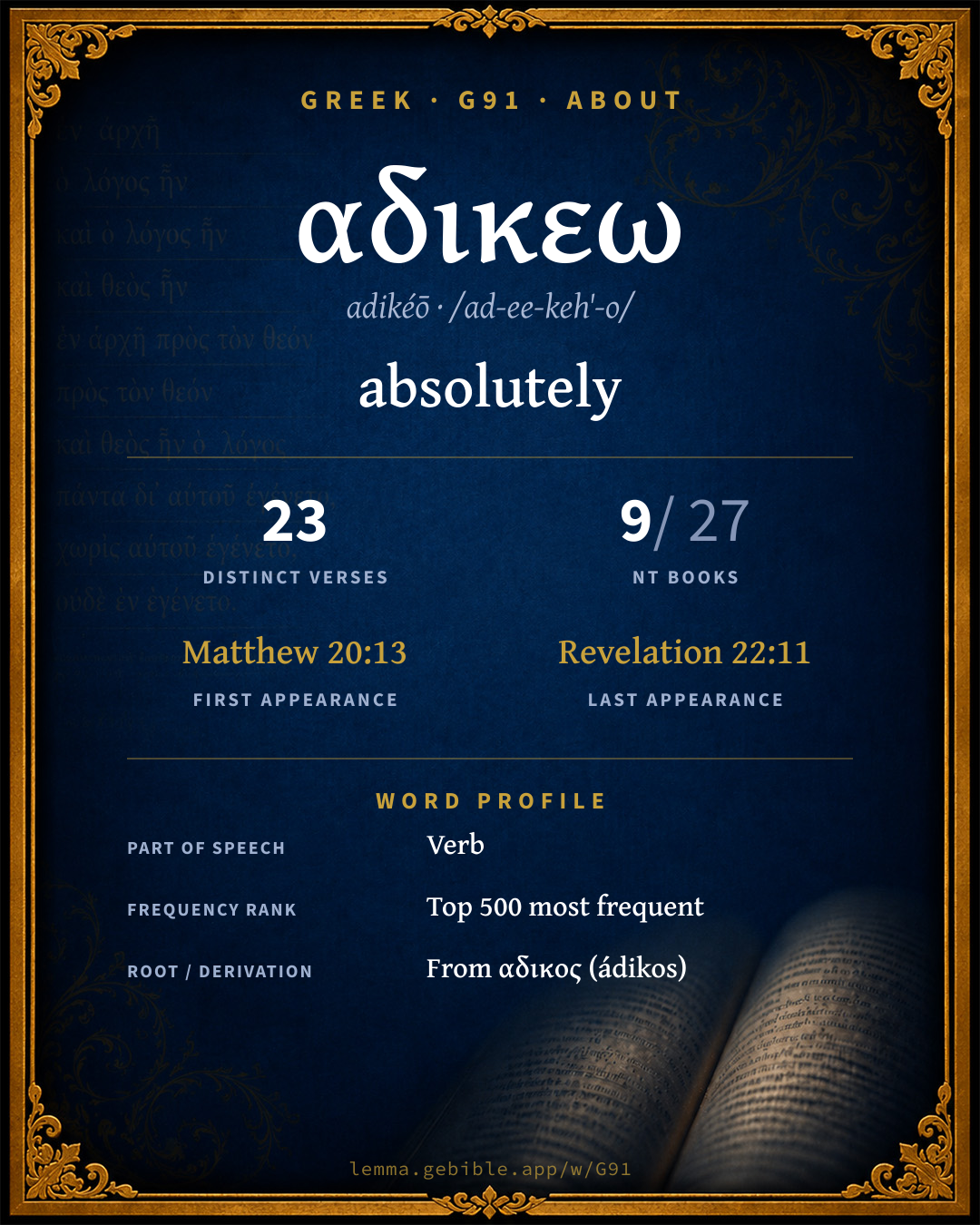
ἀδικέω
absolutely
‘absolutely’ is one of 2 main senses fuller range ↓
Full lexicon entry — Thayer's Greek Lexicon
From Thayer's Greek Lexicon
Where this word appears
See every Aorist-tense verb in the Greek New Testament →
Grammar key — what these labels mean
Part of speech
- Verb
- An action or state-of-being word.
Tense
- Aorist
- Action viewed as a simple whole, without regard to duration — often past (perfective aspect).
- Present
- Ongoing or general action in present time (imperfective aspect).
- Future
- Action expected in future time.
- Perfect
- A completed past action with continuing present results.
Voice
- Active
- The subject performs the action.
- Passive
- The subject receives the action.
Mood
- Infinitive
- A verbal noun (“to write”), unmarked for person or number.
- Participle
- A verbal adjective (“writing,” “having written”).
- Indicative
- States a fact or asks a factual question (the mood of reality).
- Imperative
- Expresses a command or request.
- Subjunctive
- Expresses probability, purpose, or possibility (the mood of contingency).
Case
- Nominative
- The case of the subject (and the predicate nominative).
- Genitive
- The case of source, possession, or “of” — answers “whose / from what.”
- Accusative
- The case of the direct object and of extent.
Person
- 3rd person
- The one spoken about (“he / she / it / they”).
- 1st person
- The speaker (“I / we”).
- 2nd person
- The one addressed (“you”).
Gender
- Masculine
- Grammatically masculine.
Number
- Singular
- One.
- Plural
- More than one.
Grammatical forms 19 distinct
- Verb, Aorist, Active, Infinitive 4 times (15%)
- Verb, Present, Active, Participle, Nominative, Singular, Masculine 3 times (11%)
- Verb, Aorist, Active, Indicative, 3rd person, Singular 2 times (7%)
- Verb, Present, Active, Indicative, 1st person, Singular 2 times (7%)
- Verb, Present, Active, Indicative, 2nd person, Plural 2 times (7%)
- Verb, Aorist, Active, Indicative, 1st person, Plural 1 time (4%)
- Verb, Aorist, Active, Indicative, 2nd person, Plural 1 time (4%)
- Verb, Aorist, Active, Imperative, 3rd person, Singular 1 time (4%)
+11 more forms (11 occurrences)
Parsed forms decoded from the imported morphology (Robinson–Tischendorf, public domain), counted across 27 parsed occurrences — not distinct verses.
Every verse where G91 appears — 23 distinct verses across 9 books. Click any verse to open its interlinear word-by-word view. Verse text shown in the World English Bible for context — . Each verse’s Greek form is shown with its reference; the English is not keyword-highlighted, since the data carries no word-level English alignment. Use “Compare translations” on any verse to read it across multiple English versions. This concordance covers the Greek New Testament; Septuagint (Greek Old Testament) occurrences of this word are not indexed here.
Matthew 1 verse
Luke 1 verse
Acts 5 verses
- Acts 7:24 ἀδικούμενον pres pass ptcp acc sg masc Seeing one of them suffer wrong, he defended him, and avenged him who was oppressed, striking the Egyptian.
- Acts 7:26 ἀδικεῖτε pres act ind 2pl "The day following, he appeared to them as they fought, and urged them to be at peace again, saying, 'Sirs, you are brothers. Why do you wrong one another?'
- Acts 7:27 ἀδικῶν pres act ptcp nom sg masc But he who did his neighbor wrong pushed him away, saying, 'Who made you a ruler and a judge over us?
- Acts 25:10 ἠδίκηκα perf act ind 1sg But Paul said, "I am standing before Caesar's judgment seat, where I ought to be tried. I have done no wrong to the Jews, as you also know very well.
- Acts 25:11 ἀδικῶ pres act ind 1sg For if I have done wrong, and have committed anything worthy of death, I don't refuse to die; but if none of those things is true that they accuse me of, no one can give me up to them. I appeal to Caesar!"
1 Corinthians 2 verses
- 1 Corinthians 6:7 ἀδικεῖσθε pres pass ind 2pl Therefore it is already altogether a defect in you, that you have lawsuits one with another. Why not rather be wronged? Why not rather be defrauded?
- 1 Corinthians 6:8 ἀδικεῖτε pres act ind 2pl No, but you yourselves do wrong, and defraud, and that against your brothers.
2 Corinthians 2 verses
- 2 Corinthians 7:2 ἠδικήσαμεν aor act ind 1pl Open your hearts to us. We wronged no one. We corrupted no one. We took advantage of no one.
- 2 Corinthians 7:12 ἀδικήσαντος ἀδικηθέντος aor act ptcp gen sg masc aor pass ptcp gen sg masc So although I wrote to you, I wrote not for his cause that did the wrong, nor for his cause that suffered the wrong, but that your earnest care for us might be revealed in you in the sight of God.
Galatians 1 verse
Colossians 1 verse
Philemon 1 verse
Revelation 9 verses
- Revelation 2:11 ἀδικηθῇ aor pass subj 3sg He who has an ear, let him hear what the Spirit says to the assemblies. He who overcomes won't be harmed by the second death.
- Revelation 6:6 ἀδικήσῃς aor act subj 2sg I heard a voice in the midst of the four living creatures saying, "A choenix of wheat for a denarius, and three choenix of barley for a denarius! Don't damage the oil and the wine!"
- Revelation 7:2 ἀδικῆσαι aor act inf I saw another angel ascend from the sunrise, having the seal of the living God. He cried with a loud voice to the four angels to whom it was given to harm the earth and the sea,
- Revelation 7:3 ἀδικήσητε aor act subj 2pl saying, "Don't harm the earth, neither the sea, nor the trees, until we have sealed the bondservants of our God on their foreheads!"
- Revelation 9:4 ἀδικήσουσιν fut act ind 3pl They were told that they should not hurt the grass of the earth, neither any green thing, neither any tree, but only those people who don't have God's seal on their foreheads.
- Revelation 9:10 ἀδικῆσαι aor act inf They have tails like those of scorpions, and stings. In their tails they have power to harm men for five months.
- Revelation 9:19 ἀδικοῦσιν pres act ind 3pl For the power of the horses is in their mouths, and in their tails. For their tails are like serpents, and have heads, and with them they harm.
- Revelation 11:5 ἀδικῆσαι ἀδικῆσαι aor act inf aor act inf If anyone desires to harm them, fire proceeds out of their mouth and devours their enemies. If anyone desires to harm them, he must be killed in this way.
- Revelation 22:11 ἀδικῶν ἀδικησάτω pres act ptcp nom sg masc aor act impv 3sg He who acts unjustly, let him act unjustly still. He who is filthy, let him be filthy still. He who is righteous, let him do righteousness still. He who is holy, let him be holy still."
About this entry
At a glance — auto-summarized from this page’s data, not written by a person. Every figure links to its source below. This summary describes the numbers; it doesn’t interpret them.
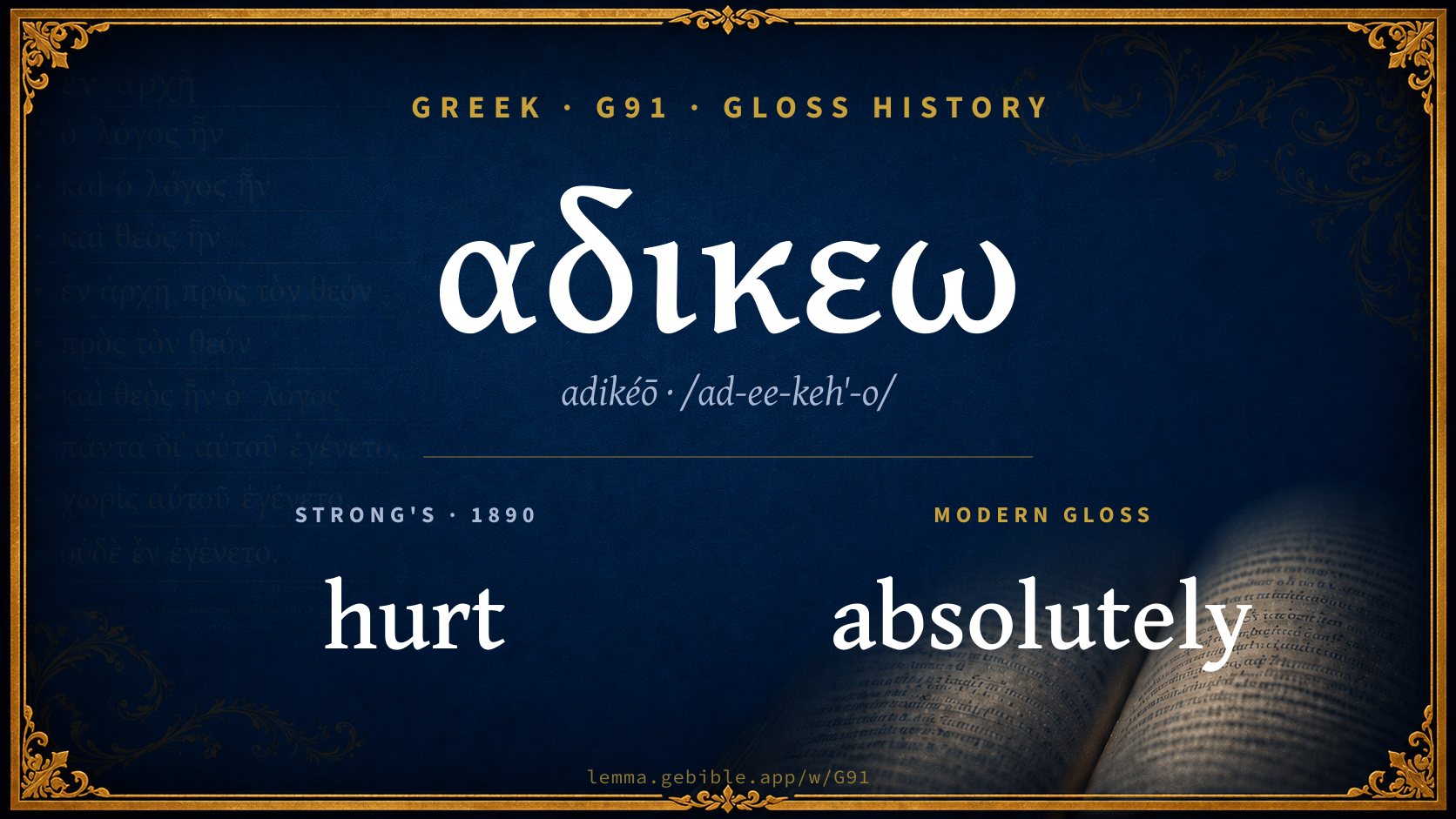
“absolutely” is the headline sense of the Greek verb αδικεω (adikéō). Its English rendering has broadened — “hurt” classically, “harm” (Berean Standard Bible) in modern versions; see the renderings breakdown. The Greek New Testament uses it across 23 verses — uncommon. More than a third of its appearances fall in Revelation. Lexicons map it across 2 senses. The sections below give every sense, occurrence, and version rendering.
Gloss history
Strong's 1890 vs modern scholarship
About this word
Strong's G91 catalogs a Greek word from the Greek New Testament.
These counts are not copied from any lexicon or concordance. They are computed here, from the morphology-tagged Greek New Testament. What Lemma adds →
- 23
- distinct verses
- The word appears in 23 distinct verses.
- 9 / 27
- NT books
- The word appears in 9 of 27 New Testament books.
- #500
- by frequency
- Top 500 most frequent Greek words (rank 500 of 5,347 Greek words by occurrence).
View all 23 occurrences in the concordance →
Most concentrated in
- Revelation 9 verses 39%
- Acts 5 verses 22%
- 1 Corinthians 2 verses 9%
By section of the New Testament
By traditional corpus
Conventional, traditional groupings — biblical authorship is debated, so this is a traditional corpus grouping, not an authorship claim. Some books belong to more than one corpus (Luke is in both the Gospels and the Lukan corpus, and so on), so these shares overlap and need not total 100%. Each figure is a share of the word’s 23 distinct verses.
- Johannine 9 verses · 39%
- Revelation 9 verses · 39%
- Pauline corpus 7 verses · 30%
- Lukan (Luke–Acts) 6 verses · 26%
- Gospels 2 verses · 9%
How translations render this word
Counts come from each version’s own published word-to-Strong’s tagging or interlinear alignment — an approximate guide to how each version renders this word, not a word-level alignment the data otherwise carries. Because each total is that version’s own tagged count, the per-version totals vary from one another and need not match the appearance or distinct-verse counts above. These counts may also differ from a printed concordance because Lemma counts each distinctly tagged rendering and does not collapse phrase taggings into a single head-word total. This is a fixed set of word-tagged versions (KJV, ASV, BSB, ULT) and does not change with the reading translation you choose elsewhere. Each version’s license is shown beside its name below (and on Sources).
- King James Version: Hurt 6×, Wrong 4×, Shall 2×
- American Standard Version: Hurt 8×, Wrong 4×
- Berean Standard Bible: Harm 5×
- unfoldingWord Literal Text: Harm 9×, Do 2×
King James Version Public Domain
Renders G91 across 35 tagged occurrences — most commonly:
Plus 23 renderings that appear only once — usually multi-word phrases or single function words the recovered tagging swept in, not distinct renderings. Not rendered by a distinct English word in 1 further occurrence.
American Standard Version Public Domain
Renders G91 across 34 tagged occurrences — most commonly:
Plus 22 renderings that appear only once — usually multi-word phrases or single function words the recovered tagging swept in, not distinct renderings.
Berean Standard Bible Public Domain
Renders G91 across 28 tagged occurrences — most commonly:
Plus 23 renderings that appear only once — usually multi-word phrases or single function words the recovered tagging swept in, not distinct renderings.
unfoldingWord Literal Text CC BY-SA 4.0
Renders G91 across 36 tagged occurrences — most commonly:
Plus 25 renderings that appear only once — usually multi-word phrases or single function words the recovered tagging swept in, not distinct renderings.
Senses in Thayer's
The 2 senses Thayer's distinguishes for this word, in lexicon order (not ranked by frequency or importance). The full entry — with sub-senses — is in the Lexicon Entry tab.
- absolutely
- transitively
Word origin
Derived from αδικος (ádikos) (G94) — unjust.
From G94 ; to be unjust that is (actively) do wrong (morally socially or physically): - hurt injure be an offender be unjust (do suffer take) wrong.
— Strong’s Exhaustive Concordance (1890), public domain.
Forms in the corpus
The 20 distinct written forms G91 takes in the Greek New Testament, most frequent first — each parse links to that tense’s occurrences in the concordance.
Same root — word family
Other Thayer's entries built from the same root as G91, grouped by Strong’s listed origin. These share a root / origin per the lexicon — not necessarily a shared meaning. Each links to that word’s own entry.
Derives from
Shares the same root
Derived from this word
Compare all same-root words → Showing 4 of 5 — not the complete family. They share a root, not necessarily a meaning.
Septuagint usage
The same Greek word αδικεω appears 53 times in the Greek Old Testament (Septuagint), across 53 verses in 19 books.
- 53
- LXX occurrences
- Tagged occurrences of this Greek word in the Septuagint.
- 53
- verses
- Distinct Septuagint verses containing this word.
- 19 / 39
- OT books
- The word appears in 19 of the 39 Old Testament books.
Sample Septuagint occurrences
- Genesis 16:5 ἀδικέω
- Exodus 2:13 ἀδικέω
- Leviticus 5:21 ἀδικέω
- Deuteronomy 28:29 ἀδικέω
- Joshua 2:20 ἀδικέω
- 1 Samuel 12:4 ἀδικέω
- 2 Samuel 19:20 ἀδικέω
- 1 Kings 8:47 ἀδικέω
- 2 Chronicles 6:37 ἀδικέω
- Ezra 10:13 ἀδικέω
- Esther 1:16 ἀδικέω
- Job 8:3 ἀδικέω
Septuagint occurrences (same lexeme)
Every verse where the same Strong’s number (G91) appears in the Greek Septuagint — showing the first 50 of 53. Verse text shown in the World English Bible for context; the Greek form is the matched word — the English is not keyword-highlighted.
- Genesis 16:5 ἀδικέω Sarai said to Abram, "This wrong is your fault. I gave my handmaid into your bosom, and when she saw that she had conceived, I was despised in her eyes. Yahweh judge between me and you."
- Genesis 21:23 ἀδικέω Now therefore swear to me here by God that you will not deal falsely with me, nor with my son, nor with my son's son. But according to the kindness that I have done to you, you shall do to me, and to the land in which you have lived as a foreigner."
- Genesis 26:20 ἀδικέω The herdsmen of Gerar argued with Isaac's herdsmen, saying, "The water is ours." He called the name of the well Esek, because they contended with him.
- Genesis 42:22 ἀδικέω Reuben answered them, saying, "Didn't I tell you, saying, 'Don't sin against the child,' and you wouldn't listen? Therefore also, behold, his blood is required."
- Exodus 2:13 ἀδικέω He went out the second day, and, behold, two men of the Hebrews were fighting with each other. He said to him who did the wrong, "Why do you strike your fellow?"
- Exodus 5:16 ἀδικέω No straw is given to your servants, and they tell us, 'Make brick!' and, behold, your servants are beaten; but the fault is in your own people."
- Leviticus 5:21 ἀδικέω
- Leviticus 5:23 ἀδικέω
- Leviticus 19:13 ἀδικέω "'You shall not oppress your neighbor, nor rob him. The wages of a hired servant shall not remain with you all night until the morning.
- Deuteronomy 28:29 ἀδικέω and you shall grope at noonday, as the blind gropes in darkness, and you shall not prosper in your ways: and you shall be only oppressed and robbed always, and there shall be none to save you.
- Deuteronomy 28:33 ἀδικέω The fruit of your ground, and all your labors, shall a nation which you don't know eat up; and you shall be only oppressed and crushed always;
- Joshua 2:20 ἀδικέω But if you utter this our business, then we shall be guiltless of your oath which you have made us to swear.
- 1 Samuel 12:4 ἀδικέω They said, You have not defrauded us, nor oppressed us, neither have you taken anything of any man's hand.
- 2 Samuel 19:20 ἀδικέω For your servant does know that I have sinned: therefore, behold, I am come this day the first of all the house of Joseph to go down to meet my lord the king.
- 2 Samuel 24:17 ἀδικέω David spoke to Yahweh when he saw the angel who struck the people, and said, Behold, I have sinned, and I have done perversely; but these sheep, what have they done? Please let your hand be against me, and against my father's house.
- 1 Kings 8:47 ἀδικέω yet if they shall repent themselves in the land where they are carried captive, and turn again, and make supplication to you in the land of those who carried them captive, saying, We have sinned, and have done perversely, we have dealt wickedly;
- 2 Chronicles 6:37 ἀδικέω yet if they shall repent themselves in the land where they are carried captive, and turn again, and make supplication to you in the land of their captivity, saying, We have sinned, we have done perversely, and have dealt wickedly;
- 2 Chronicles 26:16 ἀδικέω But when he was strong, his heart was lifted up, so that he did corruptly, and he trespassed against Yahweh his God; for he went into the temple of Yahweh to burn incense on the altar of incense.
- Ezra 10:13 ἀδικέω But the people are many, and it is a time of much rain, and we are not able to stand outside: neither is this a work of one day or two; for we have greatly transgressed in this matter.
- Esther 1:16 ἀδικέω Memucan answered before the king and the princes, Vashti the queen has not done wrong to the king only, but also to all the princes, and to all the peoples who are in all the provinces of the king Ahasuerus.
- Esther 4:1 ἀδικέω Now when Mordecai knew all that was done, Mordecai tore his clothes, and put on sackcloth with ashes, and went out into the midst of the city, and cried with a loud and a bitter cry;
- Job 8:3 ἀδικέω Does God pervert justice? Or does the Almighty pervert righteousness?
- Job 10:3 ἀδικέω Is it good to you that you should oppress, That you should despise the work of your hands, And smile on the counsel of the wicked?
- Psalms 9:24 ἀδικέω
- Psalms 34:1 ἀδικέω I will bless Yahweh at all times. His praise will always be in my mouth.
- Psalms 43:18 ἀδικέω
- Psalms 61:10 ἀδικέω
- Psalms 70:4 ἀδικέω Let all those who seek you rejoice and be glad in you. Let those who love your salvation continually say, "Let God be exalted!"
- Psalms 88:34 ἀδικέω
- Psalms 102:6 ἀδικέω I am like a pelican of the wilderness. I have become as an owl of the waste places.
- Psalms 104:14 ἀδικέω He causes the grass to grow for the cattle, And plants for man to cultivate, That he may bring forth food out of the earth:
- Psalms 105:6 ἀδικέω You seed of Abraham, his servant, You children of Jacob, his chosen ones.
- Psalms 118:121 ἀδικέω
- Psalms 145:7 ἀδικέω They will utter the memory of your great goodness, And will sing of your righteousness.
- Proverbs 1:32 ἀδικέω For the backsliding of the simple will kill them. The careless ease of fools will destroy them.
- Proverbs 24:29 ἀδικέω Don't say, "I will do to him as he has done to me; I will render to the man according to his work."
- Isaiah 1:17 ἀδικέω Learn to do well. Seek justice, Relieve the oppressed, Judge the fatherless, Plead for the widow."
- Isaiah 3:15 ἀδικέω What do you mean that you crush my people, And grind the face of the poor?" says the Lord, Yahweh of Hosts.
- Isaiah 10:20 ἀδικέω It shall come to pass in that day, that the remnant of Israel, and those who are escaped of the house of Jacob, shall no more again lean on him who struck them, but shall lean on Yahweh, the Holy One of Israel, in truth.
- Isaiah 21:3 ἀδικέω Therefore are my loins filled with anguish; pangs have taken hold on me, as the pangs of a woman in travail: I am pained so that I can't hear; I am dismayed so that I can't see.
- Isaiah 23:12 ἀδικέω He said, You shall no more rejoice, you oppressed virgin daughter of Sidon: arise, pass over to Kittim; even there shall you have no rest.
- Isaiah 25:3 ἀδικέω Therefore shall a strong people glorify you; a city of awesome nations shall fear you.
- Isaiah 25:4 ἀδικέω For you have been a stronghold to the poor, a stronghold to the needy in his distress, a refuge from the storm, a shade from the heat, when the blast of the awesome ones is as a storm against the wall.
- Isaiah 51:23 ἀδικέω and I will put it into the hand of those who afflict you, who have said to your soul, Bow down, that we may go over; and you have laid your back as the ground, and as the street, to those who go over.
- Isaiah 65:25 ἀδικέω The wolf and the lamb shall feed together, and the lion shall eat straw like the ox; and dust shall be the serpent's food. They shall not hurt nor destroy in all my holy mountain, says Yahweh.
- Jeremiah 3:21 ἀδικέω A voice is heard on the bare heights, the weeping [and] the petitions of the children of Israel; because they have perverted their way, they have forgotten Yahweh their God.
- Jeremiah 9:4 ἀδικέω Take you heed everyone of his neighbor, and don't you trust in any brother; for every brother will utterly supplant, and every neighbor will go about with slanders.
- Jeremiah 21:12 ἀδικέω House of David, thus says Yahweh, Execute justice in the morning, and deliver him who is robbed out of the hand of the oppressor, lest my wrath go forth like fire, and burn so that none can quench it, because of the evil of your doings.
- Jeremiah 22:3 ἀδικέω Thus says Yahweh: Execute you justice and righteousness, and deliver him who is robbed out of the hand of the oppressor: and do no wrong, do no violence, to the foreigner, the fatherless, nor the widow; neither shed innocent blood in this place.
- Jeremiah 44:18 ἀδικέω But since we left off burning incense to the queen of the sky, and pouring out drink-offerings to her, we have wanted all things, and have been consumed by the sword and by the famine.
These are occurrences of the same Greek lexeme (G91) in the Septuagint — not a translation of any one Hebrew word. The store carries no word-level Hebrew↔Greek alignment, so no Hebrew original is asserted here. Counts come from the recovered LXX Strong's tagging — high-frequency vocabulary is well covered, while rare or late forms may be untagged — so they reflect tagged occurrences and may slightly undercount.