Philemon 1:18

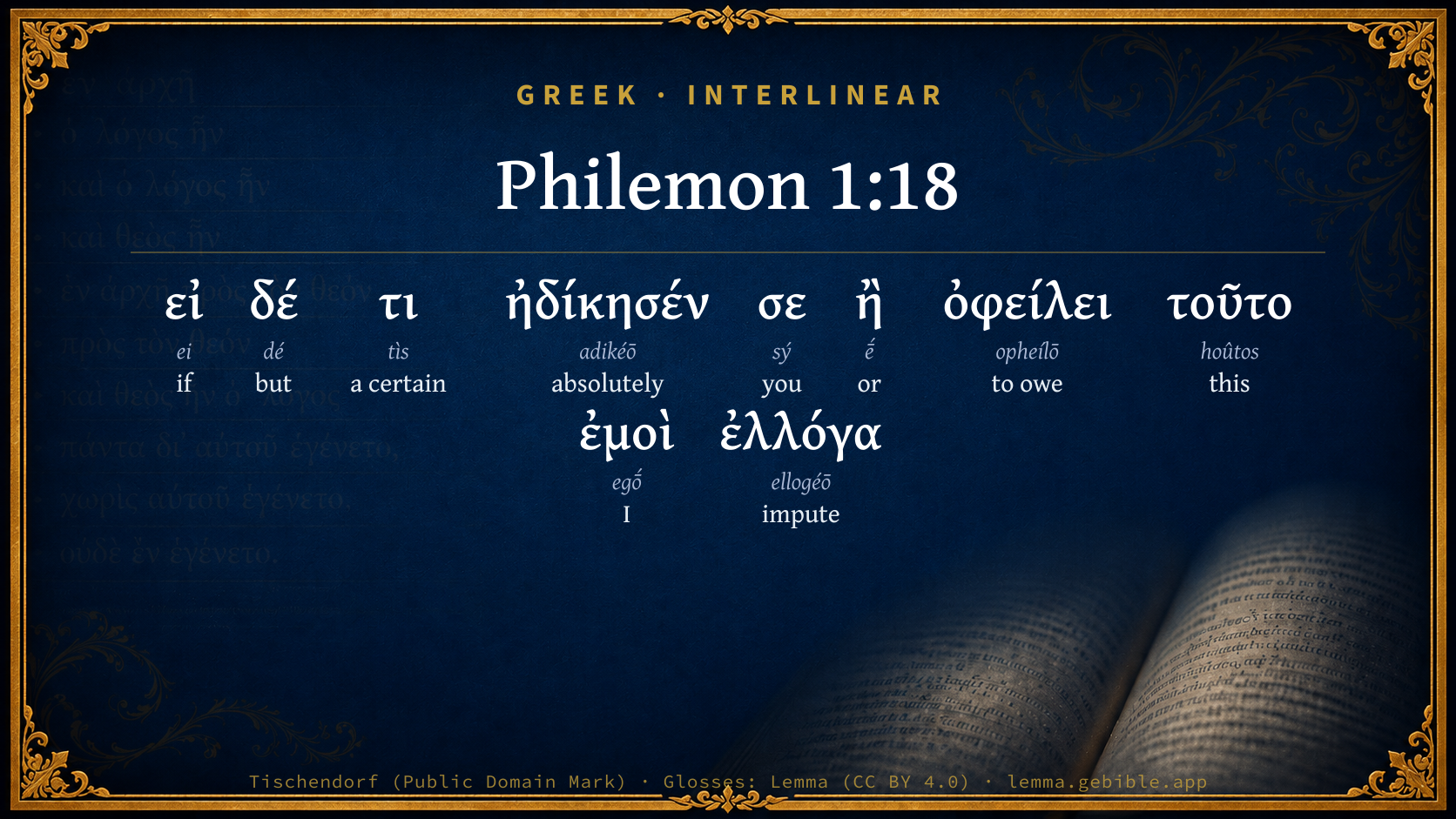
Greek (Tischendorf 8th ed.) Philemon 1:18 appears in the Greek New Testament. The text above is from the Tischendorf 8th edition. Each word links to its Strong’s number and a concise gloss. Click any word for its full Thayer’s Greek Lexicon entry.
Download image
Cite this verse

Philemon 1:18 (World English Bible). Public Domain. Lemma interlinear Bible study tool, https://lemma.gebible.app/v/philemon/1/18.

Show BibTeX & RIS
BibTeX
RIS
English Translation
But if he has wronged you at all, or owes you anything, put that to my account.
World English Bible · Public Domain
Download a study sheet

One document with this verse’s original text, its word-by-word gloss line, the meaning frame, cross-references with their text, attributed commentary, and full source and license credits — printable, and it pastes into notes with its structure intact.

This verse Autodidact and up

Study sheet (.html) Plain text (.txt)

A passage Seminary Student

Up to 50 verses in one chapter. A passage sheet keeps up to 6 commentary sources and 12 cross-references per verse, in the order this page ranks them, and says so on the sheet whenever that leaves anything out. Ask for a single verse and you get the Autodidact verse sheet above.

Everything on this page stays free to read, with no account — the sheet is a download of what is already on screen, not access to it.

Want to remove ads? Support Godless Engineer
Compare translations 3

The same verse in 3 English versions, stacked beneath the original-language interlinear above. Click any original word for its lexicon entry.

Each is an independent rendering of the whole verse — the interlinear is not word-aligned to these translations.

Highlighted words mark where these versions differ — a whole-verse word diff, not a word-by-word alignment.

  • World English Bible Public Domain
    But if he has wronged you at all, or owes you anything, put that to my account.
  • King James Version Public Domain
    If he hath wronged thee, or oweth thee ought, put that on mine account;
  • unfoldingWord Literal Text CC BY-SA 4.0
    But if he has wronged you or owes anything, charge that to me.

unfoldingWord Literal Text — © unfoldingWord, licensed CC BY-SA 4.0. Word-aligned USFM3 via Door43 (git.door43.org/unfoldingWord/en_ult).

Versions to compare (up to 4)

3 of 4 selected

Show all 19 translations

Every available English version of this verse, each an independent rendering of the whole verse.

  • World English Bible Public Domain
    But if he has wronged you at all, or owes you anything, put that to my account.
  • Berean Standard Bible Public Domain
    But if he has wronged you in any way or owes you anything, charge it to my account.
  • Majority Standard Bible Public Domain
    But if he has wronged you in any way or owes you anything, charge it to my account.
  • King James Version Public Domain
    If he hath wronged thee, or oweth thee ought, put that on mine account;
  • American Standard Version (1901) Public Domain
    But if he hath wronged the at all, or oweth `thee' aught, put that to mine account;
  • Revised Version (1885) Public Domain
    But if he hath wronged thee at all, or oweth thee aught, put that to mine account;
  • Geneva Bible (1599) Public Domain
    If he hath hurt thee, or oweth thee ought, that put on mine accounts.
  • Douay-Rheims (1899) Public Domain
    And if he hath wronged thee in any thing, or is in thy debt, put that to my account.
  • Young's Literal Translation Public Domain
    and if he did hurt to thee, or doth owe anything, this to me be reckoning;
  • Literal Standard Version CC BY-SA 4.0
    and if he did hurt to you, or owes anything, charge this to me;
  • Unlocked Literal Bible CC BY-SA 4.0
    If he has wronged you or owes you anything, charge that to me.
  • unfoldingWord Literal Text CC BY-SA 4.0
    But if he has wronged you or owes anything, charge that to me.
  • Darby Bible Public Domain
    but if he have wronged thee anything or owe anything [to thee], put this to my account.
  • World Messianic Bible Public Domain
    But if he has wronged you at all or owes you anything, put that to my account.
  • Webster's Bible Public Domain
    If he hath wronged thee, or oweth thee aught, put that on my account;
  • Free Bible Version CC BY-SA 4.0
    If he has done you any wrong, or owes you anything, charge it to my account.
  • Bible in Basic English Public Domain
    If he has done you any wrong or is in debt to you for anything, put it to my account.
  • Text-Critical English NT CC BY 4.0
    If he has wronged yoʋ in any way or owes yoʋ anything, charge it to me.
  • Tyndale New Testament (1534) Public Domain
    Yf he have hurt the or oweth the ought that laye to my charge.

Literal Standard Version (2020), Covenant Press — licensed CC BY-SA 4.0. Text via the HelloAO Bible API (eBible.org). Unlocked Literal Bible (unfoldingWord) — licensed CC BY-SA 4.0. Text via the HelloAO Bible API (eBible.org). unfoldingWord Literal Text — © unfoldingWord, licensed CC BY-SA 4.0. Word-aligned USFM3 via Door43 (git.door43.org/unfoldingWord/en_ult). Free Bible Version, Dr. Jonathan Gallagher — licensed CC BY-SA 4.0. Text via the HelloAO Bible API (eBible.org).

Word by word

More ways to search: Search by grammar → Find every occurrence → Compare this word →

Practice this passage: Drill this verse → Learn its vocabulary →

About this verse

These counts appear in no published source. They are computed here, from the morphology-tagged text and Lemma’s own curated glosses. What Lemma adds →

10
words
10
distinct lemmas
Pauline Epistles
section

Notable vocabulary

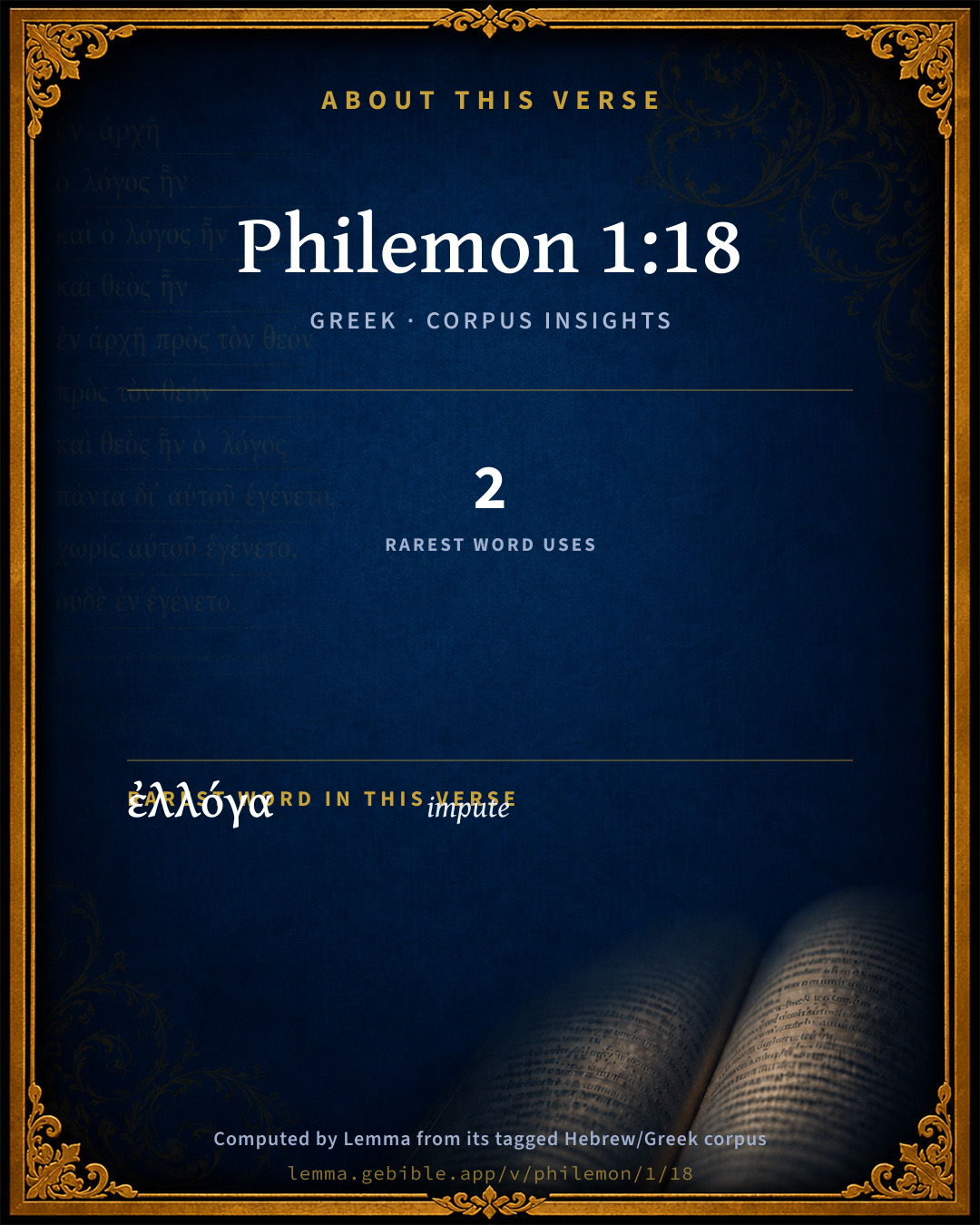
The rarest word here is ἐλλόγα impute G1677 — appearing just 2 times in the whole Greek New Testament.

Shared distinctive vocabulary

ἐλλόγα impute G1677 occurs in 2 verses of the Greek New Testament. Also found in:

Cross-references

1

Topical passages linked to Philemon 1:18 in the Treasury of Scripture Knowledge — connected by theme and wording, ordered by reader-vote popularity; previews shown in the World English Bible.

  • Isaiah 53:4–7 Surely he has borne our sickness, and carried our suffering; yet we considered him plagued, struck by God, and afflicted.

Cross-references courtesy of OpenBible.info (CC BY 4.0).

Commentary

Notes on Philemon 1:18 from classic Christian and Jewish commentators (each source and its license shown beneath its notes). The classic Christian expositions comment on the surrounding passage and are grouped to its opening verse, so a note may address several verses; the Jewish commentaries on the Tanakh (Rashi and others) are per-verse, so they appear only where the commentator wrote on this verse.

Lemma curates 59 commentaries, every one of them public domain or Creative Commons licensed, each selected and text-cleaned for this edition rather than reprinted as found. About our sources →

The Biblical Illustrator

Joseph S. Exell

Phm_1:18

If he hath wronged thee, or oweth thee ought

Theft

The form only is hypothetical.

The case is put as one which is absolutely unquestionable. No doubt Onesimus robbed his master when he ran away. The consequence of this is a debt at present unpaid. He wronged Philemon once for all, and consequently is in debt. Flight and theft were instinctively associated in the minds of Romans as the kindred offences of slaves. It will be observed that St Pauls teaching was not socialistic. Not private property, but the abstraction of it, was theft in his estimation. (Bp. W. Alexander.)

Ownership of goods

We learn from hence that the communion which is among the faithful saints doth not take away the private possession, dominion, distinction, and interest, in the things of this life. Albeit the things belonging to this temporal life be in some respect common, yet in another respect they are private. They are common touching use, they are private touching possession.

I. This truth will yet further and better appear unto us, if we enter into the considerations of the reasons that serve to strengthen it.

1. It is confirmed by the Commandments of God, and by the fourth petition of the Lords Prayer. The Eighth Commandment forbiddeth us to steal away our neighbours goods, and to do him the least hurt therein. The Tenth Commandment restraineth the inward lusts and motions that arise in our minds, and condemneth the coveting of his house, of his wife, of his servant, of his ox, and his ass, or of anything that belongeth unto him. If then God commandeth the preservation of every mans goods, and forbiddeth all injuries to be offered unto them, it standeth us upon to acknowledge a right and interest that everyone hath in earthly things given unto him. Likewise our Saviour Christ teacheth us daily to ask our daily bread, so that no man ought to desire that which is anothers bread, but everyone to know his own, what God hath given him, and what he hath given to others. If then there be bread that is ours, then also there is bread that is not ours. And if somewhat be ours and somewhat not ours it followeth that everyone hath an interest in his own goods, and cannot lay hold of another mans.

2. The invading of other mens inheritances, and the encroaching upon their private possessions, is the fruit either of a confused anarchy, or of a loose government; and both of them are contrary to that ordinance which God establisheth, and the order that He requireth.

3. Everyone hath a proper and peculiar possession, his own servants to order, his own ground to till, his own fields to husband, his own family to govern, and his own domestical affairs to manage, that he may provide things honest in the sight of God, that he may rejoice in the labour of his own hands, and be thankful to the Father and giver of all good things. It is a rule taught by nature, approved by experience, strengthened by customs, and established by the founders of cities and kingdoms, that whatsoever is cared for of all is cared for of none as it ought to be, but is neglected of all.

II. As we have seen the reasons that confirm this doctrine, so let us see the uses that instruct us in many profitable points tending to edification.

1. This confuteth and convinceth the detestable sect who deny to men any property in anything, but would have all things common.

2. Seeing every man hath a state in his own goods, it teacheth us this duty, that we ought to be content with the portion which we have, be it more or less, be it a simple or a worthy portion, and to be by all means thankful for it; considering with ourselves that the difference of places, lands, possessions, with the properties thereof, be of God, and are to be acknowledged as His gift.

3. We learn from this doctrine to take good heed that we do not abuse our property and dominion of those gifts that God hath given us, bestowing them only to our private use, and withholding the comfort of them from others, to whom they ought of right to be imparted and employed. For albeit the possession of them be ours, yet there is a use of them belonging to the saints; the property of goods and the communion of saints standing together. Whensoever we have these outward things we must not withhold them, when they may profit the Church and refresh the saints. (W. Attersoll.)

Put that on mine account--

Taking the slaves debt

The verb used here for put to the account of is a very rare word; and perhaps the singular phrase may be chosen to let another great Christian truth shine through. Was Pauls love the only one that we know of which took the slaves debts on itself? Did anybody else ever say, Put that on mine account? We have been taught to ask for the forgiveness of our sins as debts, and we have been taught that there is One on whom God has made to meet the iniquities of us all. Christ takes on Himself all Pauls debt, all Philemons, all ours. He has paid the ransom for all, and He so identifies men with Himself that they are received as Himself. It is His great example that Paul is trying to copy here. Forgiven all that great debt, he dare not rise from his knees to take his brother by the throat, but goes forth to shew to his fellow the mercy he has found, and to model his life after the pattern of that miracle of love in which is his trust. It is Christs own voice which echoes in put that on mine account. (A. Maclaren, D. D.)

Suretyship

From this offer that Paul maketh, which is, to satisfy another mans debt, we learn that it is a lawful thing for one man to become surety for another, and to engage himself for his sure and faithful friend, of whom he is well persuaded. Howsoever suretyship be to some very hurtful, and to all dangerous, yet it is to none in itself, and of its own nature, unlawful or sinful, when the merciless creditor shall take his debtor by the throat and say, pay me that thou owest.

I. And if we require better grounds to satisfy us in this truth, let us enter into the strength of reason to assure us, without any wavering herein.

1. Weigh with me the example of Christ, an excellent pattern and president of the practice of this, an example far beyond all exception, an example that overshadoweth, and dazzleth, and darkeneth, all that cloud of witnesses produced by the apostle in the Epistle to the Hebrews; He became surety for His Church unto His Father, to pay the debt of our sins, and to satisfy His justice.

2. It is a fruit of love and brotherly kindness, even this way to relieve and help such as are like to suffer damage and detriment by want of outward things. There is no man so rich but may become poor; no man so high but may be brought low; as there is no full sea but hath his ebbing. Now humane society and Christian piety requireth that one should sustain and succour another in their necessity. We are commanded to help up our enemys ox that is fallen, or his ass that is sunk down under his burden; how much more ought we to show pity and compassion to our brother himself, vexed with the creditor, terrified with the prison, oppressed with the debt, and dismayed and discouraged with the payment at hand that is to be made? So then, whether we do consider that Christ Jesus is made our surety, and that suretyship is a fruit of Christian love one toward another, in both respects we see that in itself it is not to be disallowed or condemned.

II. The uses of this doctrine are diligently to be considered of us.

1. If it be lawful to become surety one for another, it convinceth and confuteth those that hold it to be evil and unlawful, to give their word, or offer their hand, or tender their promise, for their brethren. Love is a debt that we owe to all men, as the apostle testifieth (Rom_13:8), and therefore we ought not to fail in the performance thereof.

2. Seeing we have showed it to be lawful to enter into suretyship (for if it had been simply and altogether forbidden Paul would never have proffered himself to be surety unto Philemon for Onesimus), this serveth divers ways for our instruction. For hereby we are directed to be careful to use it lawfully. It is good and lawful if a man use it well and lawfully. But if we use it and enter into it rashly, not rightly, ordinarily, not warily, foolishly, not wisely, desperately, not discreetly; if we entangle ourselves with it without much deliberation, without good circumspection, and without due consideration, it becometh unlawful unto us. Wherefore that this giving of assurance to others, and for others, either by our word or hand, may be performed lawfully to the good of others, and not the hurt of ourselves, we must mark and practise two points:--

(1) Consider the persons of others for whom it is done.

(2) Our own persons that do it; and these two are caveats for all sureties.

Touching those persons for whom we become sureties, we must know that we are not to engage ourselves and our credit, for everyone that will crave it at our hands, and enter into bands for them, and promise us fair to see us discharged; but in such men, who oftentimes have a greater feeling of their own wants and necessities than of freeing them out of woe that have pledged themselves for them, we are to observe three things.

(a) That they be well known.

(b) That they be honest and godly.

(c) That they be sufficient to pay that which they would have us bound unto another, to assure him that they will pay.

3. Touching our own persons, before we are to enter into band or suretyship for others we must mark and meditate upon two things.

(1) What is the sum for which we shall be obliged.

(2) The means how we maybe discharged. It standeth us greatly upon to bethink ourselves both what is the quantity, and what is our ability to answer it. It is a moral precept and wise saying, worthy to be written in our hearts, be not surety above thy power; for if thou be surety, think to pay it. Let every man therefore well weigh his own strength. It were foolish pity for the saving of another mans life to lose our own. It were a merciless kind of mercy to leap into the water and drown ourselves while we seek to deliver another. We are commanded to bear the burden one of another, but it were more than foolish pity to break our own shoulders, by sustaining the weight and hearing the burden of another man. Again, as we are to mark our own strength, so we are to consider our own discharge, how we may be secured and set at liberty. For, before we pass our word, or give our band and hand for the payment of other mens debts and duties, we must know how we shall be assured to be delivered from that burthen and bondage that we have undertaken. We ought indeed to bear good will to all men, but our good will should not be a loser. It is no charity to receive a blow upon our own heads to keep the stroke from another. Know what kind of man he is for whom thou becomest a surety. If he be a stranger to thee meddle not with him; if he have broken his credit with any before, suspect him; if he be a shifting companion, discard him; if he be unsufficient to pay his own debt, deny him; if the sum be great and thy ability little so that it may hinder thee and thy calling, if thou be driven to pay it, enter not into it; and if thou cannot see which way thou mayest be freed from the peril and danger that hangeth over thy head, fly away from it as from a serpent that will sting thee, as from a canker that will consume thee, as from a gulf that is ready to swallow thee.

4. Seeing it is not unlawful or forbidden to bind a mans self by band or otherwise to another, it ought to teach all creditors and lenders not to be rough and rigorous over a surety. No cruelty toward any is lawful. (W. Attersoll.)

The atonement--an illustration

Suppose, then, that Philemon had demanded the repayment of what he had lost to the uttermost farthing; suppose that for many months St. Paul had had to work very hard, and to live very sparely, in order to earn the required sum, and that at last he had actually paid it to the rich Philemon, in order that Onesimus might be got out of his debt: would that have been wrong and base? wrong of St. Paul, I mean. Would you, would any man, have blamed him for it? Would you not, rather, have been moved to an enthusiastic admiration of the man who was capable of so singular and so signal an act of self-forgetting generosity and compassion? And what would you have thought of Philemon if he had taken the money? Surely you would have been as quick to condemn him as to admire Paul. Which things may be allegorised. Let us, then, for our instruction in righteousness, turn this story into an allegory or parable. Let Philemon, the just and kind master, stand for God, our Father and Lord. Let St. Paul, the generous debt-assuming apostle, stand for Christ, our Saviour. Let Onesimus, the fraudulent and runaway slave, stand for man, the sinner. And then, sinful man, fleeing from the God he has wronged, falls into the hands of Christ, and comes to know and hate his sins. Christ goes to the Father saying, If he [i.e., man] hath wronged Thee, or oweth Thee ought, put that to My account; I will repay it. And, according to one theory of the Atonement at least, God takes the money; He demands that Christ should exhaust Himself with toil and suffering in order that mans debt may be paid, and then blots out the debt from his account. Assuming for a moment this theory of the Atonement to be a true theory, what are we to think of Christ? Was it wrong, was it blameworthy of Him, to take the sinners place, to pay the sinners debt, to atone the sinners offence? If we hold to our parallel, so far from thinking it wrong, we can only pronounce it an unparalleled act of generous and self-forgetting love: so far from blaming Him for it, we can but honour and admire Him for it with all our hearts. But if God took the money--if He would not release man from his debt till some one, no matter who, had paid the debt--what are we to think of Him? Had Philemon taken St. Pauls money, we agreed that in him it would have been an action almost incredibly mean and base; we agreed that we should have felt nothing for him but contempt. Are we to lower our standard, and alter our verdict, because it is God, and not man, who is called in question--God, from whom we expect, and have a right to expect, so much more than from man? No, we cannot, we dare not, either lower our standard or alter our verdict. What would have been wrong in man would have been at least equally wrong in God. And as God can do no wrong, either our parallel does not hold good, or this theory of the Atonement must be radically misleading and incomplete. Is the parallel at fault, then? Look at it again. Philemon was a just and kind master. And does not God Himself claim to hold a similar relation to us? Onesinms was an unprofitable servant--running away from a master he had robbed. And have not we again and again robbed God of His due, and left His service to walk after our own lusts? St. Paul loved Onesimus as his own heart, as himself (Phm_1:12; Phm_1:17); and, in his love, he even put himself in the place of Onesimus, assumed his debt, interceded for him with his justly offended master, and raised him from the status of a slave to that of a brother beloved. Are there any words, even in the Bible itself, which more accurately and happily describe Christs relation to us? The parallel holds good then. We may take Philemon as setting forth Gods relation to us, Onesimus as setting forth our relation to God, and St. Paul as setting forth Christs relation both to God and man. But as the parallel does hold good, must not that theory of the Atonement to which I have referred be radically misleading and incomplete? No doubt any theory of the Atonement must be incomplete, for the Atonement is the reconciliation of man to God; and which of us fully comprehends either God or man? How, then, can we comprehend and express that Divine act or process, that miracle of time, by which the relations of God with man and of man with God were or are being drawn into an eternal concord? No theory of the Atonement conceived by the human mind, and expressed in human words, can possibly be perfect and entire, lacking nothing. The great mystery of godliness must ever remain a deep in which all our thoughts are drowned. And any man who assumes that he can comprehend it, and crush it into some narrow and portable formula, does but prove that he pertains to that well-known category or class which presumes to rush in where angels fear to tread. Still we may refuse to hold any theory of the Atonement which is obviously untenable. We may know, we may learn from Scripture at least enough of the Atonement for faith to grasp, and for the salvation that comes by faith. And, surely, it is impossible to deny that in sundry places Scripture does teach what is known as the vicarious or substitutionary theory of the Atonement; that it speaks of Christ as taking our place, paying our debt, suffering in our stead. Whether we like it or not, there it is: the writings of St. Paul are full of it. Whatever the moral effect of it were, candour would compel us to confess that this aspect of Christs work and ministry of reconciliation is set forth in the Scriptures of the apostles--not as the only aspect, only, indeed, as one of three or four, but still as a true aspect, as demanding our acceptance. Nevertheless, I confess that I for one should hesitate to accept it, were I unable to see and to show that the proper moral effect of it is not evil, but good; that it does not tend to weaken our hatred of sin, or to relax our struggle against it, but tends rather to strengthen our hatred of it, and to brace us for new endeavours to overcome it. And I value this story of Onesimus very highly because it suggests a reasonable and a complete answer to this common difficulty and objection. For, consider: Was St. Pauls offer to pay the debt of Onesimus in the very least degree likely to confirm Onesimus in his knavery? Suppose the offer accepted; suppose he had seen the busy and weary apostle toiling night and day, suffering many additional hardships, in order to clear him of his debt--would Onesimus, after having thus seen what his crime had cost, have been the more likely to rob Philemon again? Would that have been the natural and proper effect on his mind of the apostles generous and self-sacrificing love for him? We know very well that it would not. We know very well that Onesimus, touched and melted by the love St. Paul had shown him, would rather have starved than show himself wholly unworthy of it. Why, then, if we believe that Christ Jesus, in the greatness of His love, took our place, paid our debt, toiled and suffered for our sins, and so reconciled us to the God we had wronged--why should that have a bad moral effect upon us? If Christ so loved us as to give Himself for us, the just for the unjust; if we clearly and honestly believe that, surely its proper moral effect on us will be that we shall love Him who so loved us: and how can we love Him, and yet not hate the evil that caused Him so much pain? But here we come back to a still graver difficulty. As St. Paul, to Philemon, for Onesimus, so Christ says, to God, for us, If they have wronged Thee, or owe Thee ought, put that to My account; I will repay it. Let it be granted, as I have tried to show, that this assumption of our place and debt by Christ Jesus was an act most noble and generous and Divine. Let it be granted, as I have also tried to show, that by our faith in His great love we are incited to more strenuous efforts after moral purity and righteousness, instead of being degraded and demoralised by it. Grant both these points: and, then, what are we to think of God if He took from Christ the money which paid our debt? All that series of Scriptural figures which represents our sins as debts, and the Father Almighty as keeping a book in which they are entered, and as blotting them from that book when they are paid, may be necessary, and may once have been still more necessary than it is now, to set forth certain aspects of spiritual truth. But we need not conceive of Gods book as though it were a ledger, nor of God Himself as a keen, hard-eyed merchant, still less as a peddling huckster, indifferent where his money comes from so that he gets it, and gets enough of it. All this is not in the Bible, though it may be in certain creeds and systems of divinity which, although they have had their day, have not even yet altogether ceased to be. And even the mercantile and forensic metaphors which are in the Bible are but metaphors after all; i.e., they are but human forms of Divine truth adapted to the weakness and grossness of our perceptions. Nor do they stand alone. Lest we should misinterpret them, they stand side by side with figures and words which set forth other aspects of the self-same truth in forms we cannot easily mistake. Recall and consider, for example, such sayings as these:--God so loved the world that He gave His only begotten Son, that whosoever believeth in Him might have eternal life; and again, God was in Christ reconciling the world unto Himself; and again, Herein is love, not that we loved God, but that He loved us, and sent His Son to be the propitiation for our sins. Are not these words sufficiently simple and clear and direct? Are they not instinct--charged and surcharged--with a Divine tenderness? But if these sacred and tender words be true; if God was in Christ, if He against whom we had sinned Himself took our debt upon Him that He might frankly forgive us all, is there any lack of love and kindness in Him then? It was noble in St. Paul, you admit, to take the debt of Onesimus upon him; but it would have been ignoble of Philemon to let the apostle pay it. Granted. But suppose--for even impossibilities are supposable--that St. Paul had been both himself and Philemon. Suppose that when, in the form of Philemon, he had been robbed at Colosse, he forthwith posted to Rome in order that, in the form of St. Paul, he might bring Onesimus to repentance, in order that, at any cost of toil and suffering to himself, he might wipe out his debt and atone his wrong. Would not that have been nobler still? And if God, the very God whom we had defrauded, from whom we have fled, Himself came down into our low and miserable estate, to toil and suffer with us and for us, in order that He might bring us back to our better selves and to Him, in order that He might wipe out the debt we had contracted, convince us that He had remitted it, and raise us to a new life of service and favour and peace--what was that but a love so pure, so generous, so Divine, that the mere thought of it should melt and purify our hearts? We are to think of God, then, not simply as taking the money offered Him by Christ on our behalf, but also as paying it; not as exacting His due to the uttermost farthing, but rather as Himself discharging a debt we could never have paid. In the terms of our parable, He is Paul as well as Philemon--not only the Master we have wronged, but also the Friend who takes the wrong upon Himself. And we owe to Him both whatever service and duty the forgiven Onesimus owed to Philemon, and whatever gratitude and love he felt for St. Paul. (S. Cox, D. D.)

Reparation to God

And what a light is shed on the gospel idea of making reparation to God by means of a substitute, according to this earthly analogy! How finely the apostle here follows in the footsteps of Him who, on a higher plane, offered Himself as pledge or pawn for us who had failed to render the service that was due! Sin is no doubt much more than debt, but it is debt in so far as human defalcations stand in the account with God. Through melancholy faithlessness and dereliction and apostasy toward Him, what debts have been accumulating beyond all human power to liquidate! Neither regrets nor promises can here avail. Debts must be paid, if they would creditably be written off. The grace of the Lord Jesus admits of Him being debited. To the trusting soul He says: I am your written and covenant surety; and so far as sin is a load of debt to God, it is His alone to say: Put this down to My account. I will repay. Not as if there were any transference of moral qualities, or confusion of merit. Human guilt or blameworthiness can never be transferred to Christ, only imputed or reckoned to His account. What is actually transferred is the liability. And so must Christs merit be ever His own--its benefits only can be transferred, when it itself is imputed or put to any human account. In this sense Christ is ever holding Himself forth as able and ready to bear away the burden of human debt, and cancel sin, in the account of any soul with God. (A. H. Drysdale, M. A.)

The Biblical Illustrator, edited by Joseph S. Exell (c. 1880s–1900s) — public domain. Text from a community e-Sword module.

Scofield Reference Notes

C. I. Scofield

account

Phm 1:17; Phm 1:18 perfectly illustrate imputation: "Receive him as myself"--reckon to him my merit; "If he hath wronged thee or oweth thee ought, put that on mine account"-- reckon to me his demerit.

See "Imputation," Lev 25:50. (See Scofield "Jas 2:23") .

The Scofield Reference Bible (1917 edition), notes by C. I. Scofield — public domain. Text from a community e-Sword module.

Tyndale Open Study Notes

Tyndale Open Resources

1:18 Onesimus might have stolen some things from Philemon’s home or had a debt to pay off when he ran away.

Tyndale Open Study Notes — © Tyndale Open Resources, licensed CC BY-SA 4.0. Text via the HelloAO Bible API.

Bengel's Gnomon

Johann Albrecht Bengel

Phm 1:18. Εἰ δέ τε, but if anything) A gentle expression. Onesimus had confessed to Paul what he had done.—ἢ ὀφείλει, or owes) A milder synonym is put after the verb wronged.—ἐλλόγει) Hesychius, ἐλλόγει, i.e. καταλόγησαι. Consider me the debtor.

Bengel's Gnomon of the New Testament — English translation (T&T Clark, Edinburgh, 1860) — public domain. Text from a community e-Sword module.

Meyer's Critical & Exegetical Commentary

Heinrich August Wilhelm Meyer

Phm_1:18. And herein the offence against thee, with which Onesimus is chargeable, is not to present an obstacle.

εἰ] indication in a hypothetic form, so as to spare the feelings: Attic politeness, see Herbst, ad Xen. Mem. i. 5. 1; Bornem. ad Conviv. iv. 3; Winer, p. 418 [E. T. 562].

τι ἠδίκησέ σε] Comp. Col_3:25; Gal_4:12; Act_25:10. In what the wrong done to Philemon by Onesimus, and without doubt confessed to the apostle by the latter, actually consisted, is hinted in what follows.

ἢ ὀφείλει ormore precisely to describe this ἠδίκησε]oweth (anything). This applies to a money-debt (see Phm_1:19). Accordingly the slave had probably been guilty, not merely in general of a fault in service which injured his master (Hofmann), but in reality (comp. already Chrysostom) of purloining or of embezzlement, which Paul here knows how to indicate euphemistically. The referring it merely to the running away itself, and the neglect of service therewith connected, would not be (in opposition to Bleek) in keeping with the hypothetical form of expression.

τοῦτο] the τί, which he ἠδίκησέ σε ἢ ὀφείλει; hence we have not, with Grotius, Fliatt, and others, to explain these two verbs of different offences (the former as referring to theft at his running away, the latter to defalcation).

ἐμοὶ ἐλλόγα] set it down to my account; me debitorem habe, Bengel. Friendly pleasantry, which in Phm_1:19 becomes even jocular (μετὰ χάριτος τῆς πνευματικῆς, Chrysostom), with which the subsequent ἵνα μὴ λέγω σοι κ.τ.λ. is very compatible (in opposition to Hofmann), if it is correctly apprehended. On the form ἐλλογάω we have not, with Fritzsche, ad Rom. v. 13, at once to pronounce against it: nulla est (comp. Matthies: stultum est), since ἐλλογέω likewise is only with certainty preserved in Rom. l.c., and in Boeckh, Inscr. I. p. 850. It is true λογάω, in Lucian, Lexiph. 15, means to be fond of speaking; but this single passage, in which the simple form is preserved, does not suffice to negative the use of the word in the sense of reckoning.

Meyer — Critical and Exegetical Commentary on the New Testament — English translation by Peter Christie, edited by Frederick Crombie (T&T Clark, 1880) — public domain. Text from a community e-Sword module.

Expositor's Greek Testament

ed. W. Robertson Nicoll

Phm 1:18 . εἰ δὲ τι : as Lightfoot says, the case is stated hypothetically, but the words doubtless describe the actual offence of Onesimus. ἐλλόγα : only elsewhere in N.T. in Rom 5:13 ; it occurs on the papyri (Deissmann, op. cit. , p. 52), “to reckon unto”; here, in the sense: “put it down to my account”.

The Expositor's Greek Testament, edited by W. Robertson Nicoll (1897–1910) — public domain. Text from a community e-Sword module.

Jamieson, Fausset & Brown

Robert Jamieson, A. R. Fausset & David Brown

Greek, "But it (thou art not inclined to 'receive him' because) he hath wronged thee"; a milder term than "robbed thee." Onesimus seems to have confessed some such act to Paul.

put that on mine account--I am ready to make good the loss to thee if required. The latter parts of Plm 1:19, Plm 1:21, imply that he did not expect Philemon would probably demand it.

Jamieson, Fausset & Brown — Commentary Critical and Explanatory on the Whole Bible (1871) — public domain (CC PDM 1.0). Text via the HelloAO Bible API.

Adam Clarke's Commentary

Verse 18. If he hath wronged thee, or oweth thee aught] Had the apostle been assured that Onesimus had robbed his master, he certainly would not have spoken in this hypothetical way; he only puts a possible case: If he have wronged thee, or owe thee aught, place all to my account; I will discharge all he owes thee.

Adam Clarke's Commentary on the Bible (1810–1826) — public domain. Text from a community e-Sword/MySword module.

John Calvin's Commentaries

18 If in any thing he hath done thee injury. Hence we may infer that Onesimus had likewise stolen something from his master, as was customary with fugitives; and yet he softens the criminality of the act, by adding, or if he oweth thee anything Not only was there a bond between them recognised by civil law, but the slave had become indebted to his master by the wrong which he had inflicted on him. So much the greater, therefore, was the kindness of Paul, who was even ready to give satisfaction for a crime.

John Calvin's Commentaries (1540-1563) — public domain. Text from the Calvin Translation Society English edition (1840s-50s) via the Christian Classics Ethereal Library (ccel.org). Calvin's coverage is partial (roughly two-thirds of the Bible); uncommented books and verses are honest gaps, never fabricated. The 19th-century editor's footnotes and remarks are omitted so the notes are faithfully Calvin's own voice.

Ellicott's Commentary for English Readers

(18) If he hath wronged thee.—Properly, If he wronged thee, evidently referring to the time of Onesimus’ escape. “If he oweth thee ought” is similarly, in all probability, an allusion to some theft at the same time, couched in a hypothetical form, but implying no doubt as to the fact.

Put that on mine account.—Comp. a similar commercial metaphor in Php_4:15-17, and see Note there. It is strangely out of character with the whole tone of the Apostolic life to imagine (as some commentators have done) a regular debtor and creditor account between Philemon and St. Paul.

A Bible Commentary for English Readers, edited by Charles John Ellicott (1878–1897) — public domain. Text from a community e-Sword module.

The Cambridge Bible for Schools and Colleges

gen. ed. J. J. S. Perowne

18. If he hath wronged thee] Lit., But if he wronged thee, before, or when, he fled. See on Phm_1:11. Horace (Sat., 1. i. 78) says how the anxious master “fears lest his slaves should pillage him and fly” (ne te compilent fugientes).

oweth] The slave might be trusted by his master with money for purchases; or he might work at a trade, or do casual service for others, his master claiming the proceeds. Thus he might be his owner’s debtor. See Smith’s Dict. of Greek and Roman Antiquities, art. Servus.

put that on mine account] Latin Versions, hoc mihi imputa; Wyclif, “asette thou this thing to me.”—Such collections as the Philippians sent (Php_4:10-18) enabled him to offer this generous guarantee.

The Cambridge Bible for Schools and Colleges (gen. ed. J. J. S. Perowne; Cambridge University Press, 1878–1918) — public domain. Text from a community e-Sword module.

John Gill's Exposition

If he hath wronged thee,.... By squandering away his time, spoiling his work, or corrupting his fellow servants:

or oweth thee ought; by embezzling his master's goods, robbing him of his money, and running away from his service:

put that on mine account; Signifying that he would be answerable for all, and make good all debts and damages.

John Gill's Exposition of the Whole Bible (1746–1763) — public domain (CC PDM 1.0). Text via the HelloAO Bible API.

Trapp's Complete Commentary

John Trapp

18 If he hath wronged thee, or oweth thee ought, put that on mine account;

Ver. 18. If he hath wronged thee] His shameful escape the apostle sweetly mitigateth by the name of wrong; his theft, of debt. See Phm 1:15; cf. Gen 14:5.

Put that on mine account] To the like effect speaks the Lord Christ on our behalf to his heavenly Father, in his daily intercession.

John Trapp, A Commentary or Exposition upon All the Books of the Old and New Testament (1647–1656) — public domain. Text from a community e-Sword module.

Albert Barnes' Notes on the Bible

If he hath wronged thee - Either by escaping from you, or by failing to perform what he had agreed to, or by unfaithfulness when he was with you as a servant, or by taking your property when he went away. Any of these methods would meet all that is said here, and it is impossible to determine in which of them he had done Philemon wrong. It may be observed, however, that the apostle evinces much delicacy in this matter. He does not say that he had wronged him, but he makes a supposition that he might have done it. Doubtless, Philemon would suppose that he had done it, even if he had done no more than to escape from him, and, whatever Paul’s views of that might be, he says that even if it were so, he would wish him to set that over to his account. He took the blame on himself, and asked Philemon not to remember it against Onesimus.

Or oweth thee ought - It appears from this, that Onesimus, whatever may have been his former condition, was capable of holding property, and of contracting debts. It is possible that he might have borrowed money of Philemon, or he may have been regarded as a tenant, and may not have paid the rent of his farm, or the apostle may mean that he had owed him service which he had not performed. Conjecture is useless as to the way in which the debt had been contracted.

Put that on mine account - Reckon, or impute that to me - εμοὶ ἐλλόγα emoi elloga. This word occurs nowhere else in the New Testament, except in Rom 5:13, where it is rendered imputed. See the notes at that passage. It means to “reckon;” to put to one’s account, to wit, what properly belongs to him, or what he assumes. It never implies that that is to be charged on one which does not properly belong to him, either as his own act, or as that which he has assumed. In this case, it would have been manifestly unjust for Philemon to charge the wrong which Onesimus had done, or what he owed him, to the apostle Paul without his consent; and it cannot be inferred from what Paul says here that it would have been right to do so. The steps in the case were these:

(1) Onesimus, not Paul, had done the wrong.

(2) Paul was not guilty of it, or blameworthy for it, and never in any way, or by any process, could be made to be, or conceived to be. It would be true forever that Onesimus and not he had done the wrong.

(3) Paul assumed the debt and the wrong to himself. He was willing, by putting himself in the place of Onesimus, to bear the consequences, and to have Onesimus treated as if he had not done it. When he had voluntarily assumed it, it was right to treat him as if he had done so; that is, to hold him responsible. A man may assume a debt if he pleases, and then he may be held answerable for it.

(4) If he had not assumed this himself, it never could have been right for Philemon to charge it on him. No possible supposition could make it right. No agency which he had in the conversion of Onesimus; no friendship which he had for him; no favor which he had shown him, could make it right. The consent, the concurrence on the part of Paul was absolutely necessary in order that he should be in any way responsible for what Onesimus had done.

(5) The same principle prevails in imputation everywhere.

What we have done is chargeable upon us. If we have not done a thing, or have not assumed it by a voluntary act, it is not right to charge it upon us. God reckons things as they are.

The Saviour voluntarily assumed the place of man, and God reckoned, or considered it so. He did not hold him guilty or blameworthy in the case; but as he had voluntarily taken the place of the sinner, he was treated as if he had been a sinner. God, in like manner, does not charge on man crimes of which he is not guilty. He does not hold him to be blameworthy, or ill-deserving for the sin of Adam, or any other sin but his own. He reckons things as they are. Adam sinned, and he alone was held to be blameworthy or ill-deserving for the act. By a divine constitution (compare the notes at Rom 5:12, following), he had appointed that if he sinned, the consequences or results should pass over and terminate on his posterity - as the consequences of the sin of the drunkard pass over and terminate on his sons, and God reckons this to be so - and treats the race accordingly. He never reckons those to be guilty who are not guilty; or those to be ill-deserving who are not ill-deserving; nor does he punish one for what another has done. When Paul, therefore, voluntarily assumed a debt or an obligation, what he did should not be urged as an argument to prove that it would be right for God to charge on all the posterity of Adam the sin of their first father, or to hold them guilty for an offence committed ages before they had an existence. The case should be adduced to demonstrate one point only - that when a man assumes a debt, or voluntarily takes a wrong done upon himself, it is right to hold him responsible for it.

(See the subject of imputation discussed in the supplementary notes, Rom 5:12, Rom 5:19; 2Co 5:19, 2Co 5:21 notes; Gal 3:13 note.)

Albert Barnes' Notes on the Bible (1834–1885) — public domain. Text from a community e-Sword/MySword module.

Haydock's Catholic Bible Commentary

If he hath wronged thee in any thing, as he confesses, put it to my account, to my debtor, I will repay it, and satisfy thee for it. (Witham)

George Leo Haydock (1774–1849), Haydock's Catholic Family Bible and Commentary, 1859 edition — public domain. Excludes Psalms (Douay-Rheims chapter numbering differs from Protestant) and Deuterocanonical books (Catholic canon only).

Matthew Poole's English Annotations

If he hath any way been unfaithful. If he hath taken any thing from thee, or be in thy debt, charge that upon me, let me be accountable to thee for it.

Matthew Poole's English Annotations on the Holy Bible (1683–1685) — public domain. Text from a community e-Sword/MySword module.

Whedon's Commentary on the Bible

Daniel D. Whedon

18. If—A word interposed to soften the positiveness of the charge.

If he hath wronged thee—By theft or embezzlement, as he had, doubtless, confessed to Paul.

Or oweth thee aught—If there is any pecuniary loss which he should make good in order to emancipation.

Put… mine account—St. Paul will square it up.

Daniel D. Whedon (gen. ed.), Commentary on the Old and New Testaments (1874–1909) — public domain. Text from a community e-Sword module.

The Pulpit Commentary

But if he hath wronged thee at all. It would have been needlessly irritating to Philemon to go into the details of Onesimus"s offences. No doubt St. Paul had had an account of them from the repentant youth, but he had far too much tact to occupy himself and Philemon in the discussion of details. The hypothetic form avoids the whole of these. It suffices that he assumes the responsibility of repayment. Owes thee anything. As a matter of moral right at the bar of conscience. For in a secular court the slave could be neither debtor nor creditor, properly speaking, as against his master. This offence was probably embezzlement or purloining while in service. A, C, D, F, G, a read (elloga), reckon it to me.

Vers. 18, 19. The apostle"s frank acceptance of pecuniary responsibility for Onesimus.

The injured master might plead that it was enough for him to forbear punishing his unfaithful servant, but the injuries he had received put it out of his power to replace him in his household.

I THERE IS HERE AN ACKNOWLEDGMENT OF THE WRONG DONE BY THE NOW PENITENT SLAVE. "If he hath wronged thee, or oweth thee aught, put that to mine account." It is evident that Onesimus had frankly confessed his misdeeds to the apostle.

1. Mark the mild language in which the apostle describes them. He does not say that Onesimus robbed his master, as he did not wish either to hurt the feelings of the slave or to irritate the feelings of the master; but simply speaks of a wrong done, of a possible debt incurred. If a sinner is penitent, why should his old sins or follies be thrown in his teeth?

2. Restitution in case of civil injury is a first flying. It is one of the most practical proofs of repentance.

II THERE IS A RESPONSIBILITY ASSUMED FOR THE DEBT OF ONESIMUS. "Put that to mine account: I Paul write it with mine own hand, I will repay it." The apostle here puts his name, as it were, at the foot of the bond.

1. It was an act of self-sacrificing consideration for Onesimus, as if the apostle would remove every possible obstacle to the restoration of the penitent slave to his Colossian home.

2. Yet it is so put as to imply that Philemon would hardly exact the debt.

III THERE IS THE STATEMENT OF A MUCH LARGER COUNTER-CLAIM. "Not to say to thee that thou owest to me even thine own self besides.

1. It was a true claim. The apostle had been the instrument of Philemon"s conversion.

2. It was an overpowering claim. The blessing that accrues to a man from his conversion cannot be weighed in the balance against all a man"s property.

3. There ought to be mercy in the exaction of debts. This is implied in the nature of the apostle"s appeal. Onesimus was utterly unable to make restitution, and, if the apostle became his surety, it was with an implied wish that Philemon would take a liberal view of his duty in the matter. T.C.

The Pulpit Commentary (1880–1919), ed. H.D.M. Spence-Jones & Joseph S. Exell — public domain. Text from a community e-Sword module.

Godbey's Commentary on the New Testament

William B. Godbey

18. “But if he has done you injustice as to anything, or is in debt to you, set it down to me.

William B. Godbey, Commentary on the New Testament (1896–1900) — public domain. Text from a community e-Sword module.

The People's New Testament

B. W. Johnson

18–21. If he hath wronged thee. By defrauding thee of his service. Some have seen in this a suggestion that Onesimus had robbed Philemon, but that inference is not necessary. See Introduction on the gospel and slavery.

B. W. Johnson's The People's New Testament with Notes (1889–1891) — public domain. Electronic text from the Christian Classics Ethereal Library (CCEL) ThML edition.

Cambridge Greek Testament for Schools and Colleges

18. εἰ δέ τι. The δέ states an objection which Philemon might raise against the reception of Onesimus. The hypothetical term is probably due to a desire to avoid all irritation, “Attic politeness” (Mey.), St Paul knowing from Onesimus’ confession that such was really the case. Possibly however St Paul was in some doubt as to the fact, owing to the matter presenting itself to Philemon and to Onesimus in different aspects.

ἠδίκησέν σε, “did thee an injury.”

See Col 3:25 for the use of ἀδικεῖν in reference (probably) to a slave. Though a general word in itself it must here refer to money, for otherwise St Paul could not pay it back (Phm 1:19). For a similar connotation see (probably) 1Co 6:8. The aor. marks only the time when Onesimus committed the act, and does not say whether this was when he was still with Philemon or when he went away.

ἢ ὀφείλει. Not merely epexegetic of ἡδίκησέν σε and indicating the present result of that act, but wider. He may have “injured” Philemon by directly robbing him, he may be “owing” him something partly by that and partly by not having repaid moneys expended on him. Hence ἤ rather than καί.

τοῦτο ἐμοὶ ἐλλόγα, “reckon this to me.” “Hesychius ἐλλόγει, καταλόγησαι” (Beng.); almost “ledger it.” Onesimus would have long since spent anything he took. For the form see Rom 5:13†. Exx. of ἐλλογεῖν (text Rec. here and Rom.) on monuments are given in Lightfoot. See also Blass Gram. § 22, 2, for other cases of confusion between verbs in -έω and in -άω.

Cambridge Greek Testament for Schools and Colleges (Cambridge University Press, 1896; 21 vols, various authors incl. Carr, Maclear, Plummer, Farrar, Lumby, Moule, M. R. James, Simcox) — public domain. Text from a community e-Sword module.

Alford’s Greek Testament

Henry Alford

18.] δέ, in contrast to the favourable reception bespoken for him in the last verse. ‘Confessus erat Onesimus Paulo, quæ fecerat,’ Bengel. οὐκ εἶπον, εἴ τι ἔκλεψεν ἀλλὰ τί; εἴ τι ἠδίκησεν. ἅμα κ. τὸ ἁμάρτημα ὡμολόγησε, καὶ οὐχ ὡς δούλου ἁμάρτημα ἀλλὰ ὡς φίλου πρὸς φίλον, τῷ τῆς ἀδικίας μᾶλλον ἢ τῷ τῆς κλοπῆς ὀνόματι χρησάμενος, Chrys.

ἢ ὀφείλει is said of the same matter, and is merely explanatory of ἠδίκησεν: τοῦτο referring to both verbs.

The weight of manuscript testimony to ἐλλόγα overbears the mere assertion of Fritzsche (on Rom 5:13)—‘λογᾶν est dicturire (Luc. Lexiph., p. 15), sed ἐλλογᾶν vox nulla est:’—that reckon, or impute to me: hardly perhaps, notwithstanding the engagement of the next verse, with a view to actual repayment, but rather to inducing Philemon to forego exacting it.

Henry Alford, The Greek Testament (1849–1861) — public domain. Text from a community e-Sword module.

International Critical Commentary

18. εἰ δέ τι ἠδίκησεν σε ἤ ὀφείλει: ‘if he hath in aught wronged thee or is in thy debt.’ Another exhibition of the apostle’s tact in dealing with a delicate subject. Besides running away, Onesimus had possibly robbed his master. He had at least deprived him of his services by his flight. Paul states the case hypothetically, and puts the offence as a debt.

τοῦτο ἐμοὶ ἐλλόγα: ‘place this to my account.’ He will be responsible for the amount.

Ἐλλόγα, only here and Rom 5:13. Not in class., though occurring in one or two inscriptions. It does not occur in LXX.

The reading ελλογει has very scanty support.

International Critical Commentary — older volumes (1896–1929), various authors — public domain. Text from a community e-Sword module.

Vincent's Word Studies in the New Testament

Marvin R. Vincent

If he hath wronged [ει ηδικδσεν] . The indicative mood with the conditional particle may imply that what is put hypothetically is really a fact : if he wronged thee as he did.

Oweth. Perhaps indicating that Onesimus had been guilty of theft. Notice the general word wronged instead of the more exact specification of the crime.

Put that on my account [τουτο εμοι ελλογα] . For the verb, compare Rom 5:13 (note).

Marvin R. Vincent, Word Studies in the New Testament (1887–1900) — public domain. Text from a community e-Sword/MySword module.

Lightfoot's Colossians and Philemon

J. B. Lightfoot

18–22. ‘But if he has done thee any injury, or if he stands in thy debt, set it down to my account. Here is my signature—Paul—in my own handwriting. Accept this as my bond. I will repay thee. For I will not insist, as I might, that thou art indebted to me for much more than this; that thou owest to me thine own self. Yes, dear brother, let me receive from my son in the faith such a return as a father has a right to expect. Cheer and refresh my spirits in Christ. I have full confidence in thy compliance, as I write this; for I know that thou wilt do even more than I ask. At the same time also prepare to receive me on a visit; for I hope that through your prayers I shall be set free and given to you once more’.

18. εἰ δέ τι] The case is stated hypothetically but the words doubtless describe the actual offence of Onesimus. He had done his master some injury, probably had robbed him; and he had fled to escape punishment. See the introduction.

ἢ ὀφείλει] defining the offence which has been indicated in ἠδίκησεν. But still the Apostle refrains from using the plain word ἔκλεψεν. He would spare the penitent slave, and avoid irritating the injured master.

ἐλλόγα] ‘reckon it in’, ‘set it down’. This form must be adopted instead of ἐλλόγει which stands in the received text, as the great preponderance of authority shows. On the other hand we have ἐλλογεῖται Rom. v. 13 (though with a v. l. ἐλλογᾶται), ἐλλογουμένων Boeckh C. I. no. 1732 A, and ἐνλογεῖσθαι Edict. Diocl. in Corp. Inscr. Lat. III. p. 836. But the word is so rare in any form, that these occurrences of ἐλλογεῖν afford no ground for excluding ἐλλογᾶν as impossible. The two forms might be employed side by side, just as we find ἐλεᾶν and ἐλεεῖν, ξυρᾶν and ξυρεῖν, ἐρωτᾶν and ἐρωτεῖν (Matt. xv. 23), and the like; see Buttmann Ausf. Gramm. § 112 (II. p. 53). The word λογᾶν, as used by Lucian Lexiph. 15 (where it is a desiderative ‘to be eager to speak’, like φονᾶν, θανατᾶν, φαρμακᾶν, etc.), has nothing to do with the use of ἐλλογᾶν here.

J. B. Lightfoot, St Paul's Epistles to the Colossians and Philemon: a revised text with introductions, notes and dissertations (London: Macmillan, 1875) — public domain. Electronic text from Project Gutenberg (ebook #50857). Covers Colossians and Philemon only (the verse-by-verse notes; introductions and dissertations are omitted); Lightfoot's companion Galatians and Philippians volumes are not included, as the available public-domain scans carry garbled Greek that cannot be faithfully reproduced.

Lesson kit

Teaching starters — assembled from the data on this page, not authored interpretation. Every prompt links to the verse data it draws on. Edit before teaching.

Philemon, in the Pauline Epistles, opens this verse with 10 words (10 distinct Greek lemmas). Its most distinctive word is ellogéō (“impute”). A historical commentator’s framing appears above. Read the whole chapter for the surrounding context.

Discussion questions

  1. How does “impute” (ellogéō) shape what this verse is saying?
  2. Romans 5:13 shares the word «impute» with this verse. How do the two illuminate each other?
  3. These translations render this verse differently. What is at stake in choosing one wording over another?
  4. Reading how The Biblical Illustrator and Scofield Reference Notes read this verse, where do the two commentators agree and where do they part?

Things to notice

Reading settings

Reading text

Shown beneath each verse's original-language words.

Old Testament
Old Testament edition

Read the OT as the Masoretic Hebrew (MT) or the Greek Septuagint (LXX).

English shown for the Greek Septuagint (in the Hebrew ↔ Greek comparison).

Comparing translations? Open the Compare panel on any verse page to stack up to four side by side.