
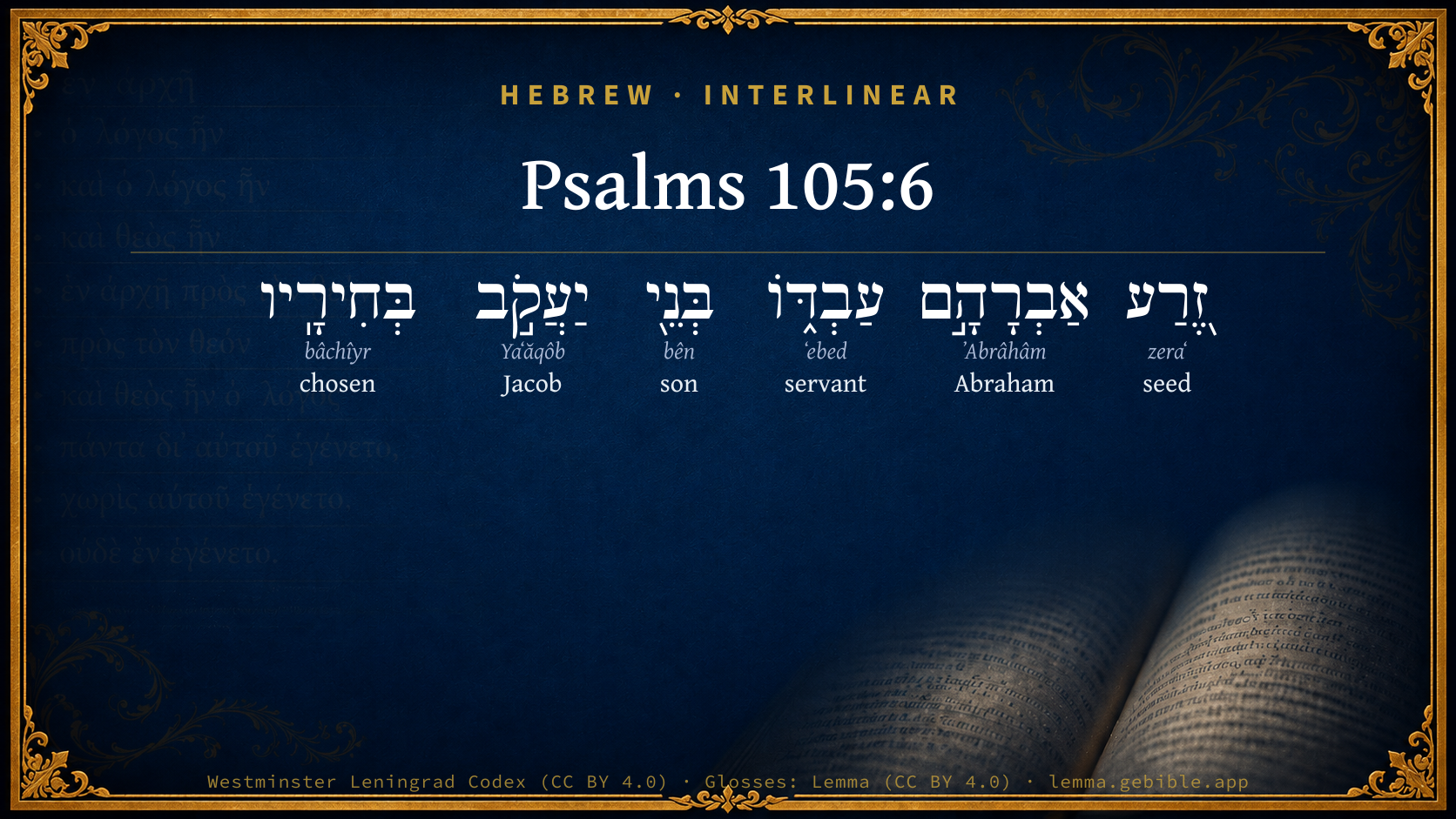
Psalms 105:6

Hebrew (Westminster Leningrad Codex) Psalms 105:6 appears in the Hebrew Old Testament. The text above is from the Westminster Leningrad Codex. Each word links to its Strong’s number, a concise gloss, and parsing drawn from the Open Scriptures Hebrew Bible morphology. Click any word for its full Brown-Driver-Briggs (BDB) entry.
Download image
Cite this verse

Psalms 105:6 (World English Bible). Public Domain. Lemma interlinear Bible study tool, https://lemma.gebible.app/v/psalms/105/6.

Show BibTeX & RIS
BibTeX
RIS
English Translation
You seed of Abraham, his servant, You children of Jacob, his chosen ones.
World English Bible · Public Domain
Download a study sheet

One document with this verse’s original text, its word-by-word gloss line, the meaning frame, cross-references with their text, attributed commentary, and full source and license credits — printable, and it pastes into notes with its structure intact.

This verse Autodidact and up

Study sheet (.html) Plain text (.txt)

A passage Seminary Student

Up to 50 verses in one chapter. A passage sheet keeps up to 6 commentary sources and 12 cross-references per verse, in the order this page ranks them, and says so on the sheet whenever that leaves anything out. Ask for a single verse and you get the Autodidact verse sheet above.

Everything on this page stays free to read, with no account — the sheet is a download of what is already on screen, not access to it.

Want to remove ads? Support Godless Engineer
Compare translations 3

The same verse in 3 English versions, stacked beneath the original-language interlinear above. Click any original word for its lexicon entry.

Each is an independent rendering of the whole verse — the interlinear is not word-aligned to these translations.

Highlighted words mark where these versions differ — a whole-verse word diff, not a word-by-word alignment.

  • World English Bible Public Domain
    You seed of Abraham, his servant, You children of Jacob, his chosen ones.
  • King James Version Public Domain
    O ye seed of Abraham his servant, ye children of Jacob his chosen.
  • unfoldingWord Literal Text CC BY-SA 4.0
    seed of Abraham his servant, sons of Jacob, his chosen ones.

unfoldingWord Literal Text — © unfoldingWord, licensed CC BY-SA 4.0. Word-aligned USFM3 via Door43 (git.door43.org/unfoldingWord/en_ult).

Versions to compare (up to 4)

3 of 4 selected

Show all 18 translations

Every available English version of this verse, each an independent rendering of the whole verse.

  • World English Bible Public Domain
    You seed of Abraham, his servant, You children of Jacob, his chosen ones.
  • Berean Standard Bible Public Domain
    O offspring of His servant Abraham, O sons of Jacob, His chosen ones.
  • Majority Standard Bible Public Domain
    O offspring of His servant Abraham, O sons of Jacob, His chosen ones.
  • King James Version Public Domain
    O ye seed of Abraham his servant, ye children of Jacob his chosen.
  • American Standard Version (1901) Public Domain
    O ye seed of Abraham his servant, Ye children of Jacob, his chosen ones.
  • Revised Version (1885) Public Domain
    O ye seed of Abraham his servant, ye children of Jacob, his chosen ones.
  • Geneva Bible (1599) Public Domain
    Ye seede of Abraham his seruant, ye children of Iaakob, which are his elect.
  • Douay-Rheims (1899) Public Domain
    O ye seed of Abraham his servant; ye sons of Jacob his chosen.
  • Young's Literal Translation Public Domain
    O seed of Abraham, His servant, O sons of Jacob, His chosen ones.
  • Literal Standard Version CC BY-SA 4.0
    O seed of Abraham, His servant, || O sons of Jacob, His chosen ones.
  • Unlocked Literal Bible CC BY-SA 4.0
    you descendants of Abraham his servant, you people of Jacob, his chosen ones.
  • unfoldingWord Literal Text CC BY-SA 4.0
    seed of Abraham his servant, sons of Jacob, his chosen ones.
  • Darby Bible Public Domain
    Ye seed of Abraham his servant, ye sons of Jacob, his chosen ones.
  • World Messianic Bible Public Domain
    you offspring of Abraham, his servant, you children of Jacob, his chosen ones.
  • Webster's Bible Public Domain
    O ye seed of Abraham his servant, ye children of Jacob his chosen.
  • Free Bible Version CC BY-SA 4.0
    descendants of Abraham, children of Israel, his chosen people.
  • Bible in Basic English Public Domain
    O you seed of Abraham, his servant, you children of Jacob, his loved ones.
  • JPS Tanakh (1917) Public Domain
    O ye seed of Abraham His servant, ye children of Jacob, His chosen ones.

Literal Standard Version (2020), Covenant Press — licensed CC BY-SA 4.0. Text via the HelloAO Bible API (eBible.org). Unlocked Literal Bible (unfoldingWord) — licensed CC BY-SA 4.0. Text via the HelloAO Bible API (eBible.org). unfoldingWord Literal Text — © unfoldingWord, licensed CC BY-SA 4.0. Word-aligned USFM3 via Door43 (git.door43.org/unfoldingWord/en_ult). Free Bible Version, Dr. Jonathan Gallagher — licensed CC BY-SA 4.0. Text via the HelloAO Bible API (eBible.org).

Word by word

More ways to search: Search by grammar → Find every occurrence → Compare this word →

Practice this passage: Drill this verse → Learn its vocabulary →

About this verse

These counts appear in no published source. They are computed here, from the morphology-tagged text and Lemma’s own curated glosses. What Lemma adds →

6
words
6
distinct lemmas
Wisdom
section

Notable vocabulary

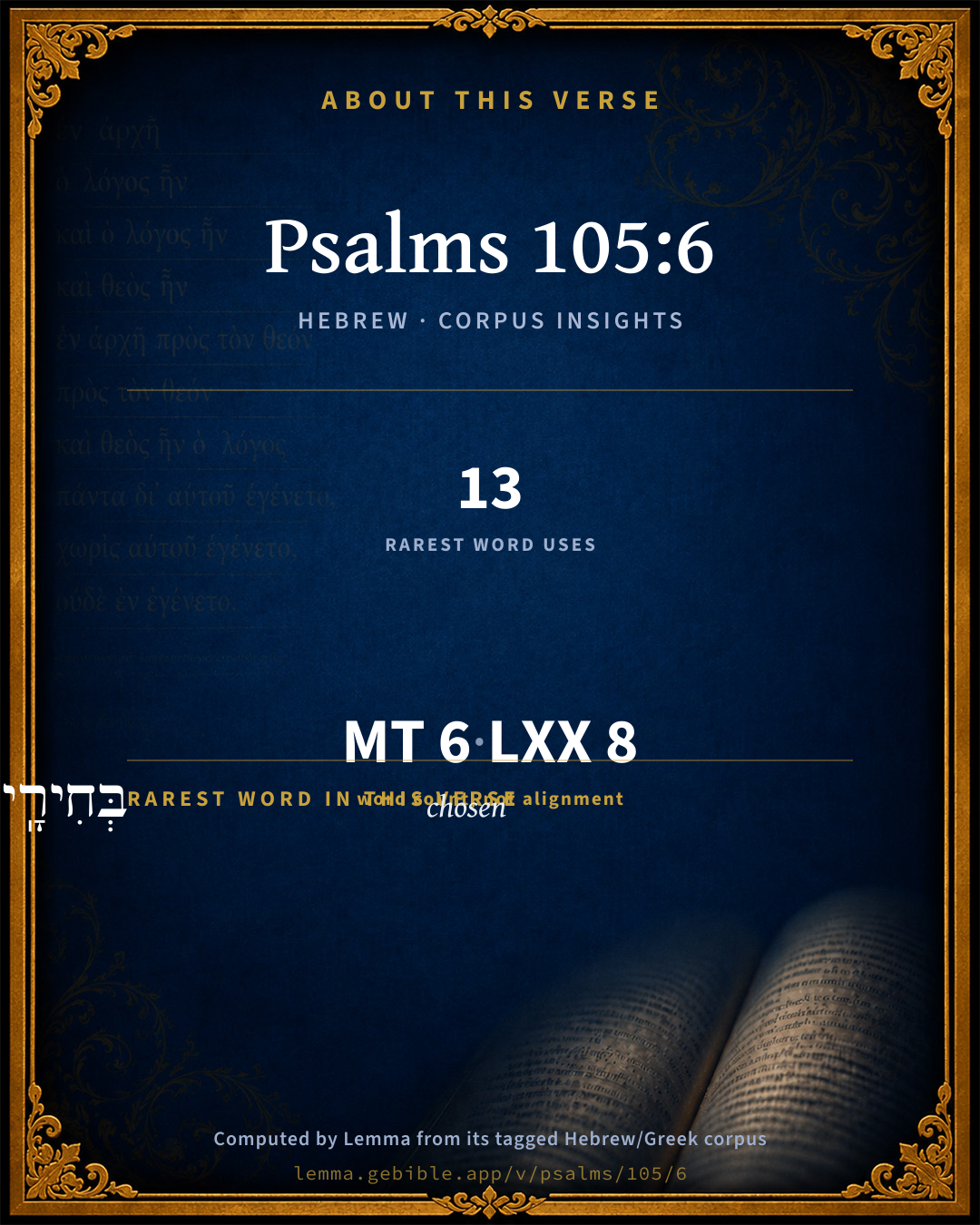
The rarest word here is בְּחִירָֽיו chosen H972 — appearing just 13 times in the whole Hebrew Bible.

Shared distinctive vocabulary

בְּחִירָֽיו chosen H972 occurs in 13 verses of the Hebrew Bible. Also found in:

Grammatical profile

  • 5 nouns
  • 1 adjective

Hebrew & Septuagint length

In English translation the verse runs 13 words from the Hebrew and 13 from the Septuagint (LXX English) — the same length.

A rough comparison of the two English renderings, which tokenize alike — not a word-level alignment.

Word counts can differ between the Hebrew and the Greek without any difference in meaning — e.g. the Hebrew direct-object marker אֵת has no separate Greek word, and Greek often adds the article ὁ.

In the original languages it is 6 Hebrew tokens and 8 Greek tokens — but the two are counted differently (Hebrew bundles its prefixes and suffixes into one token; the Greek is in lemma form), so that isn’t a like-for-like length.

Cross-references

11

Topical passages linked to Psalms 105:6 in the Treasury of Scripture Knowledge — connected by theme and wording, ordered by reader-vote popularity; previews shown in the World English Bible.

  • Isaiah 44:1–2 Yet now hear, Jacob my servant, and Israel, who I have chosen:
  • John 15:16 You didn't choose me, but I chose you, and appointed you, that you should go and bear fruit, and that your fruit should remain; that whatever you will ask of the Father in my name, he may give it to you.
  • 1 Peter 2:9 But you are a chosen race, a royal priesthood, a holy nation, a people for God's own possession, that you may show forth the excellencies of him who called you out of darkness into his marvelous light:
  • Isaiah 41:8 But you, Israel, my servant, Jacob whom I have chosen, the seed of Abraham my friend,
  • Exodus 3:6 Moreover he said, "I am the God of your father, the God of Abraham, the God of Isaac, and the God of Jacob." Moses hid his face; for he was afraid to look at God.
  • Deuteronomy 7:6–8 For you are a holy people to Yahweh your God: Yahweh your God has chosen you to be a people for his own possession, above all peoples who are on the face of the earth.
  • Psalms 105:42 For he remembered his holy word, And Abraham, his servant.
  • Psalms 106:5 That I may see the prosperity of your chosen, That I may rejoice in the gladness of your nation, That I may glory with your inheritance.
  • Psalms 135:4 For Yah has chosen Jacob for himself; Israel for his own possession.
  • Isaiah 41:14 Don't be afraid, you worm Jacob, and you men of Israel; I will help you, says Yahweh, and your Redeemer is the Holy One of Israel.
  • Romans 9:4–29 who are Israelites; whose is the adoption, the glory, the covenants, the giving of the law, the service, and the promises;

Cross-references courtesy of OpenBible.info (CC BY 4.0).

Hebrew and Greek witnesses Masoretic Hebrew ↔ Greek Septuagint

The same verse in the two great witnesses to the Old Testament, shown verse-for-verse.

You’re reading Greek Psalm 104 (Hebrew Psalm 105). The Septuagint counts the superscription, so verse numbers can differ from the Hebrew — chapter-level alignment, not verse-by-verse. Numbering follows Rahlfs.

These are two independent witnesses, not word-aligned to each other, and the Septuagint is shown in lemma (dictionary) form.

Hebrew Psalms 105:6 Masoretic · Westminster Leningrad Codex

זֶ֭רַע אַבְרָהָ֣ם עַבְדּ֑וֹ בְּנֵ֖י יַעֲקֹ֣ב בְּחִירָֽיו

You seed of Abraham, his servant, You children of Jacob, his chosen ones.

World English Bible · Public Domain

Greek LXX Greek Psalm 104:6 Septuagint · lemma form

σπέρμα ἀβραάμ δοῦλος αὐτός υἱός ἰακώβ ἐκλεκτός αὐτός

you⌃ seed of Abraam, his servants, you⌃ children of Jacob, his chosen ones.

LXX2012 (modern English Septuagint) · Public Domain

On this verse, The Cambridge Bible for Schools and Colleges discusses the Septuagint’s reading. Read the note in Commentary ↓

Hebrew: Westminster Leningrad Codex (CC BY 4.0). Greek: Septuagint (public domain); English from LXX2012 (modern English Septuagint) (Public Domain). How the Septuagint differs from the Hebrew →

Commentary

Notes on Psalms 105:6 from classic Christian and Jewish commentators (each source and its license shown beneath its notes). The classic Christian expositions comment on the surrounding passage and are grouped to its opening verse, so a note may address several verses; the Jewish commentaries on the Tanakh (Rashi and others) are per-verse, so they appear only where the commentator wrote on this verse.

Lemma curates 59 commentaries, every one of them public domain or Creative Commons licensed, each selected and text-cleaned for this edition rather than reprinted as found. About our sources →

Trapp's Complete Commentary

John Trapp

Psa 105:6 O ye seed of Abraham his servant, ye children of Jacob his chosen.

Ver. 6. O ye seed of Abraham, &c.] Do thus, or else your pedigree will profit you no more than it did Dives in the flames, that Abraham called him son. An empty title yieldeth but an empty comfort.

John Trapp, A Commentary or Exposition upon All the Books of the Old and New Testament (1647–1656) — public domain. Text from a community e-Sword module.

J. A. Alexander on Psalms

Joseph Addison Alexander

6. (Psa 105:6) Ye seed of Abraham his servant, ye sons of Jacob, his chosen (ones). Descendants of the patriarchs, and therefore heirs of the patriarchal promises. The common version of the last phrase (his chosen), though exact, conveys a wrong idea, as it seems to make chosen an epithet of Jacob, which would also seem to be required by the parallelism; but the Hebrew word is plural, and describes the object of address as the church or chosen people. Compare Isa 65:9. Abraham is called the servant of God, in an emphatic sense, as being his chosen instrument and confidential agent. See above, on Psa 18:1, and compare Ps. xc. 1. The parallel passage (1Ch 16:13) has Israel his servant.

Joseph Addison Alexander, The Psalms Translated and Explained (1850) — public domain. Text from a community e-Sword module.

Tyndale Open Study Notes

Tyndale Open Resources

105:6-11 The story of Israel is based on the Lord’s commitment to Abraham. Even when a question arises about the future of God’s covenant with David (Ps 89), God’s covenant with Abraham stands, as does the spiritual bond between God and Israel, Abraham’s descendants.

Tyndale Open Study Notes — © Tyndale Open Resources, licensed CC BY-SA 4.0. Text via the HelloAO Bible API.

Adam Clarke's Commentary

Verse 6. O ye seed of Abraham] Ye Jews especially, who have been the peculiar objects of the Divine favour.

Adam Clarke's Commentary on the Bible (1810–1826) — public domain. Text from a community e-Sword/MySword module.

John Calvin's Commentaries

6 Ye seed of Abraham his servant. The Psalmist addresses himself by name to his own countrymen, whom, as has been stated, God had bound to himself by a special adoption. It was a bond of union still more sacred, that by the mere good pleasure of God they were preferred to all other nations. By calling them the seed of Abraham, and the sons of Jacob, he reminds them that they had not attained so great dignity by their own power, but because they were descended from the holy fathers. He, however, affirms at the same time, that the holiness of their fathers flowed exclusively from God’s election, and not from their own nature. He expressly states both these truths, first, that before they were born children of Abraham, they were already heirs of the covenant, because they derived their origin from the holy fathers; and, secondly, that the fathers themselves had not acquired this prerogative by their own merit or worth, but had been freely chosen; for this is the reason why Jacob is called God’s chosen Although Abraham is also here called God’s servant, (Genesis 26:24) because he purely and sincerely worshipped him, yet in the second clause it is testified that the commencement of this distinction was not to be traced to men, but to God alone, who conferred upon the Israelites the honor of choosing them to be his peculiar possession.

From this covenant the Psalmist infers that although the government of God extends through the whole world, and although he executes his judgment in all places, he was nevertheless especially the God of that one people, (verse 7) according to the statement in the song of Moses,

“When the Most High divided to the nations their inheritance, when he separated the sons of Adam, he set the bounds of the people, according to the number of the children of Israel: For the Lord’s portion is his people; Jacob is the lot of his inheritance.” Deuteronomy 32:8, 9

The prophet again intended to show that the reason why the children of Israel excelled others was not because they were better than others, but because such was the good pleasure of God. If the divine judgments are extended through all the regions of the globe, the condition of all nations is in this respect equal. Whence it follows that the difference referred to proceeded from the love of God, — that the source of the superiority of the Israelites to other nations was his free favor. Although, then, He is the rightful proprietor of the whole earth, it is declared that he chose one people over whom he might reign. This is a doctrine which applies to us also at the present day. If we duly ponder our calling, we will undoubtedly find that God has not been induced from anything out of himself to prefer us to others, but that he was pleased to do so purely from his own free grace.

John Calvin's Commentaries (1540-1563) — public domain. Text from the Calvin Translation Society English edition (1840s-50s) via the Christian Classics Ethereal Library (ccel.org). Calvin's coverage is partial (roughly two-thirds of the Bible); uncommented books and verses are honest gaps, never fabricated. The 19th-century editor's footnotes and remarks are omitted so the notes are faithfully Calvin's own voice.

The Cambridge Bible for Schools and Colleges

gen. ed. J. J. S. Perowne

6. Grammatically, his servant may refer either to Abraham or to seed of Abraham. The parallelism is in favour of the latter construction, and the LXX and Jer. actually read his servants: but exact parallelism is not always maintained, and Psa_105:42 is decidedly in favour of connecting his servant with Abraham. For Abraham Chron. reads Israel.

his chosen] R.V. his chosen ones, to avoid the ambiguity of the A.V. Cp. Psa_105:43; Psa_106:5; Deu_4:37; &c.

This verse is to be connected with Psa_105:1-5 : the form of address reminds the Israelites at once of their privilege and their duty.

The Cambridge Bible for Schools and Colleges (gen. ed. J. J. S. Perowne; Cambridge University Press, 1878–1918) — public domain. Text from a community e-Sword module.

John Gill's Exposition

O ye seed of Abraham his servant,.... These are the persons all along before addressed; the Israelites, who descended from Abraham, were his natural seed and offspring, and who had reason to give thanks unto the Lord and praise his name, since so many and such wonderful things had been done for them; though all that were his natural seed were not the children of God; and such who have the same faith he had, and tread in the steps he did, are Christ's, and partakers of his grace; these are Abraham's seed, and heirs according to the promise; and are under the greatest obligations to praise the Lord. Abraham is here called his servant, as also in Psa 105:42, being a true worshipper of God; though sometimes his friend, which is not inconsistent; though this character, according to the Septuagint, Vulgate Latin, and all the Oriental versions, belongs to his seed, they rendering it in the plural, "his servants". It follows,

ye children of Jacob his chosen; this is added to distinguish the persons intended from the other seed of Abraham in the line of Ishmael; for in Isaac his seed was called, which were the children of the promise, and that in the line of Jacob, and not in the line of Esau; from whom they were called Israel or Israelites, a people whom the Lord chose above all people on the face of the earth; for the word "chosen" may be connected with the children as well as with Jacob. The whole spiritual Israel of God, whether Jews or Gentiles, all such who are Israelites indeed, as they appear to be the chosen of God, so they are bound to praise his name.

John Gill's Exposition of the Whole Bible (1746–1763) — public domain (CC PDM 1.0). Text via the HelloAO Bible API.

Albert Barnes' Notes on the Bible

O ye seed of Abraham his servant, ye children of Jacob his chosen - All you who are descendants of Abraham and Jacob; the former being particularly mentioned here because he was the great ancestor of the Hebrew people; the latter, because the events referred to were closely connected with the history of Jacob - with his going down into Egypt, and with the division of the tribes named after his sons. The word rendered “his chosen” would seem in our version to refer to Jacob. In the original, however, it is in the plural number, and must agree with the word rendered “children,” “Ye chosen sons of Jacob” (compare Psa 105:43). So it has been translated in 1Ch 16:13, “Ye children of Jacob, his chosen ones.”

Albert Barnes' Notes on the Bible (1834–1885) — public domain. Text from a community e-Sword/MySword module.

Matthew Poole's English Annotations

Children of Jacob; to whom he restrains the former more general expression, because these were the only branch of Abraham’s seed to whom the following covenant and blessings belong.

Matthew Poole's English Annotations on the Holy Bible (1683–1685) — public domain. Text from a community e-Sword/MySword module.

The Treasury of David

Charles H. Spurgeon

Ver. 6. O ye seed of Abraham his servant, ye children of Jacob his chosen. Should all the world forget, ye are bound to remember. Your father Abraham saw his wonders and judgments upon Sodom, and upon the kings who came from far, and Jacob also saw the Lord's marvellous works in visiting the nations with famine, yet providing for his chosen a choice inheritance in a goodly land; therefore let the children praise their father's God. The Israelites were the Lord's elect nation, and they were bound to imitate their progenitor, who was the Lord's faithful servant and walked before him in holy faith: the seed of Abraham should not be unbelieving, nor should the children of so true a servant become rebels. As we read this pointed appeal to the chosen seed we should recognise the special claims which the Lord has upon ourselves, since we too have been favoured above all others. Election is not a couch for case, but an argument for sevenfold diligence. If God has set his choice upon us, let us aim to be choice men.

Ver. 6. O ye seed of Abraham his servant. Consider the relation ye stand in to him. Ye are "the seed of Abraham his servant"; you are born in his house, and being thereby entitled to the privilege of his servants, protection and provision, you are also bound to do the duty of servants, to attend your master, consult his honour, obey his commands, and do what you can to advance his interests. Matthew Henry.

Psalms 105:7*

Charles H. Spurgeon's The Treasury of David (1869–1885) — public domain. Psalms only. Text from a community e-Sword/MySword module.

Whedon's Commentary on the Bible

Daniel D. Whedon

6. Abraham… Jacob—He reminds them of their holy ancestry: they are the children of those whom God had called, and chosen, and loved; and he grounds the foregoing exhortation in these hallowed relations and memories.

Daniel D. Whedon (gen. ed.), Commentary on the Old and New Testaments (1874–1909) — public domain. Text from a community e-Sword module.

The Pulpit Commentary

O ye seed of Abraham his servant; i.e. "his faithful and obedient follower". (see below, ver. 42; and comp. Gen_26:24 Gal_3:9) Ye children of Jacob his chosen; rather, his chosen ones. The word is in the plural, and must be referred, not to "Jacob," but to "children."

The Pulpit Commentary (1880–1919), ed. H.D.M. Spence-Jones & Joseph S. Exell — public domain. Text from a community e-Sword module.

John Wesley's Explanatory Notes

Of Jacob - The only branch of Abraham's seed to whom the following blessings belong.

John Wesley, Explanatory Notes Upon the Whole Bible (1754–1765) — public domain. Text via the GEBible commentary corpus.

Lesson kit

Teaching starters — assembled from the data on this page, not authored interpretation. Every prompt links to the verse data it draws on. Edit before teaching.

Psalms, in the Wisdom, opens this verse with 6 words (6 distinct Hebrew lemmas). Its most distinctive word is bâchîyr (“chosen”). A historical commentator’s framing appears above. Read the whole chapter for the surrounding context.

Discussion questions

  1. How does “chosen” (bâchîyr) shape what this verse is saying?
  2. 2 Samuel 21:6 shares the word «chosen» with this verse. How do the two illuminate each other?
  3. These translations render this verse differently. What is at stake in choosing one wording over another?
  4. Reading how Trapp's Complete Commentary and J. A. Alexander on Psalms read this verse, where do the two commentators agree and where do they part?

Things to notice

Reading settings

Reading text

Shown beneath each verse's original-language words.

Old Testament
Old Testament edition

Read the OT as the Masoretic Hebrew (MT) or the Greek Septuagint (LXX).

English shown for the Greek Septuagint (in the Hebrew ↔ Greek comparison).

Comparing translations? Open the Compare panel on any verse page to stack up to four side by side.