

Colossians 3:25
Greek (Tischendorf 8th ed.) Colossians 3:25 appears in the Greek New Testament. The text above is from the Tischendorf 8th edition. Each word links to its Strong’s number and a concise gloss. Click any word for its full Thayer’s Greek Lexicon entry.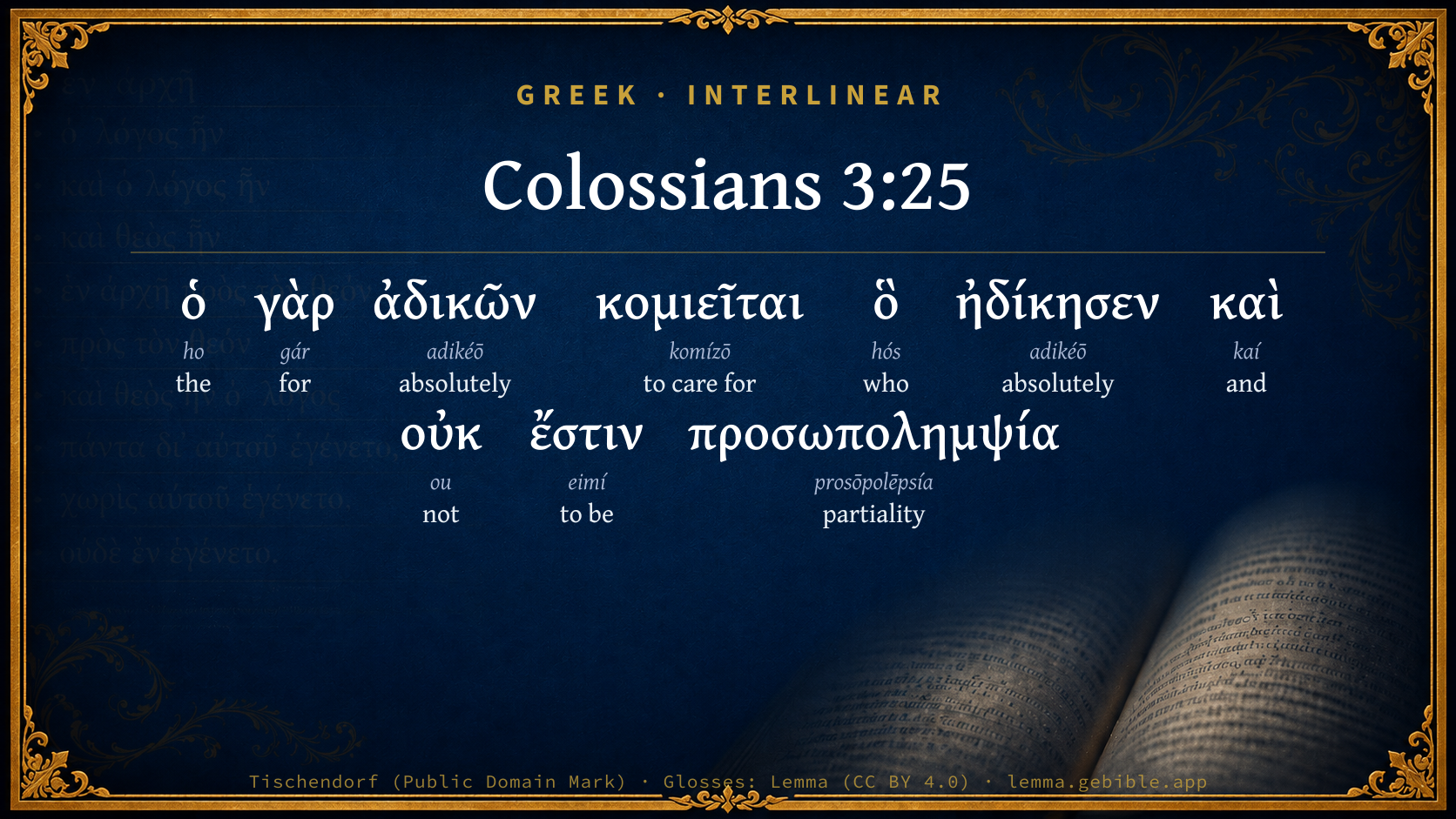
But he who does wrong will receive again for the wrong that he has done, and there is no partiality.
Download a study sheet
One document with this verse’s original text, its word-by-word gloss line, the meaning frame, cross-references with their text, attributed commentary, and full source and license credits — printable, and it pastes into notes with its structure intact.
This verse Autodidact and up
A passage Seminary Student
Up to 50 verses in one chapter. A passage sheet keeps up to 6 commentary sources and 12 cross-references per verse, in the order this page ranks them, and says so on the sheet whenever that leaves anything out. Ask for a single verse and you get the Autodidact verse sheet above.
Everything on this page stays free to read, with no account — the sheet is a download of what is already on screen, not access to it.
Compare translations 3
The same verse in 3 English versions, stacked beneath the original-language interlinear above. Click any original word for its lexicon entry.
Each is an independent rendering of the whole verse — the interlinear is not word-aligned to these translations.
Highlighted words mark where these versions differ — a whole-verse word diff, not a word-by-word alignment.
-
World English Bible Public Domain
But he who does wrong will receive again for the wrong that he has done, and there is no partiality.
-
King James Version Public Domain
But he that doeth wrong shall receive for the wrong which he hath done: and there is no respect of persons.
-
unfoldingWord Literal Text CC BY-SA 4.0
For the one doing unrighteousness will receive what he did unrighteously, and there is no favoritism.
unfoldingWord Literal Text — © unfoldingWord, licensed CC BY-SA 4.0. Word-aligned USFM3 via Door43 (git.door43.org/unfoldingWord/en_ult).
Show all 19 translations
Every available English version of this verse, each an independent rendering of the whole verse.
-
World English Bible Public Domain
But he who does wrong will receive again for the wrong that he has done, and there is no partiality.
-
Berean Standard Bible Public Domain
Whoever does wrong will be repaid for his wrong, and there is no favoritism.
-
Majority Standard Bible Public Domain
But whoever does wrong will be repaid for his wrong, and there is no favoritism.
-
King James Version Public Domain
But he that doeth wrong shall receive for the wrong which he hath done: and there is no respect of persons.
-
American Standard Version (1901) Public Domain
For he that doeth wrong shall receive again for the wrong that he hath done: and there is no respect of persons.
-
Revised Version (1885) Public Domain
For he that doeth wrong shall receive again for the wrong that he hath done: and there is no respect of persons.
-
Geneva Bible (1599) Public Domain
But he that doeth wrong, shall receiue for the wrong that he hath done: and there is no respect of persons.
-
Douay-Rheims (1899) Public Domain
For he that doth wrong, shall receive for that which he hath done wrongfully: and there is no respect of persons with God.
-
Young's Literal Translation Public Domain
and he who is doing unrighteously shall receive what he did unrighteously, and there is no acceptance of persons.
-
Literal Standard Version CC BY-SA 4.0
and he who is doing unrighteously will receive what he did unrighteously, and there is no favor by appearance.
-
Unlocked Literal Bible CC BY-SA 4.0
For anyone who does unrighteousness will receive the penalty for the unrighteousness that he did, and there is no favoritism.
-
unfoldingWord Literal Text CC BY-SA 4.0
For the one doing unrighteousness will receive what he did unrighteously, and there is no favoritism.
-
Darby Bible Public Domain
For he that does a wrong shall receive the wrong he has done, and there is no respect of persons.
-
World Messianic Bible Public Domain
But he who does wrong will receive again for the wrong that he has done, and there is no partiality.
-
Webster's Bible Public Domain
But he that doeth wrong, will receive for the wrong which he hath done: and there is no respect of persons.
-
Free Bible Version CC BY-SA 4.0
Whoever does what's wrong will be paid back for the wrong they've done, and God has no favorites.
-
Bible in Basic English Public Domain
For the wrongdoer will have punishment for the wrong he has done, without respect for any man's position.
-
Text-Critical English NT CC BY 4.0
But he who does wrong will be paid back the wrong that he has done, and there is no partiality.
-
Tyndale New Testament (1534) Public Domain
But he that doth wronge shall receave for the wronge that he hath done: for there is no respect of persons.
Literal Standard Version (2020), Covenant Press — licensed CC BY-SA 4.0. Text via the HelloAO Bible API (eBible.org). Unlocked Literal Bible (unfoldingWord) — licensed CC BY-SA 4.0. Text via the HelloAO Bible API (eBible.org). unfoldingWord Literal Text — © unfoldingWord, licensed CC BY-SA 4.0. Word-aligned USFM3 via Door43 (git.door43.org/unfoldingWord/en_ult). Free Bible Version, Dr. Jonathan Gallagher — licensed CC BY-SA 4.0. Text via the HelloAO Bible API (eBible.org).
Word by word
More ways to search: Search by grammar → Find every occurrence → Compare this word →
Practice this passage: Drill this verse → Learn its vocabulary →
- Appears 4× in the Greek New Testament
- First appears at Romans 2:11
- Part of Speech
- Noun
- Case
- Nominative
- Number
- Singular
- Gender
- Feminine
Full Thayer's Definition
- ὁ ho G3588 “the” Article, Nominative, Singular, Masculine
- γὰρ gár G1063 “for” Conjunction
- ἀδικῶν adikéō G91 “absolutely” Verb, Present, Active, Participle, Nominative, Singular, Masculine
- κομιεῖται komízō G2865 “to care for” Verb, Future, Middle, Indicative, 3rd person, Singular
- ὃ hós G3739 “who” Relative pronoun, Accusative, Singular, Neuter
- ἠδίκησεν adikéō G91 “absolutely” Verb, Aorist, Active, Indicative, 3rd person, Singular
- καὶ kaí G2532 “and” Conjunction
- οὐκ ou G3756 “not” Particle, Negative
- ἔστιν eimí G1510 “to be” Verb, Present, Active, Indicative, 3rd person, Singular
- προσωπολημψία prosōpolēpsía G4382 “partiality” Noun, Nominative, Singular, Feminine
About this verse
These counts appear in no published source. They are computed here, from the morphology-tagged text and Lemma’s own curated glosses. What Lemma adds →
- 10
- words
- 9
- distinct lemmas
- Pauline Epistles
- section
Notable vocabulary
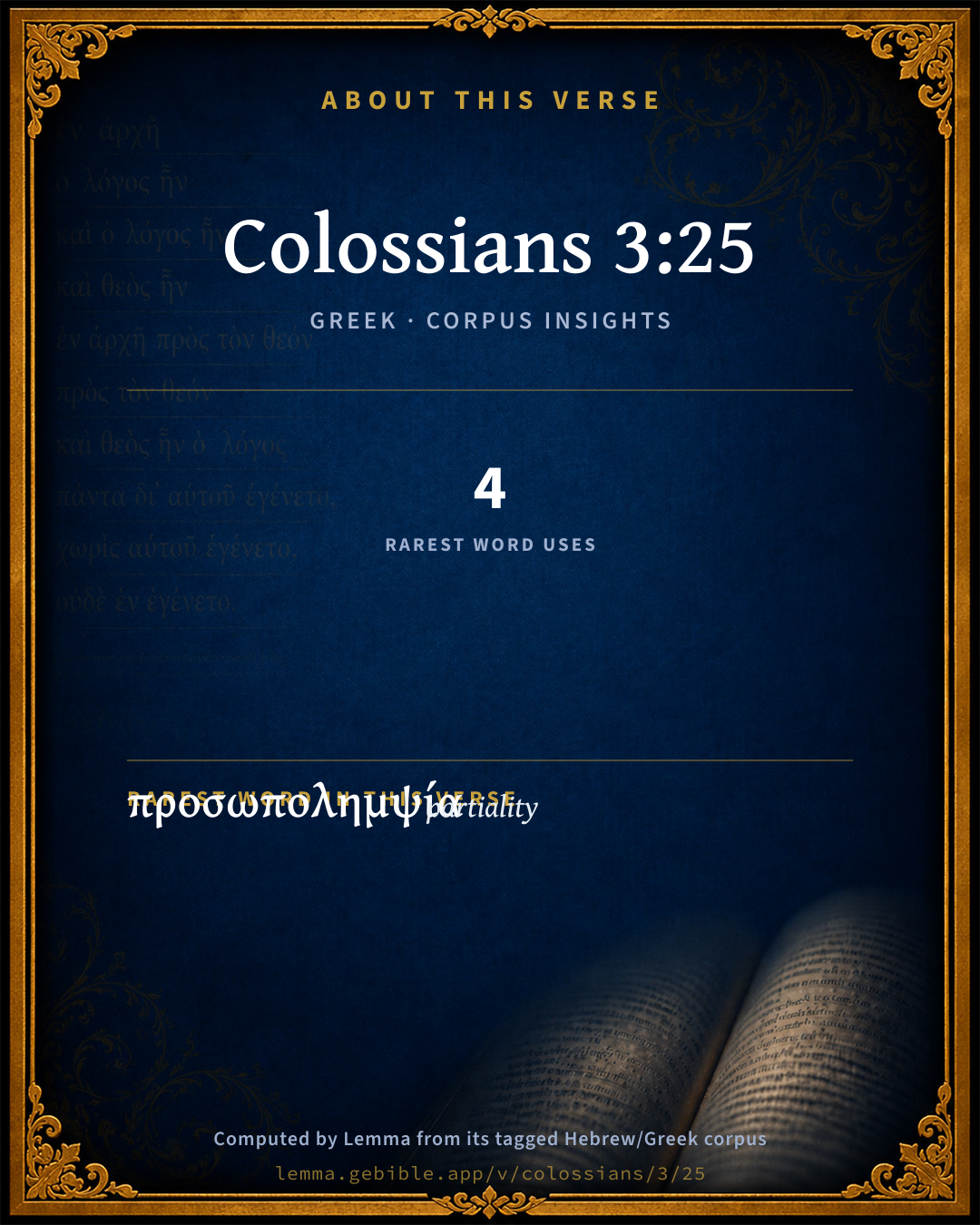
The rarest word here is προσωπολημψία partiality G4382 — appearing just 4 times in the whole Greek New Testament.
Shared distinctive vocabulary
προσωπολημψία partiality G4382 occurs in 4 verses of the Greek New Testament. Also found in:
Repetition
A word recurs within this verse:
- ἀδικῶν absolutely G91 ×2
Cross-references
18Topical passages linked to Colossians 3:25 in the Treasury of Scripture Knowledge — connected by theme and wording, ordered by reader-vote popularity; previews shown in the World English Bible.
- Acts 10:34 Peter opened his mouth and said, "Truly I perceive that God doesn't show favoritism;
- Romans 2:11 For there is no partiality with God.
- 2 Corinthians 5:10 For we must all be revealed before the judgment seat of Christ; that each one may receive the things in the body, according to what he has done, whether good or bad.
- Deuteronomy 10:17 For Yahweh your God, he is God of gods, and Lord of lords, the great God, the mighty, and the awesome, who doesn't regard persons, nor takes reward.
- 1 Thessalonians 4:6 that no one should take advantage of and wrong a brother or sister in this matter; because the Lord is an avenger in all these things, as also we forewarned you and testified.
- Ephesians 6:9 You masters, do the same things to them, and give up threatening, knowing that he who is both their Master and yours is in heaven, and there is no partiality with him.
- 2 Chronicles 19:7 Now therefore let the fear of Yahweh be on you; take heed and do it: for there is no iniquity with Yahweh our God, nor respect of persons, nor taking of bribes.
- 1 Peter 1:17 If you call on him as Father, who without respect of persons judges according to each man's work, pass the time of your living as strangers here in reverent fear:
- Colossians 4:1 Masters, give to your servants that which is just and equal, knowing that you also have a Master in heaven.
- Hebrews 2:2 For if the word spoken through angels proved steadfast, and every transgression and disobedience received a just recompense;
- Leviticus 19:15 "'You shall do no injustice in judgment: you shall not be partial to the poor, nor show favoritism to the great; but in righteousness shall you judge your neighbor.
- Deuteronomy 1:17 You shall not show partiality in judgment; you shall hear the small and the great alike; you shall not be afraid of the face of man; for the judgment is God's: and the cause that is too hard for you, you shall bring to me, and I will hear it.
- 2 Samuel 14:14 For we must needs die, and are as water split on the ground, which can't be gathered up again; neither does God take away life, but devises means, that he who is banished not be an outcast from him.
- Job 34:19 Who doesn't respect the persons of princes, Nor regards the rich more than the poor; For they all are the work of his hands.
- Job 37:24 Therefore men revere him. He doesn't regard any who are wise of heart."
- Luke 20:21 They asked him, "Teacher, we know that you say and teach what is right, and aren't partial to anyone, but truly teach the way of God.
- 1 Corinthians 6:7–8 Therefore it is already altogether a defect in you, that you have lawsuits one with another. Why not rather be wronged? Why not rather be defrauded?
- Jude 1:16 These are murmurers and complainers, walking after their lusts (and their mouth speaks proud things), showing respect of persons to gain advantage.
Cross-references courtesy of OpenBible.info (CC BY 4.0).
Lesson kit
Teaching starters — assembled from the data on this page, not authored interpretation. Every prompt links to the verse data it draws on. Edit before teaching.
Colossians, in the Pauline Epistles, opens this verse with 10 words (9 distinct Greek lemmas). Its most distinctive word is prosōpolēpsía (“partiality”). A historical commentator’s framing appears above. Read the whole chapter for the surrounding context.
Discussion questions
- What does “partiality” (prosōpolēpsía) contribute to the verse as a whole?
- Romans 2:11 shares the word «partiality» with this verse. How do the two illuminate each other?
- “absolutely” occurs 2× in this one verse. What is the effect of the repetition?
- The translations on this page render this verse differently — a whole-verse word diff, not a word-by-word alignment. What might account for the different wordings?
- Reading how The Biblical Illustrator and Bengel's Gnomon read this verse, where do the two commentators agree and where do they part?
Things to notice
- These translations choose different wording for 20 words in this verse.
- “absolutely” occurs 2× in this single verse.
- 9 distinct Greek lemmas span 10 words in this verse.
Commentary
Notes on Colossians 3:25 from classic Christian and Jewish commentators (each source and its license shown beneath its notes). The classic Christian expositions comment on the surrounding passage and are grouped to its opening verse, so a note may address several verses; the Jewish commentaries on the Tanakh (Rashi and others) are per-verse, so they appear only where the commentator wrote on this verse.
Lemma curates 59 commentaries, every one of them public domain or Creative Commons licensed, each selected and text-cleaned for this edition rather than reprinted as found. About our sources →
The Biblical Illustrator
Joseph S. Exell
The Biblical Illustrator, edited by Joseph S. Exell (c. 1880s–1900s) — public domain. Text from a community e-Sword module.
Bengel's Gnomon
Johann Albrecht Bengel
Bengel's Gnomon of the New Testament — English translation (T&T Clark, Edinburgh, 1860) — public domain. Text from a community e-Sword module.
Meyer's Critical & Exegetical Commentary
Heinrich August Wilhelm Meyer
Meyer — Critical and Exegetical Commentary on the New Testament — English translation by Peter Christie, edited by Frederick Crombie (T&T Clark, 1880) — public domain. Text from a community e-Sword module.
Expositor's Greek Testament
ed. W. Robertson Nicoll
The Expositor's Greek Testament, edited by W. Robertson Nicoll (1897–1910) — public domain. Text from a community e-Sword module.
Cambridge Greek Testament for Schools and Colleges
Cambridge Greek Testament for Schools and Colleges (Cambridge University Press, 1896; 21 vols, various authors incl. Carr, Maclear, Plummer, Farrar, Lumby, Moule, M. R. James, Simcox) — public domain. Text from a community e-Sword module.
Geneva Bible (1599)
Geneva Bible translators
Geneva Bible (1599) marginal notes — public domain. Text via Bolls.life.
Jamieson, Fausset & Brown
Robert Jamieson, A. R. Fausset & David Brown
Jamieson, Fausset & Brown — Commentary Critical and Explanatory on the Whole Bible (1871) — public domain (CC PDM 1.0). Text via the HelloAO Bible API.
Adam Clarke's Commentary
Adam Clarke's Commentary on the Bible (1810–1826) — public domain. Text from a community e-Sword/MySword module.
Ellicott's Commentary for English Readers
A Bible Commentary for English Readers, edited by Charles John Ellicott (1878–1897) — public domain. Text from a community e-Sword module.
The Cambridge Bible for Schools and Colleges
gen. ed. J. J. S. Perowne
The Cambridge Bible for Schools and Colleges (gen. ed. J. J. S. Perowne; Cambridge University Press, 1878–1918) — public domain. Text from a community e-Sword module.
John Gill's Exposition
John Gill's Exposition of the Whole Bible (1746–1763) — public domain (CC PDM 1.0). Text via the HelloAO Bible API.
Trapp's Complete Commentary
John Trapp
John Trapp, A Commentary or Exposition upon All the Books of the Old and New Testament (1647–1656) — public domain. Text from a community e-Sword module.
Matthew Poole's English Annotations
Matthew Poole's English Annotations on the Holy Bible (1683–1685) — public domain. Text from a community e-Sword/MySword module.
The Pulpit Commentary
The Pulpit Commentary (1880–1919), ed. H.D.M. Spence-Jones & Joseph S. Exell — public domain. Text from a community e-Sword module.
Burkitt's Expository Notes on the New Testament
William Burkitt
William Burkitt's Expository Notes on the New Testament (1700–1703) — public domain. Text from a community e-Sword module.
The People's New Testament
B. W. Johnson
B. W. Johnson's The People's New Testament with Notes (1889–1891) — public domain. Electronic text from the Christian Classics Ethereal Library (CCEL) ThML edition.
Alford’s Greek Testament
Henry Alford
Henry Alford, The Greek Testament (1849–1861) — public domain. Text from a community e-Sword module.
International Critical Commentary
International Critical Commentary — older volumes (1896–1929), various authors — public domain. Text from a community e-Sword module.
Vincent's Word Studies in the New Testament
Marvin R. Vincent
Marvin R. Vincent, Word Studies in the New Testament (1887–1900) — public domain. Text from a community e-Sword/MySword module.
Lightfoot's Colossians and Philemon
J. B. Lightfoot
J. B. Lightfoot, St Paul's Epistles to the Colossians and Philemon: a revised text with introductions, notes and dissertations (London: Macmillan, 1875) — public domain. Electronic text from Project Gutenberg (ebook #50857). Covers Colossians and Philemon only (the verse-by-verse notes; introductions and dissertations are omitted); Lightfoot's companion Galatians and Philippians volumes are not included, as the available public-domain scans carry garbled Greek that cannot be faithfully reproduced.