
Proverbs 24:29

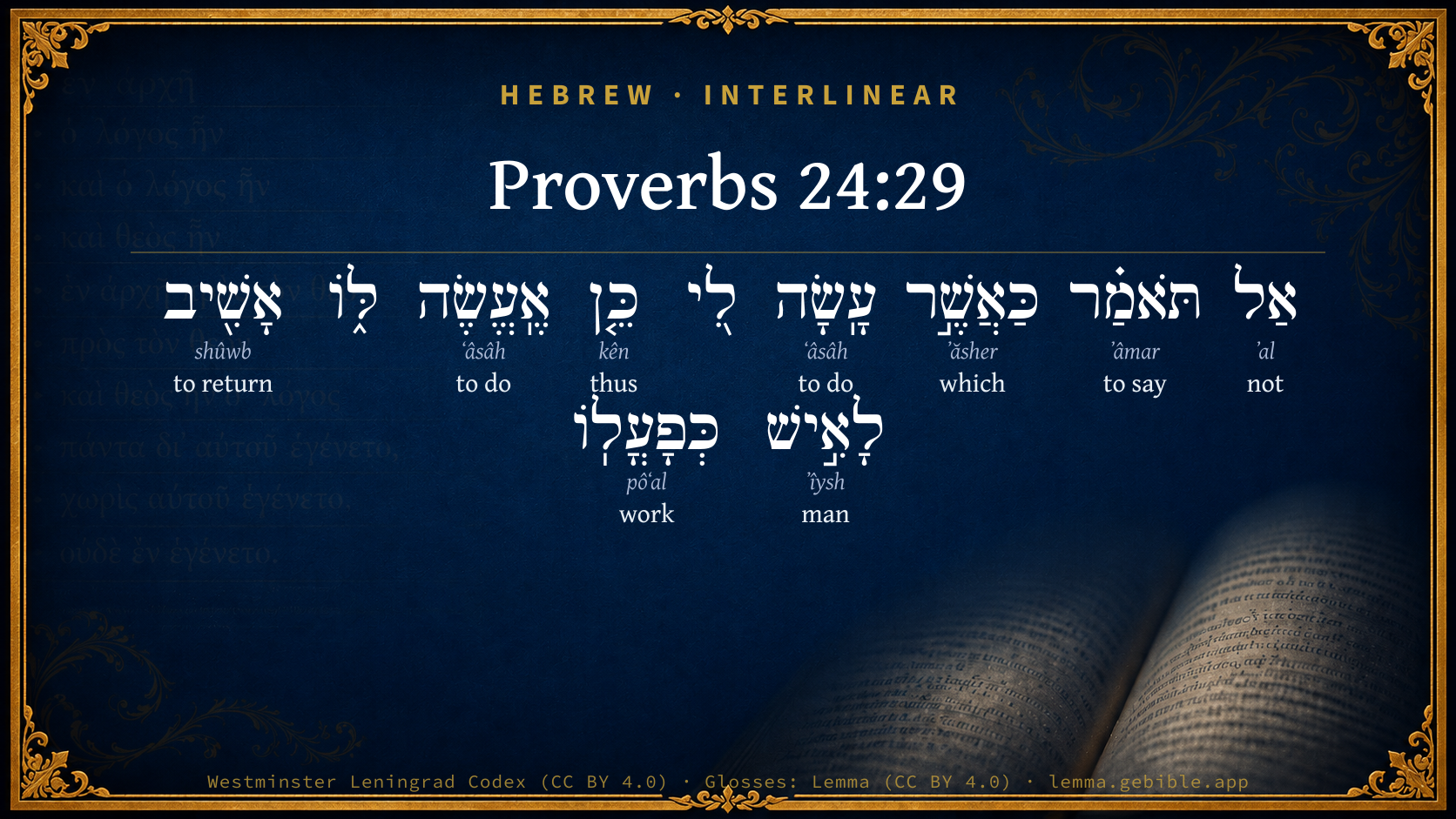
Hebrew (Westminster Leningrad Codex) Proverbs 24:29 appears in the Hebrew Old Testament. The text above is from the Westminster Leningrad Codex. Each word links to its Strong’s number, a concise gloss, and parsing drawn from the Open Scriptures Hebrew Bible morphology. Click any word for its full Brown-Driver-Briggs (BDB) entry.
Download image
Cite this verse

Proverbs 24:29 (World English Bible). Public Domain. Lemma interlinear Bible study tool, https://lemma.gebible.app/v/proverbs/24/29.

Show BibTeX & RIS
BibTeX
RIS
English Translation
Don't say, "I will do to him as he has done to me; I will render to the man according to his work."
World English Bible · Public Domain
Download a study sheet

One document with this verse’s original text, its word-by-word gloss line, the meaning frame, cross-references with their text, attributed commentary, and full source and license credits — printable, and it pastes into notes with its structure intact.

This verse Autodidact and up

Study sheet (.html) Plain text (.txt)

A passage Seminary Student

Up to 50 verses in one chapter. A passage sheet keeps up to 6 commentary sources and 12 cross-references per verse, in the order this page ranks them, and says so on the sheet whenever that leaves anything out. Ask for a single verse and you get the Autodidact verse sheet above.

Everything on this page stays free to read, with no account — the sheet is a download of what is already on screen, not access to it.

Want to remove ads? Support Godless Engineer
Compare translations 3

The same verse in 3 English versions, stacked beneath the original-language interlinear above. Click any original word for its lexicon entry.

Each is an independent rendering of the whole verse — the interlinear is not word-aligned to these translations.

Highlighted words mark where these versions differ — a whole-verse word diff, not a word-by-word alignment.

  • World English Bible Public Domain
    Don't say, "I will do to him as he has done to me; I will render to the man according to his work."
  • King James Version Public Domain
    Say not, I will do so to him as he hath done to me: I will render to the man according to his work.
  • unfoldingWord Literal Text CC BY-SA 4.0
    Do not say, “Just as he did to me, so I will do to him; I will return to the man according to his deed.”

unfoldingWord Literal Text — © unfoldingWord, licensed CC BY-SA 4.0. Word-aligned USFM3 via Door43 (git.door43.org/unfoldingWord/en_ult).

Versions to compare (up to 4)

3 of 4 selected

Show all 18 translations

Every available English version of this verse, each an independent rendering of the whole verse.

  • World English Bible Public Domain
    Don't say, "I will do to him as he has done to me; I will render to the man according to his work."
  • Berean Standard Bible Public Domain
    Do not say, “I will do to him as he has done to me; I will repay the man according to his work.”
  • Majority Standard Bible Public Domain
    Do not say, “I will do to him as he has done to me; I will repay the man according to his work.”
  • King James Version Public Domain
    Say not, I will do so to him as he hath done to me: I will render to the man according to his work.
  • American Standard Version (1901) Public Domain
    Say not, I will do so to him as he hath done to me; I will render to the man according to his work.
  • Revised Version (1885) Public Domain
    Say not, I will do so to him as he hath done to me; I will render to the man according to his work.
  • Geneva Bible (1599) Public Domain
    Say not, I wil doe to him, as he hath done to mee, I will recompence euery man according to his worke.
  • Douay-Rheims (1899) Public Domain
    Say not: I will do to him as he hath done to me: I will render to every one according to his work.
  • Young's Literal Translation Public Domain
    Say not, `As he did to me, so I do to him, I render to each according to his work.'
  • Literal Standard Version CC BY-SA 4.0
    Do not say, “As he did to me, so I do to him, || I render to each according to his work.”
  • Unlocked Literal Bible CC BY-SA 4.0
    Do not say, “I will do to him what he has done to me; I will pay him back for what he has done.”
  • unfoldingWord Literal Text CC BY-SA 4.0
    Do not say, “Just as he did to me, so I will do to him; I will return to the man according to his deed.”
  • Darby Bible Public Domain
    Say not, I will do so to him as he hath done to me, I will render to the man according to his work.
  • World Messianic Bible Public Domain
    Don’t say, “I will do to him as he has done to me; I will repay the man according to his work.”
  • Webster's Bible Public Domain
    Say not, I will do so to him as he hath done to me: I will render to the man according to his work.
  • Free Bible Version CC BY-SA 4.0
    Don't say to yourself, “I'm going to do to him what he did to me! I'll pay him back for what he's done!”
  • Bible in Basic English Public Domain
    Say not, I will do to him as he has done to me; I will give the man the reward of his work.
  • JPS Tanakh (1917) Public Domain
    Say not: 'I will do so to him as he hath done to me; I will render to the man according to his work.'

Literal Standard Version (2020), Covenant Press — licensed CC BY-SA 4.0. Text via the HelloAO Bible API (eBible.org). Unlocked Literal Bible (unfoldingWord) — licensed CC BY-SA 4.0. Text via the HelloAO Bible API (eBible.org). unfoldingWord Literal Text — © unfoldingWord, licensed CC BY-SA 4.0. Word-aligned USFM3 via Door43 (git.door43.org/unfoldingWord/en_ult). Free Bible Version, Dr. Jonathan Gallagher — licensed CC BY-SA 4.0. Text via the HelloAO Bible API (eBible.org).

Word by word

More ways to search: Search by grammar → Find every occurrence → Compare this word →

Practice this passage: Drill this verse → Learn its vocabulary →

כְּפָעֳלֽוֹ
pôʻal
H6467
“like/as · work · his”
Preposition + Noun, Common, Masculine, Singular, Construct + Suffix, Personal, 3rd Person, Masculine, Singular
Part of Speech
Preposition + Noun
Type
Common
Gender
Masculine
Number
Singular
State
Construct
Full BDB Definition

Origin: from H6466

TWOT: 1792a

work, deed, doing - deed, thing done - work, thing made - wages of work - acquisition (of treasure)
  1. אַל ʼal H408 “not” Particle, Negative
  2. תֹּאמַ֗ר ʼâmar H559 “to say” Verb, Qal, Jussive, 2nd Person, Masculine, Singular
  3. כַּאֲשֶׁ֣ר ʼăsher H834 “like/as · which” Preposition + Particle, Relative
  4. עָֽשָׂה ʻâsâh H6213 “to do” Verb, Qal, Perfect, 3rd Person, Masculine, Singular
  5. כֵּ֤ן kên H3651 “thus” Particle, Demonstrative
  6. אֶֽעֱשֶׂה ʻâsâh H6213 “to do” Verb, Qal, Imperfect, 1st Person, Common, Singular
  7. אָשִׁ֖יב shûwb H7725 “to return” Verb, Hiphil, Imperfect, 1st Person, Common, Singular
  8. לָאִ֣ישׁ ʼîysh H376 “to/for the · man” Preposition, Determined + Noun, Common, Masculine, Singular, Absolute

About this verse

These counts appear in no published source. They are computed here, from the morphology-tagged text and Lemma’s own curated glosses. What Lemma adds →

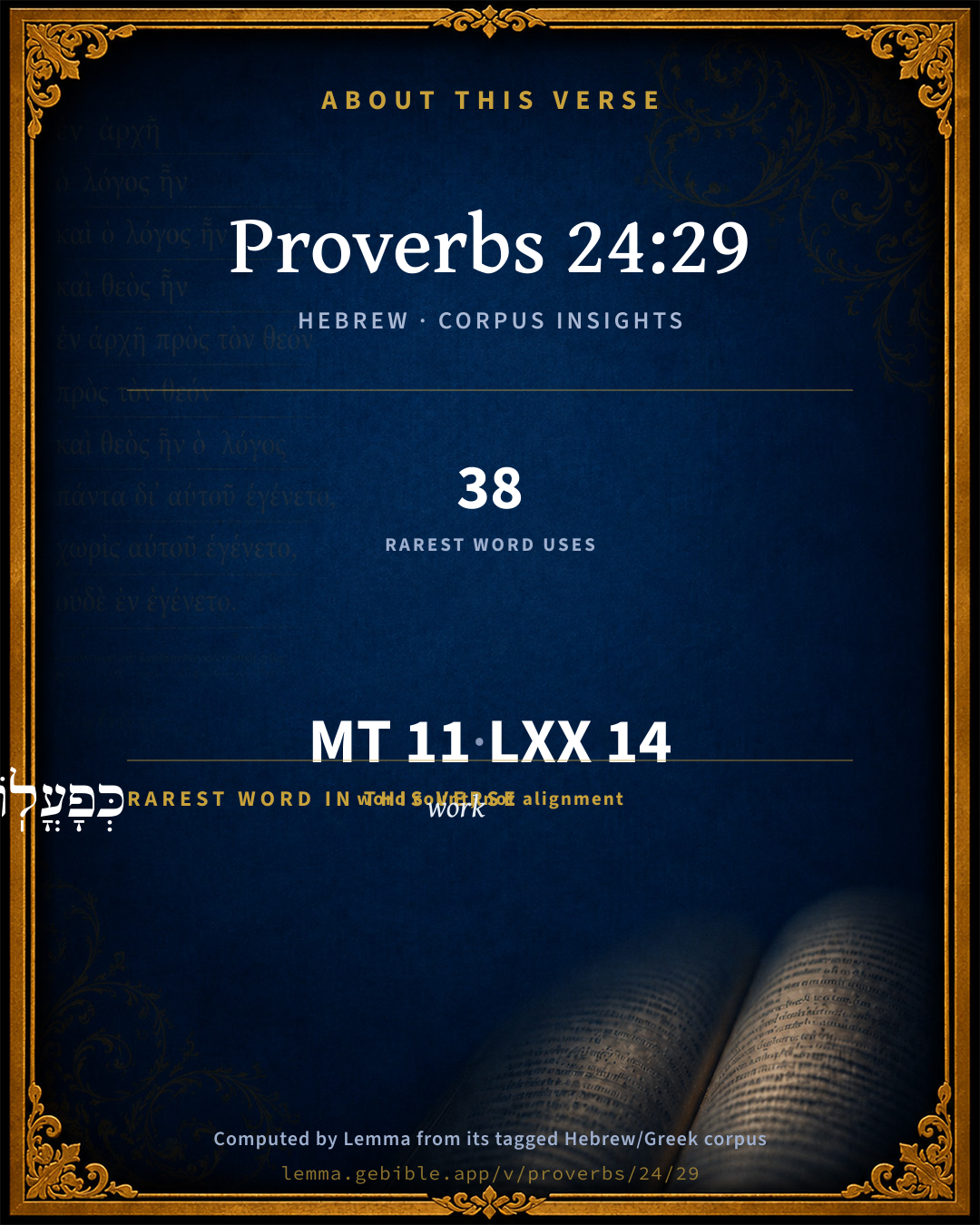
11
words
8
distinct lemmas
Wisdom
section

Shared distinctive vocabulary

כְּפָעֳלֽוֹ work H6467 occurs in 38 verses of the Hebrew Bible. Also found in:

Grammatical profile

  • 4 verbs
  • 2 nouns
  • 2 prepositions
  • 3 particles

Verb forms

  • תֹּאמַ֗ר Qal · Jussive
  • עָֽשָׂה Qal · Perfect
  • אֶֽעֱשֶׂה Qal · Imperfect
  • אָשִׁ֖יב Hiphil · Imperfect

Repetition

A word recurs within this verse — often emphatic in Hebrew:

  • עָֽשָׂה to do H6213 ×2

Hebrew & Septuagint length

In English translation the verse runs 23 words from the Hebrew and 26 from the Septuagint (LXX English) — closely comparable.

A rough comparison of the two English renderings, which tokenize alike — not a word-level alignment.

Word counts can differ between the Hebrew and the Greek without any difference in meaning — e.g. the Hebrew direct-object marker אֵת has no separate Greek word, and Greek often adds the article ὁ.

In the original languages it is 11 Hebrew tokens and 14 Greek tokens — but the two are counted differently (Hebrew bundles its prefixes and suffixes into one token; the Greek is in lemma form), so that isn’t a like-for-like length.

Cross-references

7

Topical passages linked to Proverbs 24:29 in the Treasury of Scripture Knowledge — connected by theme and wording, ordered by reader-vote popularity; previews shown in the World English Bible.

  • Proverbs 20:22 Don't say, "I will pay back evil." Wait for Yahweh, and he will save you.
  • Romans 12:17–21 Repay no one evil for evil. Respect what is honorable in the sight of all men.
  • 1 Thessalonians 5:15 See that no one returns evil for evil to anyone, but always follow after that which is good, for one another, and for all.
  • Proverbs 25:21–22 If your enemy is hungry, give him food to eat; If he is thirsty, give him water to drink:
  • Matthew 5:39–44 But I tell you, don't resist him who is evil; but whoever strikes you on your right cheek, turn to him the other also.
  • Judges 15:11 Then three thousand men of Judah went down to the cleft of the rock of Etam, and said to Samson, "Don't you know that the Philistines are rulers over us? What then is this that you have done to us?" He said to them, As they did to me, so have I done to them.
  • 2 Samuel 13:22–28 Absalom spoke to Amnon neither good nor bad; for Absalom hated Amnon, because he had forced his sister Tamar.

Cross-references courtesy of OpenBible.info (CC BY 4.0).

Hebrew and Greek witnesses Masoretic Hebrew ↔ Greek Septuagint

The same verse in the two great witnesses to the Old Testament, shown verse-for-verse.

These are two independent witnesses, not word-aligned to each other, and the Septuagint is shown in lemma (dictionary) form.

Hebrew Proverbs 24:29 Masoretic · Westminster Leningrad Codex

אַל תֹּאמַ֗ר כַּאֲשֶׁ֣ר עָֽשָׂה לִ֭י כֵּ֤ן אֶֽעֱשֶׂה לּ֑וֹ אָשִׁ֖יב לָאִ֣ישׁ כְּפָעֳלֽוֹ

Don't say, "I will do to him as he has done to me; I will render to the man according to his work."

World English Bible · Public Domain

Greek LXX Proverbs 24:29 Septuagint · lemma form

μή εἶπον ὅς τρόπος χράω ἐγώ χράω αὐτός τίνω δέ αὐτός ὅς ἐγώ ἀδικέω

Say not, As he has treated me, so will I treat him, and I will avenge myself on him for that wherein he has injured me.

LXX2012 (modern English Septuagint) · Public Domain

Hebrew: Westminster Leningrad Codex (CC BY 4.0). Greek: Septuagint (public domain); English from LXX2012 (modern English Septuagint) (Public Domain). How the Septuagint differs from the Hebrew →

Commentary

Notes on Proverbs 24:29 from classic Christian and Jewish commentators (each source and its license shown beneath its notes). The classic Christian expositions comment on the surrounding passage and are grouped to its opening verse, so a note may address several verses; the Jewish commentaries on the Tanakh (Rashi and others) are per-verse, so they appear only where the commentator wrote on this verse.

Lemma curates 59 commentaries, every one of them public domain or Creative Commons licensed, each selected and text-cleaned for this edition rather than reprinted as found. About our sources →

Trapp's Complete Commentary

John Trapp

Pro 24:29 Say not, I will do so to him as he hath done to me: I will render to the man according to his work.

Ver. 29. Say not, I will do so to him as he hath done to me.] Nothing is more natural than revenge of wrongs, and the world approves it as right temper, true touch, as to put up wrongs is held cowardice and unmanliness. But we have not so learned Christ. Nay, those that have never heard of Christ have spoken much against this vindictive disposition. {See Trapp on "Pro 20:22"} {See Trapp on "Mat 5:39"} {See Trapp on "Rom 12:17"}

I will render to the man according to his works.] But is not that God’s office? And will you needs leap into his chair - wring the sword out of his hand? or at least, will you be a pope in your own cause, depose the magistrate, or appeal from him to yourself? What Luciferian pride is this? Nemo te impune lacessit? Is not God the God of recompenses?

John Trapp, A Commentary or Exposition upon All the Books of the Old and New Testament (1647–1656) — public domain. Text from a community e-Sword module.

Geneva Bible (1599)

Geneva Bible translators

He showeth what is the nature of the wicked, to revenge wrong for wrong.

Geneva Bible (1599) marginal notes — public domain. Text via Bolls.life.

Jamieson, Fausset & Brown

Robert Jamieson, A. R. Fausset & David Brown

Especially avoid retaliation (Mat 5:43-45; Rom 12:17).

Jamieson, Fausset & Brown — Commentary Critical and Explanatory on the Whole Bible (1871) — public domain (CC PDM 1.0). Text via the HelloAO Bible API.

Ellicott's Commentary for English Readers

(29) Say not, I will do so to him as he hath done to me.—A wonderful anticipation this of New Testament teaching, very different from the spirit of Lev_24:19-20. Comp. Pro_20:22, and Jas_2:13, “For he shall have judgment without mercy that shewed no mercy.”

A Bible Commentary for English Readers, edited by Charles John Ellicott (1878–1897) — public domain. Text from a community e-Sword module.

The Cambridge Bible for Schools and Colleges

gen. ed. J. J. S. Perowne

29. See Pro_25:22 and note there.

The Cambridge Bible for Schools and Colleges (gen. ed. J. J. S. Perowne; Cambridge University Press, 1878–1918) — public domain. Text from a community e-Sword module.

John Gill's Exposition

And, lo, it was all grown over with thorns,.... Or "thistles" (y); which grow up of themselves, are the fruit of the curse, and the effect of slothfulness;

and nettles had covered the face thereof; so that nothing was to be seen but thorns and thistles, nettles and weeds; and such is the case of the souls of men when neglected, and no concern is had for them; so it is with carnal and worldly professors, who are overrun with the cares of this world, the deceitfulness of riches, and the lusts of other things, comparable to thorns and nettles for their piercing and stinging nature, and the unfruitfulness and unprofitableness of them; such are the thorny ground hearers, Mat 13:22; and such is the case of all unregenerate persons, whose souls are like an uncultivated field, and a neglected vineyard; in which grow naturally the weeds of sin and corruption, comparable to thorns and nettles for their spontaneous production, for the number of them, for their unfruitfulness, and for the pain and distress they bring when conscience is awakened; and because as such ground that bears thorns and nettles is nigh to cursing, and its end to be burned, which is their case; see Heb 6:8;

and the stone wall thereof was broken down; the fence about the fields, the wall about the vineyard, to keep out men and beasts; see Isa 5:2; which through slothfulness, and want of repair and keeping up, fell to decay, Ecc 10:18; and thus carnal professors and unregenerate men, having no guard upon themselves, are open and exposed to every sin, snare, and temptation; Satan has free egress and regress; the evil spirit can go out and come in when he pleases, and bring seven evil spirits more wicked than himself: indeed such is the evil heart of man that it needs no tempter; he is drawn aside of his own lust, and enticed; he is liable to every sin, and to fall into the utmost ruin; he has nothing to protect and defend him; not the Spirit, nor grace, nor power of God.

(y) "chamaeleones", Junius & Tremellius; "cardui", Piscator, Cocceius; "carduis", Michaelis, Schultens.

John Gill's Exposition of the Whole Bible (1746–1763) — public domain (CC PDM 1.0). Text via the HelloAO Bible API.

Albert Barnes' Notes on the Bible

A protest against vindictiveness in every form. Compare marginal reference.

Albert Barnes' Notes on the Bible (1834–1885) — public domain. Text from a community e-Sword/MySword module.

Haydock's Catholic Bible Commentary

Work. Revenge is often reprobated, though the law allowed of retaliation, which the more virtuous did not insist upon.

George Leo Haydock (1774–1849), Haydock's Catholic Family Bible and Commentary, 1859 edition — public domain. Excludes Psalms (Douay-Rheims chapter numbering differs from Protestant) and Deuterocanonical books (Catholic canon only).

Matthew Poole's English Annotations

Say not within thyself; give not way to any such thoughts or passions.

I will render to the man according to his work; I will repay him all his calumnies and injuries.

Matthew Poole's English Annotations on the Holy Bible (1683–1685) — public domain. Text from a community e-Sword/MySword module.

The Pulpit Commentary

The subject is still continued, as if the moralist would say, "Though a man has done you an injury by gratuitously testifying against you, do not you retaliate in the same way." Say not, I will do so to him as he hath done to me . (see Pro_20:22, and note there) The lex talionis should not be applied to private wrongs. The high morality of the Christian code is here anticipated, the Holy Spirit guiding both.

Rendering evil for evil.

It is interesting to note that this conduct is not only rebuked by Jesus Christ, but also forbidden in the Old Testament, and even in the Book of Proverbs, which is thought to deal too much in temporal and self-regarding motives. So utterly is it foreign to right mindedness. Yet it is most common, and apparently most natural.

I LET US CONSIDER HOW IT SEEMS NATURAL TO RENDER EVIL FOR EVIL.

1. It appears to be just. There is a natural fitness m things, and this seems to be satisfied by the lex talionis, "An eye for an eye, and a tooth for a tooth.

2. It offers to check evil. It appears to be a natural form of punishment. Indeed, it was sanctioned in rough, primitive times, though subject to judicial inquiry. (Exo_21:24)

3. It satisfies the craving for revenge. This is the reason which encourages it far more than considerations of abstract justice or anxiety about the public weal. "Revenge is sweet," and to restrain the impulse to strike an offender in return for his blow is hard and painful.

4. It agrees with prevalent customs. It is "after the manner of man" to avenge a wrong, and apparently the habit springs from innate instincts. At all events, it works without reflection. Therefore it appears to be a part of the economy of nature. To refuse it is like denying a natural appetite.

II LET US LEARN WHY IT IS WRONG TO RENDER EVIL FOR EVIL.

1. The sense of revenge lies in our lower nature. It is shared by the brute creation, like hunger and. lust. But it is aggravated by the sin of hatred and by selfishness. There is nothing noble or elevating in it. On the contrary, it drags us down. Long-suffering braces the moral fibres of the soul; revenge relaxes them.

2. We are not called upon to execute sentence on our fellow men. If there is to be a requital, this must come from God, to whom belongs just vengeance. (Rom_12:19) We are usurping the rights of God when we impatiently take it into our own hands. Moreover, we are the worst possible judges of our own rights. When deeply wounded, or irritated by insults, or blinded. by passion, we are not in a fit condition to exercise judicial functions. Yet it is just on such occasions that we are most tempted to wreak vengeance on the head of an offender.

3. It is our duty to forgive and save our fellow man. Even if punishment be due to him, vengeance from us is not owing. Our business is to seek to reclaim by "heaping coals of fire" on our wrong doer. Instead of doing to him as he has done to as, our Christian motto is to do to him as we would that he should do to us.

4. Revenge is un-Christlike. Christians are called to follow in the footsteps of the patient and brave Jesus, who was patient under provocation, even praying for his enemies.

5. Revenge is unseemly in those who need forgiveness. We are dependent on the mercy of God. He has not taken vengeance on us. But if we forgive not men their trespasses, neither will our heavenly Father forgive us our trespasses. Thus Portia rightly says to Shylock"Consider this That in the course of justice, none of us Should see salvation: we do pray for mercy; And that same prayer cloth teach us all to render The deeds of mercy.

The Pulpit Commentary (1880–1919), ed. H.D.M. Spence-Jones & Joseph S. Exell — public domain. Text from a community e-Sword module.

Keil & Delitzsch

C. F. Keil & F. Delitzsch

The following proverb is connected as to its subject with the foregoing: one ought not to do evil to his neighbour without necessity; even evil which has been done to one must not be requited with evil:

Say not, "As he hath done to me, so I do to him:

I requite the man according to his conduct."

On the ground of public justice, the talio is certainly the nearest form of punishment, Lev 24:19.; but even here the Sinaitic law does not remain in the retortion of the injury according to its external form (it is in a certain manner practicable only with regard to injury done to the person and to property), but places in its stead an atonement measured and limited after a higher point of view. On pure moral grounds, the jus talionis ("as thou to me, so I to thee") has certainly no validity. Here he to whom injustice is done ought to commit his case to God, Pro 20:22, and to oppose to evil, not evil but good; he ought not to set himself up as a judge, nor to act as one standing on a war-footing with his neighbour (Jdg 15:11); but to take God as his example, who treats the sinner, if only he seeks it, not in the way of justice, but of grace (Exo 34:6.). The expression 29b reminds of Pro 24:12. Instead of לאדם, there is used here, where the speaker points to a definite person, the phrase לאישׁ. Jerome, the Venet., and Luther translate: to each one, as if the word were vocalized thus, לאישׁ (Ps. 62:13).

Keil & Delitzsch — Biblical Commentary on the Old Testament (1861–1891) — public domain (CC PDM 1.0). Text via the HelloAO Bible API. (Old Testament only.)

Kretzmann's Popular Commentary

Paul E. Kretzmann

v. 29. Say not, I will do so to him as he hath done to me, the eagerness for revenge governing ones actions; I will render to the man according to his work. Cf Mat 5:43-45; Rom 12:17.

Paul E. Kretzmann, Popular Commentary of the Bible (1921–1924) — public domain. Text from a community e-Sword module.

Lesson kit

Teaching starters — assembled from the data on this page, not authored interpretation. Every prompt links to the verse data it draws on. Edit before teaching.

Proverbs, in the Wisdom, opens this verse with 11 words (8 distinct Hebrew lemmas). Its most distinctive word is pôʻal (“work”). A historical commentator’s framing appears above. Read the whole chapter for the surrounding context.

Discussion questions

  1. How does “work” (pôʻal) shape what this verse is saying?
  2. Deuteronomy 32:4 shares the word «work» with this verse. How do the two illuminate each other?
  3. “to do” occurs 2× in this one verse. What is the effect of the repetition?
  4. The translations on this page render this verse differently — a whole-verse word diff, not a word-by-word alignment. What might account for the different wordings?
  5. The verb «תֹּאמַ֗ר» is Qal Jussive. How does its form color the action?
  6. Reading how Trapp's Complete Commentary and Geneva Bible (1599) read this verse, where do the two commentators agree and where do they part?

Things to notice

Reading settings

Reading text

Shown beneath each verse's original-language words.

Old Testament
Old Testament edition

Read the OT as the Masoretic Hebrew (MT) or the Greek Septuagint (LXX).

English shown for the Greek Septuagint (in the Hebrew ↔ Greek comparison).

Comparing translations? Open the Compare panel on any verse page to stack up to four side by side.