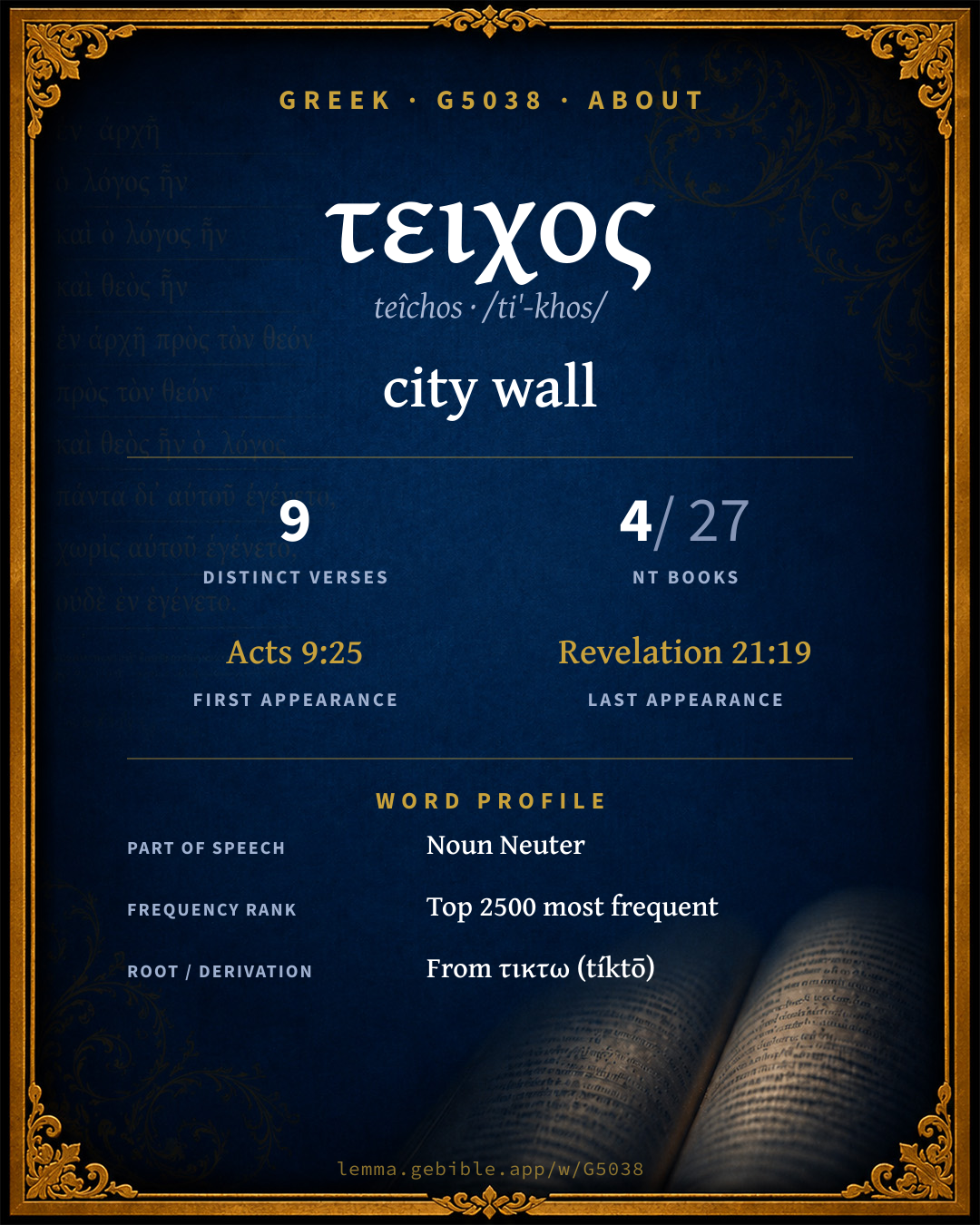
τεῖχος
city wall
Full lexicon entry — Thayer's Greek Lexicon
From Thayer's Greek Lexicon
Where this word appears
See every Accusative-case word in the Greek New Testament →
Grammar key — what these labels mean
Part of speech
- Noun
- A naming word — a person, place, thing, or idea.
Case
- Genitive
- The case of source, possession, or “of” — answers “whose / from what.”
- Accusative
- The case of the direct object and of extent.
- Nominative
- The case of the subject (and the predicate nominative).
Gender
- Neuter
- Grammatically neuter.
Number
- Singular
- One.
- Plural
- More than one.
3 verses where G5038 appears in the Accusative case in the Book of Revelation. Filtered view — show all forms. Click any verse to open its interlinear word-by-word view. Verse text shown in the World English Bible for context — . Each verse’s Greek form is shown with its reference; the English is not keyword-highlighted, since the data carries no word-level English alignment. Use “Compare translations” on any verse to read it across multiple English versions. This concordance covers the Greek New Testament; Septuagint (Greek Old Testament) occurrences of this word are not indexed here.
Revelation
- Revelation 21:12 τεῖχος n acc sg neut having a great and high wall; having twelve gates, and at the gates twelve angels; and names written on them, which are the names of the twelve tribes of the children of Israel.
- Revelation 21:15 τεῖχος n acc sg neut He who spoke with me had for a measure, a golden reed, to measure the city, its gates, and its walls.
- Revelation 21:17 τεῖχος n acc sg neut Its wall is one hundred forty-four cubits, by the measure of a man, that is, of an angel.
About this entry
At a glance — auto-summarized from this page’s data, not written by a person. Every figure links to its source below. This summary describes the numbers; it doesn’t interpret them.
τειχος (teîchos) is a Greek noun most often rendered “city wall.” It clusters heavily in Revelation, which alone accounts for 67% of its uses. It turns up in 9 verses across 4 books, an uncommon footprint. It first appears in Acts 9:25. From the same root come τικτω, τεχνη and τοκος. For the data behind this summary, explore the sense tree and the renderings breakdown below.
Gloss history
Strong's 1890 vs modern scholarship

About this word
Strong's G5038 catalogs a Greek word from the Greek New Testament.
These counts are not copied from any lexicon or concordance. They are computed here, from the morphology-tagged Greek New Testament. What Lemma adds →
- 9
- distinct verses
- The word appears in 9 distinct verses.
- 4 / 27
- NT books
- The word appears in 4 of 27 New Testament books.
- #1,140
- by frequency
- Top 2500 most frequent Greek words (rank 1,140 of 5,347 Greek words by occurrence).
View all 9 occurrences in the concordance →
Most concentrated in
- Revelation 6 verses 67%
- Acts 1 verse 11%
- 2 Corinthians 1 verse 11%
By section of the New Testament
By traditional corpus
Conventional, traditional groupings — biblical authorship is debated, so this is a traditional corpus grouping, not an authorship claim. Some books belong to more than one corpus (Luke is in both the Gospels and the Lukan corpus, and so on), so these shares overlap and need not total 100%. Each figure is a share of the word’s 9 distinct verses.
- Johannine 6 verses · 67%
- Revelation 6 verses · 67%
- Lukan (Luke–Acts) 1 verse · 11%
- Pauline corpus 1 verse · 11%
- Hebrews 1 verse · 11%
How translations render this word
Counts come from each version’s own published word-to-Strong’s tagging or interlinear alignment — an approximate guide to how each version renders this word, not a word-level alignment the data otherwise carries. Because each total is that version’s own tagged count, the per-version totals vary from one another and need not match the appearance or distinct-verse counts above. These counts may also differ from a printed concordance because Lemma counts each distinctly tagged rendering and does not collapse phrase taggings into a single head-word total. This is a fixed set of word-tagged versions (KJV, ASV, BSB, ULT) and does not change with the reading translation you choose elsewhere. Each version’s license is shown beside its name below (and on Sources).
- King James Version: Wall 8×
- American Standard Version: Wall 8×
- Berean Standard Bible: Wall 6×, Walls 3×
- unfoldingWord Literal Text: Wall 8×
King James Version Public Domain
Renders G5038 across 9 tagged occurrences — most commonly:
Plus 1 rendering that appears only once — usually multi-word phrases or single function words the recovered tagging swept in, not distinct renderings.
American Standard Version Public Domain
Renders G5038 across 9 tagged occurrences — most commonly:
Plus 1 rendering that appears only once — usually multi-word phrases or single function words the recovered tagging swept in, not distinct renderings.
Berean Standard Bible Public Domain
Renders G5038 across 9 tagged occurrences — most commonly:
unfoldingWord Literal Text CC BY-SA 4.0
Renders G5038 across 11 tagged occurrences — most commonly:
Plus 3 renderings that appear only once — usually multi-word phrases or single function words the recovered tagging swept in, not distinct renderings.
Senses in Thayer's
The 1 sense Thayer's distinguishes for this word, in lexicon order (not ranked by frequency or importance). The full entry — with sub-senses — is in the Lexicon Entry tab.
- the wall around a city, town wall
Word origin
Derived from τικτω (tíktō) (G5088) — to produce.
Akin to the base of G5088 ; a wall (as formative of a house): - wall.
— Strong’s Exhaustive Concordance (1890), public domain.
Forms in the corpus
The 3 distinct written forms G5038 takes in the Greek New Testament, most frequent first — each parse links to that case’s occurrences in the concordance.
| Form | Parsing | Example | Uses |
|---|---|---|---|
| τεῖχος teîchos | Noun, Accusative, Singular, Neuter | Revelation 21:12 | 4 |
| τείχους teíchous | Noun, Genitive, Singular, Neuter | Acts 9:25 | 4 |
| τείχη teíchē | Noun, Nominative, Plural, Neuter | Hebrews 11:30 | 1 |
Same root — word family
Other Thayer's entries built from the same root as G5038, grouped by Strong’s listed origin. These share a root / origin per the lexicon — not necessarily a shared meaning. Each links to that word’s own entry.
Derives from
Shares the same root
- τεχνη téchnē G5078 craft
- τοκος tókos G5110 usury
- τοξον tóxon G5115 bow
- τυγχανω tynchánō G5177 to happen
Derived from this word
Compare all same-root words → Showing 4 of 7 — not the complete family. They share a root, not necessarily a meaning.
Septuagint usage
The same Greek word τειχος appears 143 times in the Greek Old Testament (Septuagint), across 131 verses in 24 books.
- 143
- LXX occurrences
- Tagged occurrences of this Greek word in the Septuagint.
- 131
- verses
- Distinct Septuagint verses containing this word.
- 24 / 39
- OT books
- The word appears in 24 of the 39 Old Testament books.
Sample Septuagint occurrences
- Exodus 14:22 τεῖχος
- Leviticus 25:30 τεῖχος
- Numbers 35:4 τεῖχος
- Deuteronomy 3:5 τεῖχος
- Joshua 6:5 τεῖχος
- 1 Samuel 25:16 τεῖχος
- 2 Samuel 11:20 τεῖχος
- 1 Kings 2:35 τεῖχος
- 2 Kings 3:27 τεῖχος
- 2 Chronicles 8:5 τεῖχος
- Ezra 4:12 τεῖχος
- Job 6:10 τεῖχος
Septuagint occurrences (same lexeme)
Every verse where the same Strong’s number (G5038) appears in the Greek Septuagint — showing the first 50 of 131. Verse text shown in the World English Bible for context; the Greek form is the matched word — the English is not keyword-highlighted.
- Exodus 14:22 τεῖχος The children of Israel went into the midst of the sea on the dry ground, and the waters were a wall to them on their right hand, and on their left.
- Exodus 14:29 τεῖχος But the children of Israel walked on dry land in the midst of the sea, and the waters were a wall to them on their right hand, and on their left.
- Exodus 15:8 τεῖχος With the blast of your nostrils the waters were piled up. The floods stood upright as a heap. The deeps were congealed in the heart of the sea.
- Leviticus 25:30 τεῖχος If it isn't redeemed within the space of a full year, then the house that is in the walled city shall be made sure in perpetuity to him who bought it, throughout his generations. It shall not be released in the Jubilee.
- Leviticus 25:31 τεῖχος But the houses of the villages which have no wall round about them shall be reckoned with the fields of the country: they may be redeemed, and they shall be released in the Jubilee.
- Numbers 35:4 τεῖχος The suburbs of the cities, which you shall give to the Levites, shall be from the wall of the city and outward one thousand cubits round about.
- Deuteronomy 3:5 τεῖχος All these were cities fortified with high walls, gates, and bars; besides the unwalled towns a great many.
- Deuteronomy 28:52 τεῖχος They shall besiege you in all your gates, until your high and fortified walls come down, in which you trusted, throughout all your land; and they shall besiege you in all your gates throughout all your land, which Yahweh your God has given you.
- Joshua 6:5 τεῖχος It shall be that when they make a long blast with the ram's horn, and when you hear the sound of the trumpet, all the people shall shout with a great shout; and the wall of the city shall fall down flat, and the people shall go up every man straight before him.
- Joshua 6:20 τεῖχος So the people shouted, and [the priests] blew the trumpets; and it happened, when the people heard the sound of the trumpet, that the people shouted with a great shout, and the wall fell down flat, so that the people went up into the city, every man straight before him, and they took the city.
- 1 Samuel 25:16 τεῖχος they were a wall to us both by night and by day, all the while we were with them keeping the sheep.
- 1 Samuel 31:10 τεῖχος They put his armor in the house of the Ashtaroth; and they fastened his body to the wall of Beth-shan.
- 1 Samuel 31:12 τεῖχος all the valiant men arose, and went all night, and took the body of Saul and the bodies of his sons from the wall of Beth-shan; and they came to Jabesh, and burnt them there.
- 2 Samuel 11:20 τεῖχος it shall be that, if the king's wrath arise, and he tells you, 'Why did you go so near to the city to fight? Didn't you know that they would shoot from the wall?
- 2 Samuel 11:21 τεῖχος who struck Abimelech the son of Jerubbesheth? Didn't a woman cast an upper millstone on him from the wall, so that he died at Thebez? Why did you go so near the wall?' then shall you say, 'Your servant Uriah the Hittite is dead also.'"
- 2 Samuel 11:22 τεῖχος So the messenger went, and came and shown David all that Joab had sent him for.
- 2 Samuel 11:24 τεῖχος The shooters shot at your servants from off the wall; and some of the king's servants are dead, and your servant Uriah the Hittite is dead also.
- 2 Samuel 18:24 τεῖχος Now David was sitting between the two gates: and the watchman went up to the roof of the gate to the wall, and lifted up his eyes, and looked, and, behold, a man running alone.
- 2 Samuel 20:15 τεῖχος They came and besieged him in Abel of Beth Maacah, and they cast up a mound against the city, and it stood against the rampart; and all the people who were with Joab battered the wall, to throw it down.
- 2 Samuel 20:16 τεῖχος Then cried a wise woman out of the city, "Hear, hear! Please say to Joab, 'Come near here, that I may speak with you.'"
- 2 Samuel 20:21 τεῖχος The matter is not so: but a man of the hill-country of Ephraim, Sheba the son of Bichri by name, has lifted up his hand against the king, even against David; deliver him only, and I will depart from the city. The woman said to Joab, Behold, his head shall be thrown to you over the wall.
- 2 Samuel 22:30 τεῖχος For by you I run on a troop; By my God do I leap over a wall.
- 1 Kings 2:35 τεῖχος The king put Benaiah the son of Jehoiada in his room over the host; and Zadok the priest did the king put in the room of Abiathar.
- 1 Kings 5:14 τεῖχος He sent them to Lebanon, ten thousand a month by courses; a month they were in Lebanon, and two months at home; and Adoniram was over the men subject to forced labor.
- 1 Kings 10:22 τεῖχος For the king had at sea a navy of Tarshish with the navy of Hiram: once every three years came the navy of Tarshish, bringing gold, and silver, ivory, and apes, and peacocks.
- 1 Kings 21:30 τεῖχος
- 2 Kings 3:27 τεῖχος Then he took his eldest son who would have reigned in his place, and offered him for a burnt offering on the wall. There was great wrath against Israel: and they departed from him, and returned to their own land.
- 2 Kings 6:26 τεῖχος As the king of Israel was passing by on the wall, there cried a woman to him, saying, Help, my lord, O king.
- 2 Kings 6:30 τεῖχος It happened, when the king heard the words of the woman, that he tore his clothes (now he was passing by on the wall); and the people looked, and, behold, he had sackcloth within on his flesh.
- 2 Kings 14:13 τεῖχος Jehoash king of Israel took Amaziah king of Judah, the son of Jehoash the son of Ahaziah, at Beth-shemesh, and came to Jerusalem, and broke down the wall of Jerusalem from the gate of Ephraim to the corner gate, four hundred cubits.
- 2 Kings 18:26 τεῖχος Then said Eliakim the son of Hilkiah, and Shebnah, and Joah, to Rabshakeh, Please speak to your servants in the Syrian language; for we understand it: and don't speak with us in the Jews' language, in the ears of the people who are on the wall.
- 2 Kings 18:27 τεῖχος But Rabshakeh said to them, Has my master sent me to your master, and to you, to speak these words? Hasn't he sent me to the men who sit on the wall, to eat their own dung, and to drink their own water with you?
- 2 Kings 25:4 τεῖχος Then a breach was made in the city, and all the men of war [fled] by night by the way of the gate between the two walls, which was by the king's garden (now the Chaldeans were against the city round about); and [the king] went by the way of the Arabah.
- 2 Chronicles 8:5 τεῖχος Also he built Beth Horon the upper, and Beth Horon the lower, fortified cities, with walls, gates, and bars;
- 2 Chronicles 11:11 τεῖχος He fortified the strongholds, and put captains in them, and stores of food, and oil and wine.
- 2 Chronicles 14:6 τεῖχος He built fortified cities in Judah; for the land was quiet, and he had no war in those years, because Yahweh had given him rest.
- 2 Chronicles 25:23 τεῖχος Joash king of Israel took Amaziah king of Judah, the son of Joash the son of Jehoahaz, at Beth-shemesh, and brought him to Jerusalem, and broke down the wall of Jerusalem from the gate of Ephraim to the corner gate, four hundred cubits.
- 2 Chronicles 26:6 τεῖχος He went forth and warred against the Philistines, and broke down the wall of Gath, and the wall of Jabneh, and the wall of Ashdod; and he built cities in [the country of] Ashdod, and among the Philistines.
- 2 Chronicles 27:3 τεῖχος He built the upper gate of the house of Yahweh, and on the wall of Ophel he built much.
- 2 Chronicles 32:5 τεῖχος He took courage, and built up all the wall that was broken down, and raised [it] up to the towers, and the other wall outside, and strengthened Millo [in] the city of David, and made weapons and shields in abundance.
- 2 Chronicles 32:18 τεῖχος They cried with a loud voice in the Jews' language to the people of Jerusalem who were on the wall, to frighten them, and to trouble them; that they might take the city.
- 2 Chronicles 33:14 τεῖχος Now after this he built an outer wall to the city of David, on the west side of Gihon, in the valley, even to the entrance at the fish gate; and he compassed Ophel about [with it], and raised it up to a very great height: and he put valiant captains in all the fortified cities of Judah.
- 2 Chronicles 36:19 τεῖχος They burnt the house of God, and broke down the wall of Jerusalem, and burnt all the palaces of it with fire, and destroyed all the goodly vessels of it.
- Ezra 4:12 τεῖχος Be it known to the king, that the Jews who came up from you are come to us to Jerusalem; they are building the rebellious and the bad city, and have finished the walls, and repaired the foundations.
- Ezra 4:13 τεῖχος Be it known now to the king that if this city is built, and the walls finished, they will not pay tribute, custom, or toll, and in the end it will be hurtful to the kings.
- Ezra 4:16 τεῖχος We inform the king that, if this city be built, and the walls finished, by this means you shall have no portion beyond the River.
- Ezra 11:3 τεῖχος
- Ezra 12:8 τεῖχος
- Ezra 12:13 τεῖχος
- Ezra 12:15 τεῖχος
These are occurrences of the same Greek lexeme (G5038) in the Septuagint — not a translation of any one Hebrew word. The store carries no word-level Hebrew↔Greek alignment, so no Hebrew original is asserted here. Counts come from the recovered LXX Strong's tagging — high-frequency vocabulary is well covered, while rare or late forms may be untagged — so they reflect tagged occurrences and may slightly undercount.