Job 6:10

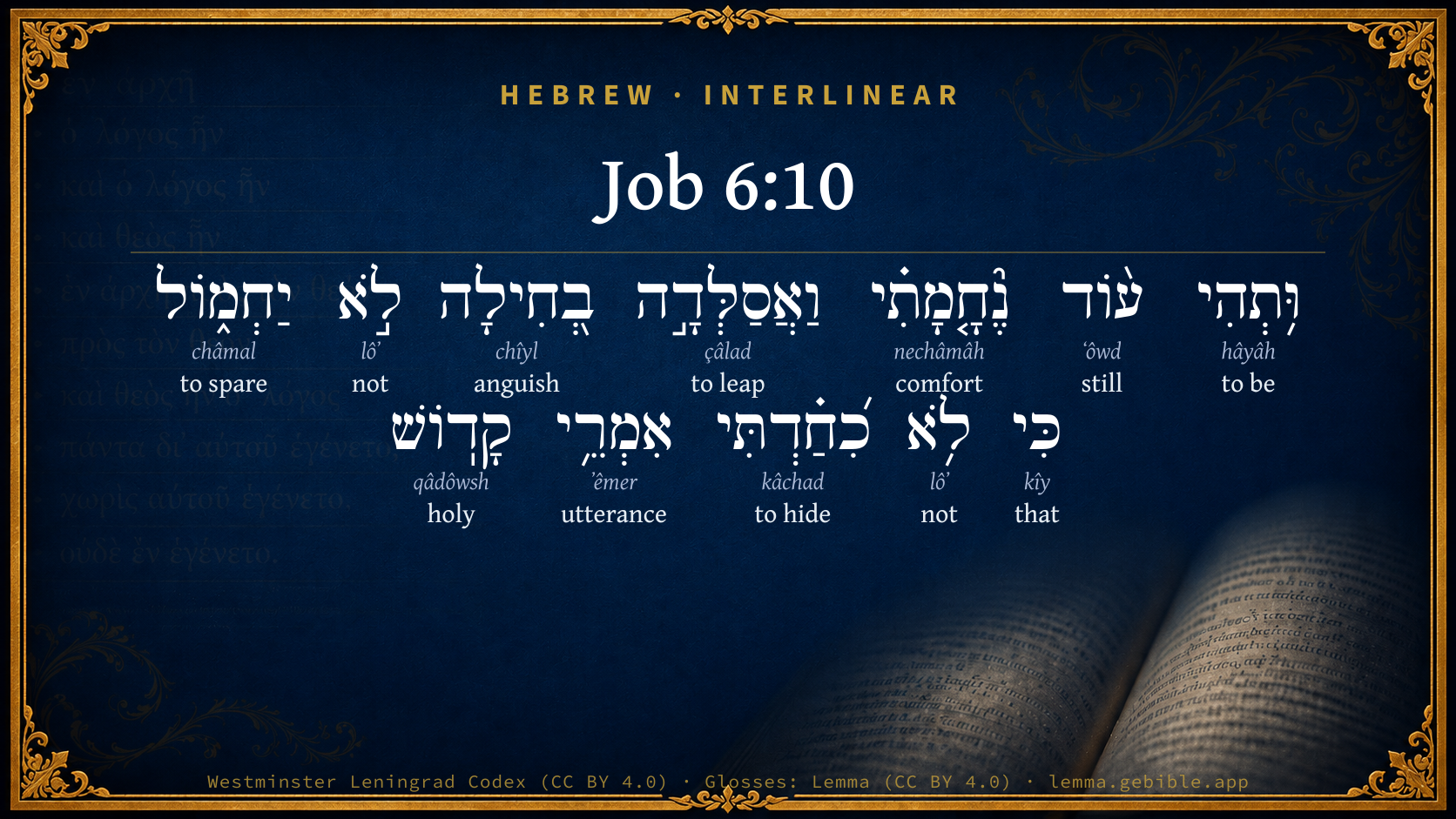
Hebrew (Westminster Leningrad Codex) Job 6:10 appears in the Hebrew Old Testament. The text above is from the Westminster Leningrad Codex. Each word links to its Strong’s number, a concise gloss, and parsing drawn from the Open Scriptures Hebrew Bible morphology. Click any word for its full Brown-Driver-Briggs (BDB) entry.
Download image
Cite this verse

Job 6:10 (World English Bible). Public Domain. Lemma interlinear Bible study tool, https://lemma.gebible.app/v/job/6/10.

Show BibTeX & RIS
BibTeX
RIS
English Translation
Be it still my consolation, Yes, let me exult in pain that doesn't spare, That I have not denied the words of the Holy One.
World English Bible · Public Domain
Highlights
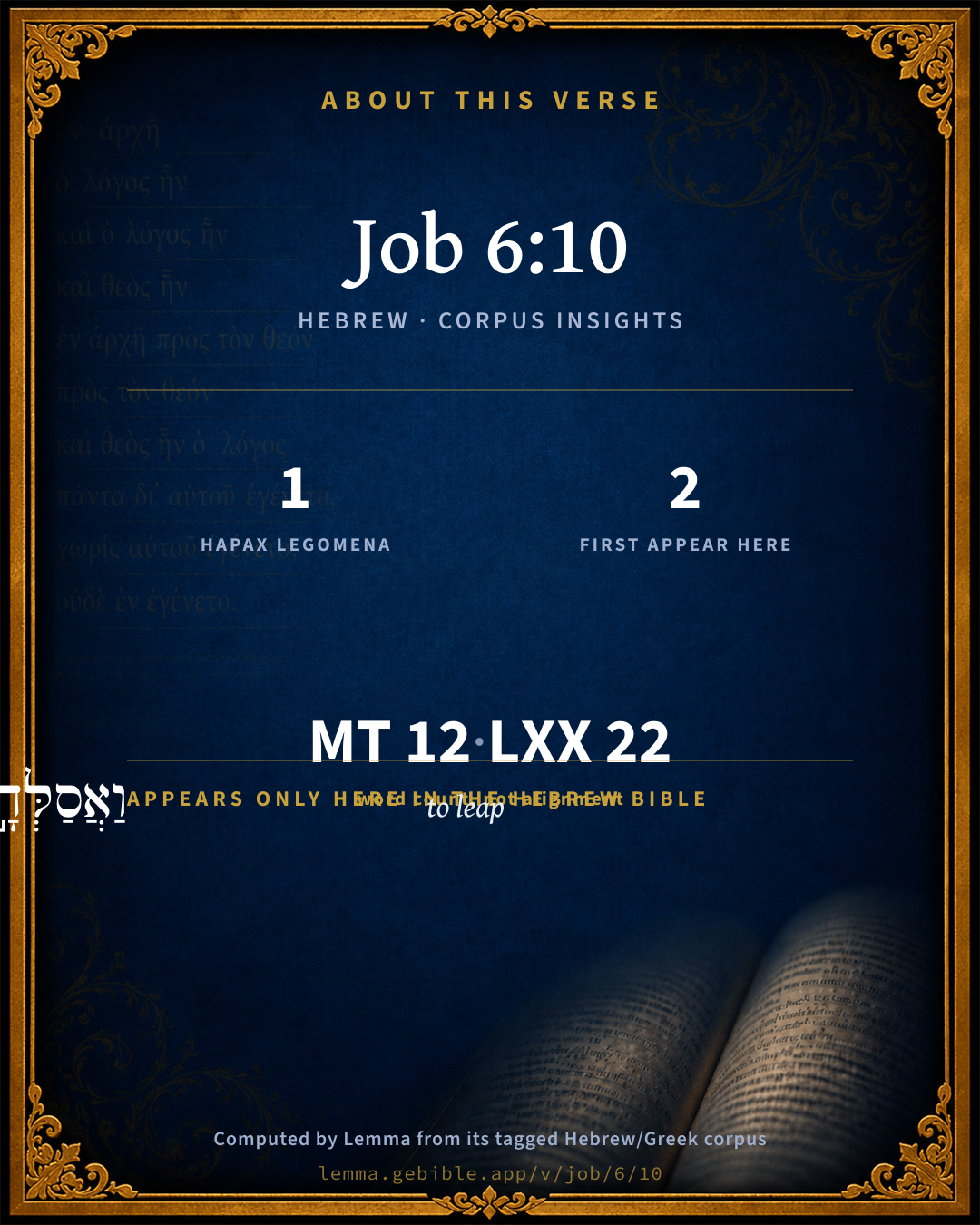
  • 1 hapax legomenon — only here in the Hebrew Bible
  • 2 first appearances in the Hebrew Bible
Full analysis ↓
Download a study sheet

One document with this verse’s original text, its word-by-word gloss line, the meaning frame, cross-references with their text, attributed commentary, and full source and license credits — printable, and it pastes into notes with its structure intact.

This verse Autodidact and up

Study sheet (.html) Plain text (.txt)

A passage Seminary Student

Up to 50 verses in one chapter. A passage sheet keeps up to 6 commentary sources and 12 cross-references per verse, in the order this page ranks them, and says so on the sheet whenever that leaves anything out. Ask for a single verse and you get the Autodidact verse sheet above.

Everything on this page stays free to read, with no account — the sheet is a download of what is already on screen, not access to it.

Want to remove ads? Support Godless Engineer
Compare translations 3

The same verse in 3 English versions, stacked beneath the original-language interlinear above. Click any original word for its lexicon entry.

Each is an independent rendering of the whole verse — the interlinear is not word-aligned to these translations.

Highlighted words mark where these versions differ — a whole-verse word diff, not a word-by-word alignment.

  • World English Bible Public Domain
    Be it still my consolation, Yes, let me exult in pain that doesn't spare, That I have not denied the words of the Holy One.
  • King James Version Public Domain
    Then should I yet have comfort; yea, I would harden myself in sorrow: let him not spare; for I have not concealed the words of the Holy One.
  • unfoldingWord Literal Text CC BY-SA 4.0
    Yet may it still be my consolation— indeed, let me exult in pain, may he not spare— that I have not concealed the sayings of the Holy One.

unfoldingWord Literal Text — © unfoldingWord, licensed CC BY-SA 4.0. Word-aligned USFM3 via Door43 (git.door43.org/unfoldingWord/en_ult).

Versions to compare (up to 4)

3 of 4 selected

Show all 18 translations

Every available English version of this verse, each an independent rendering of the whole verse.

  • World English Bible Public Domain
    Be it still my consolation, Yes, let me exult in pain that doesn't spare, That I have not denied the words of the Holy One.
  • Berean Standard Bible Public Domain
    It still brings me comfort, and joy through unrelenting pain, that I have not denied the words of the Holy One.
  • Majority Standard Bible Public Domain
    It still brings me comfort, and joy through unrelenting pain, that I have not denied the words of the Holy One.
  • King James Version Public Domain
    Then should I yet have comfort; yea, I would harden myself in sorrow: let him not spare; for I have not concealed the words of the Holy One.
  • American Standard Version (1901) Public Domain
    And be it still my consolation, Yea, let me exult in pain that spareth not, That I have not denied the words of the Holy One.
  • Revised Version (1885) Public Domain
    Then should I yet have comfort; yea, I would exult in pain that spareth not: for I have not denied the words of the Holy One.
  • Geneva Bible (1599) Public Domain
    Then should I yet haue comfort, (though I burne with sorowe, let him not spare) because I haue not denyed the wordes of the Holy one.
  • Douay-Rheims (1899) Public Domain
    And that this may be my comfort, that afflicting me with sorrow, he spare not, nor I contradict the words of the Holy One.
  • Young's Literal Translation Public Domain
    And yet it is my comfort, (And I exult in pain -- He doth not spare,) That I have not hidden The sayings of the Holy One.
  • Literal Standard Version CC BY-SA 4.0
    And yet it is my comfort || (And I exult in pain—He does not spare), || That I have not hidden || The sayings of the Holy One.
  • Unlocked Literal Bible CC BY-SA 4.0
    May this still be my consolation— even if I exult in pain that does not lessen: that I have not denied the words of the Holy One.
  • unfoldingWord Literal Text CC BY-SA 4.0
    Yet may it still be my consolation— indeed, let me exult in pain, may he not spare— that I have not concealed the sayings of the Holy One.
  • Darby Bible Public Domain
    Then should I yet have comfort; and in the pain which spareth not I would rejoice that I have not denied the words of the Holy One.
  • World Messianic Bible Public Domain
    Let it still be my consolation, yes, let me exult in pain that doesn’t spare, that I have not denied the words of the Holy One.
  • Webster's Bible Public Domain
    Then should I yet have comfort; yes, I would harden myself in sorrow: let him not spare; for I have not concealed the words of the Holy One.
  • Free Bible Version CC BY-SA 4.0
    But it still comforts me to know, making me happy through the never-ending pain, that I have never rejected the words of God.
  • Bible in Basic English Public Domain
    So I would still have comfort, and I would have joy in the pains of death, for I have not been false to the words of the Holy One.
  • JPS Tanakh (1917) Public Domain
    Then should I yet have comfort; yea, I would exult in pain, though He spare not; for I have not denied the words of the Holy One.

Literal Standard Version (2020), Covenant Press — licensed CC BY-SA 4.0. Text via the HelloAO Bible API (eBible.org). Unlocked Literal Bible (unfoldingWord) — licensed CC BY-SA 4.0. Text via the HelloAO Bible API (eBible.org). unfoldingWord Literal Text — © unfoldingWord, licensed CC BY-SA 4.0. Word-aligned USFM3 via Door43 (git.door43.org/unfoldingWord/en_ult). Free Bible Version, Dr. Jonathan Gallagher — licensed CC BY-SA 4.0. Text via the HelloAO Bible API (eBible.org).

Word by word

More ways to search: Search by grammar → Find every occurrence → Compare this word →

Practice this passage: Drill this verse → Learn its vocabulary →

וַאֲסַלְּדָ֣ה
çâlad
H5539
“and · to leap”
Conjunction + Verb, Piel, Cohortative, 1st Person, Common, Singular
Part of Speech
Conjunction + Verb
Stem
Piel
Form
Cohortative
Person
1st Person
Gender
Common
Number
Singular
Full BDB Definition

Origin: a primitive root

TWOT: 1501

(Piel) to leap, jump, spring, leap for joy
  1. וּ֥תְהִי hâyâh H1961 “and · to be” Conjunction + Verb, Qal, Jussive, 3rd Person, Feminine, Singular
  2. ע֨וֹד ʻôwd H5750 “still” Adverb
  3. נֶ֘חָ֤מָתִ֗י nechâmâh H5165 “comfort · my” Noun, Common, Feminine, Singular, Construct + Suffix, Personal, 1st Person, Common, Singular
  4. בְ֭חִילָה chîyl H2427 “in/at · anguish” Preposition + Noun, Common, Feminine, Singular, Absolute
  5. לֹ֣א lôʼ H3808 “not” Particle, Negative
  6. יַחְמ֑וֹל châmal H2550 “to spare” Verb, Qal, Imperfect, 3rd Person, Masculine, Singular
  7. כִּי kîy H3588 “that” Conjunction
  8. לֹ֥א lôʼ H3808 “not” Particle, Negative
  9. כִ֝חַ֗דְתִּי kâchad H3582 “to hide” Verb, Piel, Perfect, 1st Person, Common, Singular
  10. אִמְרֵ֥י ʼêmer H561 “utterances of” Noun, Common, Masculine, Plural, Construct
  11. קָדֽוֹשׁ qâdôwsh H6918 “holy” Adjective, Adjective, Masculine, Singular, Absolute

About this verse

These counts appear in no published source. They are computed here, from the morphology-tagged text and Lemma’s own curated glosses. What Lemma adds →

12
words
11
distinct lemmas
Wisdom
section

Notable vocabulary

1 hapax legomenon — a word that appears only here in the entire Hebrew Bible:

  • וַאֲסַלְּדָ֣ה to leap H5539

First appearance in Scripture

These words make their first canonical appearance in the Hebrew Bible here:

  • נֶ֘חָ֤מָתִ֗י comfort H5165
  • וַאֲסַלְּדָ֣ה to leap H5539

Shared distinctive vocabulary

נֶ֘חָ֤מָתִ֗י comfort H5165 occurs in 2 verses of the Hebrew Bible. Also found in:

Grammatical profile

  • 4 verbs
  • 3 nouns
  • 1 adjective
  • 1 conjunction
  • 1 adverb
  • 2 particles

Verb forms

  • וּ֥תְהִי Qal · Jussive
  • וַאֲסַלְּדָ֣ה Piel · Cohortative
  • יַחְמ֑וֹל Qal · Imperfect
  • כִ֝חַ֗דְתִּי Piel · Perfect

Repetition

A word recurs within this verse — often emphatic in Hebrew:

Hebrew & Septuagint length

In English translation the verse runs 25 words from the Hebrew and 31 from the Septuagint (LXX English) — closely comparable.

A rough comparison of the two English renderings, which tokenize alike — not a word-level alignment.

Word counts can differ between the Hebrew and the Greek without any difference in meaning — e.g. the Hebrew direct-object marker אֵת has no separate Greek word, and Greek often adds the article ὁ.

In the original languages it is 12 Hebrew tokens and 22 Greek tokens — but the two are counted differently (Hebrew bundles its prefixes and suffixes into one token; the Greek is in lemma form), so that isn’t a like-for-like length.

Cross-references

23

Topical passages linked to Job 6:10 in the Treasury of Scripture Knowledge — connected by theme and wording, ordered by reader-vote popularity; previews shown in the World English Bible.

  • Job 23:12 I haven't gone back from the commandment of his lips. I have treasured up the words of his mouth more than my necessary food.
  • Leviticus 19:2 "Speak to all the congregation of the children of Israel, and tell them, 'You shall be holy; for I Yahweh your God am holy.
  • Isaiah 57:15 For thus says the high and lofty One who inhabits eternity, whose name is Holy: I dwell in the high and holy place, with him also who is of a contrite and humble spirit, to revive the spirit of the humble, and to revive the heart of the contrite.
  • Psalms 40:9–10 I have proclaimed glad news of righteousness in the great assembly. Behold, I will not seal my lips, Yahweh, you know.
  • Psalms 71:17–18 God, you have taught me from my youth. Until now, I have declared your wondrous works.
  • Deuteronomy 29:20 Yahweh will not pardon him, but then the anger of Yahweh and his jealousy will smoke against that man, and all the curse that is written in this book shall lie on him, and Yahweh will blot out his name from under the sky.
  • 1 Samuel 2:2 There is none holy as Yahweh; For there is none besides you, Neither is there any rock like our God.
  • Job 3:22 Who rejoice exceedingly, Are glad, when they can find the grave?
  • Job 9:4 God who is wise in heart, and mighty in strength: Who has hardened himself against him, and prospered?
  • Job 21:33 The clods of the valley shall be sweet to him. All men shall draw after him, As there were innumerable before him.
  • Job 22:22 Please receive instruction from his mouth, And lay up his words in your heart.
  • Psalms 37:30 The mouth of the righteous talks of wisdom. His tongue speaks justice.
  • Psalms 119:13 With my lips, I have declared all the ordinances of your mouth.
  • Isaiah 30:11–12 get out of the way, turn aside out of the path, cause the Holy One of Israel to cease from before us."
  • Hosea 11:9 I will not execute the fierceness of my anger. I will not return to destroy Ephraim: For I am God, and not man; the Holy One in the midst of you; And I will not come in wrath.
  • Habakkuk 1:12 Aren't you from everlasting, Yahweh my God, my Holy One? We will not die. Yahweh, you have appointed him for judgment. You, Rock, have established him to punish.
  • Habakkuk 3:3 God came from Teman, The Holy One from Mount Paran. Selah. His glory covered the heavens, And his praise filled the earth.
  • Acts 20:20 how I didn't shrink from declaring to you anything that was profitable, teaching you publicly and from house to house,
  • Acts 20:27 for I didn't shrink from declaring to you the whole counsel of God.
  • Romans 8:32 He who didn't spare his own Son, but delivered him up for us all, how would he not also with him freely give us all things?
  • 2 Peter 2:4–5 For if God didn't spare angels when they sinned, but cast them down to Tartarus, and committed them to pits of darkness, to be reserved to judgment;
  • Revelation 3:7 "To the angel of the assembly in Philadelphia write: "He who is holy, he who is true, he who has the key of David, he who opens and no one can shut, and who shuts and no one opens, says these things:
  • Revelation 4:8 The four living creatures, each one of them having six wings, are full of eyes around about and within. They have no rest day and night, saying, "Holy, holy, holy, holy, holy, holy, holy, holy, holy is the Lord God, the Almighty, who was and who is and who is to come!"

Cross-references courtesy of OpenBible.info (CC BY 4.0).

Hebrew and Greek witnesses Masoretic Hebrew ↔ Greek Septuagint

The same verse in the two great witnesses to the Old Testament, shown verse-for-verse.

These are two independent witnesses, not word-aligned to each other, and the Septuagint is shown in lemma (dictionary) form.

Hebrew Job 6:10 Masoretic · Westminster Leningrad Codex

וּ֥תְהִי ע֨וֹד נֶ֘חָ֤מָתִ֗י וַאֲסַלְּדָ֣ה בְ֭חִילָה לֹ֣א יַחְמ֑וֹל כִּי לֹ֥א כִ֝חַ֗דְתִּי אִמְרֵ֥י קָדֽוֹשׁ

Be it still my consolation, Yes, let me exult in pain that doesn't spare, That I have not denied the words of the Holy One.

World English Bible · Public Domain

Greek LXX Job 6:10 Septuagint · lemma form

εἰμί δέ ἐγώ πόλις τάφος ἐπί ὅς ἐπί τεῖχος ἅλλομαι ἐπί αὐτός οὐ μή φείδομαι οὐ γάρ ψεύδω ῥῆμα ἅγιος θεός ἐγώ

Let the grave be my city, upon the walls of which I have leaped: I will not shrink from it; for I have not denied the holy words of my God.

LXX2012 (modern English Septuagint) · Public Domain

On this verse, Albert Barnes' Notes on the Bible discusses the Septuagint’s reading. Read the note in Commentary ↓

Hebrew: Westminster Leningrad Codex (CC BY 4.0). Greek: Septuagint (public domain); English from LXX2012 (modern English Septuagint) (Public Domain). How the Septuagint differs from the Hebrew →

Commentary

Notes on Job 6:10 from classic Christian and Jewish commentators (each source and its license shown beneath its notes). The classic Christian expositions comment on the surrounding passage and are grouped to its opening verse, so a note may address several verses; the Jewish commentaries on the Tanakh (Rashi and others) are per-verse, so they appear only where the commentator wrote on this verse.

Lemma curates 59 commentaries, every one of them public domain or Creative Commons licensed, each selected and text-cleaned for this edition rather than reprinted as found. About our sources →

Trapp's Complete Commentary

John Trapp

Job 6:10 Then should I yet have comfort; yea, I would harden myself in sorrow: let him not spare; for I have not concealed the words of the Holy One.

Ver. 10. Then should I yet have comfort; yea, I would harden myself in sorrow, &c.] I would take hard on, and bear what befalleth me as well as I could, by head and shoulders, had I but hopes of an end by death; as having this for my comfort;

I have not concealed the words of the Holy One] I have boldly professed the true religion, Psa 40:10; Psa 116:10; Psa 119:43, not spared to preach the truth sincerely to others for God’s glory, and their good, however you may judge of me. I never rejected the word of God, but have highly honoured it; so that my desire of death is not desperate, as you may conceive, but an effect of good assurance that by death heaven advanceth forward that happy term, when all my miseries shall end at once; and hence it is that I am so greedy after the grave.

John Trapp, A Commentary or Exposition upon All the Books of the Old and New Testament (1647–1656) — public domain. Text from a community e-Sword module.

The Biblical Illustrator

Joseph S. Exell

Job_6:10

I have not concealed the words of the Holy One.

Concealing the words of God

1. The testimony of a good conscience is the best ground of our willingness to die.

2. The counsels of God, His truths, must be revealed. It is as dangerous, if not more, to conceal what God hath made known, as to be inquisitive to know what God hath concealed.

3. The study of a godly man is to make the Word of God visible.

4. It is a dangerous thing for any man to conceal the Word of God, either in his opinion or in his practice. (J. Caryl.)

God, the Holy One

This is a title too big for anyone but God. All holiness is in God. God is so holy that properly He only is holy. God is called the Holy One in three respects: Because He is all holy in Himself; because we receive all holiness from Him; and because we are to serve Him in holiness and righteousness all our days. God is holy in His nature. His essence is purity. He is holy in His Word. He is holy in His works. These three put together lift up the glory of God in this title, The Holy One. Or we may consider God, the Holy One,

1. Radically and fundamentally, because the Divine nature is the root and original, the spring of all holiness and purity.

2. God is the Holy One by way of example and pattern, or in regard of the rule and measure of holiness.

3. By way of motive. He is, as the rule of holiness, so likewise the reason of our holiness.

4. God is the Holy One effectively, because He works, conveys, and propagates all holiness to and in the creature. Man can no more make himself or another holy, than he can redeem another or himself.

5. He is called the Holy One by way of eminency, or super-excellence, because His holiness is infinitely beyond all the holiness of men and angels. Holiness in angels is a quality; holiness in God is His essence. God is above men and angels, because He is absolutely perfect in holiness. And God is ever equally holy, ever in the same degree and frame of holiness. The holiness of man consists in his conformity to the holiness of God. There is a two-fold conformity: a conformity to the nature of God, and a conformity to the will of God, or to that which God wills. These make up the total holiness of the creature. (Joseph Caryl.)

Concealing the words of God

Jobs distress was aggravated by the remarks of his friends, but he turned the guns of the enemy upon themselves, and extracted comfort from what was meant to grieve. He had not concealed the words of the Holy One; had taught his family the great sacrificial truth; was a most faithful witness for God, and made open confession of his own faith in the one holy God.

I. Here is a sin to be avoided--concealing the words of the Holy One.

1. We can conceal these words from ourselves. We do this when we will not permit this word to search our own heart and ways--when we conceal the Gospel, and go about to find out some way of our own for self-salvation. We should hide the Gospel in our heart, but not from our heart. We conceal it when we do not receive the whole of revelation, but pick and choose out portions of it.

2. We conceal these words from others by not confessing the truth at all, or by a sinful silence after confession, or by concealing the words of the Lord by our own words, or by clouding the truth with error, or by an inconsistent life. We must shine as lights.

II. Arguments for avoiding this sin.

1. The man who conceals the Word is out of order with God. The design of words is to make known the speakers mind. If you conceal His words you are not in harmony with anything God has made. All declare His glory. Think of the consequences which would have followed if others had done so.

2. The motive to conceal is sinful. It may be cowardice, self-love, or the avoidance of shame.

3. By concealing Gods words we are disloyal to God and unlike the Saviour. Think of how this will appear on a dying bed--I knew the saving secret, but I never told even a child of it. How will this look at the last day?

III. Two methods by which we may avoid this sin.

1. By taking care that you make an open profession of your faith and unite with the people of God.

2. When you have done that, by keeping yourself clear of sinful silence by very often speaking to others of the things of God. (C. H. Spurgeon.)

The Biblical Illustrator, edited by Joseph S. Exell (c. 1880s–1900s) — public domain. Text from a community e-Sword module.

Joseph Benson's Commentary

Job 6:10. Then should I yet have comfort — The thoughts of my approaching death would comfort me in all my sorrows, and yield me abundantly more solace than life, with all that worldly safety, and glory, and happiness, for which thou hast advised me to seek unto God. Yea, I would harden myself in sorrow — I would bear up with more courage and patience, under all my torments, with the hopes of death and blessedness after death. Let him not spare — Let him use all severity against me, so far as to cut me off, and not suffer me to live any longer. For I have not concealed the words of the Holy One — That is, of God, who is frequently called the Holy One in Scripture, and is so in a most eminent and peculiar sense. The meaning is, As I have myself steadfastly believed the words, or truths of God, and not wilfully and wickedly departed from them; so I have endeavoured to teach and recommend them to others, and have not been ashamed nor afraid boldly to confess and preach the true religion in the midst of the heathen round about me. And, therefore, I know, if God do cut me off, it will be in mercy, and I shall be a gainer by it.

Joseph Benson's Commentary on the Old and New Testaments (1811–1818) — public domain. Text from a community e-Sword module.

Geneva Bible (1599)

Geneva Bible translators

That is, let me die at once, before I come to distrust in God’s promise through my impatience.

Geneva Bible (1599) marginal notes — public domain. Text via Bolls.life.

Jamieson, Fausset & Brown

Robert Jamieson, A. R. Fausset & David Brown

I would harden myself in sorrow--rather, "I would exult in the pain," if I knew that that pain would hasten my death [GESENIUS]. UMBREIT translates the Hebrew of "Let Him not spare," as "unsparing"; and joins it with "pain."

concealed--I have not disowned, in word or deed, the commands of the Holy One (Psa 119:46; Act 20:20). He says this in answer to Eliphaz' insinuation that he is a hypocrite. God is here called "the Holy One," to imply man's reciprocal obligation to be holy, as He is holy (Lev 19:2).

Jamieson, Fausset & Brown — Commentary Critical and Explanatory on the Whole Bible (1871) — public domain (CC PDM 1.0). Text via the HelloAO Bible API.

Adam Clarke's Commentary

Verse 10. Then should I yet have comfort] Instead of עוד od, YET, three of Kennicott's and De Rossi's MSS. have זאת zoth, THIS. And THIS should be my comfort. The expectation that he will speedily make an end of me would cause me to rejoice with great joy. This reading is supported by the Vulgate and the Chaldee.

I would harden myself in sorrow] To know that I should shortly have an end put to my miseries would cause me to endure the present with determinate resolution. Let him not spare - let him use whatever means he chooses, for I will not resist his decree; he is holy, and his decrees must be just.

Adam Clarke's Commentary on the Bible (1810–1826) — public domain. Text from a community e-Sword/MySword module.

Ellicott's Commentary for English Readers

(10) Concealed—i.e., denied. The same was the confidence of the Psalmist (Psa_40:9-10). (Comp. Act_20:20.)

A Bible Commentary for English Readers, edited by Charles John Ellicott (1878–1897) — public domain. Text from a community e-Sword module.

The Cambridge Bible for Schools and Colleges

gen. ed. J. J. S. Perowne

10. This verse reads,

And I should yet have my comfort,

And I would leap (for joy) amidst unsparing pain;

For I have not denied the words of the Holy One.

His comfort or consolation that he would have is death, the only one he seeks or can receive (Job_6:11). The second clause betrays a rising frenzy in the sufferer’s mind. The third clause is thrown in almost in parenthesis. It expresses Job’s feeling that there is nothing that would impair his comfort or mar his joy in death, for he has never denied or disobeyed the words, or commands, of the Holy One. Perhaps the words may be flung out also against a thought which Job felt might rise in the minds of his friends. They serve at least to give an emphatic contradiction to their suspicions, by shewing how fearlessly he looks at death.

Others render the verse somewhat differently: and it should still be my consolation … that I have not denied, etc., making his consolation in death to consist in the thought that he had never disobeyed the words of the Holy One, cf. ch. Job_13:16; Job_27:8 seq. But this gives a prominence to the innocence of Job which is not suitable in this place, and makes his words too reflective and self-possessed for the rest of the passage.

The Cambridge Bible for Schools and Colleges (gen. ed. J. J. S. Perowne; Cambridge University Press, 1878–1918) — public domain. Text from a community e-Sword module.

John Gill's Exposition

What is my strength, that I should hope?.... For a perfect restoration of health, suggested by Eliphaz; since it was so sadly weakened by the present affliction, which made death more desirable than life lengthened out in so much weakness, pain, and sorrow; or "that I should bear" (w), such a weight and heavy load that lay upon him, and crushed him, and to which his strength was not equal; or continue and endure (x):

what is mine end, that I should prolong my life? what end can be answered by living, or desiring a long life? His children were gone, and none left to take care of and provide for; his substance was taken away from him, so that he had not to support himself, nor to be useful to others, to the poor; he had lost all power, authority, and influence, among men, and could be no more serviceable by his counsel and advice, and by the administration of justice and equity as a civil magistrate; and as to religious matters, he was reckoned an hypocrite and a wicked man by his friends, and had lost his character and interest as a good man; and so for him to live could answer no valuable end, and, therefore, he desires to die; for what is here, and in Job 6:12 said, contain reasons of his above request.

(w) , Sept. "ut sustineam", V. L. (x) "Ut durem", Junius & Tremellius.

John Gill's Exposition of the Whole Bible (1746–1763) — public domain (CC PDM 1.0). Text via the HelloAO Bible API.

Albert Barnes' Notes on the Bible

Then should I yet have comfort - Dr. Good renders this, “then would I already take comfort.” Noyes, “yet it should still be my consolation.” The literal sense is, “and there would be to me yet consolation;” or “my consolation would yet be.” That is, he would find comfort in the grave (compare Job 3:13 ff), or in the future world.

I would harden myself in sorrow - Dr. Good renders this, “and I will leap for joy.” In a similar way Noyes renders it, “I would exult.” So Schultens understands the expression. The Hebrew word rendered “I would harden myself” (סלד sâlad) occurs nowhere else, and expositors have been divided in regard to its meaning. According to Castell, it means to strengthen, to confirm. The Chaldee (סלד) means to grow warm, to glow, to burn. The Arabic word is applied to a horse, and means to beat the earth with his feet, and then to leap, to exult, to spring up; and this is the idea which Gesenius and others suppose is to be retained here - an idea which certainly better suits the connection than the common one of hardening himself in sorrow. The Septuagint renders it ἡλλόμήν hēllomēn - “I would leap,” or exult, although they have sadly missed the sense in the other part of the verse. They render it, “Let but my city be a grave, upon whose walls I will leap; I will not spare, for I have not falsified the holy words of my God.” The Chaldee renders it, “and I will exult (ואבוע) when fury comes upon the wicked.” The probable meaning is, that Job would exult or rejoice, if be was permitted to die; he would triumph even in the midst of his sorrow, if he might lie down and expire.

Let him not spare - Let him not withhold or restrain those sufferings which would sink me down to the grave.

For I have not concealed the words of the Holy One - I have openly and boldly maintained a profession of attachment to the cause of God, and to his truth. I have, in a public and solemn manner, professed attachment to my Maker; I have not refused to acknowledge that I am his; I have not been ashamed of him and his cause. How much consolation may be found in such a reflection when we come to die! If there has been a consistent profession of religion; if there has been no shrinking back from attachment to God; if in all circles, high and low, rich and poor, frivolous and serious, there has been an unwavering and steady, though not ostentatious, attachment to the cause of God, it will give unspeakable consolation and confidence when we come to die. If there has been concealment, and shame, and shrinking back from a profession of religion, there will be shame, and regret, and sorrow; compare Psa 40:9; Act 20:20-27.

Albert Barnes' Notes on the Bible (1834–1885) — public domain. Text from a community e-Sword/MySword module.

Matthew Poole's English Annotations

The thoughts of my approaching death would comfort me in all my sorrows. This would solace me more than life, with all that worldly safety, and glory, and happiness which thou hast advised me to seek unto God for.

I would harden myself in sorrow, i.e. I would bear up myself with more courage and patience under all my torments with the hopes of my death, and that blessedness into which I know I shall after death be admitted, as he more fully speaks, Job 19:26,27, whereas now I pine away in lingering and hopeless miseries. Or, I would burn (i.e. I am content to burn) in sorrow. Or, I would pray (as this word signifies in Hebrew writers; and praying may be here put for praising or worshipping of God, as it is frequently used in Scripture) in, or for, my sorrow or pain; then I would worship God, and say, Blessed be the Lord’s name for these afflictions, as I did for the former, Job 1:20,21.

Let him not spare; but let him use all severity against me, so far as to cut me off, and not suffer me to live any longer; which will seem to me a cruel kind of patience towards me.

Of the Holy One, i.e. of God, who is frequently called the Holy One in Scripture, as Isa 40:25; Isa 57:15; Hab 3:3, and is so in a most eminent and peculiar manner. The sense is, Therefore I do not fear death, but desire it; and that not only to be freed from my present troubles, but also and especially to put me into the possession of the happiness of the next life; of which I am assured, because I have in good measure performed the conditions of that covenant upon which he hath promised it; for as for

the words of God, i.e. that light of sacred truths and precepts which he hath been pleased to impart to me,

I have not concealed them, neither from myself by shutting mine eyes against them, or suffering my prejudices, or passions, or worldly interests to blind my mind, lest I should see them, as you think I have done; nor from others; but as I myself have stedfastly believed them, and not wilfully and wickedly departed from them, so I have endeavoured to teach and commend them to others, and have not been ashamed nor afraid boldly to profess and preach the true religion in the midst of heathens who are round about me. And therefore I know that if God doth cut me off, it will be in mercy, and I shall be a gainer by it. Some translate and distinguish the verse thus. Yet this is my comfort, (though, or when, I scorch with pain, and he, i.e. God, doth not spare me, but afflicts me most severely,) that I have not concealed the words of God, but have professed and practised them.

Matthew Poole's English Annotations on the Holy Bible (1683–1685) — public domain. Text from a community e-Sword/MySword module.

Whedon's Commentary on the Bible

Daniel D. Whedon

10. Then should I yet have comfort — “A clear assertion of belief in a life to come.” — Wordsworth. The difficulty of any other interpretation is felt by Zockler, who cannot see in this connexion how a speedy death could, in and of itself, bring any comfort. He is forced, with Delitzsch, Schlottmann, etc., to find the source of comfort in the statement of the last clause, that he had not denied the words of the Holy One! thus making the second member of the verse parenthetical. The structure of the clause, however, naturally points to the preceding verse for the ground of his comfort. His jubilant expression, that in the midst of unsparing anguish he “would exult,” is also retrospective. The last clause of the verse is rather a continued reason why God should give him the solace of death, as both Hirtzel and Dillmann admit: the latter urging that the cool reflection that he had not denied the words of the Holy One would be out of harmony with the triumphant exultation of the second member. That he had kept the faith, is a climactical reason why God should discharge him from his troubles, and give sweet rest in the grave. “A poor consolation,” (that of being cut off,) Peters well says, “perfectly romantic and delusive, could we suppose him to have no expectations after death.”

I would harden myself, etc. — I would exult in the pain which He does not spare: (Furst:) or the pain that does not spare. — (Dillmann.) The subject of the word “spare” is not given in the original.

Harden myself — סלד. The Arabic saladha — to leap, to exult — determines the meaning of this word, which occurs only once in the Scriptures. The ηλλομην of the Septuagint corresponds: thus, “Let the grave be my city, upon the walls of which I have leaped.”

Concealed — That is, denied in the sense of renouncing.

Daniel D. Whedon (gen. ed.), Commentary on the Old and New Testaments (1874–1909) — public domain. Text from a community e-Sword module.

The Pulpit Commentary

Then should I yet have comfort. First, the comfort that the end was come, and that he would be spared further sufferings; and further, the still greater comfort that he had endured to the end, and not. denied nor renounced his trust in religion and in all the "words of the Holy One." Professor Lee sees here "the recognition of a future life, expressed in words as plain and obvious as possible" ("Book of the Patriarch Job," p. 223). But to us it seems that, if the idea is present at all, it is covered up, latent; only so far implied as it may be said to be implied in all willingness to die, since it may be argued that even the most wretched life possible would be preferred by any man to no life at all, and so that when men are content to die they must be expecting, whether consciously or not, a life beyond the grave, and be sustained by that expectation. Yea, I would harden myself in sorrow: let him not spare; rather, yea, I would exult in anguish that did not spare. However great the pain that accompanied his death, Job would rejoice and exult in it, since by it his death was to be accomplished. For I have not concealed the words of the Holy One; rather, for I have not denied"or renounced. It would be a part of Job"s satisfaction in dying that he had not let go his integrity. Rather he had held it fast, and not renounced or abandoned his trust in God and in religion. "The words of the Holy One are the commands of God, however made known to man" (Canon Cook).

The Pulpit Commentary (1880–1919), ed. H.D.M. Spence-Jones & Joseph S. Exell — public domain. Text from a community e-Sword module.

John Wesley's Explanatory Notes

Harden - I would bear up with courage under all my torments, with the hopes of death, and blessedness after death. Spare - Not suffer me to live any longer. Concealed - As I have steadfastly believed them, and not wilfully departed from them, so I have not been ashamed, nor afraid, boldly to profess and preach the true religion in the midst of Heathens. And therefore I know if God doth cut me off, I shall be a gainer by it.

John Wesley, Explanatory Notes Upon the Whole Bible (1754–1765) — public domain. Text via the GEBible commentary corpus.

unfoldingWord translationNotes

Door43 World Missions Community

May this still be my consolation

"May this bring me comfort." The word "this" refers to God allowing him to die. AT: "May my death still bring me comfort" or "May my death still comfort me" (See: Assumed Knowledge and Implicit Information)

even if I exult in pain that does not lessen

"I would leap for joy in unending pain" or "I would endure pain that does not diminish"

exult

"rejoice"

does not lessen

"does not diminish"

that I have not denied the words of the Holy One

"that I have not disowned God." This can be written in positive form. AT: "that I have always obeyed the Holy One"

What is my strength, that I should try to wait? What is my end, that I should prolong my life?

Job poses these questions to emphasize that he has no reason to continue living. These questions have the same meaning. They may be written as statements. AT: "I do not have enough strength to go on living; I have no reason to prolong my life" (See: Rhetorical Question and Parallelism)

translationWords

exult

word

Holy One

patient

unfoldingWord translationNotes — © Distant Shores Media and the Door43 World Missions Community, licensed CC BY-SA 4.0. Source: git.door43.org/Door43/en_tn.

Rashi

Rabbi Shlomo Yitzchaki (Rashi)

Then should I yet have comfort And this shall yet be to me for comfort.

and I will beg, shuddering, that He should have no pity And I will beg of Him with shuddering (Shem Ephraim) that He not refrain from finishing me off: I cannot find any similar word in Scriptures, except that in Mishnaic Hebrew it is an expression of fear and concern, that the hand fears them lest it be scalded in boiling water. That is to say, I will shudder with concern and with shuddering request this.

for I have not denied I did not fail to fulfill His words.

Rashi on the Tanakh — English translations: “The Judaica Press complete Tanach with Rashi, translated by A. J. Rosenberg” (CC BY 4.0); “Pentateuch with Rashi's commentary by M. Rosenbaum and A.M. Silbermann, 1929-1934” (public domain); “The Metsudah Tanach series, Lakewood, N.J” (CC BY 4.0); and “The Book of Joshua, Metsudah Publications, 1997” (CC BY 4.0). Text via Sefaria.

Lesson kit

Teaching starters — assembled from the data on this page, not authored interpretation. Every prompt links to the verse data it draws on. Edit before teaching.

Job, in the Wisdom, opens this verse with 12 words (11 distinct Hebrew lemmas). Its most distinctive word is çâlad (“to leap”). A historical commentator’s framing appears above. Read the whole chapter for the surrounding context.

Discussion questions

  1. The word çâlad carries the sense “to leap.” How does it shape the verse?
  2. This verse holds 1 word here found nowhere else in the Hebrew Bible. What might the rare word draw attention to?
  3. 2 words here appear for the first time in Scripture. What is being introduced at this debut?
  4. Psalms 119:50 shares the word «comfort» with this verse. How do the two illuminate each other?
  5. “not” occurs 2× in this one verse. What is the effect of the repetition?
  6. These translations render this verse differently; the difference is in the English rendering, not the original. What questions does that raise?
  7. The verb «וּ֥תְהִי» is Qal Jussive. How does its form color the action?
  8. Reading how Trapp's Complete Commentary and The Biblical Illustrator read this verse, where do the two commentators agree and where do they part?

Things to notice

  • 1 word in this verse appears nowhere else in the Hebrew Bible.
  • 2 words make their first canonical appearance in Scripture here.
  • This verse counts 12 Hebrew ↔ 22 Greek words.
  • These translations choose different wording for 21 words in this verse.
  • “not” occurs 2× in this single verse.

Reading settings

Reading text

Shown beneath each verse's original-language words.

Old Testament
Old Testament edition

Read the OT as the Masoretic Hebrew (MT) or the Greek Septuagint (LXX).

English shown for the Greek Septuagint (in the Hebrew ↔ Greek comparison).

Comparing translations? Open the Compare panel on any verse page to stack up to four side by side.