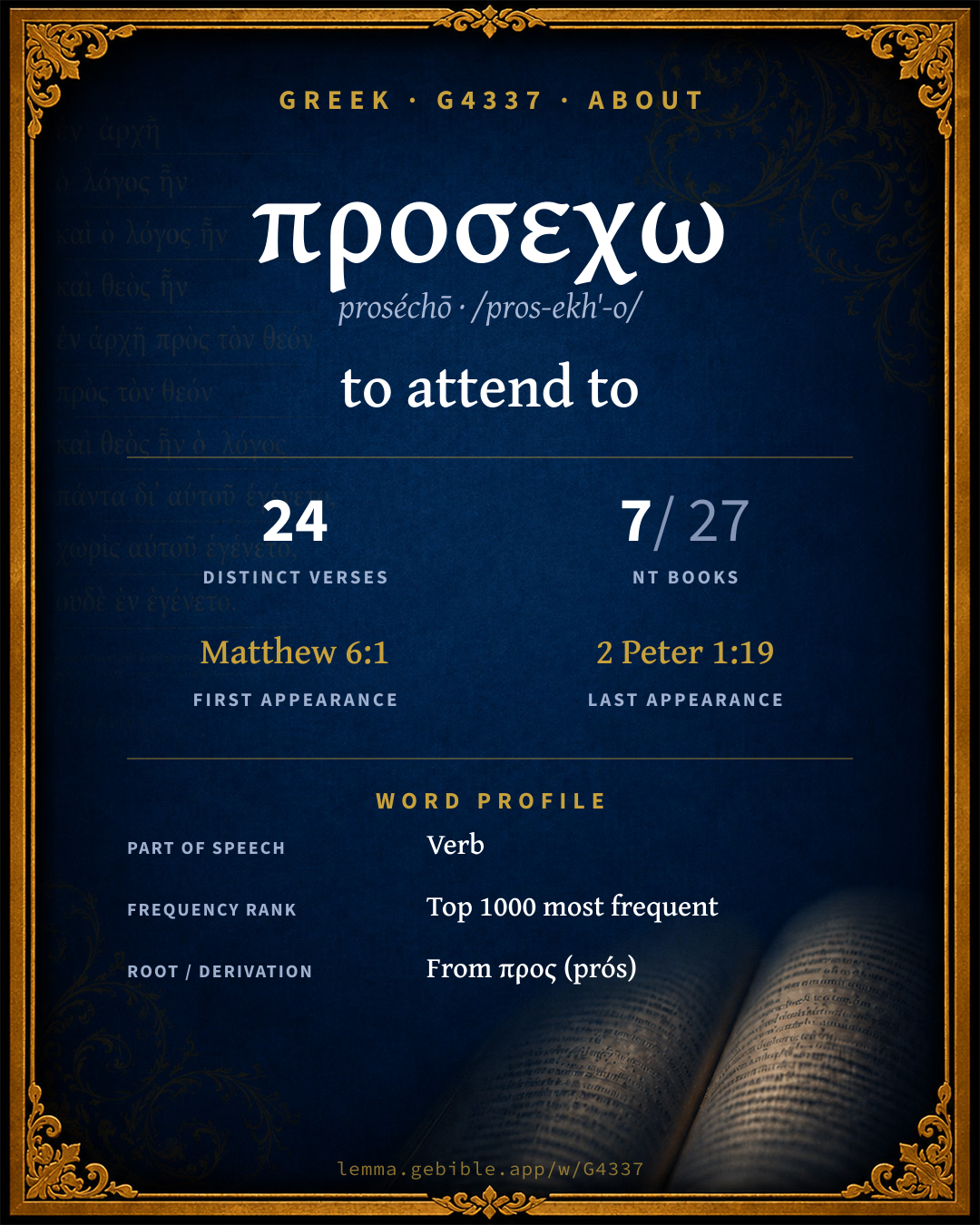
προσέχω
to attend to
‘to attend to’ is one of 4 main senses fuller range ↓
Full lexicon entry — Thayer's Greek Lexicon
From Thayer's Greek Lexicon
Where this word appears
See every Perfect-tense verb in the Greek New Testament →
Grammar key — what these labels mean
Part of speech
- Verb
- An action or state-of-being word.
Tense
- Present
- Ongoing or general action in present time (imperfective aspect).
- Imperfect
- Continuous or repeated action in past time (“was writing”).
- Perfect
- A completed past action with continuing present results.
Voice
- Active
- The subject performs the action.
Mood
- Imperative
- Expresses a command or request.
- Infinitive
- A verbal noun (“to write”), unmarked for person or number.
- Indicative
- States a fact or asks a factual question (the mood of reality).
- Participle
- A verbal adjective (“writing,” “having written”).
Case
- Nominative
- The case of the subject (and the predicate nominative).
- Accusative
- The case of the direct object and of extent.
Person
- 2nd person
- The one addressed (“you”).
- 3rd person
- The one spoken about (“he / she / it / they”).
Gender
- Masculine
- Grammatically masculine.
Number
- Plural
- More than one.
- Singular
- One.
1 verse where G4337 appears in the Perfect tense in the Book of Hebrews. Filtered view — show all forms. Click any verse to open its interlinear word-by-word view. Verse text shown in the World English Bible for context — . Each verse’s Greek form is shown with its reference; the English is not keyword-highlighted, since the data carries no word-level English alignment. Use “Compare translations” on any verse to read it across multiple English versions. This concordance covers the Greek New Testament; Septuagint (Greek Old Testament) occurrences of this word are not indexed here.
Hebrews
About this entry
At a glance — auto-summarized from this page’s data, not written by a person. Every figure links to its source below. This summary describes the numbers; it doesn’t interpret them.
προσεχω (proséchō) is a Greek verb most often rendered “to attend to.” Its English rendering has broadened — “beware” classically, “guard” (unfoldingWord Literal Text) in modern versions; see the renderings breakdown. The Greek New Testament uses it across 24 verses — uncommon. Matthew dominates its distribution — 6 of 24 verses. Ranging over 4 senses, it is not a single-sense word. For the data behind this summary, explore the sense tree and the renderings breakdown below.
Gloss history
Strong's 1890 vs modern scholarship
About this word
Strong's G4337 catalogs a Greek word from the Greek New Testament.
These counts are not copied from any lexicon or concordance. They are computed here, from the morphology-tagged Greek New Testament. What Lemma adds →
- 24
- distinct verses
- The word appears in 24 distinct verses.
- 7 / 27
- NT books
- The word appears in 7 of 27 New Testament books.
- #548
- by frequency
- Top 1000 most frequent Greek words (rank 548 of 5,347 Greek words by occurrence).
View all 24 occurrences in the concordance →
By section of the New Testament
By traditional corpus
Conventional, traditional groupings — biblical authorship is debated, so this is a traditional corpus grouping, not an authorship claim. Some books belong to more than one corpus (Luke is in both the Gospels and the Lukan corpus, and so on), so these shares overlap and need not total 100%. Each figure is a share of the word’s 24 distinct verses.
- Gospels 10 verses · 42%
- Lukan (Luke–Acts) 10 verses · 42%
- Pauline corpus 5 verses · 21%
- Hebrews 2 verses · 8%
- General (Catholic) Epistles 1 verse · 4%
How translations render this word
Counts come from each version’s own published word-to-Strong’s tagging or interlinear alignment — an approximate guide to how each version renders this word, not a word-level alignment the data otherwise carries. Because each total is that version’s own tagged count, the per-version totals vary from one another and need not match the appearance or distinct-verse counts above. These counts may also differ from a printed concordance because Lemma counts each distinctly tagged rendering and does not collapse phrase taggings into a single head-word total. This is a fixed set of word-tagged versions (KJV, ASV, BSB, ULT) and does not change with the reading translation you choose elsewhere. Each version’s license is shown beside its name below (and on Sources).
- King James Version: Beware 5×, Take heed 5×, Gave heed 2×
- American Standard Version: Beware 7×, Gave heed 2×, Giving heed to 2×
- Berean Standard Bible: Beware 7×, Watch 2×
- unfoldingWord Literal Text: Guard 5×, Pay attention 5×, Beware 3×
King James Version Public Domain
Renders G4337 across 23 tagged occurrences — most commonly:
Plus 9 renderings that appear only once — usually multi-word phrases or single function words the recovered tagging swept in, not distinct renderings. Not rendered by a distinct English word in 1 further occurrence.
American Standard Version Public Domain
Renders G4337 across 23 tagged occurrences — most commonly:
Plus 10 renderings that appear only once — usually multi-word phrases or single function words the recovered tagging swept in, not distinct renderings.
Berean Standard Bible Public Domain
Renders G4337 across 24 tagged occurrences — most commonly:
Plus 15 renderings that appear only once — usually multi-word phrases or single function words the recovered tagging swept in, not distinct renderings.
unfoldingWord Literal Text CC BY-SA 4.0
Renders G4337 across 25 tagged occurrences — most commonly:
Plus 10 renderings that appear only once — usually multi-word phrases or single function words the recovered tagging swept in, not distinct renderings.
Senses in Thayer's
The 4 senses Thayer's distinguishes for this word, in lexicon order (not ranked by frequency or importance). The full entry — with sub-senses — is in the Lexicon Entry tab.
- to bring a ship to land, and simply to touch at, put in
- to turn the mind to, attend to be attentive
- to attend to one's self, i.e. to give heed to one's self
- to apply one's self to, attach one's self to, hold or cleave to a person or a thing
Word origin
Derived from προς (prós) (G4314).
From G4314 and G2192 ; (figuratively) to hold the mind (G3563 implied) towards that is pay attention to be cautious about apply oneself to adhere to : - (give) attend (-ance -ance at -ance to unto) beware be given to give (take) heed (to unto) have regard.
— Strong’s Exhaustive Concordance (1890), public domain.
Forms in the corpus
The 8 distinct written forms G4337 takes in the Greek New Testament, most frequent first — each parse links to that tense’s occurrences in the concordance.
| Form | Parsing | Example | Uses |
|---|---|---|---|
| προσέχετε proséchete | Verb, Present, Active, Imperative, 2nd person, Plural | Matthew 10:17 | 8 |
| προσέχειν proséchein | Verb, Present, Active, Infinitive | Matthew 16:12 | 4 |
| Προσέχετε Proséchete | Verb, Present, Active, Imperative, 2nd person, Plural | Matthew 6:1 | 3 |
| προσέχοντες proséchontes | Verb, Present, Active, Participle, Nominative, Plural, Masculine | 1 Timothy 4:1 | 3 |
| προσεῖχον proseîchon | Verb, Imperfect, Active, Indicative, 3rd person, Plural | Acts 8:6 | 3 |
| προσέσχηκεν proséschēken | Verb, Perfect, Active, Indicative, 3rd person, Singular | Hebrews 7:13 | 1 |
| προσέχοντας proséchontas | Verb, Present, Active, Participle, Accusative, Plural, Masculine | 1 Timothy 3:8 | 1 |
| πρόσεχε próseche | Verb, Present, Active, Imperative, 2nd person, Singular | 1 Timothy 4:13 | 1 |
Same root — word family
Other Thayer's entries built from the same root as G4337, grouped by Strong’s listed origin. These share a root / origin per the lexicon — not necessarily a shared meaning. Each links to that word’s own entry.
Derives from
Shares the same root
- προσαγορευω prosagoreúō G4316 to address
- προσαγω proságō G4317 to bring
- προσαιτεω prosaitéō G4319 to ask alms
- προσαναβαινω prosanabaínō G4320 to go up higher
- προσαναλισκω prosanalískō G4321 to spend additionally
- προσαναπληροω prosanaplēróō G4322 to fill up
- προσανατιθημι prosanatíthēmi G4323 to lay upon
- προσαπειλεω prosapeiléō G4324 to threaten further
- προσδαπαναω prosdapanáō G4325 to spend besides
- προσδεομαι prosdéomai G4326 to need additionally
- προσδεχομαι prosdéchomai G4327 to receive to oneself
- προσδοκαω prosdokáō G4328 to expect
- προσεαω proseáō G4330 to permit approach
- προσεγγιζω prosengízō G4331 to approach
- προσεδρευω prosedreúō G4332 to sit near
- προσεργαζομαι prosergázomai G4333 to work besides
- προσερχομαι prosérchomai G4334 to draw near
- προσευχομαι proseúchomai G4336 to pray
- προσηλοω prosēlóō G4338 to nail to
- προσκαιρος próskairos G4340 temporary
- προσκαλεομαι proskaléomai G4341 to call to
- προσκαρτερεω proskarteréō G4342 to adhere to
- προσκεφαλαιον proskephálaion G4344 pillow
- προσκληροω prosklēróō G4345 to allot
+27 more words share this root (not shown).
Compare all same-root words → Showing 4 of 53 — not the complete family. They share a root, not necessarily a meaning.
Septuagint usage
The same Greek word προσεχω appears 89 times in the Greek Old Testament (Septuagint), across 89 verses in 19 books.
- 89
- LXX occurrences
- Tagged occurrences of this Greek word in the Septuagint.
- 89
- verses
- Distinct Septuagint verses containing this word.
- 19 / 39
- OT books
- The word appears in 19 of the 39 Old Testament books.
Sample Septuagint occurrences
- Genesis 4:5 προςἔχω
- Exodus 9:21 προςἔχω
- Leviticus 22:2 προςἔχω
- Deuteronomy 1:45 προςἔχω
- 1 Kings 7:17 προςἔχω
- 2 Chronicles 25:16 προςἔχω
- Ezra 7:23 προςἔχω
- Job 1:8 προςἔχω
- Psalms 5:3 προςἔχω
- Proverbs 1:24 προςἔχω
- Ecclesiastes 4:13 προςἔχω
- Song of Solomon 8:13 προςἔχω
Septuagint occurrences (same lexeme)
Every verse where the same Strong’s number (G4337) appears in the Greek Septuagint — showing the first 50 of 89. Verse text shown in the World English Bible for context; the Greek form is the matched word — the English is not keyword-highlighted.
- Genesis 4:5 προςἔχω but he didn't respect Cain and his offering. Cain was very angry, and the expression on his face fell.
- Genesis 24:6 προςἔχω Abraham said to him, "Beware that you don't bring my son there again.
- Genesis 34:3 προςἔχω His soul joined to Dinah, the daughter of Jacob, and he loved the young lady, and spoke kindly to the young lady.
- Exodus 9:21 προςἔχω Whoever didn't regard the word of Yahweh left his servants and his cattle in the field.
- Exodus 10:28 προςἔχω Pharaoh said to him, "Get away from me! Be careful to see my face no more; for in the day you see my face you shall die!"
- Exodus 19:12 προςἔχω You shall set bounds to the people round about, saying, 'Be careful that you don't go up onto the mountain, or touch its border. Whoever touches the mountain shall be surely put to death.
- Exodus 23:21 προςἔχω Pay attention to him, and listen to his voice. Don't provoke him, for he will not pardon your disobedience, for my name is in him.
- Exodus 34:11 προςἔχω Observe that which I command you this day. Behold, I drive out before you the Amorite, the Canaanite, the Hittite, the Perizzite, the Hivite, and the Jebusite.
- Exodus 34:12 προςἔχω Be careful, lest you make a covenant with the inhabitants of the land where you are going, lest it be for a snare in the midst of you:
- Leviticus 22:2 προςἔχω "Tell Aaron and his sons to separate themselves from the holy things of the children of Israel, which they make holy to me, and that they not profane my holy name. I am Yahweh.
- Deuteronomy 1:45 προςἔχω You returned and wept before Yahweh; but Yahweh didn't listen to your voice, nor gave ear to you.
- Deuteronomy 4:9 προςἔχω Only take heed to yourself, and keep your soul diligently, lest you forget the things which your eyes saw, and lest they depart from your heart all the days of your life; but make them known to your children and your children's children;
- Deuteronomy 4:23 προςἔχω Take heed to yourselves, lest you forget the covenant of Yahweh your God, which he made with you, and make you an engraved image in the form of anything which Yahweh your God has forbidden you.
- Deuteronomy 6:12 προςἔχω then beware lest you forget Yahweh, who brought you forth out of the land of Egypt, out of the house of bondage.
- Deuteronomy 8:11 προςἔχω Beware lest you forget Yahweh your God, in not keeping his commandments, and his ordinances, and his statutes, which I command you this day:
- Deuteronomy 11:16 προςἔχω Take heed to yourselves, lest your heart be deceived, and you turn aside, and serve other gods, and worship them;
- Deuteronomy 12:13 προςἔχω Take heed to yourself that you don't offer your burnt offerings in every place that you see;
- Deuteronomy 12:19 προςἔχω Take heed to yourself that you don't forsake the Levite as long as you live in your land.
- Deuteronomy 12:23 προςἔχω Only be sure that you don't eat the blood: for the blood is the life; and you shall not eat the life with the flesh.
- Deuteronomy 12:30 προςἔχω take heed to yourself that you not be ensnared to follow them, after that they are destroyed from before you; and that you not inquire after their gods, saying, How do these nations serve their gods? even so will I do likewise.
- Deuteronomy 15:9 προςἔχω Beware that there not be a base thought in your heart, saying, The seventh year, the year of release, is at hand; and your eye be evil against your poor brother, and you give him nothing; and he cry to Yahweh against you, and it be sin to you.
- Deuteronomy 24:8 προςἔχω Take heed in the plague of leprosy, that you observe diligently, and do according to all that the priests the Levites shall teach you: as I commanded them, so you shall observe to do.
- Deuteronomy 32:1 προςἔχω Give ear, you heavens, and I will speak; Let the earth hear the words of my mouth.
- Deuteronomy 32:46 προςἔχω He said to them, Set your heart to all the words which I testify to you this day, which you shall command your children to observe to do, [even] all the words of this law.
- 1 Kings 7:17 προςἔχω There were nets of checker-work, and wreaths of chain-work, for the capitals which were on the top of the pillars; seven for the one capital, and seven for the other capital.
- 2 Chronicles 25:16 προςἔχω It happened, as he talked with him, that [the king] said to him, Have we made you of the king's counsel? Stop! Why should you be struck down? Then the prophet stopped, and said, I know that God has determined to destroy you, because you have done this, and have not listened to my counsel.
- 2 Chronicles 35:21 προςἔχω But he sent ambassadors to him, saying, What have I to do with you, you king of Judah? [I come] not against you this day, but against the house with which I have war; and God has commanded me to make haste: forbear you from [meddling with] God, who is with me, that he not destroy you.
- Ezra 7:23 προςἔχω Whatever is commanded by the God of heaven, let it be done exactly for the house of the God of heaven; for why should there be wrath against the realm of the king and his sons?
- Ezra 11:6 προςἔχω
- Ezra 11:11 προςἔχω
- Ezra 19:34 προςἔχω
- Job 1:8 προςἔχω Yahweh said to Satan, "Have you considered my servant, Job? For there is none like him in the earth, a blameless and an upright man, one who fears God, and turns away from evil."
- Job 2:3 προςἔχω Yahweh said to Satan, "Have you considered my servant Job? For there is none like him in the earth, a blameless and an upright man, one who fears God, and turns away from evil. He still maintains his integrity, although you incited me against him, to ruin him without cause."
- Job 7:17 προςἔχω What is man, that you should magnify him, That you should set your mind on him,
- Job 10:3 προςἔχω Is it good to you that you should oppress, That you should despise the work of your hands, And smile on the counsel of the wicked?
- Job 13:6 προςἔχω Hear now my reasoning. Listen to the pleadings of my lips.
- Job 27:6 προςἔχω I hold fast to my righteousness, and will not let it go. My heart shall not reproach me so long as I live.
- Job 29:21 προςἔχω "Men listened to me, waited, And kept silence for my counsel.
- Psalms 5:3 προςἔχω Yahweh, in the morning you shall hear my voice. In the morning I will lay my requests before you, and will watch expectantly.
- Psalms 9:38 προςἔχω
- Psalms 16:1 προςἔχω Preserve me, God, for in you do I take refuge.
- Psalms 21:2 προςἔχω You have given him his heart's desire, And have not withheld the request of his lips. Selah.
- Psalms 21:20 προςἔχω
- Psalms 34:23 προςἔχω
- Psalms 37:23 προςἔχω A man's goings are established by Yahweh. He delights in his way.
- Psalms 39:2 προςἔχω I was mute with silence. I held my peace, even from good. My sorrow was stirred.
- Psalms 39:14 προςἔχω
- Psalms 54:3 προςἔχω For strangers have risen up against me. Violent men have sought after my soul. They haven't set God before them. Selah.
- Psalms 58:6 προςἔχω Break their teeth, God, in their mouth. Break out the great teeth of the young lions, Yahweh.
- Psalms 60:2 προςἔχω You have made the land tremble. You have torn it. Mend its fractures, For it quakes.
These are occurrences of the same Greek lexeme (G4337) in the Septuagint — not a translation of any one Hebrew word. The store carries no word-level Hebrew↔Greek alignment, so no Hebrew original is asserted here. Counts come from the recovered LXX Strong's tagging — high-frequency vocabulary is well covered, while rare or late forms may be untagged — so they reflect tagged occurrences and may slightly undercount.