
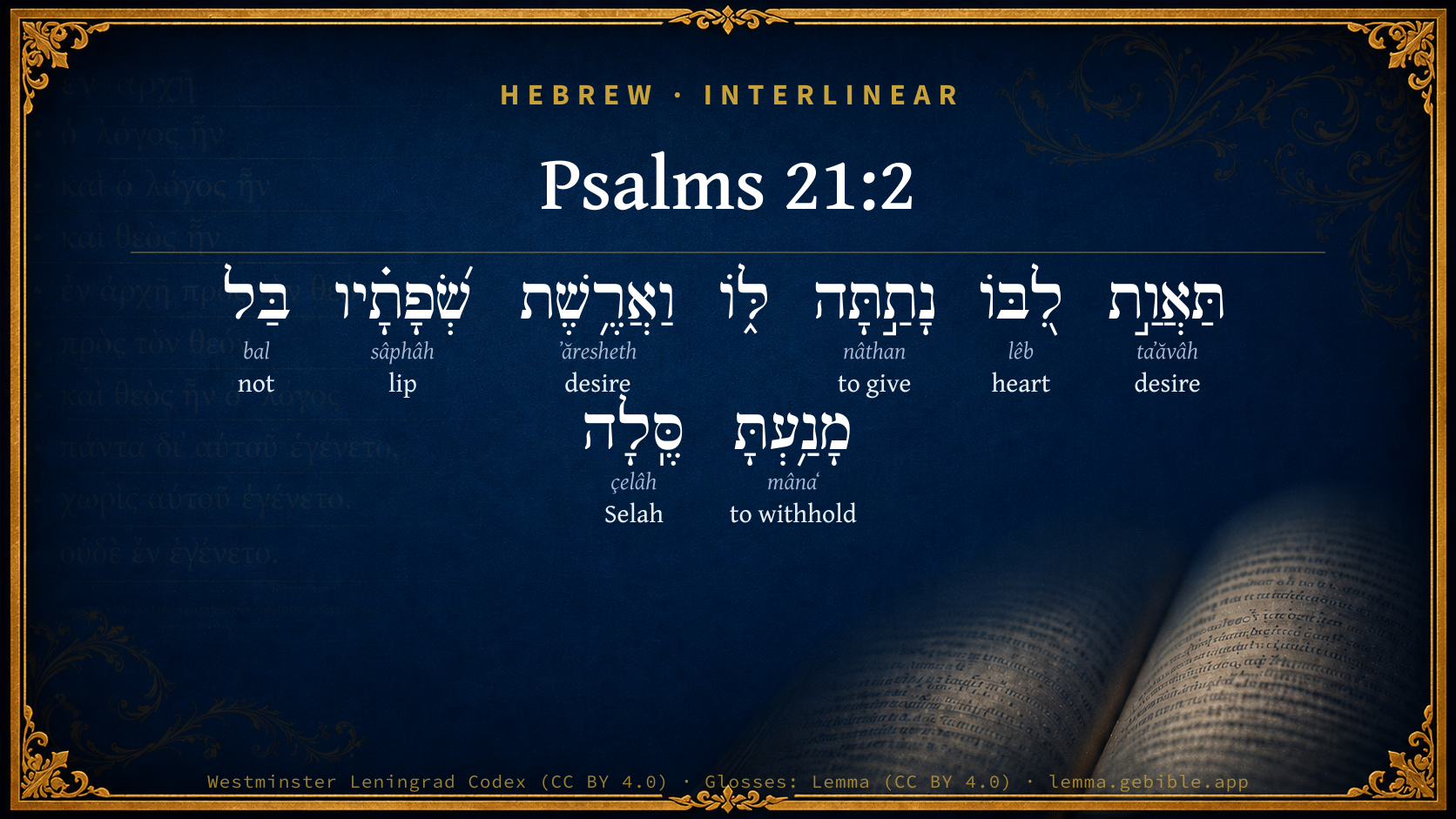
Psalms 21:2

Hebrew (Westminster Leningrad Codex) Psalms 21:2 appears in the Hebrew Old Testament. The text above is from the Westminster Leningrad Codex. Each word links to its Strong’s number, a concise gloss, and parsing drawn from the Open Scriptures Hebrew Bible morphology. Click any word for its full Brown-Driver-Briggs (BDB) entry.
Download image
Cite this verse

Psalms 21:2 (World English Bible). Public Domain. Lemma interlinear Bible study tool, https://lemma.gebible.app/v/psalms/21/2.

Show BibTeX & RIS
BibTeX
RIS
English Translation
You have given him his heart's desire, And have not withheld the request of his lips. Selah.
World English Bible · Public Domain
Highlights
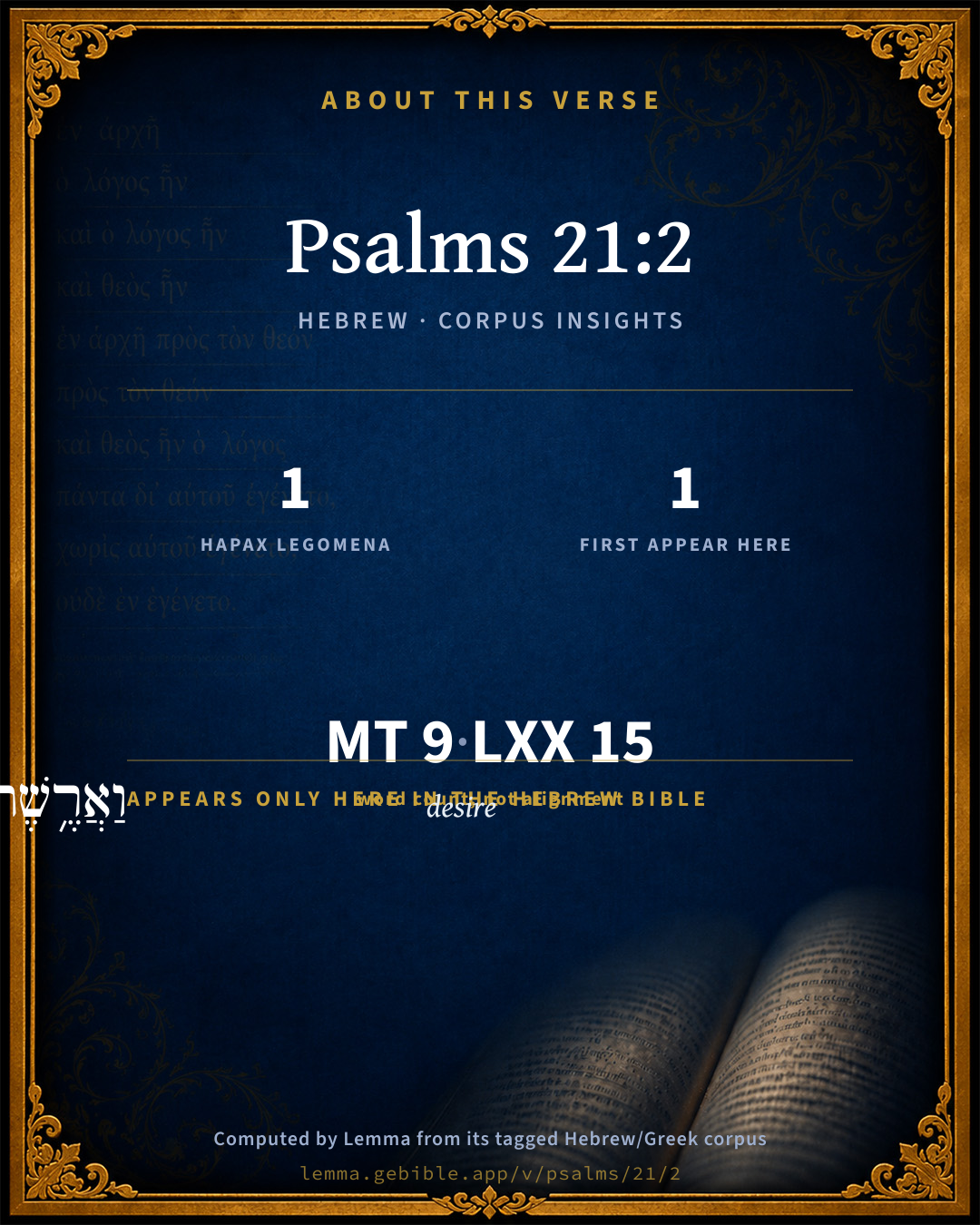
  • 1 hapax legomenon — only here in the Hebrew Bible
  • 1 first appearance in the Hebrew Bible
Full analysis ↓
Download a study sheet

One document with this verse’s original text, its word-by-word gloss line, the meaning frame, cross-references with their text, attributed commentary, and full source and license credits — printable, and it pastes into notes with its structure intact.

This verse Autodidact and up

Study sheet (.html) Plain text (.txt)

A passage Seminary Student

Up to 50 verses in one chapter. A passage sheet keeps up to 6 commentary sources and 12 cross-references per verse, in the order this page ranks them, and says so on the sheet whenever that leaves anything out. Ask for a single verse and you get the Autodidact verse sheet above.

Everything on this page stays free to read, with no account — the sheet is a download of what is already on screen, not access to it.

Want to remove ads? Support Godless Engineer
Compare translations 3

The same verse in 3 English versions, stacked beneath the original-language interlinear above. Click any original word for its lexicon entry.

Each is an independent rendering of the whole verse — the interlinear is not word-aligned to these translations.

Highlighted words mark where these versions differ — a whole-verse word diff, not a word-by-word alignment.

  • World English Bible Public Domain
    You have given him his heart's desire, And have not withheld the request of his lips. Selah.
  • King James Version Public Domain
    Thou hast given him his heart's desire, and hast not withholden the request of his lips. Selah.
  • unfoldingWord Literal Text CC BY-SA 4.0
    You have given to him the desire of his heart, and the request of his lips you have not withheld. Selah

unfoldingWord Literal Text — © unfoldingWord, licensed CC BY-SA 4.0. Word-aligned USFM3 via Door43 (git.door43.org/unfoldingWord/en_ult).

Versions to compare (up to 4)

3 of 4 selected

Show all 18 translations

Every available English version of this verse, each an independent rendering of the whole verse.

  • World English Bible Public Domain
    You have given him his heart's desire, And have not withheld the request of his lips. Selah.
  • Berean Standard Bible Public Domain
    You have granted his heart’s desire and have not withheld the request of his lips. Selah
  • Majority Standard Bible Public Domain
    You have granted his heart’s desire and have not withheld the request of his lips. Selah
  • King James Version Public Domain
    Thou hast given him his heart's desire, and hast not withholden the request of his lips. Selah.
  • American Standard Version (1901) Public Domain
    Thou hast given him his heart's desire, And hast not withholden the request of his lips. Selah
  • Revised Version (1885) Public Domain
    Thou hast given him his heart’s desire, and hast not withholden the request of his lips. Selah
  • Geneva Bible (1599) Public Domain
    Thou hast giuen him his hearts desire, and hast not denyed him the request of his lips. Selah.
  • Douay-Rheims (1899) Public Domain
    In thy strength, O Lord, the king shall joy; and in thy salvation he shall rejoice exceedingly.
  • Young's Literal Translation Public Domain
    The desire of his heart Thou gavest to him, And the request of his lips Thou hast not withheld. Selah.
  • Literal Standard Version CC BY-SA 4.0
    You gave the desire of his heart to him, || And You have not withheld the request of his lips. Selah.
  • Unlocked Literal Bible CC BY-SA 4.0
    You have given him his heart's desire and have not held back the request of his lips. Selah
  • unfoldingWord Literal Text CC BY-SA 4.0
    You have given to him the desire of his heart, and the request of his lips you have not withheld. Selah
  • Darby Bible Public Domain
    Thou hast given him his heart's desire, and hast not withholden the request of his lips. Selah.
  • World Messianic Bible Public Domain
    You have given him his heart’s desire, and have not withheld the request of his lips. Selah.
  • Webster's Bible Public Domain
    \\21:1\\To the chief Musician, a Psalm of David. The king shall joy in thy strength, O LORD; and in thy salvation how greatly shall he rejoice!
  • Free Bible Version CC BY-SA 4.0
    You gave him everything he wanted; you didn't hold back anything he asked for.
  • Bible in Basic English Public Domain
    You have given him his heart's desire, and have not kept back the request of his lips. (Selah.)
  • JPS Tanakh (1917) Public Domain
    (21-3) Thou hast given him his heart's desire, and the request of his lips Thou hast not withholden. Selah

Literal Standard Version (2020), Covenant Press — licensed CC BY-SA 4.0. Text via the HelloAO Bible API (eBible.org). Unlocked Literal Bible (unfoldingWord) — licensed CC BY-SA 4.0. Text via the HelloAO Bible API (eBible.org). unfoldingWord Literal Text — © unfoldingWord, licensed CC BY-SA 4.0. Word-aligned USFM3 via Door43 (git.door43.org/unfoldingWord/en_ult). Free Bible Version, Dr. Jonathan Gallagher — licensed CC BY-SA 4.0. Text via the HelloAO Bible API (eBible.org).

Word by word

More ways to search: Search by grammar → Find every occurrence → Compare this word →

Practice this passage: Drill this verse → Learn its vocabulary →

About this verse

These counts appear in no published source. They are computed here, from the morphology-tagged text and Lemma’s own curated glosses. What Lemma adds →

9
words
8
distinct lemmas
Wisdom
section

Notable vocabulary

1 hapax legomenon — a word that appears only here in the entire Hebrew Bible:

  • וַאֲרֶ֥שֶׁת desire H782

First appearance in Scripture

This word makes its first canonical appearance in the Hebrew Bible here:

  • וַאֲרֶ֥שֶׁת desire H782

Shared distinctive vocabulary

תַּאֲוַ֣ת desire H8378 occurs in 21 verses of the Hebrew Bible. Also found in:

Grammatical profile

  • 2 verbs
  • 4 nouns
  • 1 preposition
  • 2 particles

Verb forms

  • נָתַ֣תָּה Qal · Perfect
  • מָנַ֥עְתָּ Qal · Perfect

Hebrew & Septuagint length

In English translation the verse runs 17 words from the Hebrew and 21 from the Septuagint (LXX English) — closely comparable.

A rough comparison of the two English renderings, which tokenize alike — not a word-level alignment.

Word counts can differ between the Hebrew and the Greek without any difference in meaning — e.g. the Hebrew direct-object marker אֵת has no separate Greek word, and Greek often adds the article ὁ.

In the original languages it is 9 Hebrew tokens and 15 Greek tokens — but the two are counted differently (Hebrew bundles its prefixes and suffixes into one token; the Greek is in lemma form), so that isn’t a like-for-like length.

Cross-references

6

Topical passages linked to Psalms 21:2 in the Treasury of Scripture Knowledge — connected by theme and wording, ordered by reader-vote popularity; previews shown in the World English Bible.

  • Psalms 37:4 Also delight yourself in Yahweh, And he will give you the desires of your heart.
  • Psalms 20:4–5 May He grant you your heart's desire, And fulfill all your counsel.
  • Psalms 2:8–9 Ask of me, and I will give the nations for your inheritance, The uttermost parts of the earth for your possession.
  • Isaiah 49:6–12 yes, he says, It is too light a thing that you should be my servant to raise up the tribes of Jacob, and to restore the preserved of Israel: I will also give you for a light to the Gentiles, that you may be my salvation to the end of the earth.
  • Hebrews 7:25 Therefore he is also able to save to the uttermost those who draw near to God through him, seeing he ever lives to make intercession for them.
  • Psalms 92:11 My eye has also seen my enemies. My ears have heard of the wicked enemies who rise up against me.

Cross-references courtesy of OpenBible.info (CC BY 4.0).

Hebrew and Greek witnesses Masoretic Hebrew ↔ Greek Septuagint

The same verse in the two great witnesses to the Old Testament, shown verse-for-verse.

You’re reading Greek Psalm 20 (Hebrew Psalm 21). The Septuagint counts the superscription, so verse numbers can differ from the Hebrew — chapter-level alignment, not verse-by-verse. Numbering follows Rahlfs.

These are two independent witnesses, not word-aligned to each other, and the Septuagint is shown in lemma (dictionary) form.

Hebrew Psalms 21:2 Masoretic · Westminster Leningrad Codex

תַּאֲוַ֣ת לִ֭בּוֹ נָתַ֣תָּה לּ֑וֹ וַאֲרֶ֥שֶׁת שְׂ֝פָתָ֗יו בַּל מָנַ֥עְתָּ סֶּֽלָה

You have given him his heart's desire, And have not withheld the request of his lips. Selah.

World English Bible · Public Domain

Greek LXX Greek Psalm 20:2 Septuagint · lemma form

κύριος ἐν ὁ δύναμις σύ εὐφραίνω ὁ βασιλεύς καί ἐπί ὁ σωτήριον σύ ἀγαλλιάομαι σφόδρα

You have granted him the desire of his soul, and have not withheld from him the request of his lips. Pause.

LXX2012 (modern English Septuagint) · Public Domain

Hebrew: Westminster Leningrad Codex (CC BY 4.0). Greek: Septuagint (public domain); English from LXX2012 (modern English Septuagint) (Public Domain). How the Septuagint differs from the Hebrew →

Commentary

Notes on Psalms 21:2 from classic Christian and Jewish commentators (each source and its license shown beneath its notes). The classic Christian expositions comment on the surrounding passage and are grouped to its opening verse, so a note may address several verses; the Jewish commentaries on the Tanakh (Rashi and others) are per-verse, so they appear only where the commentator wrote on this verse.

Lemma curates 59 commentaries, every one of them public domain or Creative Commons licensed, each selected and text-cleaned for this edition rather than reprinted as found. About our sources →

Trapp's Complete Commentary

John Trapp

Psa 21:2 Thou hast given him his heart’s desire, and hast not withholden the request of his lips. Selah.

Ver. 2. Thou hast given him his heart’s desire] Good men are sure to have out their prayers either in money or in money’s worth, as they say; in that very thing they desire, or a better. If God cross them, it is in faithfulness to their souls when the wicked boasteth of their heart’s desire Psa 10:3, which yet he hath for a mischief Deus saepe dat iratus, quod negat propitius. {See Trapp on "Psa 20:4"}

And hast not withholden, &c. Selah] Ac si dicat, O magnam et admirabilem Dei benevolentiam erga Davidem! saith Vatablus. This Selah is added here to set forth the very great and wonderful love of God to David, in hearing his suits after that sort.

John Trapp, A Commentary or Exposition upon All the Books of the Old and New Testament (1647–1656) — public domain. Text from a community e-Sword module.

The Biblical Illustrator

Joseph S. Exell

Psa_21:2

Thou hast given him his hearts desire.

The desire granted

In this Psalm the joy bells of praise and thanksgiving are rung, and Te Deum laudamus sung, as after a great victory. It follows close on Psa_20:1-9, celebrating the fulfilment of the petitions there offered.

1. We are reminded of the connection between desire and prayer. Desire is the mainspring of life. Could the infinite multitude of desires be annihilated, hope and effort would die, and the busy drama of life come to a standstill. Desire is therefore the test of character. Not what a man does or says, but what he desires, marks him for what he is, and makes him what he is. Desire, therefore, is the soul of prayer. We see here, perhaps, the deepest reason why God has ordained prayer, namely, that what is deepest, most dominant in mans nature, should be consecrated to God, and supremely refer to Him.

2. The whole invisible world of human desires (never the same two moments) lies open to Gods eye. God can, if He sees fit, give us our hearts desire. No lawful desire but He has created the means of its satisfaction; and if He disappoints it, this is but for the sake of some nobler end, some richer blessing. Unlawful desires are forbidden, not because He grudges our joy, but because their fulfilment would be our injury and ruin.

3. We have a practical test suggested both of our desires and of our prayers.

(1) Of our desires. Are they such as we can put into prayer? Are they pure--such as God can approve; reasonable--such as we need not be ashamed to put into prayer; unselfish--such as consist with the great law of love; unpresumptuous--within the scope of Gods promises?

(2) Of our prayers. Do they indeed express the desires of our heart? Prayer without desire is a dead form; a featherless, pointless arrow that will reach no mark. (E. R. Conder, M. A.)

The Biblical Illustrator, edited by Joseph S. Exell (c. 1880s–1900s) — public domain. Text from a community e-Sword module.

Joseph Benson's Commentary

Psa 21:2. Thou hast given him his heart’s desire — Thou hast granted all that he desired in his heart, as well as that which he openly requested with his lips. “The desire of Christ’s heart was his own resurrection and exaltation, for the benefit of his church; and now he ever liveth to make request with his lips, for the conversion and salvation of sinners. Such desires will be granted, and such requests will never be withholden. Let us be careful to frame ours after that all-perfect model of divine love.” — Horne.

Joseph Benson's Commentary on the Old and New Testaments (1811–1818) — public domain. Text from a community e-Sword module.

J. A. Alexander on Psalms

Joseph Addison Alexander

3. (Psa 21:2). The desire of his heart thou hast given unto him, and the quest of his lips hast not withholden. Selah. The occasion of the joy and exultation mentioned in the preceding verse is now more particularly set forth. It is easy to imagine, although not recorded, that the great promise in the seventh chapter of 2 Samuel was in answer to the fervent and long-continued prayers of David for a succession in his own family.—The word translated quest occurs only here, but its sense is determined by the parallelism and the Arabic analogy. The combination of the positive and negative expressions of the same idea (given and not withholden) is a favourite Hebrew idiom.

Joseph Addison Alexander, The Psalms Translated and Explained (1850) — public domain. Text from a community e-Sword module.

Tyndale Open Study Notes

Tyndale Open Resources

21:2 The king has experienced his heart’s desire—God’s protection and blessing (see 20:5; see also 2:8).

Tyndale Open Study Notes — © Tyndale Open Resources, licensed CC BY-SA 4.0. Text via the HelloAO Bible API.

Jamieson, Fausset & Brown

Robert Jamieson, A. R. Fausset & David Brown

The sentiment affirmed in the first clause is reaffirmed by the negation of its opposite in the second.

Jamieson, Fausset & Brown — Commentary Critical and Explanatory on the Whole Bible (1871) — public domain (CC PDM 1.0). Text via the HelloAO Bible API.

Adam Clarke's Commentary

Verse 2. Thou hast given him his heart's desire] This seems to refer to the prayers offered in the preceding Psalm; see especially Ps 21:1-4.

Adam Clarke's Commentary on the Bible (1810–1826) — public domain. Text from a community e-Sword/MySword module.

Ellicott's Commentary for English Readers

(2) Request.—The Hebrew word occurs nowhere else, but is connected with a root, to be poor, and, therefore, in want. The “not” is emphatic: “And the request of his lips thou hast by no means withheld.” The mention in Psa_21:4 of a prayer for long life, or perhaps, rather, continuance of life, suggests that this “request” was uttered in sickness. On the other hand the general tone of the psalm connects it with a victory.

A Bible Commentary for English Readers, edited by Charles John Ellicott (1878–1897) — public domain. Text from a community e-Sword module.

The Cambridge Bible for Schools and Colleges

gen. ed. J. J. S. Perowne

2. This verse refers chiefly, but not exclusively, to the prayers for the success of the expedition referred to in Psa_20:3-5.

The Cambridge Bible for Schools and Colleges (gen. ed. J. J. S. Perowne; Cambridge University Press, 1878–1918) — public domain. Text from a community e-Sword module.

John Gill's Exposition

Thou hast given him his heart's desire,.... Which the church had prayed for in Psa 20:4; whatever Christ's heart desired, or his lips requested, has been given him;

and hast not withholden the request of his lips. Whatever he asked in the council and covenant of peace was granted; he asked for all the elect, as his spouse and bride; these were the desire of his heart and eyes, and they were given him; he asked for all the blessings of grace for them, and all grace was given to them in him; he asked for glory, for eternal life, and it was promised him; and not only the promise of it was put into his hand, but the thing itself; see Psa 2:8, Jo1 5:11; and Psa 20:4; whatever he requested of his Father, when here on earth, was granted; he always heard him; that memorable prayer of his in Joh 17:1 is heard and answered, both in what respects himself, his own glorification, and the conversion, sanctification, union, preservation, and glorification of his people; whatever he now desires and requests in heaven, as the advocate and intercessor for his saints, is ever fulfilled; which is an instance of the great regard Jehovah has unto him, and may be considered as a reason of his joy in him.

Selah; on this word; see Gill on Psa 3:2.

John Gill's Exposition of the Whole Bible (1746–1763) — public domain (CC PDM 1.0). Text via the HelloAO Bible API.

Albert Barnes' Notes on the Bible

Thou hast given him his heart’s desire - See the notes at Psa 20:4. This had been the prayer of the people that God would “grant him according to his own heart, and fulfil all his counsel,” and this desire had now been granted. All that had been wished; all that had been prayed for by himself or by the people, had been granted.

And hast not withholden - Hast not denied or refused.

The request of his lips - The request, or the desire which his lips had uttered. The meaning is, that his petitions had been filly granted.

Selah - See the notes at Psa 3:2.

Albert Barnes' Notes on the Bible (1834–1885) — public domain. Text from a community e-Sword/MySword module.

The Treasury of David

Charles H. Spurgeon

Ver. 2. Thou hast given him the desire of his soul. He desired to eat the passover, and to lay down his life when he would, and again when he would to take it; and thou hast given it to him. And hast not deprived him of the good pleasure of his lips. "My peace, " saith he, "I leave with you; "and it was done. Augustine, in loc.

Ver. 2. (first clause). Good men are sure to have out their prayers either in money, or in money's worth, as they sayin that very thing, or a better. John Trapp.

Ver. 2. Selah. See pages 25,29,38,345.

Ver. 2. The successful Advocate.

Psalms 21:3*

Charles H. Spurgeon's The Treasury of David (1869–1885) — public domain. Psalms only. Text from a community e-Sword/MySword module.

Whedon's Commentary on the Bible

Daniel D. Whedon

2. His heart’s desire—Comp. Psa_20:4. The cause of this answer is given in Psa_21:7. As applied to Messiah, see Joh_11:41-42 : “Father, I thank thee that thou hast heard me.”

Daniel D. Whedon (gen. ed.), Commentary on the Old and New Testaments (1874–1909) — public domain. Text from a community e-Sword module.

The Pulpit Commentary

Thou hast given him his heart"s desire. (comp. Psa_20:4, "Grant thee according to thine own heart And hast not withholden the request of his lips. "Out of the abundance of the heart the mouth speaketh." The deliverance from his enemies, which David had earnestly desired in his heart, he had also devoutly requested with his lips. (Psa_20:1, Psa_20:5) Selah. The pause here may have been for the presentation of a thank-offering.

The triumph of victory.

"Thou hast given him his heart"s desire." We seem to hear in this psalm the trumpets and harps and shams of the temple, and jubilant voices of Levites praising God for some great victory. Joy-bells are rung and Te Deum laudamus chanted because the king has come home in triumph. The psalm is closely connected with the preceding one. There we see the king going forth to war, consecrating his banner and trusting his cause to God. The Church prays, "The Lord hear thee... grant thee according to thine own heart". (Psa_20:1-4) Here it triumphs in victory, and praises God as the Hearer of prayer. Whether the psalm refers to some special victory of David or any of his successors; or whether it be applied to Christ and his kingdom, the practical spiritual lessons we may draw from it are the same. One of the greatest Jewish commentators says, "Our ancient doctors interpreted this psalm of King Messiah; but against the heretics (Christians) it is better to understand it of David" (Rashi, quoted by Perowne). Take up briefly the leading thoughts which the text naturally suggests.

I DESIRE IS THE MAINSPRING OF LIFE. Could the infinite multitude of desires, good or bad, transient or constant, noble or base, loving or selfish, which at this moment agitate human hearts, all cease, and be replaced by dull apathy, hope and effort would die. The whole busy drama of life would come to a dead stand, like an engine stopping when the fire is burnt out. Because so many of these desires are either wrong or ill-regulated, the word "lust often used in our English Bible, originally meaning simply "pleasure" or "desire has come to have an ill meaning. St. James puts his finger on these ungoverned discordant desires as the source of all the strife that disturbs the world. (Jam_4:1, Jam_4:2) If all hearts submitted their desires to reason and God"s law, the world would be one vast peace society. Vexatious litigation and unfair competition would be unknown.

II Therefore OUR HEART"S DESIRE IS THE TEST OF OUR CHARACTER. Not what a man says and does, but what he would like to say and do, if he could and dared, decide his character. "As he thinketh in his heart, so is he." From the momentary wish, too unreasonable or too languid to stir us to action, to the deep steadfast purpose which rules a life, our desires mark us for what we are, and mould us to what we shall be. Find what it is you deeply and habitually desire, and you have the key to your characters. (Pro_19:22)

III DESIRE IS THE SOUL OF PRAYER. If we do not present to God our heart"s desire, we do not pray. Words without desire are not living prayer, only a dead form. Desire without words may be the truest, highest kind of prayer. (Rom_8:26) Here is the peril of even the best forms of prayer. Their benefit is that they help to put our best desires into better words than we could find for ourselves; and by the power of association, as well as aptness, quicken our desires and instruct us what we ought to desire. Their danger is that we may mistake form and habit for life and spirit a danger not confined to set forms. Extempore prayer may be as heartless and lifeless as a Tartar prayer-mill. Our own private prayers may degenerate into dead forms. Every earnest Christian (I suppose) is aware of this danger. When men came to our Saviour, his question was not "What have you to say?" but "What wilt thou that I should do unto thee?" What is thy heart"s desire?

IV The whole world of human desire is OPEN TO GOD"S EYE. Heart-secrets are no secrets to him. (Jer_17:9, Jer_17:10) The silent wish that flashed to the surface of consciousness, soaring up into light, or plunging, like a guilty thing, into darkness God saw it; sees it still. The passionate longing, so timid yet so strong that the heart would die sooner than betray it, is to him as though proclaimed with sound of trumpet. No wish so sudden, strange, ambitious, as to take him by surprise. No lawful desire but he has provided for its satisfaction, either in creatures or in his own uncreated fulness. And unlawful desires are so, not because he forbids anything really good for us, but because they mean our harm, not happiness. This perfect Divine knowledge of all our desires, and of the wisdom or unwisdom of granting them, is not confined, remember, to the moment when we become conscious of them, or present them in prayer. They are foreseen. For the most part perhaps, if we knew all, in every case an answer to prayer implies preparation. Our prayer for daily bread is answered out of the fulness of last year"s harvest the fruit of all harvests since corn was first reaped and sown. This abyss of Divine foreknowledge utterly confounds our intellect; yet to doubt it would be to doubt if God is God. Why then, with this boundless knowledge foreknowledge of all our desires and the conditions of their fulfilment, has God appointed prayer? Why does his Word show it to us as the very heart of religion? Partly, we may venture to say, because God delights to answer prayer. If not, it would scarcely be true at least intelligible that "God is love." Partly because blessings are doubly, nay, tenfold, precious when they come in answer to prayer; a strong help to faith, a spur to hope, an assurance of God"s love, and powerful motive to love. (Pro_13:19) But supremely (I venture to think) in order that what is deepest, innermost, strongest, in our nature our "heart"s desire should bring us closest to God; make us intensely feel our dependence on him; be consecrated, being offered to him in prayer.

V Thank God, OUR HEART"S DESIRES how large, lofty, pure, reasonable, soever ARE NOT THE MEASURE OF GOD"S GIVING; do not circumscribe his willingness, any more than his power. He is "able to do exceeding abundantly," etc. (Eph_3:20) If men"s desires are like the sea, his mercy is the shore. His chiefest, "his unspeakable Gift" came in answer to no desire of human hearts or prayer from human lips. God so loved" a prayerless, thankless, godless "world, that he gave his only begotten Son." This Gift has given us a new measure of expectation. (Rom_8:32) What is more vital, it has opened a new fountain of desire in our hearts, and thereby enlarged, deepened, exalted, the whole scope of our life. Desire to be like Christ, to glorify Christ, to be with Christ, these three give to life a new meaning, purpose, hope. If these be our heart"s desires, they are secure of fulfilment, because they are in agreement with God"s most glorious Gift, his most merciful purpose, his most precious promises. Here, as everywhere, our Saviour has left us an example, that we should follow his steps. We know what the supreme consuming desire of his heart was Joh_4:34. In the midst of life and usefulness, he longed for death; not as an escape from this world, but as the accomplishment of his destined work. (Luk_12:50 Joh_10:17, Joh_10:18) "For the joy," etc. (Heb_12:2) In your salvation and mine he sees "of the travail of his soul". (Isa_53:2-4)

CONCLUSION. We are furnished with a practical test first, of our desires; secondly, of our prayers. Our desires (we said) are the index to our character. Will they fit into our prayers? Are they such that we can come with boldness to the throne of grace through the blood of Jesus, and say, "Lord, all my desire is before thee?" (Psa_38:9 Isa_26:8) Prayer (we said) is living, real, worth offering, only as it is the utterance of our desires, the pouring out of our heart. Are our prayers such a true outbreathing of our "heart"s desire?" Suppose, when you have joined in some high-toned hymn, or prayed in the earnest words of some ancient saint, a voice from heaven were to ask, "Do you mean what you say?" would it be for good or ill, here and hereafter, if God indeed granted your heart"s desire?

The Pulpit Commentary (1880–1919), ed. H.D.M. Spence-Jones & Joseph S. Exell — public domain. Text from a community e-Sword module.

Rashi

Rabbi Shlomo Yitzchaki (Rashi)

may the king rejoice with Your strength Our Rabbis (Mid. Ps. 21:1) interpreted it as referring to the King Messiah, but the matter may correctly be interpreted further as referring to David himself, in order to refute the sectarians, who became bold because of it.

Rashi on the Tanakh — English translations: “The Judaica Press complete Tanach with Rashi, translated by A. J. Rosenberg” (CC BY 4.0); “Pentateuch with Rashi's commentary by M. Rosenbaum and A.M. Silbermann, 1929-1934” (public domain); “The Metsudah Tanach series, Lakewood, N.J” (CC BY 4.0); and “The Book of Joshua, Metsudah Publications, 1997” (CC BY 4.0). Text via Sefaria.

Lesson kit

Teaching starters — assembled from the data on this page, not authored interpretation. Every prompt links to the verse data it draws on. Edit before teaching.

Psalms, in the Wisdom, opens this verse with 9 words (8 distinct Hebrew lemmas). Its most distinctive word is ʼăresheth (“desire”). A historical commentator’s framing appears above. Read the whole chapter for the surrounding context.

Discussion questions

  1. How does “desire” (ʼăresheth) shape what this verse is saying?
  2. 1 word here appears nowhere else in the Hebrew Bible. Why might the author reach for such rare wording?
  3. This is the first place “desire” appears in Scripture (first appears here). What does its debut here establish?
  4. How does Genesis 3:6, which shares the word «desire», read alongside this verse?
  5. The translations on this page render this verse differently — a whole-verse word diff, not a word-by-word alignment. What might account for the different wordings?
  6. «נָתַ֣תָּה» is a Qal Perfect verb. How does that grammatical form shape the action described?
  7. Compare how Trapp's Complete Commentary and The Biblical Illustrator read this verse. Where do they agree or differ?

Things to notice

Reading settings

Reading text

Shown beneath each verse's original-language words.

Old Testament
Old Testament edition

Read the OT as the Masoretic Hebrew (MT) or the Greek Septuagint (LXX).

English shown for the Greek Septuagint (in the Hebrew ↔ Greek comparison).

Comparing translations? Open the Compare panel on any verse page to stack up to four side by side.