
1 Kings 7:17

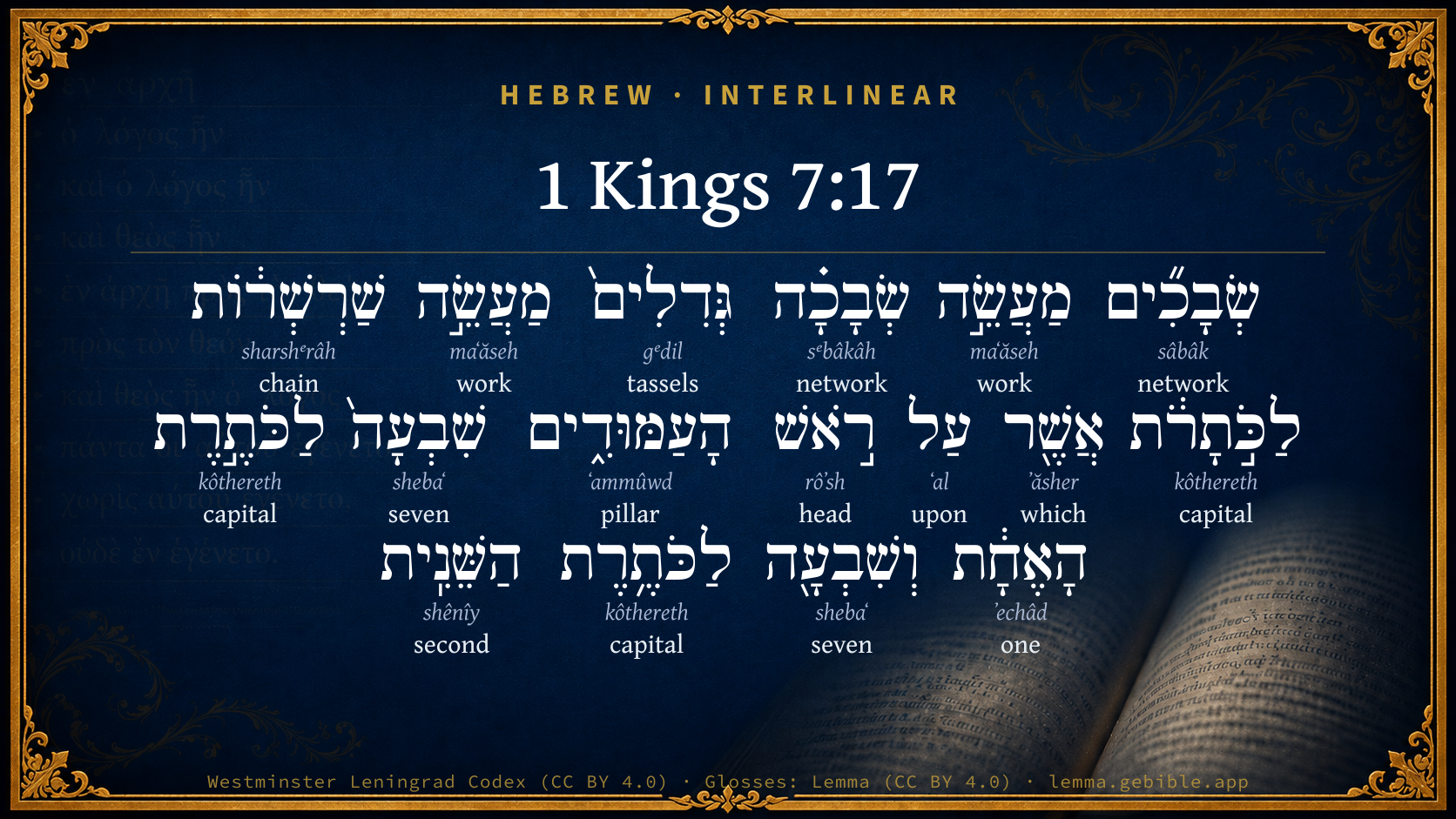
Hebrew (Westminster Leningrad Codex) 1 Kings 7:17 appears in the Hebrew Old Testament. The text above is from the Westminster Leningrad Codex. Each word links to its Strong’s number, a concise gloss, and parsing drawn from the Open Scriptures Hebrew Bible morphology. Click any word for its full Brown-Driver-Briggs (BDB) entry.
Download image
Cite this verse

1 Kings 7:17 (World English Bible). Public Domain. Lemma interlinear Bible study tool, https://lemma.gebible.app/v/1-kings/7/17.

Show BibTeX & RIS
BibTeX
RIS
English Translation
There were nets of checker-work, and wreaths of chain-work, for the capitals which were on the top of the pillars; seven for the one capital, and seven for the other capital.
World English Bible · Public Domain
Highlights
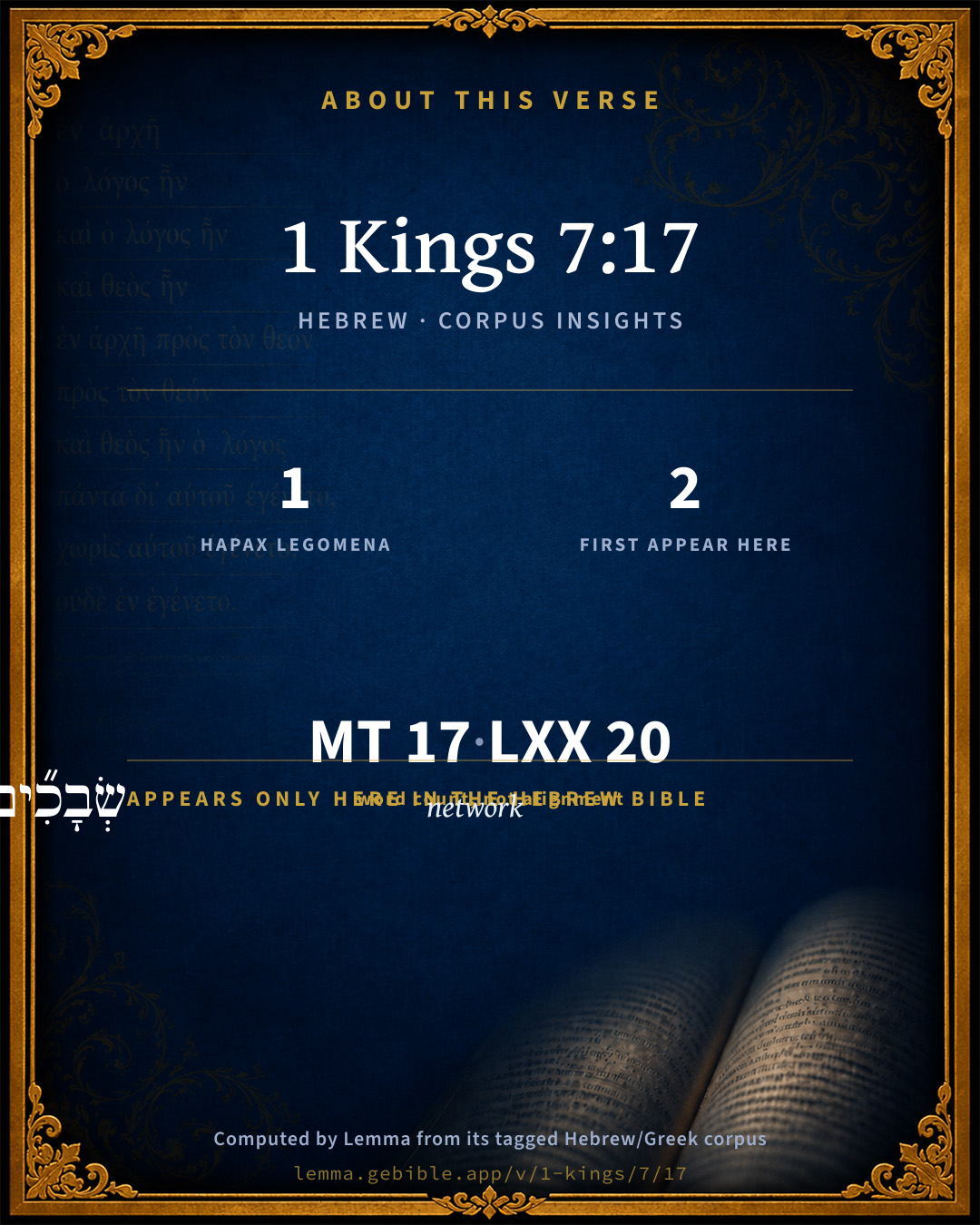
  • 1 hapax legomenon — only here in the Hebrew Bible
  • 2 first appearances in the Hebrew Bible
Full analysis ↓
Download a study sheet

One document with this verse’s original text, its word-by-word gloss line, the meaning frame, cross-references with their text, attributed commentary, and full source and license credits — printable, and it pastes into notes with its structure intact.

This verse Autodidact and up

Study sheet (.html) Plain text (.txt)

A passage Seminary Student

Up to 50 verses in one chapter. A passage sheet keeps up to 6 commentary sources and 12 cross-references per verse, in the order this page ranks them, and says so on the sheet whenever that leaves anything out. Ask for a single verse and you get the Autodidact verse sheet above.

Everything on this page stays free to read, with no account — the sheet is a download of what is already on screen, not access to it.

Want to remove ads? Support Godless Engineer
Compare translations 3

The same verse in 3 English versions, stacked beneath the original-language interlinear above. Click any original word for its lexicon entry.

Each is an independent rendering of the whole verse — the interlinear is not word-aligned to these translations.

Highlighted words mark where these versions differ — a whole-verse word diff, not a word-by-word alignment.

  • World English Bible Public Domain
    There were nets of checker-work, and wreaths of chain-work, for the capitals which were on the top of the pillars; seven for the one capital, and seven for the other capital.
  • King James Version Public Domain
    And nets of checker work, and wreaths of chain work, for the chapiters which were upon the top of the pillars; seven for the one chapiter, and seven for the other chapiter.
  • unfoldingWord Literal Text CC BY-SA 4.0
    Networks, a work of netting, strands, a work of chains, to the capitals that on the head of the pillars. Seven were to one capital, and seven were to the second capital.

unfoldingWord Literal Text — © unfoldingWord, licensed CC BY-SA 4.0. Word-aligned USFM3 via Door43 (git.door43.org/unfoldingWord/en_ult).

Versions to compare (up to 4)

3 of 4 selected

Show all 18 translations

Every available English version of this verse, each an independent rendering of the whole verse.

  • World English Bible Public Domain
    There were nets of checker-work, and wreaths of chain-work, for the capitals which were on the top of the pillars; seven for the one capital, and seven for the other capital.
  • Berean Standard Bible Public Domain
    For the capitals on top of the pillars he made a network of lattice, with wreaths of chainwork, seven for each capital.
  • Majority Standard Bible Public Domain
    For the capitals on top of the pillars he made a network of lattice, with wreaths of chainwork, seven for each capital.
  • King James Version Public Domain
    And nets of checker work, and wreaths of chain work, for the chapiters which were upon the top of the pillars; seven for the one chapiter, and seven for the other chapiter.
  • American Standard Version (1901) Public Domain
    There were nets of checker-work, and wreaths of chain-work, for the capitals which were upon the top of the pillars; seven for the one capital, and seven for the other capital.
  • Revised Version (1885) Public Domain
    There were nets of checker work, and wreaths of chain work, for the chapiters which were upon the top of the pillars; seven for the one chapiter, and seven for the other chapiter.
  • Geneva Bible (1599) Public Domain
    He made grates like networke, and wrethen worke like chaynes for the chapiters that were on the top of the pillars, euen seuen for the one chapiter, and seuen for the other chapiter.
  • Douay-Rheims (1899) Public Domain
    And a kind of network, and chain work wreathed together with wonderful art. Both the chapiters of the pillars were cast: seven rows of nets were on one chapiter, and seven nets on the other chapiter.
  • Young's Literal Translation Public Domain
    Nets of net-work, wreaths of chain-work `are' for the chapiters that `are' on the top of the pillars, seven for the one chapiter, and seven for the second chapiter.
  • Literal Standard Version CC BY-SA 4.0
    Nets of network, wreaths of chain-work [are] for the chapiters that [are] on the top of the pillars, seven for the first capital, and seven for the second capital.
  • Unlocked Literal Bible CC BY-SA 4.0
    Checker latticework and wreaths of chain work for the capitals decorated the top of the pillars, seven for each capital.
  • unfoldingWord Literal Text CC BY-SA 4.0
    Networks, a work of netting, strands, a work of chains, to the capitals that on the head of the pillars. Seven were to one capital, and seven were to the second capital.
  • Darby Bible Public Domain
    [and] nets of checker-work, wreaths of chain-work, for the capitals which were upon the top of the pillars; seven for the one capital and seven for the other capital.
  • World Messianic Bible Public Domain
    There were nets of checker work and wreaths of chain work for the capitals which were on the top of the pillars: seven for the one capital, and seven for the other capital.
  • Webster's Bible Public Domain
    And nets of checker-work, and wreaths of chain-work, for the capitals which were upon the top of the pillars; seven for the one capital, and seven for the other capital.
  • Free Bible Version CC BY-SA 4.0
    He made a network of lattice using interlinked chains for both capitals, seven for each one.
  • Bible in Basic English Public Domain
    There were nets of open-work for the crowns on the tops of the pillars, a net of open-work for one and a net of open-work for the other.
  • JPS Tanakh (1917) Public Domain
    He also made nets of checker-work, and wreaths of chain-work, for the capitals which were upon the top of the pillars: seven for the one capital, and seven for the other capital.

Literal Standard Version (2020), Covenant Press — licensed CC BY-SA 4.0. Text via the HelloAO Bible API (eBible.org). Unlocked Literal Bible (unfoldingWord) — licensed CC BY-SA 4.0. Text via the HelloAO Bible API (eBible.org). unfoldingWord Literal Text — © unfoldingWord, licensed CC BY-SA 4.0. Word-aligned USFM3 via Door43 (git.door43.org/unfoldingWord/en_ult). Free Bible Version, Dr. Jonathan Gallagher — licensed CC BY-SA 4.0. Text via the HelloAO Bible API (eBible.org).

Word by word

More ways to search: Search by grammar → Find every occurrence → Compare this word →

Practice this passage: Drill this verse → Learn its vocabulary →

שְׂבָכִ֞ים
sâbâk
H7638
“networks”
Noun, Common, Feminine, Plural, Absolute
Part of Speech
Noun
Type
Common
Gender
Feminine
Number
Plural
State
Absolute
Full BDB Definition

Origin: from an unused root meaning to entwine

TWOT: 2230

network, lattice-work, net, netting - lattice - net-ornament (on pillars) - network, toils (for catching animals)
  1. מַעֲשֵׂ֣ה maʻăseh H4639 “work of” Noun, Common, Masculine, Singular, Construct
  2. שְׂבָכָ֗ה sᵉbâkâh H7639 “network” Noun, Common, Feminine, Singular, Absolute
  3. גְּדִלִים֙ gᵉdil H1434 “tassels” Noun, Common, Masculine, Plural, Absolute
  4. מַעֲשֵׂ֣ה maʻăseh H4639 “work of” Noun, Common, Masculine, Singular, Construct
  5. שַׁרְשְׁר֔וֹת sharshᵉrâh H8333 “chains” Noun, Common, Feminine, Plural, Absolute
  6. לַכֹּ֣תָרֹ֔ת kôthereth H3805 “to/for the · capitals” Preposition, Determined + Noun, Common, Feminine, Plural, Absolute
  7. אֲשֶׁ֖ר ʼăsher H834 “which” Particle, Relative
  8. עַל ʻal H5921 “upon” Preposition
  9. רֹ֣אשׁ rôʼsh H7218 “head of” Noun, Common, Masculine, Singular, Construct
  10. הָעַמּוּדִ֑ים ʻammûwd H5982 “the · pillars” Particle, Definite Article + Noun, Common, Masculine, Plural, Absolute
  11. שִׁבְעָה֙ shebaʻ H7651 “seven” Adjective, Cardinal number, Masculine, Singular, Absolute
  12. לַכֹּתֶ֣רֶת kôthereth H3805 “to/for the · capital” Preposition, Determined + Noun, Common, Feminine, Singular, Absolute
  13. הָאֶחָ֔ת ʼechâd H259 “the · one” Particle, Definite Article + Adjective, Cardinal number, Feminine, Singular, Absolute
  14. וְשִׁבְעָ֖ה shebaʻ H7651 “and · seven” Conjunction + Adjective, Cardinal number, Masculine, Singular, Absolute
  15. לַכֹּתֶ֥רֶת kôthereth H3805 “to/for the · capital” Preposition, Determined + Noun, Common, Feminine, Singular, Absolute
  16. הַשֵּׁנִֽית shênîy H8145 “the · second” Particle, Definite Article + Adjective, Ordinal number, Feminine, Singular, Absolute

About this verse

These counts appear in no published source. They are computed here, from the morphology-tagged text and Lemma’s own curated glosses. What Lemma adds →

17
words
13
distinct lemmas
Historical
section

Notable vocabulary

1 hapax legomenon — a word that appears only here in the entire Hebrew Bible:

  • שְׂבָכִ֞ים network H7638

First appearance in Scripture

These words make their first canonical appearance in the Hebrew Bible here:

  • שְׂבָכִ֞ים network H7638
  • שְׂבָכָ֗ה network H7639

Shared distinctive vocabulary

גְּדִלִים֙ tassels H1434 occurs in 2 verses of the Hebrew Bible. Also found in:

Grammatical profile

  • 11 nouns
  • 4 adjectives
  • 1 preposition
  • 1 particle

Repetition

Words recur within this verse — often emphatic in Hebrew:

  • לַכֹּ֣תָרֹ֔ת capital H3805 ×3
  • מַעֲשֵׂ֣ה work H4639 ×2
  • שִׁבְעָה֙ seven H7651 ×2

Hebrew & Septuagint length

In English translation the verse runs 31 words from the Hebrew and 27 from the Septuagint (LXX English) — closely comparable.

A rough comparison of the two English renderings, which tokenize alike — not a word-level alignment.

Word counts can differ between the Hebrew and the Greek without any difference in meaning — e.g. the Hebrew direct-object marker אֵת has no separate Greek word, and Greek often adds the article ὁ.

In the original languages it is 17 Hebrew tokens and 20 Greek tokens — but the two are counted differently (Hebrew bundles its prefixes and suffixes into one token; the Greek is in lemma form), so that isn’t a like-for-like length.

Cross-references

5

Topical passages linked to 1 Kings 7:17 in the Treasury of Scripture Knowledge — connected by theme and wording, ordered by reader-vote popularity; previews shown in the World English Bible.

  • Exodus 28:14 and two chains of pure gold; you make them like cords shall, of braided work: and you shall put the braided chains on the settings.
  • Exodus 28:22 You shall make on the breastplate chains like cords, of braided work of pure gold.
  • Exodus 28:24–25 You shall put the two braided chains of gold in the two rings at the ends of the breastplate.
  • Exodus 39:15–18 They made on the breastplate chains like cords, of braided work of pure gold.
  • 2 Kings 25:17 The height of the one pillar was eighteen cubits, and a capital of brass was on it; and the height of the capital was three cubits, with network and pomegranates on the capital round about, all of brass: and like to these had the second pillar with network.

Cross-references courtesy of OpenBible.info (CC BY 4.0).

Hebrew and Greek witnesses Masoretic Hebrew ↔ Greek Septuagint

The same verse in the two great witnesses to the Old Testament, shown verse-for-verse.

These are two independent witnesses, not word-aligned to each other, and the Septuagint is shown in lemma (dictionary) form.

Hebrew 1 Kings 7:17 Masoretic · Westminster Leningrad Codex

שְׂבָכִ֞ים מַעֲשֵׂ֣ה שְׂבָכָ֗ה גְּדִלִים֙ מַעֲשֵׂ֣ה שַׁרְשְׁר֔וֹת לַכֹּ֣תָרֹ֔ת אֲשֶׁ֖ר עַל רֹ֣אשׁ הָעַמּוּדִ֑ים שִׁבְעָה֙ לַכֹּתֶ֣רֶת הָאֶחָ֔ת וְשִׁבְעָ֖ה לַכֹּתֶ֥רֶת הַשֵּׁנִֽית

There were nets of checker-work, and wreaths of chain-work, for the capitals which were on the top of the pillars; seven for the one capital, and seven for the other capital.

World English Bible · Public Domain

Greek LXX 1 Kings 7:17 Septuagint · lemma form

καί τέσσαρες τροχός χαλκοῦς ὁ μεχωνωθ ὁ εἷς καί ὁ προςἔχω χαλκοῦς καί τέσσαρες μέρος αὐτός ὠμία ὑποκάτω ὁ λουτήρ

And he made two ornaments of network to cover the capitals of the pillars; even a net for one chapiter, and a net for the other chapiter.

LXX2012 (modern English Septuagint) · Public Domain

On this verse, The Cambridge Bible for Schools and Colleges discusses the Septuagint’s reading. Read the note in Commentary ↓

Hebrew: Westminster Leningrad Codex (CC BY 4.0). Greek: Septuagint (public domain); English from LXX2012 (modern English Septuagint) (Public Domain). How the Septuagint differs from the Hebrew →

Targum (Aramaic paraphrase)

1

The Targum is the ancient Jewish Aramaic paraphrase of the Hebrew Scriptures — an interpretive translation, not the Hebrew text itself. Onkelos (literal) and Pseudo-Jonathan (expansive) render the Torah, and Jonathan the Prophets. Coverage is partial: where no permissively-licensed English translation exists for a verse, only the Aramaic is shown. This is verse-level text, not a word-by-word alignment to the Hebrew.

  1. Targum Jonathan Prophets (Joshua–Malachi)
    סְרִיגַן עוֹבַד סְרִיגָא קְלִיעַן עוֹבַד גְדִילַן לִקְרוֹנְתְּוָן דְעַל רֵישׁ עַמוּדַיָא שַׁבְעָא לִקְרוֹנְתָּא חֲדָא וְשַׁבְעָא לִקְרוֹנְתָּא תִנְיֵתָא:

    (no public-domain English translation for this verse)

    Targum Jonathan — Aramaic: “Mikraot Gedolot” (public domain). English: “Sefaria Community Translation” (CC0 1.0 (public-domain dedication)); “London "Chaldee Paraphrase," 1871” (public domain). Text via Sefaria.

Commentary

Notes on 1 Kings 7:17 from classic Christian and Jewish commentators (each source and its license shown beneath its notes). The classic Christian expositions comment on the surrounding passage and are grouped to its opening verse, so a note may address several verses; the Jewish commentaries on the Tanakh (Rashi and others) are per-verse, so they appear only where the commentator wrote on this verse.

Lemma curates 59 commentaries, every one of them public domain or Creative Commons licensed, each selected and text-cleaned for this edition rather than reprinted as found. About our sources →

Trapp's Complete Commentary

John Trapp

1Ki 7:17 [And] nets of checker work, and wreaths of chain work, for the chapiters which [were] upon the top of the pillars; seven for the one chapiter, and seven for the other chapiter.

Ver. 17. And nets of checker work.] These were very pleasant to the eye, and in adition significant: not such toilsome toys as nec ignoranti nocent, nec scientem iuvant. {a}

{a} Sen.

John Trapp, A Commentary or Exposition upon All the Books of the Old and New Testament (1647–1656) — public domain. Text from a community e-Sword module.

Joseph Benson's Commentary

1Ki 7:17-19. Nets of checker-work, &c., for the chapiters — Which chapiters those nets and wreaths encompassed, either covering, and, as it were, receiving and holding the pomegranates, or being mixed with them. And he made — Or, so he made, or framed, or perfected, the pillars, and two rows round about — Of pomegranates, or some other curious work, which took up one of the five cubits, whereof the chapiter consisted. And the chapiters, &c., were of lily-work — Were made in imitation of lilies. In the porch — Or, as in the porch; such work as there was in the porch of the temple, in which these pillars were set, (1Ki 7:21,) that so the work of the tops of these pillars might agree with that in the top of the porch.

Joseph Benson's Commentary on the Old and New Testaments (1811–1818) — public domain. Text from a community e-Sword module.

Geneva Bible (1599)

Geneva Bible translators

Or, cords like chains.

Geneva Bible (1599) marginal notes — public domain. Text via Bolls.life.

Jamieson, Fausset & Brown

Robert Jamieson, A. R. Fausset & David Brown

nets of checker work--that is, branch-work, resembling the branches of palm trees, and

wreaths of chain-work--that is, plaited in the form of a chain, composing a sort of crown or garland. Seven of these were wound in festoons on one capital, and over and underneath them were fringes, one hundred in a row. Two rows of pomegranates strung on chains (Ch2 3:16) ran round the capital (Kg1 7:42; compare Ch2 4:12-13; Jer 52:23), which, itself, was of a bowl-like or globular form (Kg1 7:41). These rows were designed to form a binding to the ornamental work--to keep it from falling asunder; and they were so placed as to be above the chain work, and below the place where the branch-work was.

Jamieson, Fausset & Brown — Commentary Critical and Explanatory on the Whole Bible (1871) — public domain (CC PDM 1.0). Text via the HelloAO Bible API.

Ellicott's Commentary for English Readers

(17) Seven for . . .—This is probably an erroneous reading. It should be “a net-work (or lattice-work) for the one chapiter, and a net-work for the other.”

A Bible Commentary for English Readers, edited by Charles John Ellicott (1878–1897) — public domain. Text from a community e-Sword module.

The Cambridge Bible for Schools and Colleges

gen. ed. J. J. S. Perowne

17. and nets of checker work] The two nouns are from the same root, and indicate some kind of interlaced metalwork with which the bellying parts of the capitals were overlaid. This, with the chains next mentioned, and the two rows of pomegranates (1Ki_7:18) formed the ornamentation of the lower portion of the capitals for one cubit of their breadth.

As the conjunction ‘And’ has nothing to represent it in the Hebrew it is better to render, ‘There were nets &c.’ The LXX. in this verse begins ‘And he made two nets &c.… even a net for the one chapiter and a net for the other chapiter.’ Thus the ‘seven’ of the A.V. disappears and ‘net’ is substituted. There is a good deal of similarity between שׁבעה = seven, and שׂבכה= a net, so that there may have been a confusion, and certainly below in 1Ki_7:41 mention is made of two networks, not seven.

The Cambridge Bible for Schools and Colleges (gen. ed. J. J. S. Perowne; Cambridge University Press, 1878–1918) — public domain. Text from a community e-Sword module.

John Gill's Exposition

And he made the pillars,.... Or adorned them in this manner:

and two rows round about upon the one network, to cover the chapiters that were upon the top, with pomegranates; that is, there were two rows of figures like pomegranates upon the net or branch work that covered the chapiters that were on the top of the pillars; and Kimchi owns, that some copies so read, on the top of the pillars, instead of pomegranates, though he thinks it a mistake:

and so did he for the other chapiter; put two rows about that also.

John Gill's Exposition of the Whole Bible (1746–1763) — public domain (CC PDM 1.0). Text via the HelloAO Bible API.

Albert Barnes' Notes on the Bible

Nets ... - Rather “Nets chequerwise, and festoons chainwise,” - probably a fine network over the whole, and chainwork hanging in festoons outside.

Seven for the one chapiter - The Septuagint reading is preferable. “A net for the one chapiter and a net for the other chapiter.” Compare 1Ki 7:41.

Albert Barnes' Notes on the Bible (1834–1885) — public domain. Text from a community e-Sword/MySword module.

Matthew Poole's English Annotations

For the chapiters, which those nets and wreaths did encompass, either covering, and as it were receiving and holding, the pomegranates, or being mixed with them.

Matthew Poole's English Annotations on the Holy Bible (1683–1685) — public domain. Text from a community e-Sword/MySword module.

Whedon's Commentary on the Bible

Daniel D. Whedon

17. Nets of checker work — The words would apply equally well to representations either of netting, lattice, or basket work.

Wreaths of chain work — Whether this is to be taken as in apposition with nets of checker work, or as something distinct from it, is not clear. The passage is, literally: nets, work of a net, twists, work of chains, for the capitals. 2Ch_3:16 is also obscure, and lends no aid. The more probable meaning is, that the network consisted of chain-like twists, so that “wreaths of chain work” is explanatory of “nets of checker work.”

Seven for the one — That is, the network on each capital was composed of seven strands or chains. But by comparing 1Ki_7:41, where “the two networks” are mentioned, there is reason to suspect the reading seven, (שׁבעה,) and to adopt the reading of the Septuagint, which is δικτυα, network, (שׂבכה.) Then the passage would read, a network for the one capital, and a network for the other capital. The words שׂבכה and שׁבעה are so nearly alike that one may easily have become substituted for the other.

Daniel D. Whedon (gen. ed.), Commentary on the Old and New Testaments (1874–1909) — public domain. Text from a community e-Sword module.

The Pulpit Commentary

And nets Gesen., lattice; Keil, plait. "It seems almost in vain to try and speculate on what was the exact form of the decoration of these celebrated pillars. The nets of checker work, and wreaths of chain work, etc., are all features applicable to metal architecture; and though we know that the old Tartar races did use metal architecture everywhere, and especially in bronze, from the very nature of the material, every specimen has perished, and we have now no representations from which we can restore them" (Fergusson, Dict. Bib. l.c. ) of checker work the Hebrew repeats the word: nets of network, or plaits of work of plait, and wreaths or cords, twisted work, i.e. , festoons of chain work the wreathed or twisted festoon probably resembled a chain, for or, to, i.e. , were on the chapiters which were upon the top of the pillars; seven for the one chapiter, and seven for the other chapiter The LXX having hero diktuon, it is clear that the text they had read hkb "a net," and not hb "seven." Some, accordingly, would read, "a net for the one chapiter, and a net," etc. But there is no sufficient reason for the change. "This decoration consisted of seven twists arranged as festoons, which were hung round the capitals of the pillars" (Keil). The comparison with "chain work" was probably suggestd by the fact that the intertwined threads, which crossed and recrossed each other, bore a rough resemblance to the links of a chain.

The Pulpit Commentary (1880–1919), ed. H.D.M. Spence-Jones & Joseph S. Exell — public domain. Text from a community e-Sword module.

John Wesley's Explanatory Notes

The chapiters - Which those nets and wreathes encompass, either covering, and as it were receiving and holding the pomegranates, or being mixed with them.

John Wesley, Explanatory Notes Upon the Whole Bible (1754–1765) — public domain. Text via the GEBible commentary corpus.

Rashi

Rabbi Shlomo Yitzchaki (Rashi)

Branches designed like net [mesh] work. The nets which they had were similar to a type of head covering which is called cofea [in O.F.].

Net [mesh] work. They were encircled by forms of branches of a palm tree, as in, “and he walks upon a snare [שבכה],” and the branches were [designed] like chain work.

Seven [of these] were for the one crown. There were seven branches in each encircling design for each net [mesh] work.

Rashi on the Tanakh — English translations: “The Judaica Press complete Tanach with Rashi, translated by A. J. Rosenberg” (CC BY 4.0); “Pentateuch with Rashi's commentary by M. Rosenbaum and A.M. Silbermann, 1929-1934” (public domain); “The Metsudah Tanach series, Lakewood, N.J” (CC BY 4.0); and “The Book of Joshua, Metsudah Publications, 1997” (CC BY 4.0). Text via Sefaria.

Lesson kit

Teaching starters — assembled from the data on this page, not authored interpretation. Every prompt links to the verse data it draws on. Edit before teaching.

1 Kings, in the Historical, opens this verse with 17 words (13 distinct Hebrew lemmas). Its most distinctive word is sâbâk (“network”). A historical commentator’s framing appears above. Read the whole chapter for the surrounding context.

Discussion questions

  1. How does “network” (sâbâk) shape what this verse is saying?
  2. This verse holds 1 word here found nowhere else in the Hebrew Bible. What might the rare word draw attention to?
  3. 2 words here appear for the first time in Scripture. What is being introduced at this debut?
  4. Deuteronomy 22:12 shares the word «tassels» with this verse. How do the two illuminate each other?
  5. “capital” occurs 3× in this one verse. What is the effect of the repetition?
  6. These translations render this verse differently. What is at stake in choosing one wording over another?
  7. Reading how Trapp's Complete Commentary and Joseph Benson's Commentary read this verse, where do the two commentators agree and where do they part?

Things to notice

  • 1 word in this verse appears nowhere else in the Hebrew Bible.
  • 2 words make their first canonical appearance in Scripture here.
  • This verse counts 17 Hebrew ↔ 20 Greek words.
  • These translations choose different wording for 22 words in this verse.
  • “capital” occurs 3× in this single verse.

Reading settings

Reading text

Shown beneath each verse's original-language words.

Old Testament
Old Testament edition

Read the OT as the Masoretic Hebrew (MT) or the Greek Septuagint (LXX).

English shown for the Greek Septuagint (in the Hebrew ↔ Greek comparison).

Comparing translations? Open the Compare panel on any verse page to stack up to four side by side.