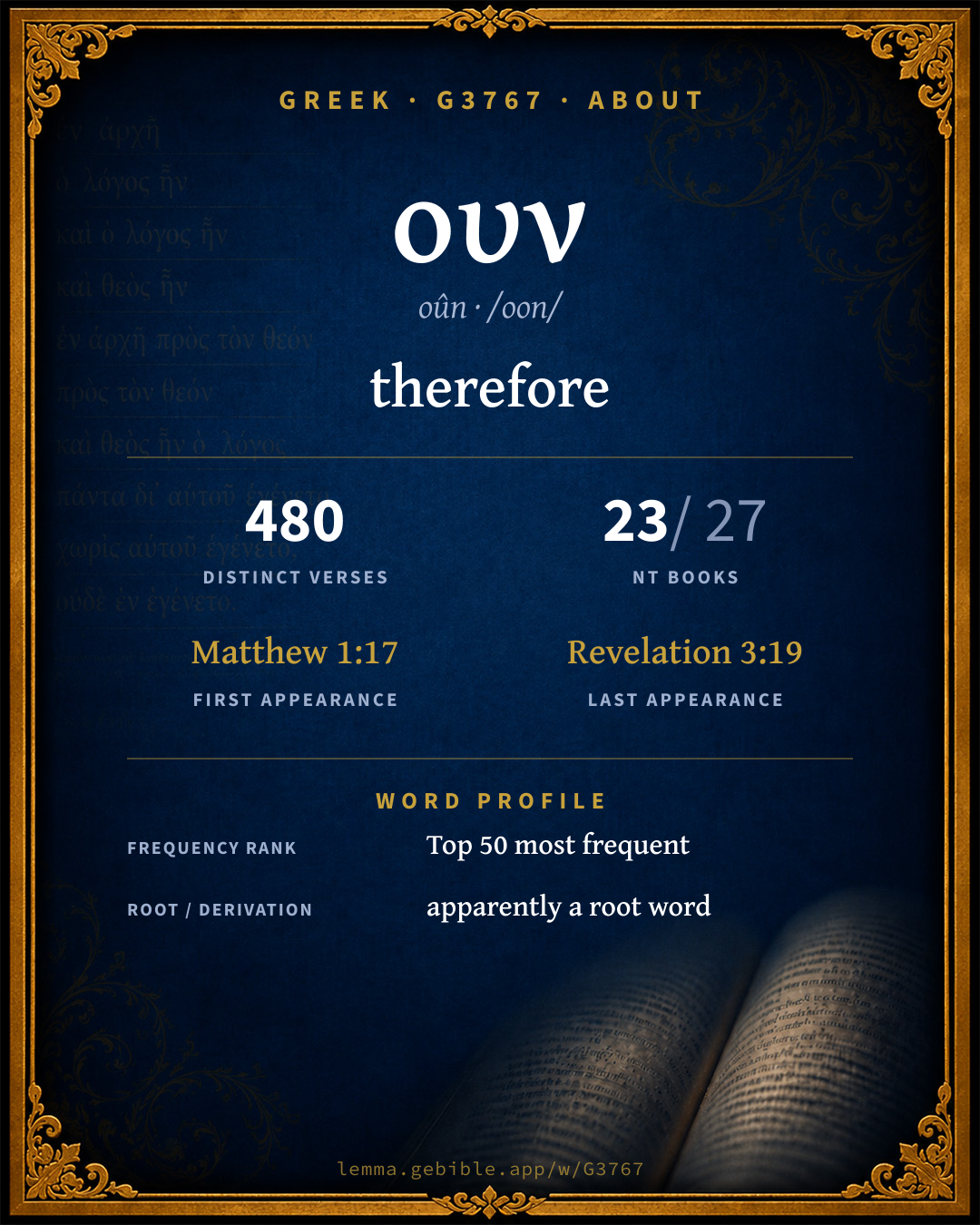
οὖν
therefore
Full lexicon entry — Thayer's Greek Lexicon
From Thayer's Greek Lexicon
Where this word appears
Grammar key — what these labels mean
Part of speech
- Conjunction
- A joining word linking words or clauses.
Every verse where G3767 appears in the Book of Philemon — 1 distinct verse. Click any verse to open its interlinear word-by-word view. Verse text shown in the World English Bible for context — . Each verse’s Greek form is shown with its reference; the English is not keyword-highlighted, since the data carries no word-level English alignment. Use “Compare translations” on any verse to read it across multiple English versions. This concordance covers the Greek New Testament; Septuagint (Greek Old Testament) occurrences of this word are not indexed here.
Philemon
About this entry
At a glance — auto-summarized from this page’s data, not written by a person. Every figure links to its source below. This summary describes the numbers; it doesn’t interpret them.
ουν (oûn) is a Greek word most often rendered “therefore.” Debuting at Matthew 1:17, it then recurs through the corpus. With 480 verses in 23 books, it is a common word in the Greek New Testament. It concentrates in John, which alone accounts for 39% of its uses. The sections below give every sense, occurrence, and version rendering.
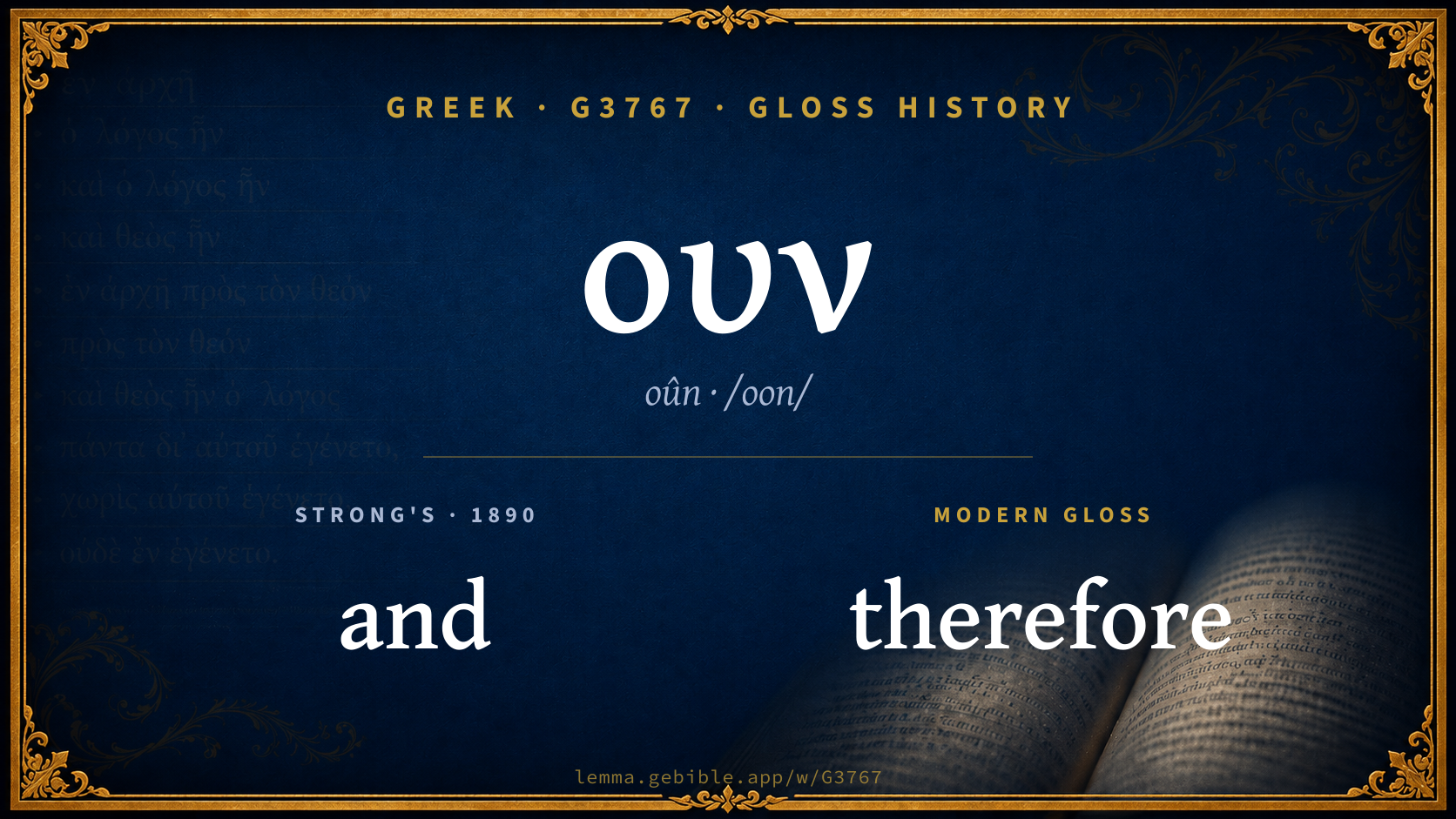
Gloss history
Strong's 1890 vs modern scholarship
About this word
Strong's G3767 catalogs a Greek word from the Greek New Testament.
These counts are not copied from any lexicon or concordance. They are computed here, from the morphology-tagged Greek New Testament. What Lemma adds →
- 480
- distinct verses
- The word appears in 480 distinct verses.
- 23 / 27
- NT books
- The word appears in 23 of 27 New Testament books.
- #41
- by frequency
- Top 50 most frequent Greek words (rank 41 of 5,347 Greek words by occurrence).
View all 480 occurrences in the concordance →
By section of the New Testament
By traditional corpus
Conventional, traditional groupings — biblical authorship is debated, so this is a traditional corpus grouping, not an authorship claim. Some books belong to more than one corpus (Luke is in both the Gospels and the Lukan corpus, and so on), so these shares overlap and need not total 100%. Each figure is a share of the word’s 480 distinct verses.
- Gospels 280 verses · 58%
- Johannine 193 verses · 40%
- Pauline corpus 109 verses · 23%
- Lukan (Luke–Acts) 92 verses · 19%
- General (Catholic) Epistles 14 verses · 3%
- Hebrews 13 verses · 3%
- Revelation 4 verses · 1%
How translations render this word
Counts come from each version’s own published word-to-Strong’s tagging or interlinear alignment — an approximate guide to how each version renders this word, not a word-level alignment the data otherwise carries. Because each total is that version’s own tagged count, the per-version totals vary from one another and need not match the appearance or distinct-verse counts above. These counts may also differ from a printed concordance because Lemma counts each distinctly tagged rendering and does not collapse phrase taggings into a single head-word total. This is a fixed set of word-tagged versions (KJV, ASV, BSB, ULT) and does not change with the reading translation you choose elsewhere. Each version’s license is shown beside its name below (and on Sources).
- King James Version: Therefore 244×, Then 187×, So 12×
- American Standard Version: Therefore 274×, Then 87×, So 30×
- Berean Standard Bible: Then 133×, So 122×, Therefore 76×
- unfoldingWord Literal Text: Therefore 250×, Then 178×, So 56×
King James Version Public Domain
Renders G3767 across 488 tagged occurrences — most commonly:
Plus 19 renderings that appear only once — usually multi-word phrases or single function words the recovered tagging swept in, not distinct renderings. Not rendered by a distinct English word in 38 further occurrences.
American Standard Version Public Domain
Renders G3767 across 473 tagged occurrences — most commonly:
Plus other, less common renderings. Plus 32 renderings that appear only once — usually multi-word phrases or single function words the recovered tagging swept in, not distinct renderings. Not rendered by a distinct English word in 14 further occurrences.
Berean Standard Bible Public Domain
Renders G3767 across 374 tagged occurrences — most commonly:
Plus 16 renderings that appear only once — usually multi-word phrases or single function words the recovered tagging swept in, not distinct renderings. Not rendered by a distinct English word in 119 further occurrences.
unfoldingWord Literal Text CC BY-SA 4.0
Renders G3767 across 494 tagged occurrences — most commonly:
Plus 3 renderings that appear only once — usually multi-word phrases or single function words the recovered tagging swept in, not distinct renderings.
Senses in Thayer's
The 1 sense Thayer's distinguishes for this word, in lexicon order (not ranked by frequency or importance). The full entry — with sub-senses — is in the Lexicon Entry tab.
- then, therefore, accordingly, consequently, these things being so
Word origin
Origin: apparently a root word
Apparently a primary word; (adverbially) certainly or (conjugationally) accordingly : - and (so truly) but now (then) so (likewise then) then therefore verily wherefore.
— Strong’s Exhaustive Concordance (1890), public domain.
Septuagint usage
The same Greek word ουν appears 132 times in the Greek Old Testament (Septuagint), across 130 verses in 17 books.
- 132
- LXX occurrences
- Tagged occurrences of this Greek word in the Septuagint.
- 130
- verses
- Distinct Septuagint verses containing this word.
- 17 / 39
- OT books
- The word appears in 17 of the 39 Old Testament books.
Sample Septuagint occurrences
- Genesis 6:14 οὖν
- Exodus 1:10 οὖν
- Numbers 9:7 οὖν
- Deuteronomy 2:3 οὖν
- Joshua 1:2 οὖν
- Judges 1:7 οὖν
- 1 Samuel 19:2 οὖν
- 2 Samuel 24:13 οὖν
- 2 Kings 18:20 οὖν
- 2 Chronicles 35:3 οὖν
- Ezra 4:13 οὖν
- Esther 1:13 οὖν
Septuagint occurrences (same lexeme)
Every verse where the same Strong’s number (G3767) appears in the Greek Septuagint — showing the first 50 of 130. Verse text shown in the World English Bible for context; the Greek form is the matched word — the English is not keyword-highlighted.
- Genesis 6:14 οὖν Make an ark of gopher wood. You shall make rooms in the ark, and shall seal it inside and outside with pitch.
- Genesis 8:21 οὖν Yahweh smelled the sweet savor. Yahweh said in his heart, "I will not again curse the ground any more for man's sake, because the imagination of man's heart is evil from his youth; neither will I ever again strike everything living, as I have done.
- Genesis 12:12 οὖν It will happen, when the Egyptians will see you, that they will say, 'This is his wife.' They will kill me, but they will save you alive.
- Genesis 12:13 οὖν Please say that you are my sister, that it may be well with me for your sake, and that my soul may live because of you."
- Genesis 16:2 οὖν Sarai said to Abram," See now, Yahweh has restrained me from bearing. Please go in to my handmaid. It may be that I will obtain children by her." Abram listened to the voice of Sarai.
- Genesis 18:21 οὖν I will go down now, and see whether they have done altogether according to the cry of it, which is come to me. If not, I will know."
- Genesis 19:9 οὖν They said, "Stand back!" They said, "This one fellow came in to live as a foreigner, and he appoints himself a judge. Now will we deal worse with you, than with them!" They pressed hard on the man, even Lot, and drew near to break the door.
- Genesis 19:22 οὖν Hurry, escape there, for I can't do anything until you get there." Therefore the name of the city was called Zoar.
- Genesis 21:23 οὖν Now therefore swear to me here by God that you will not deal falsely with me, nor with my son, nor with my son's son. But according to the kindness that I have done to you, you shall do to me, and to the land in which you have lived as a foreigner."
- Genesis 23:4 οὖν "I am a stranger and a foreigner living with you. Give me a possession of a burying-place with you, that I may bury my dead out of my sight."
- Genesis 24:49 οὖν Now if you will deal kindly and truly with my master, tell me. If not, tell me. That I may turn to the right hand, or to the left."
- Genesis 24:50 οὖν Then Laban and Bethuel answered, "The thing proceeds from Yahweh. We can't speak to you bad or good.
- Genesis 27:3 οὖν Now therefore, please take your weapons, your quiver and your bow, and go out to the field, and take me venison.
- Genesis 27:8 οὖν Now therefore, my son, obey my voice according to that which I command you.
- Genesis 27:33 οὖν Isaac trembled violently, and said, "Who, then, is he who has taken venison, and brought it me, and I have eaten of all before you came, and have blessed him? Yes, he will be blessed."
- Genesis 27:43 οὖν Now therefore, my son, obey my voice. Arise, flee to Laban, my brother, in Haran.
- Genesis 29:27 οὖν Fulfill the week of this one, and we will give you the other also for the service which you will serve with me yet seven other years."
- Genesis 30:30 οὖν For it was little which you had before I came, and it has increased to a multitude. Yahweh has blessed you wherever I turned. Now when will I provide for my own house also?"
- Genesis 31:13 οὖν I am the God of Bethel, where you anointed a pillar, where you vowed a vow to me. Now arise, get out from this land, and return to the land of your birth."
- Genesis 31:16 οὖν For all the riches which God has taken away from our father, that is ours and our children's. Now then, whatever God has said to you, do."
- Genesis 31:30 οὖν Now, you want to be gone, because you sore longed after your father's house, but why have you stolen my gods?"
- Genesis 31:44 οὖν Now come, let us make a covenant, you and I; and let it be for a witness between me and you."
- Genesis 33:13 οὖν Jacob said to him, "My lord knows that the children are tender, and that the flocks and herds with me have their young, and if they overdrive them one day, all the flocks will die.
- Genesis 34:8 οὖν Hamor talked with them, saying, "The soul of my son, Shechem, longs for your daughter. Please give her to him as a wife.
- Genesis 37:20 οὖν Come now therefore, and let's kill him, and cast him into one of the pits, and we will say, 'An evil animal has devoured him.' We will see what will become of his dreams."
- Genesis 40:8 οὖν They said to him, "We have dreamed a dream, and there is no one who can interpret it." Joseph said to them, "Don't interpretations belong to God? Please tell it to me."
- Genesis 41:24 οὖν The thin heads of grain swallowed up the seven good heads of grain. I told it to the magicians; but there was no one who could explain it to me."
- Genesis 41:33 οὖν Now therefore let Pharaoh look for a discreet and wise man, and set him over the land of Egypt.
- Genesis 43:4 οὖν If you will send our brother with us, we will go down and buy you food,
- Genesis 44:29 οὖν If you take this one also from me, and harm happens to him, you will bring down my gray hairs with sorrow to Sheol.'
- Genesis 44:30 οὖν Now therefore when I come to your servant my father, and the boy is not with us; seeing that his life is bound up in the boy's life;
- Genesis 44:33 οὖν Now therefore, please let your servant stay instead of the boy, a bondservant to my lord; and let the boy go up with his brothers.
- Genesis 45:5 οὖν Now don't be grieved, nor angry with yourselves, that you sold me here, for God sent me before you to preserve life.
- Genesis 45:8 οὖν So now it wasn't you who sent me here, but God, and he has made me a father to Pharaoh, lord of all his house, and ruler over all the land of Egypt.
- Genesis 45:9 οὖν Hurry, and go up to my father, and tell him, 'This is what your son Joseph says, "God has made me lord of all Egypt. Come down to me. Don't wait.
- Genesis 45:13 οὖν You shall tell my father of all my glory in Egypt, and of all that you have seen. You shall hurry and bring my father down here."
- Genesis 46:33 οὖν It will happen, when Pharaoh summons you, and will say, 'What is your occupation?'
- Genesis 47:4 οὖν They said to Pharaoh, "We have come to live as foreigners in the land, for there is no pasture for your servants' flocks. For the famine is severe in the land of Canaan. Now therefore, please let your servants dwell in the land of Goshen."
- Genesis 47:19 οὖν Why should we die before your eyes, both we and our land? Buy us and our land for bread, and we and our land will be servants to Pharaoh. Give us seed, that we may live, and not die, and that the land won't be desolate."
- Genesis 48:5 οὖν Now your two sons, who were born to you in the land of Egypt before I came to you into Egypt, are mine; Ephraim and Manasseh, even as Reuben and Simeon, will be mine.
- Genesis 50:5 οὖν 'My father made me swear, saying, "Behold, I am dying. Bury me in my grave which I have dug for myself in the land of Canaan." Now therefore, please let me go up and bury my father, and I will come again.'"
- Exodus 1:10 οὖν Come, let us deal wisely with them, lest they multiply, and it happen that when any war breaks out, they also join themselves to our enemies, and fight against us, and escape out of the land."
- Exodus 2:20 οὖν He said to his daughters, "Where is he? Why is it that you have left the man? Call him, that he may eat bread."
- Exodus 3:16 οὖν Go, and gather the elders of Israel together, and tell them, 'Yahweh, the God of your fathers, the God of Abraham, of Isaac, and of Jacob, has appeared to me, saying, "I have surely visited you, and seen that which is done to you in Egypt;
- Exodus 3:18 οὖν They will listen to your voice, and you shall come, you and the elders of Israel, to the king of Egypt, and you shall tell him, 'Yahweh, the God of the Hebrews, has met with us. Now please let us go three days' journey into the wilderness, that we may sacrifice to Yahweh, our God.'
- Exodus 4:1 οὖν Moses answered, "But, behold, they will not believe me, nor listen to my voice; for they will say, 'Yahweh has not appeared to you.'"
- Exodus 4:4 οὖν Yahweh said to Moses, "Put forth your hand, and take it by the tail." He put forth his hand, and laid hold of it, and it became a rod in his hand.
- Exodus 4:23 οὖν and I have said to you, "Let my son go, that he may serve me;" and you have refused to let him go. Behold, I will kill your son, your firstborn.'"
- Exodus 5:3 οὖν They said, "The God of the Hebrews has met with us. Please let us go three days' journey into the wilderness, and sacrifice to Yahweh, our God, lest he fall on us with pestilence, or with the sword."
- Exodus 5:5 οὖν Pharaoh said, "Behold, the people of the land are now many, and you make them rest from their burdens."
These are occurrences of the same Greek lexeme (G3767) in the Septuagint — not a translation of any one Hebrew word. The store carries no word-level Hebrew↔Greek alignment, so no Hebrew original is asserted here. Counts come from the recovered LXX Strong's tagging — high-frequency vocabulary is well covered, while rare or late forms may be untagged — so they reflect tagged occurrences and may slightly undercount.