Revelation 3:19

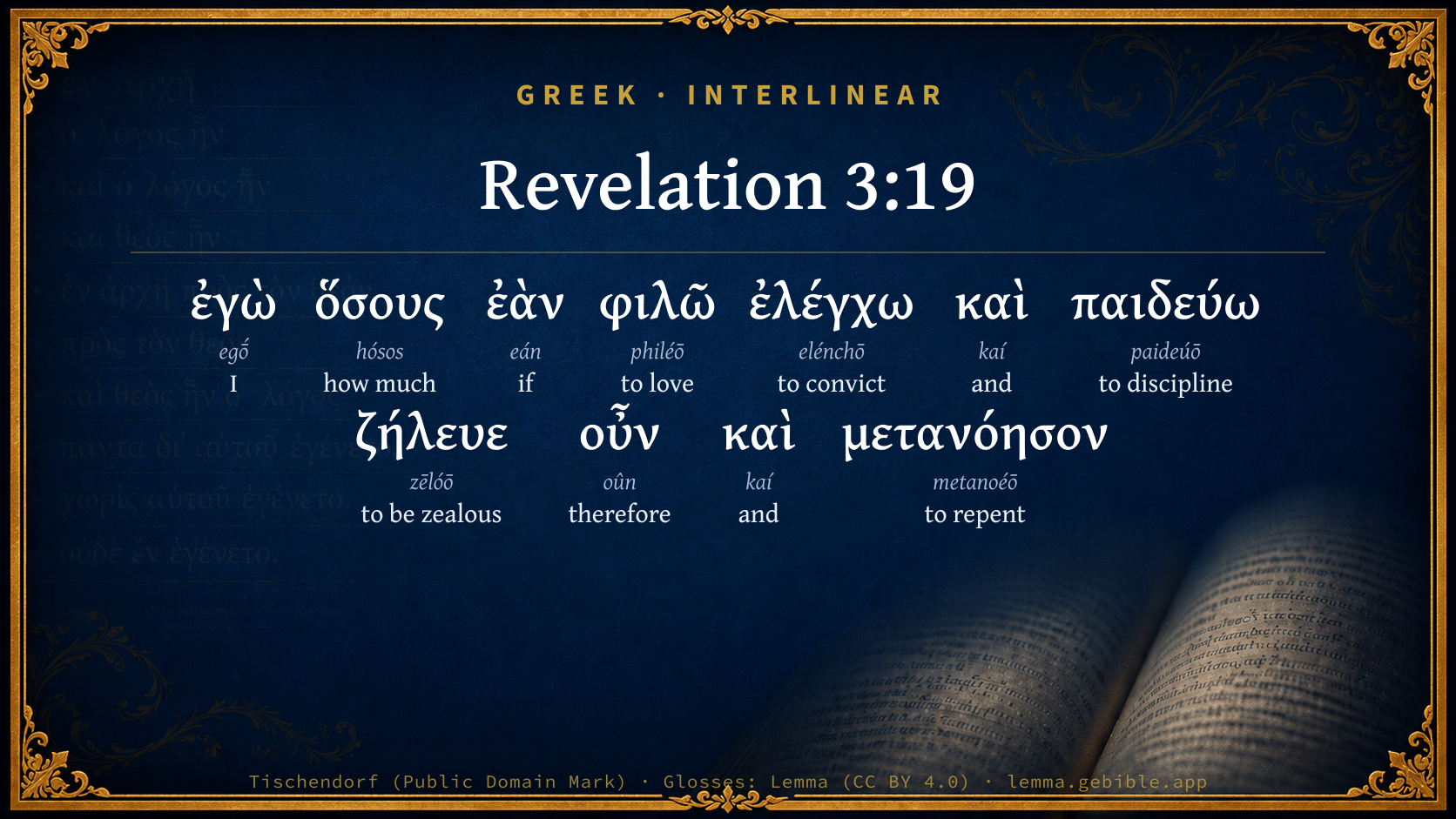
Greek (Tischendorf 8th ed.) Revelation 3:19 appears in the Greek New Testament. The text above is from the Tischendorf 8th edition. Each word links to its Strong’s number and a concise gloss. Click any word for its full Thayer’s Greek Lexicon entry.
Download image
Cite this verse

Revelation 3:19 (World English Bible). Public Domain. Lemma interlinear Bible study tool, https://lemma.gebible.app/v/revelation/3/19.

Show BibTeX & RIS
BibTeX
RIS
English Translation
As many as I love, I reprove and chasten. Be zealous therefore, and repent.
World English Bible · Public Domain
Download a study sheet

One document with this verse’s original text, its word-by-word gloss line, the meaning frame, cross-references with their text, attributed commentary, and full source and license credits — printable, and it pastes into notes with its structure intact.

This verse Autodidact and up

Study sheet (.html) Plain text (.txt)

A passage Seminary Student

Up to 50 verses in one chapter. A passage sheet keeps up to 6 commentary sources and 12 cross-references per verse, in the order this page ranks them, and says so on the sheet whenever that leaves anything out. Ask for a single verse and you get the Autodidact verse sheet above.

Everything on this page stays free to read, with no account — the sheet is a download of what is already on screen, not access to it.

Want to remove ads? Support Godless Engineer
Compare translations 3

The same verse in 3 English versions, stacked beneath the original-language interlinear above. Click any original word for its lexicon entry.

Each is an independent rendering of the whole verse — the interlinear is not word-aligned to these translations.

Highlighted words mark where these versions differ — a whole-verse word diff, not a word-by-word alignment.

  • World English Bible Public Domain
    As many as I love, I reprove and chasten. Be zealous therefore, and repent.
  • King James Version Public Domain
    As many as I love, I rebuke and chasten: be zealous therefore, and repent.
  • unfoldingWord Literal Text CC BY-SA 4.0
    I, as many as I love, rebuke and discipline. Therefore be zealous and repent.

unfoldingWord Literal Text — © unfoldingWord, licensed CC BY-SA 4.0. Word-aligned USFM3 via Door43 (git.door43.org/unfoldingWord/en_ult).

Versions to compare (up to 4)

3 of 4 selected

Show all 19 translations

Every available English version of this verse, each an independent rendering of the whole verse.

  • World English Bible Public Domain
    As many as I love, I reprove and chasten. Be zealous therefore, and repent.
  • Berean Standard Bible Public Domain
    Those I love, I rebuke and discipline. Therefore be earnest and repent.
  • Majority Standard Bible Public Domain
    Those I love, I rebuke and discipline. Therefore be earnest and repent.
  • King James Version Public Domain
    As many as I love, I rebuke and chasten: be zealous therefore, and repent.
  • American Standard Version (1901) Public Domain
    As many as I love, I reprove and chasten: be zealous therefore, and repent.
  • Revised Version (1885) Public Domain
    As many as I love, I reprove and chasten: be zealous therefore, and repent.
  • Geneva Bible (1599) Public Domain
    As many as I loue, I rebuke and chasten: be zealous therefore and amend.
  • Douay-Rheims (1899) Public Domain
    Such as I love, I rebuke and chastise. Be zealous therefore, and do penance.
  • Young's Literal Translation Public Domain
    `As many as I love, I do convict and chasten; be zealous, then, and reform;
  • Literal Standard Version CC BY-SA 4.0
    As many as I cherish, I convict and discipline; be zealous, then, and convert;
  • Unlocked Literal Bible CC BY-SA 4.0
    I train everyone whom I love, and I teach them how they should live. Therefore, be earnest and repent.
  • unfoldingWord Literal Text CC BY-SA 4.0
    I, as many as I love, rebuke and discipline. Therefore be zealous and repent.
  • Darby Bible Public Domain
    I rebuke and discipline as many as I love; be zealous therefore and repent.
  • World Messianic Bible Public Domain
    As many as I love, I reprove and chasten. Be zealous therefore, and repent.
  • Webster's Bible Public Domain
    As many as I love, I rebuke and chasten: be zealous therefore, and repent.
  • Free Bible Version CC BY-SA 4.0
    Those I love I correct and discipline. So be really sincere, and repent.
  • Bible in Basic English Public Domain
    To all those who are dear to me, I give sharp words and punishment: then with all your heart have sorrow for your evil ways.
  • Text-Critical English NT CC BY 4.0
    Those whom I love, I reprove and discipline. Therefore be zealous and repent.
  • Tyndale New Testament (1534) Public Domain
    As many as I love I rebuke and chasten. Be fervent therfore and repent.

Literal Standard Version (2020), Covenant Press — licensed CC BY-SA 4.0. Text via the HelloAO Bible API (eBible.org). Unlocked Literal Bible (unfoldingWord) — licensed CC BY-SA 4.0. Text via the HelloAO Bible API (eBible.org). unfoldingWord Literal Text — © unfoldingWord, licensed CC BY-SA 4.0. Word-aligned USFM3 via Door43 (git.door43.org/unfoldingWord/en_ult). Free Bible Version, Dr. Jonathan Gallagher — licensed CC BY-SA 4.0. Text via the HelloAO Bible API (eBible.org).

Word by word

More ways to search: Search by grammar → Find every occurrence → Compare this word →

Practice this passage: Drill this verse → Learn its vocabulary →

ζήλευε
zēlóō
G2206
“to be zealous”
Verb, Present, Active, Imperative, 2nd person, Singular
Part of Speech
Verb
Tense
Present
Voice
Active
Mood
Imperative
Person
2nd person
Number
Singular
Full Thayer's Definition

Origin: from G2205

TDNT: 16:42,3

1. to burn with zeal a. to be heated or to boil with envy, hatred, anger 1. in a good sense, to be zealous in the pursuit of good b. to desire earnestly, pursue 1. to desire one earnestly, to strive after, busy one's self about him 2. to exert one's self for one (that he may not be torn from me) 3. to be the object of the zeal of others, to be zealously sought after c. to envy
  1. ἐγὼ egṓ G1473 “I” Personal pronoun, 1st person, Nominative, Singular
  2. ὅσους hósos G3745 “how much” Correlative pronoun, Accusative, Plural, Masculine
  3. ἐὰν eán G1437 “if” Conditional
  4. φιλῶ philéō G5368 “to love” Verb, Present, Active, Subjunctive, 1st person, Singular
  5. ἐλέγχω elénchō G1651 “to convict” Verb, Present, Active, Indicative, 1st person, Singular
  6. καὶ kaí G2532 “and” Conjunction
  7. παιδεύω paideúō G3811 “to discipline” Verb, Present, Active, Indicative, 1st person, Singular
  8. οὖν oûn G3767 “therefore” Conjunction
  9. καὶ kaí G2532 “and” Conjunction
  10. μετανόησον metanoéō G3340 “to repent” Verb, Aorist, Active, Imperative, 2nd person, Singular

About this verse

These counts appear in no published source. They are computed here, from the morphology-tagged text and Lemma’s own curated glosses. What Lemma adds →

11
words
10
distinct lemmas
Revelation
section

Notable vocabulary

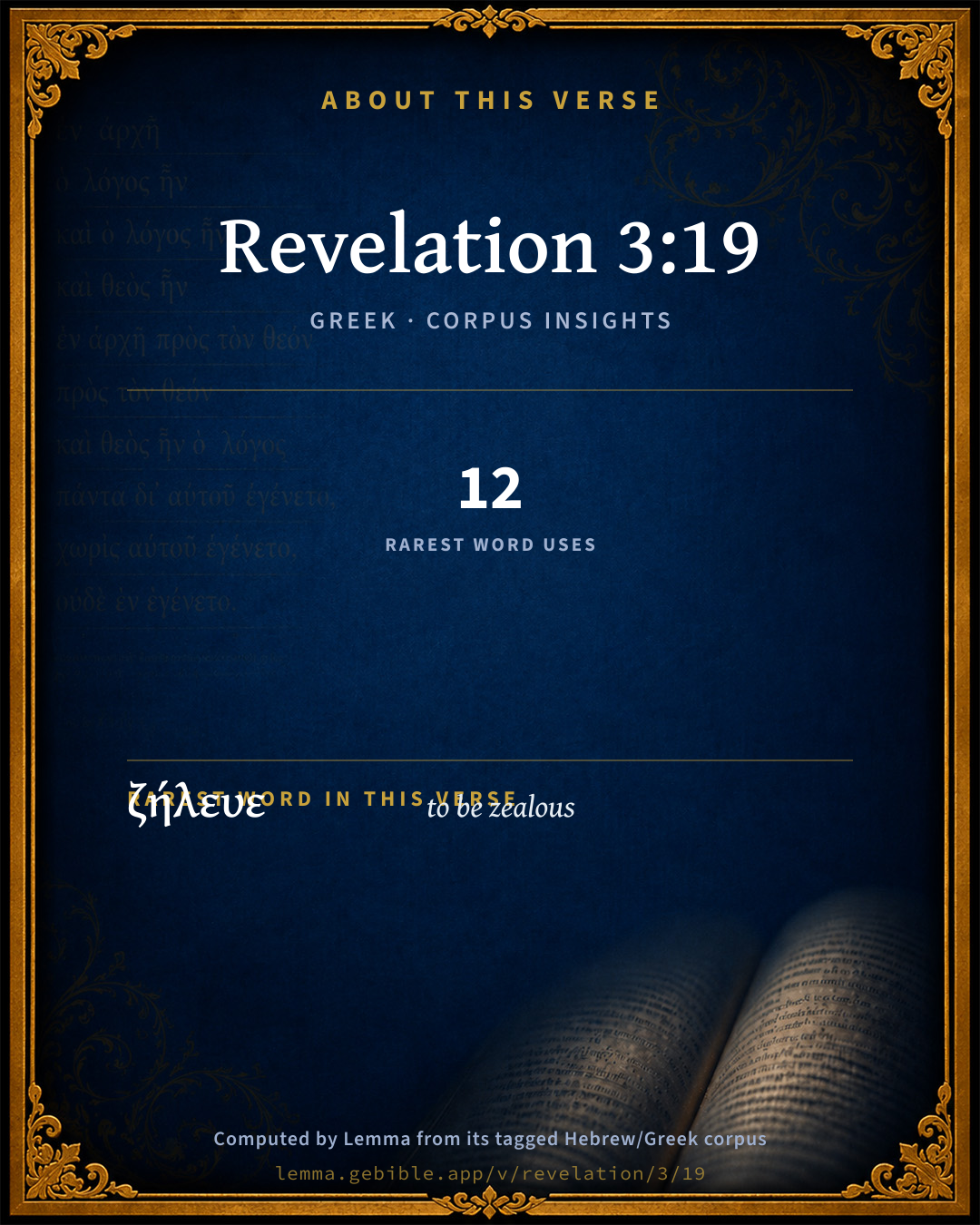
The rarest word here is ζήλευε to be zealous G2206 — appearing just 12 times in the whole Greek New Testament.

Shared distinctive vocabulary

ζήλευε to be zealous G2206 occurs in 11 verses of the Greek New Testament. Also found in:

Repetition

A word recurs within this verse:

Cross-references

30

Topical passages linked to Revelation 3:19 in the Treasury of Scripture Knowledge — connected by theme and wording, ordered by reader-vote popularity; previews shown in the World English Bible.

  • Proverbs 3:11–12 My son, don't despise Yahweh's discipline, Neither be weary of his reproof:
  • 1 Corinthians 11:32 But when we are judged, we are punished by the Lord, that we may not be condemned with the world.
  • Hebrews 12:5–11 and you have forgotten the exhortation which reasons with you as with children, "My son, don't take lightly the chastening of the Lord, Nor faint when you are reproved by him;
  • Job 5:17 "Behold, happy is the man whom God corrects: Therefore do not despise the chastening of the Almighty.
  • Revelation 2:5 Remember therefore from where you have fallen, and repent and do the first works; or else I am coming to you swiftly, and will move your lampstand out of its place, unless you repent.
  • Jeremiah 10:24 Yahweh, correct me, but in measure: not in your anger, lest you bring me to nothing.
  • Jeremiah 31:18 I have surely heard Ephraim bemoaning himself [thus], You have chastised me, and I was chastised, as a calf unaccustomed [to the yoke]: turn you me, and I shall be turned; for you are Yahweh my God.
  • 2 Corinthians 7:11 For behold, this same thing, that you were made sorry in a godly way, what earnest care it worked in you. Yes, what defense, indignation, fear, longing, zeal, and vengeance! In everything you demonstrated yourselves to be pure in the matter.
  • Deuteronomy 8:5 You shall consider in your heart that as a man chastens his son, so Yahweh your God chastens you.
  • 2 Samuel 7:14 I will be his father, and he shall be my son: if he commit iniquity, I will chasten him with the rod of men, and with the stripes of the children of men;
  • Proverbs 15:32 He who refuses correction despises his own soul, But he who listens to reproof gets understanding.
  • Proverbs 22:15 Folly is bound up in the heart of a child: The rod of discipline drives it far from him.
  • Revelation 2:21–22 I gave her time to repent, but she refuses to repent of her sexual immorality.
  • Psalms 39:11 When you rebuke and correct man for iniquity, You consume his wealth like a moth. Surely every man is but a breath." Selah.
  • Psalms 69:9 For the zeal of your house consumes me. The reproaches of those who reproach you have fallen on me.
  • Isaiah 26:16 Yahweh, in trouble have they visited you; they poured out a prayer [when] your chastening was on them.
  • Jeremiah 7:28 You shall tell them, This is the nation that has not listened to the voice of Yahweh their God, nor received instruction: truth is perished, and is cut off from their mouth.
  • Psalms 6:1 Yahweh, don't rebuke me in your anger, Neither discipline me in your wrath.
  • Psalms 94:10 He who disciplines the nations, won't he punish? He who teaches man knows.
  • Proverbs 15:10 There is stern discipline for one who forsakes the way: Whoever hates reproof shall die.
  • Jeremiah 30:11 For I am with you, says Yahweh, to save you: for I will make a full end of all the nations where I have scattered you, but I will not make a full end of you; but I will correct you in measure, and will in no way leave you unpunished.
  • John 2:17 His disciples remembered that it was written, "Zeal for your house will eat me up."
  • Romans 12:11 not lagging in diligence; fervent in spirit; serving the Lord;
  • Titus 2:14 who gave himself for us, that he might redeem us from all iniquity, and purify for himself a people for his own possession, zealous for good works.
  • James 1:12 Blessed is the man who endures temptation, for when he has been approved, he will receive the crown of life, which the Lord promised to those who love him.
  • Numbers 25:11–13 Phinehas, the son of Eleazar, the son of Aaron the priest, has turned my wrath away from the children of Israel, in that he was jealous with my jealousy among them, so that I didn't consume the children of Israel in my jealousy.
  • 2 Corinthians 6:9 as unknown, and yet well known; as dying, and behold, we live; as punished, and not killed;
  • Jeremiah 2:30 In vain have I struck your children; they received no correction: your own sword has devoured your prophets, like a destroying lion.
  • Zephaniah 3:2 She didn't obey the voice. She didn't receive correction. She didn't trust in Yahweh. She didn't draw near to her God.
  • Galatians 4:18 But it is always good to be zealous in a good cause, and not only when I am present with you.

Cross-references courtesy of OpenBible.info (CC BY 4.0).

Commentary

Notes on Revelation 3:19 from classic Christian and Jewish commentators (each source and its license shown beneath its notes). The classic Christian expositions comment on the surrounding passage and are grouped to its opening verse, so a note may address several verses; the Jewish commentaries on the Tanakh (Rashi and others) are per-verse, so they appear only where the commentator wrote on this verse.

Lemma curates 59 commentaries, every one of them public domain or Creative Commons licensed, each selected and text-cleaned for this edition rather than reprinted as found. About our sources →

The Biblical Illustrator

Joseph S. Exell

Rev_3:19-22

As many as I love, I rebuke and chasten.

Divine chastisement

I. In reference to the sinner, what is the object of Divine chastisement? The merciful design is the conviction and conversion of the sinner, his restoration to the image of God. And what are the means employed by the Holy Spirit for this end? Sickness, poverty, bereavements, the ministry of the Word, the faithful admonition of a loving friend, or even a tract offered by the wayside.

II. In regard to the Lords own people, what is His design in afflicting them?

1. To prevent sin in them, He sees the beginning of mischief in the heart, and He nips the sin in the bud.

2. To wean them from this present world.

3. To lead them nearer to Himself.

III. The attitude of the Saviour towards sinners. (H. E. Windle, M. A.)

Christ disclosing His love

The Lord next declares His love to Laodicea. It has really been love all through; but now He speaks the word out--As many as I love, I rebuke and chasten. What He has already said, severe and even terrible, has been said in love; and indeed love is the root of His whole dealing with them, love that would get quit of their sin. Now this is a thing that helps to cure lukewarmness. Love is the key that opens the barred door of the sinful heart. And the Saviour discloses His love to the Laodiceans that He may thereby touch them, melt them, restore them. I think there is a lesson here that we need to learn. We come into the presence of Laodicean lukewarmness. We are grieved by it. We are angered even more than we are grieved. We are tempted to denounce it. Ah, but here is a nobler way--to be ourselves loving! Out of Christs love there spring rebuke and chastening. Rebuke is not mere fault-finding, or coming down upon a man, or giving it hot; that is easy enough; commonly it is the outcome of the wrath of man, which worketh not the righteousness of God; and not seldom it is directed against those who do not deserve it. One of the sad things among us, indeed, is this cruel misdirection of censure. To rebuke means to bring sin home convincingly to the judgment and the conscience. To rebuke is a very different thing from fault-finding, and as high above it as heaven is above the earth. Nothing but love can do it--high-purposed, firm, holy love. It means the setting of sin so clearly and fully and convincingly before the mind and conscience, that you carry the person with you, and he is convinced. That is what love tries, and what only love can accomplish. And that is what Christ is doing with the Laodiceans now. He is setting the truth of their condition before their consciences, in holiest and tenderest mercy, that shrinks not from giving pain in order that it may heal. But this were not enough, unless something is done to help the sinner out of his evil estate. For the Lord to have reproved or convinced the Laodiceans would not have been enough. Without conviction there is and can be no conversion; but He could not have stopped short with it, any more than the physician may stop short with telling us our disease. Therefore He adds chastening to rebuke. We must dismiss the ides, of punishment. That does not lie in the word. Punishment is the deed of a judge; chastening is the work of a father. We must start from the realised fact of our sonship in the Divine family. The word chastening brings into view, under the new covenant, the whole process of earthly training for heavenly issues, which God in His wisdom ordains and conducts, and of which suffering forms so large an element. And this is the issue to which the rebuke and chastening of love should lead: Be zealous, and repent. Let the zeal show itself in this line. It is a man taking Gods side against his own sin, and looking to God to deliver him from it. It results, not from the will of the flesh or the will of man, but from Gods work in the conscience. It has its birth in a true apprehension by faith of the mercy of God in Christ. (J. Culross, D. D.)

God afflicts for our good; and what that good is

I. Gods rule.

1. That God chastises His children out of love, and for their good.

(1) Afflictions to them whom God loves are medicinal, and thereby they recover their health by repentance from some spiritual disease.

(2) Afflictions are preservatives to keep them whom God loveth from sin (2Co_12:7).

(3) Afflictions make the fruitless bring forth fruit, beget many virtues, and make Gods graces in us to bloom and bring forth works pleasing unto out Heavenly Father.

(4) Afflictions draw men nearer unto God. The main use of all is for comfort in all our sufferings and crosses whensoever God sends them: for they are signs of our sonship and tokens of His love.

2. That if God spares not those whom He loveth, much less shall His enemies escape punishment.

3. That God rebukes before He chastens.

(1) If this then be Gods manner of dealing, it should behove us not lightly to pass by His warnings.

(2) If God so powerfully warns His creature before He strikes him, how dare we strike our brother before we warn him?

II. Our duty. We must be zealous, and repent.

1. Concerning zeal.

(1) Zeal is the intention and vehemency of all our affections in matters of God and His service. It hath its name of Zew, which is, to burn and boil as water over the fire, and thence may be styled the fervency of our affections. Such a one was Apollos (Act_18:25); and such St. Paul exhorts the Romans to be (Rom_12:11). For as burning is the excess or highest pitch of heat, so is zeal of our affections. But as in our bodies we find aguish burnings as well as the healthful vigour of natural heat; and as Nadab and Abihu offered fire unto God, but not the right and holy fire (Lev_10:1), so are there some counterfeits of zeal, as it were false fires, abominable unto God and odious unto men. The kinds, then, of false zeal may be reduced unto three heads.

(a) Hypocritical zeal, which wants sincerity.

(b) Blind zeal, which wants knowledge.

(c) Turbulent zeal, which wants love and moderation. Thus I have briefly described these false fires, that by the law of contraries we may know who is the true zealot.

(2) But why should this zeal be so needful? Let us therefore now see the reasons.

(a) First, therefore, I will seek no farther than my text, where the want of zeal is reckoned for a sin, a sin to be repented of, Be zealous, and repent: is not that needful, without which all our works are sinful?

(b) It is the ground rule of the whole law of God, and of all the precepts concerning His worship, that we must love the Lord our God with all our heart, with all our soul, with all our mind, and with all our strength. What else is this but to love Him zealously, to worship Him with the highest pitch of our affections? For He is the sovereign and chiefest good; what love then can suit to Him but the very top and sovereignty of love?

(c) Zeal is that which carries our devotions up to heaven. As wings to a fowl, wheels to a chariot, sails to a ship; so is zeal to the soul of man. Without zeal our devotions can no more ascend than vapours from a still without fire put under it.

2. Repentance is the changing of our course from the old way of sin unto the new way of righteousness: or more briefly, a changing of the course of sin for the course of righteousness. It is called also conversion, turning and returning unto God. I will describe it briefly in five degrees, which are as five steps in a ladder, by which we ascend up to heaven.

(1) The first step is the sight of sin and the punishment due unto it. For how can the soul be possessed with fear and sorrow, except the understanding do first apprehend the danger?--for that which the eye sees not, the heart rues not. The serious penitent must be like the wary factor, he must retire himself, look into his books, and turn over the leaves of his life; he must consider the expense of his time, the employment of his talent, the debt of his sin, and the strictness of his account.

(2) And so he shall ascend unto the next step, which is sorrow for sin. For he that seriously considers how he hath grieved the Spirit of God and endangered his own soul by his sins, cannot but have his spirit grieved with remorse.

(3) The third step up this ladder is the loathing of sin. A surfeit of meats, how dainty and delicate soever, will afterwards make them loathsome.

(4) The fourth step is the leaving off sin. To what purpose doth the physician evacuate ill humours, if the patient still distempers himself with ill diet? What shall it avail a man to endure the lancing, searching, and tending of a wound, if he stay not for the cure?

(5) The fifth and last step is the cleaving unto God with full purpose of heart to walk before Him in newness of life. All the former degrees of repentance were for the putting off of the old man; this is for the putting on of the new.

III. The connection and dependence of these latter words (Be zealous therefore, and repent) upon the former (As many as I love, I rebuke and chasten.) Many things might be here observed, but I will name but one, which is this, that repentance is the means to avoid and prevent Gods judgments. For (as Tertullian observes) He that hath decreed to publish by justice, hath promised to grant pardon by repentance. And so Jer_18:7. (J. Mede, B. D.)

The love and the discipline

How soon a Church goes down! How quickly its love and holiness and zeal fade away! One generation often sees its rise, decline, and fall. The soul withers; the eye that looked upward now looks downward; and the once religious man, who did run well, takes the downward path into lukewarmness or death. Yet Jesus leaves him not.

I. The love. The I here is emphatic, and by its prominence Christ presents Himself specially as the lover, the rebuker, the chastener. His thoughts are not our thoughts, nor our ways His ways. He loves where others would hate. He shows His love by chastening where others would show theirs by indulging.

II. The discipline of love. Mark the way in which this love deals with Laodicea. It deals in tenderness, and yet in solemn severity. Instead of letting Laodicea escape, it takes hold of her, as a wise father of his disobedient child, and makes her sensible how much it hates the sin.

1. He reproves by word and deed.

2. What the chastening was we know not: it would be something specially suited to the self-sufficiency and worldliness of the Laodiceans. Perhaps they were stripped of their riches; perhaps visited by sickness and death; laid desolate by grievous sorrow; some long-continued trial, stroke upon stroke, crushing and emptying them. Whatever it may cost, they must be made to feel the evil of their ways.

III. The exhortation of love. Be zealous, therefore, and repent. The word zealous contrasts with lukewarmness, and implies true warmth and fervour. (H. Bonar, D. D.)

Be zealous.

Religious zeal

It is evident that the zeal which is here recommended has religion for its object. Now there are some who are mightily afraid of zeal as connected with religion. A zealous friend--a zealous teacher--a zealous patriot--are characters referred to with expressions of applause. But the moment that zeal mingles with religion, then there is distrust and disapproval. It is curious to observe how differently zeal in matters of religion is spoken of by these persons, and by the Word of God. Christ is hero introduced as rebuking the Church of Laodicea for the want of it, and as commanding them to get that want supplied. But His will, as thus expressed, is not arbitrary. It is founded in the nature and reason of the case. Why, let me ask you, are you zealous for anything whatever? Is it not because that thing, in your opinion, is important to be attained, and because the attainment of it requires energy and effort? Now, can you explain how it is that the same mode of judging and acting should not be adopted in religion? In the first place, is religion destitute of importance, or is it less important than anything else which attracts your notice and interests your attention? Then, in the second place, do you consider religion to be of such easy acquirement that a man may be invested with all its character, and animated by all its spirit, and come to the enjoyment of all its blessings, though he gives himself no great concern about it, and treats it with coldness and indifference? And then, in the third place, if for the reasons now stated, we ought to be zealous in acquiring for ourselves an interest in the grace and blessings of the gospel, the same raisons should constrain us to be zealous also in communicating these to our fellow-men throughout the world. Religion is as important to them as it is to us. Moreover, if you are actuated by zeal in other cases, and feel it to be at once becoming and necessary, we may well require you to vindicate, if you can, a want of zeal or a condemnation of it, in that vocation wherewith you are called as the disciples of Christ. If it be right to cherish and display zeal in the study of literature and philosophy, in promoting the prosperity of your country, in advancing the welfare of your friends, upon what; principle can it be wrong to cherish and display zeal in procuring for religion that ascendancy which it is entitled to hold over the minds and destinies of those for whose everlasting happiness it is intended? If religion be, as it is described in the Bible, and as you yourselves profess to regard it, then not only ought you to be zealous for it, but your zeal for it cannot be too great. Now what is the degree of importance that belongs to religion? Why, it is infinitely important. What! can you be too zealous in seeking after deliverance from the worm that never dies, and from the fire that shall not be quenched? Can you be too zealous in aspiring to that inheritance which is incorruptible, and that crown of glory which fadeth not away? Can you be too zealous in the pursuit of what was purchased at such a costly price as the blood of the incarnate Son of God? (A. Thompson, D. D.)

A coal from the altar

The true zealot, whose fervency is in the spirit, not in show; in substance, not in circumstance; for God, not himself; guided by the Word, not with humours; tempered with charity, not with bitterness: such a mans praise is of God though not of men, such a mans worth cannot be set forth with the tongues of men and of angels.

1. It is good to be zealous in good things, and is it not best in the best? Or is there any better than God, or the kingdom of heaven? Is mean and mediocrity in all excellent arts excluded, and only to be admitted in religion?

2. Consider and reason thus with thyself, canst thou brook a sluggard in thy work, if thou be of any spirit thyself? Do men choose the forwardest deer in the herd, the liveliest colt in the drove? and is the backwardest man fittest for God? Is not all His delight in the quickest and cheerfulest givers and servitors?

3. This zeal is so gracious a favourite with God, that it graces with Him all the rest of His graces. Prayer, if it be frequent, prevaileth much; the zealous witnesses had power to shut and open heaven (chap. 12.).

4. Zeal is the richest evidence of faith, and the clearest demonstration of the Spirit. Yea, but by what means shall a Christian attain this fire, and maintain it when he hath gotten it? Say not in thine heart, What Prometheus shall ascend into heaven and fetch it thence? Thou mayest fetch it thence by thine own prayer. Sermons are bellows ordained for this purpose. But here methinks I hear the lukewarm worldling of our times fume and chafe, and ask what needs all this ado for zeal, as if all Gods people were not zealous enough. Such as think they are, or can be zealous enough, need no other conviction to be poor, blind, naked, wretched, and pitiful Laodiceans. Fire is ever climbing and aspiring higher; zeal is ever aiming at that which is before; carried toward perfection; thinking meanly of that which is past, and already attained. What would you have us to do? We profess, keep our church, hear sermons, as Christians ought to do. Affectionate friendship and service is not only for public show upon festival days, but for domestical, ordinary, and private use; to such holiday and church retainers, God may well say, Let us have some of this zeal at home and apart. (A. Wood.)

Religious zeal

I. Our zeal for religion should be real and conscientious. There is a zeal of sympathy, which is awakened and kept alive by the zeal of others with whom we happen to come in contact. Be renewed in the spirit of your minds, that religion may appear to you in all its genuine excellence, and that it may hold that place in your regard to which it is justly entitled. Meditate seriously on the interest which you personally have in all that it requires you to believe, and in all that it commands you to do. Think of its necessity to the redemption and well-being of every one of the human race.

II. Our zeal for religion must be intelligent, or accompanied with knowledge.

III. There must be prudence in the exercise and manifestation of our religious zeal. Prudence does not damp nor discourage our zeal. It only prevents us from giving those expressions to it which, on the one hand, would be attended with no benefit, and, on the other, might involve us in difficulties and embarrassments.

IV. Our zeal for religion must always consist with moral integrity. It never can be allowable for us to do what is morally wrong, whatever be the advantageous consequences that are to follow it. And least of all, one should suppose, can such a proceeding be allowable, when we are striving to advance the interests of religion.

V. Our religious zeal must be under the government of charity. Our zeal being awakened to care for men, charity comes in to soften that aspect of sternness and severity, which it might otherwise assume, and to mould it into a form more consonant to the nature and circumstances of those for whom it is to labour, as well as to the spirit and precepts of that religion which it is desirous to propagate.

VI. Our zeal must be in proportion to the value and importance of the objects which excite it, and to the exigencies in which these may happen to be placed. Every system has certain leading principles and properties of which it cannot be divested, while there are other subordinate principles and properties, which appear, neither in themselves nor in their relations, to be necessary to its existence, and to its ultimate purpose. And so is it with Christianity. Being a plan of Divine contrivance, all that is to be found in it, must be considered as important and useful; but it is evident that there are some things more important and useful than others. And this being the case, it follows, of course, that whether we be cherishing Christianity in ourselves, or pressing it on the attention of others, our zeal must not operate with equal ardour upon every subject, but bear some sort of proportion to the real or the relative importance which they possess--the most important receiving its highest, and the less important its lower measure of warmth and energy (A. Thomson, D. D.)

The nature, importance, and right exercise of Christian zeal

I. Its nature.

II. Its importance. Zeal is an appropriate quality of the spiritual life--the genial heat of the new nature, immediately subservient to its continuance and support, and operating to maintain its powers in their proper capacity for action. In nature, heat is the most active of all the elements. It is the prime agent which the Author of nature employs for promoting the subsistence and well-being of the universe. Animal and vegetable life have an immediate dependence on it; nor could nature itself, according to its apparent constitution and laws, subsist without it. To the effects of heat in nature, those of zeal in religion are directly analagous. How incapable of exertion, how indisposed to motion, how listless and insensible are men found, when their spirits are benumbed with cold affection! But under the influence of that kindly warmth which the Spirit of God imparts, how quickly do they revive, and become pliant and active! While zeal is thus necessary to the effectual performance of the Christians work, it contributes also, as an effectual qualification, to render his service acceptable.

III. Rightly exercised.

1. On right objects--objects which are intrinsically good, and which are of suitable importance, Should the furnace be heated seven times more than usual for no worthier purpose than the burning of a straw?

2. Zeal must also be exercised with a right mind.

(1) Zeal must be exercised with knowledge. Perhaps there is nothing that is either more unseemly in itself or more mischievous in its consequences than zeal without knowledge. Such a zeal, considered in its exercise, may be compared to a ship, driving with full sail before the wind, without either compass or pilot--threatening the safety of everything that comes in her way, and in danger of driving at last upon some rock or shoal that shall cause her destruction.

(2) Zeal must be exercised with sincerity. The concern which is expressed for religion must be real--the genuine result of principle and feeling--not affected, merely to cover sinister designs, to second views of worldly interest, to minister to secret pride--to the selfish vain-glorious desire of applause and estimation.

(3) Genuine zeal must be exercised with impartiality--with an equal regard to the attainment of its object--whether it has respect to ourselves or to others. The zeal of too many is chiefly occupied abroad, in detecting and exposing the sins of others.

(4) Zeal must be exercised with kind affection. (T. Fleming, D. D.)

Christian zeal

1. True Christian zeal includes knowledge. It is not a blind impulse of feeling, an ignorant and infuriated passion, but a holy intelligent principle.

2. True Christian zeal includes indignation. The simple effusions of the heart in the way of grief on account of sin do not come up to the idea of zeal. It is grief and indignation at sin roused to the very utmost.

3. True Christian zeal includes ardent desire. The immediate object of this zeal is the declarative glory of God. It is a holy indignation at sin, because this evil throws a dark shade over Gods glory. It is an ardent and passionate concern that God may be glorified.

4. Christian fortitude and magnanimity are also branches of this temper. The person that is truly zealous is not easily intimidated.

5. True Christian zeal is an active and useful principle. It grasps with the greatest eagerness every means which may be subservient to the attainment of its object. (R. Culbertson.)

Christian zeal

I. The nature of Christian zeal.

II. The source of Christian zeal. Christian zeal is zeal for Christ; it has Him for its ultimate source, as well as its ultimate end. Christian enthusiasm is really the state of inspiration by God.

III. The sphere of Christian zeal. True zeal is of course zeal for God and for good.

IV. The qualities which should characterise Christian zeal.

1. True Christian zeal is intelligent. There is light in it as well as heat.

2. It is prudent. Plans warily, and works calmly.

3. It is loving and sympathetic.

4. It is patient and persevering. Not a fitful impulse, but a steady flame. Based on principle, it is the habit of the Christians life.

V. The motives which sustain Christian zeal.

1. Love to the Redeemer.

2. The salvation of the world.

3. The prosperity of our own souls.

What a protection zeal is against the coldness of the world--what a defence against temptation--what a preservative against moral deterioration--what a suitable preparation for the holy activities of heaven! (G. Jordan, M. A.)

Zeal

When a man dies in England, his friends often say of him, in praise of his diligence, energy, and concentration: Well, he lived simply to carry through that important line of railway; or--His only object was to extort from the Government a more scientific education for the people; or--He devoted himself to the cause of Free Trade; or--He was a martyr to his exertions in behalf of Protection. It was his one idea; it grew with his growth; he could think of nothing else; he spared neither time nor expense to advance ever so little his favourite cause, and the interest he had wedded; it was his monomania. He did his work in his day, and he did it well, because he was heart and soul in it; and the world is in debt to him for it. Now, why should it not be said of us: Well, he is gone. He was a man of one idea: he cared for nothing but that Gods kingdom should come, and His will be done on earth, as it is in heaven. He was eaten up with this; waking or sleeping it was always upon him; nothing daunted him; he spared neither time nor expense for his hobby, and when neither time nor money were at his disposal, he besieged heaven with prayers. He took no interest in anything else; it was meat and drink to him, and it quite mastered him; and now he is gone. Yes! he is gone; but whereas the other man left behind him his railway and his cheap bread, our friend has taken all his love and pains and prayers away with him to the judgment-seat of Jesus; and what they have done for him there, eye hath not seen, nor ear heard, nor mans heart conceived.

The Biblical Illustrator, edited by Joseph S. Exell (c. 1880s–1900s) — public domain. Text from a community e-Sword module.

Tyndale Open Study Notes

Tyndale Open Resources

3:19 Christ will correct and discipline those whom he loves (Prov 3:11-12; Heb 12:5-6), rather than rejecting them. His faithfulness extends even to the unfaithful (2 Tim 2:13).

Tyndale Open Study Notes — © Tyndale Open Resources, licensed CC BY-SA 4.0. Text via the HelloAO Bible API.

Bengel's Gnomon

Johann Albrecht Bengel

Rev 3:19. Φιλῶ) In the case of the Philadelphian Church, He (Rev 3:9) ἠγάπησε (esteemed it): in the case of the Laodicean, He φιλεῖ (loves it). The former, with His judgment: the latter, with gratuitous affection [favour]. Comp. Joh 21:15, note. In each passage[56] ἀγαπᾷν implies something more than φιλεῖν. In the passage quoted from John, the spiritual tie of relationship is of more value than the judgment of Peter. Here, in the Apocalypse, it is a more blessed thing to flourish [be esteemed] in the judgment of the Lord, than to be chastised through mere gratuitous affection.—ζήλωσον) Both ζεστὸς, Rev 3:15-16, and ζῆλος, are derived from ζέω.

[56] See footnote, Joh 21:15.

Bengel's Gnomon of the New Testament — English translation (T&T Clark, Edinburgh, 1860) — public domain. Text from a community e-Sword module.

Meyer's Critical & Exegetical Commentary

Heinrich August Wilhelm Meyer

Rev_3:19. Ἐγώ emphatically prefixed. The Lord, who alone is the true witness (Rev_3:14), and, at the same time, the one from whom the true gold can be obtained (Rev_3:18), appears as witness against those whom he loves, since through his ἐλέγχειν and παιδεύειν he wishes to make them zealous unto repentance (ζηλ. κ. μεταν), and thus participant of his eternal blessings.

ὅσους ἐὰν φιλῶ. Concerning the ἐὰς after the relative in N. T. diction, cf. my note on 1Jn_3:20. Grot. says incorrectly: φιλῶ, not absolutely, but relatively; i.e., those whom I have not altogether determined, because of their long-continued sins, to cast away and harden. Upon a similar misunderstanding rests the remark of Vitringa, that the kind address is directed only to the better part of the church. On the contrary, the entire church is still an object of the seeking love of the Lord.

ἐλέγχω καὶ παιδεύω. The distinction between the two expressions does not lie in the ἐλέγχειν occurring by means of words, and the παιδεύειν by chastisements;[1614] but the ΠΑΙΔΕΎΕΙΝ designating discipline, i.e., education in general,[1615] may occur as well by ἘΛΈΓΧΕΙΝ, as by perceptible chastisements, as ΜΑΣΤΙΓΟῦΝ.[1616] The ἘΛΈΓΧΕΙΝ[1617] occurs when the wrong is so placed before the eyes of any one that he must acknowledge it. From Rev_3:15 on, the Lord has exercised his ἘΛΈΓΧΕΙΝ by completely disclosing the faults of the church; yet he expressly says that this, as well as his entire ΠΑΙΔΕΎΕΙΝ, proceeds from love. It is nowhere said that in this he has already employed, or will employ, what are the proper means of chastisement (blows). On the other hand, to the ΠΑΙΔΕΎΕΙΝ belongs the advice of Rev_3:18. Yet this advice contains the express assurance, that, with the Lord, gold, etc., shall not be lacking. Hence not only the relentless ἘΛΈΓΧΕΙΝ, but also the tendering of grace, is a ΠΑΙΔΕΎΕΙΝ, which testifies to the Lords love. But if the Lord thus manifests himself to the lukewarm church, it follows that this (ΟὐΝ) has to do what the command expressly says: ΖΉΛΕΝΕ ΟὟΝ ΚΑῚ ΜΕΤΑΝΌΗΣΟΝ. The words contain not a hysteron proteron,[1618] but require of the church which is convicted of lukewarmness, an ardent zeal, enkindled by the love manifested by the Lord, and, as the proof of this zeal, a true change of mind.[1619]

[1614] Blows, Luke 23; Luk_16:22. Aret., Grot.

[1615] Act_22:3; Act_7:22; Tit_2:12; 2 Timothy 2.

[1616] Cf. Heb_12:6 with Pro_3:12.

[1617] Cf. Joh_16:8; Joh_8:46; Joh_3:20; 1Co_14:24.

[1618] De Wette.

[1619] Cf. Grot., Beng., Hengstenb., Ebrard.

Meyer — Critical and Exegetical Commentary on the New Testament — English translation by Peter Christie, edited by Frederick Crombie (T&T Clark, 1880) — public domain. Text from a community e-Sword module.

Expositor's Greek Testament

ed. W. Robertson Nicoll

Rev 3:19 . The prophet now relents a little; the church has still a chance of righting herself. Such a reproof as he has given in Christ’s name, and the discipline it involves ( παιδεύω , wider than ἐλ .) are really evidence of affection, not of antipathy or rejection. This is the method of God at least ( ἐγώ , emphatic; “whatever others do”), with whom censure does not mean hostility. φιλῶ , the substitution of this synonym (contrast Heb 12:6 ) for the LXX ἀγαπᾷ is remarkable in view of the latter term’s usage in the Apocalypse; the other variation ἐλέγχω καὶ παιδεύω ( ἐλ . [907] , παιδ . [908] [909] , LXX) is probably ornate rather than a duplicate. The love of Christ for his people is mentioned in the Apocalypse only here (with a reminiscence if not a quotation of O.T.), in Rev 1:5 , and in Rev 3:9 (incidentally). In the latter passage, the divine love sustains and safeguards those who are loyal; here it inflicts painful wounds upon the unworthy, to regain their loyalty. ζήλευε (pres.) = a habit, μετανόησον (aor.) = a definite change once for all. The connexion ( οὖν ) seems to be: let the foregoing rebuke open your eyes at once to the need of repentance, and also to the fact that it is really love on my part which prompts me thus to expose and to chastise you; such a sense of my loving concern, as well as of your own plight, should kindle an eager heat of indignation (2Co 8:11 , ἀλλα ζῆλον ) gathering into a flame of repentance that will burn up indifference and inconsistency ( cf. Weinel, 188 f.). The urgent need of immediate repentance rests not only on the special character of the temptation to which the local Christians were succumbing (“It is a great grace to find out that we are lukewarm, but we are lost if we do not act with vigour. It is like going to sleep in the snow, almost a pleasant, tingling feeling at the first, and then lost forever,” Faber), but on the fact that this warning was their last chance.

[907] Codex Vaticanus (sæc. iv.), published in photographic facsimile in 1889 under the care of the Abbate Cozza-Luzi.

[908] Codex Sinaiticus (sæc. iv.), now at St. Petersburg, published in facsimile type by its discoverer, Tischendorf, in 1862.

[909] Codex Alexandrinus (sæc. v.), at the British Museum, published in photographic facsimile by Sir E. M. Thompson (1879).

The Expositor's Greek Testament, edited by W. Robertson Nicoll (1897–1910) — public domain. Text from a community e-Sword module.

Geneva Bible (1599)

Geneva Bible translators

Prov. 3:12; Heb. 22:5

Zeal is set against them which are neither hot nor cold.

Geneva Bible (1599) marginal notes — public domain. Text via Bolls.life.

Jamieson, Fausset & Brown

Robert Jamieson, A. R. Fausset & David Brown

(Job 5:17; Pro 3:11-12; Heb 12:5-6.) So in the case of Manasseh (Ch2 33:11-13).

As many--All. "He scourgeth every son whom He receiveth. And shalt thou be an exception? If excepted from suffering the scourge, thou art excepted from the number of the sons" [AUGUSTINE]. This is an encouragement to Laodicea not to despair, but to regard the rebuke as a token for good, if she profit by it.

I love--Greek, "philo," the love of gratuitous affection, independent of any grounds for esteem in the object loved. But in the case of Philadelphia (Rev 3:9), "I have loved thee" (Greek, "egapesa") with the love of esteem, founded on the judgment. Compare the note in my English Gnomon of BENGEL, Joh 21:15-17.

I rebuke--The "I" in the Greek stands first in the sentence emphatically. I in My dealings, so altogether unlike man's, in the case of all whom I love, rebuke. The Greek, "elencho," is the same verb as in Joh 16:8, "(the Holy Ghost) will convince (rebuke unto conviction) the world of sin."

chasten--"chastise." The Greek, "paideu," which in classical Greek means to instruct, in the New Testament means to instruct by chastisement (Heb 12:5-6). David was rebuked unto conviction, when he cried, "I have sinned against the Lord"; the chastening followed when his child was taken from him (Sa2 12:13-14). In the divine chastening, the sinner at one and the same time winces under the rod and learns righteousness.

be zealous--habitually. Present tense in the Greek, of a lifelong course of zeal. The opposite of "lukewarm." The Greek by alliteration marks this: Laodicea had not been "hot" (Greek, "zestos"), she is therefore urged to "be zealous" (Greek, "zeleue"): both are derived from the same verb, Greek, "zeo," "to boil."

repent--Greek aorist: of an act to be once for all done, and done at once.

Jamieson, Fausset & Brown — Commentary Critical and Explanatory on the Whole Bible (1871) — public domain (CC PDM 1.0). Text via the HelloAO Bible API.

Adam Clarke's Commentary

Verse 19. As many as I love] So it was the love he still had to them that induced him thus to reprehend and thus to counsel them.

Be zealous] Be in earnest, to get your souls saved, They had no zeal; this was their bane. He now stirs them up to diligence in the use of the means of grace and repentance for their past sins and remissness.

Adam Clarke's Commentary on the Bible (1810–1826) — public domain. Text from a community e-Sword/MySword module.

Ellicott's Commentary for English Readers

(19) I rebuke and chasten.—The first word is that used in the work of the Holy Spirit (Joh_16:8), and signifies to bring conviction; it is not empty censure. The second word signifies to educate by means of correction. The pronoun is emphatic, “I,” and calls attention to the fidelity of Christ’s love in comparison with the weak partiality seen in human love. (Comp. Heb_12:6.)

Be zealous.—Or, be in a constant zealous state; and now, once for all, repent.

(2°) Behold, I stand at the door, and knock.—It is difficult not to see an allusion in this image to Son_5:2-6. Perhaps, also, the memory of the first night spent by St. John with his Master and Friend (Joh_1:39) may have been strong in his mind. Indeed, the life of Christ on earth teems with illustrations which may well have suggested the image (Luk_10:38; Luk_19:5-6; Luk_22:11-13; Luk_24:29-30).

A Bible Commentary for English Readers, edited by Charles John Ellicott (1878–1897) — public domain. Text from a community e-Sword module.

The Cambridge Bible for Schools and Colleges

gen. ed. J. J. S. Perowne

19. As many as I love, I rebuke] The pronoun “I” stands emphatically at the beginning of the sentence—as it were, “My way with those I love (the word is a strong one, expressing affection, not simply charity), is to shew them their faults,” not to “prophesy smooth things,” and encourage the self-complacent temper that was destroying the Laodiceans. In every other case, the Lord has noted both the good and the evil in the Church, and generally the good first: here He does nothing but find fault, but He adds in effect, “Do not suppose from this that I do not love you.” The word “rebuke” is more often rendered “reprove:” see e.g. Joh_16:8; Eph_5:11; Eph_5:13 : its meaning here is exactly what we express by “working conviction of sin.”

be zealous therefore, and repent] Shake off thy languid “lukewarm” temper: then thou wilt be able to start on a new life of righteousness.

The Cambridge Bible for Schools and Colleges (gen. ed. J. J. S. Perowne; Cambridge University Press, 1878–1918) — public domain. Text from a community e-Sword module.

John Gill's Exposition

To him that overcometh,.... The lukewarmness, and self-confidence, and security of this state:

will I grant to sit with me in my throne; at the close of this church state, which will be the last of this kind, consisting of imperfect saints, Christ will descend from heaven with the souls of all the righteous, and raise their bodies and unite them to them; which, with the living saints, will make one general assembly and church of the firstborn, all perfect soul and body; among these he will place his tabernacle, and fix his throne; and they being all made kings as well as priests to him, shall now reign on earth with him, and that for the space of a thousand years: and this is the blessing promised the overcomers in the Laodicean state, that when Christ shall set up his kingdom among men, and reign gloriously before his ancients, they shall sit on the same throne with him, or share with him in his kingdom and glory; see Rev 5:10,

even as I also overcame; sin, Satan, the world, death, and hell:

and am set down with my Father in his throne; in heaven, at his right hand; which is expressive of equality to him, distinction from him, communion with him, and of the honour and glory he is possessed of; but it is not on this throne that the saints will sit, only Christ sits on the same throne with the Father in heaven; it is on Christ's throne on earth, or in his personal reign there, that the saints shall sit down with him; and which honour they shall all have, all that are more than conquerors through him, and are made kings by him. And when this reign is over, then will follow the second resurrection, or the resurrection of the wicked, when will come on the judgment of the people, as Laodicea signifies; and when these, with the devils, will form themselves into the Gog and Magog army, and attack the beloved city, the church of glorified saints on earth, under Christ their King, which will issue in the everlasting destruction of the former; and thus these seven churches bring us to the end of all things.

John Gill's Exposition of the Whole Bible (1746–1763) — public domain (CC PDM 1.0). Text via the HelloAO Bible API.

Trapp's Complete Commentary

John Trapp

19 As many as I love, I rebuke and chasten: be zealous therefore, and repent.

Ver. 19. As many as I love] q.d. Think not that I hate you, because I thus chide you. He that escapes reprehension may suspect his adoption. God had one Son without corruption, but none without correction. We must look through the anger of his correction to the sweetness of his loving countenance; as by a rainbow we see the beautiful image of the sun’s light in the midst of a dark and waterish cloud. See more in my Treatise upon this verse, the second edition.

And repent] So they did in likehhood; for Eusebius commends this Church as greatly flourishing in his time. Oh, the divine rhetoric and omnipotent efficacy of repentance, saith a divine. This is the rainbow, which if God seeth shining in our hearts, he will never drown our souls.

John Trapp, A Commentary or Exposition upon All the Books of the Old and New Testament (1647–1656) — public domain. Text from a community e-Sword module.

Albert Barnes' Notes on the Bible

As many as I love, I rebuke and chasten - Of course, only on the supposition that they deserve it. The meaning is, that it is a proof of love on his part, if his professed friends go astray, to recall them by admonitions and by trials. So a father calls back his children who are disobedient; and there is no higher proof of his love than when, with great pain to himself, he administers such chastisement as shall save his child. See the sentiment here expressed fully explained in the notes on Heb 12:6. The language is taken from Pro 3:12.

Be zealous therefore, and repent - Be earnest, strenuous, ardent in your purpose to exercise true repentance, and to turn from the error of your ways. Lose no time; spare no labor, that you may obtain such a state of mind that it shall not be necessary to bring upon you the severe discipline which always comes on those who continue lukewarm in religion. The truth taught here is, that when the professed followers of Christ have become lukewarm in his service, they should lose no time in returning to him, anti seeking his favor again. As sure as he has any true love for them, if this is not done he will bring upon them some heavy calamity, alike to rebuke them for their errors, and to recover them to himself.

Albert Barnes' Notes on the Bible (1834–1885) — public domain. Text from a community e-Sword/MySword module.

Matthew Poole's English Annotations

I rebuke and chasten; elegcw kai paideuw the words may be translated, I convince and instruct, or deal with them as children; but it also signifies to chasten, and is so translated, 1Co 11:32; Heb 12:7; we translate it learn, 1Ti 1:20. By these words Christ lets this angel know, that although he had in this epistle dealt smartly with him, yet he had done it from a principle of love, as a father to a child, Heb 12:7.

Be zealous therefore, and repent; he adviseth him therefore to quit himself of his luke warmness, and to recover a warmth and zeal for God, repenting of his former coldness and negligence in his duty.

Matthew Poole's English Annotations on the Holy Bible (1683–1685) — public domain. Text from a community e-Sword/MySword module.

Whedon's Commentary on the Bible

Daniel D. Whedon

19. As many as I love—Imperfect as Laodicea’s character was, she was still Christian. She was not on a level with the paganism around her. She was still a witness for Christ, maintaining his name, holding fast his gospel, and retaining a candlestick for a richer supply of oil and a purer blaze. Even the form of religion is better than nothing, since it may stand as a future vehicle of the coming spirit and power.

We here, too, may see that there is a state of faulty sonship, of imperfect justification, in which, though the name be not blotted out of the “book of life,” yet it beams but dimly on the divine page, and is in great danger of disappearing. The divine Father still recognises his son, but treats him with rebuke, displeasure, and discipline. Not every sin after justification forfeits the sonship. Nay, there are higher and lower grades of Christian life. This Mr. Wesley well and fully shows in his sermon on “Sin in Believers.” The true test is, Does justifying faith remain, even in spite of short-comings?

And it follows from all this, that if there is a lower grade of Christian life, like that of Sardis and Laodicea, so there is a higher, like that of Smyrna and Philadelphia. In the case of Smyrna the approval is complete; not a blame is imputed, not a shadow is cast between the approving face of the Lord and that beloved Church. There is, then, a state of complete acceptance with Christ, of perfect justification, in which the Lord finds no fault, and bestows the blessed testimony of his unqualified approval. The acceptance is as perfect as it was at the moment when first our sins were swept away, and we were justified from all sin. And now sanctification, holiness, or what is sometimes called entire sanctification, is the power, through the Spirit, of retaining with more or less permanence that state of complete acceptance, without a cloud between the soul and Christ. This implies, not an absolute sinlessness on our part, as tried by absolute law, but a perfect approval on Christ’s part, according to the standard of gospel grace. The law still stands immutable; but if there come a condemnation for our shortcomings from the absolute law, there comes, also, a constant flow of love and pardon from the grace of Christ, which neutralizes that condemnation. Yet the law still stands to condemn our positive sins, and to separate us utterly from the love of Christ and consign us to hell, upon our apostasy from the faith.

Bengel notes the different Greek terms for love addressed to the Philadelphians, (ηγαπηας,) and to the Laodiceans, (φιλει,) on which see our note, Joh_21:15-17. The former is the love of estimation and approval, the latter of mere graciousness, the former being the more honouring to its object. Yet as addressed by Peter to his Lord, the latter was the tenderer and deeper term.

I rebuke and chasten—He does not cast off for every shortcoming, nor blot out his justification for every sin, so long as faith and sonship remain. Nay, the author of the Book of Hebrews, quoting this same passage from Proverbs, adds, that the being unrebuked by God is proof that we are not his legitimate children. Heb_12:5-6.

Rebuke—Rather, convince; make the fault so clear that the offender cannot but see it.

Chasten— Apply the severe corrective, perhaps the rod, where the rebuke fails.

Zealous—The zeal of conviction by the rebuke; leading to the repent, in view or in consequence of the chasten.

Daniel D. Whedon (gen. ed.), Commentary on the Old and New Testaments (1874–1909) — public domain. Text from a community e-Sword module.

The Pulpit Commentary

As many as I love, I rebuke and chasten: be zealous therefore, and repent. As many as. Not one whom God loves escapes chastening; if he be not chastened, he is not a son, (Heb_12:8) for "all have sinned, and come short." I love" is filw , I love dearly; not merely agapw . I rebuke (elegcw), to reprove, so as to convict of sin and turn to repentance; the work of the Holy Ghost, who should "convict the world of sin". (Joh_16:8) This verse is a solace and encouragement for the Laodiceans. They were required to make the sacrifices demanded of them, not so much that they might be punished for their transgressions, but to prove themselves of the number of God"s elect. The stern reproof administered was a pruning, which was an evidence of God"s loving care for them; the final sentence, "Cut it down," had not yet gone forth. But though thus intended for encouragement rather than condemnation, yet it could not but contain implied reproach, however tender. No one can be exhorted to change his path and to seek that which is holy without being reminded that he is unholy and has wandered from the right way. Those in Laodicea who took this message to heart must needs think of their unchastened life the life full of prosperity and self-satisfied security, into which so little zeal had been infused, in which so little need for repentance bad been felt. The Church, indeed, needed some of that chastening, that persecution, and hardship, which should arouse her from the perilous slumber of ease into which she had fallen, and call forth some zeal and self-sacrifice, the frequent and natural result of opposition.

The Pulpit Commentary (1880–1919), ed. H.D.M. Spence-Jones & Joseph S. Exell — public domain. Text from a community e-Sword module.

John Wesley's Explanatory Notes

Whomsoever I love - Even thee, thou poor Laodicean! O how much has his unwearied love to do! I rebuke - For what is past. And chasten - That they may amend for the time to come.

John Wesley, Explanatory Notes Upon the Whole Bible (1754–1765) — public domain. Text via the GEBible commentary corpus.

Burkitt's Expository Notes on the New Testament

William Burkitt

Here Christ lets the Laodiceans understand, that although he had been sharp with them, in reproving them for their formality and lukewarmness, yet it was upon a merciful design towards them, it proceeded from a principle of love in him; for as many as I love, says Christ, I rebuke and chasten.

Christ does not, therefore, love his children because he corrects them: but he therefore corrects them because he loves them. Name the favourite whom God loved too well to strike; nay, commonly there goes the severest exercises, where there has been the greatest love. Let not then God’s chastenings of us abate our love to him; necessity compels God to correct; nothing is done by rods but what could not be effected without them: Be zealous therefore, and repent.

As if Christ had said, O Laodecea! lay aside thy lukewarm indifferency, and be fervent in my service, repent, and amend your ways, if you would escape your chastening and rebukes, for I had much rather give you the kisses of my lips than the blows of my hand; if then you love not correction, prevent it by zeal and reformation.

William Burkitt's Expository Notes on the New Testament (1700–1703) — public domain. Text from a community e-Sword module.

The People's New Testament

B. W. Johnson

19. As many as I love, I rebuke and chasten. See Heb. 12:5, 16.

B. W. Johnson's The People's New Testament with Notes (1889–1891) — public domain. Electronic text from the Christian Classics Ethereal Library (CCEL) ThML edition.

unfoldingWord translationNotes

Door43 World Missions Community

be earnest and repent

"be serious and repent"

I am standing at the door and am knocking

Jesus speaks about wanting people to relate to him as if he wanted them to invite him into their home. AT: "I am like one standing at the door and knocking" (See: Metaphor)

am knocking

When people want someone to welcome them into their home, they knock on the door. AT: "I want you to let me come inside" (See: Symbolic Action)

hears my voice

The phrase "my voice" refers to Christ speaking. AT: "hears me speak" or "hears me call" (See: Metonymy)

I will come into his home

Some languages might prefer the verb "go" here. AT: "I will go in to his home" (See: Go and Come)

and will eat with him

This represents being together as friends. (See: Metaphor)

translationWords

love

repent

unfoldingWord translationNotes — © Distant Shores Media and the Door43 World Missions Community, licensed CC BY-SA 4.0. Source: git.door43.org/Door43/en_tn.

Cambridge Greek Testament for Schools and Colleges

19. ζήλευε οὖν. With AB2C; Text. Rec[140] reads ζήλωσον with אP 1.

[140] Rec. Textus Receptus as printed by Scrivener.

19. ἐγὼ ὄσους ἐὰν φιλῶ, ἐλέγχω. The pronoun ἐγώ stands emphatically at the beginning of the sentence—as it were, “My way with those I love (the word is a strong one, expressing affection, not simply charity), is to shew them their faults,” not to “prophesy smooth things,” and encourage the self-complacent temper that was destroying the Laodiceans. In every other case, the Lord has noted both the good and the evil in the Church, and generally the good first: here He does nothing but find fault, but He adds in effect, “Do not suppose from this that I do not love you.” The word ἐλέγχω is more often rendered “reprove”: see e.g. Joh 16:8: Eph 5:11; Eph 5:13: its meaning here is exactly what we express by “working conviction of sin.”

ζήλευε οὖν καὶ μετανόησον. Shake off thy languid “lukewarm” temper: then thou wilt be able to start on a new life of righteousness. Here too it is possible to see a reason for the contrasted tenses.

Cambridge Greek Testament for Schools and Colleges (Cambridge University Press, 1896; 21 vols, various authors incl. Carr, Maclear, Plummer, Farrar, Lumby, Moule, M. R. James, Simcox) — public domain. Text from a community e-Sword module.

Alford’s Greek Testament

Henry Alford

19.] Importing that these rich proofs of Christ’s love are only to be sought by such as the Laodiceans in the way of rebuke and chastisement: and reciprocally, as tending not to despair, but to encouragement, that rebuke and chastisement are no signs of rejection from Christ, but of His abiding and pleading love, even to the lukewarm and careless. I (emphatically prefixed: I, for my part: it is one of My ways, which are unlike men’s ways)—as many as (ἐάν = ἄν, the common particle after the relative: see reff.) I love (not as Grot., “non absolute sed comparate, i. e. quos non plane ob diuturna peccata abjicere et objurare constitui:” but in its fullest and most blessed sense. Nor is the assertion addressed, as Vitr., only “ad meliorem ecclesiæ partem,” but to all, as a gracious call to repentance; as is evident from the words next following), I rebuke and chasten (ἐλέγχειν, the convincing of sin, producing conviction, is a portion of παιδεύειν, the Lord’s chastening: the latter may extend very much wider than the former, even to judgments and personal infliction, which, however they may subserve the purpose of ἐλέγχειν, are not, properly speaking, part of it. “Redargutio sane ad verba, castigatio vero pertinet ad flagella,” Ansbert); be zealous then (ζήλευε, pres., of a habit of Christian life), and repent (begin that life of zeal by an act, decisive and effective (aor.), of change of purpose. There is not in the words any ὑστερονπρότερον, as De Wette, but the logical connexion is made plain by the tenses. Düsterd. (following Grot., Beng., Hengstb., Ebrard) is clearly wrong in saying that “the Lord requires of the church a burning zeal, kindled by the love shewn by Him (but where is this in the context?), and as the practical putting forth of this zeal, true change of purpose.” This goes directly against both the grammatical propriety and the facts of the case, in which change of purpose must precede zeal, which is the effectual working in a man’s life of that change of purpose).

Henry Alford, The Greek Testament (1849–1861) — public domain. Text from a community e-Sword module.

Vincent's Word Studies in the New Testament

Marvin R. Vincent

As many as I love. In the Greek order I stands first as emphatic. Rebuke [ελεγχω] . See on Joh 3:20. Rev., reprove.

Chasten [παιδευω] . See on Luk 23:16.

Be zealous [ζηλευε] . The verb is akin to zestov hot in verse 16, on which see note.

Repent. See on Mt 3:2; Mt 20:29.

Marvin R. Vincent, Word Studies in the New Testament (1887–1900) — public domain. Text from a community e-Sword/MySword module.

Lesson kit

Teaching starters — assembled from the data on this page, not authored interpretation. Every prompt links to the verse data it draws on. Edit before teaching.

Revelation, in the Revelation, opens this verse with 11 words (10 distinct Greek lemmas). Its most distinctive word is zēlóō (“to be zealous”). A historical commentator’s framing appears above. Read the whole chapter for the surrounding context.

Discussion questions

  1. How does “to be zealous” (zēlóō) shape what this verse is saying?
  2. Acts 7:9 shares the word «to be zealous» with this verse. How do the two illuminate each other?
  3. “and” occurs 2× in this one verse. What is the effect of the repetition?
  4. These translations render this verse differently; the difference is in the English rendering, not the original. What questions does that raise?
  5. Reading how The Biblical Illustrator and Tyndale Open Study Notes read this verse, where do the two commentators agree and where do they part?

Things to notice

Reading settings

Reading text

Shown beneath each verse's original-language words.

Old Testament
Old Testament edition

Read the OT as the Masoretic Hebrew (MT) or the Greek Septuagint (LXX).

English shown for the Greek Septuagint (in the Hebrew ↔ Greek comparison).

Comparing translations? Open the Compare panel on any verse page to stack up to four side by side.