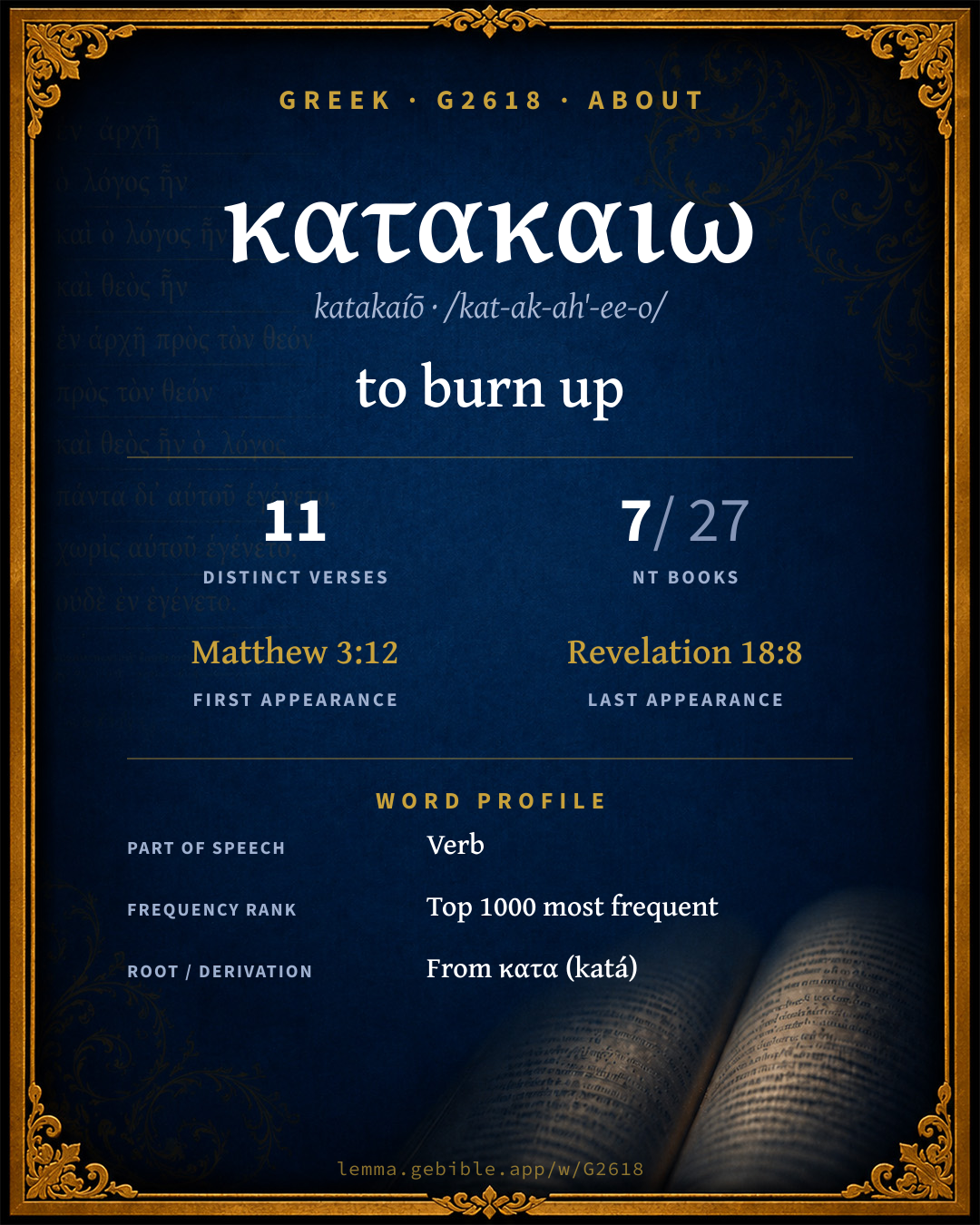
κατακαίω
to burn up
Full lexicon entry — Thayer's Greek Lexicon
From Thayer's Greek Lexicon
Where this word appears
See every Future-tense verb in the Greek New Testament →
Grammar key — what these labels mean
Part of speech
- Verb
- An action or state-of-being word.
Tense
- Aorist
- Action viewed as a simple whole, without regard to duration — often past (perfective aspect).
- Future
- Action expected in future time.
- Present
- Ongoing or general action in present time (imperfective aspect).
- Imperfect
- Continuous or repeated action in past time (“was writing”).
Voice
- Passive
- The subject receives the action.
- Active
- The subject performs the action.
Mood
- Indicative
- States a fact or asks a factual question (the mood of reality).
- Infinitive
- A verbal noun (“to write”), unmarked for person or number.
Person
- 3rd person
- The one spoken about (“he / she / it / they”).
Number
- Singular
- One.
- Plural
- More than one.
1 distinct verse where G2618 appears in the Imperfect tense, across 1 book. Filtered view — show all forms. Click any verse to open its interlinear word-by-word view. Verse text shown in the World English Bible for context — . Each verse’s Greek form is shown with its reference; the English is not keyword-highlighted, since the data carries no word-level English alignment. Use “Compare translations” on any verse to read it across multiple English versions. This concordance covers the Greek New Testament; Septuagint (Greek Old Testament) occurrences of this word are not indexed here.
Acts 1 verse
About this entry
At a glance — auto-summarized from this page’s data, not written by a person. Every figure links to its source below. This summary describes the numbers; it doesn’t interpret them.
“to burn up” is the headline sense of the Greek verb κατακαιω (katakaíō). Scripture first uses it in Matthew 3:12. It appears 11 verses across 7 books of the Greek New Testament, among its uncommon vocabulary. More than a quarter of its appearances fall in Matthew. It shares a root with κατα, καθα and καθαιρεω. The sections below give every sense, occurrence, and version rendering.
Gloss history
Strong's 1890 vs modern scholarship
About this word
Strong's G2618 catalogs a Greek word from the Greek New Testament.
These counts are not copied from any lexicon or concordance. They are computed here, from the morphology-tagged Greek New Testament. What Lemma adds →
- 11
- distinct verses
- The word appears in 11 distinct verses.
- 7 / 27
- NT books
- The word appears in 7 of 27 New Testament books.
- #863
- by frequency
- Top 1000 most frequent Greek words (rank 863 of 5,347 Greek words by occurrence).
View all 11 occurrences in the concordance →
Most concentrated in
- Matthew 3 verses 27%
- Revelation 3 verses 27%
- Luke 1 verse 9%
By section of the New Testament
By traditional corpus
Conventional, traditional groupings — biblical authorship is debated, so this is a traditional corpus grouping, not an authorship claim. Some books belong to more than one corpus (Luke is in both the Gospels and the Lukan corpus, and so on), so these shares overlap and need not total 100%. Each figure is a share of the word’s 11 distinct verses.
- Gospels 4 verses · 36%
- Johannine 3 verses · 27%
- Revelation 3 verses · 27%
- Lukan (Luke–Acts) 2 verses · 18%
- Pauline corpus 1 verse · 9%
- Hebrews 1 verse · 9%
- General (Catholic) Epistles 1 verse · 9%
How translations render this word
Counts come from each version’s own published word-to-Strong’s tagging or interlinear alignment — an approximate guide to how each version renders this word, not a word-level alignment the data otherwise carries. Because each total is that version’s own tagged count, the per-version totals vary from one another and need not match the appearance or distinct-verse counts above. These counts may also differ from a printed concordance because Lemma counts each distinctly tagged rendering and does not collapse phrase taggings into a single head-word total. This is a fixed set of word-tagged versions (KJV, ASV, BSB, ULT) and does not change with the reading translation you choose elsewhere. Each version’s license is shown beside its name below (and on Sources).
- King James Version: Burn 2×, Was burnt up 2×
- American Standard Version: Was burnt up 2×
- Berean Standard Bible: Burned 2×, He will burn up 2×
- unfoldingWord Literal Text: He will burn up 2×, Was burned up 2×
King James Version Public Domain
Renders G2618 across 12 tagged occurrences — most commonly:
Plus 8 renderings that appear only once — usually multi-word phrases or single function words the recovered tagging swept in, not distinct renderings.
American Standard Version Public Domain
Renders G2618 across 12 tagged occurrences — most commonly:
Plus 10 renderings that appear only once — usually multi-word phrases or single function words the recovered tagging swept in, not distinct renderings.
Berean Standard Bible Public Domain
Renders G2618 across 10 tagged occurrences — most commonly:
Plus 6 renderings that appear only once — usually multi-word phrases or single function words the recovered tagging swept in, not distinct renderings. Not rendered by a distinct English word in 2 further occurrences.
unfoldingWord Literal Text CC BY-SA 4.0
Renders G2618 across 14 tagged occurrences — most commonly:
Plus 10 renderings that appear only once — usually multi-word phrases or single function words the recovered tagging swept in, not distinct renderings.
Senses in Thayer's
The 1 sense Thayer's distinguishes for this word, in lexicon order (not ranked by frequency or importance). The full entry — with sub-senses — is in the Lexicon Entry tab.
- to burn up, consume by fire
Word origin
Derived from κατα (katá) (G2596) — down.
Forms in the corpus
The 8 distinct written forms G2618 takes in the Greek New Testament, most frequent first — each parse links to that tense’s occurrences in the concordance.
| Form | Parsing | Example | Uses |
|---|---|---|---|
| κατεκάη katekáē | Verb, Aorist, Passive, Indicative, 3rd person, Singular | Revelation 8:7 | 3 |
| κατακαήσεται katakaḗsetai | Verb, Future, Passive, Indicative, 3rd person, Singular | 1 Corinthians 3:15 | 2 |
| κατακαίεται katakaíetai | Verb, Present, Passive, Indicative, 3rd person, Singular | Matthew 13:40 | 2 |
| κατακαύσει katakaúsei | Verb, Future, Active, Indicative, 3rd person, Singular | Matthew 3:12 | 2 |
| κατέκαιον katékaion | Verb, Imperfect, Active, Indicative, 3rd person, Plural | Acts 19:19 | 1 |
| κατακαυθήσεται katakauthḗsetai | Verb, Future, Passive, Indicative, 3rd person, Singular | Revelation 18:8 | 1 |
| κατακαύσουσιν katakaúsousin | Verb, Future, Active, Indicative, 3rd person, Plural | Revelation 17:16 | 1 |
| κατακαῦσαι katakaûsai | Verb, Aorist, Active, Infinitive | Matthew 13:30 | 1 |
Same root — word family
Other Thayer's entries built from the same root as G2618, grouped by Strong’s listed origin. These share a root / origin per the lexicon — not necessarily a shared meaning. Each links to that word’s own entry.
Derives from
Shares the same root
- καθα kathá G2505 according as
- καθαιρεω kathairéō G2507 to tear down
- καθαπτω katháptō G2510 to fasten down
- καθεδρα kathédra G2515 seat
- καθεζομαι kathézomai G2516 to sit down
- καθεξης kathexēs G2517 in order
- καθευδω katheúdō G2518 to fall asleep
- καθηγητης kathēgētḗs G2519 guide
- καθηκω kathḗkō G2520 to come down
- καθημαι káthēmai G2521 to sit down
- καθημερινος kathēmerinós G2522 daily
- καθιημι kathíēmi G2524 to send down
- καθιστημι kathístēmi G2525 to place
- καθο kathó G2526 according to what
- καθολου kathólou G2527 wholly
- καθοπλιζω kathoplízō G2528 to arm
- καθοραω kathoráō G2529 to see clearly
- καθοτι kathóti G2530 according to what
- καθως kathṓs G2531 according as
- καμμυω kammýō G2576 to close eyes
- καταβαινω katabaínō G2597 to descend
- καταβαλλω katabállō G2598 to cast down
- καταβαρεω katabaréō G2599 to weigh down
- καταβιβαζω katabibázō G2601 to bring down
+103 more words share this root (not shown).
Compare all same-root words → Showing 4 of 129 — not the complete family. They share a root, not necessarily a meaning.
Septuagint usage
The same Greek word κατακαιω appears 85 times in the Greek Old Testament (Septuagint), across 80 verses in 17 books.
- 85
- LXX occurrences
- Tagged occurrences of this Greek word in the Septuagint.
- 80
- verses
- Distinct Septuagint verses containing this word.
- 17 / 39
- OT books
- The word appears in 17 of the 39 Old Testament books.
Sample Septuagint occurrences
- Genesis 38:24 κατακαίω
- Exodus 3:2 κατακαίω
- Leviticus 4:12 κατακαίω
- Numbers 17:2 κατακαίω
- Deuteronomy 7:5 κατακαίω
- Joshua 7:15 κατακαίω
- Judges 14:15 κατακαίω
- 1 Samuel 31:12 κατακαίω
- 2 Kings 17:31 κατακαίω
- 1 Chronicles 14:12 κατακαίω
- Job 1:16 κατακαίω
- Psalms 45:10 κατακαίω
Septuagint occurrences (same lexeme)
Every verse where the same Strong’s number (G2618) appears in the Greek Septuagint — showing the first 50 of 80. Verse text shown in the World English Bible for context; the Greek form is the matched word — the English is not keyword-highlighted.
- Genesis 38:24 κατακαίω It happened about three months later, that it was told Judah, saying, "Tamar, your daughter-in-law, has played the prostitute; and moreover, behold, she is with child by prostitution." Judah said, "Bring her forth, and let her be burnt."
- Exodus 3:2 κατακαίω The angel of Yahweh appeared to him in a flame of fire out of the midst of a bush. He looked, and behold, the bush burned with fire, and the bush was not consumed.
- Exodus 3:3 κατακαίω Moses said, I will turn aside now, and see this great sight, why the bush is not burnt.
- Exodus 12:10 κατακαίω You shall let nothing of it remain until the morning; but that which remains of it until the morning you shall burn with fire.
- Exodus 29:14 κατακαίω But the flesh of the bull, and its skin, and its dung, you shall burn with fire outside of the camp: it is a sin-offering.
- Exodus 29:34 κατακαίω If anything of the flesh of the consecration, or of the bread, remains to the morning, then you shall burn the remainder with fire: it shall not be eaten, because it is holy.
- Exodus 32:20 κατακαίω He took the calf which they had made, and burnt it with fire, ground it to powder, and scattered it on the water, and made the children of Israel drink of it.
- Exodus 34:13 κατακαίω but you shall break down their altars, and dash in pieces their pillars, and you shall cut down their Asherim;
- Leviticus 4:12 κατακαίω even the whole bull shall he carry forth outside the camp to a clean place, where the ashes are poured out, and burn it on wood with fire. Where the ashes are poured out it shall be burned.
- Leviticus 4:21 κατακαίω He shall carry forth the bull outside the camp, and burn it as he burned the first bull. It is the sin offering for the assembly.
- Leviticus 6:23 κατακαίω Every meal offering of a priest shall be wholly burned. It shall not be eaten."
- Leviticus 7:17 κατακαίω but what remains of the flesh of the sacrifice on the third day shall be burned with fire.
- Leviticus 7:19 κατακαίω "'The flesh that touches any unclean thing shall not be eaten. It shall be burned with fire. As for the flesh, everyone who is clean may eat it;
- Leviticus 8:17 κατακαίω But the bull, and its skin, and its flesh, and its dung, he burned with fire outside the camp; as Yahweh commanded Moses.
- Leviticus 8:32 κατακαίω What remains of the flesh and of the bread you shall burn with fire.
- Leviticus 9:11 κατακαίω The flesh and the skin he burned with fire outside the camp.
- Leviticus 13:52 κατακαίω He shall burn the garment, whether the warp or the woof, in wool or in linen, or anything of skin, in which the plague is: for it is a destructive mildew. It shall be burned in the fire.
- Leviticus 13:55 κατακαίω Then the priest shall examine it, after the plague is washed; and, behold, if the plague hasn't changed its color, and the plague hasn't spread, it is unclean; you shall burn it in the fire. It is a mildewed spot, whether the bareness is inside or outside.
- Leviticus 13:57 κατακαίω and if it appears again in the garment, either in the warp, or in the woof, or in anything of skin, it is spreading. You shall burn with fire that in which the plague is.
- Leviticus 16:27 κατακαίω The bull for the sin offering, and the goat for the sin offering, whose blood was brought in to make atonement in the Holy Place, shall be carried forth outside the camp; and they shall burn their skins, their flesh, and their dung with fire.
- Leviticus 16:28 κατακαίω He who burns them shall wash his clothes, and bathe his flesh in water, and afterward he shall come into the camp.
- Leviticus 19:6 κατακαίω It shall be eaten the same day you offer it, and on the next day: and if anything remains until the third day, it shall be burned with fire.
- Leviticus 20:14 κατακαίω "'If a man takes a wife and her mother, it is wickedness: they shall be burned with fire, both he and they; that there may be no wickedness among you.
- Leviticus 21:9 κατακαίω "'The daughter of any priest, if she profanes herself by playing the prostitute, she profanes her father: she shall be burned with fire.
- Numbers 17:2 κατακαίω Speak to the children of Israel, and take of them rods, one for each fathers' house, of all their princes according to their fathers' houses, twelve rods: write you every man's name on his rod.
- Numbers 17:4 κατακαίω You shall lay them up in the tent of meeting before the testimony, where I meet with you.
- Numbers 19:5 κατακαίω One shall burn the heifer in his sight; her skin, and her flesh, and her blood, with her dung, shall he burn:
- Numbers 19:8 κατακαίω He who burns her shall wash his clothes in water, and bathe his flesh in water, and shall be unclean until the even.
- Numbers 19:17 κατακαίω For the unclean they shall take of the ashes of the burning of the sin-offering; and running water shall be put thereto in a vessel:
- Deuteronomy 7:5 κατακαίω But thus shall you deal with them: you shall break down their altars, and dash in pieces their pillars, and hew down their Asherim, and burn their engraved images with fire.
- Deuteronomy 7:25 κατακαίω The engraved images of their gods shall you burn with fire: you shall not covet the silver or the gold that is on them, nor take it to you, lest you be snared therein; for it is an abomination to Yahweh your God.
- Deuteronomy 9:21 κατακαίω I took your sin, the calf which you had made, and burnt it with fire, and stamped it, grinding it very small, until it was as fine as dust: and I cast the dust of it into the brook that descended out of the mountain.
- Deuteronomy 12:3 κατακαίω and you shall break down their altars, and dash in pieces their pillars, and burn their Asherim with fire; and you shall cut down the engraved images of their gods; and you shall destroy their name out of that place.
- Deuteronomy 12:31 κατακαίω You shall not do so to Yahweh your God: for every abomination to Yahweh, which he hates, have they done to their gods; for even their sons and their daughters do they burn in the fire to their gods.
- Deuteronomy 29:22 κατακαίω The generation to come, your children who shall rise up after you, and the foreigner who shall come from a far land, shall say, when they see the plagues of that land, and the sicknesses with which Yahweh has made it sick;
- Joshua 7:15 κατακαίω It shall be, that he who is taken with the devoted thing shall be burnt with fire, he and all that he has; because he has transgressed the covenant of Yahweh, and because he has done folly in Israel.
- Joshua 11:6 κατακαίω Yahweh said to Joshua, Don't be afraid because of them; for tomorrow at this time will I deliver them up all slain before Israel: you shall hamstring their horses, and burn their chariots with fire.
- Judges 14:15 κατακαίω It happened on the seventh day, that they said to Samson's wife, Entice your husband, that he may declare to us the riddle, lest we burn you and your father's house with fire: have you called us to impoverish us? is it not [so]?
- 1 Samuel 31:12 κατακαίω all the valiant men arose, and went all night, and took the body of Saul and the bodies of his sons from the wall of Beth-shan; and they came to Jabesh, and burnt them there.
- 2 Kings 17:31 κατακαίω and the Avvites made Nibhaz and Tartak; and the Sepharvites burnt their children in the fire to Adrammelech and Anammelech, the gods of Sepharvaim.
- 2 Kings 23:4 κατακαίω The king commanded Hilkiah the high priest, and the priests of the second order, and the keepers of the threshold, to bring forth out of the temple of Yahweh all the vessels that were made for Baal, and for the Asherah, and for all the host of the sky, and he burned them outside of Jerusalem in the fields of the Kidron, and carried the ashes of them to Bethel.
- 2 Kings 23:6 κατακαίω He brought out the Asherah from the house of Yahweh, outside of Jerusalem, to the brook Kidron, and burned it at the brook Kidron, and beat it to dust, and cast the dust of it on the graves of the common people.
- 2 Kings 23:11 κατακαίω He took away the horses that the kings of Judah had given to the sun, at the entrance of the house of Yahweh, by the chamber of Nathan-melech the chamberlain, which was in the precincts; and he burned the chariots of the sun with fire.
- 2 Kings 23:15 κατακαίω Moreover the altar that was at Bethel, and the high place which Jeroboam the son of Nebat, who made Israel to sin, had made, even that altar and the high place he broke down; and he burned the high place and beat it to dust, and burned the Asherah.
- 2 Kings 23:16 κατακαίω As Josiah turned himself, he spied the tombs that were there in the mountain; and he sent, and took the bones out of the tombs, and burned them on the altar, and defiled it, according to the word of Yahweh which the man of God proclaimed, who proclaimed these things.
- 2 Kings 23:20 κατακαίω He killed all the priests of the high places that were there, on the altars, and burned men's bones on them; and he returned to Jerusalem.
- 1 Chronicles 14:12 κατακαίω They left their gods there; and David gave commandment, and they were burned with fire.
- Job 1:16 κατακαίω While he was still speaking, there also came another, and said, "The fire of God has fallen from the sky, and has burned up the sheep and the servants, and consumed them, and I alone have escaped to tell you."
- Psalms 45:10 κατακαίω Listen, daughter, consider, and turn your ear. Forget your own people, and also your father's house.
- Psalms 73:8 κατακαίω They scoff and speak with malice. In arrogance, they threaten oppression.
These are occurrences of the same Greek lexeme (G2618) in the Septuagint — not a translation of any one Hebrew word. The store carries no word-level Hebrew↔Greek alignment, so no Hebrew original is asserted here. Counts come from the recovered LXX Strong's tagging — high-frequency vocabulary is well covered, while rare or late forms may be untagged — so they reflect tagged occurrences and may slightly undercount.