
Psalms 73:8

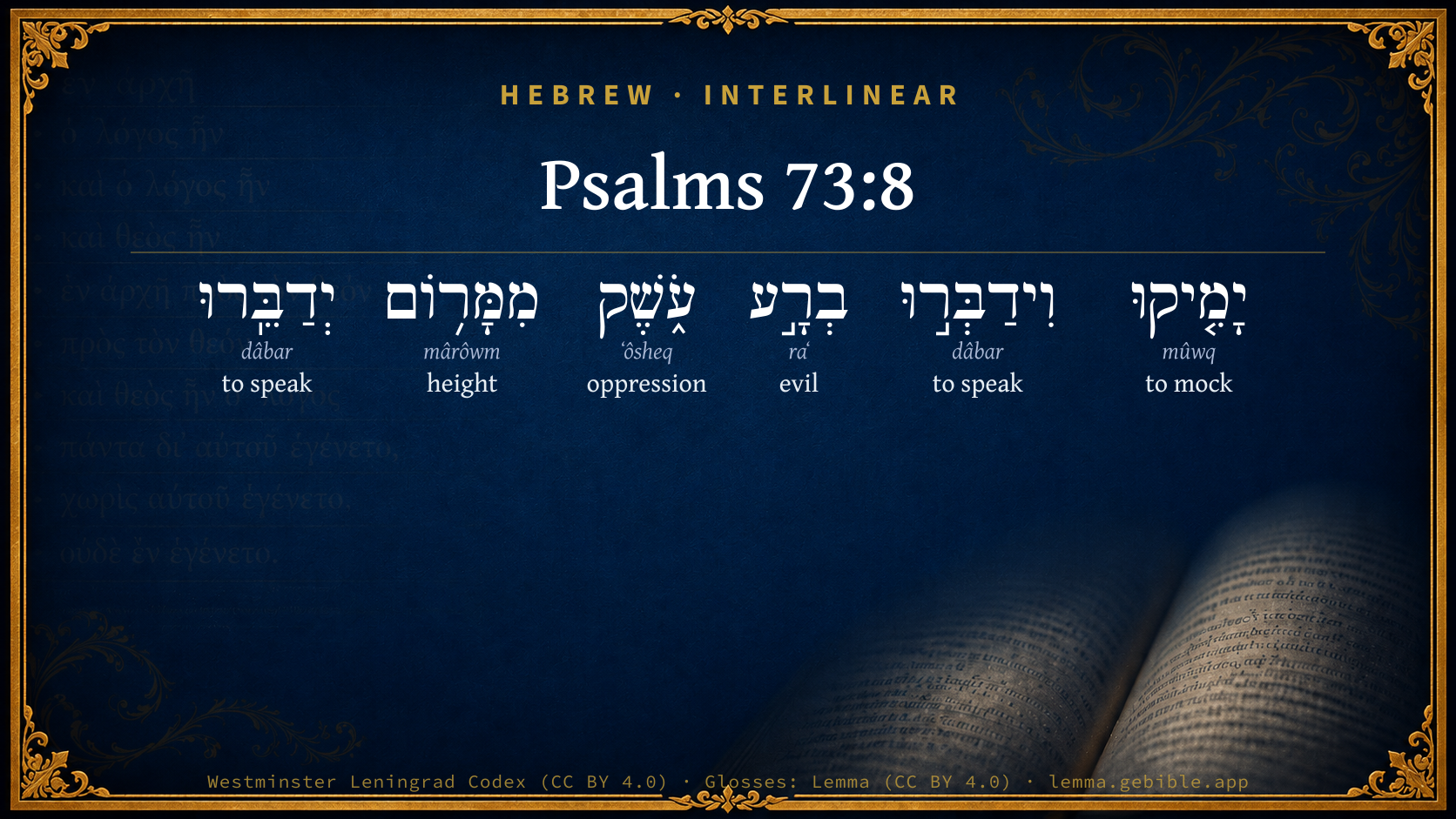
Hebrew (Westminster Leningrad Codex) Psalms 73:8 appears in the Hebrew Old Testament. The text above is from the Westminster Leningrad Codex. Each word links to its Strong’s number, a concise gloss, and parsing drawn from the Open Scriptures Hebrew Bible morphology. Click any word for its full Brown-Driver-Briggs (BDB) entry.
Download image
Cite this verse

Psalms 73:8 (World English Bible). Public Domain. Lemma interlinear Bible study tool, https://lemma.gebible.app/v/psalms/73/8.

Show BibTeX & RIS
BibTeX
RIS
English Translation
They scoff and speak with malice. In arrogance, they threaten oppression.
World English Bible · Public Domain
Highlights
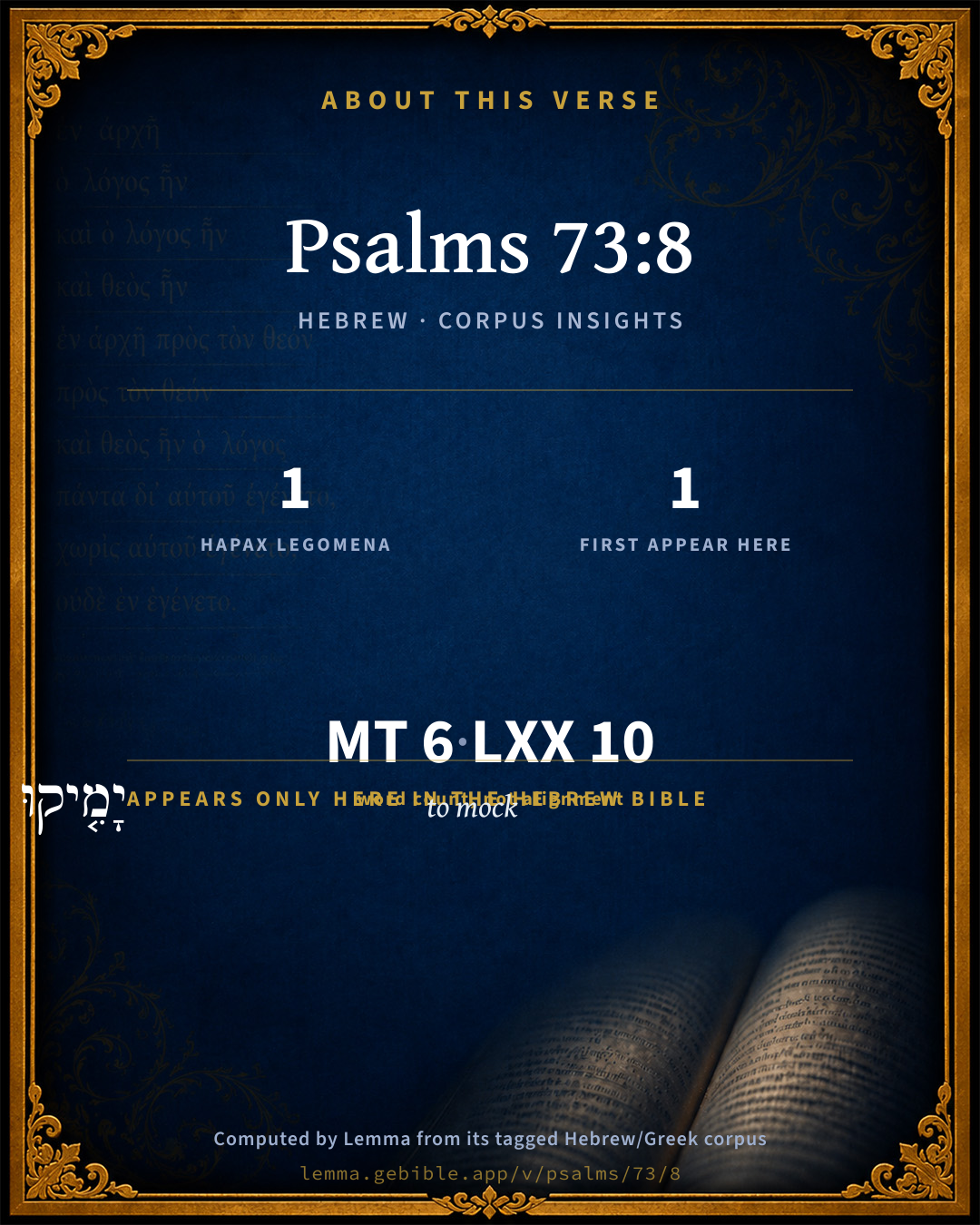
  • 1 hapax legomenon — only here in the Hebrew Bible
  • 1 first appearance in the Hebrew Bible
Full analysis ↓
Download a study sheet

One document with this verse’s original text, its word-by-word gloss line, the meaning frame, cross-references with their text, attributed commentary, and full source and license credits — printable, and it pastes into notes with its structure intact.

This verse Autodidact and up

Study sheet (.html) Plain text (.txt)

A passage Seminary Student

Up to 50 verses in one chapter. A passage sheet keeps up to 6 commentary sources and 12 cross-references per verse, in the order this page ranks them, and says so on the sheet whenever that leaves anything out. Ask for a single verse and you get the Autodidact verse sheet above.

Everything on this page stays free to read, with no account — the sheet is a download of what is already on screen, not access to it.

Want to remove ads? Support Godless Engineer
Compare translations 3

The same verse in 3 English versions, stacked beneath the original-language interlinear above. Click any original word for its lexicon entry.

Each is an independent rendering of the whole verse — the interlinear is not word-aligned to these translations.

Highlighted words mark where these versions differ — a whole-verse word diff, not a word-by-word alignment.

  • World English Bible Public Domain
    They scoff and speak with malice. In arrogance, they threaten oppression.
  • King James Version Public Domain
    They are corrupt, and speak wickedly concerning oppression: they speak loftily.
  • unfoldingWord Literal Text CC BY-SA 4.0
    They mock and speak with evil of oppression; they speak from an elevated place.

unfoldingWord Literal Text — © unfoldingWord, licensed CC BY-SA 4.0. Word-aligned USFM3 via Door43 (git.door43.org/unfoldingWord/en_ult).

Versions to compare (up to 4)

3 of 4 selected

Show all 18 translations

Every available English version of this verse, each an independent rendering of the whole verse.

  • World English Bible Public Domain
    They scoff and speak with malice. In arrogance, they threaten oppression.
  • Berean Standard Bible Public Domain
    They mock and speak with malice; with arrogance they threaten oppression.
  • Majority Standard Bible Public Domain
    They mock and speak with malice; with arrogance they threaten oppression.
  • King James Version Public Domain
    They are corrupt, and speak wickedly concerning oppression: they speak loftily.
  • American Standard Version (1901) Public Domain
    They scoff, and in wickedness utter oppression: They speak loftily.
  • Revised Version (1885) Public Domain
    They scoff, and in wickedness utter oppression: they speak loftily.
  • Geneva Bible (1599) Public Domain
    They are licentious, and speake wickedly of their oppression: they talke presumptuously.
  • Douay-Rheims (1899) Public Domain
    They have thought and spoken wickedness: they have spoken iniquity on high.
  • Young's Literal Translation Public Domain
    They do corruptly, And they speak in the wickedness of oppression, From on high they speak.
  • Literal Standard Version CC BY-SA 4.0
    They do corruptly, || And they speak in the wickedness of oppression, || They speak from on high.
  • Unlocked Literal Bible CC BY-SA 4.0
    They mock and speak wickedly; in their arrogance they threaten oppression.
  • unfoldingWord Literal Text CC BY-SA 4.0
    They mock and speak with evil of oppression; they speak from an elevated place.
  • Darby Bible Public Domain
    They mock and speak wickedly of oppression, they speak loftily:
  • World Messianic Bible Public Domain
    They scoff and speak with malice. In arrogance, they threaten oppression.
  • Webster's Bible Public Domain
    They are corrupt, and speak wickedly concerning oppression: they speak loftily.
  • Free Bible Version CC BY-SA 4.0
    They mock people, and speak maliciously; they arrogantly threaten cruelty.
  • Bible in Basic English Public Domain
    Their thoughts are deep with evil designs; their talk from their seats of power is of cruel acts.
  • JPS Tanakh (1917) Public Domain
    They scoff, and in wickedness utter oppression; they speak as if there were none on high.

Literal Standard Version (2020), Covenant Press — licensed CC BY-SA 4.0. Text via the HelloAO Bible API (eBible.org). Unlocked Literal Bible (unfoldingWord) — licensed CC BY-SA 4.0. Text via the HelloAO Bible API (eBible.org). unfoldingWord Literal Text — © unfoldingWord, licensed CC BY-SA 4.0. Word-aligned USFM3 via Door43 (git.door43.org/unfoldingWord/en_ult). Free Bible Version, Dr. Jonathan Gallagher — licensed CC BY-SA 4.0. Text via the HelloAO Bible API (eBible.org).

Word by word

More ways to search: Search by grammar → Find every occurrence → Compare this word →

Practice this passage: Drill this verse → Learn its vocabulary →

About this verse

These counts appear in no published source. They are computed here, from the morphology-tagged text and Lemma’s own curated glosses. What Lemma adds →

6
words
5
distinct lemmas
Wisdom
section

Notable vocabulary

1 hapax legomenon — a word that appears only here in the entire Hebrew Bible:

  • יָמִ֤יקוּ to mock H4167

First appearance in Scripture

This word makes its first canonical appearance in the Hebrew Bible here:

  • יָמִ֤יקוּ to mock H4167

Shared distinctive vocabulary

עֹ֑שֶׁק oppression H6233 occurs in 15 verses of the Hebrew Bible. Also found in:

Grammatical profile

  • 3 verbs
  • 2 nouns
  • 1 adjective

Verb forms

  • יָמִ֤יקוּ Hiphil · Imperfect
  • וִידַבְּר֣וּ Piel · Imperfect
  • יְדַבֵּֽרוּ Piel · Imperfect

Repetition

A word recurs within this verse — often emphatic in Hebrew:

  • וִידַבְּר֣וּ to speak H1696 ×2

Hebrew & Septuagint length

In English translation the verse runs 11 words from the Hebrew and 13 from the Septuagint (LXX English) — closely comparable.

A rough comparison of the two English renderings, which tokenize alike — not a word-level alignment.

Word counts can differ between the Hebrew and the Greek without any difference in meaning — e.g. the Hebrew direct-object marker אֵת has no separate Greek word, and Greek often adds the article ὁ.

In the original languages it is 6 Hebrew tokens and 10 Greek tokens — but the two are counted differently (Hebrew bundles its prefixes and suffixes into one token; the Greek is in lemma form), so that isn’t a like-for-like length.

Cross-references

14

Topical passages linked to Psalms 73:8 in the Treasury of Scripture Knowledge — connected by theme and wording, ordered by reader-vote popularity; previews shown in the World English Bible.

  • Jude 1:16 These are murmurers and complainers, walking after their lusts (and their mouth speaks proud things), showing respect of persons to gain advantage.
  • Psalms 17:10 They close up their callous hearts. With their mouth they speak proudly.
  • Psalms 10:2 In arrogance, the wicked hunt down the weak; They are caught in the schemes that they devise.
  • Psalms 10:10–11 The helpless are crushed, they collapse, They fall under his strength.
  • Psalms 12:4–5 Who have said, "With our tongue we will prevail. Our lips are our own. Who is lord over us?"
  • Psalms 53:1–4 The fool has said in his heart, "There is no God." They are corrupt, and have done abominable iniquity. There is no one who does good.
  • Proverbs 30:13–14 There is a generation, oh how lofty are their eyes! Their eyelids are lifted up.
  • Jeremiah 7:9–11 Will you steal, murder, and commit adultery, and swear falsely, and burn incense to Baal, and walk after other gods that you have not known,
  • 2 Peter 2:10 but chiefly those who walk after the flesh in the lust of defilement, and despise authority. Daring, self-willed, they are not afraid to speak evil of dignitaries;
  • 2 Peter 2:18 For, uttering great swelling words of emptiness, they entice in the lusts of the flesh, by licentiousness, those who are indeed escaping from those who live in error;
  • Exodus 1:9–10 He said to his people, "Behold, the people of the children of Israel are more and mightier than we.
  • 1 Samuel 13:19 Now there was no smith found throughout all the land of Israel; for the Philistines said, Lest the Hebrews make them swords or spears:
  • 1 Kings 21:7–29 Jezebel his wife said to him, Do you now govern the kingdom of Israel? arise, and eat bread, and let your heart be merry: I will give you the vineyard of Naboth the Jezreelite.
  • Hosea 7:16 They return, but not to the Most High. They are like a faulty bow. Their princes will fall by the sword for the rage of their tongue. This will be their derision in the land of Egypt.

Cross-references courtesy of OpenBible.info (CC BY 4.0).

Hebrew and Greek witnesses Masoretic Hebrew ↔ Greek Septuagint

The same verse in the two great witnesses to the Old Testament, shown verse-for-verse.

You’re reading Greek Psalm 72 (Hebrew Psalm 73). The Septuagint counts the superscription, so verse numbers can differ from the Hebrew — chapter-level alignment, not verse-by-verse. Numbering follows Rahlfs.

These are two independent witnesses, not word-aligned to each other, and the Septuagint is shown in lemma (dictionary) form.

Hebrew Psalms 73:8 Masoretic · Westminster Leningrad Codex

יָמִ֤יקוּ וִידַבְּר֣וּ בְרָ֣ע עֹ֑שֶׁק מִמָּר֥וֹם יְדַבֵּֽרוּ

They scoff and speak with malice. In arrogance, they threaten oppression.

World English Bible · Public Domain

Greek LXX Greek Psalm 72:8 Septuagint · lemma form

διανοέομαι καί λαλέω ἐν πονηρία ἀδικία εἰς ὁ ὕψος λαλέω

They have taken counsel and spoken in wickedness: they have uttered unrighteousness loftily.

LXX2012 (modern English Septuagint) · Public Domain

Hebrew: Westminster Leningrad Codex (CC BY 4.0). Greek: Septuagint (public domain); English from LXX2012 (modern English Septuagint) (Public Domain). How the Septuagint differs from the Hebrew →

Commentary

Notes on Psalms 73:8 from classic Christian and Jewish commentators (each source and its license shown beneath its notes). The classic Christian expositions comment on the surrounding passage and are grouped to its opening verse, so a note may address several verses; the Jewish commentaries on the Tanakh (Rashi and others) are per-verse, so they appear only where the commentator wrote on this verse.

Lemma curates 59 commentaries, every one of them public domain or Creative Commons licensed, each selected and text-cleaned for this edition rather than reprinted as found. About our sources →

Trapp's Complete Commentary

John Trapp

Psa 73:8 They are corrupt, and speak wickedly [concerning] oppression: they speak loftily.

Ver. 8. They are corrupt, and speak wickedly] Their pride, before taxed, Psa 73:6, buddeth, and budgeth, Eze 7:10; like a foul swelling in the body, it breaketh out into sores of all sorts, odious words and deeds, abominable to God and man. Diffiuuut et loquuntur in malitia rapinata, they melt and are spilt in sensual delights and dissolute practices. Or, they let loose themselves, and keep not within compass. Or, they secretly corrupt and make to stink the good names of others, sc. while they speak evil of them, and reproach them. Tabifici sunt, so Tremellius rendereth it.

They speak loftily] De celsitudine, from aloft; lapides loquuntur, they threaten thunderbolts, throw daggers, fastuosa voce omnes territant.

John Trapp, A Commentary or Exposition upon All the Books of the Old and New Testament (1647–1656) — public domain. Text from a community e-Sword module.

J. A. Alexander on Psalms

Joseph Addison Alexander

Psa 73:8. They mock and speak in wickedness (or malice); oppression from on high they speak: To speak oppression is to speak words tending to the injury of others. From on high, proudly, with arrogant contempt of others. They speak as if from a superior position.

Joseph Addison Alexander, The Psalms Translated and Explained (1850) — public domain. Text from a community e-Sword module.

Adam Clarke's Commentary

Verse 8. They are corrupt] ימיקו yamiku, they mock, act dissolutely.

And speak wickedly concerning oppression] They vindicate excessive acts of government: they push justice to its rigour. They neither show equity, lenity, nor mercy; they are cruel, and they vindicate their proceedings.

Adam Clarke's Commentary on the Bible (1810–1826) — public domain. Text from a community e-Sword/MySword module.

John Calvin's Commentaries

8. They become insolent, and wickedly talk of extortion. Some take the verb ימיקו, yamicu, in an active transitive sense, and explain it as meaning, that the wicked soften, that is to say, render others pusillanimous, or frighten and intimidate them. But as the idiom of the language admits also of its being understood in the neuter sense, I have adopted the interpretation which agreed best with the scope of the passage, namely, that the wicked, forgetting themselves to be men, and by their unbounded audacity trampling under foot all shame and honesty, dissemble not their wickedness, but, on the contrary, loudly boast of their extortion. And, indeed, we see that wicked men, after having for some time got every thing to prosper according to their desires, cast off all sham and are at no pains to conceal themselves when about to commit iniquity, but loudly proclaim their own turpitude. “What!” they will say, “is it not in my power to deprive you of all that you possess, and even to cut your throat?” Robbers, it is true, can do the same thing; but then they hide themselves for fear. These giants, or rather inhuman monsters, of whom David speaks, on the contrary not only imagine that they are exempted from subjection to any law, but, unmindful of their own weakness, foam furiously, as if there were no distinction between good and evil, between right and wrong. If, however, the other interpretation should be preferred, That the wicked intimidate the simple and peaceable by boasting of the great oppressions and outrages which they can perpetrate upon them, I do not object to it. When the poor and the afflicted find themselves at the mercy of these wicked men, they cannot but tremble, and, so to speak, melt and dissolve upon seeing them in possession of so much power. With respect to the expression, They speak from on high, implies, that they pour forth their insolent and abusive speech upon the heads of all others. As proud men, who disdain to look directly at any body, are said, in the Latin tongue, despicere, and in the Greek, Katablepein, that is, to look down; so David introduces them as speaking from on high, because it seems to them that they have nothing in common with other men, but think themselves a distinct class of beings, and, as it were, little gods.

John Calvin's Commentaries (1540-1563) — public domain. Text from the Calvin Translation Society English edition (1840s-50s) via the Christian Classics Ethereal Library (ccel.org). Calvin's coverage is partial (roughly two-thirds of the Bible); uncommented books and verses are honest gaps, never fabricated. The 19th-century editor's footnotes and remarks are omitted so the notes are faithfully Calvin's own voice.

Ellicott's Commentary for English Readers

(8) They are corrupt . . .—This, which is the Rabbinical rendering, is now universally abandoned in favour of another derivation of the verb. The Masoretic arrangement of the clauses may be also improved on:

“They scoff and speak of wickedness,

Of violence from their eminence they speak,”

where the first clause means, they speak mockingly of wickedness, or make a jest of sin.

A Bible Commentary for English Readers, edited by Charles John Ellicott (1878–1897) — public domain. Text from a community e-Sword module.

The Cambridge Bible for Schools and Colleges

gen. ed. J. J. S. Perowne

8. The rhythm seems to require a different division of the verse from that given by the Massoretic accentuation, thus;

They scoff, and talk of evil:

Of oppression do they talk from on high.

Not the commandments of God (Deu_6:7; Deu_11:19) but their own nefarious designs are the subject of their conversation: they talk “as if they were gods and their words oracles.” Cp. Isa_14:13. P.B.V. “their talking is against the most High” (Great Bible from Münster) is untenable.

The Cambridge Bible for Schools and Colleges (gen. ed. J. J. S. Perowne; Cambridge University Press, 1878–1918) — public domain. Text from a community e-Sword module.

John Gill's Exposition

They are corrupt,.... In themselves, in their principles, and in their practices, being shapen and conceived in sin, and born of the flesh; and are corrupters, or "corrupt" themselves, and their ways, and also others by their corrupt speech, evil communications, and bad examples: or "they consume away"; like smoke, or into it, as Psa 37:20 or as wax melteth at the fire, Psa 68:2, where the same word is used as here: or "they cause to consume away" (o); "they melt or dissolve others"; they consume them, and waste their estates by their oppression and violence; they make their hearts to melt with their threatening and terrifying words; or they make them dissolute in their lives by keeping them company:

and speak wickedly concerning oppression; they speak oppression and revolt, threaten with it, Isa 59:13, and speak in vindication of it, and in a boasting glorying manner; so Arama; which is speaking wickedly concerning it:

they speak loftily: proudly, arrogantly, in a haughty and imperious manner: or "from on high" (p); as if they were in heaven, and above all creatures, and even God himself; and as if what they said were oracles, and to be received as such, without any scruple and hesitation. Thus Pharaoh, Sennacherib, and Nebuchadnezzar spake, Exo 5:2 and the little horn, or antichrist, Dan 7:20.

(o) "dissolutos reddunt", Vatablus; "reddent se dissolutos", Montanus; "faciunt tabescere", Cocceius, Gejerus, Michaelis. (p) "a sublimi", Musculus, Tigurine version, Junius & Tremellius, Piscator; "ex alto", Cocceius, Gejerus, Michaelis.

John Gill's Exposition of the Whole Bible (1746–1763) — public domain (CC PDM 1.0). Text via the HelloAO Bible API.

Albert Barnes' Notes on the Bible

They are corrupt - literally, “they mock.” The word rendered “they are corrupt” never has this signification. It is the very word - מוק mûq - from which our word mock is derived, and means the same thing. The idea is that they deride religion, or mock at all that pertains to God, and to the retributions of the future world.

And speak wickedly concerning oppression ... - literally, “they speak in wickedness; oppression they speak from on high.” That is, they use arrogant language; they speak in a proud manner, as if they were above others; they use harsh and violent language, not regarding the feelings or the rights of others.

Albert Barnes' Notes on the Bible (1834–1885) — public domain. Text from a community e-Sword/MySword module.

Matthew Poole's English Annotations

They are corrupt; or, dissolved in pleasure. Or, they corrupt themselves.

Speak wickedly concerning oppression; wickedly boasting of their oppressions; either of what they have done, or of what they intend to do, in that kind.

They speak loftily; arrogantly presuming upon their own strength, and despising both God and men.

Matthew Poole's English Annotations on the Holy Bible (1683–1685) — public domain. Text from a community e-Sword/MySword module.

The Treasury of David

Charles H. Spurgeon

Ver. 8. They are corrupt. They rot above ground; their heart and life are depraved.

And speak wickedly concerning oppression. The reek of the sepulchre rises through their mouths; the nature of the soul is revealed in the speech. They choose oppression as their subject, and they not only defend it, but advocate it, glory in it, and would fain make it the general rule among all nations. "Who are the poor? What are they made for? What, indeed, but to toil and slave that men of education and good family may enjoy themselves? Out on the knaves for prating about their rights! A set of wily demagogues are stirring them up, because they get a living by agitation. Work them like horses, and feed them like dogs; and if they dare complain, send them to the prison or let them die in the workhouse." There is still too much of this wicked talk abroad, and, although the working classes have their faults, and many of them very grave and serious ones too, yet there is a race of men who habitually speak of them as if they were an inferior order of animals. God forgive the wretches who thus talk.

They speak loftily. Their high heads, like tall chimneys, vomit black smoke. Big talk streams from them, their language is colossal, their magniloquence ridiculous. They are Sir Oracle in every case, they speak as from the judges' bench, and expect all the world to stand in awe of them.

Ver. 8. They are corrupt. Prosperity, in an irreligious heart, breeds corruption, which from thence is emitted by the breath in conversation, to infect and taint the minds of others. George Horne.

Ver. 8. They speak wickedly concerning oppression. Indeed, we see that wicked men, after having for some time got everything to prosper according to their desires, cast off all shame, and are at no pains to conceal themselves, when about to commit iniquity, but loudly proclaim their own turpitude. "What!" they will say, "is it not in my power to deprive you of all that you possess, and even to cut your throat?" Robbers, it is true, can do the same thing; but then they hide themselves for fear. These giants, or rather inhuman monsters, of whom David speaks, on the contrary not only imagine that they are exempted from subjection to any law, but, unmindful of their own weakness, foam furiously, as if there were no distinction between good and evil, between right and wrong. John Calvin.

Ver. 8. Connection between a corrupt heart and a proud tongue.

Psalms 73:9*

Charles H. Spurgeon's The Treasury of David (1869–1885) — public domain. Psalms only. Text from a community e-Sword/MySword module.

Whedon's Commentary on the Bible

Daniel D. Whedon

8. They are corrupt—They are mockers. They treat serious subjects lightly and with derision.

They… speak wickedly concerning oppression—In reference to their plans of deceit and violence to rob the poor and exalt themselves, they scorn alike the restraints of law and the rights of men.

They speak loftily—Literally, They speak from on high, haughtily. See on Psa_73:6

Daniel D. Whedon (gen. ed.), Commentary on the Old and New Testaments (1874–1909) — public domain. Text from a community e-Sword module.

The Pulpit Commentary

They are corrupt, and speak wickedly concerning oppression: they speak loftily; rather, they scoff, and speak wickedly; of oppression do they speak from heavens height; i.e. "they scoff at the righteous, and speak wickedly concerning them; they talk of the oppressive acts which they meditate, as though they were Divine beings, speaking from the heavenly height" (Cheyne).

The Pulpit Commentary (1880–1919), ed. H.D.M. Spence-Jones & Joseph S. Exell — public domain. Text from a community e-Sword module.

John Wesley's Explanatory Notes

And speak - Boasting of their oppressions.

John Wesley, Explanatory Notes Upon the Whole Bible (1754–1765) — public domain. Text via the GEBible commentary corpus.

unfoldingWord translationNotes

Door43 World Missions Community

General Information:

Asaph continues to describe how he sometimes wants to complain to God about those who are "arrogant" and "wicked" (Psalms 73:3).

They mock

Whom they mock can be stated clearly. AT: "They mock God and his people" (See: Assumed Knowledge and Implicit Information)

They set their mouth against the heavens

Here "their mouth" is a metonym for their speech, and "heavens" is a metonym for God, who lives in the heavens. AT: "They speak against God, who is in the heavens" (See: Metonymy)

their tongues march through the earth

The word "tongues" represents the people themselves. Possible meanings are 1) "they go through the earth saying bad things about God" or "they go everywhere and boast about themselves." (See: Synecdoche)

translationWords

mock

evil

heaven

tongue

earth

unfoldingWord translationNotes — © Distant Shores Media and the Door43 World Missions Community, licensed CC BY-SA 4.0. Source: git.door43.org/Door43/en_tn.

Rashi

Rabbi Shlomo Yitzchaki (Rashi)

They consume their neighbors.

and speak wickedly about oppression To oppress the needy.

they speak about the Most High e.g. Pharaoh, Sennacherib, and Nebuchadnezzar. [Pharaoh said] (Exod. 5:2): “Who is the Lord that I should obey Him?” [Sennacherib said] (Isa. 36:20), “Who are they among all the gods of the lands...?” [Nebuchadnezzar said] (Isa. 14:14), “I will ascend above the heights of the clouds.” That is the meaning of: “They have set their mouth against Heaven.”

Rashi on the Tanakh — English translations: “The Judaica Press complete Tanach with Rashi, translated by A. J. Rosenberg” (CC BY 4.0); “Pentateuch with Rashi's commentary by M. Rosenbaum and A.M. Silbermann, 1929-1934” (public domain); “The Metsudah Tanach series, Lakewood, N.J” (CC BY 4.0); and “The Book of Joshua, Metsudah Publications, 1997” (CC BY 4.0). Text via Sefaria.

Lesson kit

Teaching starters — assembled from the data on this page, not authored interpretation. Every prompt links to the verse data it draws on. Edit before teaching.

Psalms, in the Wisdom, opens this verse with 6 words (5 distinct Hebrew lemmas). Its most distinctive word is mûwq (“to mock”). A historical commentator’s framing appears above. Read the whole chapter for the surrounding context.

Discussion questions

  1. What does “to mock” (mûwq) contribute to the verse as a whole?
  2. This verse holds 1 word here found nowhere else in the Hebrew Bible. What might the rare word draw attention to?
  3. The word “to mock” first appears here in Scripture. What is being introduced at this debut?
  4. Leviticus 6:4 shares the word «oppression» with this verse. How do the two illuminate each other?
  5. “to speak” occurs 2× in this one verse. What is the effect of the repetition?
  6. The translations on this page render this verse differently — a whole-verse word diff, not a word-by-word alignment. What might account for the different wordings?
  7. The verb «יָמִ֤יקוּ» is Hiphil Imperfect. How does its form color the action?
  8. Reading how Trapp's Complete Commentary and J. A. Alexander on Psalms read this verse, where do the two commentators agree and where do they part?

Things to notice

  • 1 word in this verse appears nowhere else in the Hebrew Bible.
  • 1 word makes its first canonical appearance in Scripture here.
  • This verse counts 6 Hebrew ↔ 10 Greek words.
  • These translations choose different wording for 12 words in this verse.
  • “to speak” occurs 2× in this single verse.

Reading settings

Reading text

Shown beneath each verse's original-language words.

Old Testament
Old Testament edition

Read the OT as the Masoretic Hebrew (MT) or the Greek Septuagint (LXX).

English shown for the Greek Septuagint (in the Hebrew ↔ Greek comparison).

Comparing translations? Open the Compare panel on any verse page to stack up to four side by side.