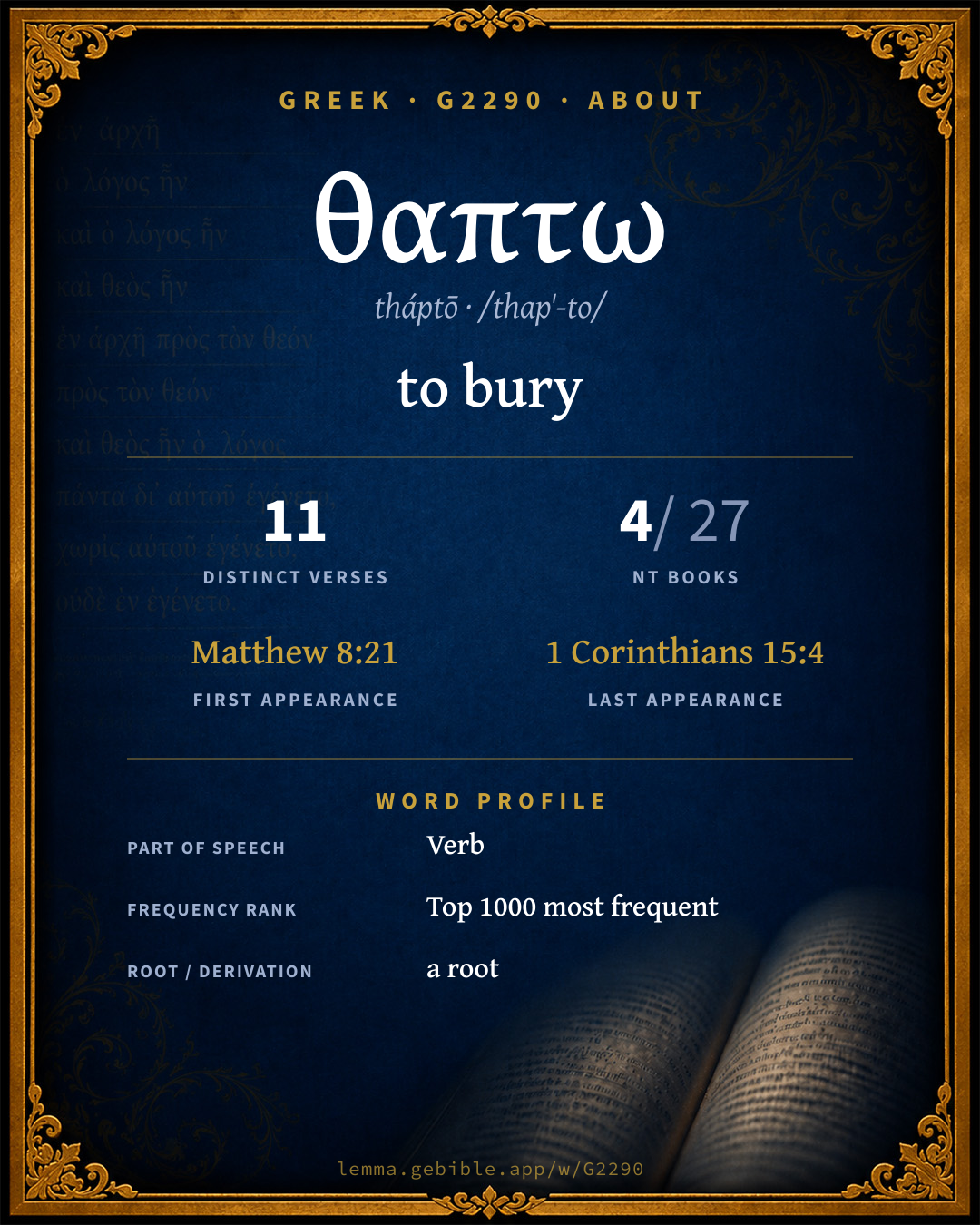
θάπτω
to bury
Full lexicon entry — Thayer's Greek Lexicon
From Thayer's Greek Lexicon
Where this word appears
Grammar key — what these labels mean
Part of speech
- Verb
- An action or state-of-being word.
Tense
- Aorist
- Action viewed as a simple whole, without regard to duration — often past (perfective aspect).
Voice
- Active
- The subject performs the action.
- Passive
- The subject receives the action.
Mood
- Infinitive
- A verbal noun (“to write”), unmarked for person or number.
- Indicative
- States a fact or asks a factual question (the mood of reality).
- Participle
- A verbal adjective (“writing,” “having written”).
Case
- Genitive
- The case of source, possession, or “of” — answers “whose / from what.”
Person
- 3rd person
- The one spoken about (“he / she / it / they”).
Gender
- Masculine
- Grammatically masculine.
Number
- Singular
- One.
- Plural
- More than one.
Every verse where G2290 appears in the Book of Acts — 4 distinct verses. Click any verse to open its interlinear word-by-word view. Verse text shown in the World English Bible for context — . Each verse’s Greek form is shown with its reference; the English is not keyword-highlighted, since the data carries no word-level English alignment. Use “Compare translations” on any verse to read it across multiple English versions. This concordance covers the Greek New Testament; Septuagint (Greek Old Testament) occurrences of this word are not indexed here.
Acts
- Acts 2:29 ἐτάφη aor pass ind 3sg "Brothers, I may tell you freely of the patriarch David, that he both died and was buried, and his tomb is with us to this day.
- Acts 5:6 ἔθαψαν aor act ind 3pl The young men arose and wrapped him up, and they carried him out and buried him.
- Acts 5:9 θαψάντων aor act ptcp gen pl masc But Peter asked her, "How is it that you have agreed together to tempt the Spirit of the Lord? Behold, the feet of those who have buried your husband are at the door, and they will carry you out."
- Acts 5:10 ἔθαψαν aor act ind 3pl She fell down immediately at his feet, and died. The young men came in and found her dead, and they carried her out and buried her by her husband.
About this entry
At a glance — auto-summarized from this page’s data, not written by a person. Every figure links to its source below. This summary describes the numbers; it doesn’t interpret them.
“to bury” is the headline sense of the Greek verb θαπτω (tháptō). First canonically at Matthew 8:21, it enters the text early. It appears 11 verses across 4 books of the Greek New Testament, among its uncommon vocabulary. More than a third of its appearances fall in Acts. Related forms include ταφη and ταφος. See the sense tree, 11-verse concordance, and the renderings breakdown below.
Gloss history
Strong's 1890 vs modern scholarship
About this word
Strong's G2290 catalogs a Greek word from the Greek New Testament.
These counts are not copied from any lexicon or concordance. They are computed here, from the morphology-tagged Greek New Testament. What Lemma adds →
- 11
- distinct verses
- The word appears in 11 distinct verses.
- 4 / 27
- NT books
- The word appears in 4 of 27 New Testament books.
- #978
- by frequency
- Top 1000 most frequent Greek words (rank 978 of 5,347 Greek words by occurrence).
View all 11 occurrences in the concordance →
By section of the New Testament
By traditional corpus
Conventional, traditional groupings — biblical authorship is debated, so this is a traditional corpus grouping, not an authorship claim. Some books belong to more than one corpus (Luke is in both the Gospels and the Lukan corpus, and so on), so these shares overlap and need not total 100%. Each figure is a share of the word’s 11 distinct verses.
- Lukan (Luke–Acts) 7 verses · 64%
- Gospels 6 verses · 55%
- Pauline corpus 1 verse · 9%
How translations render this word
Counts come from each version’s own published word-to-Strong’s tagging or interlinear alignment — an approximate guide to how each version renders this word, not a word-level alignment the data otherwise carries. Because each total is that version’s own tagged count, the per-version totals vary from one another and need not match the appearance or distinct-verse counts above. These counts may also differ from a printed concordance because Lemma counts each distinctly tagged rendering and does not collapse phrase taggings into a single head-word total. This is a fixed set of word-tagged versions (KJV, ASV, BSB, ULT) and does not change with the reading translation you choose elsewhere. Each version’s license is shown beside its name below (and on Sources).
- King James Version: Buried 4×, Bury 4×
- American Standard Version: Bury 4×, Buried 2×, Was buried 2×
- Berean Standard Bible: Buried 4×, Bury 4×, Was buried 2×
- unfoldingWord Literal Text: Bury 4×, Was buried 2×
King James Version Public Domain
Renders G2290 across 11 tagged occurrences — most commonly:
Plus 3 renderings that appear only once — usually multi-word phrases or single function words the recovered tagging swept in, not distinct renderings.
American Standard Version Public Domain
Renders G2290 across 11 tagged occurrences — most commonly:
Plus 3 renderings that appear only once — usually multi-word phrases or single function words the recovered tagging swept in, not distinct renderings.
Berean Standard Bible Public Domain
Renders G2290 across 11 tagged occurrences — most commonly:
Plus 1 rendering that appears only once — usually multi-word phrases or single function words the recovered tagging swept in, not distinct renderings.
unfoldingWord Literal Text CC BY-SA 4.0
Renders G2290 across 11 tagged occurrences — most commonly:
Plus 5 renderings that appear only once — usually multi-word phrases or single function words the recovered tagging swept in, not distinct renderings.
Senses in Thayer's
The 1 sense Thayer's distinguishes for this word, in lexicon order (not ranked by frequency or importance). The full entry — with sub-senses — is in the Lexicon Entry tab.
- to bury, inter
Word origin
Origin: a root
A primary verb; to celebrate funeral rites that is inter : - bury.
— Strong’s Exhaustive Concordance (1890), public domain.
Forms in the corpus
The 4 distinct written forms G2290 takes in the Greek New Testament, most frequent first — each parse links to that tense’s occurrences in the concordance.
| Form | Parsing | Example | Uses |
|---|---|---|---|
| θάψαι thápsai | Verb, Aorist, Active, Infinitive | Matthew 8:21 | 4 |
| ἐτάφη etáphē | Verb, Aorist, Passive, Indicative, 3rd person, Singular | Luke 16:22 | 3 |
| ἔθαψαν éthapsan | Verb, Aorist, Active, Indicative, 3rd person, Plural | Matthew 14:12 | 3 |
| θαψάντων thapsántōn | Verb, Aorist, Active, Participle, Genitive, Plural, Masculine | Acts 5:9 | 1 |
Same root — word family
Other Thayer's entries built from the same root as G2290, grouped by Strong’s listed origin. These share a root / origin per the lexicon — not necessarily a shared meaning. Each links to that word’s own entry.
Derived from this word
Compare all same-root words → They share a root, not necessarily a meaning.
Septuagint usage
The same Greek word θαπτω appears 122 times in the Greek Old Testament (Septuagint), across 112 verses in 16 books.
- 122
- LXX occurrences
- Tagged occurrences of this Greek word in the Septuagint.
- 112
- verses
- Distinct Septuagint verses containing this word.
- 16 / 39
- OT books
- The word appears in 16 of the 39 Old Testament books.
Sample Septuagint occurrences
- Genesis 15:15 θάπτω
- Numbers 11:34 θάπτω
- Deuteronomy 10:6 θάπτω
- Joshua 24:31 θάπτω
- Judges 2:9 θάπτω
- Ruth 1:17 θάπτω
- 1 Samuel 25:1 θάπτω
- 2 Samuel 2:4 θάπτω
- 1 Kings 2:10 θάπτω
- 2 Kings 8:24 θάπτω
- 1 Chronicles 10:12 θάπτω
- 2 Chronicles 9:31 θάπτω
Septuagint occurrences (same lexeme)
Every verse where the same Strong’s number (G2290) appears in the Greek Septuagint — showing the first 50 of 112. Verse text shown in the World English Bible for context; the Greek form is the matched word — the English is not keyword-highlighted.
- Genesis 15:15 θάπτω But you will go to your fathers in peace. You will be buried in a good old age.
- Genesis 23:4 θάπτω "I am a stranger and a foreigner living with you. Give me a possession of a burying-place with you, that I may bury my dead out of my sight."
- Genesis 23:6 θάπτω "Hear us, my lord. You are a prince of God among us. In the choice of our tombs bury your dead. None of us will withhold from you his tomb, but that you may bury your dead."
- Genesis 23:8 θάπτω He talked with them, saying, "If it be your mind that I should bury my dead out of my sight, hear me, and entreat for me to Ephron the son of Zohar,
- Genesis 23:11 θάπτω "No, my lord, hear me. I give you the field, and I give you the cave that is in it. In the presence of the children of my people I give it to you. Bury your dead."
- Genesis 23:13 θάπτω He spoke to Ephron in the audience of the people of the land, saying, "But if you will, please hear me. I will give the price of the field. Take it from me, and I will bury my dead there."
- Genesis 23:15 θάπτω "My lord, listen to me. What is a piece of land worth four hundred shekels of silver between me and you? Therefore bury your dead."
- Genesis 23:19 θάπτω After this, Abraham buried Sarah his wife in the cave of the field of Machpelah before Mamre (the same is Hebron), in the land of Canaan.
- Genesis 25:9 θάπτω Isaac and Ishmael, his sons, buried him in the cave of Machpelah, in the field of Ephron, the son of Zohar the Hittite, which is before Mamre,
- Genesis 25:10 θάπτω the field which Abraham purchased of the children of Heth. There was Abraham buried, with Sarah his wife.
- Genesis 35:19 θάπτω Rachel died, and was buried in the way to Ephrath (the same is Bethlehem).
- Genesis 35:29 θάπτω Isaac gave up the spirit, and died, and was gathered to his people, old and full of days. Esau and Jacob, his sons, buried him.
- Genesis 47:29 θάπτω The time drew near that Israel must die, and he called his son Joseph, and said to him, "If now I have found favor in your sight, please put your hand under my thigh, and deal kindly and truly with me. Please don't bury me in Egypt,
- Genesis 47:30 θάπτω but when I sleep with my fathers, you shall carry me out of Egypt, and bury me in their burying place." He said, "I will do as you have said."
- Genesis 49:29 θάπτω He charged them, and said to them, "I am to be gathered to my people. Bury me with my fathers in the cave that is in the field of Ephron the Hittite,
- Genesis 49:31 θάπτω There they buried Abraham and Sarah, his wife. There they buried Isaac and Rebekah, his wife, and there I buried Leah:
- Genesis 50:5 θάπτω 'My father made me swear, saying, "Behold, I am dying. Bury me in my grave which I have dug for myself in the land of Canaan." Now therefore, please let me go up and bury my father, and I will come again.'"
- Genesis 50:6 θάπτω Pharaoh said, "Go up, and bury your father, just like he made you swear."
- Genesis 50:7 θάπτω Joseph went up to bury his father; and with him went up all the servants of Pharaoh, the elders of his house, all the elders of the land of Egypt,
- Genesis 50:12 θάπτω His sons did to him just as he commanded them,
- Genesis 50:13 θάπτω for his sons carried him into the land of Canaan, and buried him in the cave of the field of Machpelah, which Abraham bought with the field, for a possession of a burying-place, from Ephron the Hittite, before Mamre.
- Genesis 50:14 θάπτω Joseph returned into Egypt--he, and his brothers, and all that went up with him to bury his father, after he had buried his father.
- Genesis 50:26 θάπτω So Joseph died, being one hundred ten years old, and they embalmed him, and he was put in a coffin in Egypt.
- Numbers 11:34 θάπτω The name of that place was called Kibrothhattaavah, because there they buried the people who lusted.
- Numbers 20:1 θάπτω The children of Israel, even the whole congregation, came into the wilderness of Zin in the first month: and the people abode in Kadesh; and Miriam died there, and was buried there.
- Numbers 33:4 θάπτω while the Egyptians were burying all their firstborn, whom Yahweh had struck among them: on their gods also Yahweh executed judgments.
- Deuteronomy 10:6 θάπτω (The children of Israel traveled from Beeroth Bene Jaakan to Moserah. There Aaron died, and there he was buried; and Eleazar his son ministered in the priest's office in his place.
- Deuteronomy 21:23 θάπτω his body shall not remain all night on the tree, but you shall surely bury him the same day; for he who is hanged is accursed of God; that you don't defile your land which Yahweh your God gives you for an inheritance.
- Deuteronomy 34:6 θάπτω He buried him in the valley in the land of Moab over against Beth Peor: but no man knows of his tomb to this day.
- Joshua 24:31 θάπτω Israel served Yahweh all the days of Joshua, and all the days of the elders who outlived Joshua, and had known all the work of Yahweh, that he had worked for Israel.
- Joshua 24:33 θάπτω Eleazar the son of Aaron died; and they buried him in the hill of Phinehas his son, which was given him in the hill-country of Ephraim.
- Judges 2:9 θάπτω They buried him in the border of his inheritance in Timnath Heres, in the hill country of Ephraim, on the north of the mountain of Gaash.
- Judges 8:32 θάπτω Gideon the son of Joash died in a good old age, and was buried in the tomb of Joash his father, in Ophrah of the Abiezrites.
- Judges 10:2 θάπτω He judged Israel twenty-three years, and died, and was buried in Shamir.
- Judges 10:5 θάπτω Jair died, and was buried in Kamon.
- Judges 12:7 θάπτω Jephthah judged Israel six years. Then died Jephthah the Gileadite, and was buried in [one of] the cities of Gilead.
- Judges 12:10 θάπτω Ibzan died, and was buried at Bethlehem.
- Judges 12:12 θάπτω Elon the Zebulunite died, and was buried in Aijalon in the land of Zebulun.
- Judges 12:15 θάπτω Abdon the son of Hillel the Pirathonite died, and was buried in Pirathon in the land of Ephraim, in the hill-country of the Amalekites.
- Judges 16:31 θάπτω Then his brothers and all the house of his father came down, and took him, and brought him up, and buried him between Zorah and Eshtaol in the burying-place of Manoah his father. He judged Israel twenty years.
- Ruth 1:17 θάπτω where you die, will I die, and there will I be buried: Yahweh do so to me, and more also, if anything but death part you and me."
- 1 Samuel 25:1 θάπτω Samuel died; and all Israel gathered themselves together, and lamented him, and buried him in his house at Ramah. David arose, and went down to the wilderness of Paran.
- 1 Samuel 28:3 θάπτω Now Samuel was dead, and all Israel had lamented him, and buried him in Ramah, even in his own city. Saul had put away those who had familiar spirits, and the wizards, out of the land.
- 1 Samuel 31:13 θάπτω They took their bones, and buried them under the tamarisk tree in Jabesh, and fasted seven days.
- 2 Samuel 2:4 θάπτω The men of Judah came, and there they anointed David king over the house of Judah. They told David, saying, The men of Jabesh Gilead were those who buried Saul.
- 2 Samuel 2:5 θάπτω David sent messengers to the men of Jabesh Gilead, and said to them, Blessed be you of Yahweh, that you have shown this kindness to your lord, even to Saul, and have buried him.
- 2 Samuel 2:32 θάπτω They took up Asahel, and buried him in the tomb of his father, which was in Bethlehem. Joab and his men went all night, and the day broke on them at Hebron.
- 2 Samuel 3:32 θάπτω They buried Abner in Hebron: and the king lifted up his voice, and wept at the grave of Abner; and all the people wept.
- 2 Samuel 4:12 θάπτω David commanded his young men, and they killed them, and cut off their hands and their feet, and hanged them up beside the pool in Hebron. But they took the head of Ish-bosheth, and buried it in the grave of Abner in Hebron.
- 2 Samuel 21:14 θάπτω They buried the bones of Saul and Jonathan his son in the country of Benjamin in Zela, in the tomb of Kish his father: and they performed all that the king commanded. After that God was entreated for the land.
These are occurrences of the same Greek lexeme (G2290) in the Septuagint — not a translation of any one Hebrew word. The store carries no word-level Hebrew↔Greek alignment, so no Hebrew original is asserted here. Counts come from the recovered LXX Strong's tagging — high-frequency vocabulary is well covered, while rare or late forms may be untagged — so they reflect tagged occurrences and may slightly undercount.